"Turn it up," Wyatt whispered.
I increased the television volume.
The presenter sat behind a polished news desk, holding several printed documents.
Behind her appeared a photograph of Crestwood's headquarters, followed by the image of my mother and a photograph of me taken during a company event years earlier.
I barely recognized myself.
I looked younger.
Happier.
Completely unaware of what was happening around me.
The presenter continued.
"Documents independently reviewed by our investigative team indicate that the late Eleanor, co-founder of Crestwood Industries, established substantial beneficial ownership interests for her younger son, Nolan."
I stopped breathing.
Wyatt remained silent on the phone.
"Those arrangements reportedly included significant voting protections and consent requirements concerning major corporate transactions."
The screen changed.
A diagram appeared showing Crestwood's historical ownership structure.
Beside my name was a figure that made me lean forward.
Thirty-eight percent.
I stared at it.
Although Marshall had warned me that the historical figures required careful interpretation, seeing that number displayed on national television felt completely different.
The presenter explained that the figure represented the beneficial interest established under my mother's arrangements, subject to the terms of the trust and the resolution of disputed corporate records.
Then she continued.
"Questions have emerged concerning documents that allegedly surrendered those protections. Independent records indicate that the validity of those documents is now being challenged."
I lowered the remote.
"Wyatt?"
"Yeah?"
"Who gave them this information?"
"I thought you did."
"I didn't."
"Then who?"
I watched the television.
The presenter introduced an investigative correspondent who had apparently spent considerable time examining Crestwood's corporate history.
He described discrepancies between historical ownership records and more recent representations made by company executives.
He also confirmed that representatives of the proposed investment partner had suspended further steps toward completing the merger.
The report was careful.
Nobody declared Richard guilty of a crime.
Nobody claimed the ownership dispute had already been resolved.
But the questions were serious enough to change everything.
Wyatt finally spoke.
"Dad keeps saying it's impossible."
I looked toward my mother's photograph.
"What does he think is impossible?"
"That those records still exist."
The answer came so naturally that Wyatt apparently didn't realize what he had admitted.
I sat upright.
"Why wouldn't they exist?"
Silence.
"Wyatt?"
"I don't know."
"You just said Dad thought they didn't exist."
"He was shouting. I don't know what he meant."
I closed my eyes.
Even now, my brother was retreating behind uncertainty.
On television, the correspondent displayed a timeline of relevant corporate events.
My mother's death.
The disputed changes to ownership arrangements.
My departure from Crestwood.
Richard's increasing authority.
The proposed merger.
Seeing those events presented together made my stomach tighten.
For years, I had experienced them individually.
Now strangers were examining the connections.
The presenter announced that Crestwood had been contacted for comment before the broadcast.
The company had denied wrongdoing and described the matter as an unresolved family dispute.
I recognized Richard's language immediately.
Wyatt spoke again.
"Where are you?"
"At home."
"Can you come back?"
"To the hotel?"
"Yes."
"Why?"
"Dad wants to talk to you."
I almost laughed.
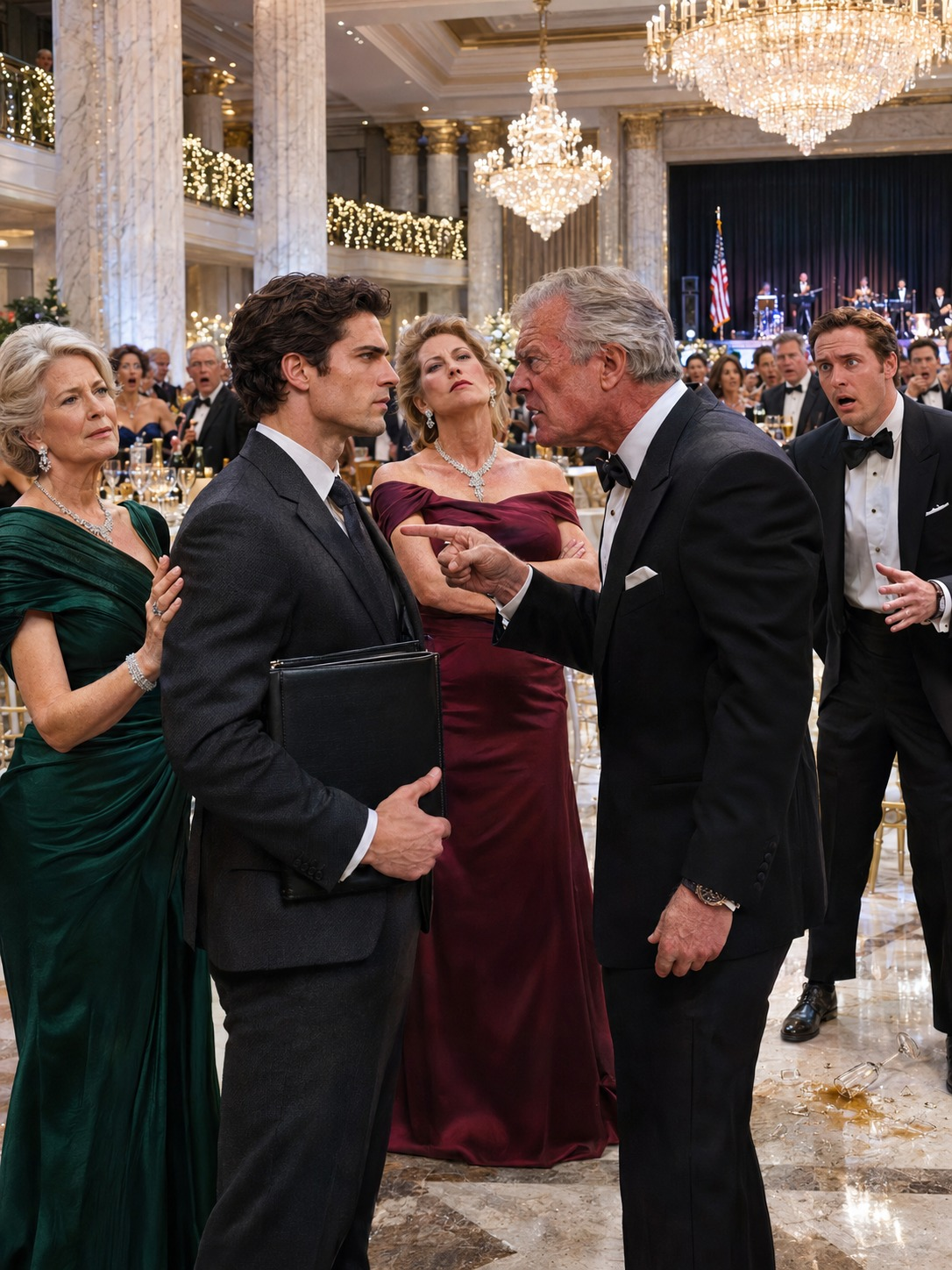
Three hours earlier, he had threatened to have security remove me.
He had publicly declared that I owned nothing.
He had told me I was no longer his responsibility.
Now he wanted me to return.
"What does he want to discuss?"
"I don't know."
"Then ask him."
I heard voices in the background.
Brenda was shouting.
Someone else was attempting to calm her down.
Then Richard's voice became unmistakable.
"Give me the damn phone!"
There was a brief struggle.
A moment later, my father spoke.
"Nolan."
I remained silent.
"Are you listening?"
"Yes."
"What did you tell those reporters?"
"Nothing."
"Don't lie to me."
"I'm not."
"Your name is all over the television."
"I can see that."
"Who authorized this?"
"I don't know."
He released an angry breath.
"You need to make a statement immediately."
"What kind of statement?"
"Tell them the ownership issue is a misunderstanding."
I stared at the television.
"Is it?"
"Of course it is."
"Then provide the records establishing that."
Richard became quiet.
I could hear the distant noise of the hotel celebration.
Somewhere behind him, people were still welcoming the New Year.
"Nolan, listen to me carefully," he said. "You are putting this company's future at risk."
"I didn't contact the reporters."
"You're responsible for what happened tonight."
"Because I questioned your authority?"
"Because you don't understand the consequences."
I looked at the black folder on my kitchen table.
"Then perhaps you should have explained those consequences before asking me to surrender my rights for ten thousand dollars."
He didn't respond.
For several seconds, neither of us spoke.
Then his voice changed.
It became softer.
Almost affectionate.
"Son, we can work this out."
The word caught me completely off guard.
Son.
Not disappointment.
Not embarrassment.
Not an ungrateful child.
Son.
I wondered how many times I had wanted to hear him address me that way.
Now that he finally had, I felt nothing resembling comfort.
"What are you proposing?" I asked.
"We'll discuss it privately."
"With Marshall present?"
His voice hardened again.
"There's no need to involve outsiders."
"Then there's nothing to discuss tonight."
"Nolan."
"Happy New Year, Dad."
I disconnected.
My hands were trembling.
I placed the phone on the table and stared at the television.
The report had moved on to commentary concerning corporate governance and the importance of verified ownership records.
My name remained beneath the headline.
I felt strangely exposed.
Three weeks earlier, I had been an ordinary supply chain manager living in an inexpensive apartment.
Now people I had never met were discussing my financial interests, my family history, and my mother's final decisions.
I hadn't wanted this kind of attention.
I hadn't prepared for it.
And I certainly hadn't authorized it.
My phone began vibrating repeatedly.
Former colleagues.
Relatives.
People I hadn't spoken to in years.
One message came from a cousin who had ignored me at the previous Christmas gathering.
Just saw the news. We should catch up soon.
Another came from an old college friend.
Is that really you on television?
I didn't respond.
Then Marshall called.
"Nolan, are you watching?"
"Yes."
"Did you speak to anyone from the network?"
"No."
"Neither did I."
"Could it have been Martha?"
"I've already spoken with her. She denies providing the documents."
I looked at the television again.
"Then how did they get them?"
"That's what we need to determine."
He paused.
"The report appears to include information beyond what we presented tonight."
"Such as the ownership percentage?"
"Among other things."
"Is that figure accurate?"
"It matches the historical beneficial interest established for you. But the precise legal and financial consequences still require further examination."
I sat back.
Thirty-eight percent.
My father had told me I owned nothing.
Not once.
Not twice.
He had repeated it so often that I eventually accepted it as a fact.
Now I was learning that my mother had established an interest that could represent a substantial portion of the company.
"How much is it worth?" I asked.
Marshall hesitated.
"That depends on Crestwood's actual financial condition, the structure of the trust, and the outcome of the disputed arrangements."
He continued.
"I wouldn't advise you to focus on a dollar figure right now."
"I wasn't planning to."
And I meant it.
Money had never been the reason I started examining those documents.
I wanted to know why my father had treated me like an outsider.
I wanted to understand why my mother had hidden a letter behind a wooden panel.
The financial implications were enormous, but they couldn't answer every question.
"Richard called me," I told Marshall.
"What did he want?"
"A public statement saying everything was a misunderstanding."
"Don't issue one."
"I won't."
"Refer any media inquiries to my office. We need to protect your position and avoid making statements about matters that haven't been fully established."
I agreed.
Before ending the call, Marshall told me that the board was preparing an emergency meeting for the following morning.
Several directors were demanding an independent investigation.
Others wanted Richard to explain why the company had continued representing that he possessed exclusive authority.
The merger suspension had already created serious concerns.
The television report had made those concerns impossible to contain.
After we disconnected, I turned off the television.
The apartment became quiet.
Outside, fireworks continued illuminating the sky.
I picked up my mother's photograph.
"Did you know it would come to this?"
I studied her smile.
Of course, there was no answer.
But I wondered whether she had anticipated something resembling this moment.
Perhaps she knew that Richard would eventually become careless.
Perhaps she understood that a structure built upon questionable documents couldn't remain stable forever.
Or perhaps she had simply hoped I would find the courage to ask questions.
I placed the photograph beside my folder.
Then another message appeared.
The unknown sender.
Now Richard knows the records survived.
I stared at the screen.
My fingers moved immediately.
Did you contact the reporters?
The response arrived seconds later.
They have been investigating Crestwood for months.
That doesn't answer my question.
There was a longer pause.
Then another message appeared.
Your mother wasn't the only person keeping copies.
I sat perfectly still.
For weeks, I had assumed the anonymous sender knew about Eleanor's lockbox because she had trusted them with some part of her plan.
Now I wondered whether that person possessed an entirely separate collection of records.
Who are you?
No response.
I typed again.
I think I've earned an answer.
Several minutes passed.
Finally, the sender replied.
Tomorrow. After the board meeting.
I stared at those words.
Whoever this person was, they knew about the emergency meeting.
They understood Crestwood's internal affairs.
And they had apparently been waiting for years to reveal something.
I forwarded the messages to Marshall.
Then I tried to sleep.
I failed.
Every time I closed my eyes, I imagined Richard watching the television report.
I imagined Brenda demanding explanations.
I imagined Wyatt realizing that his signature might eventually become part of a much larger investigation.
At six thirty in the morning, I gave up and made coffee.
The city outside looked exhausted.
Snow covered the sidewalks.
Discarded party decorations lay near the entrance of the neighboring building.
Most people were probably sleeping after celebrating the New Year.
I opened my laptop.
Crestwood's name appeared across several business news websites.
The original report had been picked up by regional publications.
Some articles focused on the merger suspension.
Others examined the disputed ownership arrangements.
A few portrayed the situation as a dramatic family inheritance battle.
That description frustrated me.
My father's will was almost irrelevant to the legal questions Marshall was investigating.
Richard could leave his personal assets to whoever he wanted.
What he couldn't legitimately do was erase arrangements my mother had independently established simply because they interfered with his ambitions.
At eight fifteen, Martha called.
"How are you holding up?"
"I'm still trying to understand what happened."
"So is everyone else."
"Did the board know about the report before it aired?"
"Not collectively. Richard apparently received a request for comment yesterday afternoon."
I remembered the way he had behaved during the gala.
His insistence that everything proceed as planned.
His confidence that he could publicly declare exclusive control.
"He knew reporters were asking questions?"
"Apparently."
"And he still went onstage?"
Martha sighed.
"I suspect he believed the story wouldn't be published, or that he could dismiss it before it gained attention."
I shook my head.
My father had spent so many years controlling information that he apparently couldn't imagine a situation where someone refused to cooperate.
"What's happening with the meeting?" I asked.
"Several directors are demanding that Richard temporarily step away from decisions connected to the disputed transactions."
"Will he agree?"
"Richard?"
She almost laughed.
"No."
I heard papers moving.
"There's something else, Nolan."
"What?"
"Employees are worried."
My expression changed.
"About their jobs?"
"Yes. They're hearing rumors that the merger suspension could affect operations."
I thought about Daniel and the other employees who had approached me during the gala.
They hadn't created this situation.
They hadn't signed questionable documents.
They hadn't authorized suspicious payments.
Yet they might be the people most immediately affected by the uncertainty.
"Can the company continue operating without the merger?" I asked.
"Under ordinary circumstances, it should be able to. But we need a reliable picture of its current finances."
Her answer bothered me.
"What do you mean by reliable?"
"Some of the figures presented to the board over the past year may require closer examination."
I gripped my coffee cup.
"How serious is it?"
"I don't know yet."
That uncertainty frightened me more than a definitive answer would have.
My father had presented Crestwood as a thriving empire.
He had hosted expensive celebrations.
He had spoken confidently about expansion.
But beneath those polished presentations, something might have been deteriorating.
Martha continued.
"We'll push for an independent financial review today."
"Please make sure the employees aren't forgotten."
"I will."
After ending the call, I received another message from Wyatt.
Dad wants me to come to the office.
I responded.
Then go.
He's blaming me.
I stared at the screen.
For what?
Everything.
I didn't know whether to feel sympathy or anger.
For years, Wyatt had benefited from Richard's decisions.
Now that those decisions were being questioned, my father was apparently looking for someone else to carry the responsibility.
You need your own attorney, I wrote.
Wyatt called immediately.
"Do you think I'm in trouble?"
"I think you've signed documents you knew weren't accurate."
"I didn't understand everything."
"Then tell the truth about what you did understand."
He became quiet.
"Nolan, you don't know how much Dad has been hiding."
"Then tell me."
"I can't explain it over the phone."
I walked toward the window.
"Is this about Westbridge?"
"Partly."
"What else?"
He hesitated.
"There are obligations connected to the merger."
"What kind of obligations?"
"Financial ones."
"Whose?"
Another silence.
Then he whispered, "Dad's."
I frowned.
"Personal obligations?"
"Some of them."
I remembered the investment representatives leaving the ballroom.
Richard following them into the hallway.
His desperate expression when they refused to continue the conversation.
Suddenly, I wondered whether the merger had been more than an opportunity for corporate expansion.
Perhaps Richard needed it for reasons that had little to do with Crestwood's future.
"Wyatt, how much money does Dad owe?"
"I don't know the total."
"Who does he owe?"
"I need to go."
"Wait."
The call disconnected.
I stared at my phone.
Then I called Marshall and told him everything Wyatt had said.
He listened carefully.
"If personal financial obligations are connected to the proposed transaction, that could raise additional concerns."
"Could Dad have been using Crestwood to cover his own debts?"
"We need evidence before drawing that conclusion."
I knew he was right.
But the question wouldn't leave my mind.
At ten forty, Marshall asked me to come to his office.
He had received additional materials from an independent records custodian and wanted to review them with me.
I arrived shortly after eleven.
He looked exhausted.
Several empty coffee cups sat beside his computer.
"You haven't slept either," I said.
"Not much."
He motioned toward a chair.
"The board meeting is underway."
"Any news?"
"Martha says Richard is refusing to acknowledge the seriousness of the ownership dispute."
That didn't surprise me.
Marshall opened a folder.
"However, these records may help explain why he is so determined to complete the merger."
He showed me several financial summaries.
Some related to Westbridge.
Others involved companies I didn't recognize.
There were consulting payments, financing arrangements, and transactions involving assets associated with Crestwood.
"These need to be examined by forensic accountants," he explained.
"But there are patterns that deserve attention."
I studied the figures.
"How much money is involved?"
"Potentially several million dollars across the transactions identified so far."
I leaned back.
Several million.
I remembered Richard offering me ten thousand dollars.
I remembered Brenda describing that amount as generous.
The contrast was almost insulting.
Marshall turned another page.
"What's particularly concerning is the timing."
He pointed toward several transactions occurring shortly after my mother's death.
"Some coincide with changes in management authority."
Then he pointed toward a more recent series.
"Others coincide with negotiations concerning the proposed merger."
I looked at him.
"Could the merger have been intended to cover something up?"
"Possibly. Or it may have been intended to generate funds needed elsewhere. We don't yet know."
Before I could respond, his phone rang.
Martha.
He placed the call on speaker.
"What happened?" he asked.
"The board has agreed to commission an independent review."
I released a breath.
"And Richard?"
"He's furious. He attempted to delay the vote."
"Did it pass?"
"Yes."
Marshall nodded.
"That's significant."
Martha continued.
"However, there's another development."
Her voice sounded strained.
"One of the company's former financial officers contacted me this morning."
Marshall leaned forward.
"Who?"
"I'd rather explain in person."
"Can you come here?"
"I'm already on my way."
The call ended.
Marshall looked at me.
For the next twenty minutes, we continued examining the documents.
Then his receptionist knocked.
"Martha Bennett is here."
Martha entered carrying a large brown envelope.
She looked considerably older than she had the previous evening.
Her expression was serious.
"Nolan, I need you to understand that what you're about to hear may be difficult."
I stood.
"What happened?"
She placed the envelope on the conference table.
"Someone contacted me after seeing the television report. Someone who worked closely with Eleanor during her final years."
Marshall reached for the envelope.
"What's inside?"
"Copies of records that were never included in the official board materials."
I watched him open it.
There were printed emails, internal financial reports, and several handwritten notes.
Then he removed a photograph.
It showed my mother sitting inside a conference room with a man I recognized from old Crestwood events.
"Who is he?" Marshall asked.
Martha answered quietly.
"Samuel Reed. Crestwood's former chief financial officer."
I remembered him immediately.
He had disappeared from the company shortly before my mother died.
Richard told everyone that Samuel had resigned for personal reasons.
Nobody discussed him afterward.
Martha looked at me.
"Samuel didn't resign voluntarily."
I felt a chill.
"What happened?"
"He discovered something."
Marshall examined the documents.
"What exactly?"
Before Martha could answer, my phone vibrated.
The unknown sender.
I'm downstairs.
I stared at the message.
Another arrived.
It's time you heard what Eleanor was trying to prove.
Marshall looked toward me.
"What is it?"
I showed him the screen.
Martha read the messages.
Her face changed.
Then the receptionist knocked again.
"There's a gentleman here asking to speak with Nolan."
I stood.
Marshall closed the folder.
Martha whispered, "Oh, my God."
The door opened.
Samuel Reed stepped inside, carrying a black briefcase.
He looked directly at me.
"Your mother discovered where the money was going, Nolan. But she never discovered who was helping your father move it."
He placed the briefcase on the table.
Then he opened it.
The first document contained a photograph of someone I knew.






Comments 0