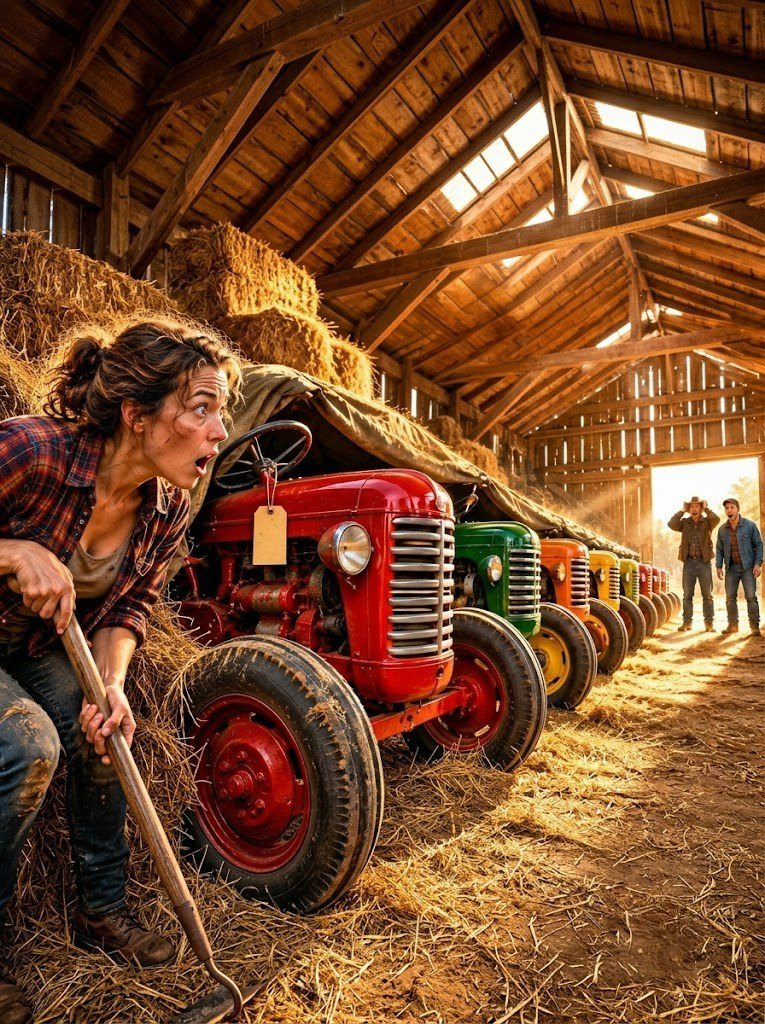
"Step away from that door!" Gordon shouted.
The lock clicked.
Ardis Lindquist stood beside the county records table, clutching the document that carried her dead husband's signature.
The door swung inward.
A uniformed courthouse security officer stepped into the room.
Behind him stood a tall man in a charcoal overcoat, holding a brown leather briefcase.
The stranger looked directly at Ardis.
"Mrs. Lindquist," he said, "my name is Robert Ruona. My grandfather owned those tractors."
Gordon moved between them.
"Nobody invited you in here."
Robert glanced at the security officer.
"I was told Mrs. Lindquist was examining records connected to my family's former business."
"That doesn't give you the right to interrupt her," Gordon answered.
Robert ignored him.
He placed his briefcase on an empty chair.
"I understand you've found seven John Deere tractors inside the old Vasa Junction Creamery."
Ardis said nothing.
Robert studied her face.
"Four Model B tractors. Two Model A machines. One Model LA."
Her stomach tightened.
The exact inventory.
He knew all seven.
And she had never spoken to him before.
"Who told you that?" she asked.
Robert smiled faintly.
"Information travels quickly in a small town."
"Not that quickly."
The smile disappeared.
Carol Jensen, the records clerk, stepped forward.
"Mr. Ruona, this is a public records office. You cannot interfere with another visitor's examination."
"I'm not interfering."
"You entered a restricted records room without permission."
"The officer let me through."
The security officer looked uncomfortable.
"Mr. Ruona said he had an appointment."
Carol's expression hardened.
"He doesn't."
Robert raised both hands.
"Then I apologize."
But he made no move to leave.
Instead, he opened his briefcase and removed a cream-colored envelope.
"I believe Mrs. Lindquist will want to see this."
Ardis looked at the envelope.
Across its front was written:
Vasa Junction Creamery — Private Agreement — June 1946.
Her heartbeat quickened.
It was the agreement referenced in the courthouse inventory record.
The agreement Eino had withdrawn in June 1989.
The agreement that had been returned three days after his death.
"Where did you get that?" she asked.
Robert held the envelope between two fingers.
"My family archives."
Gordon stepped closer.
"Then why did somebody return a document to this courthouse under a different signature?"
Robert's expression changed.
Only slightly.
But Ardis noticed.
"I don't know what you're referring to."
Gordon pointed toward the index.
"This."
Robert looked down.
For the first time, his confidence faltered.
Then he straightened.
"Mrs. Lindquist, perhaps we should speak privately."
Ardis folded her arms.
"No."
"This concerns a complicated ownership dispute."
"Then Gordon can hear it."
Robert glanced toward Carol.
"And the clerk?"
"She works here."
He took a slow breath.
"Very well."
He placed the envelope on the table.
But when Ardis reached toward it, he pulled it back.
"Before you examine this, I need your assurance that you won't attempt to sell or move the equipment."
Ardis stared at him.
"You're asking me to promise something before you'll show me a document?"
"I'm trying to protect everyone's interests."
"Then show me what you've got."
Robert hesitated.
Gordon gave a humorless laugh.
"Sounds like you came here expecting to frighten her."
Robert's jaw tightened.
"Mr. Niskanen, this is a legal matter."
"And Ardis has every right to understand it."
Robert looked back at the widow.
"Those tractors could be worth a considerable amount of money."
"Then why were they hidden behind a brick wall for forty-six years?"
The question struck harder than she expected.
Robert looked away.
For one second, the room was silent.
Then he said, "That is precisely what we're trying to determine."
Ardis watched him carefully.
He had come prepared to make demands.
But he hadn't come prepared for questions.
And she intended to ask plenty.
Carol insisted that Robert either conduct his business in the public reading area or leave.
He reluctantly agreed.
The security officer escorted them into the adjoining room.
There, beneath fluorescent lights and framed photographs of former county commissioners, Robert finally opened the envelope.
Inside were three photocopied pages.
He placed them on the table.
Ardis leaned forward.
The first page described a temporary storage arrangement between Ruona Implement Company and the Vasa Junction Creamery.
The second listed seven agricultural machines.
The serial numbers matched the tractors.
The third contained several signatures.
Werner Ruona.
Harold Velde.
And a representative of First State Bank.
Ardis recognized the bank official's name from the earlier courthouse filing.
"Where's the original?" she asked.
Robert paused.
"This is a certified family copy."
"That wasn't my question."
"The original is being reviewed."
"By whom?"
"Our attorney."
Ardis looked at him.
"Then I want to know who certified this copy."
Robert frowned.
"Mrs. Lindquist—"
"Because the document I found in the courthouse says there was an attached agreement. That agreement disappeared from the file. Now you show up with something that looks like it."
She pointed toward the pages.
"But there's no certification stamp here."
Gordon leaned closer.
"She's right."
Robert's face tightened.
"The document is authentic."
"Then proving it shouldn't be difficult," Ardis answered.
Carol, who had remained nearby, examined the pages without touching them.
"These appear to be ordinary photocopies," she said.
Robert turned toward her.
"Are you suggesting they're fraudulent?"
"I'm saying I cannot verify their origin."
Ardis sat back.
For years, government officials had handed her documents and expected her to accept every number.
She had signed refinancing agreements she barely understood.
She had listened while men in expensive jackets explained why her land was worth less than the debt attached to it.
She had been polite.
She had been patient.
And she had paid dearly for trusting people who sounded certain.
This time, she wasn't going to be rushed.
"Mr. Ruona," she said, "I paid seven hundred dollars for that building."
"I understand."
"The auction notice said building and all contents."
"That doesn't necessarily establish ownership of concealed personal property."
"Then you'll have to prove somebody else owns it."
Robert's eyes narrowed.
"My family intends to do exactly that."
"Good."
He looked surprised.
Ardis continued.
"Because I intend to find out the truth, too."
Robert gathered his papers.
Before closing the briefcase, he removed a business card.
"Here is my attorney's contact information."
Ardis accepted it.
The card identified a Minneapolis law firm.
Robert continued.
"I strongly advise you not to discuss the tractors publicly."
"Why?"
"Because publicity could complicate matters."
"Complicate matters for whom?"
He didn't answer.
Gordon leaned against the table.
"Maybe you'd better explain why your grandfather hid seven tractors behind a wall."
Robert looked at him coldly.
"My grandfather was a respected businessman."
"That wasn't the question."
"He died before I was born."
"Then you don't know why he hid them."
Robert's expression hardened.
"I know my family has documents establishing an interest in those machines."
Ardis looked directly at him.
"An interest isn't the same as ownership."
For several seconds, Robert stared at her.
Then he snapped his briefcase shut.
"I hope you understand the seriousness of this situation."
"I understand perfectly."
"Do you?"
Ardis rose from her chair.
She was shorter than Robert by nearly a foot.
Her jacket was faded.
Her boots were scuffed.
Her hands were rough.
But she didn't lower her eyes.
"You came into a courthouse where I was examining public records. You interrupted me. You demanded promises. And you showed me papers you won't let anyone verify."
Robert said nothing.
"So here's what I understand."
She picked up her notebook.
"You want those tractors."
His jaw tightened.
"And you're worried I might have a legal right to them."
Gordon watched Robert's face.
The man didn't deny it.
He simply stepped backward.
"Expect to hear from our attorney."
Then he turned and walked away.
Ardis watched him disappear down the corridor.
Only after he was gone did she sit down.
Her hands had begun trembling.
Gordon noticed.
"You all right?"
She nodded.
"Just angry."
"Good."
She looked at him.
"Good?"
"Anger can keep you standing when fear wants you sitting down."
Ardis looked toward the courthouse window.
Outside, Robert Ruona climbed into a gray sedan.
He sat behind the steering wheel for several seconds before driving away.
Ardis had a terrible feeling that the confrontation was only beginning.
They spent the remainder of the morning examining the county files.
Carol helped them locate additional references to the creamery's ownership.
Some documents dated back to the cooperative's founding.
Others concerned tax liens, equipment transfers, and the eventual abandonment of the building.
The records were incomplete.
Several old filings had been transferred between departments.
Some contained handwritten corrections.
Others referred to attachments that were no longer present.
Ardis copied everything she could.
She wasn't trained in law.
She didn't understand every term.
But she understood dates.
She understood signatures.
And she understood that a document could be important precisely because somebody didn't want her to see it.
At noon, Gordon bought sandwiches from a nearby diner.
They ate in his pickup.
Ardis spread her notes across the dashboard.
"Look at this," she said.
Gordon leaned closer.
She pointed to a sequence of dates.
June 1946.
Werner Ruona died.
August 1946.
A creamery asset transfer was recorded.
1947.
First State Bank listed missing machinery inventory.
June 1989.
Eino withdrew the supplemental agreement.
Three days after Eino's death, somebody returned it.
Gordon studied the list.
"That return date bothers me."
"Me, too."
"Who signed it?"
Ardis looked at her notes.
"Dale Mercer."
Gordon went still.
"The auctioneer?"
"Yes."
He took the paper.
"You're sure?"
"Carol showed me the signature."
Gordon stared at the name.
Dale Mercer.
The man who had laughed when Ardis bought the creamery.
The man who had asked whether she understood what she was purchasing.
The man who had accepted her seven hundred dollars and issued the sale documents.
"How old was Dale in 1989?" Gordon asked.
"Early fifties, I suppose."
"Old enough to have handled property records."
Ardis nodded.
"He worked with the village on surplus sales for years."
Gordon rubbed his chin.
"Then why was he returning an agreement Eino borrowed?"
"That's what I want to ask him."
Gordon looked at her.
"Not yet."
"Why?"
"Because we don't know what he knew."
Ardis folded her notes.
"Then we find out."
That afternoon, they drove to the creamery.
The building looked almost peaceful beneath the pale November sunlight.
But Ardis knew better.
The southern roof sagged farther than it had when she purchased the property.
A section of gutter had fallen.
The loading dock was increasingly unstable.
Gordon examined the damaged rafters from a safe position.
"We're going to need a contractor."
"How much?"
"Depends on what needs shoring up."
Ardis sighed.
"Everything costs money."
Gordon looked at her.
"Those tractors might be worth enough to justify professional protection."
"Might."
"That's why we need a proper appraisal."
They entered through the reinforced north-side access.
Inside, the air smelled of old timber and dust.
The hidden ice room remained dry.
The seven tractors stood in their careful rows.
Ardis paused at the doorway.
Every time she saw them, she experienced the same strange feeling.
Disbelief.
Seven machines.
Green hoods.
Yellow wheels.
Original dealer tags.
Forty-six years of silence.
They looked almost unreal.
As though somebody had arranged them for a museum exhibition and then forgotten to invite visitors.
Gordon switched on his flashlight.
"Let's check the serial plates again."
Ardis opened her notebook.
They began with the nearest Model B.
Gordon read the number.
Ardis confirmed it.
They moved to the next machine.
Then the third.
Then the fourth.
Every number matched the inventory list.
At the first Model A, Gordon stopped.
"Look at this."
Ardis leaned closer.
He pointed toward a small metal plate near the engine.
The plate carried a manufacturing identification.
Beneath it was a faint mark.
Not a serial number.
A small stamped symbol.
A circle containing a letter.
Ardis frowned.
"What is that?"
Gordon studied it.
"Could be an inspection mark."
"Does it matter?"
"Maybe. Alvar would know better."
They photographed it.
Then they examined the second Model A.
It carried a similar mark.
The smaller Model LA had something different.
A narrow strip of aged masking tape was attached beneath the steering column.
On it, someone had written a short notation.
Hold — W.R.
Ardis stared at the letters.
Werner Ruona.
The same initials that appeared on the warning tag.
Gordon rubbed his forehead.
"Somebody was keeping track of these machines."
"Then there must have been records."
"Maybe."
"Maybe they're still here."
Gordon looked around the room.
"Where?"
Ardis studied the walls.
The ice room had been designed to preserve blocks of winter ice.
Its thick masonry and cork-lined ceiling helped maintain stable temperatures.
There were no windows.
The floor was dry.
Old wooden shelving stood against the back wall.
A canvas cover lay folded beside several crates.
She remembered the metal box they had found earlier.
It was still on the shelf.
Locked.
Labeled with Werner Ruona's name.
June 1946.
"That box," she said.
Gordon followed her gaze.
"We haven't opened it."
"No."
"Could be important."
Ardis looked at the rusted lock.
"We should have someone open it without damaging anything."
Gordon nodded.
"And photograph it first."
They documented the box again.
Then Ardis examined the shelf beneath it.
A narrow gap separated the shelf from the wall.
Something pale protruded from behind the wood.
She leaned closer.
"There's paper back there."
Gordon moved beside her.
"Don't pull too hard."
Ardis carefully reached behind the shelf.
Her fingers touched a folded sheet.
It was wedged between the wood and masonry.
She eased it free.
The paper was brittle.
Its edges were darkened.
She unfolded it on a clean board.
Across the top were typed words.
Ruona Implement Company.
Below was a list of machinery.
Seven tractors.
The same serial numbers.
But this document included an additional column.
Delivery destination.
Every entry contained the same notation.
Vasa Junction Creamery — North Storage.
Ardis looked at Gordon.
"That proves where they were sent."
"Looks like it."
Then she noticed another column.
Customer allocation.
Six entries were blank.
The seventh contained a name.
Not Werner Ruona.
Not Harold Velde.
Not First State Bank.
A farmer.
A man from a neighboring township.
Ardis frowned.
"Why would only one tractor have a customer's name?"
Gordon examined the sheet.
"Could've been reserved for somebody."
"Then why hide it?"
He shook his head.
"I don't know."
Ardis copied the name into her notebook.
Then she looked at the date.
December 1945.
The tractors had been moved into the creamery months before Werner's death.
Months before the warning tag was written.
Months before the inventory transfer.
Someone had planned the storage arrangement carefully.
And at least one tractor might have been intended for a specific customer.
The discovery made the ownership questions even more complicated.
Gordon telephoned Alvar Teppo that evening.
The retired dealer answered after several rings.
Gordon explained what they had found.
Alvar listened.
Then he asked them to read the customer name.
Gordon did.
There was a long silence.
"Alvar?"
"I'm here."
"Do you recognize it?"
"Yes."
"Who was he?"
Alvar hesitated.
"A farmer who waited years for a tractor."
Ardis moved closer to the telephone.
"Did he ever receive it?"
"No."
"Why not?"
"That's what caused trouble."
Gordon looked at Ardis.
"What kind of trouble?"
Alvar sighed.
"During the war, machinery allocations were tightly controlled. Farmers had to justify their need for new equipment. Some waited a long time."
He paused.
"If a dealer promised a machine to an approved customer and then withheld it, people noticed."
"Did Werner do that?" Ardis asked.
"I don't know whether he deliberately withheld that particular tractor."
"But the name was on the list."
"Yes."
"Could the customer still own it?"
Alvar answered carefully.
"A name on an allocation sheet doesn't prove ownership. We'd need to know whether money changed hands, whether the tractor was delivered, and what agreements existed."
Ardis appreciated the honesty.
Everyone else seemed eager to tell her what the papers meant.
Alvar was willing to admit what he didn't know.
"Can you come back?" she asked.
"I can."
"When?"
"Tomorrow afternoon, if the roads stay clear."
"Thank you."
Before hanging up, Alvar added something.
"Mrs. Lindquist?"
"Yes?"
"Don't let anyone remove those tags."
"I won't."
"And don't let anyone start the tractors."
"I understand."
He paused.
"Those machines are telling a story. We just haven't learned how to read all of it yet."
The following afternoon, Alvar arrived carrying a magnifying glass, a small camera, and a folder of old dealership records.
He moved slowly through the creamery.
When he reached the hidden room, he stopped and looked at the tractors again.
"Still hard to believe," he murmured.
Ardis handed him the newly discovered delivery sheet.
He studied it carefully.
Then he examined the Model A bearing the customer's name.
He checked the serial plate.
The hour meter.
The paper tag.
Then he sat on a crate.
"This machine was never delivered to its intended customer."
"Are you certain?" Ardis asked.
"Not completely. But the evidence points that way."
Gordon crossed his arms.
"Who was the customer?"
Alvar looked at the name.
"Henry Soderberg."
Ardis recognized the surname.
"The Soderbergs farmed east of town."
"They did."
"Is Henry still alive?"
"No. Died in the seventies."
Alvar looked toward the tractor.
"He was a good farmer. Lost two horses during the war. Needed a tractor badly."
"Did he complain about Werner?"
"According to what I remember, he did."
Ardis sat beside him.
"What happened?"
Alvar rubbed his hands together.
"Henry believed he'd been approved to receive a new machine. But when he went to the dealership, Werner told him none were available."
Gordon looked toward the Model A.
"While this one sat behind a wall."
"Possibly."
Ardis felt anger rising.
She thought of the farmers who had struggled through wartime shortages.
Men trying to keep crops growing.
Families waiting for equipment.
And seven tractors sitting unused.
"Why would Werner do that?" she asked.
Alvar shook his head.
"Money. Fear. A bad business decision. I can't tell you."
He examined the delivery sheet again.
"But I can tell you something else."
"What?"
"These machines were probably worth a substantial amount when they were hidden. Today, their preservation may make them far more valuable to collectors."
Ardis looked at him.
"How much?"
Alvar hesitated.
"I don't want to give you a figure without a formal appraisal."
"Could they cover my farm debt?"
He studied her.
"Potentially."
The word struck her harder than any number.
Potentially.
For months, she had been calculating how to survive another week.
Another month.
Another winter.
Now an eighty-three-year-old machinery expert was telling her that seven tractors might be worth enough to pay off the debt threatening her home.
She looked toward the machines.
Her eyes stung.
But she didn't cry.
Not yet.
Because the tractors were still surrounded by questions.
And people were already preparing to fight over them.
Alvar spent nearly three hours examining the equipment.
He explained that originality was crucial.
The paint should remain untouched.
The dealer tags should be preserved.
The protective grease should not be removed.
Even the dust could help document how long the machines had remained undisturbed.
He pointed toward the tires.
"See the sidewalls?"
Ardis nodded.
"Remarkably good considering the age. Being supported on blocks probably helped."
Gordon examined the wheels.
"Some cracking."
"Of course. They're old. But the preservation is unusual."
Alvar moved toward the Model LA.
He examined the steering wheel tag.
Then he looked at the handwritten warning.
DO NOT TELL THE BANK.
He read the date again.
June 11, 1946.
His expression became thoughtful.
"Werner died later that month," he said.
"We know," Ardis answered.
"Then whoever wrote this may have known the bank was about to investigate."
Gordon frowned.
"Could Werner have written it himself?"
"Possibly."
"Could Harold Velde?"
"Possibly."
Ardis looked at Alvar.
"Could somebody at the bank have written it?"
He paused.
"That's another possibility."
The three of them stood silently.
Then Alvar asked to see the old inventory transfer.
Ardis handed him a copy.
He examined the signatures.
His finger stopped on the bank official's name.
"Martin Kessler."
Gordon looked up.
"You knew him?"
"Everybody in Kettle Rapids knew Martin."
"What kind of man was he?"
Alvar hesitated.
"Careful. Ambitious. Very protective of the bank's reputation."
"Did he know Werner?"
"Certainly."
Ardis leaned closer.
"Did he know about the tractors?"
Alvar looked at the signature.
"If this document is authentic, he knew they were in storage."
"Then why did the bank report them missing?"
Alvar slowly lowered the paper.
"That's an excellent question."
After Alvar left, Gordon helped Ardis secure the creamery.
The afternoon light was fading.
The building creaked in the cold.
They checked the reinforced doors.
Then Gordon examined the southern roof from a safe distance.
A long crack had appeared along one of the weakened rafters.
He frowned.
"That wasn't there last week."
Ardis looked upward.
"Is it dangerous?"
"Yes."
"How dangerous?"
"Enough that I don't want either of us working beneath it."
She sighed.
"We need to protect the tractors."
"We do."
"Can we move them?"
"Not until we know the safest way and have somebody qualified to help."
Ardis looked toward the ice room.
The machines stood in the northern section, which appeared more stable.
But the entire building was deteriorating.
Every day brought another risk.
She had bought the creamery because she hoped its well might save her cows.
Now the building contained something that might save the entire farm.
And the roof was threatening to destroy it.
"How much would temporary repairs cost?" she asked.
Gordon shook his head.
"More than you've got."
She stared at the floor.
Seven hundred dollars.
That was all she had paid.
And now she might need thousands simply to protect what she'd discovered.
Gordon touched her shoulder.
"We'll figure something out."
Ardis nodded.
But she wasn't sure she believed him.
The next morning, a letter arrived from a Minneapolis attorney.
The envelope was thick.
The return address belonged to the law firm listed on Robert Ruona's business card.
Ardis opened it at the kitchen table.
The letter asserted that the seven tractors were personal property belonging to the Ruona family or its lawful successors.
It demanded that she preserve the equipment.
It warned her not to sell, transfer, restore, or remove the machines.
And it stated that the family was investigating its legal rights.
Ardis read it twice.
Then she telephoned Gordon.
He arrived within half an hour.
She handed him the letter.
He read it slowly.
"Well," he said, "they're not wasting time."
Ardis looked at him.
"Can they take the tractors?"
"Not just because they sent a letter."
"But they can sue me."
"Yes."
She sat down.
"I can't afford a lawsuit."
Gordon folded the letter.
"Then we find somebody who can help."
"With what money?"
He didn't answer.
Ardis looked toward the kitchen drawer containing her bills.
The government wanted $94,600.
The farm needed water.
The creamery needed repairs.
And now a family with lawyers was claiming the only thing that might save her.
She felt exhausted.
Not physically.
Something deeper.
The kind of exhaustion that came from fighting the same battle for years without ever seeing the end.
Gordon sat opposite her.
"Ardis."
She looked up.
"Don't give them anything just because they sound important."
She stared at him.
"That's easy to say."
"I know."
"They have lawyers."
"I know."
"They have money."
"Probably."
"And I have nine cows and a roof that's about to fall down."
Gordon leaned forward.
"You also have a deed, a bill of sale, seven tractors, and documents they may not know you've found."
Ardis looked at him.
He continued.
"That's more than you had six weeks ago."
She considered his words.
Then she straightened.
"All right."
Gordon nodded.
"All right what?"
"We keep digging."
That afternoon, Ardis drove to the creamery alone.
She had promised Gordon she wouldn't go there without him.
But she didn't intend to enter the dangerous sections.
She only wanted to check the locks from outside.
The yard was empty.
The north-side door appeared secure.
The loading entrance remained reinforced.
She walked around the building, staying clear of the weakened southern wall.
Then she noticed something near the old loading dock.
Fresh tire tracks.
Not hers.
Not Gordon's.
The tracks were wider than those left by a passenger car.
A pickup.
Possibly a truck.
Ardis crouched.
The ground was damp enough to preserve the pattern.
Someone had driven close to the building.
Very close.
She followed the tracks with her eyes.
They stopped near the north entrance.
Then turned back toward the road.
Ardis felt a chill.
She looked at the lock.
It was still attached.
But the metal around it carried fresh scratches.
Someone had tried to open the door.
She stepped backward.
Then she heard a sound from inside.
A dull metallic knock.
She froze.
The building was supposed to be empty.
The tractors were stationary.
There was no machinery running.
Another sound came.
This time from deeper inside.
Ardis stared at the door.
"Hello?"
No answer.
She waited.
The wind moved through the broken boards.
Then something scraped against the interior wall.
Ardis reached into her jacket pocket.
Her fingers closed around the small flashlight she always carried.
She considered going inside.
Then remembered Gordon's warning.
Don't go there alone.
She stepped back toward her pickup.
Before she reached it, the north door moved.
Only slightly.
The lock remained in place.
But the wood shifted from the inside.
Ardis stopped.
Someone was behind it.
She could hear breathing.
Then a man's voice whispered through the narrow gap.
"Mrs. Lindquist?"
Her heart began pounding.
"Who's there?"
Silence.
She raised her flashlight.
"Answer me."
The voice came again.
Low.
Urgent.
"Don't call the sheriff."
Ardis stared at the door.
"Why not?"
The man hesitated.
Then he said something that made her blood run cold.
"Because the man who sent me is already inside the county office."
Ardis took a step backward.
"Who sent you?"
The voice dropped to a whisper.
"Robert Ruona."
Her grip tightened around the flashlight.
"What are you doing in my building?"
The man didn't answer.
Instead, something slid beneath the door.
A folded piece of paper.
Ardis stared at it.
The paper stopped beside her boot.
She crouched and picked it up.
It was a photocopy of a bank document.
At the top were the words:
FIRST STATE BANK.
Below was a date.
June 1946.
And beneath the date was a list of seven tractor serial numbers.
Every one matched.
But that wasn't what frightened her.
At the bottom of the page was a handwritten note.
Inventory to remain concealed until further instruction.
The note carried two initials.
M.K.
Martin Kessler.
The bank official who had signed the original storage agreement.
Ardis looked toward the door.
"Where did you get this?"
The man inside didn't answer.
She stepped closer.
"Who are you?"
A long silence followed.
Then the voice whispered:
"Somebody who should've told the truth forty-five years ago."
Ardis felt her pulse pounding in her throat.
"Open the door."
"I can't."
"Why?"
"Because if they know I'm here, they'll destroy the rest of the papers."
"Who will?"
The man didn't answer.
Instead, she heard footsteps moving away from the door.
Ardis pressed her ear against the wood.
"Wait!"
The footsteps stopped.
Then the man spoke one final time.
"Mrs. Lindquist, there's another document hidden inside the creamery."
"Where?"
"Behind the ice-room wall."
Ardis froze.
They had already broken through the sealed doorway.
They had found the tractors.
The tags.
The inventory transfer.
The metal box.
What else could possibly be hidden?
"Which wall?" she demanded.
The man hesitated.
Then whispered:
"The one nobody thought to check."
Ardis looked toward the north end of the building.
The ice room had thick masonry walls.
No windows.
A cork-lined ceiling.
And seven tractors standing in two rows.
She suddenly remembered something from the original building plans.
The measurements.
Twenty-two feet by thirty feet.
But when Gordon had paced the interior, the room had seemed slightly smaller.
She hadn't thought much of it.
Old buildings were rarely exact.
Now she wondered.
Was there another space behind the wall?
Another concealed compartment?
Another secret?
She stepped away from the door.
Then the man inside spoke again.
"There's a reason Werner Ruona never came back for those tractors."
Ardis swallowed.
"What reason?"
The voice became barely audible.
"Because he wasn't the only one who owned them."
She stared at the wood.
"Then who did?"
A sudden crash echoed from inside the creamery.
The man gasped.
Footsteps pounded across the floor.
A second voice shouted.
"Get away from that door!"
Ardis stumbled backward.
Something heavy struck the interior wall.
Then silence.
She stood frozen in the cold afternoon air.
The paper trembled in her hand.
From somewhere inside the building came a low groan.
Then a scraping sound.
Then nothing.
Ardis turned toward her pickup.
She needed Gordon.
She needed the sheriff.
She needed someone who could help her understand what was happening.
But before she reached the truck, her eyes caught something beneath the north wall.
A narrow line of fresh mortar dust had fallen onto the ground.
She looked up.
The old masonry was shifting.
Not near the doorway.
Farther along the wall.
Exactly where the original plans showed solid brick.
A small crack widened.
Then another.
Ardis heard a hollow sound from behind the masonry.
Someone was moving inside a space she hadn't known existed.
She stepped closer.
The crack widened again.
A brick pushed outward.
Then a second.
Ardis raised her flashlight.
Through the opening, she saw the corner of a wooden crate.
A rusted metal handle.
And a strip of paper attached to something hidden behind it.
She leaned forward.
The paper carried a name.
Not Werner Ruona.
Not Harold Velde.
Not Martin Kessler.
It was a name she recognized from Eino's old farm records.
A name she had seen on a government document years earlier.
Ardis's breath caught.
She moved the flashlight closer.
And just as the full name came into view, a hand reached through the opening from the darkness and grabbed the paper.






Comments 0