The telephone went dead before Richard Kessler could finish his sentence.
Ardis Lindquist stood in her farmhouse kitchen, listening to the empty line.
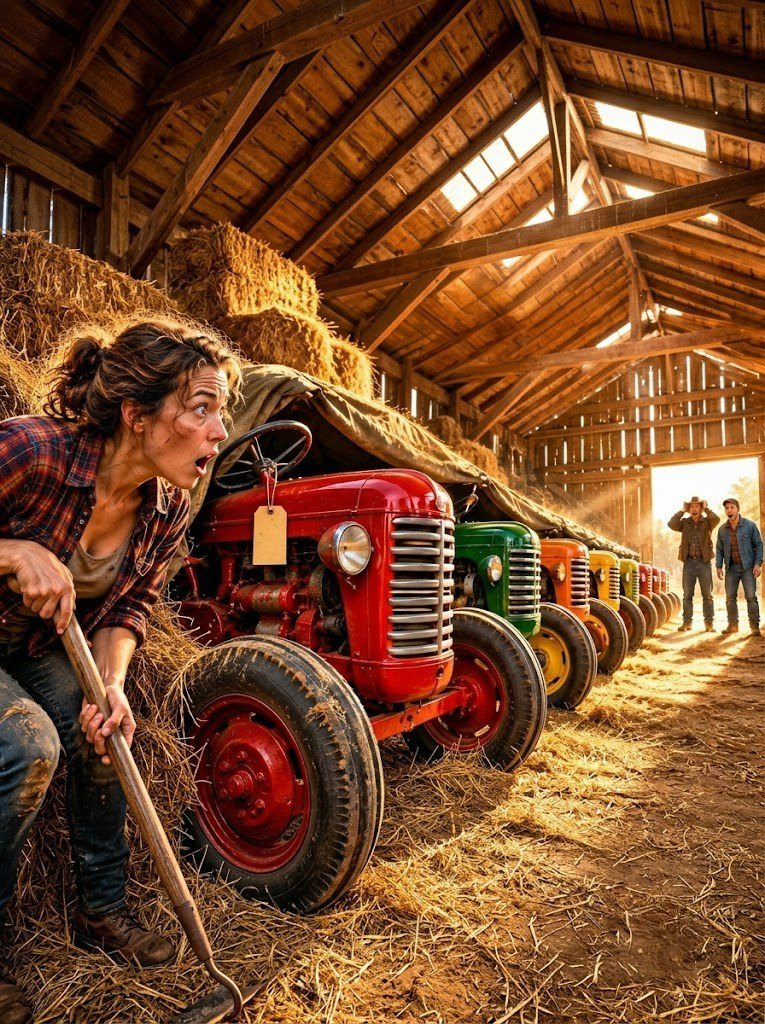
The tractors were transferred to...
Transferred to whom?
Her husband?
The creamery?
Some forgotten company?
She pressed the receiver against her ear.
"Richard?"
Nothing.
"Richard, can you hear me?"
A faint click sounded.
Then silence.
Ardis slowly lowered the telephone.
Outside, snow swept across the dark fields. The wind rattled the kitchen windows, and somewhere in the barn, one of her cows gave a restless lowing.
She looked toward Eino's photograph.
For twenty-eight months, she had believed she understood the final weeks of her husband's life.
He had been exhausted. Worried about the farm. Working too hard.
Then his heart had failed.
Now she was learning that he had spent those same weeks investigating a forty-year-old machinery dispute.
He had withdrawn records from the courthouse.
He had visited Harold Velde.
He had written a letter in case something happened to him.
And Richard Kessler had just claimed that Eino's name appeared on a payment receipt dated June 1989.
Ardis gripped the edge of the table.
"What were you doing, Eino?"
The house offered no answer.
Then the telephone rang again.
She snatched it up.
"Richard?"
"No, ma'am."
It was Sheriff Daniel Harlan.
"Mrs. Lindquist, are you alone?"
Her stomach tightened.
"Yes."
"Good. Keep your doors locked."
"Why?"
"We're trying to locate Dale Mercer."
Ardis stared at the receiver.
"The auctioneer?"
"Yes."
"He left me a message tonight."
There was a pause.
"What kind of message?"
"He said somebody paid him to keep people from bidding on the creamery."
The sheriff went silent.
Ardis continued.
"He also said I should tell you to look in the locked drawer beneath his auction desk if anything happened to him."
"Mrs. Lindquist, don't erase that recording."
"I won't."
"Did he identify the person who paid him?"
"No."
The sheriff exhaled.
"All right. I'll send a deputy to collect a copy of the message tomorrow."
Ardis looked toward the dark window.
"What's happened to Dale?"
"We don't know yet."
"Then why are you looking for him?"
Another pause.
"Because someone reported his office door standing open. His car is still there, but nobody can find him."
Ardis felt cold.
She remembered the knocking in the background of Dale's message.
The frightened voice.
The abrupt ending.
"Sheriff, I think somebody was at his door while he was calling me."
"That's why I want the recording."
"Do you think he's hurt?"
"I don't know."
Ardis closed her eyes.
The sheriff continued.
"And Mrs. Lindquist?"
"Yes?"
"Don't go looking for him yourself."
She gave a tired, humorless laugh.
"Apparently everyone in Minnesota thinks I'm determined to get myself killed."
"No," the sheriff answered. "I think you're determined to save your farm. That can make a person take chances she wouldn't otherwise take."
Ardis said nothing.
Because he was right.
At seven the following morning, Gordon Niskanen arrived carrying a thermos of coffee and a snow shovel.
He found Ardis clearing the barn entrance.
"You look terrible," he announced.
"Good morning to you, too."
"Did you sleep?"
"A little."
He studied her face.
"How little?"
"Not enough to satisfy you."
Gordon leaned the shovel against the wall.
"Something happened."
Ardis stopped working.
She told him about Richard's telephone call.
The receipt.
Eino's name.
The warning.
And the accusation that someone close to her couldn't be trusted.
Gordon listened without interrupting.
When she finished, his face had gone pale.
"Richard said that?"
"Yes."
"Exactly those words?"
"He said not to trust the man who helped me buy the creamery."
Gordon stared at the snow.
"That could mean Dale Mercer."
"That's what I thought."
"And the other warning?"
Ardis hesitated.
"He said not to trust the man who told me Eino died without knowing the truth."
Gordon slowly looked up.
"You thought he meant me."
She didn't answer.
He nodded once.
"I see."
"Gordon—"
"No. It's a fair question."
He stepped away from the barn door.
"I told you Eino died of a heart attack. Because that's what the doctor said."
"I know."
"And I helped you buy the creamery because you needed a working well."
"I know that, too."
He looked directly at her.
"But if you're wondering whether I've been keeping something from you, ask me."
Ardis felt ashamed of how relieved she was to hear him say it.
"Did Eino tell you about the tractors?"
Gordon shook his head.
"No."
"Did you know about the hidden room?"
"Not until we found it."
"Did you know he went to Harold Velde?"
"No."
She studied him.
"Then why did Richard mention someone who knew Eino's secret?"
Gordon rubbed his forehead.
"I don't know."
For several seconds, they stood in the cold.
Then Gordon spoke quietly.
"Ardis, I've known you for thirty-five years. I helped carry Eino's coffin. If there's something you need to ask me, don't let it sit between us."
Her eyes filled.
"I don't want to lose another friend."
His expression softened.
"Then don't throw one away because a frightened stranger said something over a bad telephone connection."
She nodded.
It was reasonable.
But Richard's warning remained in her mind.
And she knew that trust, once questioned, was difficult to restore completely.
By nine o'clock, Ardis was sitting in Margaret Bell's office.
The attorney had already contacted the hospital.
Richard Kessler was stable.
The telephone connection had failed because of an equipment problem in the hospital's older wing.
There had been no attack.
No mysterious disappearance.
No new emergency.
For once, an alarming event had an ordinary explanation.
Ardis welcomed it.
But Margaret had more troubling news.
"I spoke to Richard this morning," she said.
Ardis leaned forward.
"What did he mean about the tractors being transferred?"
Margaret opened a folder.
"He was trying to describe a notation on the back of an old receipt."
"Whose receipt?"
"Eino's."
Ardis felt her heart tighten.
Margaret continued.
"The receipt records a payment made in June 1989 to obtain copies of historical bank records."
Ardis stared.
"Not a tractor?"
"No."
She sat back.
For the first time since the telephone call, she could breathe normally.
Margaret studied her.
"Richard was injured, medicated, and trying to explain several documents at once. The nurse misunderstood part of what he said."
Ardis nodded slowly.
"Then Eino didn't buy a tractor."
"Not according to this receipt."
"What did he buy?"
"Access to an archived file held by the successor bank."
Ardis looked toward the folder.
"What file?"
Margaret turned a page.
"A 1946 account reconciliation involving Ruona Implement Company."
Gordon leaned forward.
"Then Eino was following the money."
"Exactly."
Ardis stared at the receipt.
Her husband's signature appeared at the bottom.
She touched it gently.
"He was trying to prove something."
Margaret nodded.
"And I believe he was close."
The attorney spread three documents across the desk.
The first was Werner Ruona's inventory transfer.
The second was the First State Bank financing record.
The third was the newly recovered bank ledger.
"Look at these initials," Margaret said.
W.R.
H.V.
M.K.
Ardis nodded.
"Werner, Harold, and Martin."
"Yes. Three men who knew the tractors were being stored at the creamery."
Margaret pointed toward the bank ledger.
"But the entries show something more important."
"What?"
"Seven customer deposits were credited against the dealership's inventory account."
Ardis frowned.
"Seven deposits?"
"Yes."
"One for each tractor?"
"Possibly. The amounts vary, and we need the original supporting records."
Gordon looked toward the papers.
"Henry Soderberg was one of the customers."
Margaret nodded.
"His name appears clearly."
Ardis felt anger rising.
"Then Werner took money from farmers and hid their tractors?"
"That's one possible interpretation. But the ledger suggests the situation was more complicated."
Margaret pointed toward another column.
"The bank appears to have applied the customer deposits to reduce the dealership's outstanding financing."
Ardis stared.
"Without delivering the tractors?"
"Apparently."
"Then the bank got the money?"
"Some of it, yes."
"And the farmers got nothing?"
"At least one farmer complained publicly. We don't yet know what happened to the others."
Ardis looked toward Gordon.
"Henry waited for a tractor that was already sitting in the creamery."
Gordon nodded grimly.
Margaret continued.
"Now consider what happened when Werner died. The dealership's finances were under investigation. The bank had a problem. The machinery was hidden, customer money had been received, and the records didn't clearly establish who was entitled to what."
Ardis leaned forward.
"So they left the tractors behind a wall."
"That's what the evidence suggests."
"For forty-six years."
"Yes."
She shook her head.
"Seven machines. Seven families waiting. And three men keeping secrets."
Margaret looked at her.
"That's why we need the original agreement."
Richard had told Margaret that the satchel contained several documents.
One was the receipt bearing Eino's signature.
Another was a memorandum written by Martin Kessler.
The third was a partial account reconciliation.
But the original agreement was missing.
Ardis stared at her.
"Missing?"
"Richard says it was in the satchel when he entered the creamery."
"Then where is it?"
"He believes someone took it during the confrontation."
Gordon's expression hardened.
"Robert Ruona?"
"Richard says Robert wasn't the man who attacked him."
Ardis remembered the warning.
Not him.
"Then who?"
Margaret hesitated.
"Richard couldn't identify the man clearly. He says the attacker wore a dark coat and a wool cap."
"Did he recognize his voice?"
"He thought it sounded familiar."
"From where?"
"He isn't sure."
Ardis looked toward the window.
Outside, the snow had stopped.
The sky remained gray.
She felt the familiar pressure of time.
The farm debt.
The damaged creamery.
The threatened lawsuit.
And now a missing agreement that might settle everything.
"Margaret," she said, "how long can I keep fighting this?"
The attorney studied her.
"As long as we have a reasonable legal basis and a plan for the financial pressure."
"That's not what I asked."
Margaret's expression softened.
"I know."
Ardis looked down at her hands.
"They're going to take my farm before we find the truth."
Margaret was quiet for a moment.
Then she reached for another folder.
"Not necessarily."
The attorney had filed a request for administrative review of the loan acceleration.
She had also asked the agency to identify the basis for the decision and preserve records concerning outside inquiries.
"Does that stop them?" Ardis asked.
"It may give us an opportunity to challenge the action and request available servicing relief. I won't promise a result until we receive the agency's response."
Ardis nodded.
Margaret continued.
"And I contacted an appraiser who specializes in antique agricultural equipment."
"Alvar?"
"He recommended someone with formal appraisal experience."
"How much?"
Margaret gave her the figure.
Ardis winced.
"I can't afford that."
"I know."
"Then why call him?"
"Because he agreed to inspect the tractors and prepare a preliminary assessment at a reduced fee, provided the building is made safe."
Ardis looked up.
"Why would he do that?"
"Alvar explained the circumstances."
Gordon smiled faintly.
"That old fellow knows everybody."
Margaret nodded.
"He also believes the machines may be historically significant."
Ardis stared at the desk.
For the first time in days, she felt a small opening in the darkness.
Not a solution.
Not yet.
But a possibility.
Then Margaret's telephone rang.
She answered.
Listened.
And slowly sat straighter.
"Are you certain?"
A pause.
"All right. Thank you."
She hung up.
Ardis leaned forward.
"What?"
Margaret looked at her.
"That was Sheriff Harlan."
"Did he find Dale?"
"Yes."
Ardis felt her heart jump.
"Is he alive?"
"Yes."
"Where was he?"
"At his sister's house."
Ardis closed her eyes in relief.
Margaret continued.
"He says he left town because someone threatened him."
Gordon frowned.
"Who?"
Margaret looked directly at Ardis.
"He won't say over the telephone."
Dale Mercer agreed to meet at the sheriff's office that afternoon.
Ardis, Gordon, and Margaret arrived shortly after two.
The auctioneer sat in a small conference room.
He looked ten years older than he had at the sale.
His face was pale.
His hands trembled.
When Ardis entered, he lowered his eyes.
"Mrs. Lindquist."
"Dale."
He swallowed.
"I'm sorry."
She sat opposite him.
"For what?"
He stared at the table.
"For the auction."
Ardis waited.
Dale rubbed his hands together.
"Six weeks before the sale, a man came to my office."
"Who?"
"He said he represented a private investment company."
"Ruona Investment Corporation?"
Dale looked up sharply.
"How did you know?"
Ardis felt cold.
"Keep talking."
Dale nodded.
"He wanted the creamery sold quickly."
"Why?"
"He said the village needed to clear the property from its books."
"That sounds reasonable."
"That's what I thought."
Dale looked ashamed.
"But then he offered me money."
Gordon leaned forward.
"How much?"
"Five hundred dollars."
Ardis stared.
"To do what?"
"Schedule the auction with minimal advertising. Make sure the building sounded like a liability. Emphasize the roof damage."
She felt anger rising.
"And discourage bidders."
Dale nodded.
"Yes."
Ardis looked at him.
"You laughed when I bid."
His face reddened.
"I know."
"You told everyone I was buying a ruin."
"I know."
"You made me feel like a fool."
Dale's eyes filled.
"I'm sorry."
Ardis leaned forward.
"Why?"
He swallowed.
"Because I thought the company wanted the land after the building was demolished."
"Then why didn't they bid?"
Dale looked toward Sheriff Harlan.
"That was the strange part."
The sheriff nodded for him to continue.
Dale took a shaky breath.
"The man told me to make sure the property sold to a private buyer."
Ardis stared.
"Any private buyer?"
"Yes."
"Why?"
"He said the village couldn't complete certain paperwork while it still owned the property."
Margaret's expression sharpened.
"What paperwork?"
Dale shook his head.
"I don't know."
Ardis felt a chill.
The company hadn't wanted to purchase the creamery.
It had wanted someone else to purchase it.
Someone who could later be pressured.
Someone who might surrender the building or its contents without understanding their value.
Someone like a widow desperate for a well.
"Did you know about the tractors?" Sheriff Harlan asked.
Dale shook his head.
"Not until after Ardis found them."
"Then why did you return Eino Lindquist's courthouse document in 1989?"
Dale looked toward Ardis.
His expression changed.
"Because Eino asked me to."
Ardis froze.
"What?"
Dale nodded.
"He came to my office a few days before he died."
She felt the room tilt.
"Why?"
"He wanted me to hold an agreement while he checked something."
"What agreement?"
"The old bank agreement concerning the creamery machinery."
Margaret leaned forward.
"Why would Eino leave it with you?"
Dale swallowed.
"Because I handled estate and surplus auctions. He thought I might know whether the document affected the ownership of abandoned equipment."
Ardis stared at him.
"And did you?"
"No."
"Then why keep it?"
"He said he didn't want it lying around the farmhouse until he knew what it meant."
Ardis felt a sharp pain in her chest.
Eino had been protecting her from another worry.
Again.
Dale continued.
"After he died, I returned the document to the courthouse."
"Why?"
"Because I thought it belonged in the public file."
Margaret frowned.
"Did you make a copy?"
Dale hesitated.
"Yes."
Ardis leaned forward.
"Where is it?"
He looked toward the sheriff.
"In the locked drawer beneath my auction desk."
The room went silent.
Sheriff Harlan nodded.
"We found the drawer."
Dale looked relieved.
"Good."
"But the document wasn't there."
Dale's face went white.
"What?"
"The drawer had been forced open."
Dale stared.
"That's impossible."
The sheriff folded his arms.
"Somebody got there before us."
Ardis felt anger rise like heat through her chest.
"Who knew about the drawer?"
Dale shook his head.
"Nobody."
"Somebody did."
"I know."
Margaret leaned forward.
"Mr. Mercer, did you tell the investment-company representative about Eino's document?"
Dale hesitated.
Then nodded.
Ardis stared.
"When?"
"After the tractors were found."
"Why?"
"He asked whether anyone had investigated the creamery before the auction."
"And you told him about Eino?"
"Yes."
Ardis closed her eyes.
There it was.
The connection.
The old records.
The auction.
The hidden tractors.
The company.
Dale had told someone that Eino investigated the building before his death.
And that someone had apparently been searching for the missing agreement.
"Who was the representative?" Margaret asked.
Dale looked toward the sheriff.
"I don't know his full name."
"First name?"
"Charles."
Margaret went still.
"Charles Whitcomb?"
Dale stared at her.
"Yes."
Robert Ruona's attorney.
Ardis felt cold.
The man who had demanded that she surrender the tractors.
The man who had interrupted the courthouse confrontation.
The man who claimed to represent the Ruona family's interests.
He had also paid Dale Mercer to discourage bidders.
And he had known about Eino's investigation.
Sheriff Harlan made a note.
"Did Mr. Whitcomb threaten you?"
Dale swallowed.
"Not directly."
"What did he say?"
Dale looked at Ardis.
"He said people who interfered with old family business sometimes lost more than money."
The sheriff's expression hardened.
"That's worth documenting."
Dale nodded.
"I know."
By late afternoon, Ardis felt drained.
She had learned more in one day than in the previous week.
But every answer created another question.
Why had the Ruona family's attorney wanted the creamery sold to a private buyer?
Why had Eino trusted Dale with the old agreement?
Who had stolen the copy?
And what had Richard Kessler discovered that frightened Robert Ruona so badly?
Margaret walked her to the courthouse steps.
"Ardis, I want you to go home."
"I will."
"And stay away from the creamery."
"I know."
Margaret studied her.
"You're not listening."
Ardis gave a tired smile.
"I'm listening. I'm just not enjoying it."
The attorney almost smiled.
Then her expression grew serious.
"There's something else we need to discuss."
Ardis looked up.
"What?"
"The possibility that the Ruona family isn't the only party trying to control the tractors."
Ardis frowned.
"Who else?"
Margaret hesitated.
"The bank's successors. Former customers or their heirs. Possibly the creamery's successors, depending on the records."
Ardis sighed.
"Everybody wants them."
"Not necessarily. But we need to identify every plausible claim before we make decisions."
Ardis looked toward the street.
"How long will that take?"
"Longer than either of us would like."
She nodded.
Then Margaret touched her arm.
"Ardis, there's one thing I want you to remember."
"What?"
"You're not required to surrender property just because someone sends a threatening letter."
Ardis looked at her.
"Even if they have more money?"
"Especially then."
Gordon drove her home.
The sun was setting behind the bare trees.
Snow lay along the ditches.
The fields looked empty and cold.
Ardis watched them pass.
Then she spoke.
"Gordon?"
"Yes?"
"Do you think Eino knew the tractors were valuable?"
Gordon considered.
"He probably suspected."
"Then why didn't he tell me?"
"Maybe he wanted proof first."
She nodded.
"He always did that."
Gordon glanced at her.
"Did what?"
"Carried his worries alone."
Gordon was quiet.
Then he said, "He loved you."
"I know."
"He thought protecting you meant keeping some things to himself."
Ardis looked out the window.
"Sometimes I wish he'd trusted me enough to share the burden."
Gordon nodded.
"That's fair."
She turned toward him.
"Do you think he was afraid?"
Gordon hesitated.
"Maybe."
"Of Werner's family?"
"Maybe."
"Of the bank?"
"I don't know."
Ardis looked down at her hands.
"I keep thinking about the letter he wrote."
Gordon waited.
"He said not to let anyone tell me I was too foolish to understand my own business."
Her voice trembled.
"Maybe he knew somebody would try."
Gordon looked toward the road.
"Then he'd be proud of how you're handling it."
Ardis swallowed.
"I hope so."
When they reached the farmhouse, a white envelope was wedged between the screen door and the frame.
Ardis stopped.
Gordon noticed.
"What's that?"
She approached carefully.
There was no stamp.
No return address.
Only her name.
ARDIS LINDQUIST.
Printed in block letters.
Gordon looked toward the yard.
"Stay back."
He examined the envelope.
Then handed it to her.
Ardis opened it.
Inside was a single sheet of paper.
A photocopy.
At the top were the words:
Ruona Investment Corporation.
Below was a typed paragraph.
Proposed acquisition of agricultural property and associated equipment.
Ardis felt cold.
She read the next line.
Subject property: Lindquist Farm, 120 acres.
Gordon leaned closer.
"What?"
She continued.
The document described a proposed purchase of her farm following resolution of the government debt.
It included an estimated acquisition price.
A figure far below what she believed the land was worth.
And a handwritten notation.
Owner financially distressed. Likely to accept expedited settlement.
Ardis stared.
"They've been planning to buy my farm."
Gordon's expression darkened.
"Looks that way."
She turned the page.
A second sheet contained a diagram.
The Lindquist farm.
The abandoned creamery.
A proposed access road connecting the two properties.
Ardis frowned.
"Why would they want both?"
Gordon studied the map.
"Maybe the well."
She looked at him.
"The creamery well?"
"Could be."
"But why?"
He traced the proposed access road.
"There's something else here."
Ardis leaned closer.
A shaded area extended beyond the creamery property.
It included part of the old railroad right-of-way.
And a section of land near the river.
Gordon frowned.
"That isn't part of your farm."
"No."
"Then why is it on the acquisition plan?"
Ardis looked at the document.
The map carried a date.
October 1991.
Weeks before the auction.
Before she bought the creamery.
Before she discovered the tractors.
Robert Ruona's company had been planning something.
Something involving her farm, the creamery, and land near the river.
She looked toward Gordon.
"This was never just about the tractors."
He nodded slowly.
"No."
Ardis carried the papers into the kitchen.
She placed them beside Eino's photograph.
Then she called Margaret.
The attorney answered from home.
Ardis explained the envelope.
The acquisition plan.
The map.
The handwritten notation.
Margaret listened carefully.
"Don't throw away the envelope," she said.
"I won't."
"And don't assume the document is authentic until we verify it."
"I understand."
"Can you bring it tomorrow?"
"Yes."
Margaret paused.
"Ardis, did anyone see who delivered it?"
"No."
"Then keep your doors locked tonight."
Ardis sighed.
"I've become very good at locking doors."
Margaret's voice softened.
"I know."
After hanging up, Ardis looked toward the barn.
The cows were quiet.
The house was warm.
But the farm no longer felt entirely hers.
Somebody had drawn lines across it.
Somebody had calculated its value.
Somebody had decided she was desperate enough to surrender it cheaply.
And somewhere inside the ruined creamery stood seven tractors that might be the only thing preventing that plan from succeeding.
At ten-thirty, the telephone rang.
Ardis answered cautiously.
"Hello?"
A man's voice spoke.
"Mrs. Lindquist?"
"Yes."
"This is Thomas Velde."
She straightened.
"Thomas."
"I heard about the roof."
"Everybody has."
"I'm sorry."
"Thank you."
He hesitated.
"There's something I need to tell you."
Ardis gripped the receiver.
"What?"
"I went through another box of my father's papers."
Her heartbeat quickened.
"Did you find something?"
"Yes."
"What?"
"A letter from Martin Kessler."
Ardis felt cold.
"The banker?"
"Yes."
"What's in it?"
Thomas took a shaky breath.
"It's dated July 1946."
"After Werner died."
"Yes."
Ardis looked toward her notebook.
"What does it say?"
Thomas hesitated.
"It says the seven tractors were never supposed to remain hidden permanently."
"Then why did they?"
"Because somebody refused to sign the final transfer."
Ardis stared.
"Who?"
Thomas's voice dropped.
"That's what frightened my father."
"Thomas, tell me."
He swallowed.
"The letter says the bank wanted the tractors released to the creamery cooperative."
Ardis felt her heart pounding.
"Then the creamery owned them?"
"Not necessarily. The transfer was never completed."
"Why?"
"Because the cooperative's chairman refused."
Ardis looked toward the window.
"Who was chairman?"
Thomas hesitated.
Then said a name she recognized.
Not from the old newspapers.
Not from the dealership records.
From the handwritten acquisition plan lying on her kitchen table.
Ardis felt the blood drain from her face.
"Thomas, are you sure?"
"Yes."
She stared at the paper.
The same family name appeared in both places.
In 1946.
And in 1991.
Forty-five years apart.
She reached for her pen.
"Tell me exactly what the letter says."
Thomas began reading.
His voice trembled.
Then he stopped.
"Mrs. Lindquist?"
"Yes?"
"There's another page."
Ardis felt her pulse quicken.
"What page?"
"The one my father folded inside the letter."
"What does it say?"
Thomas was silent for several seconds.
Then he whispered:
"It's a list of people who were supposed to receive money when the tractors were sold."
Ardis froze.
"Who?"
Thomas swallowed.
"Seven names."
Her heart pounded.
"Read them."
He began.
"Henry Soderberg."
Ardis gripped the receiver.
"Yes."
"Olaf Peterson."
She wrote it down.
"Martin Erickson."
Another name.
"Samuel Berg."
Another.
"Edward Halvorson."
Another.
"Peter Nelson."
Then Thomas stopped.
Ardis stared at the paper.
"That's only six."
"I know."
"Who's the seventh?"
Thomas didn't answer.
"Thomas?"
She heard him breathing.
Then he whispered:
"Mrs. Lindquist, the seventh name isn't a farmer."
Ardis felt cold.
"Then who is it?"
Thomas took a shaky breath.
"It's a woman."
Ardis's hand trembled.
"What woman?"
Thomas read the name.
And Ardis felt the room disappear beneath her feet.
Because the seventh name was not someone from the Ruona family.
Not a banker.
Not a creamery official.
It was a name she had seen every day for thirty-five years.
A name written on her wedding certificate.
A name carved into the headstone beside Eino's grave.
Thomas whispered it again.
"Ardis Lindquist."
She stared at the telephone.
"That's impossible."
Thomas swallowed.
"Mrs. Lindquist, the document is dated July 1946."
"Twenty years before I married Eino."
"I know."
"Then it can't be me."
Thomas was silent.
Then he spoke again.
"There's a handwritten note beside the name."
Ardis closed her eyes.
"What does it say?"
Thomas took a breath.
"It says the seventh share was transferred to the Lindquist family."
Ardis opened her eyes.
"The Lindquist family?"
"Yes."
She gripped the receiver.
"Thomas, whose signature is on that transfer?"
There was a long pause.
Then Thomas whispered:
"Your husband's father."
Ardis stopped breathing.
And before she could ask another question, she heard a door open on Thomas's end of the line.
Footsteps entered the room.
Thomas gasped.
Then a man's voice said:
"Put down the telephone, Thomas. She wasn't supposed to find out about the seventh share."






Comments 0