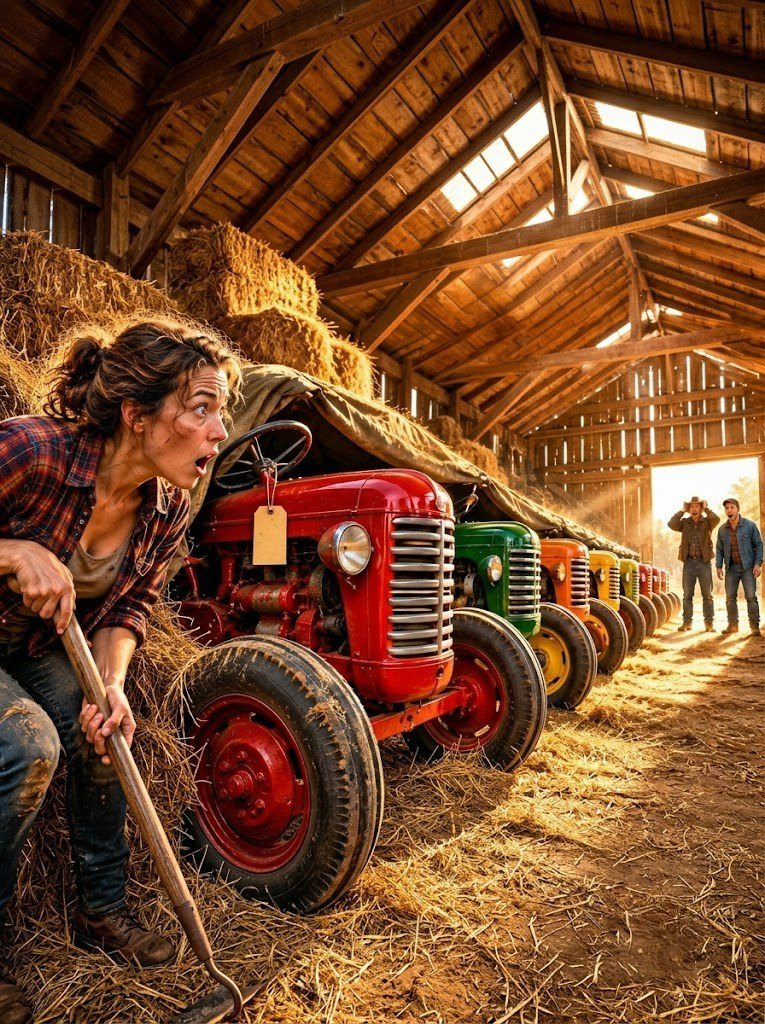
The man entering the ruined creamery looked so much like Werner Ruona that Ardis Lindquist felt the blood drain from her face.
He had the same narrow jaw.
The same deep-set eyes.
The same prominent nose she had seen in the photograph from June 1946.
Even the way he carried his shoulders seemed familiar.
For one impossible second, she wondered whether every fact she had uncovered was wrong.
Werner Ruona had died in 1946.
His death had been reported in newspapers. His estate had been settled. His dealership had closed.
Yet here stood a man wearing his face.
"Ardis," the stranger said, "I'm sorry."
Sheriff Daniel Harlan moved forward.
"Identify yourself."
The man removed his hat.
"My name is Walter Ruona."
Ardis stared at him.
"Walter?"
"Werner was my father."
Robert Ruona appeared behind him, accompanied by Charles Whitcomb.
The attorney held a leather briefcase.
Robert looked furious.
"Father, you shouldn't have come."
Walter ignored him.
He was an elderly man, perhaps seventy-five, with trembling hands and eyes that looked as though they had carried a burden for decades.
He approached Ardis slowly.
"I knew your husband."
Her heart tightened.
"Eino?"
Walter nodded.
"He came to see me in June 1989."
Ardis felt the familiar ache of grief.
"Then you know what he was looking for."
"Yes."
"What?"
Walter looked toward the seven green tractors standing in the shadows.
"The truth my father never managed to tell."
Robert stepped forward.
"Father, don't say another word."
Walter turned.
"Robert, I've kept quiet long enough."
Whitcomb opened his briefcase.
"Mr. Ruona, I strongly advise—"
Walter raised one hand.
"Charles, you can stop advising me."
The room fell silent.
Then Walter looked directly at Ardis.
"Those tractors were never ours to sell."
Margaret Bell stepped beside Ardis.
"Mr. Ruona, are you prepared to make that statement formally?"
Walter nodded.
"Yes."
Robert's face reddened.
"You don't understand what you're doing."
Walter looked at his son.
"For forty-five years, I understood exactly what I was doing. That's the problem."
Sheriff Harlan gestured toward the table.
"Let's sit down."
The recovery contractor remained near the entrance. Alvar Teppo and Gordon Niskanen stood beside the tractors.
Nobody moved the equipment.
Nobody touched the newly discovered bank records.
The sheriff had already secured the documents, and Margaret was examining the emergency court order.
Ardis looked at Walter.
"Start at the beginning."
The old man lowered himself into a chair.
"My father was a good mechanic and a terrible businessman."
He looked toward the Model A nearest the wall.
"During the war, farmers were desperate for equipment. My father promised machines he couldn't always deliver. Some customers paid deposits. Some paid nearly the full price."
Ardis nodded.
"We found the ledger."
Walter closed his eyes.
"Then you know what happened."
"Tell me anyway."
He took a breath.
"The bank financed the inventory. When the tractors arrived, there were competing claims. The bank had already credited customer money against my father's debts. If the machines were delivered without reconciling the accounts, the bank might lose its collateral and still face demands from the customers."
Gordon shook his head.
"So they hid them."
"Yes."
"Behind a wall?"
Walter nodded.
"My father believed the arrangement would last a few weeks."
Ardis looked at him.
"But he died."
"Three days after writing the letter you found."
Walter's voice trembled.
"After his death, the bank wanted the problem buried. The creamery held the equipment. Harold Velde kept the records. Martin Kessler tried to arrange a settlement."
Margaret leaned forward.
"And the seven customer claims?"
"Six were eventually resolved."
"And the seventh?"
Walter looked at Ardis.
"That one passed to the Lindquist family."
Ardis felt her heartbeat quicken.
"Anders?"
Walter nodded.
"Your husband's father."
He explained that Anders Lindquist had acquired the remaining customer claim from a distant relative, Walter Lindquist, in the late 1940s.
Anders had kept the paperwork.
He believed the claim would eventually be paid.
But the cooperative's finances deteriorated, and the bank's records became tangled in transfers, closures, and reorganizations.
In 1971, a settlement had finally been approved.
The bank agreed to release its remaining inventory interest.
The creamery cooperative agreed to release its old option involving the Lindquist farm.
And the outstanding seventh claim was to be satisfied through a designated settlement account.
Ardis looked toward Margaret.
"The forty-eight thousand dollars."
Walter nodded.
"Yes."
"Why wasn't it paid?"
He lowered his eyes.
"Because the settlement administrator died before completing the distribution."
"Who was the administrator?"
"Martin Kessler."
Ardis frowned.
"But Martin died in 1978."
"Yes. The money remained in a restricted account through several bank reorganizations. The beneficiary records were never properly transferred."
Margaret opened the ledger.
"And how did Ruona Investment Corporation become involved?"
Walter's expression darkened.
"My son acquired certain old bank receivables and administrative files through a business transaction in the 1980s."
Robert stepped forward.
"That was entirely lawful."
Walter looked at him.
"Acquiring records doesn't mean acquiring someone else's money."
Robert stopped.
Walter continued.
"Robert found the settlement account. He discovered the Lindquist claim. And instead of notifying the family, he tried to use the confusion to acquire the farm and creamery."
Ardis felt cold.
"So he knew."
Walter nodded.
"He knew there was money owed to your family."
She looked at Robert.
"And you watched me struggle."
Robert's jaw tightened.
"Mrs. Lindquist, the situation is more complicated than—"
"No."
Her voice cut through the room.
"Not this time."
Everyone turned toward her.
Ardis stood slowly.
"For two years, I've worried about losing the farm my husband and I worked our whole lives to keep. I've sold equipment. I've repaired things that should have been replaced. I've counted every dollar before buying feed."
Her voice trembled.
"And all that time, you knew there might be money belonging to my family."
Robert looked away.
Ardis stepped closer.
"You didn't tell me. You tried to buy my land."
Robert said nothing.
"You paid someone to discourage bidders at the creamery auction."
Whitcomb opened his mouth.
Margaret spoke sharply.
"Mr. Whitcomb, I suggest you let your client answer only after consulting independent counsel."
Robert stared at the floor.
Ardis looked at Walter.
"Why are you telling me now?"
The old man wiped his eyes.
"Because Eino asked me to."
Walter removed a folded letter from his coat.
He handed it to Ardis.
The envelope bore her husband's handwriting.
For Ardis, if I cannot finish this.
Her hands began shaking.
She opened it carefully.
Inside was a letter dated June 17, 1989.
She recognized every curve of Eino's handwriting.
My darling Ardis,
I found something connected to Father's old machinery claim. I don't yet know whether it will bring us money or only another argument. But I know you deserve the truth.
I've spoken with Harold Velde and Walter Ruona. I've asked Dale Mercer to help me understand the auction and ownership records. There are papers missing, and I don't trust the people who say the matter is finished.
If I can settle it, I want to surprise you with good news. You've carried enough worries.
If I cannot, please don't let anyone convince you that you are too old, too poor, or too foolish to stand up for what belongs to you.
You have always been the strongest person in this family.
Love, Eino.
Ardis couldn't see the final words clearly.
Tears blurred the ink.
For a moment, the room disappeared.
She remembered Eino at the kitchen table.
His hands wrapped around a cup of coffee.
His tired smile.
The way he always kissed her forehead before leaving for the barn.
She had spent twenty-eight months wondering whether she could have saved him.
Now she understood something she hadn't known.
Even in his final weeks, he had been trying to save her.
Gordon quietly placed a hand on her shoulder.
Ardis folded the letter.
Then looked at Walter.
"Why didn't you give me this after he died?"
Walter lowered his eyes.
"Because I was ashamed."
"Of what?"
"Of knowing what Robert was doing and saying nothing."
Ardis stared at him.
Walter continued.
"I thought I could persuade him privately. Then years passed. And when you bought the creamery, I realized he was going to use the same old records against you."
His voice broke.
"I should have come sooner."
Ardis looked at the letter in her hands.
"Yes," she said quietly. "You should have."
Margaret turned toward the sheriff.
"We need to address the emergency order."
Harlan nodded.
Whitcomb stepped forward.
"The order prohibits removal of the tractors pending a hearing."
Margaret examined the document again.
"That is correct. It does not establish ownership, and it does not authorize your clients to take possession."
Whitcomb stiffened.
"Nevertheless—"
"And it does not prevent emergency measures necessary to preserve the property, provided they comply with the court's terms and the building inspector's requirements."
The sheriff nodded.
"We'll maintain security."
Walter looked toward his son.
"Withdraw the claim, Robert."
Robert stared at him.
"You don't understand how much money is involved."
Walter's expression hardened.
"I understand that money has made you forget what kind of man you were supposed to become."
Robert looked away.
Whitcomb closed his briefcase.
"Mr. Ruona, we need to discuss this privately."
Margaret stood.
"Before anyone leaves, Sheriff, I believe you'll want a formal statement concerning the attempted account closure and the acquisition plan."
Harlan nodded.
"Yes."
Robert's face went pale.
For the first time since Ardis had met him, he looked like a man who understood that wealth might not protect him from consequences.
The following week changed everything.
Not all at once.
Not through a miracle.
But through documents, sworn statements, careful accounting, and people finally willing to tell the truth.
Walter Ruona gave investigators his father's correspondence.
James Kessler provided the bank records inherited from Martin.
Thomas Velde surrendered the remaining cooperative documents.
Dale Mercer gave a full statement about the auction arrangements and the money Charles Whitcomb had paid him.
Leonard Voss admitted that he had impersonated Richard Kessler to gain access to bank records, using information obtained from James's family files.
He had known about the 1946 machinery arrangement because he had worked as a young bank clerk when the tractors were concealed.
The false identity had allowed him to approach Margaret's office without revealing his involvement in the original concealment.
His injuries at the creamery had been real.
So had the confrontation.
He admitted that he had taken the original agreement from the satchel during the confusion and passed it to Whitcomb.
The sheriff recovered it during the investigation.
The mysterious man who had passed a photocopy beneath the creamery door weeks earlier was also identified.
He was a former employee of Ruona Investment Corporation who had become frightened after discovering the company's acquisition plans.
He had tried to warn Ardis anonymously.
The scuffle at the creamery had involved one of the Dugan brothers, who had been searching for the hidden records.
The investigation finally connected the threatening calls, the stolen documents, and the attempted barn fire.
Frank and Ellis Dugan admitted their involvement in the attempted arson.
They said they had been paid to frighten Ardis into abandoning the property.
Financial records and communications led investigators toward Whitcomb and the investment corporation.
Whitcomb's professional conduct came under formal investigation, and criminal charges followed against those the evidence showed had participated in the threats, thefts, and attempted arson.
Robert Ruona was not allowed to buy his way out of the investigation.
He retained legal counsel.
He answered questions.
And the company was forced to preserve its records while the disputed funds were examined.
Walter Ruona cooperated fully.
He did not ask Ardis to forgive his son.
He only asked that the truth be allowed to stand.
The financial accounting took several weeks.
A court-appointed accountant examined the old settlement account.
The original forty-eight thousand dollars had not simply been sitting untouched.
It had passed through successor institutions and administrative accounts, with interest, fees, and transfers recorded unevenly over the years.
Some entries were legitimate.
Others required correction.
The final calculation identified a recoverable amount substantially greater than the original settlement.
Margaret called Ardis into her office on a cold December morning.
Gordon accompanied her.
The attorney placed a document on the desk.
"Ardis, the parties have agreed to a court-supervised settlement, subject to final approval."
Ardis sat very still.
"How much?"
Margaret looked at her.
"The amount allocated to the Lindquist claim is one hundred eighty-six thousand four hundred dollars."
For several seconds, Ardis couldn't speak.
Gordon stared.
"One hundred eighty-six thousand?"
Margaret nodded.
"Four hundred."
Ardis looked down at her hands.
They were rough.
Cracked from winter work.
The same hands that had milked cows, repaired fences, and counted coins at the kitchen table.
"Is it really ours?"
Margaret's expression softened.
"The settlement recognizes the claim through Anders's estate and Eino's succession. Once the required approvals and distributions are completed, the money will be payable to you."
Ardis felt tears fill her eyes.
"And the farm debt?"
"We can address it in full."
She closed her eyes.
Ninety-four thousand, six hundred dollars.
The number that had haunted her.
The number that had followed her into sleep.
The number that had made every winter morning feel like a countdown.
Margaret continued.
"After paying the farm debt, legal costs, and necessary expenses, you'll still have funds available for repairs and reserves."
Ardis covered her mouth.
Gordon looked away, blinking rapidly.
Margaret waited.
Then Ardis whispered:
"Eino would have been so happy."
The tractors required a separate resolution.
The settlement account did not automatically make Ardis their owner.
Margaret had been careful about that from the beginning.
The seven machines had their own complicated history.
But the recovered final schedule established that the bank had released its financing interest.
The six earlier customer claims had been resolved.
The seventh claim had been satisfied through the settlement account.
And the creamery cooperative had retained custody of the tractors after the machinery claims were settled.
Later dissolution records showed that the cooperative's remaining equipment assets had passed with the creamery property through successive transfers.
The village's auction documents included the building and its remaining contents.
After reviewing the chain of title, the surviving claimants entered a court-approved agreement recognizing Ardis's ownership of the seven tractors.
Robert Ruona's company withdrew its equipment claim.
The emergency order was lifted.
And the recovery work resumed.
Ardis stood outside the creamery on the morning the first tractor emerged.
Snow lay along the road.
A crane and specialized moving equipment waited beside the stabilized northern wall.
Alvar Teppo stood with his hands in his coat pockets.
Gordon watched beside him.
The contractor gave a signal.
Slowly, carefully, the first John Deere Model B rolled into daylight.
Its green paint was dusty.
Its yellow wheels were dull.
But it was beautiful.
Ardis felt her throat tighten.
Alvar smiled.
"Forty-six years."
Gordon nodded.
"Long time to wait."
One by one, the tractors emerged.
Four Model B machines.
Two Model A machines.
And finally, the little Model LA.
All seven.
The last machine rolled clear of the building just after noon.
Ardis began crying.
She didn't try to hide it.
Gordon put an arm around her shoulders.
Alvar removed his cap.
For a long moment, nobody spoke.
Then Ardis whispered:
"We did it."
The formal appraisal surprised even Alvar.
The tractors were unusually well preserved.
Their serial numbers matched the historical records.
Most original components remained intact.
Their paint, fittings, and dealer markings provided rare evidence of the machines' history.
After careful inspection, the appraiser valued the collection at a figure well above what Ardis had initially imagined.
She did not sell them immediately.
She didn't need to.
The settlement money had already given her a way to save the farm.
Instead, she worked with Alvar and Margaret to arrange a sale of five tractors to established collectors, with full documentation and fair market terms.
She kept two.
One Model B.
And the little Model LA.
The Model B reminded her of Anders Lindquist and the farmers who had waited for machinery that never arrived.
The Model LA reminded her of the moment she had stepped into the hidden room and realized that a ruined building might contain a future.
The sale proceeds provided additional financial security.
Ardis paid for a new farm well.
She repaired the barn roof.
She replaced worn fencing.
She purchased a reliable used tractor for daily work.
And she set aside enough money that she would never again have to choose between buying feed and paying an overdue bill.
The creamery itself was too damaged to restore completely.
After the evidence was removed and the historical features documented, the unsafe sections were carefully dismantled.
The sound north wall and the original well structure were preserved.
A small historical marker was placed near the road.
It told the story of the Vasa Junction Creamery, the hidden tractors, and the farmers whose claims had been forgotten.
It did not celebrate the men who concealed the machines.
It remembered the people who had waited for them.
By early spring, the Lindquist farm looked different.
Not wealthy.
Not grand.
Just healthy.
The fields were ready for planting.
The barn stood straight.
The new well delivered clear water.
Rosie, Clara, Pearl, Mabel, June, Daisy, Esther, Bonnie, and Ruth were all still there.
Ardis had kept every cow.
One morning, Gordon arrived carrying a small wooden sign.
He held it behind his back.
Ardis looked suspicious.
"What have you done now?"
He grinned.
"Nothing expensive."
"That usually means trouble."
He brought the sign forward.
It read:
LINDQUIST FARM — ESTABLISHED 1938
Below it, in smaller letters:
STILL STANDING.
Ardis stared.
Then she began laughing.
Gordon looked pleased.
"Thought it belonged by the gate."
She wiped her eyes.
"It certainly does."
Together, they carried it to the entrance.
Gordon held the ladder.
Ardis insisted on driving the final nail herself.
When the sign was secure, they stepped back.
The morning sun caught the fresh paint.
Ardis smiled.
For the first time in years, the farm looked like a place with a future rather than a place waiting for a foreclosure notice.
A month later, Walter Ruona visited.
He came alone.
He stood awkwardly on the farmhouse porch holding a small envelope.
Ardis invited him inside.
They sat at the kitchen table.
Walter looked toward Eino's photograph.
"He was a good man."
Ardis nodded.
"Yes."
Walter placed the envelope before her.
"These belonged to my father."
Inside were several photographs.
The creamery in 1946.
The seven tractors before the wall was built.
Harold Velde standing beside the loading dock.
Martin Kessler holding a ledger.
And Daniel Lindquist, Eino's uncle, smiling beside the Model LA.
Ardis examined them carefully.
Then she looked at Walter.
"Why bring these to me?"
He swallowed.
"Because they should have been with the tractors."
She nodded.
Walter stared at his hands.
"I can't undo what happened."
"No."
"I can't give you back the years you spent worrying."
"No."
He looked up.
"But I'm glad you kept the farm."
Ardis studied him.
Then said quietly:
"So am I."
Walter nodded.
It wasn't forgiveness for everything.
It wasn't a declaration that the past no longer mattered.
But it was enough.
He left shortly afterward.
Ardis placed the photographs beside Eino's letter.
The old secrets finally had names, dates, and explanations.
They no longer belonged to shadows.
In June, exactly two years after she had begun to lose hope, Ardis invited her friends to the farm.
Gordon came early.
Margaret arrived with a homemade pie.
Alvar brought photographs of the restored tractors.
Thomas Velde came with his father's old creamery notebook.
Carol Jensen brought a framed copy of the corrected property record.
Sheriff Harlan stopped by after his shift.
Even Dennis Rourke attended.
He stood near the barn, looking uncomfortable.
Ardis approached him.
"Dennis."
"Mrs. Lindquist."
She smiled.
"Ardis."
He nodded.
"Ardis."
He looked toward the new well.
"Looks like things worked out."
"They did."
He hesitated.
"I'm sorry about the way your account was handled."
Ardis studied him.
"Did you learn anything?"
Dennis nodded.
"Quite a lot."
"Good."
She smiled.
"Then perhaps the next farmer who walks into your office won't have to fight quite so hard to be heard."
Dennis looked ashamed.
"I hope not."
Ardis patted his arm.
"That's a start."
That evening, after everyone had eaten, Gordon stood beside the old Model LA.
He raised his glass.
"I'd like to say something."
The conversations quieted.
Ardis looked embarrassed.
"Gordon, don't you dare make a speech."
He grinned.
"Too late."
A few people laughed.
Gordon looked around the yard.
"When Ardis bought that creamery for seven hundred dollars, most of the town thought she'd lost her mind."
More laughter.
Ardis folded her arms.
"Some of the town still thinks that."
Gordon nodded.
"Probably."
Then his expression softened.
"But she saw something the rest of us didn't."
Ardis looked toward the tractor.
Gordon continued.
"She saw a chance."
He raised his glass slightly.
"And when that chance turned into trouble, she didn't run. When people threatened her, she didn't surrender. When the roof came down, she kept going."
His voice thickened.
"Eino always said Ardis was the strongest person he knew."
Ardis felt tears fill her eyes.
Gordon looked directly at her.
"He was right."
For a moment, nobody spoke.
Then everyone raised their glasses.
Ardis laughed through her tears.
"Well, now you've made me cry in front of everybody."
Gordon smiled.
"You're welcome."
Later, when the guests had gone, Ardis sat alone on the farmhouse porch.
The sky was turning gold.
The fields stretched toward the horizon.
A gentle breeze moved through the grass.
The barn stood quiet.
The cows were fed.
The well was working.
The farm was hers.
Not because someone had rescued her.
Not because a wealthy man had taken pity on her.
But because she had refused to surrender what belonged to her family.
She looked toward the two green tractors parked beneath the new equipment shelter.
Then toward the small wooden sign by the gate.
Still Standing.
Ardis smiled.
She remembered the day of the auction.
The laughter.
The raised eyebrows.
The way Dale Mercer had shaken his head when she offered seven hundred dollars.
She remembered walking into the abandoned creamery, smelling dust and damp wood, wondering whether she had made the worst mistake of her life.
Then she remembered the hidden doorway.
The seven green tractors.
The old letters.
The bank records.
The threats.
The fire.
The collapsing roof.
And the people who had stood beside her when everything seemed lost.
She thought of Eino.
For so long, she had wanted one more conversation with him.
One more chance to ask why he hadn't told her what he was investigating.
One more chance to tell him that she didn't need to be protected from the truth.
Now she understood that he had been trying, in his imperfect way, to leave her something more than money.
He had left her a trail.
And she had followed it.
Ardis reached into her pocket.
She removed Eino's final letter.
The paper had grown soft from being unfolded so many times.
She read the last lines again.
You have always been the strongest person in this family.
Her eyes filled.
Then she folded the letter and placed it against her heart.
"I did it, Eino," she whispered.
The breeze moved through the maple tree.
Ardis looked across the farm.
Tomorrow, there would be chores.
There would always be chores.
There would be fences to mend, machinery to maintain, and animals to care for.
There would be ordinary problems.
Ordinary bills.
Ordinary mornings.
And that was exactly what she wanted.
She stood slowly.
Walked down the porch steps.
And crossed the yard toward the barn.
Rosie was waiting near the stall gate.
Ardis smiled.
"All right, girl. I'm coming."
She opened the barn door.
Warm air greeted her.
The familiar smell of hay filled her lungs.
For the first time in a long while, she wasn't counting the days until someone might take the farm away.
She was thinking about tomorrow.
And tomorrow belonged to her.






Comments 0