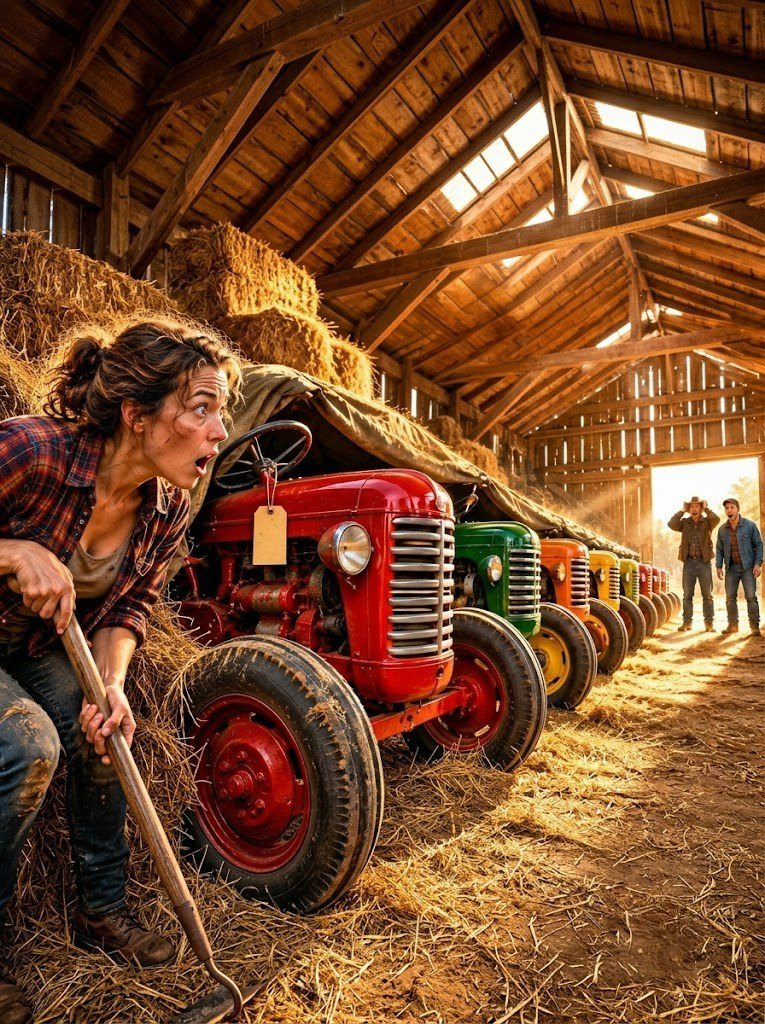
"Let go of that paper!" Ardis shouted.
The hand disappeared into the crack in the creamery wall.
A brick struck the ground.
Then came the sound of someone stumbling in the darkness.
Ardis stepped backward, gripping her flashlight.
"Who are you?"
No answer.
She heard a man's strained breathing.
Then a low voice.
"Don't let him take it."
Another crash echoed behind the wall.
Ardis froze.
There were two men inside.
One had tried to warn her.
The other had come to stop him.
She turned toward her pickup.
Her first instinct was to run toward the building, but the weakened roof and shifting masonry made that impossible.
She had spent forty-six years surviving Minnesota winters, farm accidents, and equipment failures.
She knew the difference between courage and foolishness.
Entering an unstable building while two strangers struggled inside would be foolish.
She hurried to her truck.
Her hands shook as she opened the door.
She reached for the radio, then remembered the pickup had none.
She needed a telephone.
She needed Gordon.
And she needed the sheriff.
As she started the engine, a final sound came from the creamery.
A heavy wooden door slammed.
Ardis looked through the windshield.
A dark figure moved behind a broken window.
Then vanished.
She drove toward the highway.
But before reaching the road, she noticed something beside the loading dock.
A gray sedan.
It had been parked behind a pile of old lumber, hidden from the main entrance.
The license plate was covered with mud.
Ardis slowed just enough to memorize the first three characters.
Then she drove away.
Gordon answered his telephone on the second ring.
"Ardis?"
"There's somebody inside the creamery."
His voice changed immediately.
"Where are you?"
"Driving home."
"Good. Stay away from the building."
"There are two men, Gordon. One of them tried to give me a document."
"What document?"
"Something about the tractors. And there was another room behind the ice-room wall."
Gordon went silent.
"Another room?"
"Or a narrow space. I couldn't see clearly."
"Did you go inside?"
"No."
"Thank God."
Ardis swallowed.
"Someone grabbed the paper before I could read it."
"Did you recognize him?"
"No."
"Did you see a vehicle?"
"A gray sedan behind the loading dock."
Gordon cursed softly.
"Get home. I'm calling the sheriff."
Ardis looked at the road ahead.
"Gordon, I think someone is trying to destroy evidence."
"Then we'll let the sheriff handle it."
She hesitated.
"What if they're gone before he gets there?"
"Then we'll still have your description. Don't turn around."
Ardis tightened her grip on the steering wheel.
"I wasn't going to."
But she had considered it.
And Gordon knew her well enough to understand.
Sheriff Daniel Harlan arrived at the creamery forty minutes later.
He was fifty-six, broad-shouldered, with thinning brown hair and the patient expression of a man who had spent twenty years settling disputes between neighbors.
Two deputies accompanied him.
Gordon met them outside.
Ardis arrived shortly afterward.
The sheriff looked at her.
"You the owner?"
"Yes."
"Tell me exactly what happened."
She described the strange voice behind the locked door.
The paper pushed beneath it.
The warning about Robert Ruona.
The second voice.
The crash.
And the hand that had reached through the opening in the wall.
Sheriff Harlan listened without interrupting.
When she finished, he examined the building.
"Nobody goes inside until we know it's safe."
Gordon pointed toward the southern roof.
"That section's rotten."
"I can see that."
The sheriff contacted the county building inspector.
While they waited, the deputies checked the exterior.
The gray sedan was gone.
Fresh tire tracks remained beside the loading dock.
The north entrance showed signs of attempted forced entry.
One lock was scratched.
A wooden panel had been loosened.
Sheriff Harlan crouched beside it.
"Somebody's been working on this."
Ardis nodded.
"I told you."
He stood.
"I'm not saying you imagined it, Mrs. Lindquist."
"Then what are you saying?"
"I'm saying we need evidence before we accuse anyone."
She looked toward the creamery.
"I have evidence."
She handed him the photocopied bank document.
He examined it.
FIRST STATE BANK.
June 1946.
Seven tractor serial numbers.
Inventory to remain concealed until further instruction.
Initials: M.K.
The sheriff frowned.
"Where did you get this?"
"Someone pushed it under the door."
"Did you see who?"
"No."
He looked at the paper again.
"Could be important."
"Could be?"
He met her eyes.
"Mrs. Lindquist, a forty-five-year-old document doesn't tell me who broke into your building today."
Ardis felt frustration rising.
"But somebody did."
"That part we can investigate."
He placed the paper inside an evidence sleeve.
Then he looked toward the creamery.
"And if there are people inside, we're going to find out."
The building inspector arrived shortly before sunset.
His name was Walter Berg.
He examined the roof from outside, then entered the safer northern section with the sheriff and a deputy.
Ardis waited near Gordon's pickup.
The minutes passed slowly.
A cold wind moved across the gravel yard.
She could hear the inspector speaking inside.
Then footsteps.
Then silence.
Finally, Sheriff Harlan emerged.
"Nobody's inside."
Ardis stared at him.
"That's impossible."
"We searched the accessible areas."
"What about behind the ice-room wall?"
The inspector stepped forward.
"There's a narrow service cavity behind part of the north masonry."
Gordon looked at Ardis.
"A service cavity?"
Walter nodded.
"Probably part of an old ventilation or insulation arrangement."
"Could a person fit inside?" Ardis asked.
"Possibly, in sections."
"Did you search it?"
"Not completely. The masonry is unstable."
Ardis felt her stomach tighten.
"So somebody could still be there."
Sheriff Harlan shook his head.
"We checked for movement and called out. No response. There are openings leading toward the old service corridor."
"An exit?"
"Possibly."
Gordon frowned.
"Then whoever was inside could've escaped."
"That's one explanation," the sheriff answered.
Ardis looked toward the north wall.
The gap she had seen was now partly collapsed.
Loose bricks lay on the ground.
The wooden crate remained visible through the opening.
But the paper label was gone.
Someone had taken it.
"Did you find anything else?" she asked.
The sheriff hesitated.
"There's evidence someone disturbed the masonry recently."
"Anything missing?"
"We can't determine that without an inventory."
Ardis looked at him.
"I can tell you what was there."
"Then write it down."
She nodded.
The sheriff continued.
"I strongly recommend you stay out of this building until the roof is stabilized."
"I understand."
"And you need better security."
"I've already installed locks."
"Locks don't help much when somebody can remove a wall panel."
Ardis looked toward Gordon.
He didn't disagree.
That night, Ardis sat at her kitchen table with the sheriff's incident report.
The house was quiet.
The barn light glowed through the window.
Her nine cows were fed.
The milk had been collected.
The pump had worked, although it had sputtered twice.
Ordinary farm life continued.
But nothing felt ordinary anymore.
Seven tractors.
A hidden room.
A warning from a stranger.
A missing paper.
And a family claiming equipment that had been concealed for nearly half a century.
She opened her notebook.
The list of names had grown.
Werner Ruona.
Harold Velde.
Martin Kessler.
Robert Ruona.
Dale Mercer.
Eino Lindquist.
She stared at the last name.
Her husband.
The man who had never told her about the tractors.
The man who had apparently investigated the creamery before his death.
The man who had left her a letter because he feared something might happen before he could explain.
Ardis looked toward his photograph.
"What were you trying to tell me, Eino?"
The room remained silent.
She reached for the inventory transfer.
The document had two signatures.
Werner Ruona.
Harold Velde.
But the courthouse records suggested that Martin Kessler, the bank official, had also known about the machinery.
Three men.
Three different interests.
A dealership.
A creamery.
A bank.
And seven tractors that had disappeared from ordinary business records.
Ardis began to suspect that the secret wasn't simply about hiding equipment.
It was about who had the right to claim it.
And perhaps who had been paid for it.
The next morning, Gordon arrived carrying a cardboard box.
"What's that?" Ardis asked.
"Old newspapers."
"Where did you get them?"
"My attic."
She raised an eyebrow.
"You've been keeping newspapers since 1946?"
"Not all of them."
He placed the box on the table.
"My father used to save anything about farm equipment prices. Thought it helped him know when to buy."
Ardis opened the box.
The papers smelled of dust and dry wood.
Gordon removed several folded editions.
"Look at these."
The first was dated January 1946.
An advertisement announced the arrival of new agricultural machinery at Ruona Implement Company.
The second, from February, contained a brief report about equipment shortages.
The third mentioned complaints from local farmers who believed dealerships were withholding machinery.
Ardis read carefully.
One name appeared repeatedly.
Henry Soderberg.
The farmer whose name had been written on the allocation sheet found behind the tractors.
She pointed toward the article.
"He complained publicly."
Gordon nodded.
"Looks that way."
The article quoted Henry as saying he had waited months for a tractor that had supposedly been allocated to him.
He believed the dealership had misrepresented its available inventory.
The report didn't prove wrongdoing.
But it established that the dispute had been public.
Ardis continued reading.
A later article mentioned that federal officials were reviewing machinery distribution practices in the region.
Another referred to inventory discrepancies at Ruona Implement.
Then came a notice about Werner's sudden death.
Ardis stopped.
The obituary described him as a respected businessman.
But a small article on the opposite page mentioned that the dealership's financial affairs were under review.
She looked at Gordon.
"Werner died while the investigation was still going on."
"Seems so."
"And the tractors stayed hidden."
"Yes."
"Then somebody decided not to bring them out."
Gordon studied the paper.
"Or nobody could agree who owned them."
Ardis considered that.
If Werner had financed the tractors through First State Bank, the bank might have claimed an interest.
If customers had paid deposits, they might have claims.
If the creamery had accepted the machines as part of a business arrangement, the cooperative might have asserted rights.
And if the records had been altered, the truth could be buried beneath decades of paperwork.
She looked toward the kitchen window.
The creamery was only a few miles away.
Seven tractors stood inside.
But their history stretched through forty-six years of decisions she hadn't made.
And now those decisions were threatening her farm.
Later that morning, Alvar Teppo telephoned.
His voice sounded tired.
"Mrs. Lindquist?"
"Yes."
"Gordon told me about the break-in."
Ardis sighed.
"News travels fast."
"Unfortunately."
"Do you know anything about the hidden cavity?"
Alvar paused.
"I remember the ice room had thick walls. There may have been service spaces for ventilation."
"Could somebody hide documents there?"
"Certainly."
"Could somebody hide a person?"
He hesitated.
"Depends on the dimensions."
Ardis told him about the hand that had grabbed the paper.
Alvar listened.
Then he asked a question.
"Did you see the name?"
"Only part of it."
"Whose name?"
Ardis closed her eyes.
She tried to remember the letters.
The flashlight had moved.
The hand had appeared.
The paper had vanished.
"I recognized it," she said. "But I didn't get a clear look."
"Was it Werner's?"
"No."
"Harold's?"
"No."
"Martin Kessler?"
She hesitated.
"I don't think so."
Alvar was silent.
Then he said, "There's something you should know about Martin Kessler."
Ardis sat down.
"What?"
"He wasn't simply a bank employee."
"What do you mean?"
"He handled inventory financing for several dealerships. Ruona Implement was one of them."
"Did he approve the loans?"
"Possibly. He certainly knew the accounts."
"Then he could have known the tractors were hidden."
"Yes."
Ardis felt a chill.
"Why would he keep quiet?"
Alvar sighed.
"Because if the bank's records were wrong, somebody might have been responsible."
"Responsible for what?"
"Approving loans against inventory that wasn't where the bank believed it was."
Ardis looked at her notebook.
"And if the tractors were never recovered?"
"The bank could have suffered a loss."
"Then why didn't they seize them?"
"That's what we need to understand."
He paused.
"Mrs. Lindquist, I think you should speak to an attorney before you uncover anything else."
She almost laughed.
"Everybody keeps telling me that."
"Because it's good advice."
"With what money?"
Alvar was quiet.
Then he said, "I know someone who might help."
The attorney's name was Margaret Bell.
She practiced in Fergus Falls and had spent twenty-five years handling property disputes, agricultural debt, and estate matters.
Alvar explained that Margaret had once helped his family resolve a complicated land-title problem.
"She's fair," he said. "And she doesn't scare easily."
Ardis hesitated.
"How much does she charge?"
"I don't know her current rates."
"Then I can't promise anything."
"Call her anyway."
That afternoon, Ardis telephoned Margaret's office.
A receptionist answered.
Ardis explained that she had purchased an abandoned building containing valuable machinery.
Several parties were questioning ownership.
And she was facing serious farm debt.
The receptionist listened.
Then asked whether Ardis could come in the following morning.
"How much for a consultation?" Ardis asked.
The receptionist gave her the fee.
Ardis felt her stomach sink.
It was more than she had spent on groceries in two weeks.
She almost declined.
Then she looked at the bill of sale.
Building and all contents.
Five words.
Five words that might save everything.
"I'll be there," she said.
Margaret Bell was sixty, with short dark hair streaked with gray and a direct manner that reminded Ardis of her mother.
Her office was modest.
There were no marble floors.
No expensive paintings.
Only shelves of legal books, a wooden desk, and a framed photograph of a dairy farm.
Margaret listened as Ardis explained the purchase.
The tractors.
The documents.
The threatening calls.
The Ruona family.
The break-in.
The government debt.
When Ardis finished, Margaret sat silently for several seconds.
Then she asked, "Do you have the original bill of sale?"
Ardis handed it over.
Margaret read it carefully.
"Building and all contents," she murmured.
"That's what it says."
"Yes."
"Does that mean I own the tractors?"
Margaret looked up.
"Not automatically."
Ardis felt disappointment.
"But it may give you a strong argument, depending on what interests the village held and whether any competing claims remain legally enforceable."
"Can the Ruona family take them?"
"They can assert a claim. Whether they can prove it is another matter."
"What about the bank?"
"We'd need to examine the financing records."
"And the creamery cooperative?"
"The same."
Ardis sighed.
"So everybody might have a claim."
"Possibly."
"And nobody knows who owns them."
"Not yet."
Margaret leaned forward.
"But there's something important here."
Ardis looked up.
"What?"
"You purchased the property through a public sale. You paid the stated price. You didn't conceal the tractors. You discovered them after taking possession."
"Yes."
"Those facts matter."
Ardis felt a small measure of relief.
Margaret continued.
"Also, if the equipment has been abandoned for decades, there may be defenses against certain claims. But we must examine the actual documents and applicable law."
Ardis nodded.
"Can you help me?"
Margaret looked at the thick folder.
Then at Ardis's worn jacket.
Then at the photograph of the farm on her wall.
"My father lost his dairy farm in 1985," she said quietly.
Ardis stared.
"I'm sorry."
Margaret nodded.
"So am I."
She closed the folder.
"I can't promise you'll win. But I can help you understand what you're facing."
Ardis swallowed.
"Thank you."
Margaret continued.
"First, don't sell anything. Second, preserve every document. Third, don't let anyone remove the machinery without a court order or a legally sound agreement."
Ardis nodded.
"And fourth," Margaret said, "we need to find out what happened to the bank's interest in those tractors."
They spent the next hour reviewing the records.
Margaret examined the inventory transfer.
The bank filing.
The newspaper articles.
The dealer tags.
The photocopy pushed beneath the creamery door.
Then she stopped at one document.
The August 1946 creamery asset transfer.
She read it twice.
"Interesting."
Ardis leaned forward.
"What?"
Margaret pointed toward a paragraph.
"This transfer refers to certain machinery and equipment being excluded pending reconciliation."
"That's what we found."
"Yes. But look at the next sentence."
Ardis read it.
Any unresolved equipment interests shall remain subject to separate determination.
She frowned.
"What does that mean?"
"It means the parties knew some equipment interests hadn't been resolved."
"The tractors?"
"Possibly."
Margaret looked at the bank filing.
"Now here's the important question."
"What?"
"Was the bank's interest ever formally released, satisfied, or otherwise extinguished?"
Ardis shook her head.
"I don't know."
"Then we need the successor bank's records."
"Does First State Bank still exist?"
"Not under that name."
Margaret made a note.
"It merged with another institution years ago."
Ardis felt uneasy.
"Could the new bank claim the tractors?"
"We don't know. Old security interests can be complicated, and the passage of time matters."
Margaret looked at her.
"But if the bank wrote off the inventory, that doesn't necessarily mean the debt was forgiven or the collateral released."
Ardis sighed.
"Nothing is simple."
Margaret gave a small smile.
"No. But complicated doesn't mean hopeless."
Before Ardis left, Margaret asked one final question.
"Did your husband ever discuss the creamery with you?"
Ardis hesitated.
"Only the well."
"Nothing about the tractors?"
"No."
"Did he leave any papers?"
Ardis handed her a copy of Eino's letter.
Margaret read it slowly.
When she finished, her expression softened.
"He was trying to protect you."
Ardis looked away.
"I know."
Margaret placed the letter on the desk.
"He also believed somebody altered the records."
"Yes."
"Did he say who?"
"No."
Margaret thought for a moment.
"Then we should examine the document returned to the courthouse after his death."
Ardis nodded.
"Dale Mercer signed the return entry."
Margaret looked up.
"The auctioneer?"
"Yes."
"That's unusual."
"Why?"
"Because if your husband withdrew the document, someone else returning it immediately after his death raises questions."
Ardis felt her pulse quicken.
"Do you think Dale knew what Eino found?"
"I think we should ask him."
Ardis looked toward the window.
Dale Mercer had sold her the creamery for seven hundred dollars.
He had laughed about the roof.
He had asked whether she understood what she was buying.
And now his signature appeared on a record connected to Eino's final investigation.
The coincidence was becoming difficult to ignore.
Ardis returned home shortly before sunset.
Gordon was waiting in the driveway.
"How'd it go?"
"She'll help."
"Good."
"She says we need the bank records."
Gordon nodded.
"That makes sense."
Ardis climbed out of the pickup.
"She also wants to talk to Dale Mercer."
Gordon's expression changed.
"About the courthouse document?"
"Yes."
He looked toward the road.
"Then we'd better be careful."
Ardis sighed.
"Everybody keeps saying that."
"Because somebody broke into your building yesterday."
"I know."
"And somebody threatened you."
"I know that, too."
Gordon studied her.
"You're not going to stop, are you?"
Ardis looked toward the barn.
Nine cows waited inside.
The well was failing.
The government debt remained.
And the tractors might be her only chance.
"No," she said.
"I'm not."
That night, Ardis examined the old creamery plans again.
She spread them across the kitchen table.
The north ice room measured twenty-two feet by thirty feet.
She traced the walls with her finger.
Then compared the plans with Gordon's measurements.
Something didn't match.
The interior length appeared shorter than the original drawing.
Not by much.
Perhaps four feet.
But enough to create a narrow space behind the rear wall.
She remembered the hidden cavity.
The wooden crate.
The paper label.
The hand that had grabbed it.
She studied the plan more closely.
A faint line ran along the north wall.
It wasn't labeled.
She held the paper beneath the kitchen lamp.
Then she noticed a small handwritten notation near the corner.
Service access.
Her heartbeat quickened.
She moved the lamp closer.
A second notation appeared.
Revised 1946.
Ardis stared.
The ice room had been modified in 1946.
The same year Werner Ruona died.
The same year the bank records became confused.
The same year the tractors disappeared.
She reached for the telephone.
Gordon answered.
"Hello?"
"I found something on the plans."
"What?"
"A service access behind the ice room."
He went silent.
"Ardis, don't tell me you're going back there tonight."
"No."
"Good."
"But we need to look tomorrow."
He sighed.
"With the inspector."
"Yes."
"And the sheriff."
"Yes."
Gordon paused.
"You're learning."
Ardis almost smiled.
"Don't sound so surprised."
The following morning, Gordon, Sheriff Harlan, and Walter Berg met Ardis at the creamery.
The inspector examined the plans.
Then the north wall.
He nodded slowly.
"There's definitely a cavity behind here."
"Can we reach it safely?" Ardis asked.
"Possibly, but we need to brace the masonry first."
They spent several hours preparing the area.
Walter supervised the work.
The sheriff remained nearby.
Ardis waited with Gordon.
Finally, the inspector removed several loose bricks from the damaged section.
A narrow opening appeared.
He shone a flashlight inside.
"There's a space back here."
Ardis stepped closer.
"Can you see anything?"
"Wooden crates."
"Anything else?"
"Old shelving. Some debris."
The sheriff leaned forward.
"Any sign someone used it recently?"
Walter examined the floor.
"Hard to say."
He widened the opening enough to inspect the cavity without entering it.
Then he stopped.
"What is it?" Ardis asked.
Walter moved the flashlight.
"There's a metal cabinet back here."
Gordon leaned closer.
"Locked?"
"Looks like it."
The sheriff examined the opening.
"Can we remove it?"
Walter nodded.
"Carefully."
They worked slowly.
The cabinet was heavy.
Its surface was coated with rust and dust.
After nearly an hour, they managed to bring it into the safer section of the creamery.
Ardis stared at it.
A faded label remained attached to the front.
RUONA IMPLEMENT COMPANY.
PRIVATE RECORDS.
The sheriff examined the lock.
"Mrs. Lindquist, this may be evidence connected to the break-in."
Ardis nodded.
"Then document everything."
He looked at her.
"We will."
The cabinet was opened under the sheriff's supervision.
Inside were several folders.
Old invoices.
Bank correspondence.
Inventory lists.
And a thick ledger wrapped in oilcloth.
Ardis felt her heart pounding.
The sheriff carefully removed the ledger.
Its cover was dark green.
Across the front, in faded gold lettering, were the words:
RUONA IMPLEMENT COMPANY.
1945–1946.
Gordon leaned closer.
"That's what we've been looking for."
The sheriff opened the first page.
Columns of numbers filled the paper.
Dates.
Serial numbers.
Payments.
Names.
Ardis recognized several entries.
The seven tractors.
The same serial numbers.
But beside each machine was a payment notation.
Not from customers.
Not from the creamery.
From First State Bank.
Ardis frowned.
"What does that mean?"
The sheriff turned another page.
More entries.
More payments.
Then a handwritten summary.
Inventory financing adjusted.
Seven units retained.
Bank acknowledgment received.
Gordon looked at Ardis.
"That sounds important."
The sheriff nodded.
"It may be."
He turned to the final section.
Several pages had been removed.
Their torn edges remained visible near the binding.
Ardis felt her stomach tighten.
"Somebody took them."
The sheriff examined the damage.
"Looks that way."
"Recently?"
"Can't tell."
Then Gordon noticed something tucked into the back cover.
A small envelope.
The sheriff removed it.
Inside was a folded letter.
The paper was yellowed.
The handwriting was careful.
At the top was a date.
June 18, 1946.
Three days before Werner Ruona's death.
The sheriff unfolded it.
Ardis leaned closer.
The letter began:
To whoever eventually finds the seven tractors...
Her breath caught.
The sheriff read the next line.
Then stopped.
His expression changed.
Gordon looked at him.
"What does it say?"
The sheriff stared at the paper.
"Mrs. Lindquist, I think you need to sit down."
Ardis didn't move.
"Read it."
He hesitated.
Then turned the letter toward her.
The second paragraph contained a statement that made her hands go cold.
Werner Ruona had written that the tractors were not being concealed from the bank.
They were being concealed at the bank's request.
Ardis stared at the words.
Gordon whispered, "Good Lord."
The sheriff continued reading.
Then he reached the final paragraph.
His face tightened.
"There's a name here."
Ardis leaned closer.
"What name?"
The sheriff looked toward the creamery entrance.
Then back at the letter.
"Someone who was supposed to receive the tractors if Werner died."
Ardis felt her heartbeat pounding.
"Who?"
The sheriff slowly lowered the paper.
Before he could answer, a vehicle stopped outside.
A car door slammed.
Footsteps approached.
Then a man's voice called from the entrance.
"Mrs. Lindquist?"
Ardis turned.
Robert Ruona stood in the doorway.
Beside him was Dale Mercer.
And behind them was a third man carrying a leather briefcase.
Robert looked directly at the open cabinet.
His expression changed.
For the first time, genuine fear crossed his face.
He stepped forward.
"That cabinet belongs to my family."
The sheriff moved between them.
"Stay where you are."
Robert ignored him.
His eyes remained fixed on the letter.
"Mrs. Lindquist," he said, "you have no idea what you've just opened."
Ardis looked at the document.
Then at Robert.
And suddenly she understood something.
He hadn't come to recover the tractors.
He had come to recover the records.
The sheriff unfolded the final page of Werner Ruona's letter.
Robert took one step backward.
The sheriff read the name written at the bottom.
Then looked directly at Ardis.
"Mrs. Lindquist," he said, "the person Werner named to receive those tractors was..."






Comments 0