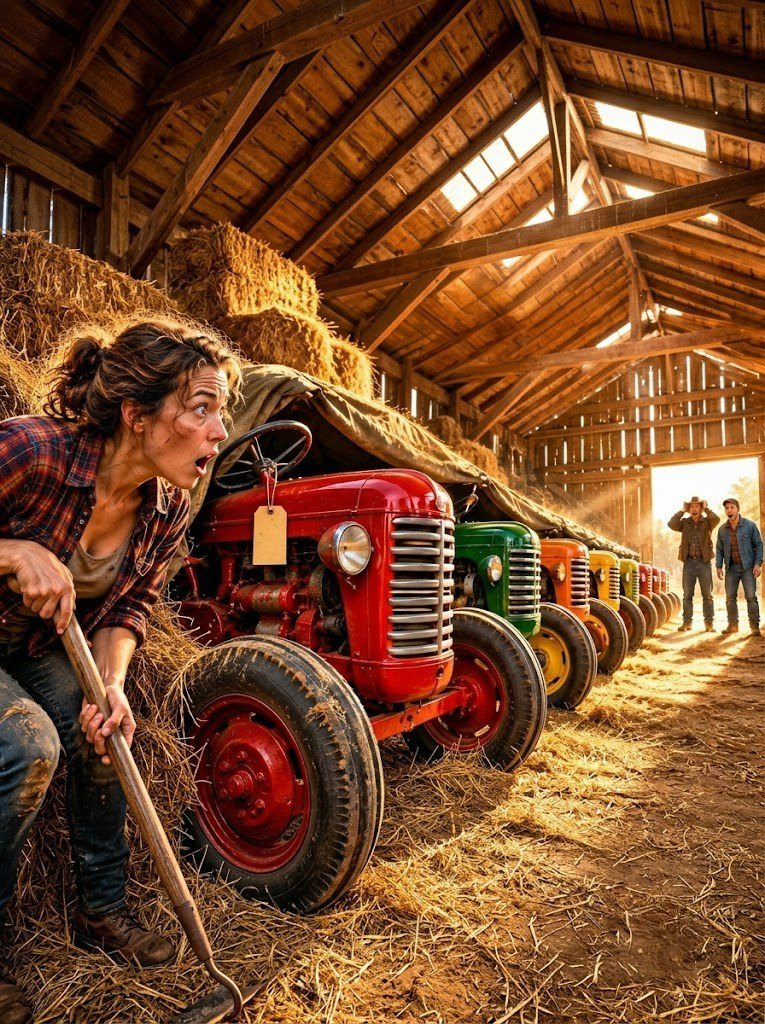
"Don't tell anyone what?" Ardis whispered.
Gordon Niskanen held the yellowed paper tag beneath the flashlight, his fingers trembling.
The warning was written in faded pencil.
DO NOT TELL THE BANK.
Below those five words was a date.
June 11, 1946.
And beneath the date, almost erased by time, were two initials.
W.R.
Gordon looked toward the seven tractors standing in the darkness.
"Ardis," he said quietly, "I think somebody went to a lot of trouble to make sure these machines were never found."
She stared at the handwriting.
"Then why leave a warning where anyone could see it?"
"Maybe whoever wrote it didn't expect anyone to get inside."
"Or maybe they expected somebody to come back."
Gordon didn't answer.
The old creamery creaked around them.
Outside, a November wind rattled the loose boards along the southern wall. Somewhere overhead, a pigeon fluttered beneath the rafters.
Ardis turned the tag carefully between her fingers.
It was attached to the steering wheel of the smallest tractor, a compact John Deere machine tucked against the far wall.
The paper had become brittle.
The string holding it in place looked almost ready to break.
On the front was a faded dealership stamp.
RUONA IMPLEMENT COMPANY.
KETTLE RAPIDS, MINNESOTA.
STOCK NO. 45-3.
On the back was the warning.
Ardis read it again.
DO NOT TELL THE BANK.
She had spent nearly three years receiving letters from banks, government agencies, and creditors.
She knew what it felt like to owe money.
She knew what it felt like to hide an overdue bill beneath another envelope because looking at it wouldn't make the amount smaller.
But this was different.
Seven tractors had been concealed behind a brick wall.
And someone had apparently been afraid of a bank finding them.
"Could they have been stolen?" she asked.
Gordon slowly shook his head.
"Could've been. Could've been something else entirely."
"Something illegal?"
"Maybe."
Ardis looked around the room.
The tractors stood in two orderly rows.
Four appeared to be John Deere Model B machines.
Two were larger Model A tractors.
The smaller one at the back looked like a Model LA.
Their green paint was coated with decades of dust, but the metal beneath appeared remarkably well preserved.
Heavy oak blocks supported their wheels.
Protective grease covered exposed components.
Each machine had been positioned carefully, as though someone expected to return within a few weeks.
Nothing about the room suggested hurried abandonment.
Whoever had hidden the tractors had taken time to protect them.
"Nobody forgets seven tractors," Ardis said.
"No."
"Especially not new ones."
Gordon crouched beside the nearest front wheel.
He brushed dust from the tire.
"These weren't parked here because somebody ran out of shed space."
Ardis watched him.
"How can you tell?"
He pointed toward the wooden blocks.
"Somebody wanted the tires off the ground. Wanted the machines dry. Look at the grease on those fittings."
He stood with difficulty.
"Whoever put these here knew exactly what he was doing."
Ardis turned toward the sealed doorway.
"Then why didn't he come back?"
Gordon looked at the warning again.
"That's the question, isn't it?"
They didn't remove another brick that afternoon.
Gordon insisted they first make certain the opening was stable.
The creamery was old, and the last thing Ardis needed was a collapsing wall on top of seven potentially valuable machines.
They photographed the doorway with Gordon's camera.
Then they carefully recorded the location of the paper tag and the condition of the room.
Ardis wrote everything in her notebook.
November 19, 1991.
North ice room.
Seven tractors.
Original green paint.
Yellow wheels.
Paper tags.
Possible wartime equipment.
Handwritten warning.
She paused before writing the final words.
DO NOT TELL THE BANK.
Then she underlined them.
Gordon watched her.
"You're going to keep that notebook somewhere safe?"
"Kitchen drawer."
"Not good enough."
"Why?"
"Because if these machines are worth what I think they might be, people are going to start asking questions."
Ardis closed the notebook.
"What do you think they're worth?"
Gordon hesitated.
He had spent most of his life repairing farm equipment.
He knew what used tractors brought at local auctions.
He knew what collectors sometimes paid for rare machinery.
But seven nearly unused wartime tractors were something else.
"I don't want to give you a number," he said.
"Why not?"
"Because I don't know enough."
"Give me a guess."
He looked toward the machines.
"More than seven hundred dollars."
Despite everything, Ardis let out a small breath that almost became a laugh.
"Well, that's encouraging."
Gordon didn't smile.
"I'm serious. Don't sell anything until somebody who knows these models has looked at them."
Ardis nodded.
"Who?"
"Alvar Teppo."
She recognized the name.
"Didn't he run the implement dealership in Kettle Rapids?"
"Years ago. Before his son took over."
"Is he still alive?"
"Eighty-three and mean enough to outlive the rest of us."
Gordon pulled his cap back onto his head.
"He knows old John Deere machines better than anybody around here."
"Would he come?"
"If I tell him what we've found, he might."
Ardis looked back into the room.
The tractors stood silently beneath the flashlight beam.
She thought of the nine cows waiting at home.
She thought of the old well that still needed testing.
She thought of the $94,600 debt.
For the first time in months, a dangerous thought entered her mind.
Maybe there was a way out.
She immediately pushed it aside.
Hope had become something she handled carefully.
It could hurt worse than disappointment.
By the time Ardis returned home, the sun had dropped behind the western fields.
The cows were waiting.
Rosie complained loudly when Ardis entered the barn.
"I know," Ardis murmured. "I'm late."
She filled the feed troughs.
Checked the water.
Cleaned the stalls.
Then began the evening milking.
Her hands moved through the familiar routine while her mind remained inside the creamery.
Seven tractors.
Hidden for forty-five or forty-six years.
She tried to imagine the men who had put them there.
Had they worked at night?
Had they driven the machines through the loading entrance?
Had someone stood outside watching for headlights?
And why had they sealed the doorway with bricks instead of simply locking it?
By the time she finished milking Pearl, her shoulders ached.
She washed her hands and returned to the farmhouse.
A letter waited in the mailbox.
The return address made her stomach tighten.
FARMERS HOME ADMINISTRATION.
Ardis carried it inside.
She placed it on the kitchen table.
Then she made coffee.
She didn't open the envelope immediately.
There had been a time when she opened every letter the moment it arrived.
Now she sometimes waited until after supper.
Not because she believed the contents would change.
Because she wanted a few more minutes before the worry began.
She sat beneath the kitchen light and looked at Eino's photograph.
He was standing beside their old dairy barn, one hand resting on a fence post.
He had been smiling.
Ardis remembered the day the picture was taken.
Their youngest son had just graduated from high school.
The farm had been doing well enough that Eino talked about replacing the old tractor.
"We'll get something dependable," he had said. "Something that'll last us twenty years."
They never bought it.
The interest rates climbed.
Milk prices disappointed them.
A drought ruined the hay crop.
And one refinancing agreement led to another.
Ardis touched the edge of the photograph.
"You wouldn't believe what I found today," she whispered.
The room remained silent.
She opened the government envelope.
It contained another account statement.
The balance remained $94,600.
There were additional warnings about arrears and possible collection action.
Nothing in the letter suggested that anyone was willing to wait for her circumstances to improve.
Ardis folded it.
She placed it beside the creamery bill of sale.
For a long moment, she studied the two papers.
One represented everything she might lose.
The other represented something she didn't yet understand.
Then she opened her notebook.
Seven tractors.
She wrote the words again.
And beneath them:
Find out who owns them.
The following morning, Gordon telephoned Alvar Teppo.
Ardis stood beside the kitchen counter while Gordon spoke.
"No, Alvar, I'm not calling about a broken carburetor."
A pause.
"Seven tractors."
Another pause.
"No, I haven't been drinking."
Ardis covered her mouth.
Gordon rolled his eyes.
"Four B models. Two A models. One little LA, far as I can tell."
The voice on the other end became loud enough for Ardis to hear.
Gordon held the receiver away from his ear.
"That's what I'm telling you."
He listened.
"Original paint. Dealer tags. Almost no hours."
Another pause.
Then Gordon's expression changed.
"Yes," he said. "Ruona Implement."
He listened for nearly thirty seconds.
When he finally spoke again, his voice was quieter.
"You remember something about that?"
Ardis moved closer.
Gordon glanced at her.
"All right. Thursday morning."
He hung up.
For a moment, neither spoke.
"What did he say?" Ardis asked.
Gordon looked toward the window.
"He wants to see them."
"Did he know the dealership?"
"He knew Werner Ruona."
Ardis felt a small tightening in her chest.
"What kind of man was Werner?"
Gordon slowly pulled out a chair.
"Alvar wouldn't say."
"Why?"
"He said he'd rather talk when he got here."
Ardis frowned.
"That's strange."
"There's something else."
"What?"
Gordon looked directly at her.
"When I mentioned the paper tag, he asked whether we'd found anything written on the back."
Ardis went still.
"How would he know to ask that?"
"That's what I'd like to find out."
Thursday arrived with a hard frost.
Alvar Teppo drove into the creamery yard shortly after nine in an old brown Oldsmobile.
He was eighty-three, thin, and slightly bent, with a narrow face and hands that trembled when he wasn't using them.
He wore a dark wool overcoat, a plaid scarf, and polished shoes that were entirely unsuitable for the creamery floor.
Gordon met him outside.
"You're late."
Alvar shut the car door.
"I'm eighty-three. Be grateful I came at all."
Ardis introduced herself.
Alvar studied her for a moment.
"You're Eino Lindquist's wife."
"I am."
"Good man, Eino."
"Thank you."
"He bought parts from me when he was young."
Ardis nodded.
Alvar looked toward the creamery.
"Now show me what you've found."
They led him through the cleared processing area.
He walked slowly, using a cane.
When they reached the partially opened brick doorway, he stopped.
He examined the mortar.
Then he looked at Gordon.
"This wall wasn't here when I was a young man."
Gordon raised an eyebrow.
"You've been inside this building before?"
"Many times."
"When?"
"Before the war. During it. A few times afterward."
Alvar touched one of the newer bricks.
"I remember the ice room."
Ardis watched his face.
"Did you know it had been sealed?"
"No."
He stared at the opening.
"Nobody ever told me."
They entered the hidden room.
Alvar took three steps.
Then stopped.
His cane made a small sound against the floor.
He looked at the first tractor.
Then the second.
Then the row behind them.
His lips parted.
For several seconds, he said nothing.
Gordon waited.
Ardis watched his expression.
Finally, Alvar whispered, "I'll be damned."
He moved toward the nearest Model B.
His hands no longer seemed to tremble.
He wiped dust from the hood with a clean cloth.
Then he crouched to inspect the serial plate.
Gordon offered to help.
Alvar waved him away.
"I can still read a number."
He took out a small notebook.
Ardis handed him a pencil.
He recorded the serial number.
Then he moved to the next machine.
And the next.
He examined the tags.
The wheels.
The tires.
The paint.
The grease.
The hour meters.
He inspected the engines without attempting to start them.
After nearly an hour, he sat on an overturned crate.
Ardis brought him a thermos cup of coffee.
He accepted it with both hands.
"Well?" Gordon asked.
Alvar looked at the seven machines.
"These are extraordinary."
Ardis felt her heartbeat quicken.
"Are they valuable?"
"Yes."
"How valuable?"
Alvar took a slow drink.
"That depends on condition, documentation, and what a serious collector is willing to pay."
"Could they be worth ten thousand dollars?"
Alvar looked at her.
"Mrs. Lindquist, don't let anyone talk you into selling these for ten thousand dollars."
Gordon slowly removed his cap.
Ardis stared at the old dealer.
"All seven?"
"Any of them, until you've had a proper appraisal."
The room became very quiet.
Alvar leaned forward.
"Do you understand what you've found?"
Ardis shook her head.
"I was hoping you would tell me."
He looked toward the tractors.
"During the war, new agricultural machinery was difficult to obtain. Manufacturers were working under wartime restrictions. Farmers couldn't always buy what they needed."
He pointed toward the Model A nearest the wall.
"Machines like these were valuable. Very valuable."
"Then why hide them?" Ardis asked.
Alvar didn't answer immediately.
Instead, he held out his hand.
"Show me the tag."
Ardis removed the protective sleeve containing the photographed and carefully preserved dealer tag.
She handed it to him.
Alvar read the front.
Then turned it over.
His expression changed.
"Do not tell the bank," he whispered.
Gordon leaned closer.
"You knew about that warning?"
Alvar stared at the date.
June 11, 1946.
For a moment, he looked much older than eighty-three.
"I knew Werner was in trouble," he said.
"What kind of trouble?" Ardis asked.
Alvar folded his hands.
"Money. Inventory. Government questions."
He paused.
"Werner Ruona was a clever businessman. Too clever, sometimes."
"Did he steal the tractors?"
"I don't know."
"Then what happened?"
Alvar looked toward the sealed doorway.
"In 1945, there were rumors that Werner was holding machinery back from customers. People said he expected prices to rise when wartime controls ended."
Gordon frowned.
"Was that illegal?"
"Depending on what he did and which rules applied, it could have brought serious trouble."
Alvar nodded toward the tractors.
"Seven machines hidden behind a wall would certainly have raised questions."
Ardis looked at the paper tag.
"And the bank?"
"Dealers financed inventory. Banks expected that inventory to remain accounted for."
He paused.
"If Werner used borrowed money to purchase these machines and then concealed them, the bank might have believed its collateral was missing."
"Did the bank ever find out?"
Alvar shook his head.
"I don't know."
"Did Werner go to prison?"
"No."
"What happened to him?"
Alvar looked directly at her.
"He died in June 1946."
Ardis glanced at the date on the tag.
June 11.
"When?"
"Later that month."
A chill moved through her.
The warning had been written only days before Werner Ruona's death.
They spent another hour examining the tractors.
Alvar insisted that nothing be restored.
"No fresh paint," he warned.
"All right," Ardis said.
"No polishing the metal."
"I won't."
"And don't start the engines."
Gordon nodded.
"Wasn't planning to."
Alvar pointed toward the original grease.
"That stuff tells a story. So do the tags, the dust, and the hour readings."
He walked toward the smallest tractor.
"Collectors pay for originality. Once you change something, you can't always put it back."
Ardis wrote his instructions in her notebook.
Then she asked the question that had been troubling her since the discovery.
"Do I own them?"
Alvar stopped.
"That's a question for an attorney."
"But I bought the building and all its contents."
"That's what your paper says?"
"Yes."
"Then keep that paper safe."
Ardis looked at him.
"Do you think somebody might challenge it?"
Alvar studied the room.
"Mrs. Lindquist, if these machines are as valuable as I suspect, I'd be surprised if nobody did."
Gordon crossed his arms.
"Who?"
"Werner's descendants, perhaps. A successor to the creamery. Someone claiming an old financial interest."
"After forty-five years?" Ardis asked.
"People have remarkable memories when money is involved."
He looked at the tractors again.
"And remarkable imaginations."
Before leaving, Alvar gave Ardis the name of a machinery appraiser in Iowa.
He also recommended checking county records and old newspaper archives.
"Find out everything you can," he said. "Especially about the dealership."
Ardis nodded.
"And don't tell strangers what you've found until you understand what you're dealing with."
Gordon looked at him.
"That's the second time you've warned us about that."
Alvar adjusted his scarf.
"Because I'm old enough to know that a valuable discovery can bring out the worst in people."
He started toward the door.
Then stopped.
"One more thing."
Ardis looked up.
"What?"
Alvar glanced back at the tractors.
"Werner Ruona wasn't the only man who knew that ice room existed."
Gordon frowned.
"Who else?"
Alvar hesitated.
"The creamery manager. A few employees. Possibly the men who delivered the machines."
"Do you remember their names?"
"Some."
"Will you tell us?"
Alvar looked toward the doorway.
"After I check something."
"What?"
"An old newspaper clipping I kept."
He refused to explain further.
That evening, Ardis returned to the farmhouse carrying more questions than answers.
She milked the cows.
Fed them.
Checked the well.
The pump sputtered twice before the water began flowing.
She stood beside the trough, listening to the uneven motor.
The creamery had been purchased to solve this problem.
Yet the well was still untested.
She had spent weeks clearing debris and had now discovered seven tractors that might be worth more than anything she owned.
But she still didn't have enough money to drill a new well.
She still owed $94,600.
And the government wasn't going to accept a story about hidden tractors as payment.
Ardis returned to the house.
She took out the bill of sale.
Building and all contents.
She read the phrase repeatedly.
Then she placed the document in a clean envelope and tucked it inside a metal box containing Eino's death certificate, their marriage license, and the deed to the farm.
For the first time, she understood that the creamery purchase might involve more than salvaging bricks and repairing a well.
It might involve lawyers.
Courtrooms.
Claims from people she had never met.
And money large enough to change the rest of her life.
She wasn't comfortable with any of it.
But she was no longer willing to walk away.
The following Monday, Ardis visited Elaine Maki at the village office.
Elaine looked up from her desk.
"How's the creamery?"
"Still standing."
"That's good news."
"Most of it."
Elaine smiled.
Ardis placed her notebook on the counter.
"I need the original property records."
Elaine's expression became curious.
"Something wrong?"
"Not necessarily."
"Are you having trouble with the deed?"
"No. I just want to understand exactly what I bought."
Elaine opened a filing cabinet.
She retrieved the sale folder.
Inside were the auction notice, property description, inspection reports, and copies of the village's authorization to dispose of the building.
Ardis read each page carefully.
The language was consistent.
The village had offered the creamery building and its contents.
There was no inventory of movable equipment.
No listed exclusions.
No reservation of machinery.
But the records also made clear that the village was selling only whatever interests it lawfully held.
Ardis pointed toward the phrase.
"What does that mean?"
Elaine leaned closer.
"It means the village can't transfer something it doesn't own."
Ardis felt her stomach tighten.
"So even if the bill says all contents, somebody else could claim something inside?"
"Possibly. It would depend on the facts."
Elaine studied her.
"Ardis, what did you find?"
Ardis hesitated.
She trusted Elaine.
But Gordon and Alvar had both warned her to be careful.
"Some old machinery."
Elaine raised an eyebrow.
"What kind?"
"Farm equipment."
"Anything valuable?"
"I don't know yet."
Elaine looked at her for several seconds.
Then she closed the folder.
"Whatever it is, get legal advice before you sell it."
Ardis nodded.
"I intend to."
Elaine made copies of the relevant documents.
As Ardis prepared to leave, the clerk spoke again.
"One thing bothers me."
Ardis turned.
"What?"
"The creamery was abandoned for decades. But the village's files don't show any inspection of the sealed ice room."
"Maybe nobody knew it was there."
"Maybe."
Elaine tapped the folder.
"But if there was valuable equipment inside, somebody might have known."
Ardis felt a familiar uneasiness.
"Who?"
Elaine shook her head.
"I couldn't tell you."
The next day, Ardis and Gordon drove to the Kettle Rapids library.
A librarian named Margaret helped them operate the microfilm reader.
They searched old newspaper editions from 1945 and 1946.
Most pages contained ordinary local news.
Church suppers.
School basketball scores.
Livestock auctions.
Farm equipment advertisements.
Wedding announcements.
Then Gordon found a legal notice dated March 14, 1946.
He called Ardis over.
She leaned toward the screen.
The notice referred to a federal administrative hearing involving Ruona Implement Company.
It mentioned allegations concerning the withholding of regulated agricultural machinery from distribution.
Ardis read it twice.
"That's what Alvar was talking about."
Gordon nodded.
"Looks that way."
"Does it say Werner was guilty?"
"No."
"Then we can't assume he was."
Gordon looked at her.
"Fair enough."
They continued searching.
Several weeks later, another brief article mentioned the continuing inquiry.
Then came Werner Ruona's obituary.
June 1946.
Age fifty-one.
Survived by his wife, two children, and several relatives.
The obituary described him as a respected businessman and community supporter.
There was no mention of the machinery investigation.
No mention of missing tractors.
No mention of the creamery ice room.
Ardis copied the relevant articles.
She placed them in a folder.
Then she asked Margaret whether old bank records might still exist.
The librarian suggested the county courthouse.
"Commercial filings sometimes survive longer than people expect," she explained.
Gordon looked at Ardis.
"Looks like we've got another trip."
Ardis nodded.
She was tired.
Her knees hurt.
The farm needed attention.
But every answer seemed to uncover another question.
And the more she learned, the less she believed the tractors had been forgotten accidentally.
That night, Gordon returned to the farm with an unexpected concern.
He found Ardis carrying feed into the barn.
"Did you tell anybody about the tractors?"
She stopped.
"Elaine knows I found machinery."
"Anybody else?"
"No."
Gordon looked toward the road.
"Somebody was parked outside the creamery this afternoon."
"Who?"
"Didn't recognize the pickup."
"What were they doing?"
"Just sitting there."
"Maybe they were curious."
"Maybe."
He lowered his voice.
"When I drove past again, they were gone."
Ardis set down the feed bucket.
"Do you think somebody knows?"
"Alvar came out here. We went to the library. People notice things."
She looked toward the darkening fields.
"Should we move the tractors?"
"Not without a plan. They're heavy, and the building isn't safe enough for careless work."
"Then what?"
"Better locks. Reinforce the doors. Keep the paperwork somewhere secure."
Ardis nodded.
Gordon studied her.
"You're not scared?"
She considered the question.
"Of course I am."
"Then why do you look so calm?"
Ardis picked up the bucket.
"Because being scared doesn't feed the cows."
Gordon followed her into the barn.
Neither spoke for several minutes.
Then he said, "Eino would be proud of you."
Ardis stopped.
Her eyes moved toward the empty stall where Eino used to keep his tools.
She swallowed.
"I'd rather he were here."
Gordon looked away.
"So would I."
Two days later, the first stranger telephoned.
Ardis was washing dishes when the kitchen phone rang.
"Mrs. Lindquist?"
"Speaking."
"My name is Harold Benson. I'm a collector in Iowa."
Ardis tightened her grip on the receiver.
"How can I help you?"
"I understand you've come across some vintage John Deere tractors."
She said nothing.
"I'd be interested in making an offer."
"How did you hear about them?"
"A friend mentioned it."
"What friend?"
The man laughed.
"Small world, isn't it?"
Ardis waited.
He continued.
"I could offer two thousand dollars per machine. Cash. No need to bother with appraisals."
Ardis looked toward the metal box on the kitchen shelf.
Seven tractors.
Fourteen thousand dollars.
It was more cash than she had seen in years.
Enough to repair the well.
Enough to buy feed.
Enough to postpone disaster.
But Alvar's warning echoed in her mind.
Don't let anyone talk you into selling these for ten thousand dollars.
"Thank you," she said. "I'm not selling."
"Mrs. Lindquist, that's a generous offer."
"I'm sure you believe it is."
"These old machines can be expensive to restore."
"They don't appear to need restoration."
Silence.
Then the man's tone changed.
"Well, I wouldn't wait too long. Ownership can get complicated."
Ardis felt a chill.
"What do you mean?"
"Just friendly advice."
The line went dead.
She stood holding the receiver.
How had a stranger in Iowa learned about the tractors?
And why had he mentioned ownership?
The following day, another man called.
He offered cash.
He refused to give his full name.
Ardis hung up.
Then a third caller asked whether the tractors were still inside the creamery.
She refused to answer.
By the weekend, Gordon had installed stronger locks on the loading doors.
They also arranged temporary security measures around the damaged sections of the building.
Ardis photographed every tractor again.
She copied the serial numbers into two notebooks.
One stayed with her.
The other went into Gordon's locked filing cabinet.
She had never owned anything valuable enough to attract strangers.
Now she was learning how quickly attention could become a threat.
On Sunday evening, Ardis found an unfamiliar vehicle stopped near the creamery.
She was driving home after checking the reinforced doors.
A dark pickup stood beside the gravel road.
Its headlights were off.
Someone sat behind the steering wheel.
Ardis slowed.
The driver didn't wave.
She continued past.
In her rearview mirror, she saw the pickup's headlights come on.
It pulled onto the road.
For a moment, she thought it might follow her.
Instead, it turned toward the highway.
Ardis drove home without stopping.
She locked the farmhouse door.
Then she telephoned Gordon.
He listened carefully.
"Did you get the plate number?"
"No."
"Could you see the driver?"
"Not clearly."
"All right. Don't go over there alone after dark."
"I wasn't planning to."
"Ardis."
"What?"
"I'm serious."
She looked through the kitchen window.
The yard was empty.
"I know."
After hanging up, she checked the locks again.
She felt foolish doing it.
Then she remembered the stranger's words.
Ownership can get complicated.
She turned off the kitchen light.
And for the first time since Eino's death, she wished she had someone else sleeping in the house.
Monday morning brought a letter from Alvar Teppo.
Inside was a photocopy of an old newspaper clipping.
He had included a short handwritten note.
Ardis, I found this among my papers. I thought you should see it before anyone else does. Don't assume the old story is complete. — Alvar.
The clipping concerned the disappearance of agricultural machinery from dealership inventory in the spring of 1946.
It did not name the seven tractors.
But it mentioned financial irregularities and a bank seeking information about missing collateral.
Ardis read the article at the kitchen table.
Then she noticed a second sheet.
It was a photocopy of an old business ledger entry.
Several serial numbers appeared in a handwritten column.
She compared them with her notebook.
The first matched.
So did the second.
Then the third.
Her pulse quickened.
She checked all seven.
Every number matched.
Beside the serial-number column was an abbreviation.
F.S.B.
Gordon arrived twenty minutes later.
Ardis handed him the paper.
"What does F.S.B. mean?"
He studied it.
"Could be First State Bank."
"Was that Werner's bank?"
"I think so."
Ardis pointed toward the numbers.
"Then these tractors were listed somewhere."
"Looks like it."
"And somebody knew exactly which ones were missing."
Gordon read Alvar's note.
His expression darkened.
"There's more to this than an old dealer hiding equipment."
Ardis looked at the paper.
"Do you think the bank still has a claim?"
"After forty-five years? I don't know."
"Could they take the tractors?"
"I don't know that either."
She pressed her fingers against her forehead.
Every time she imagined the machines might save her farm, another obstacle appeared.
First the uncertain value.
Then the ownership questions.
Then the strangers.
Now a bank ledger.
She was beginning to understand that finding a fortune and keeping it were two entirely different things.
That afternoon, Ardis returned to the creamery with Gordon.
They inspected the roof bracing.
Checked the locks.
Then entered the hidden ice room.
The seven tractors stood exactly where they had been found.
Ardis moved slowly between them.
She touched the steering wheel of the nearest Model B.
"Forty-six years," she murmured.
Gordon looked at her.
"What?"
"These machines sat here for forty-six years. Nobody came for them."
"Seems that way."
"And now everybody wants to know about them."
Gordon nodded.
"Money has a way of waking people up."
Ardis looked toward the sealed doorway.
"Whoever put these here must've thought he could come back."
"Probably."
"But he died."
"Yes."
"And nobody else knew?"
Gordon considered that.
"Maybe somebody did."
Ardis turned toward him.
"Then why leave them?"
He didn't answer.
She looked at the paper tags.
At the oak blocks.
At the protective grease.
At the careful arrangement of the machines.
Someone had invested considerable effort in preserving them.
Someone had expected the room to remain dry.
Someone had wanted the tractors protected.
Then she noticed something she hadn't seen before.
A narrow wooden shelf stood behind the smallest Model LA.
It was partly concealed by an old canvas cover.
Ardis stepped closer.
"What's that?"
Gordon followed her gaze.
"Looks like a shelf."
"There's something on it."
He moved beside her.
A small metal box sat beneath the canvas.
It was dark with age.
Its corners were rusted.
A faded paper label had been glued to the lid.
Ardis brushed away the dust.
The label carried a name.
WERNER RUONA.
Below it was a date.
JUNE 1946.
Gordon leaned closer.
"Don't force it."
Ardis nodded.
She examined the box.
A small lock held the lid shut.
The metal around the lock was corroded.
She photographed it and wrote down its location.
Then she noticed a folded piece of paper wedged beneath the box.
She carefully pulled it free.
The paper was brittle.
The ink had faded.
But several words remained readable.
Inventory transfer.
Seven units.
Private storage.
At the bottom was a signature.
Werner Ruona.
And beneath it, a second signature.
Ardis stared.
She recognized the surname.
It belonged to a man who had once served on the Vasa Junction village council.
A man whose family still lived in the area.
A man who had been involved in the creamery's final property records.
She looked at Gordon.
"Gordon, I think somebody else knew."
He took the paper.
His expression changed.
"Well, I'll be..."
Ardis pointed toward the second signature.
"Do you know who this was?"
Gordon nodded slowly.
"I knew his son."
"Is he still alive?"
"Yes."
"Where does he live?"
Gordon hesitated.
"Not far from here."
Ardis looked back at the seven tractors.
The room suddenly felt less like an abandoned storage space and more like a place where someone had buried a secret.
A secret that had survived the deaths of the men who created it.
And now she was standing in the middle of it.
They left the creamery before sunset.
Gordon carried copies of the newly discovered document.
Ardis kept the original in a protective folder.
Neither spoke much during the drive.
At the farmhouse, Gordon helped her unload the tools.
Then he stopped beside his pickup.
"Ardis, there's something I ought to tell you."
She looked at him.
"What?"
He stared toward the road.
"That second name on the paper. The family still has connections around here."
"What kind of connections?"
"Business. Property. People at the courthouse."
Ardis frowned.
"Are you saying we shouldn't ask questions?"
"I'm saying we should be careful who we ask."
She crossed her arms.
"Gordon, I bought that creamery legally."
"I know."
"I paid the village what it asked."
"I know that, too."
"And I haven't taken anything from anybody."
Gordon looked at her.
"That doesn't mean nobody will accuse you."
Ardis felt a familiar anger rising.
Not the kind that made her shout.
The kind that settled deep inside her chest and refused to leave.
For years, she had been treated as though losing Eino meant losing the ability to make decisions.
Bank officials spoke slowly to her.
Equipment dealers suggested she bring one of her sons.
Neighbors discussed her finances as though she couldn't hear them.
And at the auction, people had laughed when she raised her hand.
Now she had found something valuable.
And strangers were already preparing to tell her it wasn't hers.
She looked directly at Gordon.
"I'm not giving those tractors away."
He nodded.
"Good."
"I'm not letting somebody scare me out of them."
"Good."
"And I'm not losing Eino's farm without a fight."
Gordon's expression softened.
"Then we'd better find out exactly what that paper means."
He climbed into his pickup.
Ardis watched him drive away.
Then she returned to the house.
She fed the stove.
Prepared a simple supper.
And placed the creamery documents on the kitchen table.
The original bill of sale.
The serial-number list.
The newspaper clipping.
The old ledger entry.
And the newly discovered inventory transfer.
She studied them until her eyes hurt.
At nine-thirty, the telephone rang.
Ardis picked it up.
"Hello?"
For several seconds, nobody spoke.
She heard faint breathing.
Then a man's voice.
"Mrs. Lindquist?"
"Yes."
"You found the tractors."
Ardis gripped the receiver.
"Who's calling?"
The man ignored the question.
"You need to stop asking about Werner Ruona."
Her heartbeat quickened.
"Who is this?"
"Some things were buried for a reason."
Ardis looked toward the kitchen window.
Outside, the yard was dark.
"Are you threatening me?"
The man paused.
Then he said something that made her blood run cold.
"Your husband should have left that creamery alone."
Ardis froze.
Eino had inspected the well years earlier.
But she had never told anyone outside the family that he had been interested in the property.
"How did you know my husband went there?"
The man didn't answer.
"Who are you?"
A click.
The line went dead.
Ardis stood motionless.
Then she slowly replaced the receiver.
She looked at Eino's photograph.
Her husband had died twenty-eight months earlier.
The creamery had been abandoned for thirty years.
And a stranger had just warned her about something Eino supposedly should never have investigated.
She crossed the kitchen and checked the front door.
Locked.
Then the back door.
Locked.
She returned to the table.
Her eyes fell on the inventory transfer.
Two signatures.
Seven tractors.
One hidden room.
She reached for the telephone to call Gordon.
Before her fingers touched the receiver, headlights swept across the kitchen window.
A vehicle had entered the driveway.
Ardis turned off the light.
The headlights stopped.
A car door opened.
Footsteps approached the porch.
Then someone knocked three times.
Ardis stood completely still.
A man's voice came through the door.
"Mrs. Lindquist, I know you found the inventory transfer."
She stared at the locked handle.
The man knocked again.
Then he said a name she had never expected to hear connected to the creamery.
"Eino told me where to find it."
Ardis moved toward the door.
Her hand stopped above the lock.
Outside, the stranger spoke again.
"And before you open this door, there's something you need to know about the night your husband died."






Comments 0