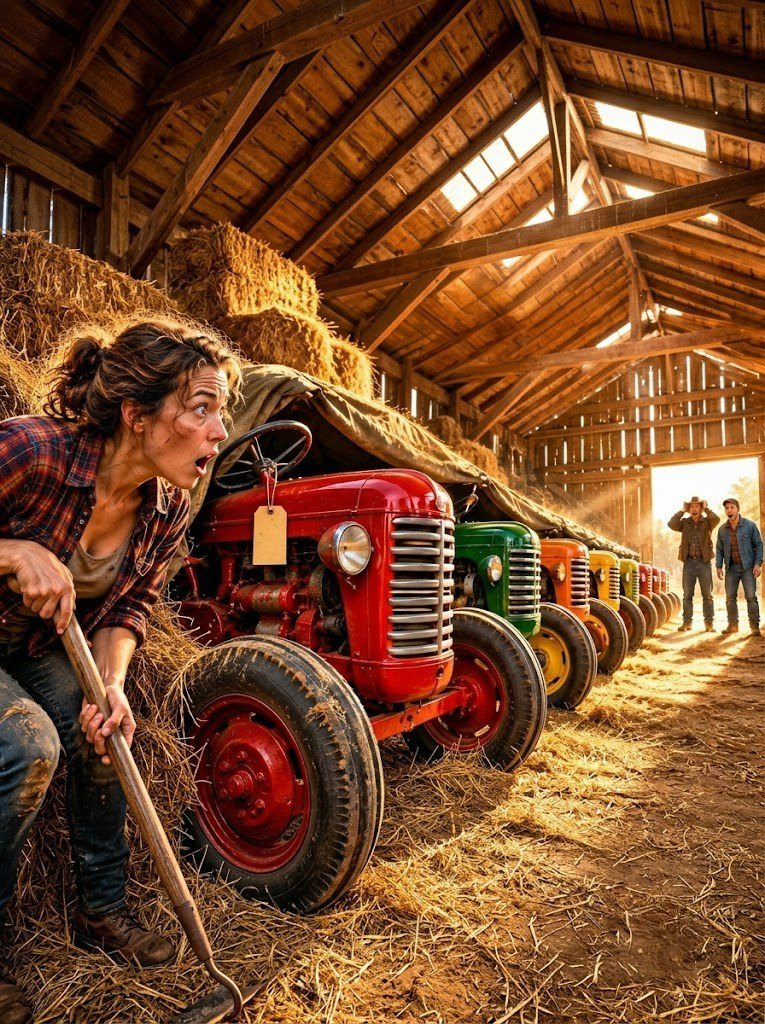
"Those tractors don't belong to you!" the man shouted, thrusting a legal document toward the elderly widow.
Robert Ruona stood inside the abandoned creamery, holding a leather briefcase and staring at seven dust-covered John Deere tractors.
On the back of his document was a handwritten number.
$94,600.
Ardis Lindquist recognized it immediately.
That was the exact amount she owed the government.
And suddenly, the visit didn't feel like a coincidence.
Six weeks earlier, nobody in Vasa Junction had believed Ardis Lindquist possessed anything worth stealing.
At sixty-two, she was a widow with nine dairy cows, a failing water well, a pickup truck that needed a new transmission, and a government debt large enough to swallow everything her husband had spent his life building.
Her hands were rough from decades of milking cows.
Her short silver-gray hair was usually tucked behind her ears, and her dark green corduroy jacket had been repaired so many times that the patches had become part of its appearance.
She owned no expensive jewelry.
She hadn't bought herself a new winter coat in seven years.
And on the morning of October 8, 1991, she had exactly seven hundred dollars in a bank envelope.
That money was supposed to keep her alive through November.
Instead, she was about to spend every dollar on a building nobody wanted.
"Seven hundred dollars," the auctioneer announced.
His name was Dale Mercer, and he stood on a wooden platform outside the abandoned Vasa Junction Creamery, holding a clipboard beneath one arm.
"That's the minimum bid, folks. Building and all contents. Sold as is."
Twenty-two people stood in the gravel lot.
Some were local farmers.
Others were retired mechanics, village employees, and curious neighbors who had come because an auction was better entertainment than another morning at the diner.
Nobody appeared particularly interested in buying the property.
The creamery had been abandoned for thirty years.
Its wooden roof sagged dangerously along the southern wall.
Several windows had been broken by children throwing rocks.
The loading dock was rotting.
Pigeons nested beneath the rafters.
And the interior smelled of wet timber, animal droppings, and machinery that had been forgotten by time.
Dale looked toward the building and laughed.
"Anybody buying this place better bring a shovel and a prayer."
A few men chuckled.
Ardis didn't.
She stood near the back, one hand resting inside the pocket of her jacket.
Her fingers touched the envelope.
Seven hundred dollars.
Seven bills.
Seven chances to change her mind.
"Do I hear seven hundred?"
Silence.
Dale scanned the crowd.
"Come on, folks. There's a good foundation under there somewhere."
"Yeah," someone called. "Under about forty tons of garbage!"
More laughter.
Ardis looked beyond the crowd toward the creamery's north wall.
She wasn't thinking about the broken windows.
She wasn't thinking about the roof.
She was thinking about something her husband had told her years earlier.
A well.
A deep one.
And if the old well still worked, it might save the nine cows waiting for her at home.
She raised her hand.
The laughter stopped.
Dale blinked.
"Mrs. Lindquist?"
"Seven hundred," she said.
He looked almost embarrassed.
"Ardis, you understand this is a condemned building?"
"I understand."
"And you'll be responsible for whatever happens to it?"
"Yes."
He glanced at the crowd.
Nobody offered another bid.
For a moment, the only sound was the wind moving through dry weeds.
Then Dale brought down his hammer.
"Sold. Seven hundred dollars."
Ardis stepped forward.
She didn't smile.
She didn't celebrate.
She simply handed over the envelope containing almost every dollar she had left.
Elaine Maki, the village clerk, counted the bills carefully.
Then she gave Ardis a receipt and a copy of the bill of sale.
"Are you sure about this?" Elaine asked quietly.
Ardis folded the paper.
"No," she answered. "But I'm doing it anyway."
Behind her, someone muttered, "Eino must be turning over in his grave."
Ardis heard every word.
She kept walking.
Because if she stopped to defend herself every time somebody called her foolish, she'd never have enough time left to do the work that mattered.
And there was still evening milking to finish.
The Lindquist farm stood on 120 acres outside Vasa Junction, where the fields rolled gently toward a line of cottonwood trees.
Ardis and her husband, Eino, had purchased the property when they were young enough to believe hard work could solve almost anything.
They had raised two sons there.
They had buried an infant daughter beneath a small headstone in the church cemetery.
They had endured blizzards, droughts, bad harvests, broken equipment, and the agricultural collapse of the 1980s.
Through it all, Eino had remained convinced that the farm would survive.
"We've got good land," he used to tell her. "And we've got each other."
For thirty-four years, that had been enough.
Then, twenty-eight months before the auction, Ardis found him lying beside a broken baler in the machine shed.
His coffee was still warm.
The wrench he had been holding lay beside his right hand.
She remembered kneeling in the dirt.
She remembered saying his name.
She remembered shaking his shoulder.
And she remembered the terrible silence that followed.
Eino was fifty-four.
A heart attack had ended his life before lunchtime.
After the funeral, people brought casseroles, flowers, and promises.
They told Ardis to call if she needed anything.
They said Eino had been a good man.
They said God had a plan.
Then they went home.
And the cows still needed milking.
The bills still arrived.
The bank still expected payment.
The government still wanted its money.
Grief didn't postpone a mortgage.
Ardis learned that lesson quickly.
By autumn 1990, she had sold eighteen cows.
Over the following winter, she sold eleven more.
The proceeds disappeared into feed bills, interest payments, veterinary expenses, and overdue machinery repairs.
Nine cows remained.
Rosie.
Clara.
Pearl.
Mabel.
June.
Daisy.
Esther.
Bonnie.
And Ruth.
To outsiders, they were nine aging dairy animals producing too little milk to justify the effort.
To Ardis, they were the last pieces of a life she had promised Eino she would protect.
Every morning, she rose before five.
Every evening, she worked until her back ached.
And every night, she sat at the kitchen table beneath the same yellow light, opening envelopes she increasingly dreaded.
The worst came from the Farmers Home Administration.
Her outstanding debt had reached $94,600.
That number lived inside her head.
She saw it while washing dishes.
She thought about it while feeding the cows.
Sometimes she dreamed about it.
Ninety-four thousand, six hundred dollars.
It was more money than she could imagine earning in the years she had left.
The land had once been valued at approximately $1,600 an acre.
Then farmland prices collapsed.
Now, much of it might bring only six hundred dollars an acre.
The debt hadn't collapsed with the land value.
It had continued growing.
And the old farm well was failing.
That was the problem nobody at the auction understood.
The well near the barn had been producing less water for years.
During dry periods, the pump pulled air.
Sometimes Ardis had to haul water from a neighboring farm.
She could stretch feed.
She could repair fences with leftover wire.
She could mend clothing instead of buying new.
But she couldn't teach cows to live without water.
A new well would cost thousands.
She didn't have thousands.
Then she remembered Eino mentioning the abandoned creamery.
He had once inspected its well with a former employee.
According to him, the casing went deep into sandstone and might still be usable.
The creamery stood downhill from their farm.
If the well could be tested and a water line installed, it might give her animals a dependable supply.
There were no guarantees.
The casing might be ruined.
The water might be unsuitable.
The necessary permits might cost more than she could afford.
But the possibility was real.
And at that point, possibility was all Ardis had.
The evening after the auction, her neighbor Gordon Niskanen arrived in an old pickup.
Gordon was seventy-one, broad-shouldered, and permanently irritated by anything he considered foolish.
He had known Eino since childhood.
His right knee was stiff from an accident involving a hay wagon, and he walked with a slight limp.
He knocked twice on the kitchen door.
Ardis opened it.
"I hear you bought a building," he said.
"I did."
"A bad building."
"That's what they tell me."
"A building with a roof that's about ready to land in somebody's lap."
"I noticed."
Gordon removed his cap.
"Ardis, why?"
She stepped aside.
"Come in. Coffee's still hot."
He followed her into the kitchen.
The room smelled of bread, coffee, and the wood polish Ardis used on the old dining table.
Eino's photograph stood beside the clock.
Gordon glanced at it before sitting down.
Ardis poured two cups.
Then she explained the well.
Gordon listened without interrupting.
When she finished, he stared into his coffee.
"That well might be worth something," he admitted.
"That's what Eino thought."
"Or it might be plugged solid."
"I know."
"And getting water uphill won't be cheap."
"I know that, too."
Gordon rubbed his forehead.
"You're gambling seven hundred dollars on a hole in the ground."
Ardis looked at him.
"I'm gambling seven hundred dollars on keeping my farm."
He didn't answer immediately.
Outside, the last light disappeared behind the barn.
Finally, Gordon sighed.
"When are you going over there?"
"Tomorrow."
"What time?"
"Seven."
He grunted.
"I'll be there at six-thirty."
Ardis almost smiled.
"You don't have to."
"I know I don't."
He stood.
"And don't go climbing around that roof without me."
"I wasn't planning to."
"That's what worries me."
After he left, Ardis washed the cups and put them away.
Then she took the bill of sale from her purse.
She read the printed description carefully.
Vasa Junction Creamery.
Building and all contents.
Sold as is, where is.
Purchaser assumes responsibility for repairs or demolition.
She folded it again.
At the time, those words seemed ordinary.
A building full of broken shelving, pigeon nests, and rotting wood didn't contain much worth claiming.
She placed the paper inside a kitchen drawer.
Then she went to bed.
She had no idea that the wording would eventually become the most important five words in her life.
The next morning, Gordon arrived before sunrise.
He brought a pry bar, two flashlights, a hammer, work gloves, and a thermos.
Ardis loaded a broom, shovel, notebook, and first-aid kit into her pickup.
Together, they drove to the creamery.
Up close, the building looked worse than it had during the auction.
The southern roofline had dipped visibly.
Water stains marked the interior walls.
Broken glass covered part of the bottling room floor.
Gordon examined the loading dock and shook his head.
"Don't step on that."
"I wasn't going to."
"Good. Because it'll put you in the basement before you know what happened."
They began with the safest rooms.
The old processing area contained rusted pipes, broken cabinets, and equipment too damaged to identify.
They carried rubbish outside.
They swept debris into piles.
They opened boarded windows to improve ventilation.
Ardis wrote down anything that might have salvage value.
Copper piping.
Usable brick.
Heavy timber.
Old metal fittings.
The work was slow.
By noon, both were exhausted.
They sat on overturned buckets and ate sandwiches Ardis had packed.
Gordon studied the building.
"There's more brick in here than I expected."
"A buyer in Wisconsin said he might take some."
"How much?"
"Depends on condition."
"Could help with the well."
"That's the idea."
Gordon looked at her.
"You really think you can save the place?"
Ardis took a bite of her sandwich.
"I don't know."
"Then why keep working?"
She swallowed.
"Because I know what happens if I stop."
Gordon didn't argue.
They returned the following day.
And the day after that.
Over the next several weeks, they removed nine pickup loads of debris.
Ardis went home every afternoon to milk the cows.
Some evenings, she fell asleep in her chair before supper.
Other nights, she sat awake, adding columns of numbers in her notebook.
The salvage estimate was uncertain.
The well still needed professional testing.
The farm debt continued growing.
But the work gave her something she hadn't felt in months.
Direction.
She could point to a cleared room and say it was better than yesterday.
She could count bricks.
She could repair a door.
She could make progress.
It wasn't enough to save the farm.
Not yet.
But it was something.
On November nineteenth, Ardis entered the north end of the creamery carrying a flashlight.
Gordon was sorting old shelving in the adjoining room.
She had been comparing the building's interior with a set of original plans Elaine Maki had found in the village archives.
The plans showed an old ice-storage room.
Twenty-two feet by thirty feet.
Thick walls.
No windows.
A heavy doorway connecting it to the processing area.
But Ardis couldn't find the doorway.
She studied the north wall.
The brickwork looked ordinary at first.
Then she noticed a rectangular section where the mortar was a different color.
She moved closer.
The surrounding joints were hard and carefully finished.
The mortar inside the rectangle was softer.
Gray.
Uneven.
And the bricks didn't connect properly with the older wall.
"Gordon?"
He appeared behind her.
"What now?"
"Look at this."
He examined the bricks.
"Somebody patched the wall."
"That's where the ice-room door should be."
"Maybe they sealed it when the creamery closed."
Ardis shook her head.
"Why use all these bricks?"
"To keep people out?"
"A plywood door would've been cheaper."
Gordon studied the rectangle again.
He ran one finger along the mortar.
"You're right about one thing."
"What?"
"This wasn't built with the rest of the wall."
Ardis held up the plans.
"The room should be right behind it."
"Could be full of junk."
"Probably."
"Could be full of water."
"Maybe."
"Could be empty."
Ardis looked at the sealed doorway.
"Then why hide it?"
Gordon didn't answer.
He tapped one of the newer bricks with his hammer.
The sound was dull.
He tried another.
Then he looked at Ardis.
"We ought to get somebody who understands masonry before we start knocking holes through walls."
Ardis nodded.
They inspected the surrounding structure carefully and arranged temporary bracing before returning to the doorway.
By late afternoon, Gordon had loosened one brick near the upper corner.
He removed it.
A small black opening appeared.
Cold, stale air escaped.
Ardis raised her flashlight.
The beam entered the darkness but revealed almost nothing.
Gordon removed another brick.
Then a third.
Dust fell onto the floor.
The opening widened.
Ardis leaned forward.
Something inside reflected the light.
She moved the flashlight.
A curved metal surface appeared.
Dark green.
Smooth.
Too large to be a cabinet.
She blinked.
"Gordon."
"What?"
"There's something in there."
He stepped beside her.
Ardis adjusted the flashlight.
A yellow wheel emerged from the darkness.
Then the outline of a steering column.
Gordon's breathing changed.
"Well, I'll be..."
Ardis moved the beam higher.
Letters appeared beneath the dust.
JOHN DEERE.
For several seconds, neither spoke.
Then Gordon leaned closer.
"That's a tractor."
Ardis stared.
"A tractor?"
"Looks like a Model B."
She moved the flashlight toward the back of the room.
Another curved hood appeared.
Then another.
She counted the outlines she could see.
One.
Two.
Three.
Her heart began pounding.
"Gordon," she whispered, "there's more than one."
He took the flashlight from her and angled it farther into the darkness.
His face changed.
The color drained from his cheeks.
He slowly removed his cap.
"Ardis..."
She looked at him.
"What?"
Gordon didn't answer.
He was staring at something deeper inside the room.
Something beyond the first three tractors.
Ardis reached for the flashlight.
"How many?"
Gordon swallowed.
Then he moved the beam toward the far wall.
A row of yellow wheels emerged from the darkness.
He began counting.
And when the light reached the last machine, Gordon suddenly stopped breathing.
Because hanging from its steering wheel was a paper tag bearing a name he had not heard spoken in forty-five years.
He leaned forward and read the first line aloud.
"Werner Ruona..."
Then he turned the tag over.
On the back, beneath the faded dealership stamp, someone had written a warning in pencil.
Gordon stared at the words.
His hand began trembling.
"Ardis," he whispered, "you need to see what this says."
She stepped closer.
He held the tag toward her.
And the moment her flashlight touched the handwriting, she saw the first three words—
DO NOT TELL...






Comments 0