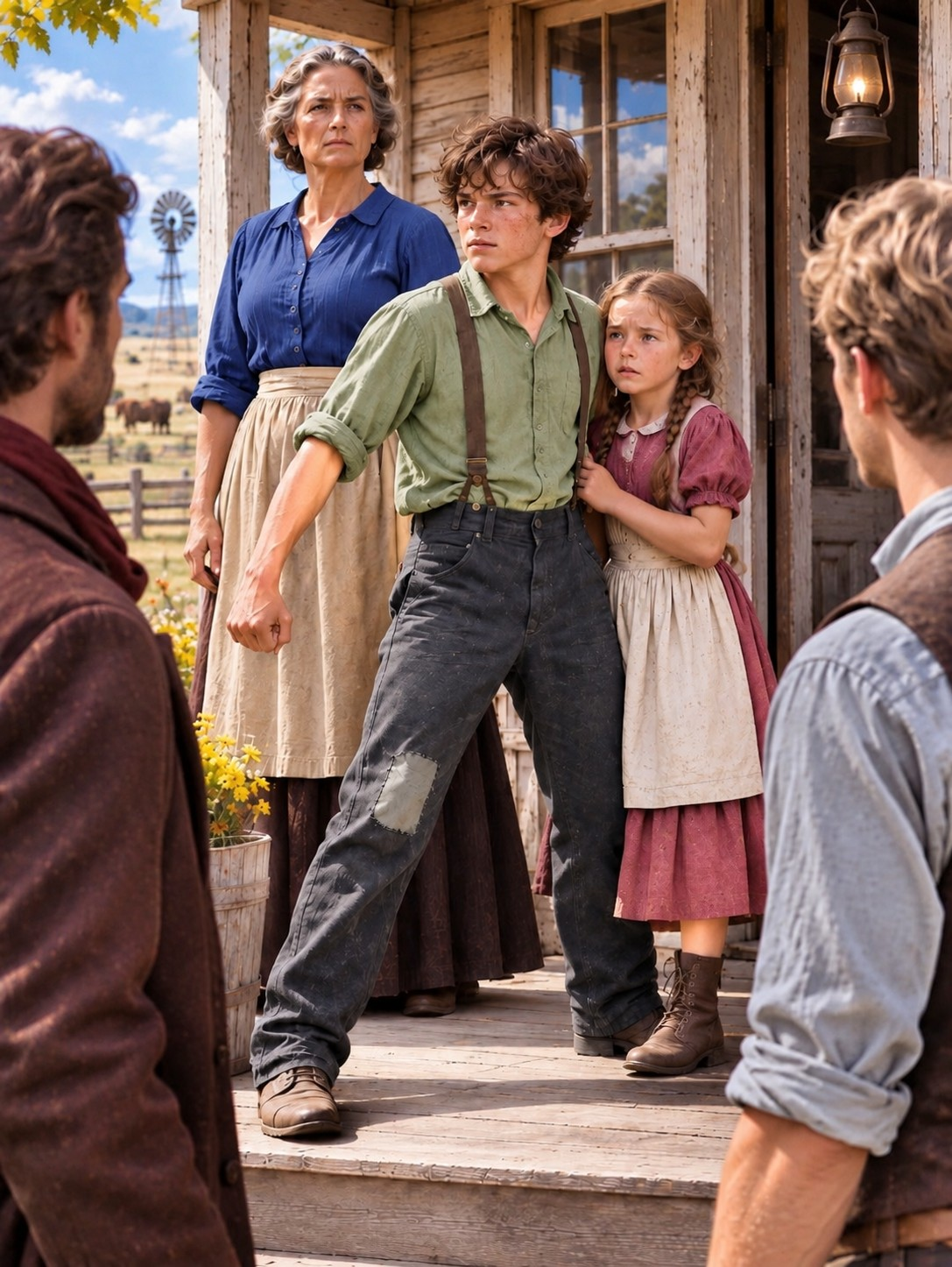
"Don't open that door, Grandma!" Eli shouted from the staircase.
The man standing beside Deputy Harlan held a folded document against his chest.
His name was Walter Pritchard.
And I had not seen him since the afternoon my husband secretly visited the county office.
But it wasn't the document that frightened me.
It was the way Walter looked past my shoulder, directly toward Samuel, as though the two men had already agreed on what would happen next.
"Mrs. Whitaker," Deputy Harlan said, removing his hat, "I'm sorry to disturb you at this hour."
I kept one hand on the door.
"Then perhaps you'd better tell me why you're here."
The deputy was a broad, tired-looking man in his forties, with a neatly trimmed mustache and the uncomfortable expression of someone who would rather be sitting beside his own stove.
I knew him.
His father had helped Thomas build our first cattle fence.
His wife had brought me bread after the funeral.
But the man beside him was another matter.
Walter Pritchard had spent twenty years making a living from other people's financial difficulties.
He bought overdue debts.
He arranged loans.
He helped desperate farmers sell land for less than it was worth.
And he always managed to describe his business as a public service.
"Good evening, Martha," Walter said.
I did not return the greeting.
"Why are you on my property?"
He gave a thin smile.
"Official business."
"Then let the deputy speak."
His smile disappeared.
Deputy Harlan cleared his throat.
"We've received a complaint concerning two orphaned children residing here without a legal guardian."
I felt Eli move behind me.
Annie had appeared at the top of the stairs.
She was holding the railing with both hands.
Her nightdress hung loose around her small shoulders.
"Grandma?" she whispered.
I looked up.
"Go back to your room, sweetheart."
She shook her head.
Eli stepped beside her.
"We're not leaving."
Walter looked toward the children.
"Nobody wants to make this unpleasant."
I turned back to him.
"Then you've chosen a strange way to begin."
The deputy unfolded his paper.
"Mrs. Whitaker, this isn't an order to remove them tonight. It's a notice requiring you to appear before the county authorities concerning their care."
I felt my breathing ease slightly.
"Then why come after dark?"
Walter answered before the deputy could.
"Because the matter is urgent."
"Urgent for whom?"
His eyes narrowed.
"For everyone concerned."
I looked at the document.
Then at Walter.
Then toward the study where my sons had been arguing about my husband's hidden letter.
Something was wrong.
And I was beginning to suspect that the children were only one part of it.
"Who filed the complaint?" I asked.
Deputy Harlan hesitated.
Walter shifted his weight.
I noticed.
"That information will be discussed at the hearing," the deputy said.
"Then I suppose it can wait until the hearing."
Walter stepped forward.
"Martha, surely you understand that two children cannot simply appear on a property and become members of the household."
I stared at him.
"Is that so?"
"There are procedures."
"Then explain them."
He adjusted his coat.
"Guardianship. Proper supervision. Questions about the children's history."
"Their father died. Their mother died before him. They were starving when I found them. What other history do you require?"
Walter's expression hardened.
"Sentiment doesn't replace the law."
"No," I answered. "But neither does a man's opinion."
Behind me, Samuel entered the hallway.
I heard his boots before I saw him.
Walter's gaze flickered toward my son.
Just once.
But it was enough.
"Samuel," I said without turning, "come here."
He stopped beside me.
I looked from him to Walter.
"Do you know why Mr. Pritchard is here?"
Samuel's face remained carefully blank.
"I imagine he's doing his job."
"That wasn't my question."
Caleb appeared behind his brother.
"Ma?"
I raised one hand.
"Samuel, answer me."
My eldest son looked toward the deputy.
Then at Walter.
Finally, he said, "I spoke to Mr. Pritchard this afternoon."
The words struck me like cold water.
"About what?"
"The ranch."
I waited.
"And the children?"
Samuel swallowed.
"I mentioned them."
Walter immediately intervened.
"Mrs. Whitaker, your son was concerned about your welfare."
I turned toward him.
"Mr. Pritchard, I have spent fifty-six years learning when a man is trying to answer a question nobody asked him. Kindly be quiet."
Caleb made a small sound behind me.
Under different circumstances, I might have smiled.
But there was nothing amusing about the situation.
I looked directly at Samuel.
"Did you ask someone to take Eli and Annie away?"
His face changed.
"No."
"Did you report them?"
"I told Walter they were living here."
"Why?"
"Because I thought someone should know."
"Someone?"
"The proper authorities."
I stared at him.
The boy I had raised.
The man who had been absent from my life for seven years.
He had returned to my home, insulted two children, questioned my judgment, and contacted a man who had come to my door with a deputy.
All in one afternoon.
"Samuel," I said quietly, "you have no idea what you've done."
He looked offended.
"I'm trying to protect you."
I shook my head.
"No. You're trying to control something you no longer understand."
Deputy Harlan looked deeply uncomfortable.
"Mrs. Whitaker, may I speak plainly?"
"Please do."
"The children are not being removed tonight. The notice requires you to appear at the county office in three days. You'll have an opportunity to explain the circumstances."
"Will the children be required to attend?"
"Possibly."
I glanced toward the staircase.
Annie had begun to cry silently.
Eli stood with one arm around her shoulders.
The sight made something inside me ache.
"Then I'll be there," I said.
Walter frowned.
"You should understand that keeping the children may require formal arrangements."
"Then I'll make them."
"It may be expensive."
"Then I'll pay."
"It may affect your ability to manage the property."
I looked directly at him.
"That sounds like a separate concern."
Walter's mouth tightened.
Deputy Harlan handed me the notice.
I accepted it.
"Thank you, Deputy."
He nodded.
"I'm sorry for the disturbance."
Walter lingered.
"Martha, I think it would be wise for us to discuss the ranch privately."
"No."
His eyebrows rose.
"No?"
"You may speak to me at the county office, in daylight, with whatever papers you believe give you a reason to interfere in my affairs."
He stared at me.
Then gave a stiff nod.
"As you wish."
I closed the door.
Not violently.
Not dramatically.
I simply closed it.
And turned the lock.
Behind me, Samuel said, "Ma, you didn't have to be rude."
I faced him.
"Get out of my hallway."
He blinked.
"What?"
"Go to the sitting room. I need to speak to the children."
"Ma—"
"Now."
For once, he obeyed.
Annie came down the stairs slowly.
Eli followed close behind her.
Neither child spoke.
I knelt at the bottom step.
Annie stopped in front of me.
"Are they taking us?"
"No, sweetheart."
"But the man said—"
"I heard what he said."
She looked toward the front door.
"Papa said people could take children away."
I felt a sharp pain beneath my ribs.
Daniel Harper had apparently understood the world well enough to frighten his children before he died.
Or perhaps he had simply been honest.
I took Annie's hands.
"Listen carefully. Nobody is taking you anywhere tonight."
"Tomorrow?"
"Not tomorrow."
She swallowed.
"What about after that?"
I hesitated.
Eli noticed immediately.
He always noticed hesitation.
"Mrs. Whitaker," he said, "we can leave before morning."
I looked up.
"What?"
"We can go back to the Miller place."
"No."
"I can fix the roof. It's warmer now."
"Eli—"
"We won't need much."
His voice was steady.
Too steady.
He was already planning.
Already calculating how much food he could carry.
Already preparing to disappear before anyone could separate him from Annie.
I stood.
"Eli, look at me."
He did.
"You are not going back to that shed."
"But if staying here causes trouble—"
"Then we'll deal with the trouble."
He shook his head.
"You don't understand."
I almost answered too quickly.
Then I stopped.
Because perhaps he was right.
I had never been fourteen years old and responsible for keeping a little sister alive.
I had never watched someone I loved grow feverish while knowing I had no money for medicine.
I had never been forced to steal food and wonder whether the person who caught me would show mercy.
So I changed my answer.
"Then help me understand."
Eli stared at me.
His eyes were bright.
"Every time somebody helped us, they wanted something."
Annie lowered her head.
Eli continued.
"One man let us sleep in his barn. Then he said I had to work for him until the debt was paid."
"What happened?"
"He kept adding to it."
I felt my stomach tighten.
"How long?"
"Nine days."
"How did you leave?"
Eli looked away.
"I waited until he was asleep."
I said nothing.
"Another woman gave Annie soup. Then she told the sheriff we were there."
Annie began trembling.
Eli put his arm around her.
"We ran before he came."
I looked at the children.
At their thin wrists.
Their worn clothing.
Their frightened faces.
And I understood why kindness had never felt safe to them.
Every act of generosity had come with a condition.
Every roof had belonged to someone who could change their mind.
Every meal had carried the possibility of a debt.
I knelt again.
"Eli, I'm not going to pretend I can control every person in Kansas."
He watched me carefully.
"But I can tell you what I intend to do."
"What?"
"I'm going to that county office. I'm going to find out what papers are required. And I'm going to fight to keep you and Annie together."
His lips parted.
"You'd do that?"
"Yes."
"Even if your sons don't want us?"
I glanced toward the sitting room.
Then back at him.
"Especially then."
After the children returned upstairs, I found Caleb waiting in the kitchen.
Samuel was outside.
I could see his silhouette through the window.
He stood near the porch railing, staring toward the dark pasture.
Caleb had made coffee.
Two cups sat on the table.
For a moment, I remembered all the mornings I had set out an extra cup for someone who never came.
I sat down.
Caleb pushed one toward me.
"Ma, I'm sorry."
I wrapped my hands around the cup.
"For what?"
He gave a humorless laugh.
"Where should I start?"
I looked at him.
"With the truth."
He nodded.
For a while, he watched the steam rise.
Then he said, "Samuel didn't tell me he was going to speak to Walter."
"Do you believe him?"
"About the children?"
"About anything."
Caleb looked wounded.
I regretted the sharpness of my words.
But I did not take them back.
"He's not a bad man," Caleb said.
"That isn't what I asked."
He sighed.
"Samuel's been in trouble."
My hands tightened around the cup.
"What kind of trouble?"
"Money."
Of course.
I looked toward the window.
"How much?"
"I don't know exactly."
"Caleb."
"I truly don't."
He rubbed his forehead.
"He bought cattle on credit last year. Prices fell. Then he borrowed against his equipment."
I felt a familiar dread.
Thomas had always warned the boys about debt.
Not because he disliked borrowing.
Because he believed debt gave another man a claim over your choices.
"Does Samuel owe Walter Pritchard money?"
Caleb hesitated.
That was answer enough.
"How much?" I asked again.
"I heard it was several thousand dollars."
I stared at him.
Several thousand dollars.
In Kansas, in 1884, that was enough to ruin a family.
Enough to cost a man his land.
Enough to make him desperate.
"And he came here because he thinks he can use this ranch to pay it."
Caleb looked down.
"I think so."
I closed my eyes.
The anger I felt was sharp.
But beneath it was something worse.
Recognition.
Samuel had not returned because he missed me.
He had returned because he was frightened.
And instead of admitting it, he had brought his fear into my house and turned it against two children who had nothing.
"Why didn't he simply ask me for help?" I whispered.
Caleb looked up.
"Would you have given it?"
I considered the question.
A year earlier, perhaps I would have said yes without hesitation.
I would have sold cattle.
Mortgaged a field.
Worked myself into the ground.
Anything to make my son come home.
But now?
Now there were two children sleeping upstairs.
Two children who depended on this ranch for safety.
I could not pretend their future was separate from my decisions.
"I would have listened," I said.
Caleb nodded slowly.
"Samuel doesn't know how to ask for help."
"Neither did your father."
"No."
He looked toward the study.
"Ma, there's something else."
I felt my shoulders tighten.
"About the document?"
"Yes."
I waited.
Caleb leaned forward.
"Samuel told me Pa asked him to sign papers at the county office before he died."
"He said that much."
"But he didn't tell you what happened afterward."
I stared at him.
"What happened?"
Caleb lowered his voice.
"Pa changed his mind."
I felt a chill.
"About what?"
"Whatever arrangement he'd been making with Samuel."
"How do you know?"
"Because Pa wrote to me."
I stared at him.
"When?"
"About a month before he died."
"And you never told me?"
Caleb's eyes filled.
"I didn't understand the letter until later."
"What did it say?"
He hesitated.
Then reached into his coat.
From an inside pocket, he withdrew a folded piece of paper.
The edges were worn.
The creases had nearly split.
"I've carried this for years," he said.
I took it.
Thomas's handwriting covered one side.
My hands trembled as I unfolded it.
Caleb,
I have been a hard father to both my sons.
I cannot undo the years, but I can stop making the same mistakes.
If Samuel comes to you asking about the north pasture, tell him I have reconsidered.
The arrangement is not final.
I will not sign away Martha's security to satisfy my pride.
I stopped reading.
My heart pounded.
The north pasture.
The most valuable part of the ranch.
Nearly four hundred acres of good grazing land, with access to the creek.
Thomas had bought it during our tenth year of marriage.
We had spent years paying it off.
And now I was discovering that he had nearly signed it away.
I looked at Caleb.
"Why would Samuel want the north pasture?"
Caleb shook his head.
"I don't know."
I turned the paper over.
There was another sentence at the bottom.
Written in smaller letters.
If I cannot put matters right myself, tell your mother to look beneath the false bottom of my desk.
I stared at the words.
Then toward the study.
Thomas had hidden something.
Something neither Samuel nor Walter Pritchard wanted me to find.
I rose so quickly my chair scraped against the floor.
Caleb stood.
"Ma?"
"Bring the lamp."
We entered Thomas's study.
The drawer remained open.
The letters lay where I had left them.
I moved the papers aside.
The bottom of the drawer looked ordinary.
Dark wood.
A few scratches.
A faint stain where Thomas had once spilled ink.
I pressed against the corners.
Nothing.
Caleb held the lamp closer.
"Maybe there's a catch."
I ran my fingers along the inside edges.
Near the back, beneath a narrow wooden strip, I felt a small metal pin.
I pressed it.
A soft click.
The wooden bottom lifted slightly.
I stared.
For thirty-five years, I had dusted this desk.
Polished it.
Sorted Thomas's accounts.
And I had never known it contained a hidden compartment.
Caleb carefully lifted the panel.
Beneath it lay a narrow leather folder.
I opened it.
Inside were three documents.
The first was a survey of the north pasture.
The second was a handwritten agreement bearing Samuel's signature.
And the third was a copy of a deed.
I held it closer to the lamp.
Walter Pritchard's name appeared near the bottom.
My stomach turned.
"Caleb."
He leaned over my shoulder.
"What?"
I pointed.
"Look at the date."
He read it aloud.
"September seventeenth, eighteen eighty-two."
I felt the room tilt.
Thomas had died nineteen months earlier.
The document had been prepared while he was still alive.
But the signature beneath his name—
I knew my husband's handwriting.
I had seen it on thousands of checks, receipts, and letters.
The signature looked like his.
Almost.
But something was wrong.
Thomas always made the final stroke of his surname rise sharply.
This one curved downward.
I brought the paper closer.
"Caleb, I don't think your father signed this."
He stared.
"Then who did?"
Before I could answer, Samuel appeared in the doorway.
He saw the folder.
And stopped.
His face went white.
"Where did you find that?"
I looked at him.
"Your father left instructions."
Samuel took a step forward.
"Ma, put it away."
"No."
"You don't understand what you're holding."
"Then explain it."
He stared at the document.
His breathing changed.
"That paper could ruin everything."
I felt a cold certainty settle over me.
"Whose everything, Samuel?"
He looked at me.
And for the first time, I saw genuine fear in his eyes.
We argued until nearly midnight.
Samuel insisted the agreement had never been completed.
Caleb demanded to know why Walter's name appeared on the deed.
I asked whether Samuel had signed anything transferring rights to the north pasture.
He admitted he had signed a preliminary agreement.
But he claimed Thomas had intended to help him establish his own cattle operation.
"Pa said I could use the land as security," Samuel insisted.
"Did he?"
"Yes."
"Then why did he write Caleb saying he'd changed his mind?"
Samuel stared at the letter.
He seemed genuinely surprised.
For a moment, I wondered whether he had been deceived too.
Then he looked away.
"Pa never told me."
"Perhaps because you stopped listening."
He flinched.
I regretted the cruelty immediately.
But I was too tired to soften it.
Caleb placed the documents on the desk.
"We need to take these to someone who understands the law."
Samuel shook his head.
"No."
"Why not?" Caleb demanded.
"Because Walter will say they're invalid."
"Then let him."
Samuel looked toward me.
"Ma, if this goes to court, we could lose the ranch."
I felt the words settle heavily.
Lose the ranch.
The house where I had raised my sons.
The land Thomas and I had spent decades working.
The only safe home Eli and Annie had ever known.
I looked toward the ceiling.
Above us, two children were sleeping.
Or trying to.
And I realized that whatever battle had begun between Samuel, Walter, and my dead husband's papers was no longer only about land.
It was about whether I could keep the promise I had made to those children.
I gathered the documents.
"Tomorrow, I'm going to town."
Samuel stepped forward.
"Ma—"
"And I'm taking these papers to Reverend Collins."
Caleb frowned.
"The preacher?"
"His brother is an attorney in Topeka. He'll know whom to contact."
Samuel looked desperate.
"Please don't do that."
I faced him.
"Then give me one good reason."
He opened his mouth.
Closed it.
And finally whispered, "Because Walter has something else."
My blood ran cold.
"What?"
Samuel looked toward the stairs.
"Something about the children."
I stared at him.
"What about them?"
He shook his head.
"I don't know everything."
"Samuel."
His eyes filled.
"He said their father left debts."
I felt my stomach tighten.
"Daniel Harper?"
Samuel nodded.
"And Walter claims someone has the right to collect."
I stared at him.
"From two orphaned children?"
Samuel looked away.
"Not exactly."
I waited.
He swallowed.
"He claims their father signed an agreement before he died."
I thought of Eli.
Of Annie.
Of the abandoned shed.
Of the half-smoked ham.
Of the boy who had been willing to starve rather than let anyone take his sister.
"What kind of agreement?"
Samuel whispered, "One involving their custody."
I barely slept.
Every sound in the house made me sit upright.
At dawn, I went upstairs.
Annie was still asleep.
Eli sat beside the window, fully dressed.
His satchel rested near his boots.
I knew immediately.
He had been planning to leave.
"Good morning," I said.
He looked startled.
"Morning."
I sat beside him.
"How long have you been awake?"
"A while."
I looked at the satchel.
"Planning a trip?"
His cheeks reddened.
"No, ma'am."
"Eli."
He stared at his hands.
"I thought if we left, maybe your sons would stop arguing."
I felt a familiar ache.
"Did you sleep at all?"
"A little."
I looked toward Annie.
She had one hand curled beneath her cheek.
"Your sister needs rest."
"I know."
"And food."
"I know."
"And a home."
His jaw tightened.
"I can find us somewhere."
I turned toward him.
"That's what frightens me."
He looked up.
"Why?"
"Because you're so determined to protect her that you keep forgetting you're a child too."
His expression hardened.
"I'm not a child."
I nodded slowly.
"Perhaps you haven't been allowed to be one."
He looked away.
For a moment, neither of us spoke.
Then I asked, "Eli, did your father ever mention a man named Walter Pritchard?"
His entire body went rigid.
I noticed immediately.
"Eli?"
He stared at the window.
"Why?"
"Because that man came here last night."
The color drained from his face.
I felt my heart begin to pound.
"Do you know him?"
Eli nodded.
Very slowly.
"How?"
His voice was barely audible.
"He came to see Papa before the accident."
I leaned closer.
"What did he want?"
Eli swallowed.
"Money."
"Did your father owe him money?"
"I think so."
"How much?"
"I don't know."
He looked toward Annie.
Then back at me.
"Papa told me if anything happened to him, I wasn't supposed to let that man near us."
I felt cold.
"Why?"
Eli's eyes filled.
"Because he said Mr. Pritchard wanted something more than money."
I waited.
"What?"
Eli looked down.
Then whispered, "Annie."
I sat perfectly still.
The morning sunlight fell across the floor.
Outside, the chickens were making their usual racket.
Somewhere downstairs, Caleb was moving around the kitchen.
The world continued as though nothing had changed.
But I could barely breathe.
"Eli," I said carefully, "what do you mean he wanted Annie?"
He shook his head.
"I don't know."
"Did your father explain?"
"He said Mr. Pritchard knew something about Mama."
My heart tightened.
"Your mother?"
Eli nodded.
"He said it was old business."
"What kind of business?"
"I don't know."
He looked ashamed.
"Papa wouldn't tell me."
I took his hand.
"You haven't done anything wrong."
He swallowed.
"Mrs. Whitaker, is that man going to take her?"
I looked toward Annie.
She was still sleeping.
Her face was peaceful.
For once, she wasn't frightened.
I thought about the notice from the county office.
The suspicious deed.
Samuel's debts.
Thomas's hidden letters.
And Walter Pritchard standing on my porch, smiling as though he already knew how everything would end.
I squeezed Eli's hand.
"Not if I can stop him."
He looked at me.
"Promise?"
I held his gaze.
"Promise."
Then I stood.
Because I knew exactly where I needed to go.
By midmorning, Caleb had saddled the horses.
Samuel wanted to come.
I refused.
"You can stay here and make yourself useful," I told him.
He looked offended.
"Ma, I know more about this than you do."
"Then perhaps you should have told me sooner."
Caleb looked away to hide his expression.
I handed Samuel a list.
"The chickens need feeding. The south gate needs checking. And Annie likes her bread with a little honey."
He stared at the paper.
"You want me to babysit?"
I looked directly at him.
"I want you to spend one day caring for someone without asking what you'll receive in return."
He said nothing.
I turned toward Caleb.
"Let's go."
We rode toward town beneath a pale morning sky.
The road was dry.
Dust rose behind the horses.
For several miles, neither of us spoke.
Then Caleb asked, "Ma, do you think Samuel knew about Walter and the children?"
I considered it.
"I think Samuel knows more than he's told us."
Caleb nodded.
"But I also think Walter has been using him."
"Because of the debt?"
"Because frightened people are easier to control."
Caleb looked toward the horizon.
"Pa used to say that."
I almost smiled.
"Your father said many things."
"Some of them were right."
"Yes."
I looked at my younger son.
"And some of them hurt people."
Caleb nodded.
We rode on.
After a while, he said, "Ma?"
"Yes?"
"I'm glad you took those children in."
I looked at him.
He seemed embarrassed.
"I know I didn't say much yesterday. But Annie reminds me of the little girls who used to come to church with their families."
I waited.
"And Eli reminds me of Samuel."
That surprised me.
"How?"
Caleb gave a sad smile.
"Always trying to prove he's worth keeping."
I looked ahead.
For a long time, I said nothing.
Because the truth of it hurt.
We reached town shortly before noon.
The main street was busy with wagons, horses, and men carrying supplies.
I tied my horse outside the church.
Reverend Collins was inside, arranging hymnbooks.
He looked surprised to see us.
"Martha. Caleb."
He shook my son's hand.
"It's good to see you home."
Caleb gave an awkward smile.
"Thank you, Reverend."
I wasted no time.
"I need legal advice."
The reverend's expression changed.
"What happened?"
I placed Thomas's documents on the nearest pew.
He studied them.
His brow furrowed.
Then he looked at me.
"Where did you find these?"
"In Thomas's desk."
He examined the deed.
Then the agreement.
Then the letter.
When he reached the final page, his face went pale.
"Martha," he said quietly, "did Thomas ever tell you he had spoken to my brother?"
I stared at him.
"No."
The reverend sat down.
"About two years ago, Thomas came here asking for advice."
"What kind of advice?"
"He wanted to know how to protect property from a fraudulent claim."
My heart began to pound.
"Whose claim?"
Reverend Collins looked at the document.
Then at Caleb.
Then back at me.
"Walter Pritchard's."
I felt the room tilt.
The reverend continued.
"Thomas believed someone was trying to obtain part of your ranch through a forged agreement."
I gripped the pew.
"Did he know who?"
The reverend hesitated.
"He suspected someone close to him had been involved."
I looked at Caleb.
His face had gone white.
"Samuel?" he whispered.
The reverend did not answer.
Instead, he reached into his coat.
He withdrew a sealed envelope.
"Thomas left this with me," he said.
I stared at it.
My name was written across the front.
In my husband's handwriting.
Another letter.
Another secret.
Another piece of a life I thought I understood.
"Why didn't you give it to me?" I asked.
The reverend looked deeply troubled.
"Because Thomas gave me very specific instructions."
"What instructions?"
"He said I was only to deliver it if Walter Pritchard ever came after your land."
I felt my fingers go cold.
The reverend held out the envelope.
"And Martha, before you open it, there's something you need to understand."
I looked at him.
"What?"
He swallowed.
"Thomas didn't believe Walter was acting alone."
I stared at the envelope.
Then I noticed the words written beneath my name.
For Martha Whitaker. In the event that Samuel returns with Walter Pritchard.
My breath caught.
The reverend lowered his voice.
"Your husband knew this day might come."
I reached for the letter.
But before my fingers touched it, the church doors opened behind us.
Heavy footsteps crossed the wooden floor.
A familiar voice spoke from the entrance.
"Reverend, I wouldn't give her that if I were you."
I turned.
Walter Pritchard stood in the doorway.
And beside him was a woman I had not seen in more than twenty years.
A woman whose face I recognized immediately.
Because she had been standing beside Daniel Harper's first wife in the only photograph Eli had ever shown me.






Comments 0