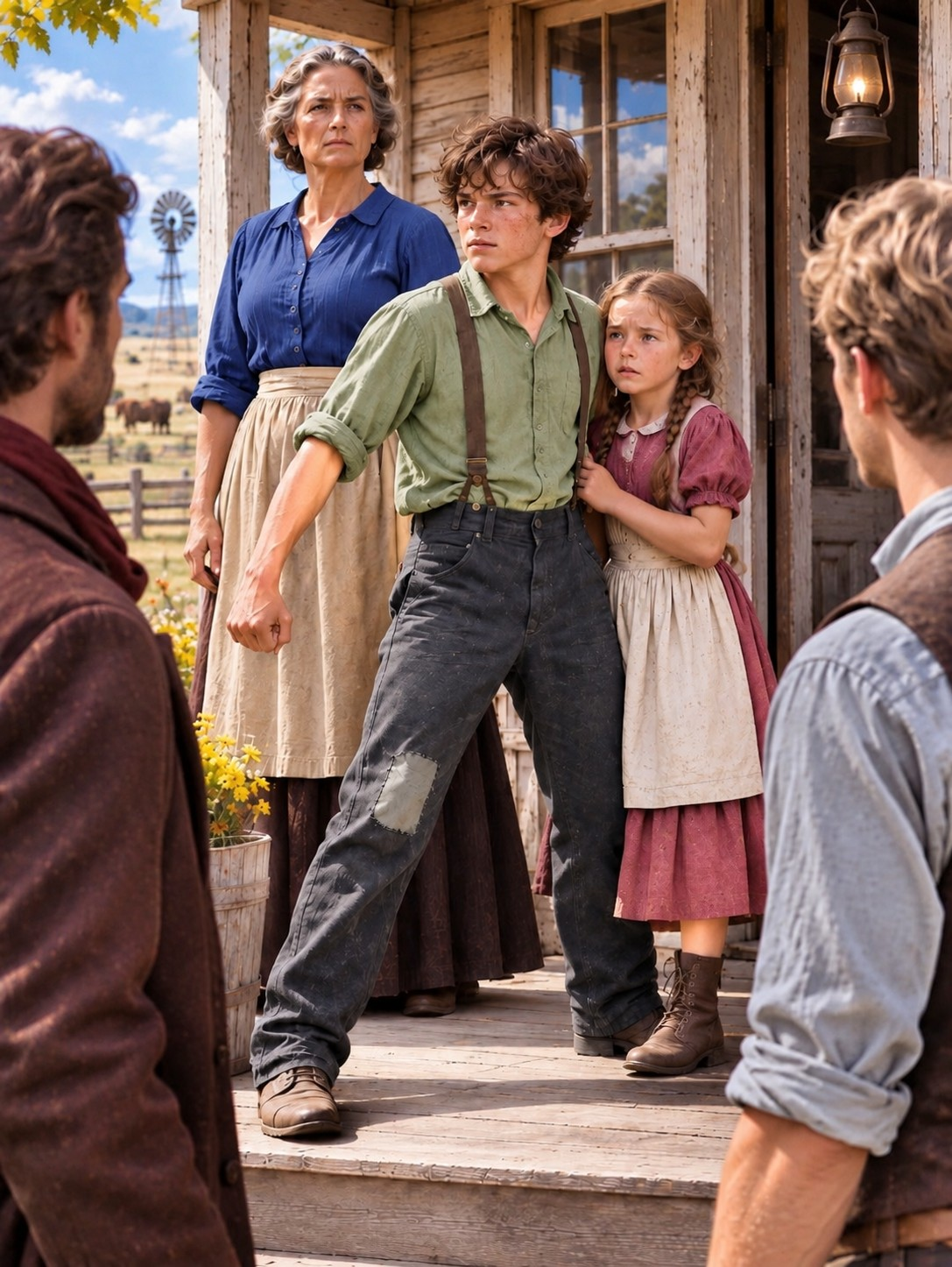
The woman standing on my porch was holding a photograph of my husband.
And she had just told me she was his first wife.
For a moment, I could only stare.
Behind me, Samuel stood motionless.
Caleb's hand rested against the doorframe.
Eleanor had gone so pale that I thought she might faint.
The stranger was an elderly woman, perhaps sixty-five, with silver hair beneath a dark traveling bonnet. Her clothes were plain but carefully kept. She carried a worn leather bag, and her hands trembled as she held the photograph toward me.
"My name is Clara Bennett," she said.
I looked at the picture.
Thomas was young.
No more than twenty.
He stood beside a smiling woman outside a small farmhouse.
I recognized his eyes immediately.
The same serious expression.
The same stubborn set of his jaw.
But the young woman beside him was someone I had never seen.
"How did you find me?" I whispered.
Clara looked toward Eleanor.
"Your sister-in-law sent for me."
I turned.
Eleanor closed her eyes.
"I'm sorry, Martha."
I felt something inside me harden.
"How many times am I supposed to hear those words?"
Neither woman answered.
I looked back at Clara.
"Come inside."
She hesitated.
"Are you certain?"
"No," I answered. "But I'm finished having strangers announce my husband's secrets on my porch."
We gathered in Thomas's study.
Benjamin Collins remained with us.
Samuel and Caleb stood beside the desk.
Eleanor sat near the window.
Clara placed her photograph on the table.
Then she removed a folded certificate from her bag.
It matched the document I had discovered in Thomas's final compartment.
The date was twenty-five years before my wedding.
The names were unmistakable.
Thomas Whitaker.
Clara Bennett.
I stared at the paper.
"Was this marriage lawful?"
Clara nodded.
"Yes."
My chest tightened.
"Then was I ever legally married to Thomas?"
Benjamin leaned forward.
"Mrs. Whitaker, we need to establish whether that marriage had legally ended before yours began."
Clara looked at him.
"It did."
She opened her bag again.
This time, she produced a second document.
A decree of divorce.
Issued several years before Thomas and I married.
Benjamin examined it carefully.
Then looked toward me.
"The dates appear consistent. Subject to verification, there is no reason here to believe your marriage was invalid."
I closed my eyes.
For a moment, relief washed over me.
Then anger followed.
"Why did Thomas tell me he'd never been married?"
Clara looked ashamed.
"Because he didn't want you to know what happened between us."
I stared at her.
"What happened?"
She folded her hands.
"We married young. Too young. Thomas wanted land. I wanted a family. He borrowed money, made promises, and believed every problem could be solved if he worked hard enough."
I almost laughed.
That sounded like the man I knew.
Clara continued.
"When his father's debts became worse, Thomas began looking for ways to save the family property. He asked me to help him obtain money from an account belonging to my relatives."
I felt cold.
"Rebecca's family."
Clara nodded.
"My sister married into the Bell family. Rebecca's grandmother had placed funds in trust for her descendants."
I looked toward Eleanor.
She lowered her eyes.
Clara continued.
"I refused to let Thomas use the money without permission."
My heart pounded.
"And?"
"He did it anyway."
The room fell silent.
Clara looked down.
"When I discovered what he'd done, I left him. I obtained a divorce. I thought the matter was finished."
I stared at her.
"But the money remained missing."
"Yes."
"And Thomas used part of it to buy the north pasture."
She nodded.
I sat slowly.
For thirty-five years, I had believed my husband was a difficult but honorable man.
Now I understood that he had spent much of his life trying to escape the consequences of a decision made before he ever met me.
"Why didn't you come forward sooner?" I asked.
Clara's eyes filled.
"Because I believed the money had been repaid. Thomas told me he had settled everything."
I looked toward Eleanor.
"And you knew?"
She nodded.
"I knew about the first marriage. I knew about the original debt. But I didn't know how far Walter's fraud had spread until Thomas began writing to me again."
I felt exhausted.
"Then why come now?"
Clara reached into her bag.
"Because Eleanor told me someone was trying to take your home."
She placed a small bundle of papers on the desk.
"And because I kept the original records."
Benjamin Collins examined the documents for nearly an hour.
Clara had preserved letters from Thomas, copies of the original trust accounts, and receipts showing which funds had been used.
Most importantly, she possessed an acknowledgment signed by Thomas years before my marriage.
It stated that the money belonged to Rebecca's family and that Thomas intended to restore it.
The agreement did not name Walter Pritchard.
It did not authorize Walter to seize the ranch.
And it did not give Josiah Mercer ownership.
Benjamin looked up.
"These papers may be exactly what we need."
My heart began pounding.
"To save the ranch?"
"To establish the legitimate trust obligation and distinguish it from Walter's fraudulent claims."
Samuel stepped forward.
"And Josiah?"
Benjamin turned toward him.
"The original agreement with Josiah was conditional. The version filed by Mr. Price omitted that condition. If the court accepts the evidence, his petition should fail."
Josiah, who had been waiting in the hallway, entered quietly.
"I'll testify."
Everyone turned.
He looked toward me.
"Martha, I know I've given you little reason to trust me."
I didn't answer.
He continued.
"Thomas asked me to preserve evidence. I let Walter's lawyer convince me that I could protect myself by claiming the ranch."
His eyes filled.
"I was wrong."
I looked at him.
"Yes."
He swallowed.
"I'll tell the judge everything."
I nodded.
"Then do it."
That evening, I gathered my sons in the kitchen.
Samuel sat across from me.
Caleb leaned against the counter.
The house was quiet.
Rebecca and Daniel were upstairs with the children.
Clara and Eleanor had retired to the sitting room.
I looked at my sons.
"There's something I want you both to understand."
They waited.
"Your father made mistakes that hurt this family."
Samuel nodded.
"Yes."
"But I won't let those mistakes decide the rest of our lives."
Caleb looked at me.
"What do you mean?"
I took a breath.
"I mean we're going to face the court. We're going to settle Rebecca's rightful claim. And whatever remains, we're going to decide what kind of family we want to be."
Samuel looked down.
"Ma, I don't deserve any part of the ranch."
I studied him.
"That's not a decision you need to make tonight."
He swallowed.
"I signed papers that could have destroyed everything."
"Yes."
"I trusted Walter."
"Yes."
He looked up.
"And I treated Eli and Annie like they didn't belong here."
My heart tightened.
"Yes."
His eyes filled.
"I was wrong about all of it."
I reached across the table.
"Then become better because of what you've learned."
He took my hand.
Caleb watched us quietly.
Then he said, "Ma, I think I'm going back to Wichita."
I felt a familiar ache.
"When?"
"After the hearing."
I nodded.
He looked nervous.
"Are you disappointed?"
I shook my head.
"No."
His eyes filled.
"I love this place."
"I know."
"But I built something of my own there."
I smiled sadly.
"Then you should be proud of it."
He stepped forward and embraced me.
For the first time, I didn't feel that loving my son meant holding him close enough that he could never leave.
The final hearing took place three weeks later.
By then, the entire county seemed to know our story.
People whispered when I entered the courthouse.
Some looked sympathetic.
Others curious.
A few openly disapproving.
I ignored them.
Samuel walked beside me.
Caleb followed.
Rebecca and Daniel came with Eli and Annie.
Eleanor and Clara sat behind us.
Josiah stood near Benjamin Collins.
Walter Pritchard was brought into the courtroom under guard.
His expression was no longer confident.
Alden Price sat beside him, surrounded by papers.
Judge Fletcher entered.
The hearing began.
Benjamin presented Clara's original records.
He showed how Thomas had used money entrusted to Rebecca's family.
He explained the later agreement intended to restore the debt.
He identified the altered deed and the missing conditions in Josiah's assignment.
Then he called Samuel.
My son stood.
I watched him walk toward the witness chair.
His injured arm had healed enough that he no longer wore a sling.
But I knew he was frightened.
He took the oath.
Benjamin asked him about Walter's loans.
Samuel answered every question.
He admitted signing papers he had not properly examined.
He admitted agreeing to help Walter locate the Harper children.
He admitted that he had allowed pride and financial desperation to cloud his judgment.
Then Benjamin asked, "Did your mother authorize any of those arrangements?"
Samuel looked toward me.
"No."
"Did she know you had signed the preliminary agreement?"
"No."
"Did she agree to surrender the ranch?"
Samuel's voice became firm.
"Never."
Walter's attorney attempted to challenge him.
Samuel did not retreat.
When asked whether he had benefited from Walter's money, he answered yes.
When asked whether he had been reckless, he answered yes.
When asked whether he had lied to his mother, he answered yes.
And when asked whether he was willing to accept responsibility, he said:
"I already have."
I felt tears rise.
My son had finally stopped trying to look like a strong man.
He was becoming one.
The evidence continued.
Josiah testified about the forged death certificate and the altered assignment.
Margaret described Walter's threats and her role in taking Annie.
Daniel testified about the attack on his wagon and his years away.
Rebecca confirmed the original trust arrangements.
Eleanor and Clara established the history of the missing funds.
A records examiner explained that the disputed deed contained irregularities inconsistent with the original instruments.
The county clerk who had altered Samuel's birth record had also provided a sworn statement.
He admitted receiving money from Walter to change the paternal entry.
The judge made clear that the altered record could not establish Samuel's biological parentage.
I looked toward my son.
He sat quietly.
For weeks, he had feared that the name on that paper defined him.
Now the court was confirming what I had told him.
A document could be forged.
A man's character could not be determined by a line of ink.
The examiner also addressed the mysterious witness named in Thomas's final transfer.
The name belonged to Clara Bennett.
The county death register had mistakenly listed her as deceased after a woman of the same name died in another county.
Clara's testimony, identity papers, and earlier divorce record established that she was alive and had witnessed Thomas's original conditional arrangement.
That explained the final telegram.
And it exposed another weakness in the altered document filed by Price.
Walter's attorney had relied on a version that omitted conditions Clara remembered witnessing.
By the end of the testimony, even Price looked defeated.
Judge Fletcher delivered his ruling the following afternoon.
I stood beside my sons.
My hands trembled.
The judge first addressed Walter's claim.
The deed purporting to transfer the north pasture to Walter Pritchard would not be recognized as valid.
The altered assignment filed on Josiah's behalf would not transfer possession of the ranch.
The request for receivership was denied.
Walter's financial claims would be examined separately, without allowing him to seize my home through the disputed documents.
I felt Samuel exhale beside me.
Then the judge addressed Rebecca's inheritance.
The original trust obligation was valid.
Thomas had used money that belonged to Rebecca's family.
That debt could not simply disappear because he had died.
The court approved a settlement prepared by Benjamin Collins and accepted by Rebecca, Daniel, and me.
Rebecca would receive a legally recorded interest in the north pasture and a share of its future income until the outstanding obligation was satisfied.
The ranch would remain under my management.
Our home, barns, and working land would not be taken from us.
I closed my eyes.
For a moment, I could barely breathe.
We had not escaped responsibility.
We had accepted it.
And because we had, there was finally a way forward.
The judge then addressed the Harper children.
Rebecca and Daniel were their parents.
But the court also recognized the extraordinary circumstances of their disappearance and the children's need for stability.
With their parents' consent, Eli and Annie could remain at my ranch while the family rebuilt trust.
No one would force them to leave suddenly.
No one would separate them.
I looked toward Eli.
He was holding Annie's hand.
His face crumpled.
Then he smiled.
It was the first unguarded smile I had seen from him since the day I found him stealing food.
Walter Pritchard did not walk out of the courthouse a free man.
The criminal proceedings against him continued.
Over the following months, evidence from the forged documents, the threats against the Harper children, and Daniel's disappearance was examined.
Walter was eventually convicted of fraud and related offenses.
His hired accomplice also faced punishment for his part in the violence.
Alden Price lost his standing to practice before the local court after his role in submitting altered documents was established.
Josiah received no ownership of the ranch.
He did, however, help the investigators recover additional records and accepted responsibility for his own concealment.
Margaret admitted what she had done to Annie.
She cooperated with the authorities and later apologized directly to both children.
Annie listened.
Eli remained guarded.
Neither child was required to forgive her.
I was grateful for that.
Because I had learned that forgiveness offered freely could heal.
Forgiveness demanded as payment for someone else's guilt could only wound again.
By autumn, life at the ranch had begun to change.
Not all at once.
Not perfectly.
But steadily.
Rebecca and Daniel moved into a small cottage near the eastern pasture.
Caleb repaired the roof before returning to Wichita.
Samuel helped build a new fence around the garden.
Eli spent afternoons working with Daniel, learning to mend harnesses and care for the horses.
At first, their conversations were awkward.
Sometimes Eli became angry.
Sometimes he walked away.
Daniel never chased him or demanded respect.
He simply remained available.
When Eli returned, Daniel listened.
Rebecca spent mornings with Annie.
They baked bread.
Picked flowers.
Read stories.
Sometimes Annie wanted to sleep at the cottage.
Sometimes she wanted her old room at my house.
We allowed her to choose.
One evening, she asked me, "Grandma, can I love Mama and you?"
I pulled her into my lap.
"Of course."
She looked relieved.
"Even if I love you different?"
I kissed her forehead.
"Love doesn't have to be the same to be real."
She considered that.
Then smiled.
"Good."
Samuel stayed through the winter.
He worked harder than I had ever seen him work.
Not because Thomas was watching.
Not because he wanted to prove himself.
Because there were fences to mend, animals to feed, and debts to repay.
He sold his remaining interest in the failed cattle venture and arranged a lawful repayment plan for the obligations that were truly his.
He also accepted the consequences of his cooperation in Walter's scheme.
The court considered his testimony and the circumstances of his involvement. He paid a fine and completed the obligations imposed upon him.
I did not rescue him from them.
He did not ask me to.
One cold morning, I found him repairing the barn door.
Snow covered the yard.
His breath rose in white clouds.
He looked up.
"Ma?"
"Yes?"
"Do you think Pa would've been proud of me?"
I stood beside him.
For a moment, I considered the question.
Then answered honestly.
"I don't know."
He nodded.
I continued.
"But I am."
His face changed.
He looked down.
Then whispered, "That's enough."
And I knew he meant it.
Caleb returned from Wichita the following spring.
Not because he had failed.
Because he wanted to visit.
He arrived with a wagon full of supplies, a new set of woodworking tools, and a smile I had not seen on him since he was a boy.
He stayed two weeks.
He repaired the porch steps.
Built shelves for Annie's books.
And carved a wooden sign for the front gate.
He refused to show it to me until it was finished.
When he finally called everyone outside, the entire family gathered near the road.
Samuel stood beside me.
Rebecca held Annie's hand.
Daniel rested one arm around Eli's shoulders.
Eleanor and Clara had come for a visit.
Even Josiah stood quietly at the edge of the gathering, invited after years of difficult but honest efforts to make amends.
Caleb removed a cloth from the sign.
The words were simple.
WHITAKER-HARPER RANCH
Beneath them, in smaller letters, he had carved:
All Who Are Loved Are Welcome.
I stared at the sign.
My eyes filled.
Samuel put an arm around my shoulders.
"What do you think, Ma?"
I looked at the people gathered around me.
My sons.
The children.
Their parents.
The women whose stories had been hidden from me.
The people who had hurt one another.
The people who were trying to heal.
Then I smiled.
"I think it's perfect."
That summer, we held a gathering at the ranch.
Not a grand celebration.
Just a long table beneath the cottonwood trees.
Neighbors brought pies.
Reverend Collins brought his wife.
Benjamin Collins arrived with a basket of apples.
The children ran through the yard.
Annie wore her favorite yellow dress.
Eli had grown taller.
He no longer watched every doorway as though someone might arrive to take his sister away.
Rebecca laughed while helping prepare supper.
Daniel carried benches from the barn.
Samuel argued good-naturedly with Caleb over how to hang a lantern.
And I stood in the kitchen looking out at all of them.
For a moment, I remembered the day Samuel returned after seven years.
The anger in his voice.
The way he had looked at Eli and Annie.
The words that had broken my heart.
They aren't family.
I thought about everything that had happened since.
The letters.
The lies.
The courtroom.
The secrets Thomas had carried.
The land we nearly lost.
The children who had been abandoned.
The sons who had finally come home.
Then I looked toward the table.
Annie was placing flowers in a jar.
Eli was helping her.
Samuel and Caleb were laughing.
Rebecca called for Daniel.
And suddenly I understood something I had spent most of my life trying to learn.
A family was not made by pretending nobody had ever done wrong.
It was made by people willing to face the truth, accept responsibility, and choose one another again.
That evening, after the guests had gone, I walked alone to Thomas's grave.
The sun was setting.
The prairie glowed gold.
I carried a small bunch of wildflowers.
I placed them beside the stone.
For a long moment, I stood in silence.
Then I spoke.
"Thomas, I loved you."
The words came easily.
They were true.
"I loved you for thirty-five years."
I looked toward the horizon.
"But you hurt us."
My voice trembled.
"You hurt Samuel. You hurt Caleb. You hurt people who trusted you."
I swallowed.
"And you left me to discover things you should have told me yourself."
The wind moved through the grass.
I wiped my eyes.
"I don't know whether I forgive all of it."
I took a breath.
"Maybe I never will."
Then I looked back toward the ranch.
Smoke rose from the chimney.
Laughter drifted across the yard.
Annie's voice carried through the evening air.
"Grandma!"
I smiled.
"But I want you to know something."
I touched the cold stone.
"We're going to be all right."
When I returned to the house, everyone was waiting on the porch.
Samuel held a lantern.
Caleb leaned against the railing.
Rebecca and Daniel stood beside the steps.
Eli sat with Annie curled against him.
Eleanor and Clara were talking quietly near the doorway.
I stopped at the gate.
For a moment, I simply looked at them.
Samuel called, "Ma, supper's ready."
I smiled.
"I'm coming."
Annie jumped down from the porch.
She ran toward me.
"Grandma!"
I caught her in my arms.
She laughed.
"You're late."
I kissed her cheek.
"I know."
She looked at me seriously.
"Did you get lost?"
I shook my head.
"No, sweetheart."
I looked toward the house.
Toward the warm light spilling through the windows.
Toward the people waiting for me.
"Not anymore."
Annie slipped her hand into mine.
Together, we walked up the path.
At the porch, Eli reached for my other hand.
Samuel opened the door.
Caleb stepped aside to let us through.
And for the first time in thirty-five years, I entered my home without wondering whose approval I needed, whose secrets I had to protect, or whether I had done enough to deserve my place there.
The ranch was still standing.
The children were safe.
My sons had come home.
Rebecca and Daniel were rebuilding their family.
The land was being cared for honestly.
And the people gathered around my table were there because they wanted to be.
Not because a document required it.
Not because blood demanded it.
But because love, responsibility, and forgiveness had given us something stronger than the past.
I sat at the head of the table.
Annie climbed into the chair beside me.
Eli took the other.
Samuel began passing the bread.
Caleb poured the coffee.
Rebecca smiled across the table.
Daniel bowed his head.
And when Reverend Collins's familiar blessing came to mind, I whispered it myself.
"Thank You for bringing us home."
Then I looked around the table one final time.
At every face.
Every scar.
Every second chance.
And I knew that whatever storms might come in the ordinary years ahead, we would meet them with open eyes and honest hearts.
Because this was no longer a house held together by silence.
It was a home built on truth.
And it finally belonged to all of us.






Comments 0