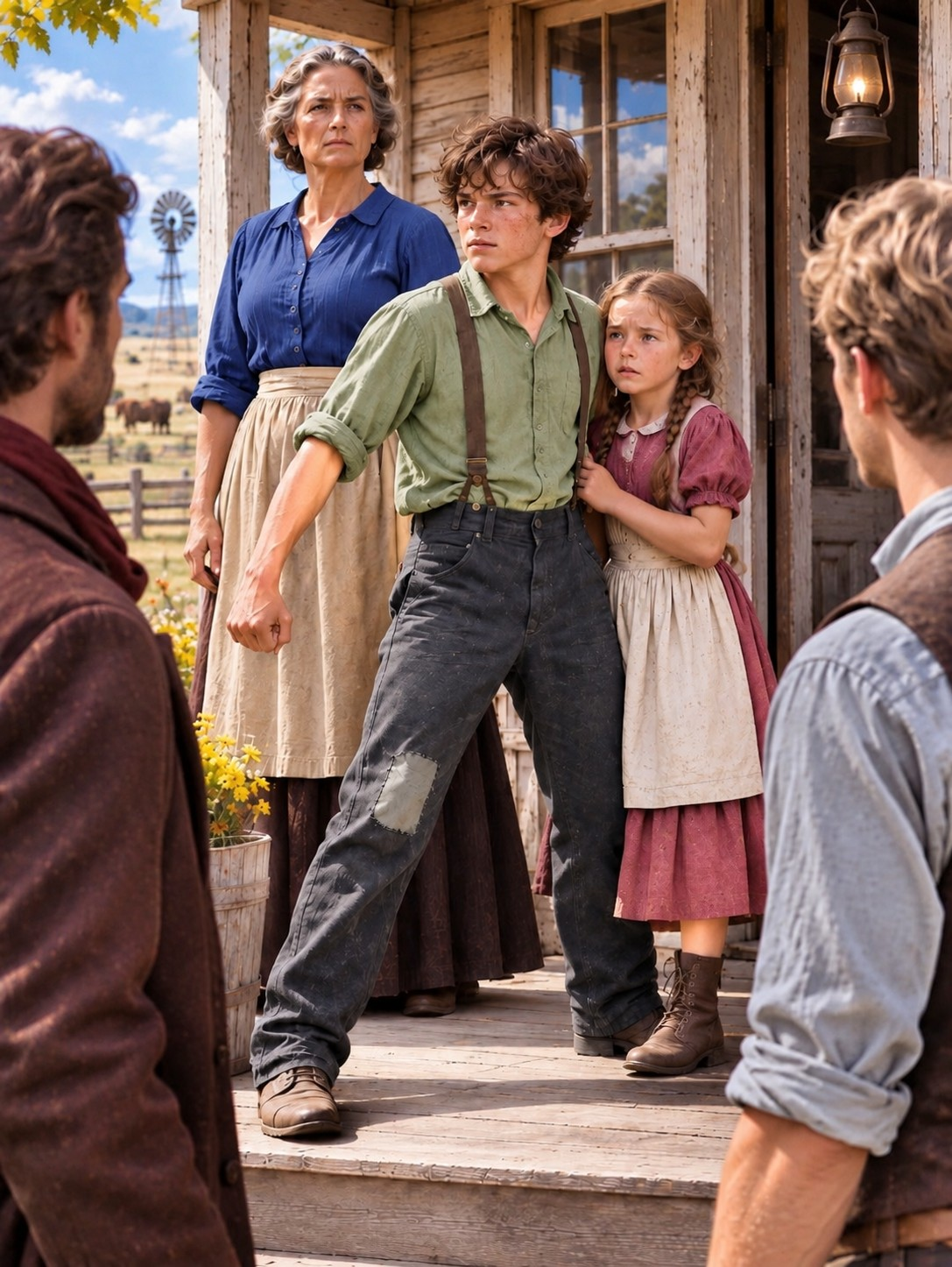
"Samuel Whitaker."
Deputy Harlan spoke my eldest son's name as though it hurt him to say it.
I turned toward Samuel.
He stood beside Thomas's open desk, his father's silver pocket watch still hanging from his fingers.
For one terrible moment, nobody moved.
Then Caleb whispered, "You filed the complaint?"
Samuel shook his head.
"No."
Deputy Harlan looked down at the warrant.
"The sworn statement carries your name, Samuel."
"Then somebody put it there."
I stared at my son.
I wanted to believe him.
God help me, I wanted to believe him so badly that I could feel the old habit rising inside me.
The habit of finding an explanation.
Making excuses.
Protecting my children from the consequences of their choices.
But there were two other children upstairs.
And I could no longer afford to protect one son by sacrificing someone else's safety.
"Samuel," I said quietly, "look at me."
He did.
"Did you sign anything for Walter Pritchard concerning Eli and Annie?"
His mouth opened.
Then closed.
My heart sank.
"Samuel."
"I signed a statement."
Caleb stepped backward.
"What?"
Samuel's eyes filled.
"I didn't know what he intended to do with it."
I looked toward the deputy.
"What did the statement say?"
Harlan hesitated.
Then he handed me the paper.
I read the first paragraph.
My hands began trembling.
Samuel had sworn that I was an elderly widow of uncertain judgment.
That I had taken two unrelated children into my home without proper supervision.
That the children were being encouraged to believe they possessed rights to the Whitaker property.
And that I had concealed information concerning their parentage.
I looked up.
"Uncertain judgment?"
Samuel covered his face.
"Ma—"
"Is that what you think of me?"
"No."
"Then why is your name on this?"
"Walter said it was only to request an investigation."
I stared at him.
"And you believed him."
Samuel said nothing.
I looked at the deputy again.
"Why does this paper accuse me of concealing their identity?"
Harlan glanced toward the second man standing behind him.
The stranger wore a dark coat and a silver badge.
He was younger than the deputy, with sharp eyes and a stiff expression.
"My name is Marshal Nathaniel Brooks," he said. "I'm assisting with a disputed guardianship matter."
I looked at him.
"Then you can begin by explaining why armed men have come to my house after dark."
He glanced at the children on the staircase.
"Because someone claims these children are being unlawfully kept from their legal guardian."
My stomach turned.
"Who?"
The marshal opened a leather folder.
"That is what we need to establish."
I stepped between him and the stairs.
"Then establish it without frightening them."
Annie was crying.
Not loudly.
That would have been easier.
She stood beside Eli with tears slipping down her cheeks, trying desperately to remain quiet.
Children who have been punished for making trouble learn to cry without making a sound.
I hated that she knew how.
"Eli," I said, "take your sister into the kitchen."
He shook his head.
"No."
"Son—"
"They're here for us."
The marshal looked toward him.
"Elias Harper?"
Eli stiffened.
I felt the change in him.
His shoulders rose.
His hands curled.
He was no longer standing in my house.
In his mind, he was back in that abandoned shed, listening for footsteps and deciding whether to run.
"Don't answer him," Annie whispered.
I turned toward the marshal.
"These children have done nothing wrong."
"I haven't suggested otherwise."
"Then stop speaking to them as though they're prisoners."
Deputy Harlan cleared his throat.
"Mrs. Whitaker, nobody is taking them tonight unless there's an immediate danger."
I looked at him.
"Is there?"
He hesitated.
"No danger has been established."
"Then perhaps everyone could lower their voices."
The marshal studied me.
For a moment, I thought he might argue.
Instead, he closed his folder.
"Very well."
I looked toward Eli.
"Please take Annie into the kitchen."
He searched my face.
"Promise they won't come after us?"
I felt every adult in the room listening.
"I promise I will not let anyone take you away without making them answer for it."
Eli considered that.
Then he took Annie's hand.
They disappeared down the stairs.
I waited until I heard the kitchen door close.
Only then did I turn back toward the men.
"Now," I said, "we can discuss whatever foolishness brought you here."
Marshal Brooks placed the warrant on Thomas's desk.
"This complaint concerns more than the children's living arrangements."
"I gathered that."
"There is a question regarding the identity of their mother."
My heart tightened.
Rebecca Harper.
The false death certificate.
The missing burial.
The silver locket.
I glanced toward Margaret Bell.
She stood near the window, her face pale.
Josiah Mercer had gone completely still.
The marshal noticed.
"Mrs. Bell?"
Margaret swallowed.
"Yes?"
"You were Rebecca Harper's cousin?"
"Yes."
"And you were present during her final illness?"
Margaret looked toward me.
I gave her a small nod.
"Tell the truth."
She drew a breath.
"I cared for Rebecca while she was ill."
"Did you witness her death?"
"No."
The marshal's expression changed.
"Who did?"
"Daniel said she died after I left."
"Did you see the body?"
"No."
He turned toward Josiah.
"And you are the undertaker listed on the certificate?"
Josiah nodded.
"But I never received a body."
The marshal stared at him.
"Explain."
Josiah opened his document case.
He removed the burial register.
"The certificate carries my name. The signature is not mine."
The marshal examined it.
Then the separate certificate.
He looked toward Deputy Harlan.
"Did you know about this?"
Harlan shook his head.
"No."
The marshal turned back toward me.
"Mrs. Whitaker, where did these documents come from?"
"Some were brought here tonight. Others were hidden in my husband's desk."
"Why?"
"That's what I'm trying to discover."
He studied me for a long moment.
Then looked at the open metal box.
"What is that?"
I felt my fingers tighten.
"Something my husband left behind."
"May I see it?"
I hesitated.
Not because I had anything to hide.
Because I was beginning to understand that papers could be more dangerous than guns when placed in the wrong hands.
"First," I said, "tell me whether you're working for Walter Pritchard."
The marshal's expression hardened.
"No."
"Has he spoken to you?"
"Yes."
"Has he shown you documents?"
"Yes."
"Then you should know he is accused of forging signatures and using fraudulent agreements to claim my property."
The marshal looked surprised.
"Who made that accusation?"
"My dead husband."
I handed him Thomas's letter.
The marshal read slowly.
I watched his face.
At first, he looked skeptical.
Then thoughtful.
Then troubled.
When he finished, he folded the pages carefully.
"Mrs. Whitaker, this is serious."
"I know."
"Your husband believed someone had forged his signature?"
"Yes."
"And you believe Mr. Pritchard may have used the same method to obtain a death certificate?"
"Yes."
The marshal glanced at Josiah.
"That will require investigation."
"Then investigate."
He looked at me.
I continued.
"But don't begin by removing two children from the only safe home they've known in months."
For a moment, nobody spoke.
Then Marshal Brooks nodded.
"That is reasonable."
Samuel exhaled.
I hadn't realized he was holding his breath.
The marshal turned toward him.
"Mr. Whitaker, did you personally witness your mother mistreating these children?"
Samuel looked startled.
"No."
"Did you see evidence they were being neglected?"
"No."
"Then why did you sign a statement suggesting otherwise?"
Samuel stared at the floor.
"Because Walter told me it would protect my mother."
The marshal's eyes narrowed.
"Protect her from what?"
Samuel hesitated.
"Financial exploitation."
"By two orphaned children?"
Caleb gave a bitter laugh.
Samuel looked ashamed.
"I know how it sounds."
The marshal's voice became colder.
"Mr. Whitaker, a sworn statement is not a place for suspicions you haven't verified."
Samuel nodded.
"I understand."
I looked at my son.
Did he?
I wasn't certain.
But for the first time, someone outside our family was holding him accountable.
And I realized how desperately that had been needed.
The marshal examined the document from Thomas's metal box.
It was the agreement I had barely begun reading when the men arrived.
I watched his expression change.
He turned one page.
Then another.
Finally, he looked up.
"Mrs. Whitaker, have you read this entire document?"
"No."
"Do you know what it concerns?"
"Partly."
He hesitated.
"Then I suggest we review it carefully before anyone draws conclusions."
I sat down.
Caleb moved beside me.
Samuel remained near the wall.
The marshal placed the document on the desk.
"It appears to be a trust agreement."
I frowned.
"A trust?"
"An arrangement under which property is held or administered for someone's benefit."
My heart began pounding.
"Whose benefit?"
He pointed to a paragraph.
"The beneficiary named here is Rebecca Harper."
Margaret made a small sound.
I stared at the paper.
Rebecca.
Not Eli.
Not Annie.
Their mother.
The marshal continued.
"The document appears to establish an interest in the north pasture for Rebecca Harper, subject to certain conditions."
I looked at him.
"Why would Thomas do that?"
He shook his head.
"I can't answer that from this paper alone."
I remembered the date.
The year Thomas purchased the north pasture.
The signature I had placed on documents without understanding them.
I felt sick.
"Does it say I agreed?"
The marshal pointed to another line.
"Your signature appears here."
I stared.
My name.
My handwriting.
Or something that looked like it.
I tried to remember the day.
The kitchen.
The baby crying.
Thomas telling me where to sign.
I had trusted him.
I had never imagined that a signature placed beside the stove might one day threaten everything I owned.
"Is it valid?" I whispered.
"That would require legal examination."
I looked toward Samuel.
He seemed stunned.
For once, he wasn't thinking about his inheritance.
He was looking at the document as though the ground beneath him had shifted.
"Pa gave part of the ranch to Rebecca Harper?"
The marshal shook his head.
"Not necessarily. The document describes a conditional interest. Its effect depends on whether the conditions were met and whether the instrument was properly executed."
I looked at Thomas's handwriting.
She must never know the reason.
My husband had hidden the truth from me.
But now I was beginning to suspect he had hidden it from our sons too.
Marshal Brooks closed the folder.
"I will not remove the children tonight."
I felt my shoulders loosen.
"But the guardianship hearing remains scheduled."
"I'll be there."
"And these documents must be preserved."
"I intend to preserve them."
He looked toward Deputy Harlan.
"Please note that the complaint requires further examination."
Harlan nodded.
The marshal turned back toward me.
"Mrs. Whitaker, I suggest you obtain legal counsel immediately."
"Reverend Collins has contacted his brother."
"Good."
He paused.
"Until this matter is resolved, I advise everyone involved to avoid discussing the documents with Mr. Pritchard without a witness."
I almost smiled.
"That won't be difficult."
The marshal's expression softened slightly.
Then he looked toward Samuel.
"Mr. Whitaker, I may need to speak with you again."
Samuel nodded.
"I understand."
The men prepared to leave.
At the door, Deputy Harlan lingered.
"Martha?"
I looked at him.
"I'm sorry."
I studied his face.
He looked genuinely ashamed.
"Then help us make this right."
He nodded.
"I'll do what I can."
They stepped outside.
The door closed.
And for the first time that night, I allowed myself to breathe.
But the relief lasted only a moment.
Because when I turned around, Samuel was staring at the trust agreement.
And his face had gone white.
"Ma," he whispered, "I think I know why Pa kept that hidden."
I looked at him.
"Then tell me."
He swallowed.
"Because he was afraid you'd leave him."
The words struck me.
"Leave him?"
Samuel nodded.
I stared at him.
"Your father and I were married thirty-five years."
"I know."
"Then explain why a document concerning Rebecca Harper would make him afraid I'd leave."
Samuel looked toward Caleb.
His brother shook his head.
"Don't start guessing."
"I'm not guessing."
"Then say what you know."
Samuel rubbed his forehead.
"Pa once told me there were things a man did when he was young that could follow him forever."
I felt a chill.
"When?"
"The afternoon we argued before he died."
I waited.
"He said he had wronged someone."
"Who?"
"He wouldn't say."
I looked at the trust agreement.
Rebecca Harper.
A woman much younger than Thomas.
A woman whose family had somehow become entangled with our land.
A woman whose children were now sleeping beneath my roof.
I felt an awful possibility forming.
But I refused to speak it.
Not without proof.
Not in front of people who were already frightened.
"Samuel," I said, "your father was not a perfect man."
He nodded.
"But I will not condemn him for something we haven't established."
Samuel looked ashamed.
"I understand."
I wasn't sure he did.
But I was beginning to understand something about myself.
For years, I had believed loyalty meant refusing to see another person's faults.
Now I knew that real loyalty sometimes required looking directly at them.
Even when the person was dead.
Even when the truth hurt.
After the visitors left, Margaret asked whether she could remain until morning.
I agreed immediately.
Josiah offered to sleep in the barn.
Caleb insisted he take the sitting room instead.
Samuel moved his bedding near the stove.
For once, nobody argued about bedrooms.
I went upstairs to check on the children.
Annie was asleep.
Eli wasn't.
He sat beside her bed, staring at the silver locket.
When he saw me, he stood.
"Are they gone?"
"Yes."
"Are we staying?"
"Yes."
He looked relieved.
Then he glanced toward Annie.
"She cried after you went downstairs."
I sat beside him.
"I know."
He swallowed.
"She thinks Mama might be alive."
My heart tightened.
"What do you think?"
He stared at the locket.
"I don't know."
I waited.
"Sometimes I used to dream Mama came back."
His voice trembled.
"Then I'd wake up and remember."
I placed my hand over his.
"Eli, whatever we discover, you don't have to face it alone."
He looked at me.
"Even if it's bad?"
"Even then."
He nodded.
Then whispered, "I wish Papa had told us the truth."
I thought of Thomas.
Of Daniel Harper.
Of the secrets both men had carried.
"So do I."
I returned downstairs long after midnight.
The house was quiet.
Margaret slept in the sitting room.
Josiah had settled beside the stove.
Caleb was upstairs.
Samuel sat alone at the kitchen table.
He looked up when I entered.
"Ma?"
I stopped.
"What is it?"
He stared at his hands.
"I know you don't trust me."
I didn't answer.
He continued.
"I don't blame you."
I sat opposite him.
For a long time, neither of us spoke.
Then he said, "When I was little, I used to think Pa loved the ranch more than us."
I looked at him.
"He loved you."
Samuel gave a sad smile.
"He had a strange way of showing it."
I couldn't argue.
He continued.
"I thought if I could own land, build something bigger than he had, maybe he'd finally respect me."
I felt my throat tighten.
"Samuel—"
"That's why I borrowed money."
He looked up.
"I wasn't trying to become rich. I was trying to become someone he couldn't look down on."
I stared at my son.
For years, I had wondered why he was so determined to prove himself.
Now I understood that even after leaving home, he had never escaped his father's judgment.
"Samuel," I said gently, "you were enough before you owned a single acre."
His face crumpled.
He looked away.
"I wish he'd told me that."
"So do I."
We sat in silence.
Then he whispered, "Do you think you can forgive me?"
I looked at him.
I loved him.
That had never changed.
But love was not the same thing as trust.
And forgiveness was not something I could give merely because he was finally ready to ask.
"I want to," I said.
He nodded.
"But I need you to understand something."
He looked at me.
"You endangered two children because you were afraid of losing money."
Tears filled his eyes.
"I know."
"And you endangered this ranch because you wanted your father to respect you."
He lowered his head.
"Yes."
I reached across the table.
"Samuel, I can love you while refusing to excuse what you've done."
He took my hand.
For a moment, he looked like a little boy again.
"Then tell me how to make it right."
I squeezed his fingers.
"Start by telling the truth. All of it."
He nodded.
"I will."
I wanted to believe him.
I wanted that more than anything.
But before I could answer, a sound came from the front porch.
A soft scrape.
Then another.
Samuel looked toward the door.
"Did you hear that?"
I nodded.
Someone was outside.
At this hour, no decent visitor would approach without knocking.
Samuel stood.
I reached for the lantern.
He moved toward the door.
"Stay behind me, Ma."
I almost protested.
Then I saw his face.
For once, he wasn't trying to command me.
He was frightened for me.
I let him go first.
He lifted the curtain.
His expression changed.
"What is it?" I whispered.
He didn't answer.
I stepped beside him.
A small object lay on the porch.
Wrapped in brown paper.
Tied with string.
No person was visible.
Only the empty yard.
The dark barn.
The prairie beyond.
Samuel opened the door.
I followed him outside.
The night air was cold.
He picked up the package.
There was writing on the paper.
My name.
Martha Whitaker.
I recognized the handwriting immediately.
Walter Pritchard.
Samuel looked at me.
"Don't open it."
I took the package.
"Why?"
"Because he wants us frightened."
I looked toward the darkness.
"Then perhaps we should find out what he's frightened of."
I untied the string.
Inside was a small wooden box.
No larger than my palm.
I lifted the lid.
A child's ribbon lay inside.
Faded blue.
Beside it was a folded note.
I opened the paper.
There were only two sentences.
You have until sunrise to surrender the Harper children.
If you refuse, the truth about Rebecca will be delivered to the county judge.
My heart pounded.
Samuel looked over my shoulder.
"Ma, what does it mean?"
I stared at the ribbon.
It looked familiar.
Too familiar.
Then I remembered.
Annie had worn a ribbon just like it the day I first took her into town.
I looked toward the staircase.
And suddenly I knew something was wrong.
"Samuel," I whispered, "go check on the children."
He turned.
"Why?"
"Now."
He ran inside.
I followed.
We climbed the stairs.
Annie's bedroom door stood open.
The lamp inside had gone out.
I heard Samuel stop.
Then a terrible silence.
I pushed past him.
The bed was empty.
The window stood open.
And on Annie's pillow lay a second note.
This one was written in a child's trembling hand.
Grandma, I went with the lady because she said she knew where Mama was.
I stared at the words.
Then I heard Eli shouting from the hallway.
"Annie!"
He ran into the room.
Saw the empty bed.
Saw the open window.
And stopped breathing.
I reached for him.
But he was already turning toward the stairs.
"She took her!"
I grabbed his arm.
"Who?"
His face had gone white.
He pointed toward the window.
Then whispered the name of the woman he had seen standing beneath it.
And the moment he spoke, I realized the person who had taken Annie had been inside my house all along.






Comments 0