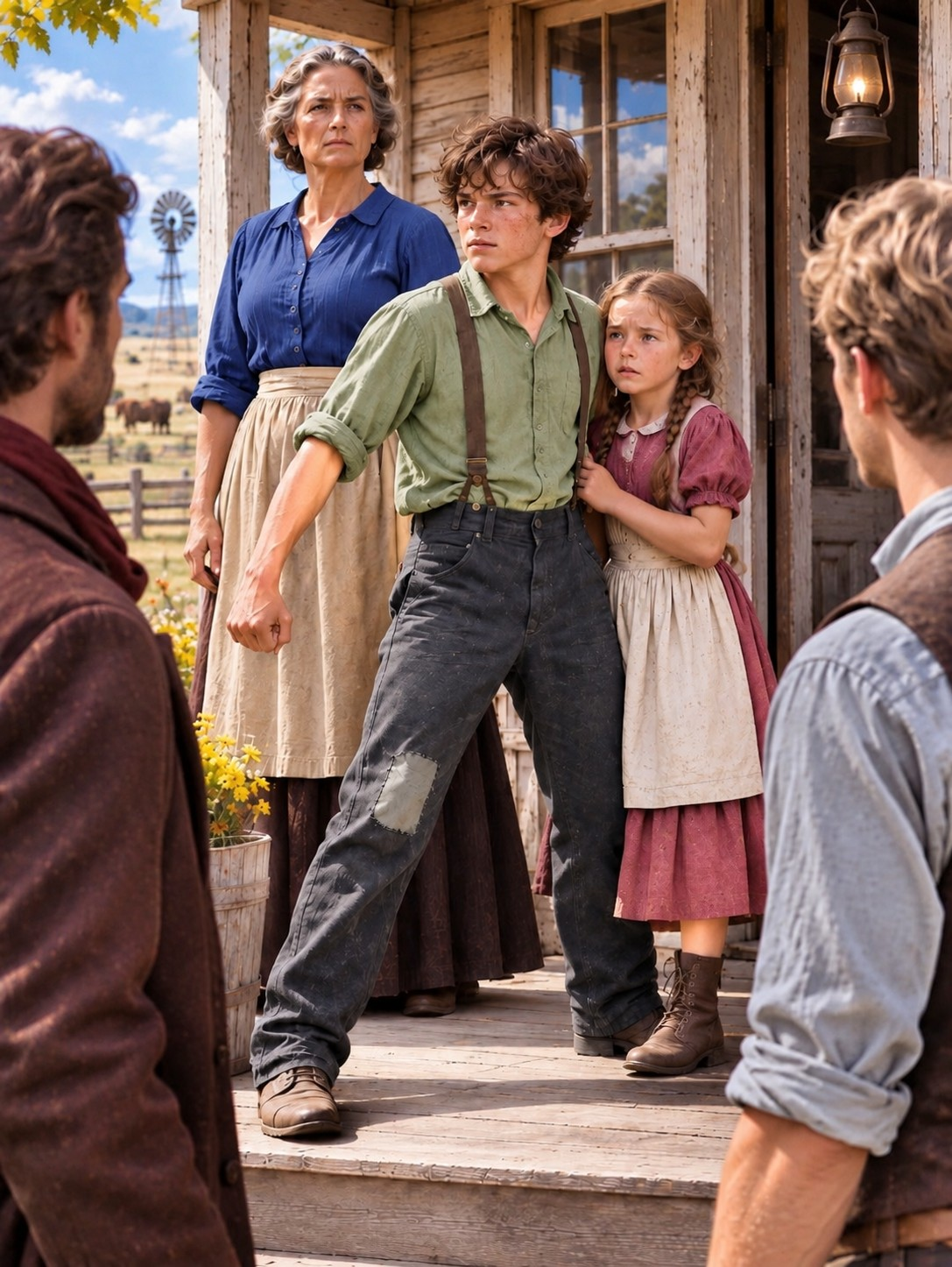
"Get away from my sister!" Eli shouted, stepping between Annie and the two strangers.
My eldest son, Samuel Whitaker, stood at the bottom of my porch with his father's old pocket watch in his hand.
The silver case had a deep scratch beside the initials T.W.
But beneath those initials was a smaller mark I had never noticed before.
And suddenly, I knew Samuel hadn't come home simply to see his mother.
"Those children aren't family."
Samuel said it again, louder this time, as though repeating something cruel might somehow make it reasonable.
My granddaughter-sized little girl stood frozen beside the front door, holding one of my good ceramic bowls against her chest.
Her name was Annie.
She was eight years old, with two uneven braids, a scattering of freckles, and the kind of serious blue eyes that belonged to someone who had already learned too much about disappointment.
Her brother, Eli, stood in front of her.
Fourteen years old.
Thin as a fence rail.
Stubborn as a Missouri mule.
His hands were rough from repairing fences, carrying feed, and doing every chore he could find, whether I asked him to or not.
He had been living under my roof since the previous winter.
And in all those months, I had never seen him look at another human being the way he was looking at my son.
Not with hatred.
With recognition.
He knew what was coming.
He had spent most of his young life learning how to recognize the moment when someone decided he and Annie were unwanted.
I had promised myself he would never experience that feeling again.
Yet there we were.
Standing in front of my own house.
And the people making him feel unwelcome were the two boys I had given birth to.
"Samuel," I said quietly, "you will lower your voice."
He turned toward me.
My oldest boy was thirty-two now.
He had his father's broad shoulders, his father's square jaw, and unfortunately, in that moment, his father's habit of believing that speaking with certainty was the same thing as speaking with authority.
"Ma, I'm not trying to start trouble."
"Then you're doing a remarkable job of it by accident."
Caleb, my younger son, shifted uncomfortably beside him.
At twenty-nine, Caleb still had the same nervous habit he'd had as a child. Whenever a conversation turned unpleasant, he rubbed his thumb against the side of his forefinger.
He was doing it now.
"Maybe we should go inside," Caleb suggested.
"That's what I was hoping," I answered. "Before your brother decided to insult two children standing on their own porch."
Samuel looked toward Eli.
"Their porch?"
"Yes."
He gave a short, disbelieving laugh.
"Ma, you can't be serious."
I looked directly at him.
"Try me."
For a moment, neither of us spoke.
Behind Samuel, the Kansas prairie stretched toward the western horizon.
The afternoon sun hung above the pasture, catching on the old windmill and turning the dry grass the color of honey.
Our cattle moved slowly beyond the fence.
Everything looked ordinary.
That was what struck me most.
The world had not changed.
The birds were still calling from the cottonwood trees.
The wind was still pushing dust across the yard.
Somewhere behind the barn, a loose gate was knocking against its post.
Yet something inside my chest had shifted.
My sons had been home less than ten minutes.
And already I was being asked to choose who deserved a place in my life.
Nineteen months earlier, I had buried my husband.
Thomas Whitaker had been sixty-one when his heart finally gave out beside the north pasture fence.
He had been fixing a broken rail.
That was the sort of thing Thomas would have appreciated.
A man who spent his entire life working himself toward an early grave would have considered dying while repairing something a respectable ending.
We had been married thirty-five years.
Some of those years had been good.
Some had been difficult.
And some had been so quiet that I sometimes wondered whether silence itself had become a third person living in our marriage.
Thomas wasn't a cruel man in the obvious ways.
He didn't drink away our money.
He didn't chase women.
He didn't come home and throw furniture.
He worked.
He provided.
He expected obedience.
And he believed a man who put food on the table had earned the right to decide how everyone sitting around it should live.
Samuel inherited his stubbornness.
Caleb inherited his tendency to retreat.
And I?
I learned how to keep the peace.
For years, I had told myself that keeping peace was the same thing as protecting a family.
I was beginning to understand how wrong that could be.
Our sons had left after years of arguments with their father.
Samuel went first.
He was twenty-five when he packed his belongings and rode west after a terrible argument about money, land, and the future of the ranch.
Caleb followed two years later.
Neither departure had been peaceful.
There were slammed doors.
Bitter words.
Accusations.
And long stretches of silence afterward.
Thomas refused to apologize.
The boys refused to return.
And I stood between them, writing letters that never said enough.
When Thomas died, I sent word to both sons.
Samuel wrote back.
Caleb sent a short note.
Neither came to the funeral.
I told people the roads were difficult.
I told myself they had obligations.
I told the preacher they were grieving in their own ways.
Perhaps some of that was true.
But the simple fact remained.
I buried their father without either of them standing beside me.
Afterward, the ranch grew terribly quiet.
I would wake before sunrise, put coffee on the stove, and set two cups on the table before remembering there was nobody to drink from the second.
Sometimes I left it there.
That was the embarrassing part.
I knew Thomas was dead.
I knew my sons were gone.
Yet some stubborn piece of my heart kept preparing for people who were never coming through the door.
Then, one winter night, someone finally did.
Not through the front door.
Through my smokehouse.
The first sound was the latch.
A small metallic scrape.
Then a pause.
Then another scrape.
I had lived on that ranch long enough to know the difference between a loose shutter, a raccoon, and a human hand trying to open a door quietly.
I took Thomas's shotgun from beside the kitchen cupboard.
I didn't intend to shoot anybody.
But a woman living alone on an isolated Kansas ranch in 1884 could not afford to assume every stranger came with good intentions.
I stepped outside.
The moon was bright enough to make the frozen ground look silver.
The smokehouse door stood open.
A thin figure was crouched inside.
"Put the ham down and step into the light."
The figure froze.
Then slowly turned.
He was a boy.
No more than fourteen.
His coat was too large, his boots were tied with twine, and he held half a smoked ham beneath one arm.
A sack hung from his shoulder.
I could see biscuits, dried apples, and a jar of preserves sticking out of it.
He stared at the shotgun.
Most children would have cried.
This one simply looked exhausted.
"Please," he said. "Don't shoot."
"Then don't give me a reason."
He carefully lowered the ham.
I looked at the sack again.
"That's a lot of food for one boy."
He said nothing.
"Who else are you feeding?"
"No one."
"You're a poor liar."
His eyes flickered toward the eastern pasture.
Just once.
But I noticed.
"Who's out there?"
"No one."
"Is someone sick?"
His face changed.
That was my answer.
I lowered the shotgun.
"Boy, if somebody needs help, standing here arguing with an old woman isn't going to do them much good."
He swallowed.
"You're going to call the sheriff."
"Not unless you give me a reason."
"They'll separate us."
"Separate who?"
His lips trembled.
It was the first time I saw the child beneath all that stubbornness.
"My sister."
I asked where she was.
He refused to answer.
I told him I could either spend the next hour asking questions or spend it helping her.
That finally convinced him.
Nearly a mile east of my pasture, inside the collapsing shed on the abandoned Miller property, I found Annie.
She was curled beneath old feed sacks.
Her skin was burning.
Her lips were dry.
And when I touched her forehead, she barely opened her eyes.
Eli dropped beside her.
"Annie, I brought food."
She tried to smile.
I had never seen anything more heartbreaking.
He had risked being shot over half a ham because he believed his little sister might wake up hungry.
Their father had died six weeks earlier in a wagon accident.
Their mother had been gone for years.
They had no nearby family willing to take both of them.
Eli had heard stories about orphaned children being separated.
Little girls went to families.
Older boys went to work.
He had decided that starving together was better than surviving apart.
"We stay together," he told me.
I looked at his sister.
Then at him.
"Yes," I answered. "You do."
I carried Annie home that night.
And without realizing it, I began the second half of my life.
At first, I told them they could stay one week.
Then Annie's fever broke.
Eli repaired the chicken coop.
Annie started helping me wash dishes.
One week became two.
Two became a month.
By early spring, the house had become a place I recognized again.
There were boots beside the kitchen door.
Crumbs beneath the table.
Small arguments over biscuits.
Annie drew horses in the condensation on the windows, although her horses generally looked like potatoes with legs.
Eli worked harder than any grown ranch hand I had ever hired.
Too hard.
Every time I gave him something, he searched for a way to repay it.
A new shirt meant he cleaned the barn.
Medicine for Annie meant he repaired a fence.
An extra helping of stew meant he chopped enough firewood to last three days.
One evening, I found him outside after dark, trying to mend a broken gate by lantern light.
"Eli, come inside."
"Almost finished."
"It'll still be broken tomorrow."
"I know."
"Then leave it."
He hesitated.
I stepped closer.
"Son, you don't owe me for every meal."
He stared at me.
As though I had told him the sun would rise in the west.
"Everybody owes somebody," he said.
I remember feeling something break inside me.
Not because he was wrong.
Because he was fourteen and already believed kindness was a debt that eventually came due.
I took the hammer from his hand.
"Not in this house."
He didn't answer.
But the next morning, when I found him sitting at the kitchen table eating breakfast without first asking what chores needed doing, I considered it a small victory.
Annie was different.
She accepted affection the way a flower accepts sunlight.
Cautiously at first.
Then completely.
She started calling me Mrs. Whitaker.
Sometimes, when she was sleepy, she called me Grandma.
The first time it happened, she looked terrified.
"I'm sorry."
I asked what for.
"Calling you that."
I told her she could call me whatever made her comfortable.
She considered that carefully.
Then she asked whether Grandma would be all right.
I had to turn toward the stove before answering.
"Grandma would be just fine."
That night, I sat alone in my bedroom and cried for the first time since Thomas's funeral.
Not from grief.
From the frightening realization that I had nearly forgotten what happiness felt like.
Now those same children stood on my porch while Samuel stared at them as though they were squatters.
"How long have they been here?" he demanded.
"Since winter."
"And you never wrote to tell us?"
I almost laughed.
"I wrote you both several times."
"Not about this."
"No, Samuel. Mostly I wrote about the ranch, my health, and the fact that I hadn't heard from you."
His expression tightened.
"That's not fair."
"Neither is what you just said to Annie."
Caleb cleared his throat.
"Ma, we're only surprised."
"Then be surprised politely."
Annie shifted behind Eli.
The ceramic bowl trembled slightly in her hands.
I noticed Samuel looking at it.
It was one of the blue-rimmed bowls from the wedding set my mother had given me.
Thomas had always insisted those dishes were for special occasions.
After his death, I kept them wrapped in cloth.
Then Annie found them one afternoon.
She asked why beautiful dishes should spend their whole lives hidden in a cupboard.
I couldn't think of a good answer.
We had been using them ever since.
Samuel recognized the bowl.
"You're letting them use Grandma's dishes?"
"Yes."
"Ma—"
"Samuel."
My voice was sharper than I intended.
He stopped.
"Those dishes belong to me," I said. "And if I choose to serve breakfast on them every morning, that's my business."
He looked away.
Caleb shifted again.
I could feel the afternoon slipping toward something uglier.
So I made a decision.
"Annie, sweetheart, would you take that bowl inside?"
She nodded.
"Eli, please help her set the table."
He didn't move.
His eyes stayed on Samuel.
"Eli."
He turned toward me.
I softened my voice.
"It's all right."
He hesitated.
Then he took Annie's free hand and led her inside.
Samuel watched them disappear through the doorway.
"That boy doesn't trust me."
I looked at him.
"You haven't given him much reason to."
"He looks at me like I'm dangerous."
"He looks at you like a boy who's spent his life protecting his sister."
Samuel folded his arms.
"That's exactly what concerns me."
"What?"
"You're letting strangers become too comfortable."
I felt a slow heat rise beneath my collar.
"They're children."
"They're not your children."
"Neither were you born knowing how to mend fences, Samuel. Someone taught you."
He ignored that.
"What happens when they get older?"
"They get older."
"What happens when they start expecting something?"
"Like what?"
He looked toward the pasture.
The barn.
The house.
Then back at me.
And there it was.
The thing that had brought my sons home.
Not concern.
Not affection.
Not even guilt.
Land.
We sat at the kitchen table twenty minutes later.
Annie and Eli were outside collecting eggs.
I had asked them to give us some privacy.
I regretted needing to.
Samuel removed his gloves and placed them beside his cup.
Caleb sat opposite him.
I poured coffee.
Nobody touched it.
Samuel began.
"We heard you were sick last year."
"I had a fever."
"We heard it was serious."
"It was serious enough that I wrote to both of you."
Caleb lowered his eyes.
Samuel continued.
"We also heard you've had trouble managing the place."
"From whom?"
"People talk."
"People always have."
"The north fence needs work."
"Eli and I repaired it."
"The barn roof?"
"Repaired."
"The eastern well?"
"Still producing water."
Samuel frowned.
"You can't keep doing everything yourself."
"I'm not."
He glanced toward the window.
"Exactly."
I put down my cup.
"Say what you came to say."
He leaned back.
"Ma, we're worried about what happens to the ranch."
"When?"
"When you can't manage it anymore."
"You mean when I die."
"That's not what I said."
"It's what you're asking."
Caleb finally spoke.
"Ma, we don't want anything to happen to you."
I studied him.
He looked genuinely uncomfortable.
That gave me a little hope.
"Then why didn't you come when I was ill?"
He opened his mouth.
Closed it.
Samuel answered for him.
"We had obligations."
"So did I."
Silence.
I looked at my hands.
They were not pretty hands.
Years of ranch work had left them rough, with swollen knuckles and a crooked little finger that never healed properly after a horse kicked a gate against it.
Those hands had cooked thousands of meals.
Washed clothes.
Bandaged knees.
Held feverish foreheads.
Buried a husband.
And lately, they had held two frightened children who needed someone to tell them they weren't alone.
I placed them flat on the table.
"This ranch is still mine," I said.
Samuel's expression changed.
"Of course it is."
"Then I don't understand why we're discussing who gets it."
"Because eventually—"
"Eventually I'll be dead. Until then, I intend to live."
Caleb looked at me.
Something almost like admiration crossed his face.
Samuel wasn't pleased.
"You're making this difficult."
"No. I'm making it clear."
He leaned forward.
"Ma, I know you have a soft heart. But those children could take advantage of you."
I stared at him.
"Eli has worked every day since he arrived. Annie was nearly dead when I found her. What advantage do you imagine they're taking?"
"You don't know where they came from."
"I know exactly where they came from."
"You don't know what kind of people their parents were."
That did it.
I stood.
Samuel looked startled.
I had spent most of his childhood avoiding arguments.
I had spent most of my marriage finding ways to make angry men comfortable.
But I was fifty-six years old.
I had buried too many hopes.
And I was tired.
"Samuel Whitaker, you will not sit at my table and suggest that two orphaned children are worth less because their parents are dead."
He stood too.
"I'm trying to protect what's ours."
I looked him directly in the eyes.
"Then perhaps you should have started by protecting the people."
The kitchen door creaked.
Annie stood there.
She had come in quietly enough that none of us heard her.
Her hands were empty.
Her face was pale.
"Grandma?"
Samuel turned.
I saw her flinch at the movement.
"Yes, sweetheart?"
She looked from me to Samuel.
Then toward the floor.
"Should I go back outside?"
My throat tightened.
"No."
She swallowed.
"I didn't mean to cause trouble."
Samuel said nothing.
Caleb stared at his hands.
I crossed the kitchen and knelt in front of her.
At fifty-six, kneeling was no longer something I did gracefully.
My knees protested.
I ignored them.
"Look at me, Annie."
She did.
"You have not caused any trouble."
"But he said—"
"I know what he said."
Her lower lip trembled.
"Are we going to have to leave?"
I heard Caleb inhale.
Samuel looked away.
And suddenly I understood something that had taken me thirty-five years of marriage and two grown sons to learn.
Children don't always remember the exact words adults say.
But they remember how those words make them feel.
They remember being unwanted.
They remember standing in doorways while grown people discuss whether they belong.
They remember who defended them.
And who stayed silent.
I took Annie's small hands in mine.
"You and Eli are staying right here."
"Even if they don't want us?"
"Even then."
She looked toward Samuel.
I gently turned her face back to mine.
"This is your home."
She leaned forward and wrapped her arms around my neck.
I held her.
Over her shoulder, I saw Samuel standing beside the table.
His face had gone hard.
But Caleb was looking at Annie with an expression I couldn't quite read.
Perhaps guilt.
Perhaps memory.
Perhaps he was remembering a time when he, too, had stood in a doorway wondering whether his father wanted him.
Annie whispered into my ear.
"Thank you, Grandma."
I closed my eyes.
"You're welcome, sweetheart."
When she went back outside, I remained kneeling for a moment.
Not because I needed to pray.
Because I needed to steady myself.
Samuel left the kitchen first.
He walked onto the porch, his boots striking the boards with deliberate force.
Caleb stayed behind.
For a while, he said nothing.
Then he looked toward the doorway.
"She calls you Grandma."
"Yes."
"Does that bother you?"
I studied him.
"Why would it?"
He rubbed his thumb against his forefinger.
"I don't know."
I sat down.
Caleb looked older than I remembered.
There were lines beside his eyes now.
A faint scar beneath his chin.
I wondered how many birthdays I'd missed.
How many illnesses.
How many disappointments.
How many ordinary mornings.
I had spent years being angry with Thomas for driving our sons away.
But anger was convenient.
It allowed me to believe the blame belonged entirely to someone who could no longer defend himself.
I had not yet found the courage to examine my own part in the silence.
"Caleb," I said, "why did you really come home?"
He looked toward the window.
"Samuel said we needed to settle things."
"What things?"
"The ranch."
"That much I gathered."
He hesitated.
Then spoke so quietly I nearly missed it.
"He thinks Pa promised him something."
I frowned.
"Promised him what?"
Caleb shook his head.
"I don't know everything."
"Then tell me what you do know."
He opened his mouth.
Outside, Samuel called his name.
Caleb stopped.
I watched his expression change.
It was the same look he had worn as a boy whenever Thomas entered a room during an argument.
That old instinct to retreat.
"Later," Caleb whispered.
Then he stood and followed his brother.
I remained at the table.
For the first time since their arrival, I felt something colder than anger.
Suspicion.
That evening, I made chicken stew.
I had planned to cook beef, but the conversation had left me too unsettled to spend another hour preparing supper.
Eli helped peel potatoes.
Annie set the table.
Samuel and Caleb remained outside, inspecting the barn and fences as though the ranch were already theirs.
I watched them through the window.
Samuel pointed toward the north pasture.
Caleb shook his head.
Samuel said something sharply.
Caleb looked away.
Eli noticed.
"They don't like us."
I kept slicing carrots.
"They don't know you."
"That's not the same thing."
"No."
He paused.
"Are they going to make us leave?"
I set down the knife.
"Eli."
He looked at me.
"You heard what I told Annie."
"People say things."
"Yes, they do."
"Sometimes they change their minds."
I thought about the countless promises adults had made to that boy.
Promises that had disappeared when circumstances became inconvenient.
I dried my hands.
Then I turned toward him.
"I won't change my mind about you and Annie."
He searched my face.
"Even if they're your sons?"
"Even then."
He looked down at the potato in his hand.
His voice was barely audible.
"All right."
It wasn't trust.
Not yet.
But it was a beginning.
Supper was uncomfortable.
Samuel barely spoke.
Caleb tried twice to ask Annie about her drawings.
Each time, Samuel interrupted with another question about the ranch.
Eli ate quietly.
Annie sat close to me.
At one point, she dropped her spoon.
The sound against the floor made her jump.
Samuel looked toward her.
She immediately apologized.
I picked up the spoon.
"Accidents happen."
She nodded.
Then she looked toward Samuel again.
I noticed.
So did Eli.
And I began to wonder whether the most dangerous thing about my sons' return was not what they wanted from the ranch.
It was what their presence might teach the children about being loved.
After supper, Samuel announced that he and Caleb would stay the night.
I had expected as much.
Their old bedrooms were upstairs.
But those rooms were no longer empty.
Annie slept in Caleb's former room.
Eli slept in Samuel's.
I explained that I could prepare beds in the sitting room.
Samuel stared at me.
"You gave them our rooms?"
"Nobody had slept in those rooms for years."
"That doesn't mean they weren't ours."
I looked at him.
"Samuel, you are thirty-two years old."
"So?"
"So perhaps it's time you stopped expecting the world to remain exactly as you left it."
Caleb coughed into his hand.
I suspected he was hiding a smile.
Samuel wasn't amused.
"Fine," he said. "We'll sleep downstairs."
He walked away.
I watched him go.
Then I turned toward the stairs.
Eli was standing on the third step.
He had heard everything.
Of course he had.
That boy heard every conversation that might threaten his sister's safety.
I gave him a small smile.
"Off to bed."
He hesitated.
"Mrs. Whitaker?"
"Yes?"
"Would it help if Annie and I slept in the barn?"
I felt my heart sink.
"No."
"We've slept in worse places."
"I know."
"We don't mind."
I climbed the first step.
"Eli, listen carefully. You are not going to sleep in a barn to make grown men comfortable."
His eyes filled.
He blinked quickly.
I pretended not to notice.
"Now go wash up."
He nodded.
And disappeared upstairs.
Much later, after the lamps had been turned low and the house had finally grown quiet, I went into Thomas's study.
I hadn't spent much time there since his death.
The room still smelled faintly of tobacco, leather, and old paper.
His desk stood beneath the window.
A heavy oak thing with brass handles and a stubborn center drawer.
Thomas had always kept that drawer locked.
Even after thirty-five years of marriage, I had never asked what was inside.
Not because I didn't wonder.
Because I had learned not to ask questions he didn't want to answer.
I stood in front of the desk.
Then I thought about Samuel's strange certainty.
The way he had inspected the ranch.
The questions about ownership.
Caleb's whispered admission.
He thinks Pa promised him something.
I remembered something else.
Earlier that afternoon, Samuel had taken his father's silver pocket watch from his vest.
I had recognized it immediately.
Thomas carried that watch for almost thirty years.
I had assumed it was buried with him.
But now I remembered that Samuel had taken it years before Thomas died, during one of their last terrible arguments.
The scratch beside the initials had been there since Samuel was a boy.
What troubled me was the smaller mark beneath it.
It had looked like a number.
Or perhaps a letter.
I hadn't seen it clearly.
I reached for the desk drawer.
Locked.
Of course.
I opened the small wooden box on the shelf above it.
Inside were Thomas's cuff links, an old church receipt, two buttons, and a handful of keys.
I tried the first key.
Nothing.
The second.
Nothing.
The third slid into the lock.
I turned it.
A soft click.
For a moment, I simply stood there.
Thirty-five years of marriage.
Nineteen months of widowhood.
And I was finally opening a drawer my husband had kept from me.
I pulled it toward me.
Inside were several folded documents, a small leather notebook, and a bundle of letters tied with faded blue ribbon.
The handwriting on the top envelope was unmistakable.
Samuel's.
But the letter beneath it was addressed to Caleb.
And the third—
I stopped breathing.
The third envelope had my name on it.
In Thomas's handwriting.
Across the bottom, in darker ink, he had written four words.
If the boys return.
I stared at the envelope.
Then I heard a floorboard creak behind me.
I turned.
Samuel stood in the doorway.
His eyes went straight to the open drawer.
And the moment he saw the letter in my hand, his face changed.
"Ma," he said sharply. "Don't open that."
I looked at the envelope.
Then back at my son.
"Why not?"
He took one step into the room.
"Because Pa made me promise something before he died."
I felt my fingers tighten around the paper.
Samuel reached toward the desk.
And behind him, Caleb appeared in the doorway, staring at the letter as though he had just seen a ghost.
"Samuel," Caleb whispered, "tell her what you did."
Samuel froze.
Then Caleb said the words that made the room go completely silent.
"Tell Ma why Pa's last letter never reached her."






Comments 0