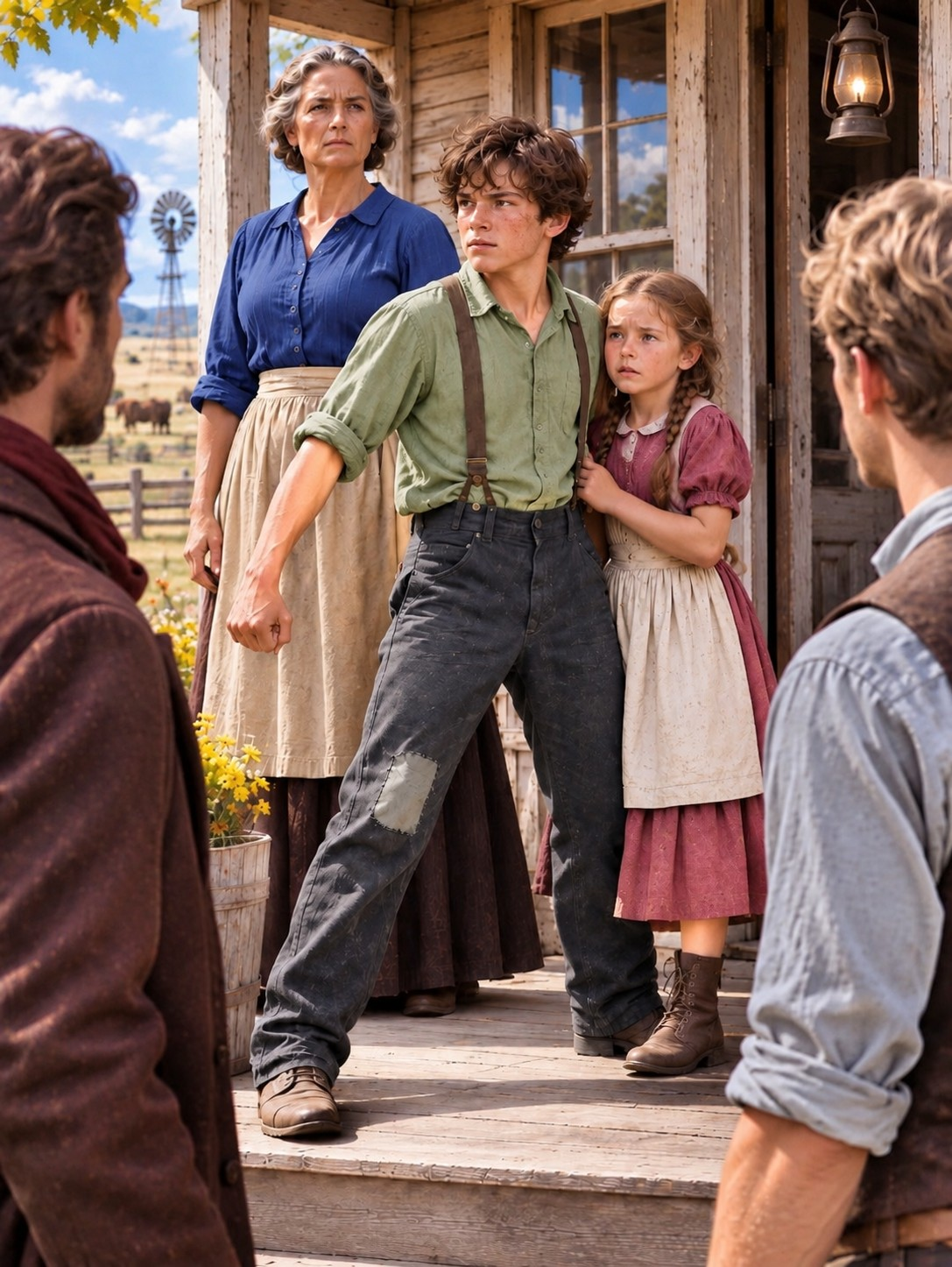
"Tell Ma why Pa's last letter never reached her."
Caleb's voice was barely louder than a whisper, but it struck the room harder than any shout.
Samuel stood between us, his broad shoulders filling the doorway of Thomas's study.
For a moment, nobody moved.
The oil lamp on the desk flickered.
I could hear the clock ticking in the hallway.
And in my hand was an envelope bearing my dead husband's handwriting.
"Samuel," I said, "what is your brother talking about?"
My eldest son looked at Caleb with an expression I remembered too well.
It was the same look Thomas used to give him when he was young.
A warning.
A command.
An expectation that the conversation would end simply because one man wanted it to.
"Caleb doesn't understand what happened."
"Then explain it."
"Ma, this isn't the time."
I looked down at the envelope.
Across the bottom, Thomas had written four words.
If the boys return.
Nineteen months.
My husband had been dead for nineteen months, and apparently there were things he had wanted me to know.
Things my sons had known.
Things they had chosen to keep from me.
I placed the envelope on the desk.
"Samuel, I buried your father alone."
He flinched.
Not much.
But I saw it.
"I stood beside his grave while Reverend Collins said the prayers. I went home afterward and ate supper at this very desk because I couldn't bear to sit at our kitchen table by myself."
"Ma—"
"I wrote to both of you. I told you he was gone. I told you where he would be buried."
Caleb lowered his head.
"And now you're standing in my house telling me there was a letter I never received."
Samuel drew a slow breath.
"Pa wrote something before he died."
"That much is obvious."
"He didn't want you upset."
I stared at him.
"Your father was dead. What exactly did he imagine would upset me more?"
Samuel had no answer.
Caleb stepped forward.
"That's not why he kept it."
Samuel turned sharply.
"Enough."
"No," Caleb said.
His voice shook, but he didn't retreat.
"Not this time."
I looked between them.
For the first time since they had arrived, I saw something beneath their arguments about the ranch.
Fear.
Not fear of me.
Fear of something that had followed them home.
I reached for the envelope.
Samuel moved toward the desk.
"Ma, please."
I stopped.
Not because he had persuaded me.
Because I had never heard that particular word sound so desperate in his mouth.
"Why?" I asked.
He swallowed.
"Because once you read it, you might never forgive me."
There are moments in a mother's life when she discovers that the child she raised has become a stranger.
Not all at once.
Sometimes it happens slowly.
A missed birthday.
A letter unanswered.
A visit postponed.
Then one day that child stands in front of her, thirty-two years old, carrying a secret large enough to change the shape of everything she remembers.
I looked at Samuel.
For a moment, I could still see the little boy who used to follow Thomas through the pasture with a wooden hammer tucked into his belt.
He had wanted so badly to be useful.
Thomas had rarely praised him.
When Samuel fixed something correctly, his father would inspect the work and say, "That's how it should have been done."
When he made a mistake, Thomas remembered it for weeks.
I used to tell myself that Samuel was strong enough to endure his father's harshness.
Now I wondered whether strength was simply the name we gave children when we expected them to survive without comfort.
"Sit down," I told him.
He looked surprised.
"Ma—"
"Both of you."
Caleb obeyed immediately.
Samuel hesitated before lowering himself into the chair opposite the desk.
I remained standing.
The envelope lay between us.
"Before I open this," I said, "you're going to tell me what happened."
Samuel rubbed his forehead.
"Pa sent for me."
"When?"
"A few days before he died."
My stomach tightened.
Thomas had been working the ranch that week.
He complained about a pain in his chest one evening, but insisted it was indigestion.
I had urged him to rest.
He had laughed.
"Men don't die from a little hard work, Martha."
Three days later, I found him collapsed beside the north pasture fence.
"Your father sent for you?" I repeated.
Samuel nodded.
"Through a man traveling west. I received the message and came back."
I stared at him.
"You came here?"
"Yes."
"Before he died?"
"Yes."
I gripped the back of Thomas's chair.
Samuel had returned to the ranch.
My eldest son had come home.
And I had never known.
"Where was I?"
"In town. Pa said you'd gone to collect supplies."
I remembered that afternoon.
I had purchased flour, lamp oil, and medicine for one of the horses.
Thomas had insisted I go myself.
He said he needed the afternoon to finish some accounts.
I had thought nothing of it.
"What did he want?" I asked.
Samuel looked toward Caleb.
His brother shook his head.
"Tell her."
Samuel's jaw tightened.
"He wanted to talk about the ranch."
Of course.
Even dying, Thomas had found a way to make the land more important than the people standing on it.
"What about the ranch?"
"He said he'd made mistakes."
Those words startled me.
Thomas Whitaker had admitted to many things during our marriage.
Being tired.
Being angry.
Being disappointed.
But mistakes?
Those were usually things other people made.
Samuel continued.
"He said he wanted to put certain matters right."
"What matters?"
"I don't know everything."
"Then tell me what you do know."
He looked at the envelope.
"Pa gave me a letter for you. He said I was to deliver it if he couldn't speak to you himself."
"And you didn't."
Samuel shook his head.
"Why?"
His eyes filled with something I had not expected.
Shame.
"Because I was angry."
I waited.
"He said things that afternoon. Things about me. About Caleb. About how we'd left you alone."
Caleb looked up.
"That's not all he said."
Samuel ignored him.
"He told me I had become the kind of man who measured everything by what he expected to inherit."
I looked toward the desk.
The words sounded painfully like Thomas.
Even when he was right, he had a talent for saying things in the cruelest possible way.
Samuel continued.
"I told him he had no right to judge me after the way he'd treated us."
"And?"
"He said I could prove I was different."
"How?"
Samuel's hands tightened.
"By giving you the letter."
I waited.
"He told me it was more important than anything he'd ever signed."
The room grew very still.
"Then why didn't you give it to me?"
Samuel stared at the floor.
"Because I wanted him to be wrong about me."
I frowned.
"By doing exactly what he expected?"
He looked up.
The pain in his expression was unmistakable.
"I didn't understand that until later."
I could have opened the letter then.
Perhaps I should have.
But something stopped me.
I had spent nineteen months living with one version of my husband's death.
Now I was discovering another.
And I was afraid that if I opened the envelope too quickly, I would lose the chance to understand how my family had reached this terrible place.
"Where was the letter all this time?" I asked.
Samuel looked embarrassed.
"I kept it."
"At your home?"
"Yes."
"Then how did it get into this drawer?"
He glanced toward Caleb.
"I brought it back this afternoon."
My eyes narrowed.
"You were in this room?"
"When you were outside with the children."
"Without asking me?"
Samuel didn't answer.
I looked at Caleb.
He seemed just as surprised as I was.
"Why put it back?" I asked.
Samuel rubbed his hands together.
"I thought if you found it among Pa's papers, you'd believe it had always been here."
The admission hurt more than I expected.
"You wanted me to believe your father had hidden it."
He nodded.
"And you would let me think he was responsible for another nineteen months of silence."
Samuel closed his eyes.
"I'm sorry."
I looked at the man sitting before me.
My son.
The little boy who had once cried because he accidentally stepped on a baby bird.
The young man who had left home swearing he would never become his father.
And now he was trying to escape responsibility by placing blame on a dead man.
"Samuel," I said, "you may have been hurt by your father. But that doesn't give you permission to hurt me."
He lowered his head.
For a long time, nobody spoke.
Then Caleb asked a question.
"Ma, do you remember what Pa used to say about keeping promises?"
I looked at him.
"That a promise was worth more than a man's signature."
Caleb nodded.
"He made Samuel promise to deliver that letter."
Samuel stared at his brother.
"And you knew?" I asked Caleb.
"Not at first."
"When did you find out?"
"After the funeral."
I felt another sharp pain.
"You weren't at the funeral."
Caleb's eyes filled.
"I know."
He looked away.
"I've regretted it every day."
I wanted to believe him.
That was the difficult thing about being a mother.
Even when your children disappoint you, some part of your heart continues reaching toward them.
I remembered Caleb at seven years old, standing beside the chicken coop with a broken egg in his hand.
He had been terrified Thomas would punish him.
I had told him accidents were not crimes.
He had asked me to promise.
I had promised.
Now he was twenty-nine, sitting in the same house, looking as though he was waiting for permission to tell the truth.
"Caleb," I said, "why didn't you come?"
He swallowed.
"Because I was a coward."
Samuel turned toward him.
"That's not fair."
Caleb gave a bitter laugh.
"Isn't it?"
He looked at me.
"When you wrote about Pa's death, I read your letter three times. I packed my bag. I even bought a train ticket."
My throat tightened.
"Then what happened?"
"I remembered the last thing he said to me."
I knew the argument he meant.
Caleb had wanted to leave the ranch and work with a carpenter in Wichita.
Thomas had called it foolishness.
He said a Whitaker man belonged on Whitaker land.
Caleb had answered that he would rather build houses for strangers than spend another year trying to earn his father's approval.
Thomas had told him to leave.
And not return until he understood the value of what he was throwing away.
"What did he say?" I asked.
Caleb stared at his hands.
"He said if I walked out that door, I shouldn't expect him to welcome me back."
I closed my eyes.
I remembered.
Worse, I remembered standing in the kitchen while it happened.
I had wanted to intervene.
But Thomas was angry.
Caleb was angry.
And I had told myself that if I remained quiet, the argument might end sooner.
"I should have stopped him," I whispered.
Caleb looked up.
"Ma, you couldn't stop Pa."
"Perhaps not."
I sat down slowly.
"But I could have told you that you were welcome."
His expression changed.
I continued.
"I could have followed you outside. I could have told you that this was still your home."
Tears gathered in his eyes.
"Ma—"
"I didn't."
The words tasted bitter.
"And for that, Caleb, I am sorry."
He covered his face.
Samuel looked away.
For the first time that evening, the silence between us felt less like a weapon and more like a wound finally exposed to the air.
Then a small sound came from the hallway.
A floorboard creaked.
I turned.
Eli stood just beyond the doorway.
He was wearing his nightshirt and holding a folded blanket.
"Mrs. Whitaker?"
I immediately rose.
"What is it, son?"
He glanced at Samuel and Caleb.
"Annie's having a bad dream."
I found Annie sitting upright in bed, her blanket twisted around her knees.
Her face was wet with tears.
When she saw me, she held out both arms.
I sat beside her.
She climbed into my lap.
"Grandma," she whispered, "I dreamed they came to take Eli."
I wrapped my arms around her.
"Nobody's taking Eli."
"They said he was too big."
My heart sank.
"Who said that?"
"The people."
"What people?"
"The ones who came after Papa died."
I held her closer.
She rarely spoke about the weeks between her father's death and the night I found her in the Miller shed.
Eli had told me most of what I knew.
Their father, Daniel Harper, had been a wagon driver.
He wasn't wealthy.
He wasn't particularly successful.
But according to Eli, he had always found enough work to keep his children fed.
Then one afternoon, a wagon overturned on a muddy road.
Daniel was killed.
The children were left with a few belongings, a small amount of money, and no adult willing to take responsibility for them.
A neighbor had suggested contacting the sheriff.
Another mentioned families who might take Annie.
Nobody had promised to keep the children together.
So Eli took his sister and disappeared.
For weeks, they survived on whatever he could find.
He traded small repairs for bread.
Gathered fallen apples.
Slept in abandoned buildings.
And eventually, when Annie became sick, he stole food from my smokehouse.
I looked at the little girl in my arms.
"Annie, listen to me."
She nodded.
"You and Eli are together."
"Forever?"
I hesitated.
Not because I doubted my promise.
Because I knew the world was not always kind to promises.
But I also knew that frightened children needed something firmer than uncertainty.
"As long as I have any say in it."
She considered that.
Then she pressed her face against my shoulder.
"Can Eli sleep in here tonight?"
"Of course."
I looked toward the doorway.
Eli was standing there.
He had heard everything.
I motioned him inside.
He crossed the room and sat on the edge of Annie's bed.
She immediately reached for his hand.
He took it.
The gesture was so practiced that I knew they had done it hundreds of times.
Two children holding on to each other because nobody else had been there.
I brushed Annie's hair away from her forehead.
"Try to sleep, sweetheart."
She nodded.
When I stood, Eli followed me into the hallway.
"Mrs. Whitaker?"
"Yes?"
"Are your sons angry because we took their rooms?"
I sighed.
"They're angry about several things."
"Would it help if we moved?"
"No."
He looked down.
"I don't want to cause trouble."
I placed a hand on his shoulder.
"Eli, do you remember what you told me the night we met?"
He frowned.
"I said a lot of foolish things."
"You told me you and Annie stayed together."
His expression grew serious.
"I meant it."
"So did I when I said you could stay."
He swallowed.
"But they're your real sons."
I studied him.
"Do you think that means there's less room in my heart for you?"
He didn't answer.
I knew why.
The question was too large for a boy who had spent months believing love was something he had to earn.
I squeezed his shoulder.
"Go sit with your sister."
He nodded.
Then he surprised me.
He stepped forward and hugged me.
It lasted only a second.
But I felt the weight of it long after he returned to Annie's room.
When I went downstairs, Samuel was standing beside the kitchen window.
Caleb sat at the table.
The letter remained unopened on Thomas's desk.
Samuel turned as I entered.
"Is the little girl all right?"
"She's frightened."
He looked uncomfortable.
"I didn't mean to frighten her."
"But you did."
He nodded.
I could see he wanted me to forgive him immediately.
Once, I would have.
I would have told him he meant well.
I would have smoothed the argument away.
But I was beginning to understand that forgiveness given too quickly sometimes becomes permission to repeat the injury.
"Samuel, those children have already lost both parents. They have spent enough nights wondering where they'll sleep and whether they'll have food in the morning."
He looked toward the stairs.
"I didn't know."
"You didn't ask."
He lowered his eyes.
I sat opposite him.
"Let me tell you something about Eli."
Samuel said nothing.
"The night I caught him stealing, he was carrying half a smoked ham. He could barely stand. His boots were tied together with twine because the leather had split."
Caleb listened closely.
"He thought I was going to shoot him. But he didn't run."
"Why not?" Caleb asked.
"Because he had food for Annie. And he wasn't willing to leave it behind."
Samuel looked up.
"I asked him who he was feeding. He lied. Poorly."
Despite himself, Caleb almost smiled.
"Sounds like a stubborn boy."
"He is."
I looked toward the stairs.
"But he was willing to risk everything for his sister."
Samuel shifted.
"That's admirable."
"Yes."
I turned back to him.
"And when I found Annie, she was burning with fever in an abandoned shed. Eli had wrapped her in every piece of cloth he could find. He was trying to keep her warm with his own coat."
Caleb's expression softened.
"He was fourteen?"
"Fourteen."
Samuel stared at the table.
I continued.
"He offered to give me the ham back if I promised not to tell the sheriff where they were."
Samuel frowned.
"Why was he so afraid of the sheriff?"
"Because he thought the authorities would separate them."
I let the words settle.
"He believed someone might take Annie because she was young. But nobody would want a boy old enough to work and too young to protect himself."
Caleb looked toward the hallway.
"That's terrible."
"It is."
Samuel remained quiet.
Then he asked, "Did you ever try to find their relatives?"
"Yes."
"And?"
"There was no one nearby willing to take them both."
He rubbed his jaw.
"Ma, I understand why you helped them."
"Do you?"
"I do."
"Then understand this too. They aren't staying here because I need hired hands. They aren't staying because I want someone to leave the ranch to. They're staying because they needed a home, and I had one."
Samuel's expression tightened at the mention of inheritance.
There it was again.
That same shadow.
He looked toward Thomas's study.
"Ma, you don't understand what Pa was planning."
I held his gaze.
"Then perhaps it's time I read his letter."
We returned to the study.
The lamp had burned lower.
Shadows stretched across the walls.
Thomas's old chair stood behind the desk, its leather seat cracked from years of use.
I sat in it.
Samuel remained standing.
Caleb took the chair beside the door.
I picked up the envelope.
The paper was yellowed at the edges.
Thomas had sealed it carefully.
I turned it over.
For a moment, I remembered the last morning I saw him alive.
He had been sitting at this very desk.
I had brought him coffee.
He had looked tired.
Older than usual.
When I asked whether he was feeling well, he said he had too much work to finish.
I remembered touching his shoulder.
He had covered my hand with his.
It was such a small gesture.
But Thomas had not been a man who offered affection easily.
I had treasured it.
Now I wondered what had been on his mind.
Had he known his heart was failing?
Had he been frightened?
Had he wanted to say something?
And had I been too accustomed to silence to recognize the opportunity?
I slid my finger beneath the seal.
Samuel made a small sound.
I looked up.
"Whatever is written here, we will face it."
He nodded.
But he looked terrified.
I unfolded the letter.
Thomas's handwriting filled two pages.
The first line read:
Martha, if you are reading this, then I have either lost the courage to tell you the truth myself, or I have run out of time.
I stopped.
Caleb leaned forward.
Samuel stared at the floor.
I continued.
There are things I should have told you years ago.
I have spent too much of my life believing that a man protects his family by making every decision himself.
I was wrong.
My eyes blurred.
I blinked.
Thomas had written those words.
My Thomas.
The man who could argue for an hour rather than admit he had mistaken one fence post for another.
I read on.
I drove Samuel away with my pride.
I drove Caleb away with my temper.
And I taught you to stand quietly between us while we wounded one another.
I pressed a hand against my mouth.
Across the room, Caleb began to cry.
Not loudly.
Just a quiet, broken sound.
Samuel turned away.
I kept reading.
You deserved a kinder husband than I knew how to be.
Our sons deserved a father who could love them without making them earn it.
If they return, I hope you will tell them that I knew this before I died.
I stopped.
The words were almost unbearable.
For nineteen months, I had carried anger toward Thomas like a stone in my chest.
Now I was holding an apology he had written before his death.
An apology Samuel had kept from me.
I looked at my eldest son.
"How could you?"
He closed his eyes.
"I know."
"No, Samuel. I don't think you do."
I held up the letter.
"Your father finally said the things we spent years waiting to hear."
My voice broke.
"And you kept them from us."
Samuel's face crumpled.
For the first time since arriving, he looked less like Thomas and more like the frightened boy who had once begged me to tell his father he hadn't meant to break a harness.
"I was angry," he whispered.
I shook my head.
"So was I."
He looked at me.
"But I never stopped loving you."
I wanted to stop reading.
I wanted to put the letter away and allow us all a moment to grieve the years we had lost.
But there was another page.
And Thomas had underlined a sentence near the bottom.
There is one more matter concerning the ranch.
I felt Samuel stiffen.
Caleb noticed.
"Samuel?"
My eldest son said nothing.
I continued.
I have made arrangements that may surprise you.
They are not meant as punishment.
They are meant to correct something I should have corrected long ago.
My heart began beating faster.
Thomas had always kept careful records.
Every acre.
Every fence.
Every debt.
Every payment.
I had trusted him to manage the legal affairs of the ranch because he insisted those matters were too complicated for me.
Now I wondered what he had done without my knowledge.
The next sentence read:
The land has never belonged to one generation alone.
I frowned.
Below it, Thomas had written:
Ask Samuel what happened at the county office the day he came to see me.
I looked up.
Samuel had gone pale.
"Samuel?"
He shook his head.
"Ma, please."
"What happened at the county office?"
Caleb stood.
"What did you do?"
Samuel looked between us.
Then he sank into the chair.
"I didn't know Pa would write that."
I placed the letter on the desk.
"Answer me."
Samuel stared at his hands.
"He asked me to sign something."
"What?"
"A document."
"What kind of document?"
His silence told me more than his words.
I stood.
"Samuel Whitaker, what did you sign?"
He looked up.
His eyes were wet.
"Something I thought would make him finally respect me."
I felt a chill.
"Did it concern my land?"
He nodded.
"Did it concern this house?"
Another nod.
Caleb took a step toward him.
"Samuel, what have you done?"
Before Samuel could answer, footsteps sounded in the hallway.
Not the light steps of Annie.
Not Eli's familiar tread.
Heavy boots.
A man's boots.
We all turned.
There came a knock at the front door.
Three hard strikes.
Then a voice called through the house.
"Mrs. Whitaker? This is Deputy Harlan. I need to speak with you."
My stomach tightened.
The sheriff's office had no reason to visit my ranch after dark.
Unless someone had reported something.
Unless someone had come asking about two orphaned children.
I looked toward Samuel.
He was staring at the doorway.
And the expression on his face told me he knew exactly why the deputy had come.
I moved toward the hall.
Behind me, Caleb whispered, "Samuel, tell me you didn't."
Samuel said nothing.
The knocking came again.
Then Deputy Harlan spoke words that stopped me before I reached the door.
"Mrs. Whitaker, I've been sent with an order concerning the Harper children."
I looked toward the staircase.
Above us, Annie's bedroom door creaked open.
Eli appeared at the top of the stairs.
He had heard everything.
And in his hand was the small leather satchel he had carried the night I caught him stealing from my smokehouse.
"Grandma," he whispered, "don't let them take her."
I reached for the front door.
Then the deputy called out one final sentence.
"Mrs. Whitaker, the man who requested this order is standing right here with me."
I pulled back the curtain.
A second figure stood beside the deputy.
He lifted his head.
And I recognized the man whose name was written on the document Thomas had hidden in his desk.






Comments 0