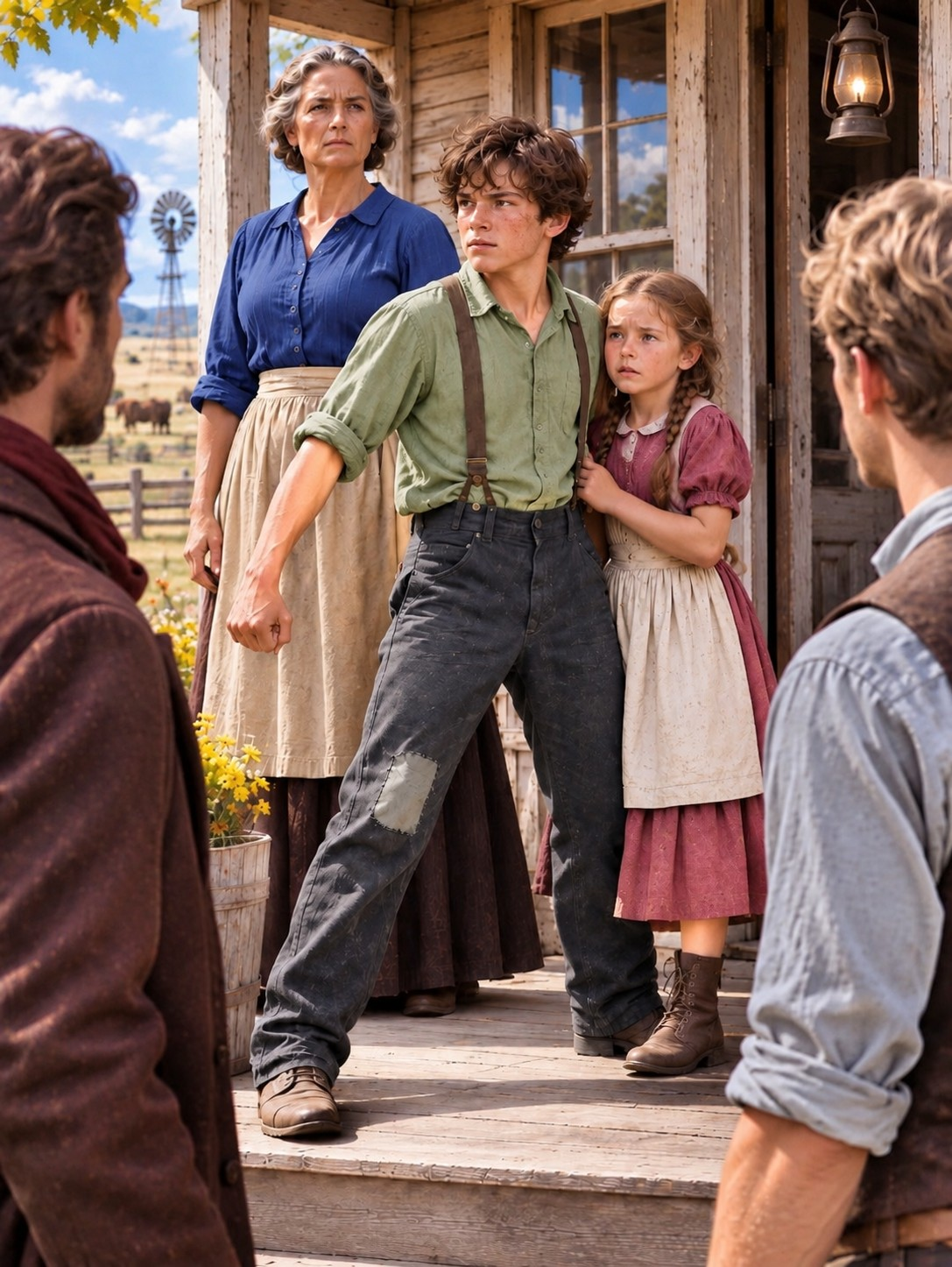
The dead man was standing in front of me.
Daniel Harper.
The father of two children who had spent months believing they were orphans.
The husband of a woman who had mourned him.
The man whose supposed death had helped Walter Pritchard tighten his grip around my family.
He stood between two deputies in the county courtroom, his wrists bound in iron.
And he was looking directly at me.
"Thomas lied to you about my death, too."
I gripped the back of the bench.
Beside me, Eli made a sound I would remember for the rest of my life.
It was not quite a cry.
Not quite a word.
It was the sound of a child watching the world he understood break apart.
"Papa?"
Daniel turned.
His face crumpled.
"Eli."
The boy took one step forward.
Then stopped.
I watched his expression change from disbelief to hope, from hope to anger, and finally to something so wounded that I wanted to pull him against me and hide him from every person in that room.
"You're dead," Eli whispered.
Daniel closed his eyes.
"I know what you were told."
Eli shook his head.
"No."
Rebecca rose from her seat.
"Daniel?"
He looked at her.
For a moment, neither spoke.
Then Rebecca covered her mouth.
"Oh, Daniel."
He lowered his head.
"I'm sorry."
Two words.
After years of grief.
After abandoned children, false graves, and nights spent hungry in a collapsing shed.
Two words.
I felt anger rise so fiercely that my hands began trembling.
I stepped forward.
"Sorry for what?"
Daniel looked at me.
I held his gaze.
"For allowing your children to believe they had nobody left?"
The courtroom went silent.
"Or for leaving them to survive without you?"
His face twisted.
"Mrs. Whitaker—"
"No."
I shook my head.
"Before you tell us how much you suffered, I want you to understand what your children suffered."
Eli stood beside me, trembling.
I put my arm around his shoulders.
"Your son stole food because his sister was starving."
Daniel's eyes filled.
"Your daughter nearly died in an abandoned shed."
He lowered his head.
"And while they were fighting to survive, the people who were supposed to protect them were either missing, hiding, or keeping secrets."
Daniel began crying.
I didn't look away.
"Now," I said, "tell us why."
The judge entered moments later.
Judge Abram Fletcher was a stern man in his sixties, with gray whiskers and a reputation for disliking unnecessary speeches.
He surveyed the crowded courtroom.
Then looked at Daniel.
"Mr. Harper, you have been brought here under a warrant concerning false statements, disputed financial instruments, and your disappearance from this county."
Daniel nodded.
"Yes, Your Honor."
The judge turned toward Walter Pritchard.
Walter stood beside his attorney, Alden Price.
For the first time since I had known him, he looked uncertain.
The judge continued.
"This hearing was scheduled to consider a provisional property claim. Given the new testimony and documents presented this morning, I intend to hear evidence relevant to that claim before making any further order."
Benjamin Collins rose beside me.
"Your Honor, I represent Mrs. Martha Whitaker."
"Proceed."
Benjamin placed Thomas's letters on the table.
He also submitted the disputed deed, the trust agreement, and the birth record bearing Walter's name.
The judge examined the papers.
Then looked toward Daniel.
"Mr. Harper, do you understand that your testimony may expose you to criminal liability?"
Daniel nodded.
"I do."
"Have you been offered immunity?"
"No, sir."
"Do you wish to speak with counsel before answering questions?"
Daniel hesitated.
Then shook his head.
"I want to tell the truth."
The judge studied him.
"Very well. You may answer, but the court will not treat your willingness to speak as proof that your account is accurate."
I appreciated that.
After everything my family had endured, I was finished accepting words without evidence.
Daniel was brought forward.
The deputies remained beside him.
And he began.
"Six years ago," Daniel said, "my wife discovered that money left to her family had been used to purchase land."
Rebecca lowered her head.
"Thomas Whitaker had been responsible for part of those funds."
I felt my chest tighten.
Daniel continued.
"He admitted what he'd done. He said he intended to repay the money through an agreement involving the north pasture."
The judge nodded.
"And Mr. Pritchard?"
Daniel's face hardened.
"He offered to arrange the settlement."
Walter shifted in his chair.
Daniel looked toward him.
"He told us he could prepare documents that would protect Rebecca's interest while allowing Thomas to keep operating the ranch."
Benjamin Collins made a note.
"What happened?"
"The papers changed."
Daniel swallowed.
"The amount owed increased. The interest changed. New conditions appeared. And suddenly the agreement said Walter could claim the land if I failed to repay a separate business loan."
The judge frowned.
"Did you sign that version?"
"No."
Walter's attorney rose.
"Your Honor, my client disputes this account."
The judge looked at him.
"Then your client will have an opportunity to respond."
Price sat.
Daniel continued.
"I confronted Walter. He threatened to accuse Rebecca of fraud and have the children placed elsewhere while the matter was investigated."
Rebecca began crying quietly.
I felt Eli stiffen beside me.
Daniel looked toward him.
"I'm sorry, son."
Eli stared at the floor.
The judge spoke.
"Continue."
"Thomas arranged for Rebecca to leave Kansas temporarily. He believed that if Walter thought she was dead, she could remain safe while he collected evidence."
I felt sick.
"Daniel," I whispered, "why didn't you send the children with her?"
The judge looked at me.
Benjamin touched my arm.
But Daniel answered.
"Because Walter was watching us. Thomas said moving all of us together would make it easy to find her."
He swallowed.
"I thought she'd be gone a few weeks."
Rebecca looked up.
"A few weeks?"
Daniel closed his eyes.
"I know."
Her voice broke.
"You told me you'd bring them."
"I tried."
"You stopped writing."
Daniel's face crumpled.
"Because Walter intercepted the letters."
Walter shook his head.
"Lies."
The judge struck his gavel.
"Mr. Pritchard, you will remain silent unless called upon."
Daniel continued.
"Thomas arranged a meeting near the old crossing. I was supposed to give him documents proving Walter had altered the agreements."
I leaned forward.
"The wagon accident."
Daniel nodded.
"Yes."
"What happened?"
His hands began trembling.
"The wagon was forced off the road."
A murmur spread through the courtroom.
Daniel looked toward Walter.
"Two men stopped me. They took the documents. One struck me with the butt of a pistol."
I felt cold.
"Then?"
"I woke in a freight wagon with my hands tied."
Rebecca covered her mouth.
Daniel swallowed.
"I was taken west. I was held for months. Later I was forced to work under another name to repay a debt Walter claimed I owed."
The judge leaned forward.
"Can you identify where?"
"Several places. A cattle operation near Dodge City first. Then a freight yard farther west."
"And how did you return?"
Daniel looked toward Marshal Brooks, who stood near the courtroom entrance.
"The marshal found me after Reverend Collins's brother began asking about the forged records. I had been trying to get word home."
Marshal Brooks nodded.
"We located Mr. Harper after receiving information from a former employee of the freight operation. His account is being investigated."
I looked at Daniel.
The explanation answered some questions.
Not all.
"Why didn't you come home sooner?" I asked.
He looked at me.
"Because I was afraid Walter would kill the children if I did."
Eli pulled away from my arm.
"Papa."
Daniel turned.
The boy's face was wet with tears.
"You should've come anyway."
Daniel closed his eyes.
"You're right."
The simplicity of the answer surprised me.
No excuses.
No attempt to make the boy feel guilty.
Just an acknowledgment.
Eli shook his head.
"You should've found us."
"I know."
"You should've told somebody."
"I know."
Then Eli asked the question that broke my heart.
"Did you ever think we were hungry?"
Daniel began sobbing.
And for the first time, I saw a grown man understand that his reasons, however frightening, could not erase what his children had endured.
The hearing continued for nearly two hours.
Benjamin Collins questioned Daniel about the altered agreements.
Reverend Collins confirmed that Thomas had asked him to preserve a sealed letter.
Josiah Mercer testified that Rebecca's death certificate carried a forged signature.
Margaret Bell admitted she had helped lure Annie from my home after Walter threatened her.
She also admitted that she had concealed Rebecca's survival for years.
The judge listened carefully.
Then Benjamin called Eleanor Whitaker.
She walked forward slowly.
Her hands trembled as she took the oath.
I watched her.
Thomas's sister.
A woman who had spent thirty-five years hidden from my family.
A woman whose silence had helped make all of this possible.
Benjamin asked, "Mrs. Whitaker, did your brother Thomas receive funds belonging to Rebecca Harper's family?"
"Yes."
"Did he have permission to use those funds to purchase the north pasture?"
Eleanor hesitated.
Then answered.
"No."
I closed my eyes.
There it was.
The truth.
Spoken aloud in a courtroom.
My husband had taken money that did not belong to him.
And I had spent decades believing every acre of our ranch had been purchased through honest labor.
Benjamin continued.
"Did Thomas later attempt to restore the money?"
"Yes."
"How?"
"Through a trust agreement giving Rebecca Harper a conditional interest in part of the pasture."
"Was Walter Pritchard involved?"
"Yes."
"Did Thomas authorize the deed transferring the land directly to Walter?"
"No."
Walter's attorney rose.
"Objection. The witness cannot know every document her brother may have signed."
The judge nodded.
"Sustained as to personal knowledge. Mrs. Whitaker, explain the basis for your answer."
Eleanor looked toward me.
Then at Benjamin.
"Thomas showed me the agreement he intended to sign. It named Rebecca as beneficiary. It did not transfer the land to Walter."
Benjamin nodded.
"And did Thomas later discuss the deed bearing Walter's name?"
"Yes."
"What did he say?"
Eleanor swallowed.
"He said someone had copied his signature."
The courtroom murmured.
Walter stared at the table.
I watched him carefully.
He had spent years making other people afraid.
Now, for the first time, I saw fear in him.
Then Benjamin placed Samuel's birth record before Eleanor.
I felt my heart stop.
"Mrs. Whitaker," he asked, "have you seen this document before?"
Eleanor looked at it.
Her expression changed.
"Yes."
Samuel went rigid beside me.
Benjamin continued.
"Do you know why Walter Pritchard's name appears on it?"
Eleanor looked toward me.
Then at Samuel.
Her eyes filled.
"Because Walter wanted it there."
My heart began pounding.
Samuel stood halfway from his seat.
"What?"
The judge raised a hand.
"Mr. Whitaker, remain seated."
Samuel sat.
But his face had gone white.
Benjamin leaned forward.
"Please explain."
Eleanor took a trembling breath.
"When Martha was expecting Samuel, Thomas asked me to help him locate a physician who could confirm the likely dates of conception."
I felt a sharp pain.
Thomas had never told me that.
Eleanor continued.
"He was frightened by what Walter might claim."
"Did the physician establish paternity?"
"No."
Samuel lowered his head.
Eleanor looked at him.
"I'm sorry."
Benjamin continued.
"Then what happened?"
"Thomas married Martha and acknowledged Samuel as his son. The original family record carried Thomas's name."
I stared at her.
"Original?"
She nodded.
"Yes."
Benjamin pointed toward the document.
"And this?"
Eleanor's expression hardened.
"This is not the original entry."
Walter's attorney rose.
"Your Honor—"
The judge raised his hand.
"Sit down, Mr. Price."
Benjamin asked, "How do you know?"
Eleanor reached into her handbag.
She removed a folded paper.
My breath caught.
It was a copy of a family register.
Thomas's handwriting appeared at the bottom.
And beside Samuel's name was a single entry.
Father: Thomas Whitaker.
Samuel stared.
Eleanor continued.
"Thomas asked me to keep this after Walter threatened to alter the county record."
The judge leaned forward.
"Do you have evidence the official record was changed?"
Eleanor nodded.
"The clerk who made the alteration wrote to Thomas before he died."
She handed Benjamin another letter.
I felt my heart pound.
Benjamin read it.
Then looked toward the judge.
"Your Honor, this letter appears to acknowledge that Walter Pritchard paid a county clerk to change the paternal entry."
Walter shot to his feet.
"That's a lie!"
The judge struck his gavel.
"Sit down!"
Walter remained standing.
Marshal Brooks stepped forward.
Walter looked around the courtroom.
For a moment, I thought he might run.
Then he sat.
I turned toward Samuel.
His eyes were full of tears.
"Ma," he whispered, "does that mean—"
I took his hand.
"It means the paper was altered."
He swallowed.
"But who was my father?"
I looked at him.
And told him the only answer I could give honestly.
"Thomas was the man who raised you. The rest may never be certain."
Samuel looked down.
For a moment, I feared he would pull away.
Instead, he squeezed my hand.
And whispered, "I think I can live with that."
By late afternoon, Judge Fletcher announced his provisional ruling.
The deed transferring the north pasture to Walter Pritchard would not be enforced while its authenticity was under investigation.
The survey order would be suspended.
The ranch would remain in my possession pending a full determination of the trust obligations.
And the guardianship matter involving Eli and Annie would be reviewed separately, with their wishes and their parents' circumstances considered.
I felt relief wash over me.
Not victory.
Not yet.
There were still questions.
Still debts.
Still the money Thomas had taken.
But Walter had not won.
At least not that day.
As the courtroom emptied, Rebecca approached me.
Her face was pale.
"Martha."
I turned.
She looked toward Eli, who stood beside Daniel near the doorway.
"Thank you for caring for them."
I nodded.
"They needed a home."
Her eyes filled.
"I know."
She hesitated.
"I don't expect you to forgive me."
I studied her.
She had suffered.
But so had her children.
And I was learning that compassion did not require pretending harm had never happened.
"Rebecca," I said, "your children need time."
She nodded.
"I know."
"They need you to stay."
"I will."
"And they need you to understand that they may be angry."
Her face crumpled.
"I deserve that."
I shook my head.
"This isn't about what you deserve. It's about what they need."
She looked toward Eli.
Then whispered, "I don't know how to begin."
I took her hand.
"Begin by listening."
We returned to the ranch at sunset.
Annie ran from the porch when she saw Eli.
He caught her in his arms.
"You're back!"
He nodded.
She looked past him.
Then froze.
Daniel Harper stood beside the wagon.
For a moment, Annie didn't move.
Then she whispered, "Papa?"
Daniel fell to his knees.
"Annie."
The little girl stared.
Her face changed.
Then she ran.
She threw herself into his arms so hard that he nearly fell backward.
He held her.
And cried.
I stood beside the wagon watching them.
Rebecca joined them.
Eli remained a few steps away.
He was not ready to forgive.
I understood.
But when Annie reached one hand toward him, he stepped closer.
And for a moment, the four of them stood together.
Not healed.
Not yet.
But together.
Samuel watched from the porch.
Caleb stood beside him.
I approached my sons.
Samuel looked at me.
"Ma?"
"Yes?"
"Can we talk?"
I nodded.
He glanced toward Caleb.
"Both of us."
I felt my chest tighten.
"Of course."
We sat in the kitchen after supper.
The children were upstairs.
Rebecca and Daniel were speaking quietly in the sitting room.
Eleanor had retired early.
Josiah was preparing to return to town.
Samuel sat across from me.
Caleb beside him.
For a long moment, neither spoke.
Then Samuel said, "I owe you an apology."
I looked at him.
"You've already apologized."
He shook his head.
"Not for everything."
I waited.
He swallowed.
"When I came home, I thought the ranch belonged to me."
Caleb looked toward him.
Samuel continued.
"I thought because I was your son, I had a greater claim to this place than anyone else."
I felt a familiar ache.
"And now?"
He looked down.
"Now I understand I was wrong."
I nodded.
He continued.
"I also thought Pa was a man who always knew what he was doing."
Caleb gave a sad laugh.
Samuel looked at him.
"We both did."
Caleb shook his head.
"I stopped believing that a long time ago."
Samuel nodded.
"I know."
He turned back toward me.
"Ma, I don't want to be like him."
The words surprised me.
"Your father had good qualities."
"I know."
Samuel swallowed.
"But he let pride hurt everyone he loved."
I felt tears rise.
"Yes."
He looked at me.
"I don't want to do that."
I reached across the table.
"Then don't."
He took my hand.
Caleb leaned forward.
"Ma, there's something I need to say too."
I turned.
He looked nervous.
The old habit returned.
His thumb rubbed against his forefinger.
"I used to think you chose Pa over us."
I felt my heart tighten.
"Caleb—"
He shook his head.
"Please let me finish."
I nodded.
He continued.
"When he sent me away, I waited by the barn because I thought you'd come."
My eyes filled.
"I know."
"I thought if you didn't, it meant you agreed with him."
I swallowed.
"I was afraid."
He nodded.
"I understand that now."
I looked at him.
"But it doesn't make what I did right."
Caleb's eyes filled.
"No."
I reached for his hand.
"I'm sorry."
He squeezed my fingers.
For a long moment, we sat together.
Three people who had spent years waiting for someone else to say the words that might finally let them come home.
Later, after my sons went upstairs, I returned to Thomas's study.
The house was quiet.
I sat at his desk.
The metal box lay open.
The letters were spread before me.
I thought about the man I had married.
He had loved us.
I believed that.
But he had also lied.
He had taken money.
He had allowed fear to become an excuse for silence.
And he had left me to untangle the damage after his death.
I felt anger.
Grief.
And something else.
A strange, painful freedom.
For thirty-five years, I had allowed Thomas to decide what I needed to know.
Now I was the one deciding.
I gathered the letters.
Placed them in order.
Then noticed something I had overlooked.
A narrow envelope tucked beneath the bottom of the metal box.
It was addressed to Samuel and Caleb.
My heart began pounding.
I opened it.
Inside was a single page.
Thomas's handwriting.
My sons,
If you are reading this, then your mother has discovered the truth.
I have spent my life demanding strength from you while hiding my own weakness.
I wanted you to become men who would never make my mistakes.
Instead, I taught you to fear making any mistake at all.
My eyes filled.
I continued.
Samuel, I was harder on you because I was afraid of what Walter might claim. That fear was mine, not yours.
Caleb, I sent you away because you reminded me of the courage I had lost. You questioned me when I deserved to be questioned.
I covered my mouth.
Thomas had finally written the words his sons had needed all their lives.
But he had hidden them.
Again.
I turned the page.
There was no second page.
Only a final paragraph.
There is one thing I must ask you both to do.
Protect your mother.
Not because she is weak.
Because she is the only one among us who never stopped trying to keep this family together.
I stared at the words.
Then I began crying.
Not because Thomas had finally praised me.
Because he had understood too late what his silence had cost us.
I folded the letter.
Then heard footsteps.
Samuel and Caleb stood in the doorway.
I looked up.
"Come in."
They entered.
I handed them the page.
"Your father left this for you."
Samuel read first.
His face changed.
Then he passed it to Caleb.
Caleb's hands trembled.
For a long time, neither spoke.
Finally, Samuel whispered, "He knew."
I nodded.
Caleb wiped his eyes.
"He knew what he did."
"Yes."
Samuel looked toward me.
"Why didn't he tell us?"
I shook my head.
"I don't know."
And for once, I didn't try to explain my husband.
I didn't defend him.
I didn't soften the truth.
I simply sat with my sons while they grieved the father they had loved and the father they had needed.
The next morning, Benjamin Collins returned to the ranch.
He looked troubled.
I met him on the porch.
"What is it?"
He removed his hat.
"Mrs. Whitaker, I received a telegram from Topeka."
My heart tightened.
"About Walter?"
"About the trust."
I stared at him.
"What happened?"
He hesitated.
"The state records contain another document."
I felt cold.
"What kind?"
"A transfer agreement."
I looked toward the house.
"From whom?"
Benjamin swallowed.
"Thomas Whitaker."
My heart pounded.
"To whom?"
He opened his briefcase.
Removed a folded paper.
And handed it to me.
I stared at the heading.
Then at the date.
The agreement had been executed shortly before Thomas died.
I looked at Benjamin.
"Is it valid?"
He hesitated.
"We don't know yet."
I unfolded the paper.
The first paragraph named the north pasture.
The second described the trust.
The third contained a provision I had never seen.
My hands began trembling.
Because Thomas had not simply attempted to restore Rebecca Harper's inheritance.
He had made another arrangement.
One that involved the entire ranch.
I looked up.
"Benjamin, what does this mean?"
He swallowed.
"It means your husband may have transferred his remaining interest in the property before his death."
I felt the porch tilt beneath me.
"To whom?"
Benjamin looked toward the road.
A wagon was approaching.
Two men sat in front.
One held a leather case.
The other wore the dark coat of a county official.
Benjamin's face went white.
"Martha," he whispered, "I think we're about to find out."
The wagon stopped.
The official climbed down.
He approached the porch.
Then removed a document bearing the state seal.
"Mrs. Martha Whitaker?"
I stared at him.
"Yes."
He unfolded the paper.
"I have been instructed to serve notice of a newly recorded claim."
My heart stopped.
He looked at Benjamin.
Then back at me.
"The claimant is requesting immediate possession of the Whitaker ranch."
I gripped the porch railing.
"Who?"
The official glanced toward the wagon.
The second man stepped down.
He removed his hat.
And when I saw his face, I realized that the person trying to take my home was someone I had welcomed into it only days before.
The man smiled.
Then said, "Martha, I'm sorry. But Thomas promised this ranch to me."






Comments 0