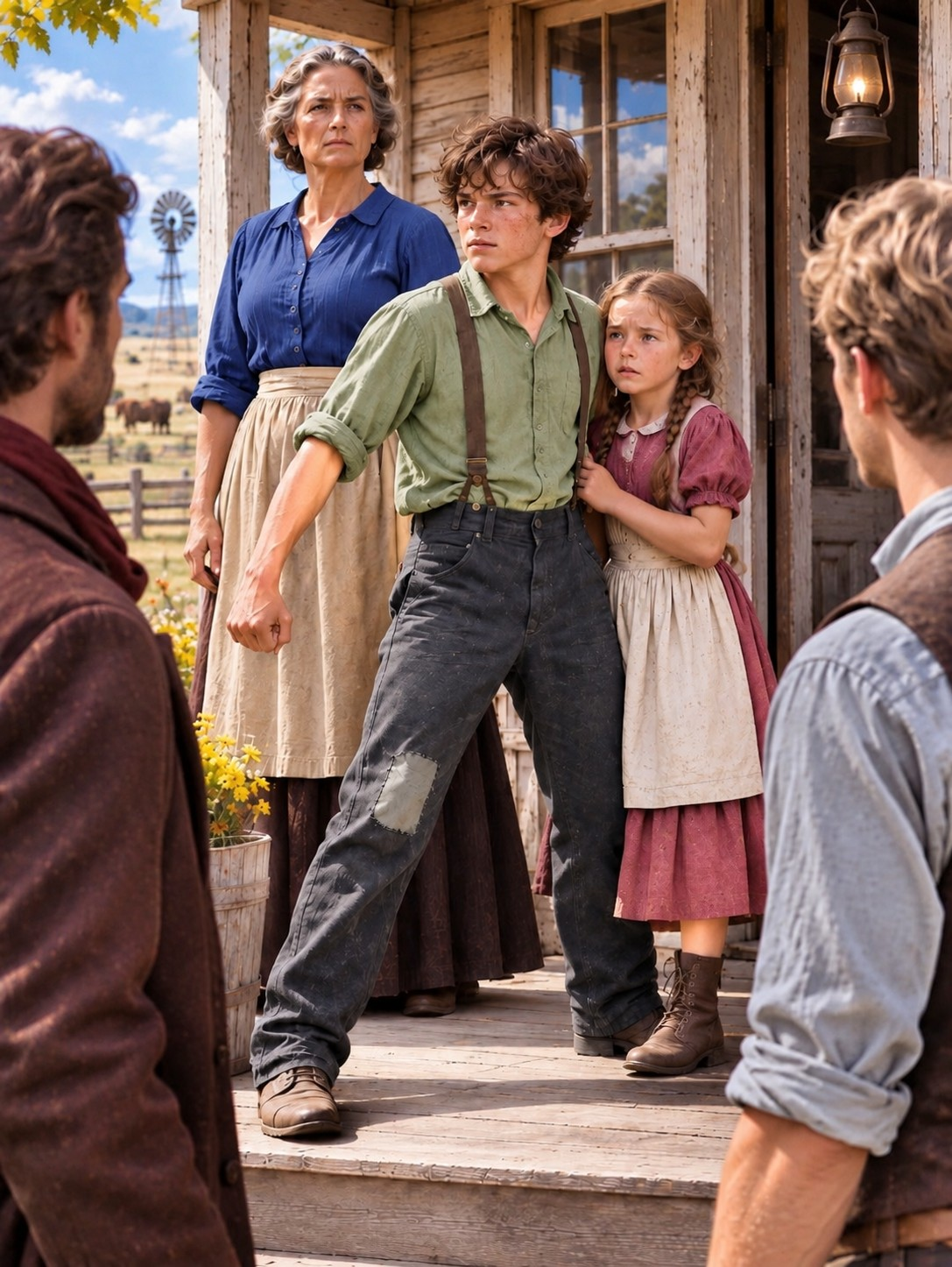
"Don't give her that letter, Reverend."
Walter Pritchard's voice echoed through the little church.
I stood beside the front pew with my dead husband's sealed envelope in my hand.
Walter was blocking the entrance.
Beside him stood a woman in a faded plum-colored traveling dress, her gloved fingers gripping a worn leather handbag.
I knew her face.
Twenty years had changed it, but not enough.
Her name was Margaret Bell.
And the last time I had seen her, she had been standing beside a young woman named Rebecca in a photograph Eli Harper kept hidden inside his father's Bible.
Rebecca had been Daniel Harper's first wife.
Eli's mother.
Annie's mother.
A woman who had supposedly died years before either child was old enough to understand what death meant.
I looked at Margaret.
Then at Walter.
And suddenly, the trouble surrounding my ranch seemed much larger than a dispute over property.
"Mrs. Whitaker," Walter said, stepping forward, "I suggest you put that envelope down."
I did not move.
Reverend Collins stood beside me.
Caleb shifted closer to the aisle.
"Mr. Pritchard," the reverend said, "this is a house of worship."
Walter smiled.
"Then I trust we can conduct ourselves peacefully."
"That depends," I answered, "on whether you intend to explain why you're following me."
His smile faded.
"I came to prevent a misunderstanding."
"You've been causing them since yesterday."
Margaret Bell lowered her eyes.
I noticed that she had not spoken.
Not once.
She stood beside Walter like someone who had been instructed to remain silent.
I knew that look.
I had worn it myself for too many years.
"Margaret," I said, "do you remember me?"
Her eyes lifted.
For one brief moment, I saw recognition.
Then fear.
"Yes, Mrs. Whitaker."
"Then you remember my husband."
She swallowed.
"Yes."
"And Daniel Harper?"
Walter turned sharply toward her.
"Margaret, there's no need—"
"I wasn't speaking to you," I said.
The church fell silent.
I took one step toward the woman.
"Margaret, did you know Daniel Harper?"
Her fingers tightened around her handbag.
"Yes."
"Did you know his children?"
She hesitated.
Then nodded.
I felt my heart begin to pound.
"Then perhaps you can explain why a man who claims their dead father owed him money has suddenly become so interested in taking them away from my home."
Walter stepped between us.
"Mrs. Whitaker, you are making accusations without evidence."
I looked directly at him.
"No, Mr. Pritchard. I'm asking questions."
Then I held up Thomas's envelope.
"And apparently, my husband left me some answers."
Walter's expression changed.
It was subtle.
A tightening around his mouth.
A flicker in his eyes.
But I saw it.
The man was afraid of a piece of paper.
And that frightened me more than his threats.
"That letter is private correspondence," he said.
"Then it doesn't concern you."
"It may contain information that has already been legally resolved."
"Then you should have nothing to worry about."
Caleb moved beside me.
"Ma, open it."
Walter's eyes snapped toward him.
"Young man, you would be wise not to involve yourself in matters you don't understand."
Caleb straightened.
For a moment, I saw the boy who used to shrink whenever Thomas raised his voice.
Then something changed.
"I'm already involved," Caleb said. "That's my mother you're threatening."
Walter gave a short laugh.
"Threatening? I merely suggested caution."
"Then you've made your suggestion," Reverend Collins replied. "You may leave."
Walter looked toward Margaret.
She remained near the doorway.
Her face had gone pale.
I broke the seal.
The sound was small.
Just paper tearing.
Yet Walter reacted as though I had fired a gun.
"Martha, don't."
I unfolded the letter.
Thomas's familiar handwriting covered two pages.
The first line read:
Martha, if Walter Pritchard has begun asking questions about our land, then I have failed to settle a matter that should never have reached your doorstep.
My hands tightened.
I read on.
I made a mistake trusting a man who believed every human weakness could be turned into a debt.
I also made the greater mistake of allowing our sons to believe that the ranch was something they might claim before you were finished living your life.
I glanced at Caleb.
He was watching me closely.
I continued.
The property is your home. Whatever arrangements I considered, none should be allowed to take that security from you.
My throat tightened.
Thomas had spent decades making decisions without consulting me.
And now, after his death, I was discovering that he had finally understood what those decisions had cost.
But understanding had come terribly late.
I turned the page.
There are papers in my desk concerning Samuel and the north pasture. Do not accept them at face value. I came to believe that my signature had been copied onto an instrument I never approved.
My breath caught.
Caleb leaned closer.
"What does it say?"
I read the sentence aloud.
Walter moved toward us.
Reverend Collins stepped into his path.
"That's far enough."
Walter stopped.
His face had lost all color.
I continued reading.
I have asked Reverend Collins to preserve the names of those who witnessed my objections. If the matter reaches court, the truth must be established there.
Below that, Thomas had written another sentence.
And Martha, if the Harper children have become involved, you must understand that their father's troubles were not separate from mine.
I stopped.
The words blurred.
The Harper children.
Thomas had written about them before Daniel died.
Before Eli stole food from my smokehouse.
Before Annie nearly froze to death in an abandoned shed.
I looked toward Walter.
"How did my husband know Daniel Harper?"
Walter said nothing.
Margaret Bell made a small sound.
I turned toward her.
"Margaret?"
She covered her mouth.
Then whispered, "Because Daniel tried to warn him."
Walter seized Margaret's arm.
"That's enough."
She flinched.
I felt something cold settle inside me.
"Take your hand off her."
He released her.
"Mrs. Bell is confused."
Margaret shook her head.
"No."
Walter turned.
"Margaret."
She looked at him.
And for the first time, I saw anger beneath her fear.
"I am tired of being confused whenever the truth becomes inconvenient."
Reverend Collins stepped closer.
"Mrs. Bell, would you like to sit down?"
She nodded.
Caleb brought her to the nearest pew.
Walter remained standing.
I folded Thomas's letter carefully.
"Margaret, tell me what happened."
She stared at her hands.
"Rebecca Harper was my cousin."
I nodded.
"I remember."
"She was younger than me. Too trusting."
Her voice trembled.
"She married Daniel when she was barely twenty. They were happy for a while."
"What happened?"
"Money became difficult. Daniel's wagon work wasn't steady. Then Rebecca inherited a small sum from her mother's family."
Walter looked toward the door.
Margaret noticed.
"She wanted to buy a little house," she continued. "Somewhere the children could grow up."
"Eli and Annie?"
"Eli was very small then. Annie hadn't been born."
I waited.
"Daniel borrowed money to purchase equipment for his business. Walter arranged the loan."
I looked at Pritchard.
He remained silent.
"Rebecca didn't understand the papers," Margaret said. "Neither did Daniel, not completely."
"What papers?"
"An agreement involving the loan, the equipment, and Rebecca's inheritance."
I frowned.
"How does that concern my ranch?"
Margaret looked toward Thomas's letter.
"Because Daniel discovered that one of the documents had been altered after he signed it."
My stomach tightened.
"Altered how?"
"An additional guarantee appeared. A guarantee involving land that did not belong to Daniel."
Caleb stared at her.
"Our land?"
Margaret nodded.
I felt the church floor grow unsteady beneath me.
"How could Daniel guarantee property he didn't own?"
"He couldn't," Margaret said. "That was the problem."
Walter finally spoke.
"This is absurd. Mrs. Bell has no understanding of commercial agreements."
Margaret turned toward him.
"I understood enough to see Rebecca crying over papers she never agreed to sign."
Walter's jaw tightened.
I looked back at Margaret.
"Did Thomas know?"
"Eventually."
"How?"
"Daniel went to him."
I thought of the letters.
The hidden compartment.
The suspicious deed.
The way Thomas had seemed troubled during the final months of his life.
I had believed he was worried about cattle prices.
Now I wondered how many nights he had sat awake trying to undo something he had never told me about.
"Did Daniel prove the documents were false?" I asked.
Margaret hesitated.
"He found evidence."
"What evidence?"
She looked toward Walter.
Then back at me.
"That's what he was carrying the day his wagon overturned."
Nobody spoke.
I heard the wind pressing against the church windows.
A wagon overturned.
Daniel Harper killed.
Two children left alone.
A debt that refused to disappear.
I looked at Walter Pritchard.
"Was Daniel's death an accident?"
He stared at me.
"Be careful, Martha."
The words were quiet.
Almost gentle.
That made them worse.
I stepped toward him.
"Was it?"
Walter's face hardened.
"Daniel Harper drove an overloaded wagon on a dangerous road. He died because he made a foolish decision."
Margaret began crying.
I turned toward her.
"Margaret?"
She shook her head.
"I don't know what happened to Daniel. I truly don't."
I believed her.
"But I know Rebecca was frightened of Walter long before Daniel died."
Walter laughed bitterly.
"Rebecca Harper was a troubled woman."
Margaret stood so suddenly that Caleb reached toward her.
"Don't you dare speak about her that way."
Her voice rang through the church.
Walter looked stunned.
"She was frightened because you kept telling her that Daniel's debts would take everything from them," Margaret continued. "You told her she could lose her children."
I felt a sharp pain beneath my ribs.
"What?"
Margaret looked at me.
"Rebecca believed that if Daniel couldn't repay the loan, Walter would arrange for Eli to be sent to work and Annie to be placed with another family."
I thought of Eli's terror.
His refusal to trust the sheriff.
His desperate insistence that he and Annie stay together.
Now I understood where some of that fear had begun.
It had been planted long before their father died.
"That's not how a debt works," Reverend Collins said firmly.
Walter spread his hands.
"Precisely. This woman is repeating nonsense."
Margaret shook her head.
"You knew she didn't understand the law. You used that against her."
I looked at Walter.
He did not deny it.
Instead, he reached for his hat.
"I have heard enough."
"Then leave," I said.
He turned toward me.
"You should consider carefully what you're doing, Martha."
I held his gaze.
"I have spent thirty-five years considering what men wanted me to do."
He said nothing.
"I'm finished with that."
For a moment, I thought he might argue.
Instead, he smiled.
A thin, unpleasant smile.
"Then I hope you are prepared to pay the price."
He walked out.
The church door slammed behind him.
Margaret sank onto the pew.
And began to sob.
We remained in the church for nearly an hour.
Reverend Collins brought water.
Caleb sat beside Margaret.
I asked questions.
Some she answered.
Others she could not.
Rebecca Harper had died after a long illness, several years before Daniel's accident.
Margaret had helped care for her during the final weeks.
Rebecca had spoken repeatedly about documents, debts, and a promise Daniel had made to protect their children.
But she had never explained everything.
"She was ashamed," Margaret whispered.
"Ashamed of what?"
"Of needing help. Of not understanding what she'd signed."
I looked down at my hands.
I knew something about that kind of shame.
Thomas had managed our finances for most of our marriage.
I could count money.
Keep household records.
Negotiate with merchants.
But legal documents were another matter.
Whenever I asked questions, Thomas would say, "Don't trouble yourself with things I've already handled."
I had accepted that for years.
Now I was discovering how dangerous ignorance could become when it was mistaken for trust.
"Margaret," I said, "why did you come with Walter?"
She wiped her eyes.
"He told me the Harper children had been found."
I waited.
"He said they were living with a woman who intended to use them for ranch labor."
Caleb looked furious.
"That's a lie."
"I know that now."
Margaret looked toward me.
"He said if I came to town and confirmed their identities, he could arrange a proper home for Annie."
"And Eli?"
She began crying again.
"He said Eli was old enough to earn his keep."
My stomach turned.
The same cruel division.
The same threat Eli had feared since his father died.
"What did he promise you?" I asked gently.
Margaret looked ashamed.
"That Annie would be safe."
I nodded.
"And you believed him."
"I wanted to."
There was a difference.
I understood it.
People sometimes believe terrible men because the alternative is admitting they have no safe place left to turn.
"Would you be willing to tell the county authorities what you've told us?" Reverend Collins asked.
Margaret hesitated.
Walter's shadow still hung over her.
"I don't know."
I reached across the pew.
"Margaret, those children have already lost enough."
She looked at me.
"If you know something that can keep them together, please don't make them suffer because you're afraid of him."
Tears rolled down her cheeks.
Finally, she nodded.
"I'll try."
It wasn't a promise.
But it was more than I had expected when she walked through the church doors.
Reverend Collins examined Thomas's letter again.
Then he took the questionable deed from the folder.
"These papers need an attorney's attention."
"Your brother?" I asked.
"Yes. I'll send a telegram today."
"How soon can he come?"
"Perhaps within several days."
I looked at him.
"The hearing is in three."
"Then I'll ask him to advise us by telegram first."
Caleb leaned forward.
"What about Walter?"
The reverend studied the deed.
"If this signature is forged, the matter is serious."
"Can he take the ranch?" I asked.
"Not simply by claiming he owns it. But a disputed instrument can create costly trouble, particularly if someone has already borrowed money against it."
My stomach tightened.
"Samuel."
Caleb looked at me.
We were thinking the same thing.
My eldest son had borrowed money.
Walter held his debts.
And somehow, the north pasture had become part of an arrangement Thomas never approved.
I felt a terrible suspicion forming.
Had Samuel knowingly helped Walter?
Or had Walter used my son's desperation to gain control of the land?
I wanted to believe the second possibility.
But I had learned enough in the past twenty-four hours to distrust what I wanted to believe.
"Reverend," I said, "I need you to keep copies of these documents."
He nodded.
"I will."
"And the original letter?"
"Take it home. Thomas meant you to have it."
I folded the pages.
For a moment, I pressed them against my chest.
It was the closest I had come to hearing my husband's voice since the day he died.
And the strange thing was that I no longer knew whether I wanted to forgive him.
Part of me did.
Another part remembered all the years when a living apology would have mattered more than a dead one.
Perhaps forgiveness would come.
Perhaps it wouldn't.
But I was no longer willing to pretend that love erased responsibility.
Not for Thomas.
Not for Samuel.
Not for anyone.
Caleb and I rode home in silence.
The afternoon sun had begun sinking toward the prairie.
The road stretched ahead in a ribbon of pale dust.
At one point, Caleb asked, "Ma, do you hate Pa?"
The question surprised me.
I considered it carefully.
"No."
"Even after everything?"
"I loved your father for thirty-five years."
Caleb nodded.
"But loving someone doesn't mean every choice they made was right."
He looked toward the horizon.
"I spent years hating him."
"I know."
"Sometimes I still do."
I glanced at him.
"Then perhaps you have more grieving left to do than you realized."
He gave a sad smile.
"Maybe."
We rode another mile.
Then he said, "I was angry with you too."
I felt the words land.
"I know."
He looked surprised.
"You did?"
"Of course."
"Then why didn't you say anything?"
I thought about that.
Because I had been ashamed.
Because I had believed mothers were supposed to hold families together.
Because admitting that my sons were angry with me meant admitting I had failed them in ways I couldn't repair with supper and clean clothes.
"I suppose I was afraid you'd tell me why," I said.
Caleb looked at me for a long moment.
Then he nodded.
"That sounds about right."
It hurt.
But it was honest.
And honesty, I was learning, could be painful without being cruel.
"Would you tell me now?" I asked.
He took a breath.
"When Pa told me to leave, I waited outside by the barn."
I remembered that day.
The argument.
The slammed door.
The sound of Caleb's horse being saddled.
"I thought you'd come after me," he continued.
My throat tightened.
"I wanted to."
"But you didn't."
"No."
He looked ahead.
"I waited almost an hour."
I closed my eyes briefly.
An hour.
My boy had waited an hour for his mother.
And I had remained inside, washing dishes while Thomas sat at the kitchen table pretending nothing had happened.
"I am sorry," I whispered.
Caleb nodded.
"I know."
Then he added something that nearly broke me.
"I didn't need you to fight Pa. I just needed you to tell me I could come back."
I had no answer.
Because he was right.
We reached the ranch shortly before sunset.
Samuel was in the yard repairing the south gate.
Eli stood nearby holding a hammer.
For a moment, the sight surprised me.
My eldest son and the orphan boy were working together.
Not speaking much.
But working.
Annie sat on the porch with a sheet of paper balanced on her knees.
She looked up when she saw me.
"Grandma!"
She ran down the steps.
I dismounted carefully.
She threw her arms around my waist.
"Did you find out?"
I looked at her.
"Some things."
"Are we staying?"
I knelt.
"Yes."
Her face brightened.
Then she noticed my serious expression.
"Are you sure?"
I touched her cheek.
"I'm doing everything I can."
She nodded solemnly.
That was enough for the moment.
Eli approached.
He looked from me to Caleb.
Then toward the road.
"Did you see the sheriff?"
"Not today."
He seemed relieved.
Samuel set down his hammer.
"Ma, can we talk?"
I looked at him.
"Later."
His expression tightened.
"It's important."
"So is supper."
I took Annie's hand.
Then I walked toward the house.
I could feel Samuel watching me.
For once, I didn't turn around to make him feel better.
That evening, something unexpected happened.
Samuel helped Annie carry dishes to the table.
He did it awkwardly.
As though he wasn't sure how to speak to a little girl who had spent the previous evening frightened of him.
Annie watched him carefully.
When he placed a bowl beside her plate, she whispered, "Thank you."
He nodded.
"You're welcome."
Eli noticed.
So did I.
Later, Samuel asked Eli about the south fence.
The boy answered cautiously.
They discussed a broken post.
A loose hinge.
A section of wire that needed replacing.
For a few minutes, they sounded like two people who had something ordinary in common.
I wanted to be pleased.
I was pleased.
But I was also wary.
One afternoon of kindness could not undo the fear Samuel had caused.
And I would not ask the children to pretend otherwise.
After supper, Annie showed Caleb her drawings.
He laughed at one of the horses.
"That's a fine-looking animal."
Annie frowned.
"It's supposed to be a cow."
Caleb laughed harder.
She looked offended.
Then she began laughing too.
The sound filled the kitchen.
For a moment, I saw what our family might become.
Not perfect.
Not healed.
But capable of beginning again.
Then Samuel asked me to step outside.
We stood on the porch beneath the hanging lantern.
The prairie was dark.
Crickets sang in the grass.
A warm breeze carried the smell of hay from the barn.
Samuel leaned against the railing.
"I fixed the gate."
"I saw."
"Eli helped."
"He's good with tools."
Samuel nodded.
"He is."
For a while, neither of us spoke.
Then he said, "I was wrong about the children."
I looked at him.
He continued.
"I didn't know what they'd been through."
"No."
"I thought they were taking advantage of you."
"And now?"
He looked toward the kitchen window.
Inside, Annie was laughing at something Caleb had said.
Eli stood beside the table, trying not to smile.
Samuel watched them.
"Now I think maybe you've been helping each other."
I felt something soften inside me.
"That's true."
He nodded.
Then his expression changed.
"Ma, I need to tell you something."
I waited.
He rubbed his hands together.
"I owe Walter money."
"I know."
He looked startled.
"Caleb told you?"
"Enough."
Samuel stared toward the pasture.
"It's worse than he knows."
My stomach tightened.
"How much worse?"
He swallowed.
"I borrowed against my cattle. Then my equipment. Then the land Pa promised me."
I looked at him.
"The north pasture."
He nodded.
"Samuel, that land was never yours."
"I know."
"Then how could you use it as security?"
He covered his face.
"Because Walter said the papers were already prepared."
I felt cold.
"What papers?"
"The ones Pa had signed."
I shook my head.
"Your father said he never approved them."
Samuel stared at me.
"What?"
I told him about the letter.
The suspected forgery.
The warning Thomas had left with Reverend Collins.
Samuel listened without moving.
When I finished, he looked sick.
"Then Walter lied to me."
"Perhaps."
He looked at me sharply.
"You think I knew?"
"I don't know what to think."
His face crumpled.
"Ma, I swear I didn't forge Pa's name."
I held his gaze.
"Then tell me everything."
He looked toward the road.
"I signed an agreement at the county office. Walter said it was temporary. He said once Pa approved the arrangement, I could borrow enough to save my cattle operation."
"And when your father refused?"
"Walter told me the agreement was already binding."
I felt my heart pound.
"Did you believe him?"
Samuel nodded miserably.
"I wanted to."
There it was again.
The same dangerous sentence.
Margaret had wanted to believe Walter.
Samuel had wanted to believe Walter.
And I had wanted to believe my sons came home because they missed me.
Wanting something to be true did not make it so.
"Samuel," I said, "you must tell the attorney everything."
He shook his head.
"Then Walter will ruin me."
I looked at him.
"He's already trying."
Samuel stared at the floor.
Then whispered, "Ma, there's something else."
I felt a familiar dread.
"What?"
He looked toward the kitchen window.
"Yesterday, when I spoke to Walter, he told me the Harper children were connected to the debt."
"I know."
Samuel looked startled.
"How?"
"Margaret Bell."
His expression changed.
"You spoke to Margaret?"
"Yes."
He stepped closer.
"Ma, you don't understand. Walter has been looking for those children for months."
I felt my stomach tighten.
"Why?"
Samuel swallowed.
"He said Daniel Harper left something behind."
"What?"
"I don't know."
"Samuel."
His eyes filled.
"He said if I helped him find the children, he'd forgive part of my debt."
For a moment, I could not speak.
I looked through the window.
Annie was sitting at the kitchen table.
Eli stood beside her.
Two children who had already lost everything.
And my son had considered using them to pay what he owed.
"Did you agree?" I asked.
Samuel looked away.
I felt the answer before he spoke.
"At first."
The words struck me harder than any insult.
I stepped backward.
Samuel reached toward me.
"Ma, I changed my mind."
I raised one hand.
"Don't."
He stopped.
"I didn't know what he wanted."
"You knew he wanted the children."
"I thought—"
"You thought what?"
My voice remained quiet.
That made him look even more ashamed.
"You thought their safety was something you could bargain with?"
He covered his face.
"I'm sorry."
I looked at him.
My firstborn son.
The boy I had held through fevers.
The young man I had defended against his father's anger.
The man who had returned after seven years.
And now I understood the terrible price he had been willing to let someone else pay for his mistakes.
"Samuel," I whispered, "you will spend the rest of your life proving that apology means something."
He nodded.
Tears slipped down his cheeks.
"I know."
I turned toward the door.
Then he spoke again.
"Ma, Walter said something about Annie."
I stopped.
"What?"
"He said her mother left a document."
My heart began pounding.
"What kind of document?"
Samuel shook his head.
"He wouldn't tell me."
"Where is it?"
"He said Daniel hid it before the accident."
I stared at him.
"Did he say where?"
Samuel hesitated.
Then looked toward the barn.
"He thought Eli might have it."
I found Eli in the kitchen washing the last of the supper dishes.
Annie had gone upstairs with Caleb to find a book.
The boy looked up when I entered.
"Mrs. Whitaker?"
I closed the door behind me.
"Eli, I need to ask you something."
His expression changed immediately.
"What happened?"
"Nothing has happened."
He didn't believe me.
I sat at the table.
"Do you remember the satchel you carried the night we met?"
He nodded.
"Of course."
"Did your father give it to you?"
Eli looked surprised.
"Yes."
"Did he put anything inside it?"
"Some clothes. His Bible. A few papers."
My heart began pounding.
"What papers?"
Eli frowned.
"I don't know. I never looked at all of them."
"Where is the satchel now?"
"In my room."
I stood.
"Would you bring it down?"
He hesitated.
Then nodded.
A few minutes later, he returned carrying the worn leather bag.
He placed it on the table.
I recognized it immediately.
The cracked strap.
The missing buckle.
The dark stain near the bottom.
I had seen him carrying it through the snow the night Annie nearly died.
Eli opened the flap.
Inside were two shirts, a small wooden toy, Daniel Harper's Bible, and several folded papers.
He removed them carefully.
One was a receipt.
Another was an old letter.
The third was a small envelope.
It was addressed to Rebecca Harper.
Eli stared at it.
"I've never opened that."
I looked at him.
"Would you like to?"
He swallowed.
Then nodded.
His fingers trembled as he broke the seal.
Inside was a single sheet of paper.
He unfolded it.
I watched his expression change.
Confusion.
Then surprise.
Then something very close to fear.
"What is it?" I asked.
He looked at me.
"Mrs. Whitaker, this isn't Papa's handwriting."
I leaned closer.
The letter was written in a careful, elegant hand.
At the bottom was a signature.
I recognized it.
I had seen that signature hundreds of times during my marriage.
Thomas Whitaker.
My dead husband.
Eli looked up.
"Why would your husband write to my mother?"
I took the paper.
My hands began to shake.
The first sentence read:
Rebecca, if Walter Pritchard discovers what Daniel and I have done, he will come for the children.
I stopped breathing.
Below it, Thomas had written:
There is only one person I trust to keep them safe.
I stared at the next line.
It contained my name.
Martha Whitaker.
Then, beneath it, in darker ink, were six words that made my blood turn cold.
She must never know the reason.
I looked toward the staircase.
Annie's laughter floated down from above.
Eli stood beside me, waiting.
And suddenly I understood that Thomas had not merely known about the Harper children.
He had been hiding something about them.
Something he believed I could not bear to discover.
I turned the page over.
There was another paragraph.
But before I could read it, a sharp knock sounded at the back door.
Three times.
Then a woman's voice called through the darkness.
"Martha Whitaker, please don't let the children hear me."
I froze.
The voice was familiar.
Far too familiar.
I crossed the kitchen and lifted the curtain.
Margaret Bell stood outside.
Her face was streaked with tears.
Her dress was torn at the sleeve.
And in her trembling hands she held a small silver locket.
The same locket Annie had told me her mother was buried wearing.
Margaret pressed her face close to the glass.
Then she whispered:
"Martha, I lied to you at the church. Rebecca Harper didn't die the way everyone thinks she did."
I reached for the lock.
But Margaret shook her head desperately.
"Before you open that door, you need to know who's standing behind me."
I looked past her shoulder.
A second figure stepped out of the darkness.
And when the lantern light touched the stranger's face, I recognized someone who had attended my husband's funeral nineteen months earlier.






Comments 0