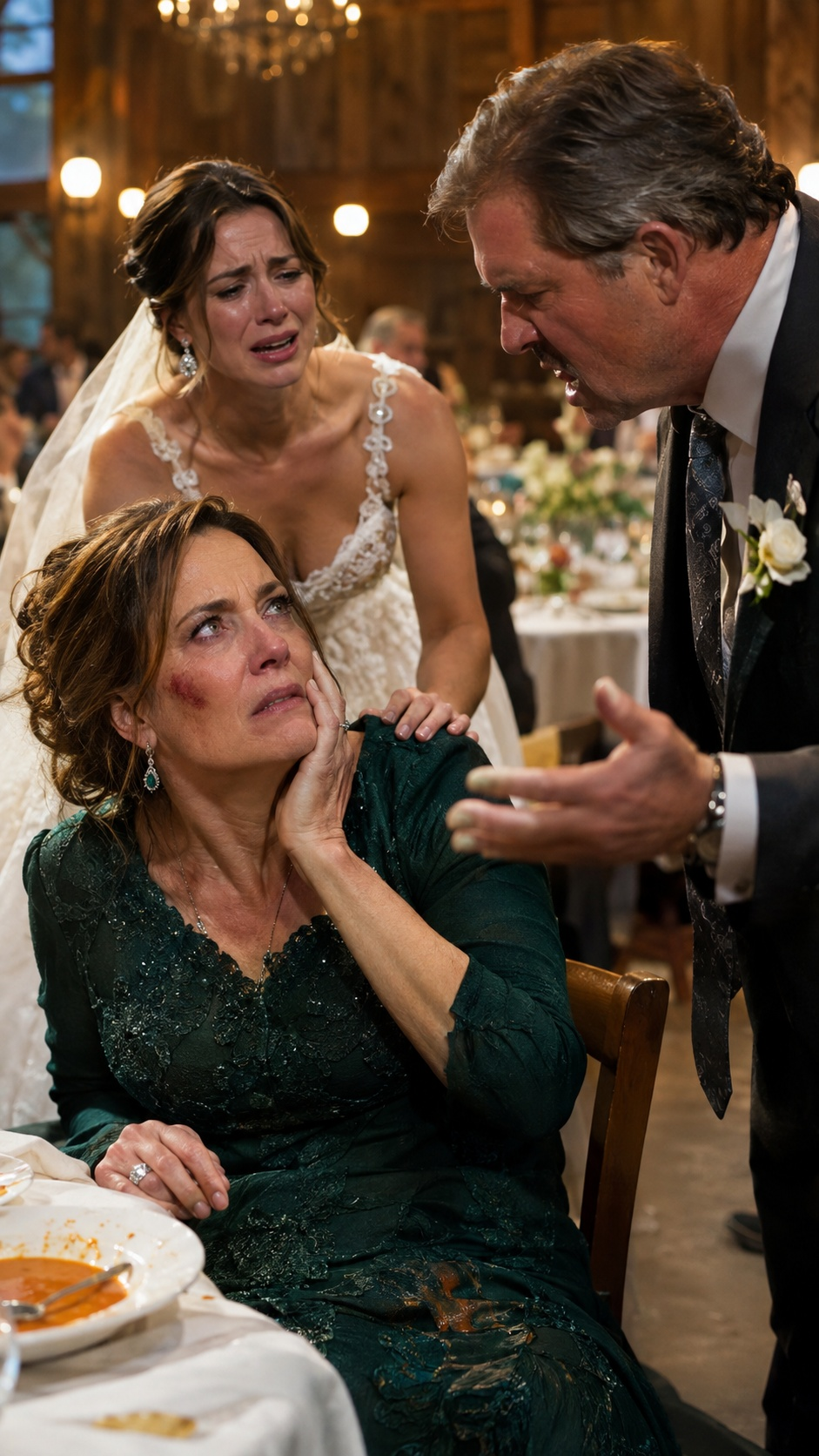
"Grace, open the door. Please."
I stood barefoot in Evelyn's guesthouse, staring at the brass doorknob.
The voice belonged to a man I had buried in my mind three years earlier.
Not my father.
Not a relative.
A man whose supposed death had been used to explain the disappearance of nearly half a million dollars from Gabriel's development company.
His name was Samuel Reed.
And according to Gabriel, Samuel had died in a highway accident outside Dallas.
I had attended no funeral.
Seen no death certificate.
Only heard my husband say, "Terrible business. Sam was a good man."
Now Samuel was standing outside my door.
Alive.
And carrying an envelope thick enough to change everything.
"Grace," he whispered again, "I know you're frightened. I would be too."
I stepped closer without touching the lock.
"How do I know it's really you?"
A pause.
Then he said, "Your father built my daughter's rocking chair. He carved a little bluebird underneath the seat because she was born in April."
My breath caught.
I remembered that chair.
Daddy had made it when Samuel's daughter turned two.
He had refused payment.
Samuel had been a young accountant working for a local construction company then, struggling to support his family.
Daddy told him to save his money.
"Children grow fast," he had said. "Let the chair be my gift."
Only a handful of people knew about the bluebird.
I pressed my forehead against the door.
"Sam?"
"Yes."
"Gabriel told me you were dead."
"I know."
"Why?"
His answer came quietly.
"Because dead men don't testify."
I didn't open the door immediately.
I called Evelyn.
She answered on the second ring.
"Grace?"
"Someone's outside."
"Who?"
"Samuel Reed."
Silence.
Then Evelyn said, "The accountant?"
"Yes."
"The one Gabriel said died?"
"Yes."
I heard her getting out of bed.
"Don't open that door until I'm there."
Three minutes later, lights came on in the main house.
Evelyn appeared on the walkway wearing a bathrobe and carrying her phone.
She stopped several feet from Samuel.
I watched through the window.
Samuel raised his hands.
He was older than I remembered.
His hair had turned almost completely white.
He had lost weight.
But his face was unmistakable.
Evelyn spoke to him for several minutes.
Then she called me.
"It's him," she said. "But I want us to hear what he has to say together."
I unlocked the door.
Samuel stepped inside.
The moment he saw my bruised cheek, his expression changed.
"Dear God, Grace."
I looked away.
"Don't."
He nodded.
"I'm sorry."
He placed the envelope on the kitchen table.
Then he sat down without being asked.
For a moment, none of us spoke.
Finally, I asked the question that had been burning inside me.
"Why did Gabriel tell me you were dead?"
Samuel folded his hands.
"Because three years ago, I discovered what he and Richard were doing with the company accounts."
I stared at him.
"What were they doing?"
He looked toward Evelyn.
Then back at me.
"Borrowing money against assets they didn't own."
My stomach tightened.
"Like my father's land?"
Samuel nodded slowly.
"Exactly like your father's land."
Samuel had worked as an outside accountant for Gabriel's development company for nearly eight years.
He handled financial statements, loan schedules, and investor reports.
At first, he said, the company appeared successful.
Gabriel bought properties.
Built expensive homes.
Sold them to wealthy buyers.
He cultivated bankers and local officials.
He donated to charities.
He sponsored golf tournaments.
And he made certain everyone knew his name.
But beneath the polished reputation, the business had been weakening for years.
Projects ran over budget.
Investors demanded repayment.
Construction loans came due before houses sold.
Gabriel responded by borrowing more.
Richard found lenders willing to overlook inconvenient details.
Then, according to Samuel, they began using questionable property valuations and unsupported claims of collateral to secure additional financing.
"Your father's property kept appearing in internal projections," Samuel said.
I gripped my coffee cup.
"How long?"
"At least twelve years."
Twelve years.
I felt the number settle inside me.
Twelve years of Gabriel telling me the land was worthless.
Twelve years of insisting Daddy had left me nothing but a financial burden.
Twelve years of trying to persuade me to sell.
"He wanted it all along," I whispered.
Samuel nodded.
"He believed the land would eventually become extremely valuable."
"Why?"
"Because of planned development west of Fredericksburg. Road access, commercial expansion, luxury residential demand. Your property sits in an area investors have been watching for years."
I looked down.
Daddy had never cared about development projections.
He cared about the pecan trees.
The workshop.
The pond.
But Gabriel had seen something else.
Money.
"Three years ago," Samuel continued, "I found a set of financial statements that included your land as pledged collateral."
My head snapped up.
"But I never signed anything."
"I know."
"How could they do that?"
"They represented that authorization existed. I demanded the supporting documents."
"And?"
Samuel's face tightened.
"Richard told me to stop asking questions."
I stared at him.
"What happened next?"
"I refused to certify the statements."
He paused.
"Two days later, someone broke into my office."
Evelyn leaned forward.
"Did you report it?"
"Yes. But nothing valuable appeared to be missing."
"Except?" I asked.
Samuel looked at me.
"Except my working files."
He told us the rest slowly.
After the break-in, Gabriel accused him of mishandling company money.
Richard threatened to sue.
Then Samuel began receiving anonymous messages.
His wife was followed.
His daughter found a photograph of their house tucked beneath the windshield wiper of her car.
Samuel contacted an attorney.
He preserved what records he could.
And when the threats escalated, he moved his family out of Texas.
"Gabriel told people I died in a car accident," he said.
I shook my head.
"How could he get away with that?"
"He didn't make a public announcement. He told selected people privately. You were one of them."
I remembered the conversation.
Gabriel standing in our kitchen.
His expression solemn.
His voice full of practiced sadness.
Sam was killed outside Dallas. Terrible accident.
I had believed him.
I had even offered to send flowers to Samuel's family.
Gabriel told me they wanted privacy.
Now I understood why.
"Why didn't you contact me?" I asked.
Samuel lowered his eyes.
"Because I didn't know whether you were involved."
The words hurt.
But I couldn't blame him.
Gabriel had spent years presenting us as a united couple.
He spoke for me at business dinners.
Answered questions directed at me.
Signed holiday cards from both of us.
He made certain people believed I shared his opinions.
Samuel looked at my bruised face.
"I know better now."
I swallowed.
"Why come tonight?"
He slid the envelope toward me.
"Because Richard made a mistake."
Inside the envelope were copies of financial records.
Loan summaries.
Internal emails.
Property valuations.
And a photograph of a document bearing my name.
I recognized the signature immediately.
The same false signature Margaret had shown me.
Samuel pointed to a handwritten notation beside it.
"Look at the date."
It was three years earlier.
Not the week of Nora's wedding.
I stared at him.
"They've been using my name for years?"
"Trying to. Some lenders rejected the paperwork. Others accepted preliminary representations without completing the transaction."
I felt sick.
Samuel continued.
"The recent filing is different. They appear to be trying to formalize a claim before a major financing deadline."
"How much money?"
He hesitated.
"Potentially several million dollars."
Evelyn whispered something I couldn't hear.
I looked at Samuel.
"And Nora?"
His expression changed.
"What about her?"
"Her name appears on the recent document."
Samuel was silent.
Then he said, "I was afraid of that."
My chest tightened.
"What do you mean?"
He reached into his jacket and removed a folded page.
It was a copy of an email.
The sender was Richard Voss.
The recipient was Gabriel.
The subject line read:
FAMILY WITNESS REQUIREMENT
I read the message.
Richard had written that a witness connected to the family would make the supporting paperwork appear more credible.
He suggested Nora.
Gabriel's reply contained only one sentence.
She'll do what I tell her.
I stared at those words.
My daughter.
My little girl.
The child I had raised.
Gabriel had spoken about her as though she were another tool he could use.
Just as he had used me.
I pressed the paper against the table.
"Did Nora know what she was signing?"
Samuel shook his head.
"I don't know."
"Could Gabriel have tricked her?"
"Possibly."
"Could her signature be forged too?"
"Yes."
I looked toward the window.
The sky was beginning to lighten.
Somewhere, Nora was probably waking beside her new husband.
Perhaps she was happy.
Perhaps she was frightened.
Perhaps she had no idea what her father had done.
I wanted to call her.
Demand answers.
Ask whether she understood that her name was attached to something potentially criminal.
But I remembered Margaret's warning.
Don't confront Nora.
Not yet.
I folded the email.
Then I looked at Samuel.
"What do you want from me?"
"Nothing."
I almost laughed.
Nobody had said that to me in a very long time.
Samuel continued.
"I came because your father was kind to my family. And because I should have warned you sooner."
He stood.
"I've already spoken with my attorney. I'll cooperate with any lawful investigation."
I looked at the envelope.
"Will you speak with Margaret Bell?"
"Yes."
"Will you tell her everything?"
"Everything I can document."
I nodded.
Then I asked one final question.
"Sam, do you think Gabriel will stop?"
Samuel looked at my bruised cheek.
"No, Grace."
He paused.
"Not while he believes you still have something he can take."
By sunrise, Samuel was gone.
Evelyn and I sat at the kitchen table surrounded by documents.
I felt as though the floor beneath my life had disappeared.
My husband had lied about a man's death.
He had tried to use my inheritance for financing.
He had apparently involved our daughter.
And he had spent years convincing me I was too foolish to understand business.
But the most painful discovery wasn't in Samuel's envelope.
It was in myself.
I had known Gabriel could be cruel.
I had known he could lie.
I had known he cared too much about money and reputation.
Yet I had continued protecting him.
I told myself I was protecting Nora.
Protecting our marriage.
Protecting the life we had built.
Now I understood that my silence had protected only Gabriel.
Evelyn watched me.
"What are you thinking?"
I looked at the papers.
"I'm thinking I don't want to spend the rest of my life being afraid."
She nodded.
"Then don't."
I gave a tired smile.
"As if it's that easy."
"No," she said. "It won't be easy."
She reached across the table.
"But it can still be done."
Over the next several weeks, my life changed in ways I never could have imagined.
Margaret filed the necessary papers to begin ending my marriage.
She arranged for me to retrieve my personal belongings safely.
I collected my clothes, photographs, family keepsakes, and the small amount of furniture I had made myself.
Gabriel wasn't present when I entered the house.
That was a condition Margaret had insisted upon.
But his presence seemed to linger in every room.
His expensive cologne.
His polished shoes.
His awards displayed in the hallway.
His framed photographs with politicians and business leaders.
I walked past them without stopping.
In our bedroom, I opened the closet.
My clothes occupied less than one-third of the space.
Gabriel's suits filled the rest.
I stared at the arrangement.
It seemed ridiculous now.
Even in our closet, he had taken more room than he needed.
I packed my things.
Then I found an old photograph tucked inside a jewelry box.
Nora at seven years old.
She was sitting on Daddy's workbench, holding a wooden birdhouse.
Her cheeks were covered in sawdust.
She was laughing.
I sat on the bed and cried.
I missed my daughter.
Not the woman who had ordered me out of her wedding.
The little girl who used to tell me I was her favorite person.
I placed the photograph carefully in my bag.
Then I left the house.
I didn't look back.
The divorce was ugly.
Gabriel contested nearly everything.
He accused me of abandoning the marriage.
He claimed I had become irrational.
He told mutual friends I was suffering from emotional problems.
He suggested Evelyn had manipulated me.
He even tried to portray my refusal to pledge the land as evidence that I was deliberately sabotaging his business.
Margaret answered with documents.
The deed.
The title records.
The suspicious filing.
The sheriff's report.
The photographs of my bruised cheek.
And the financial information Samuel had preserved.
Gabriel's attorneys changed their approach.
Suddenly, he wanted a private settlement.
He wanted confidentiality.
He wanted me to agree not to discuss the wedding.
I refused to sign anything that would prevent me from speaking truthfully about my own life.
Margaret negotiated carefully.
The disputed property filing was formally challenged.
The financing claims involving my land became the subject of further scrutiny.
I learned that legal processes were slow.
That evidence mattered more than outrage.
And that justice did not arrive simply because someone had behaved terribly.
But I also learned something Gabriel had never wanted me to know.
I could stand up to him.
And survive.
Nora called occasionally during those first months.
Our conversations were painful.
She wanted me to forgive Gabriel.
She wanted me to stop the divorce.
She wanted me to understand how much pressure he was under.
I tried to explain.
But every conversation ended the same way.
"Mom, you're tearing the family apart."
One afternoon, I finally answered.
"No, sweetheart. I'm leaving a marriage where I was hurt. Those aren't the same thing."
She went silent.
Then she said, "You sound different."
I looked around Evelyn's guesthouse.
At the small table.
The open windows.
The tools I had begun arranging on a shelf.
"I am different."
"I don't like it."
The words pierced me.
I swallowed.
"I know."
"Then why won't you come home?"
"Because I can't become the woman I was just to make everyone else comfortable."
Nora began crying.
For a moment, I almost apologized.
Almost promised to reconsider.
Almost surrendered everything just to hear her say she loved me.
But I stopped myself.
"I love you, Nora."
She didn't answer.
Then the call ended.
That was the last time we spoke for a very long time.
I began working again.
At first, I repaired furniture for Evelyn's friends.
A broken dining chair.
An antique dresser.
A cedar chest with a damaged hinge.
Then someone asked me to build a small coffee table.
I charged four hundred dollars.
The customer paid without negotiating.
A week later, she recommended me to her sister.
Then her neighbor.
Then a local interior designer.
I rented a small workshop outside Kerrville.
It had a concrete floor, two large windows, and a roof that leaked during heavy rain.
I loved it.
I bought used equipment.
A table saw.
A planer.
A drill press.
I restored Daddy's old hand tools.
Every morning, I unlocked the workshop and breathed in the smell of fresh wood.
I worked until my shoulders ached.
Then I went home tired in a way that felt honest.
Not exhausted from managing Gabriel's anger.
Not drained from pretending everything was fine.
Tired because I had built something.
Something real.
My first major commission was a walnut dining table for a retired couple celebrating their fortieth anniversary.
The husband wanted something his grandchildren could inherit.
I spent six weeks on it.
When they came to collect it, the wife ran her hand across the smooth surface and began crying.
"It's beautiful," she whispered.
I looked at the table.
Then at my hands.
For the first time in years, I felt proud of myself.
Not because someone else approved.
Because I knew what I had made.
The first year was difficult.
Money was tight.
I worried about rent.
Equipment repairs.
Medical insurance.
Legal bills.
Some nights, I lay awake wondering whether I had made a terrible mistake.
Then I remembered the wedding.
The slap.
Nora's face.
And I knew I could never return.
The second year was better.
I hired a part-time assistant named Luis Martinez, a young carpenter who had recently finished a vocational training program.
He was talented.
Patient.
And eager to learn traditional joinery.
We worked well together.
By the third year, we had enough commissions to move into a larger workshop.
I named the business Whitaker Fine Woodworks.
Not Cain.
Whitaker.
My father's name.
The name Gabriel had once mocked.
I painted it on the sign myself.
The first time I saw it hanging above the entrance, I stood on the sidewalk for nearly ten minutes.
Then I cried.
But this time, they were good tears.
The years passed.
Slowly at first.
Then faster.
I learned how to negotiate contracts.
How to hire employees.
How to read financial statements.
How to say no without apologizing.
I learned that customers respected clear boundaries.
That good work could speak for itself.
That kindness and weakness were not the same thing.
I also learned that loneliness could exist alongside freedom.
There were birthdays when I missed Nora so badly I couldn't concentrate.
Christmas mornings when I stared at my phone, hoping she would call.
Thanksgivings when Evelyn invited me to dinner and I smiled through the ache of an empty chair.
Sometimes Nora sent a short message.
Happy birthday, Mom.
Or:
Hope you're doing okay.
I always answered.
I love you.
I never stopped loving her.
But I stopped begging her to choose me.
Gabriel, meanwhile, faded from my daily life.
The divorce was eventually finalized.
The disputed filing against my land was challenged and could not be used to establish a valid transfer of my ownership.
The original records remained secure.
I kept the eleven acres.
I visited when I could.
I repaired the farmhouse roof.
Restored the workshop.
Trimmed the pecan trees.
And made certain the property taxes were paid directly from my own account.
The land remained mine.
Not because Gabriel allowed it.
Because it had always been mine.
By the seventh year, Whitaker Fine Woodworks had become something I never dared imagine.
We built custom furniture for wealthy homeowners, boutique hotels, and private collectors.
Our pieces appeared in design magazines.
Architects recommended us.
Interior designers competed for available production slots.
I employed twelve people.
Luis managed the workshop.
I handled design and major clients.
And every table we built carried a small brass maker's mark beneath the surface.
WHITAKER.
It was my father's legacy.
And mine.
I was sixty-five years old.
My silver-blonde hair had grown longer.
The bruise on my cheek had vanished years earlier.
But I still remembered the wedding.
Not every day.
Not even every week.
Yet sometimes, when a customer raised his voice or someone slammed a door, my body reacted before my mind did.
Healing hadn't erased the past.
It had simply taught me that the past no longer had the right to control my future.
One November afternoon, I received the largest commission of my career.
A fourteen-foot dining table.
Solid American walnut.
Hand-cut joinery.
Custom brass detailing.
Designed for a private dining room in a luxury estate outside Austin.
The client was a billionaire investor named Charles Whitmore.
His assistant explained that the table would be the centerpiece of a private dinner for important guests.
The budget was extraordinary.
So was the deadline.
I accepted.
For months, Luis and I worked on the design.
We selected the walnut ourselves.
Matched the grain.
Built the base.
Finished the surface by hand.
When the table was complete, I stood beside it in the workshop and ran my palm across the wood.
It was the finest thing I had ever made.
Daddy would have loved it.
I was certain.
The delivery took place on a Thursday.
Charles Whitmore's estate was enormous.
Tall gates.
Long driveways.
Stone terraces.
A dining room larger than the entire farmhouse where I grew up.
But the moment the table was installed, the room changed.
The walnut warmed the space.
The brass details caught the light.
The surface reflected the chandeliers without appearing glossy.
Charles himself came to inspect it.
He was a tall man in his late sixties with white hair and a calm, thoughtful manner.
He ran his hand along the edge.
"Mrs. Cain?"
I smiled politely.
"Whitaker, please."
He nodded.
"Mrs. Whitaker. This is remarkable."
"Thank you."
"My wife would have loved it."
Something in his voice made me pause.
"Did she enjoy furniture?"
He smiled sadly.
"She enjoyed things made by people who cared about their work."
I looked at the table.
"Then I think we would have gotten along."
He laughed softly.
Then he invited me to attend the private dinner the following evening.
"I'd like my guests to meet the woman who built this."
I hesitated.
I wasn't accustomed to attending events like that as a guest.
For years, Gabriel had taken me to expensive dinners and expected me to remain quiet.
Now someone was inviting me because of something I had accomplished.
"I'd be honored," I said.
The next evening, I arrived wearing a simple black dress and a pearl necklace that had belonged to my mother.
Charles greeted me personally.
The dining room glowed with candlelight.
A dozen guests were already seated.
Business leaders.
Investors.
Philanthropists.
People whose names appeared in newspapers.
I felt nervous.
Then I looked at the table.
My table.
And the nervousness faded.
Charles introduced me.
He spoke about craftsmanship.
Patience.
The value of making something that could last generations.
The guests applauded.
I smiled.
For one extraordinary moment, I felt that the life I had built after leaving Gabriel had brought me exactly where I belonged.
Then a server approached with a tray of water glasses.
She was young.
Perhaps thirty-five.
Her dark uniform was immaculate.
Her hair was pulled back.
She kept her eyes lowered as she moved between the guests.
I barely noticed her.
Until she reached my chair.
Her hand trembled.
A glass tipped.
Water spilled across the tablecloth.
Several guests gasped.
The server froze.
"I'm so sorry," she whispered.
I turned toward her.
"It's all right."
She looked up.
And the world stopped.
I knew those eyes.
I had known them since the day she was born.
"Nora?"
My daughter stared at me.
Her face went white.
For seven years, I had imagined seeing her again.
I had imagined tears.
An embrace.
An apology.
I had never imagined finding her working as a waitress in a billionaire's dining room.
Her lips trembled.
"Mom," she whispered.
Then she glanced toward the doorway.
Fear flashed across her face.
She leaned closer, pretending to wipe the spilled water.
Something folded slipped into my hand.
A document.
Heavy paper.
Official lettering.
Nora's fingers closed briefly around mine.
"Don't let him know you saw me," she whispered.
I stared at her.
"Who?"
She shook her head.
"Please."
Then she straightened and hurried away.
I looked down at the folded paper.
A court seal appeared at the top.
Beneath it were three words.
APPLICATION FOR PROBATE.
My heart began pounding.
I opened the document beneath the table.
My name appeared on the first page.
Grace Anne Cain.
Then another line.
Date of Death: October 18.
Seven years earlier.
The night of Nora's wedding.
I stopped breathing.
Someone had told a Texas court that I had died the night I walked away from my husband.
And the person requesting control of my estate was Gabriel.
I looked toward the doorway.
Nora had disappeared.
Then my phone vibrated.
An unknown number.
A single message appeared.
Mrs. Whitaker, do not leave the dining room. The man who filed that document has just arrived.
I raised my eyes.
The doors at the far end of the room began to open.
And someone on the other side said my husband's name.






Comments 0