The storage-room door handle turned.
I stepped backward into the darkness.
"Richard, I told you to check the bottom drawer," a man whispered.
My heart stopped.
Richard.
Gabriel's business partner.
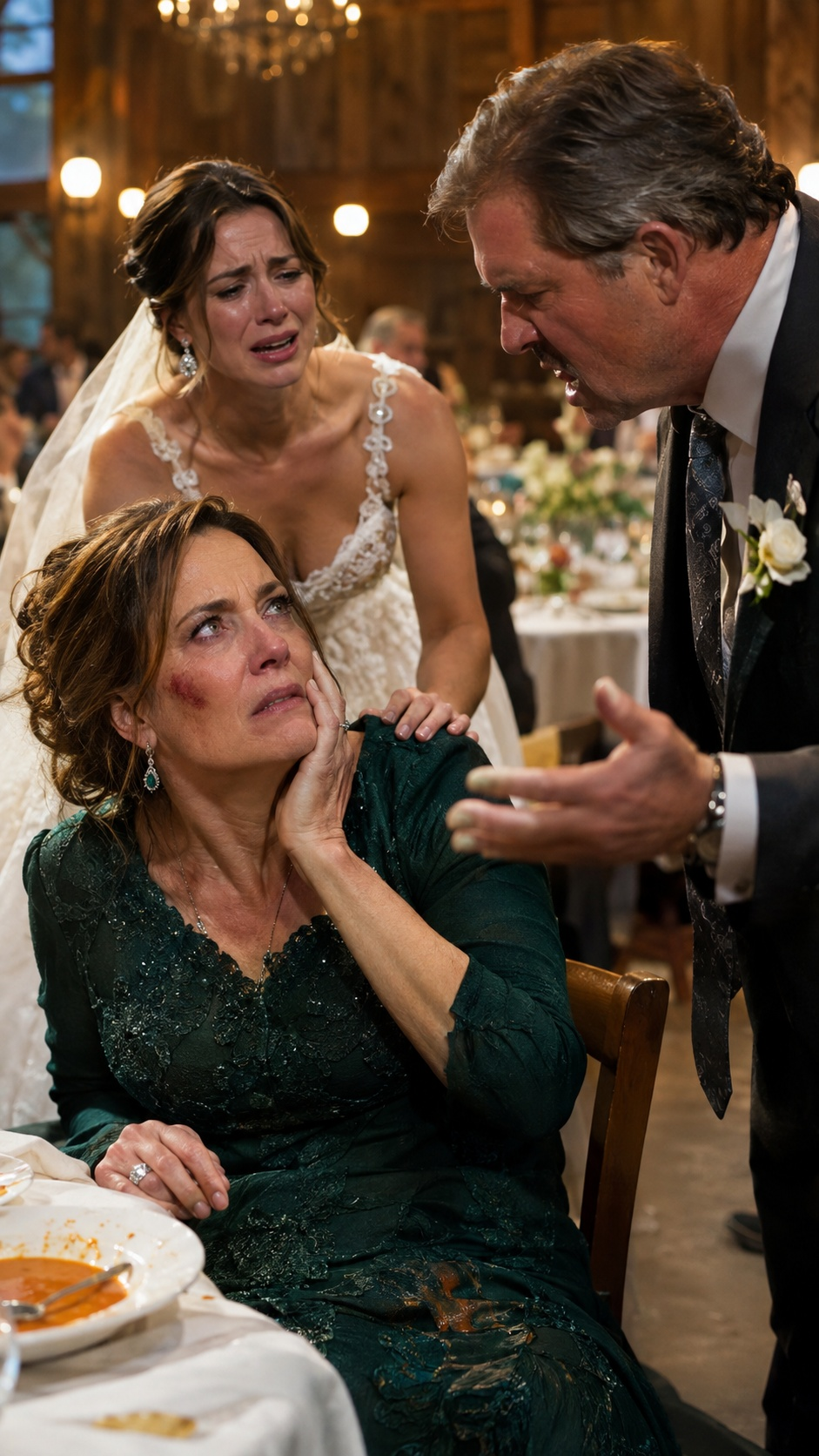
The same man who had laughed while pumpkin soup soaked through my dress.
The same man who had watched my husband slap me in front of two hundred wedding guests.
And now, less than an hour later, he was inside my dead father's workshop.
Looking for something Gabriel had no right to touch.
I pressed myself against the wall beside a tall cabinet filled with woodworking clamps. The room smelled of cedar, dust, and machine oil. My father's old work jacket still hung from a hook near the entrance.
I could almost hear him telling me to stay calm.
Don't make a move until you understand what you're looking at, Gracie.
The storage-room door opened.
A narrow beam of yellow light crossed the workshop floor.
I held my breath.
A man stepped out.
He wasn't Richard.
He was younger, perhaps forty, wearing dark work pants and a brown leather jacket. His face was unfamiliar, but his voice carried the impatient confidence of someone accustomed to doing unpleasant things for money.
"There's nothing in the cabinets," he said.
Richard answered from inside the storage room.
"Then look again."
"Gabriel said the documents were under the workbench."
"Gabriel doesn't know where they are. That's why we're here."
I felt my fingers tighten around my evening bag.
They weren't guessing.
They knew my father had hidden something.
But how?
For years, Gabriel had dismissed Daddy's workshop as a worthless collection of old tools. He had called the building an embarrassment. He had suggested demolishing it and selling the lumber.
Now he had sent men to search it during our daughter's wedding.
The timing wasn't an accident.
Gabriel had expected me to remain at the reception, too humiliated to think clearly.
Or perhaps he had expected me to drive home, cry myself to sleep, and wake up ready to apologize.
Either way, he hadn't expected me here.
The younger man moved toward the workbench.
I watched through a gap between two shelves.
Daddy's seven-foot maple workbench stood beneath the western windows. He had built it himself forty years earlier, using thick boards salvaged from an old schoolhouse.
Every scratch on its surface had a story.
There was the burn mark from the time I knocked over his soldering iron.
The deep groove where a chisel slipped while he was teaching me to carve.
And near the right front corner, a tiny brass screw that didn't match the others.
My father had once told me that the screw held a secret.
I was twelve years old.
I thought he meant a birthday present.
Now, standing in the darkness while strangers searched his workshop, I remembered something I hadn't thought about in decades.
The brass screw wasn't a screw.
It was a release.
"Move the bench," Richard ordered.
The younger man grunted.
"That thing weighs a ton."
"Then use your back."
They dragged the heavy workbench several inches across the concrete floor.
The sound made my stomach twist.
Daddy had positioned that bench himself.
He used to say the afternoon light was best from the western windows because it revealed imperfections in the grain.
I had never moved it.
Not once.
The younger man knelt and ran his fingers beneath the front edge.
"There's a drawer here."
My pulse hammered.
Richard came closer.
"Open it."
"It's locked."
"Break it."
I almost stepped forward.
Almost shouted.
Almost demanded that they leave my father's property.
But then I remembered the red mark on my cheek.
Gabriel had struck me in front of two hundred people because I refused to surrender eleven acres.
What would he do if he learned I had caught his business partner searching for the original property records?
I stayed still.
A metallic crack echoed through the room.
The younger man had forced open a drawer.
Richard cursed.
"Nothing but old pencils."
I closed my eyes.
Relief washed through me.
They had found the ordinary drawer.
Not the hidden compartment.
Daddy had designed the workbench with two separate storage spaces. The obvious drawer sat beneath the front edge, exactly where anyone would expect it.
The concealed compartment was built into the thick maple support behind it.
To open it, someone had to know which brass screw to press and how to shift the narrow wooden panel.
Gabriel had searched this workshop before.
Apparently, he still hadn't learned the difference.
"Maybe the papers are in the house," the younger man suggested.
Richard exhaled sharply.
"We already checked the house."
My stomach dropped.
They had searched the farmhouse too.
"Then Gabriel's wrong."
"Gabriel isn't wrong about everything."
The younger man laughed.
"Could've fooled me."
Richard's voice hardened.
"Watch your mouth."
A phone vibrated.
For several seconds, neither man spoke.
Then Richard answered.
"Yeah?"
I leaned closer.
"No. Not yet."
A pause.
"We're looking."
Another pause.
Richard glanced toward the workshop entrance.
"She's not coming here tonight."
My skin turned cold.
He was talking about me.
"Gabriel, listen to me. She's probably crying somewhere. You know how she gets."
I pressed my lips together.
There it was.
The familiar contempt.
The assumption that humiliation would leave me helpless.
Richard continued.
"We'll find the records before morning."
He listened.
Then his expression changed.
"What do you mean she left the reception?"
I stopped breathing.
Gabriel knew I was gone.
Richard straightened.
"Did she go home?"
A pause.
"No, I understand."
His voice became quieter.
"We'll be out before she gets here."
He ended the call.
The younger man looked at him.
"Problem?"
Richard slipped his phone into his pocket.
"Gabriel can't reach his wife."
"So?"
"So she has a habit of coming here when she's upset."
My blood ran cold.
Richard looked toward the main workshop.
"Finish up. Now."
I had less than a minute.
The workshop had two exits.
The front door, which I had entered through, and a narrow service door beside the lumber storage area.
The service door opened toward the pecan orchard.
I could reach it if I moved quietly.
But the floor between me and that door was covered with old boards, clamps, and wooden crates.
One wrong step would expose me.
I slipped off my heels.
The concrete felt cold beneath my feet.
Holding my shoes in one hand, I moved along the wall.
Three steps.
Four.
I reached the lumber racks.
Behind me, Richard spoke again.
"Did you check the cabinet near the entrance?"
My body went rigid.
"Not yet."
"Then check it."
The younger man's footsteps approached.
I crouched behind a stack of walnut boards.
The boards were thick, dusty, and heavy enough to hide me if he didn't look too closely.
He stopped less than six feet away.
I could hear his breathing.
He opened a cabinet.
Metal tools rattled.
Then he sneezed.
"Nothing."
"Check the bottom."
A drawer scraped open.
I looked toward the service door.
Ten feet.
That was all.
Ten feet between me and the orchard.
But the younger man stood directly in my path.
My phone vibrated inside my evening bag.
The sound seemed impossibly loud.
I grabbed it.
Gabriel's name glowed across the screen.
I silenced the call.
The younger man stopped moving.
"Did you hear that?"
Richard answered from the storage room.
"Hear what?"
"A phone."
I closed my eyes.
For one terrible second, I thought I was about to be discovered.
Then another phone rang.
Richard's.
He cursed.
"Gabriel again."
The younger man turned toward him.
I moved.
Barefoot, carrying my heels, I slipped behind the lumber rack and reached the service door.
The old latch resisted.
I pressed harder.
It gave with a faint click.
I stepped outside.
Cold air struck my face.
I closed the door gently behind me.
Then I ran.
I didn't stop until I reached the far side of the pecan orchard.
My feet hurt.
My lungs burned.
My ruined evening gown caught against low branches.
But I kept moving until the workshop lights disappeared behind the trees.
Only then did I bend forward, hands on my knees, trying to breathe.
I was fifty-eight years old.
I had spent most of my adult life arranging dinners, remembering birthdays, balancing household accounts, and smoothing over my husband's moods.
I had never imagined I would spend my daughter's wedding night hiding from strangers in my father's orchard.
Yet there I was.
Barefoot.
Bruised.
Terrified.
And suddenly very, very angry.
Not the kind of anger that makes people scream.
The kind that arrives after fear has exhausted itself.
I straightened.
Somewhere beyond the trees, a car engine started.
Headlights swept across the farmhouse.
Richard and his companion were leaving.
I waited until the vehicle disappeared down the driveway.
Then I waited another ten minutes.
I had learned something important about Gabriel.
He rarely acted alone when he was doing something dishonest.
He preferred witnesses who could become accomplices.
People who had accepted his money.
People who had secrets of their own.
Richard was one of those people.
And if Gabriel had sent him to search the workshop, then the documents Daddy had hidden were worth far more than I had understood.
I returned to the building shortly after midnight.
This time, I checked every window before entering.
The workshop was empty.
The storage room had been ransacked.
Drawers hung open.
Papers littered the floor.
A cabinet door had been torn from its hinges.
I stood in the doorway and felt tears rise in my eyes.
They had treated my father's life like garbage.
His carefully labeled boxes had been overturned.
His measuring tools lay scattered.
A framed photograph of him and me had fallen facedown beside the workbench.
I picked it up.
The glass was cracked.
In the picture, I was fourteen.
Daddy stood behind me with one hand resting on my shoulder.
We had just finished building a small cherrywood bookshelf for my bedroom.
I remembered how proud he had been.
"Look at that, Gracie," he had said. "You made something that'll outlast both of us."
I held the photograph against my chest.
"I'm sorry, Daddy," I whispered.
Then I put it carefully on a shelf.
There would be time to grieve later.
Right now, I needed to find what Gabriel wanted.
The workbench stood crooked beneath the windows.
The ordinary drawer had been broken open.
Its contents lay on the floor.
Pencils.
Sandpaper.
Old receipts.
A small tin of brass screws.
I knelt beside the right front leg.
My fingers found the mismatched screw.
I pressed it.
Nothing happened.
For a moment, panic rose in my throat.
Had I remembered incorrectly?
Had Daddy changed the mechanism?
I pressed again.
Still nothing.
Then I remembered his voice.
Never force a piece of wood, Gracie. Find the direction it wants to move.
I placed my left palm against the maple support and pushed upward while pressing the brass screw.
A soft click sounded.
The narrow panel shifted.
My breath caught.
I slid the panel sideways.
Behind it was a shallow compartment lined with dark felt.
Inside lay a rectangular metal document box.
It was smaller than I expected.
Perhaps twelve inches long.
Six inches wide.
A simple brass clasp held the lid closed.
My father's initials were engraved on top.
T.W.
I stared at them.
For a moment, I was twelve years old again, standing beside him while he showed me how to use a hand plane.
Then I lifted the box from its hiding place.
It was heavier than it looked.
I carried it to the workbench and opened the clasp.
Inside were several carefully wrapped bundles of paper.
An original deed.
Survey records.
A handwritten property description.
Copies of tax receipts.
A title insurance policy.
And a thick envelope bearing my father's handwriting.
FOR GRACE. ONLY GRACE.
My throat tightened.
I opened the envelope.
Inside was a letter.
The paper had yellowed slightly.
Daddy's handwriting leaned to the right, just as I remembered.
My dearest Gracie,
If you're reading this, then you've found the records I promised to keep safe.
I hope you never need them for anything more serious than settling a boundary dispute.
But I have lived long enough to know that land can make honest men foolish and dishonest men dangerous.
Your mother and I worked for everything on this property. We never borrowed against it. We never pledged it as security. And I have made certain the ownership records are clear.
This land belongs to you.
Not to your husband.
Not to anyone who tells you he knows better.
You.
I stopped reading.
My eyes blurred.
For years, Gabriel had told me that Daddy was stubborn.
Old-fashioned.
Suspicious of success.
But reading those words, I understood that my father had seen something in Gabriel long before I had been willing to admit it.
I wiped my eyes and continued.
There is one thing I want you to remember.
People may try to convince you that protecting what is yours means you don't love them.
That is not love.
Love doesn't require you to disappear so someone else can become larger.
Keep your name on what belongs to you.
And never sign anything you haven't read twice.
All my love,
Daddy.
I lowered the letter.
For several minutes, I couldn't move.
The workshop was silent except for the ticking of an old wall clock.
I had spent thirty-one years trying to be a good wife.
I had forgotten how to be my father's daughter.
Now, sitting beneath the light he had installed with his own hands, I finally understood the difference.
I began examining the documents.
The original deed showed that the property had been transferred to me through my father's estate.
The survey identified the exact boundaries of the eleven acres.
The tax receipts established decades of continuous ownership.
The title policy listed no mortgage.
No outstanding lien.
No business obligation.
Nothing that gave Gabriel a legal claim to the property simply because he was my husband.
I wasn't an attorney.
I knew I would eventually need one.
But even I could recognize the importance of those papers.
Gabriel wanted the land because he couldn't get it without me.
And I had refused.
I placed the documents back inside the metal box.
Then I noticed another envelope beneath the title policy.
This one was smaller.
It contained several old letters exchanged between my father and a local attorney named Walter Hensley.
Most concerned estate planning.
But one letter, dated nearly fifteen years earlier, caught my attention.
It mentioned a proposed development partnership.
Gabriel's company.
Richard Voss.
And an offer to purchase the eleven acres.
I read the letter twice.
Daddy had rejected their offer.
That wasn't surprising.
What surprised me was the date.
Gabriel had told me he first became interested in developing the property only three years earlier.
But this letter proved he had been trying to acquire it long before Daddy died.
Long before the company's latest financial problems.
Long before the collateral agreement.
I felt a chill spread through me.
Had Gabriel been planning this for years?
I looked at the letter again.
There was a handwritten note in the margin.
Daddy had written only six words.
Grace must never sign for Gabriel.
I stared at the sentence.
Then I folded the letter and placed it with the other documents.
I didn't yet understand everything.
But I understood enough.
My husband hadn't simply lost his temper at our daughter's wedding.
He had been furious because I was standing between him and something he had wanted for a very long time.
And now he was willing to send men into my father's workshop to get it.
At 1:18 a.m., I sat at Daddy's workbench with my phone in front of me.
Gabriel had called fourteen times.
There were six text messages.
The first three were angry.
You embarrassed me.
Nora is devastated.
You owe both of us an apology.
The fourth was a command.
Come home.
The fifth was a threat.
Don't make this worse than it already is.
The sixth arrived while I was reading.
I know where you go when you're upset.
I stared at the screen.
Then I turned the phone off.
I didn't know whether Richard had told Gabriel that the documents were missing.
I didn't know whether they would return.
But I knew I couldn't take the box back to our house.
Gabriel had access to everything there.
My bedroom.
My closet.
My desk.
My bank statements.
For years, I had mistaken that access for intimacy.
Now I recognized it as vulnerability.
I needed somewhere safe.
Somewhere Gabriel wouldn't think to look.
I remembered an old friend from high school, Evelyn Brooks, who lived outside Kerrville.
We hadn't spoken in nearly two years.
Gabriel disliked her.
He said she encouraged me to think badly of him.
Once, after Evelyn questioned the way he spoke to me at a dinner party, Gabriel had insisted I stop inviting her to our home.
I had obeyed.
The memory made me ashamed.
Evelyn had been trying to help.
And I had pushed her away to keep the peace.
I switched my phone on long enough to find her number.
My thumb hovered over the call button.
It was after one in the morning.
What would I say?
Hello, Evelyn. My husband slapped me at our daughter's wedding, my daughter threw me out, and I just caught two men searching my dead father's workshop.
It sounded impossible.
Like something that happened to other women.
Not to me.
Then I remembered Evelyn's words from our last conversation.
"Grace, you don't have to explain everything. If you ever need somewhere to go, just come."
I pressed call.
She answered on the fourth ring.
"Grace?"
Her voice was thick with sleep.
I tried to speak.
Nothing came out.
"Grace, honey? Are you all right?"
I looked down at my stained gown.
At the metal box.
At my father's letter.
"No," I whispered.
Evelyn was silent for half a second.
Then she said, "Where are you?"
"At Daddy's workshop."
"Are you alone?"
"I think so."
"Are you hurt?"
I touched my cheek.
"Gabriel hit me."
I heard Evelyn inhale sharply.
Then her voice became steady.
"Listen carefully. I'm going to give you an address. It's a small guesthouse behind my property. You can stay there tonight. I'll meet you in the morning."
"Evelyn, I don't want to involve you."
"Grace Anne Cain, you've spent thirty years worrying about everybody except yourself. I'm not asking permission."
I began crying.
Not loudly.
Not dramatically.
Just quiet tears falling onto the wooden workbench.
Evelyn waited.
When I could speak again, I thanked her.
"Bring anything important," she said. "And don't tell Gabriel where you're going."
"I won't."
"Promise me."
"I promise."
After we ended the call, I sat for several minutes staring at the dark screen.
For the first time that night, I had a plan.
Not a complete one.
But enough to get through the next few hours.
I found an old canvas tool bag beneath the workbench.
I wrapped the metal document box in a clean shop towel and placed it inside.
Then I gathered my father's letter, the attorney correspondence, and the photograph with the cracked glass.
I locked the workshop cabinets as best I could.
I turned off the lights.
But before leaving, I stopped beside the hidden compartment.
My wedding ring felt heavy on my finger.
I looked at it for a long time.
Thirty-one years.
Thirty-one anniversaries.
One daughter.
A house full of memories.
And a marriage that had slowly taught me to apologize for things I hadn't done.
I remembered Gabriel slipping the ring onto my finger in a small church outside San Antonio.
He had looked handsome.
Nervous.
Almost boyish.
He had whispered, "I'll take care of you, Grace."
I had believed him.
I wanted to believe that the man standing beside me that day had been real.
Perhaps he had been.
Perhaps he had changed.
Or perhaps I had spent three decades loving the person I hoped he would become.
I couldn't answer that question.
Not yet.
But I knew one thing.
I couldn't keep wearing a symbol of promises he had broken.
I twisted the ring gently.
It resisted.
My fingers were swollen.
I tried again.
Finally, it slipped free.
A pale band of skin remained beneath it.
I held the ring in my palm.
The diamond glittered beneath the workshop light.
For a moment, I almost put it back on.
Then I opened the concealed drawer.
I placed the ring inside.
Not with anger.
Not with hatred.
With a strange, terrible sadness.
I slid the panel closed.
The brass mechanism clicked.
My marriage had lasted thirty-one years.
And I had just left its most expensive symbol inside a drawer my husband didn't know existed.
I carried the canvas bag to my car.
The night had grown colder.
Fog drifted between the pecan trees.
I placed the bag on the passenger seat and covered it with my coat.
Then I looked back at the workshop.
I didn't know when I would return.
I didn't know what Gabriel would do when he realized I hadn't gone home.
I didn't know whether Nora would call.
Part of me still hoped she would.
I imagined her voice.
Mom, I'm sorry.
Dad was wrong.
Please come back.
But my phone remained silent.
I started the engine.
The dashboard clock read 2:06 a.m.
I had several hours before sunrise.
Several hours before Gabriel began searching seriously.
Several hours before the world expected Grace Anne Cain to return to her usual place.
I put the car into reverse.
Then my headlights swept across the farmhouse porch.
Something moved.
I stopped.
A dark vehicle was parked beside the old equipment shed.
Its lights were off.
I hadn't noticed it when I returned from the orchard.
For a moment, I wondered whether it belonged to a neighbor.
Then the driver's door opened.
A man stepped out.
He wore a dark jacket.
He stood beside the vehicle, looking directly toward my car.
I couldn't see his face.
But I recognized the shape of the phone he raised to his ear.
My stomach tightened.
I reached for the gearshift.
Before I could move, my own phone lit up on the passenger seat.
An incoming call.
Gabriel.
I stared at the screen.
Then a text message appeared beneath his name.
I told you not to make this worse.
I looked toward the man standing beside the equipment shed.
He lowered his phone.
Then he began walking toward my car.
I locked the doors.
The man stopped directly in front of my headlights.
And slowly, he reached inside his jacket.






Comments 0