The woman screamed.
Then the telephone went dead.
I stood in my kitchen with the phone pressed against my ear, listening to the empty line.
"Hello?"
Nothing.
"Ma'am, can you hear me?"
Silence.
A moment earlier, a stranger had told me she worked at a funeral home and knew something about the paperwork Gabriel had arranged after our daughter's wedding.
Now she was gone.
I called back.
The number rang six times before switching to voicemail.
I tried again.
No answer.
On the third attempt, the call disconnected immediately.
I lowered the phone.
My kitchen clock read 12:17 a.m.
Outside, the windows reflected my own face.
Silver-blonde hair.
A black dress.
The pearl necklace my mother had left me.
Seven years earlier, I had stood in another kitchen with a swollen cheek, wondering how my husband could have become a stranger.
Now I was standing in a house I owned, holding evidence that he had tried to declare me dead.
And somewhere, a woman who might know how he had done it was in danger.
I called Margaret Bell.
She answered after several rings.
"Grace?"
"Someone just called me."
I told her everything.
The photographs.
The certificate.
The funeral home.
The scream.
Margaret listened without interrupting.
When I finished, she said, "Do not delete anything. Save the messages and the number. I'm going to contact the appropriate authorities."
"Do you think she's hurt?"
"I don't know."
"Margaret, she sounded terrified."
"I believe you."
I sat down.
"What if Gabriel knows she called me?"
There was a pause.
Then Margaret said something I hadn't expected.
"Grace, I think we need to assume Gabriel knows more about your movements than we'd like."
I checked the locks twice.
Then I closed the curtains.
For the first time in years, my house felt unfamiliar.
I had built a life here.
A quiet life.
A life where I could leave a book open on the sofa without someone criticizing me.
Where I could eat dinner at eight instead of six.
Where I could spend Sunday afternoons in my workshop and return covered in sawdust without hearing Gabriel complain about the mess.
Now his shadow seemed to have entered every room.
I placed the court document on the kitchen table beside my laptop.
Then I opened the photographs the unknown caller had sent.
The supposed death certificate looked official at first glance.
But when I enlarged the image, I noticed something strange.
The document wasn't a certified death certificate.
It was a preliminary worksheet.
A form containing information someone might use while preparing a death record.
Several fields were blank.
Others contained typed entries.
My name.
My date of birth.
My former address.
And the date Gabriel claimed I had died.
October nineteenth.
The morning after Nora's wedding.
I stared at the form.
I remembered that morning.
I had been sitting at Evelyn's kitchen table, drinking coffee while my friend tried to convince me to eat breakfast.
I remembered the sunlight.
The smell of toast.
The bruising on my cheek.
I remembered being alive with painful clarity.
Yet someone had entered my name on a form intended for the dead.
My phone vibrated.
Margaret.
"I've spoken with a contact who can help us determine whether an actual death record was ever registered," she said. "The image you received may be a draft or fabricated document. We can't assume it was officially issued."
I exhaled.
"Then why would Gabriel have it?"
"That's what we're going to find out."
She paused.
"There's something else. I've contacted the probate court about the pending application. We're preparing to challenge the allegations and establish your identity before the hearing."
"Will I have to appear?"
"Very likely."
I looked at the table.
At the walnut grain beneath the documents.
My father had taught me to read wood by its lines.
Every knot told a story.
Every flaw revealed something about how a tree had grown.
I wished people were as easy to understand.
"I'll appear," I said.
Margaret's voice softened.
"Good."
I didn't sleep.
At six in the morning, I made coffee and walked into my workshop.
The building smelled of walnut, cedar, and finishing oil.
A half-completed cabinet stood near the eastern window.
Luis had left a pencil tucked behind one of the clamps.
A measuring tape lay beside the plans.
Everything was exactly where it belonged.
I ran my hand across the cabinet's unfinished surface.
For seven years, this place had been my refuge.
Whenever I felt lonely, I worked.
Whenever I missed Nora, I worked.
Whenever a memory of Gabriel threatened to overwhelm me, I picked up a plane or chisel and made something useful.
But that morning, I couldn't concentrate.
I kept seeing Nora's face.
The way she had looked up at me in Charles Whitmore's dining room.
The fear in her eyes.
The trembling hand that slipped the court document into mine.
And the words she had whispered in the hallway.
He checks my phone.
I had spent seven years believing my daughter wanted nothing to do with me.
Perhaps I had been wrong.
Perhaps she had wanted to reach me and couldn't.
Or perhaps she had made choices she was ashamed to explain.
I didn't know.
But I knew I couldn't wait another seven years to find out.
I picked up my phone.
Opened the message containing the address Nora had whispered.
A small apartment complex in Austin.
I stared at it.
Then I called Evelyn.
She answered immediately.
"Grace?"
"I need to see Nora."
A pause.
"Are you sure?"
"No."
Evelyn laughed softly.
"That's an honest answer."
"I'm going anyway."
"Then I'm coming with you."
We met Margaret at her office before leaving.
She had spent the night reviewing the documents and making calls.
There were dark circles beneath her eyes.
But her voice was steady.
"Grace, I want you to understand something."
I sat across from her.
"The probate application is not proof that you're dead. It's a claim someone has made. The court will require evidence, and we intend to challenge it directly."
I nodded.
"Good."
"However, the purported will and the supporting documents may be part of a broader attempt to create a false record."
"Gabriel's been doing that for years."
Margaret looked at me.
"Possibly. But we need to distinguish what we suspect from what we can prove."
She slid a folder toward me.
Inside were copies of the documents I had provided.
My father's deed.
The challenged collateral filing.
The probate application.
The purported will.
The preliminary death-record worksheet.
And Samuel Reed's financial records.
"Keep this copy with you," she said.
"Why?"
"Because I want you to know exactly what we're dealing with."
I opened the folder.
Margaret pointed to the probate application.
"Gabriel claims you disappeared after the wedding and that he has been unable to locate you."
"That's ridiculous."
"Yes. You have years of tax returns, employment records, business registrations, bank statements, and witnesses who can establish that you've been alive."
I almost smiled.
"I also built a fourteen-foot dining table."
Margaret smiled back.
"That too."
Then her expression became serious.
"Grace, if Nora has information about the documents, she may be frightened. Don't pressure her. Don't promise anything on behalf of the authorities. Just listen."
I nodded.
"And if she tells me Gabriel threatened her?"
"Call me immediately."
Austin was two hours away.
Evelyn drove.
I sat in the passenger seat with the folder on my lap.
For the first half hour, neither of us spoke.
Then Evelyn said, "Do you remember Nora's eighth birthday?"
I turned toward her.
"The pony?"
She laughed.
"The pony."
Gabriel had promised Nora a pony for her birthday.
Not a real pony.
A visit from a traveling petting zoo.
But he forgot to book it.
When Nora woke that morning, she ran outside expecting to see an animal waiting in the yard.
There was nothing.
Gabriel blamed the company.
Then blamed me for not reminding him.
Nora cried.
I spent the next three hours calling every farm within fifty miles.
Finally, I found a woman who agreed to bring a small brown pony named Buttercup.
Nora rode that pony around the backyard until sunset.
She told everyone it was the best birthday of her life.
Evelyn glanced at me.
"You always found a way to fix things for her."
I looked out the window.
"Not this time."
"Maybe she doesn't need you to fix everything."
I swallowed.
"What does she need?"
Evelyn thought for a moment.
"Maybe she needs you to hear what happened."
I stared at the passing fields.
For years, I had imagined the conversation we would have if Nora ever came back.
I had imagined telling her how deeply she hurt me.
How many nights I cried.
How many birthdays passed without a phone call.
But now I wondered whether the first thing I needed to say was something much simpler.
I'm listening.
The apartment complex stood behind a shopping center on the outskirts of Austin.
Three low buildings surrounded a cracked parking lot.
The paint was faded.
Several windows had broken blinds.
A bicycle lay chained to a railing.
I stared at the address.
This wasn't the life Gabriel had promised Nora.
He had paid for an extravagant wedding.
He had boasted about her new husband's career.
He had told everyone she would never have to worry about money.
Now she was working as a server and living in a building where the stairwell light flickered.
Evelyn parked near the entrance.
"Do you want me to come up?"
I hesitated.
Then nodded.
"Please."
We climbed to the second floor.
Apartment 214.
I stood outside the door.
My hand trembled as I knocked.
No answer.
I waited.
Knocked again.
Still nothing.
I looked at Evelyn.
"Maybe she's working."
Then I heard movement inside.
A chain rattled.
The door opened two inches.
Nora looked through the gap.
Her face went pale.
"Mom?"
I swallowed.
"Hello, sweetheart."
She stared at me.
Then at Evelyn.
Then down the hallway.
"What are you doing here?"
"You gave me your address."
"I didn't think you'd come so soon."
"I was worried."
Nora closed her eyes.
For a moment, I thought she might shut the door.
Instead, she removed the chain.
"Come in."
The apartment was small.
A sofa.
A folding dining table.
A narrow kitchen.
Two framed photographs on a shelf.
One showed Nora on her wedding day.
The other showed a little girl with dark curls.
I stopped.
"Who's that?"
Nora followed my gaze.
Her expression changed.
"That's Lily."
I stared at the photograph.
The child looked about four years old.
She had Nora's eyes.
And a smile that made my chest ache.
"Your daughter?"
Nora nodded.
I couldn't speak.
For seven years, I had imagined my daughter building a life without me.
I had wondered whether she had children.
Whether she was happy.
Whether she ever thought about me.
But seeing that photograph was different from imagining it.
I had a granddaughter.
A little girl I had never met.
I reached toward the frame.
Then stopped.
"How old is she?"
"Five."
Five.
Five birthdays.
Five Christmases.
Five years of bedtime stories and scraped knees.
Five years I had missed.
I pressed my hand against my mouth.
Nora looked away.
"I'm sorry," she whispered.
The words broke something inside me.
I had waited seven years to hear them.
And now that they had come, I didn't know what to do.
Evelyn quietly stepped into the kitchen.
She gave us space.
I looked at Nora.
"Why didn't you tell me?"
Tears filled her eyes.
"Because Dad said you didn't want to know."
I stared at her.
"What?"
"He said you were angry with me. That you didn't want me in your life."
I shook my head.
"Nora, I sent you messages."
"I know."
"I told you I loved you."
She wiped her face.
"He said you were just being polite."
I felt anger rise.
Not at Nora.
At Gabriel.
Even after our divorce, he had found ways to stand between us.
"Sweetheart," I whispered, "I never stopped wanting you."
Nora began crying.
Then she stepped forward.
I opened my arms.
And for the first time in seven years, my daughter held me.
We sat on the sofa.
Nora told me about her marriage.
It had ended after four years.
Her husband, Daniel, had struggled with debt.
Gabriel had promised to help him start a business.
The money never arrived.
Instead, Daniel became involved in one of Gabriel's failed investments.
When the business collapsed, the marriage followed.
Nora had been left with bills, a young child, and very little support.
"Why didn't you call me?" I asked.
She looked down.
"Because I was ashamed."
"Of what?"
"Everything."
She swallowed.
"The wedding. The way I treated you. The things I said afterward."
I waited.
Nora twisted her hands together.
"Dad told me you were trying to destroy him. He said you wanted to take everything."
I shook my head.
"I only wanted what Daddy left me."
"I know that now."
Her voice cracked.
"But back then, I believed him."
I looked at my daughter.
She seemed older than thirty-five.
Not because of her face.
Because of the exhaustion in her eyes.
"What changed?" I asked.
Nora hesitated.
Then she said, "Lily."
I glanced toward the photograph.
"When she was born, I started noticing things."
"What things?"
"The way Dad spoke to me. The way he made promises and then blamed me when they fell apart. The way he expected me to apologize whenever he was angry."
I listened.
"One day," Nora continued, "Lily spilled juice on his carpet."
My stomach tightened.
"He shouted at her."
I closed my eyes.
"She was only three."
Nora's voice trembled.
"She hid behind me. And suddenly I remembered you at my wedding."
I looked at her.
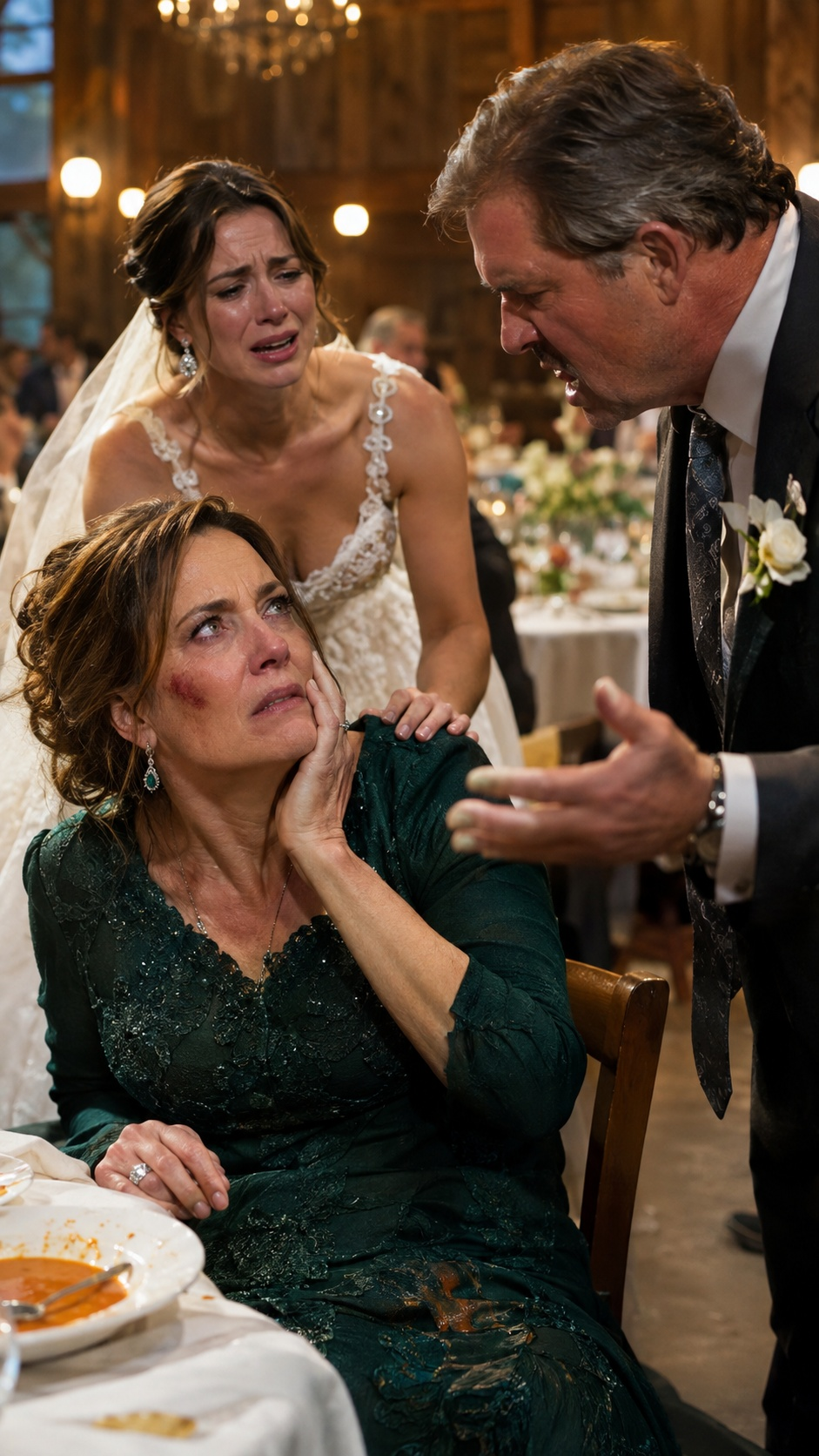
"The soup," she whispered.
I nodded.
"I remembered Dad blaming you. And I remembered telling you to leave."
Tears slipped down her cheeks.
"Mom, I heard myself using his words."
I reached for her hand.
She gripped mine.
"I was so ashamed."
For a long time, we sat together without speaking.
Then I asked, "Where's Lily now?"
"With Daniel's sister. She watches her while I work."
"Is she safe?"
Nora nodded.
"Yes. She's wonderful with her."
I felt some of the tension leave my shoulders.
Then I asked the question I had come to ask.
"Nora, how did you get the probate document?"
Her face changed.
She glanced toward the door.
Then lowered her voice.
"I found it in Dad's office."
I waited.
"He asked me to help organize some files. He said he needed someone he could trust."
"Did you know what he was doing?"
"No."
She shook her head.
"Not until I saw your name."
I leaned closer.
"What happened?"
"I opened the folder. There was a will. A court application. And a document saying you were dead."
Her voice broke.
"I thought it was some kind of mistake."
"What did Gabriel say?"
"He told me it was a legal strategy."
I stared at her.
"A legal strategy?"
"He said you had abandoned the family and disappeared. He said the lawyers could use that to settle old property matters."
I felt sick.
"Nora, he knows I'm alive."
"I know."
"Then why would he—"
"Because he's desperate."
She looked at me.
"Mom, the company is collapsing."
I thought about Samuel Reed.
The financial records.
The questionable loans.
The development projects.
"How bad?"
Nora swallowed.
"Worse than you think."
She told me Gabriel had been borrowing money from increasingly aggressive lenders.
Richard had promised that the eleven acres would eventually become available.
The property had risen dramatically in value.
A developer wanted to purchase it for a luxury residential project.
The offer was enormous.
Gabriel believed that if he could establish control over the land, he could rescue his company.
"But he doesn't own it," I said.
"I know."
"He never did."
Nora nodded.
"That's why he's doing this."
I stared at her.
"Trying to declare me dead?"
She lowered her eyes.
"Yes."
I felt a coldness settle inside me.
For years, I had wondered whether Gabriel regretted what happened at the wedding.
Whether he ever thought about the woman he had humiliated.
Whether he understood why I left.
Now I knew.
He didn't regret losing me.
He regretted losing access to what I owned.
I looked at Nora.
"Why did you give me the papers at Charles Whitmore's dinner?"
She hesitated.
"Because I knew you'd be there."
I frowned.
"How?"
"Charles's assistant told the catering company the furniture maker would attend."
"And you requested that assignment?"
She nodded.
"I needed to see you."
My throat tightened.
"Why didn't you just call?"
Nora looked toward the window.
"Because Dad has been watching me."
I remembered her warning.
He checks my phone.
"What do you mean?"
She swallowed.
"He pays someone to monitor my accounts. He knows where I work. He knows when I visit Lily."
I felt anger rise again.
"Why?"
"Because he thinks I took something from his office."
I stared at her.
"Did you?"
Nora nodded.
Then she stood.
"Wait here."
She walked into the bedroom.
I heard a drawer open.
Then another.
Evelyn returned from the kitchen.
She looked at me.
I nodded slightly.
I was all right.
Or as close to all right as I could be.
Nora came back carrying a small brown envelope.
She placed it on the table.
"This is what I wanted to show you."
I opened it.
Inside were several photographs.
A copy of an old letter.
And a flash drive.
I picked up the letter.
The handwriting was familiar.
My father's.
Thomas Whitaker.
My breath caught.
"Where did you get this?"
Nora sat down.
"Dad kept it in a locked drawer."
I unfolded the paper.
It was addressed to Gabriel.
Dated sixteen years earlier.
One year before Daddy died.
I began reading.
The letter was short.
But every sentence felt like a blow.
Daddy had written that he knew Gabriel was attempting to use my property in business negotiations.
He warned him to stop.
He stated clearly that he would never approve any transfer or encumbrance involving the land.
Then came the final paragraph.
Gabriel, I know what you have done with the documents you asked me to sign.
I have kept copies.
If you ever attempt to use my daughter's inheritance without her knowledge, those copies will be delivered to the proper authorities.
I stared at the page.
My father had known.
Not merely suspected.
Known.
I looked at Nora.
"What documents?"
She shook her head.
"I don't know."
"Did Gabriel say anything about this letter?"
"He was furious when he found out I'd seen it."
I looked at the flash drive.
"What's on that?"
Nora's face went pale.
"I haven't opened it."
"Why not?"
"Because Dad said if I touched it, Lily would suffer."
The room went silent.
Evelyn stepped forward.
"What exactly did he say?"
Nora began trembling.
"He said people who interfere with his business sometimes lose things they love."
I stood up.
"Nora, you should have told someone."
"I know."
"Did he threaten Lily directly?"
She nodded.
Tears spilled down her face.
I moved beside her.
Put my arms around her.
For years, I had wanted my daughter to understand what Gabriel had done to me.
Now I wished she had never learned it this way.
I called Margaret from Nora's kitchen.
She listened carefully.
Then asked me to photograph the letter and preserve the flash drive without altering its contents.
She advised Nora to document the threats and consider making a report.
She also suggested we arrange a safer place for Nora and Lily to stay.
Evelyn immediately offered her guesthouse.
Nora hesitated.
"I can't just leave."
"Why not?" I asked.
"Because Dad will know."
I looked at her.
"He already knows you're afraid."
She shook her head.
"You don't understand."
I sat beside her.
"Then help me understand."
Nora stared at her hands.
For a moment, she looked like the little girl who used to come into my workshop after school.
Then she whispered, "Dad has something on Daniel."
I frowned.
"Your ex-husband?"
She nodded.
"He says Daniel signed documents that could send him to prison."
"Did he?"
"I don't know."
She swallowed.
"But if Dad gets angry, he says he'll make sure Lily loses her father."
I looked at Evelyn.
Then back at Nora.
Gabriel had found another way to control her.
Not through money.
Through fear.
I reached for my daughter's hand.
"We're going to handle this carefully."
She looked at me.
"How?"
"With Margaret. With evidence. And with people who don't answer to your father."
Nora began crying again.
I held her.
And for the first time in seven years, I felt the old instinct to protect my child return with full force.
But this time, I knew protection couldn't mean surrendering to Gabriel.
It had to mean standing against him.
We left Nora's apartment shortly before sunset.
She agreed to bring Lily to Evelyn's guesthouse the following morning.
We would arrange transportation.
Margaret would help us determine the safest next steps.
I wanted Nora to come immediately.
But she insisted on collecting Lily herself.
I didn't like it.
Still, I understood that after years of being controlled, my daughter needed to make some decisions of her own.
At the door, she hugged me.
"Mom?"
"Yes?"
"I'm sorry about the wedding."
I closed my eyes.
For seven years, I had carried those words inside me.
Waiting.
Hoping.
Sometimes believing I would never hear them.
I held her tighter.
"I know, sweetheart."
"I should have defended you."
I swallowed.
"Yes."
She began crying.
I pulled back and looked into her eyes.
"But we can't change that night."
She nodded.
"We can decide what happens next."
For the first time, she gave me a small, genuine smile.
Then she whispered, "I love you."
I touched her cheek.
"I love you too."
Evelyn drove us back toward Kerrville.
The sky darkened.
Traffic thinned.
I sat quietly with the envelope on my lap.
My father's letter.
The photographs.
The flash drive.
Pieces of a puzzle I had been trying to understand for fifteen years.
I thought about the wedding.
The slap.
The eleven acres.
The forged signatures.
The supposed death certificate.
And the daughter I had finally held again.
For the first time, I understood that Gabriel's cruelty had not ended when I left him.
It had simply changed shape.
He no longer controlled my home.
So he tried to control my property.
He no longer controlled my marriage.
So he tried to control my legal identity.
And when he could no longer control me, he turned toward Nora.
I looked down at the flash drive.
It was small.
Black.
Unmarked.
But I had the terrible feeling it contained something Gabriel feared more than anything else.
The truth.
We reached my house after nine.
Evelyn insisted on staying the night.
I agreed.
We locked the doors.
Checked the windows.
Then sat at the kitchen table.
I placed the flash drive beside my laptop.
Margaret had advised us not to alter the contents.
I decided to wait until she could arrange for a proper forensic copy.
But before I could put it away, my phone vibrated.
A message from Nora.
Mom, Lily's with Daniel's sister. I'm packing now.
I replied.
Be careful. Call me when you're ready.
A few minutes later, another message arrived.
Dad called. He knows I saw you.
My stomach tightened.
I typed quickly.
Don't answer him. Call Margaret if he threatens you.
Three dots appeared.
Then disappeared.
I waited.
Nothing.
I called Nora.
No answer.
I called again.
Voicemail.
Evelyn looked up.
"What's wrong?"
"Nora isn't answering."
I stood.
Then my phone vibrated again.
A photograph.
It showed Nora's apartment door.
Open.
The hallway beyond it was dark.
Beneath the photograph was a message.
Mom, someone is here.
I stared at the screen.
Another message appeared.
I think it's Dad.
I grabbed my keys.
Evelyn stood.
"Grace, wait."
Then my phone rang.
Nora.
I answered immediately.
"Nora?"
For a moment, there was only breathing.
Then my daughter's voice came through, barely audible.
"Mom, don't come here."
My heart stopped.
"Why?"
She whispered, "Because the man standing in my apartment isn't Dad."
I gripped the phone.
"Then who is it?"
Nora began to cry.
And behind her, a man's voice said, "Tell your mother I found the flash drive."






Comments 0