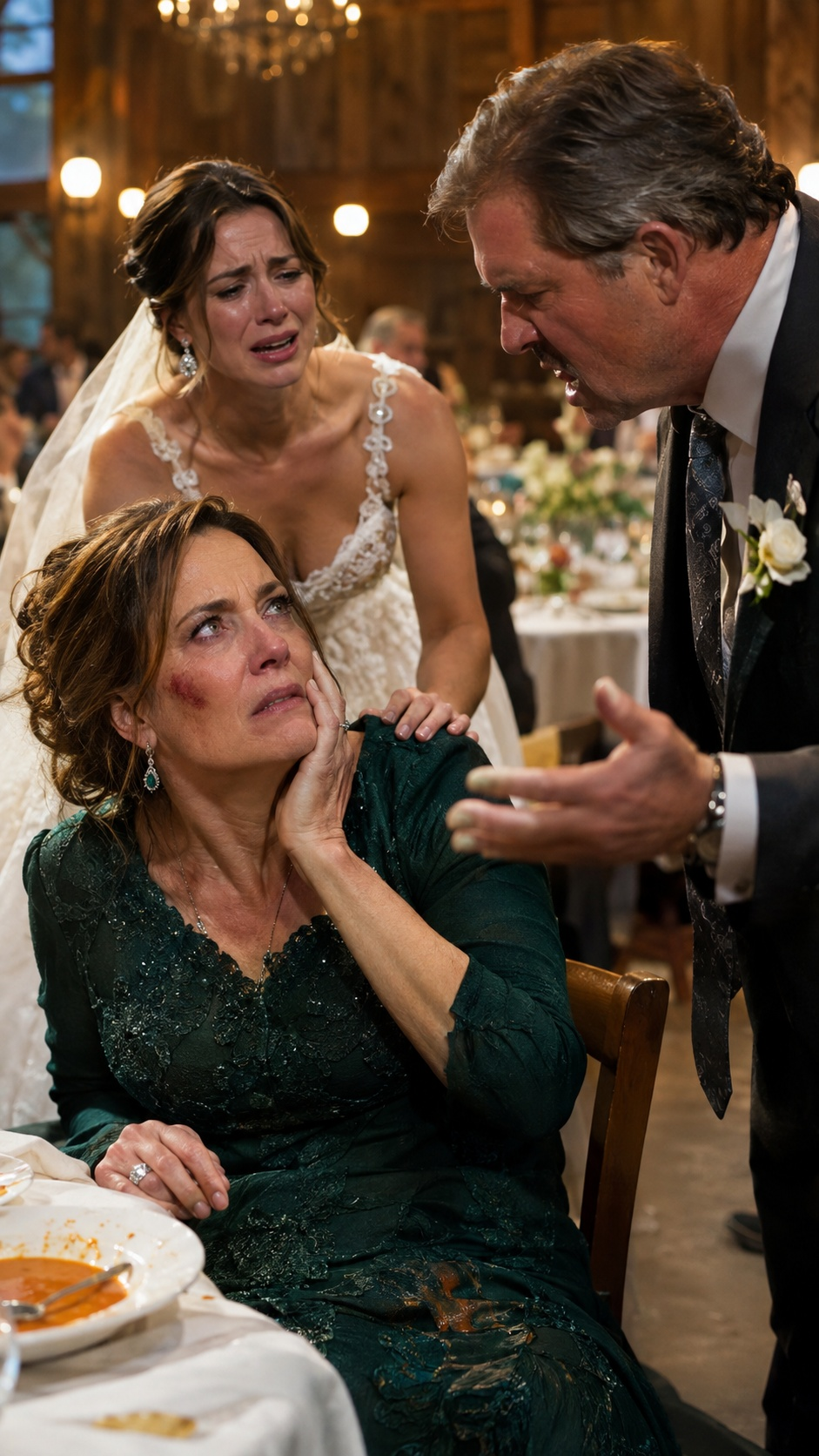
"Gabriel, please! Sit down!"
I reached for my husband's wrist as he raised his whiskey glass above our daughter's wedding table.
He jerked away, knocking a folded property document from his jacket pocket.
A handwritten number showed through the paper.
11.00 ACRES.
My father's land.
And suddenly, I understood that Gabriel hadn't come to our daughter's wedding simply to celebrate.
He had come to punish me.
My name is Grace Anne Cain, and the night my marriage ended, two hundred people watched my husband strike me across the face.
Not one of them stopped him.
But the slap wasn't the worst part.
The worst part came afterward, when I looked into my only daughter's eyes and realized she was more embarrassed by my pain than by the man who had caused it.
Until that October evening, I had spent thirty-one years convincing myself that marriage meant enduring things other people would never understand.
I had endured Gabriel's temper.
His drinking.
His business failures disguised as temporary setbacks.
His habit of turning every disagreement into a test of loyalty.
And perhaps most humiliating of all, I had endured his certainty that everything I owned belonged to him.
Everything except eleven acres of Texas land.
Those eleven acres had belonged to my father, Thomas Whitaker, a carpenter who believed a man's hands should create more than his mouth promised.
My father had never been wealthy.
He owned an old farmhouse, a workshop, several acres of pecan trees, and a stretch of pasture that turned golden every September.
But he had something Gabriel never understood.
He owned what he had earned.
When Daddy died, he left the property to me.
Not to Gabriel.
Not to our marriage.
To me.
That distinction would eventually become the most dangerous fact in my life.
But on the night of Nora's wedding, I still believed my greatest responsibility was keeping our family together.
I was wrong.
The wedding took place in a restored nineteenth-century barn outside Fredericksburg, Texas.
Nora had dreamed about that venue since she was twenty-two.
She wanted crystal chandeliers hanging from wooden rafters, long tables dressed in ivory linen, white roses, expensive champagne, and enough flowers to make the entire building smell like spring.
Gabriel had paid for almost everything.
He reminded us of that constantly.
"One hundred and eighty thousand dollars," he had announced that morning while adjusting his tie.
"That's what this little fairy tale is costing me."
I had looked up from fastening my earrings.
"Then maybe you shouldn't keep reminding Nora."
Gabriel had smiled at me through the bedroom mirror.
It wasn't a pleasant smile.
"Someone should remind her who makes things possible."
I said nothing.
I had learned that silence could sometimes prevent an argument.
What I hadn't learned was that silence could also teach a cruel man he would never face consequences.
By six that evening, the reception was underway.
Nora looked beautiful.
Her ivory satin gown moved like water whenever she walked, and her platinum-blonde hair was pulled into an elegant bridal ponytail beneath a delicate veil.
When she entered the barn with her new husband, the guests stood and applauded.
I cried.
Not because I was sad.
Because I remembered the little girl who used to fall asleep against my shoulder while I read her stories.
The girl who had once told me she would never grow up because grown-ups always looked tired.
I remembered her missing front teeth.
Her first bicycle.
The night she called me from college because a boy had broken her heart.
I remembered everything.
And for a few precious minutes, I forgot that Gabriel and I had barely spoken for a week.
Then the pumpkin soup arrived.
Gabriel was sitting to my right.
He had already finished three glasses of whiskey before dinner.
His business partner, Richard Voss, occupied the chair beside him.
Richard was the kind of man who laughed before Gabriel finished speaking, especially when money was involved.
I had never liked him.
He had a polished smile, expensive shoes, and a habit of studying people as though he were calculating what they might be worth.
That evening, he kept glancing at me.
I knew why.
Seven days earlier, Gabriel had brought Richard to our house with a stack of financial documents.
They wanted me to sign a collateral agreement involving my father's land.
Gabriel called it a temporary business arrangement.
Richard called it a bridge financing opportunity.
I called it what it was.
A demand that I risk my inheritance to rescue a development company Gabriel had mismanaged.
"No," I had told them.
Gabriel had stared at me.
"Excuse me?"
"I said no."
Richard tried to smile.
"Grace, perhaps you don't understand the financial structure."
"I understand it perfectly."
I pushed the papers back across the kitchen table.
"My father left that property to me. I'm not putting it at risk."
Gabriel's expression changed.
Not dramatically.
That was the frightening thing about him.
When he became truly angry, his face often went still.
"We'll discuss this privately," he said.
We did.
For three hours.
He accused me of being selfish.
Ungrateful.
Disloyal.
He said I was humiliating him in front of his business partner.
He said a wife who loved her husband wouldn't hesitate to help him.
Finally, he told me something I had never forgotten.
"Your father was a nobody with a hammer, Grace. Stop pretending his dirt is more important than this family."
I had stood up so quickly my chair scraped the floor.
"Don't ever speak about my father that way again."
Gabriel had looked genuinely surprised.
For once, I hadn't lowered my eyes.
For once, I hadn't apologized.
And for the following week, he treated me like a stranger living in his house.
Now, at our daughter's wedding, Richard leaned close to him and whispered something.
Gabriel laughed.
Then he looked directly at me.
"Still guarding your little kingdom, sweetheart?"
I kept my eyes on my soup.
"Not tonight, Gabriel."
Richard chuckled.
"Come on, Grace. We're all family here."
"No," I said quietly. "We're at our daughter's wedding."
Gabriel picked up his spoon.
"You always did know how to ruin a good conversation."
I felt the warning in his voice.
I had heard it too many times.
I turned toward the dance floor, where Nora was laughing with her bridesmaids.
I wanted to preserve that image.
My daughter happy.
My daughter loved.
My daughter beginning a life that I hoped would be kinder than mine.
Then Gabriel moved.
His elbow struck the edge of my soup bowl.
The bowl tipped.
Hot pumpkin soup poured across my lap.
I gasped.
The heat penetrated the velvet of my midnight-blue gown almost immediately.
I pushed my chair backward.
"Oh, my God!"
Several guests turned.
Orange soup ran down the front of my dress and dripped onto the floor.
Gabriel stared at me.
Then he laughed.
"Jesus, Grace. Can't you manage one meal without making a spectacle of yourself?"
I looked at him.
He had knocked the bowl over.
I knew it.
He knew it.
Richard knew it.
But Richard only covered his mouth and laughed into his napkin.
"I'm sorry," I whispered automatically.
The words escaped before I could stop them.
Gabriel shook his head.
"Unbelievable."
I grabbed a napkin and pressed it against my dress.
The soup was hot enough to sting.
A young server hurried over with towels.
"Ma'am, are you all right?"
"Yes, thank you."
"Would you like some cold water for—"
"She's fine," Gabriel interrupted.
The server hesitated.
I gave her a small nod.
She left.
I watched her go and felt something inside me sink.
It was such a small moment.
A stranger had shown more concern for me than the man I had married.
Ten minutes later, Gabriel stood for his toast.
He tapped his spoon against a champagne glass.
The music softened.
Conversations stopped.
Two hundred faces turned toward him.
Gabriel loved an audience.
He always had.
He straightened his charcoal-gray jacket and lifted his glass.
"First of all," he began, "I'd like to congratulate my beautiful daughter and her new husband."
Applause filled the barn.
Nora smiled.
Gabriel continued.
"Marriage is about partnership. Loyalty. Sacrifice."
His eyes moved toward me.
I felt my stomach tighten.
"Sometimes," he said, "one person carries the family while the other enjoys the benefits."
A few guests laughed politely.
Richard laughed loudly.
I stared at the tablecloth.
Gabriel began talking about his development company.
The properties he had built.
The investments he had made.
The life he had provided.
Then he mentioned my father.
"My late father-in-law was a simple carpenter," he said. "Good with his hands, I suppose. Left behind a little patch of land."
I raised my head.
Gabriel smiled.
"Eleven acres, to be precise."
Richard lifted his glass.
"Valuable acres," he added.
A strange quiet settled over our table.
Gabriel continued.
"Now, I've always believed family assets should serve the family. Unfortunately, not everybody understands that."
My hands tightened around my napkin.
Across the room, Nora's smile faltered.
I wondered whether she understood what her father was doing.
Whether she knew he was turning her wedding toast into another attempt to shame me.
Gabriel looked down at me.
"Isn't that right, Grace?"
I spoke softly.
"Gabriel, please."
He tilted his head.
"What was that?"
"Sit down. That's enough."
His smile vanished.
For one second, I thought he might actually listen.
Instead, he set his glass on the table.
"What did you just say to me?"
"Please don't do this here."
He leaned closer.
"You think you can embarrass me in front of these people?"
I shook my head.
"No. I just want Nora to have her wedding."
"Don't tell me what I can do."
"Gabriel—"
His hand moved.
Fast.
Open.
Hard.
The slap struck the left side of my face with a sound I would remember for the rest of my life.
My head turned.
My earring caught against my hair.
The room went silent.
Not gradually.
Instantly.
The band stopped playing.
Someone gasped.
A fork hit a plate.
And I sat there with my cheek burning, trying to understand how thirty-one years of marriage had brought me to this moment.
I had seen Gabriel angry before.
I had heard him shout.
I had watched him throw objects across rooms.
But he had never struck me in public.
Never in front of our daughter.
Never in front of two hundred people.
My hand rose slowly to my cheek.
I could feel the heat spreading beneath my skin.
Gabriel stood over me.
His breath smelled of whiskey.
"You are furniture, Grace," he said.
His voice was low enough that only the nearest tables could hear.
"You sit where you are put until someone has a use for you."
I looked up at him.
I wanted to say something.
Anything.
But the words wouldn't come.
For the first time in my life, I wasn't searching for the right sentence to calm him down.
I was searching for the woman I had been before I learned to fear his anger.
And I couldn't find her.
Then I heard Nora.
"Mom!"
Her voice came from behind me.
I turned.
She was hurrying across the reception floor, lifting the front of her wedding gown with one hand.
Her veil floated behind her.
Her face was flushed.
For one beautiful, foolish second, I felt relief.
My daughter was coming.
My little girl.
The child I had protected from fevers and nightmares.
The girl whose scraped knees I had kissed.
The young woman I had defended when Gabriel called her college ambitions a waste of money.
She had seen what happened.
She would help me.
I was certain.
"Nora," I whispered.
She reached me and grabbed my shoulder.
Her fingers pressed into the velvet.
"Mom! Look at what you're doing!"
I blinked.
"What?"
"Everyone's staring!"
I stared at her.
"I know, sweetheart. Your father—"
"Why couldn't you just let it go?"
Her voice cracked with anger.
Behind her, I saw her new husband standing several feet away.
He looked uncomfortable.
He didn't approach.
"Nora," I said carefully, "your father hit me."
She glanced toward Gabriel.
Then toward the guests.
Then back at me.
"I saw."
Those two words nearly broke me.
She had seen.
She knew.
And somehow, I was still the problem.
"Then why are you angry with me?"
Nora's eyes filled with frustrated tears.
"Because it's my wedding, Mom! My wedding! And now everybody's talking about you!"
I felt the world narrow around us.
The chandeliers.
The flowers.
The guests.
The music that hadn't resumed.
Everything seemed distant except my daughter's face.
I reached for her hand.
"Nora, please listen—"
She pulled away.
"Just go!"
I stared at her.
She swallowed.
Then she repeated it.
"Please, Mom. Just leave."
Gabriel said nothing.
He didn't need to.
His expression told me he was enjoying every second.
Richard looked down at his drink.
A woman at the next table quietly wiped her eyes.
Someone else whispered my name.
But nobody stood.
Nobody told Nora she was wrong.
Nobody told Gabriel to apologize.
I looked at my daughter one final time.
I wanted her to change her mind.
I wanted her to see the bloodless violence of what she had just done.
Instead, she looked toward the wedding coordinator, waiting for the reception to continue.
That was when I understood.
The daughter I loved was standing in front of me.
But the little girl who once ran to me for safety was gone.
I lowered my hand from my cheek.
My fingers were trembling.
I pressed them together until they stopped.
Then I stood.
The chair scraped against the wooden floor.
Nora stepped back.
For a moment, she looked surprised.
Perhaps she expected me to argue.
Perhaps she expected tears.
Perhaps she expected another apology.
I gave her none.
I smoothed the front of my ruined gown.
The orange stain had spread across the dark velvet.
I could still feel the damp heat against my skin.
Gabriel folded his arms.
"Finally," he muttered.
I looked at him.
Thirty-one years.
That was how long I had spent learning his moods.
Thirty-one years of measuring my words.
Thirty-one years of making excuses.
Thirty-one years of telling myself that the good days justified the bad ones.
And now he stood before me, satisfied.
He believed he had won.
I didn't correct him.
I turned toward Nora.
"I hope your marriage brings you happiness, sweetheart."
Her expression flickered.
For one second, I thought she might reach for me.
Instead, she looked away.
I walked toward the exit.
The guests parted.
Some stared at their plates.
Others pretended to adjust their napkins.
A woman I had known for twenty years whispered, "Grace, I'm so sorry."
I kept walking.
An older gentleman touched my arm.
"Would you like me to call someone?"
"No, thank you."
My voice sounded strange.
Steady.
Almost unfamiliar.
At the barn doors, I stopped.
Behind me, the wedding coordinator was speaking quietly to the band.
A few uncertain notes began playing.
Then the music resumed.
My daughter's wedding continued.
Without me.
I pushed open the heavy wooden doors.
Cold October air touched my injured cheek.
Beyond the parking area, fog was settling over the fields.
I walked toward my car, holding my evening bag against my chest.
My heels clicked against the gravel.
Halfway there, I heard laughter from inside the barn.
Not Gabriel's laughter.
Not Richard's.
Ordinary wedding laughter.
The kind that comes when people decide an uncomfortable moment is over.
I stopped beside my car.
For a long time, I stood without moving.
Then I opened the driver's door.
I placed my bag on the passenger seat.
And I looked at my wedding ring.
The diamond caught a faint reflection from the parking lights.
Gabriel had given it to me when we were twenty-four.
Back then, he had been ambitious and charming.
He had promised we would build something beautiful together.
I had believed him.
I had believed almost everything he said.
But I no longer believed that love required me to surrender what my father had left behind.
I started the engine.
My phone vibrated.
A message from Gabriel.
Don't come home until you're ready to apologize.
I read it twice.
Then another message appeared.
And we WILL discuss that land.
I set the phone facedown.
For the first time in thirty-one years, I didn't feel an urgent need to answer him.
I pulled out of the parking lot.
At the highway intersection, the road toward our house stretched east.
The road toward my father's old workshop turned west.
I sat beneath the traffic light.
My cheek still burned.
My dress was ruined.
My daughter had ordered me out of her wedding.
And my husband believed I would eventually return home, apologize, and sign whatever papers he placed in front of me.
The light changed.
I turned west.
My father's workshop stood behind the farmhouse, several miles from the nearest town.
I hadn't visited it in almost six months.
After Daddy died, Gabriel had insisted we should sell the equipment.
He said the building was deteriorating.
He said the tools were worthless.
He said the land could be put to better use.
But I had refused.
The workshop was the last place where I could still hear my father's voice.
When I was a little girl, he taught me how to sand a piece of maple until it felt as smooth as river stone.
He taught me to recognize walnut by its grain.
He taught me that a crooked board could sometimes become the strongest part of a table if you understood how to work with it.
And he taught me something else.
"Gracie," he used to say, "never let a man convince you that because he can buy something, he knows its value."
I had forgotten that lesson for too many years.
Now I was driving toward the only place where I might recover it.
At 11:47 p.m., I reached the old farmhouse.
The driveway was dark.
The workshop stood behind the pecan trees.
I parked beside the building and switched off the headlights.
For a moment, I sat in silence.
Then I reached into my bag for the workshop key.
Daddy had given it to me shortly before he died.
"Keep this one separate from the others," he had said.
I had asked why.
He smiled.
"Because some things are worth protecting, even from people who say they love you."
At the time, I thought he was being sentimental.
Now I wasn't so sure.
I stepped out of the car.
The gravel shifted beneath my heels.
I approached the workshop door and inserted the key.
The lock turned.
Inside, the familiar smell of sawdust and old wood waited for me.
I reached for the light switch.
Then I stopped.
Something was wrong.
A narrow strip of light showed beneath the door leading to my father's private storage room.
I hadn't turned on any lights.
Nobody was supposed to be there.
I took one careful step forward.
Then I heard a sound.
Metal scraping against wood.
Someone was opening a drawer.
My father's hidden drawer.
I froze.
A man's voice came from the other side of the door.
"Check underneath the workbench. Gabriel said the original papers have to be here."
Then the storage-room door handle began to turn.






Comments 0