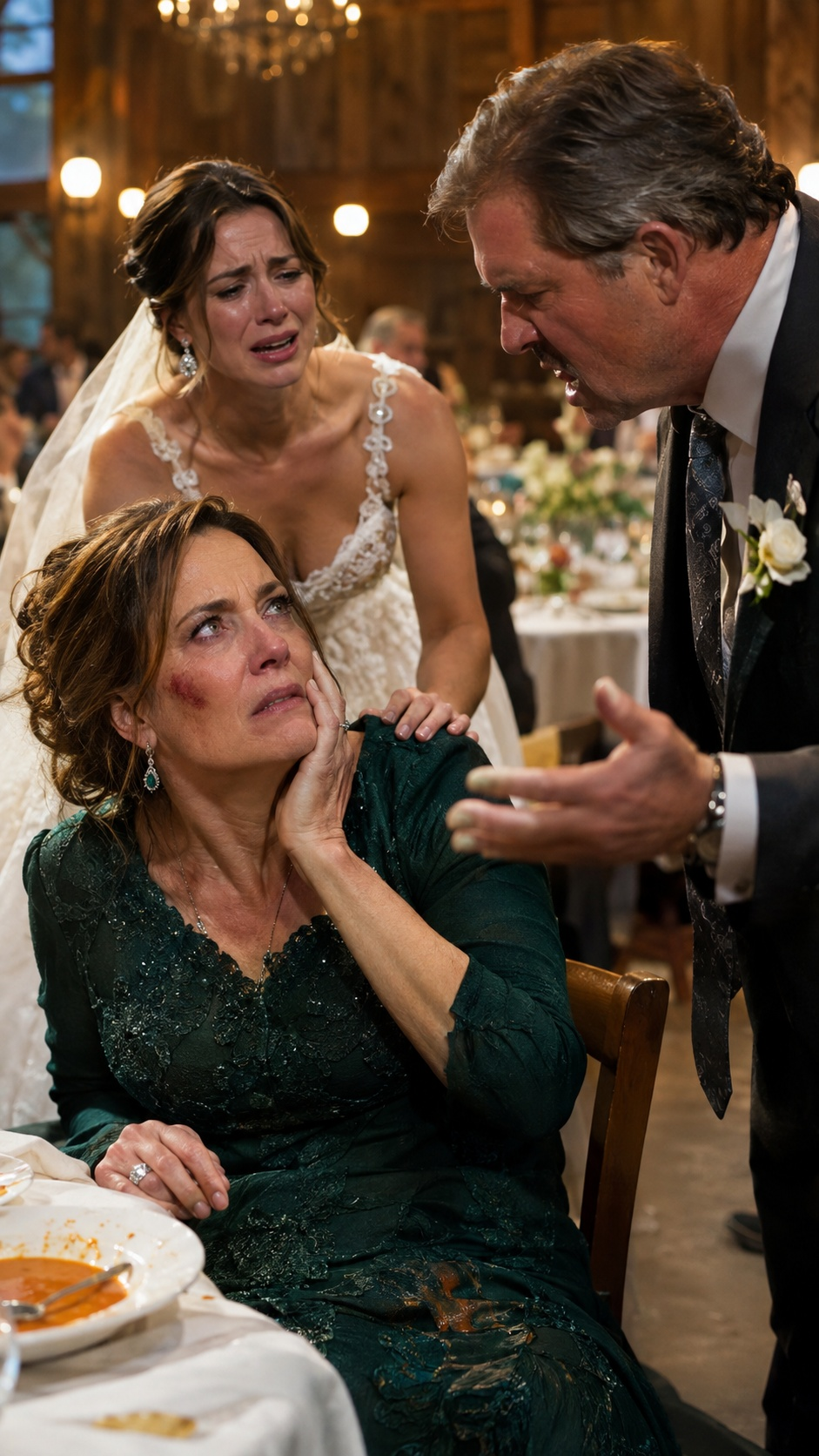
"Mr. Gabriel Cain has arrived."
The announcement came from the dining room doorway.
I sat perfectly still.
My former husband's name moved through the room like a cold draft.
Seven years.
Seven years since he had slapped me at our daughter's wedding.
Seven years since I had driven away from my father's workshop with a metal box full of documents and a bruise on my face.
Seven years since I had heard his voice without a telephone between us.
And now he was standing somewhere beyond the doors of Charles Whitmore's dining room.
I looked down at the folded court document in my lap.
Grace Anne Cain. Deceased.
The words seemed to pulse against the paper.
I was sixty-five years old.
I had built a successful business.
I owned my father's eleven acres.
I had paid taxes, signed contracts, employed twelve people, and lived an ordinary, documented life for seven years.
Yet my former husband had apparently persuaded someone to file a legal proceeding based on the claim that I was dead.
And he had chosen tonight to walk into the very room where I was sitting.
I folded the document once.
Then again.
I slipped it into my evening bag.
Across the table, Charles Whitmore rose from his chair.
"Gabriel," he said.
His voice was polite.
But not warm.
I watched the doorway.
A tall man entered.
Silver hair.
Charcoal suit.
Burgundy tie.
Gabriel had aged.
There were deeper lines around his mouth, and his shoulders had lost some of their old confidence.
But I recognized the way he carried himself.
Chin lifted.
Smile carefully arranged.
Eyes moving across the room to determine who mattered.
He shook Charles's hand.
"Charles. Thank you for having me."
Then he turned toward the table.
His gaze passed over the guests.
Over the flowers.
Over the candles.
And stopped on me.
For one brief second, his expression emptied.
He looked as though he had seen a ghost.
Which, according to his court papers, he had.
I didn't stand.
I didn't smile.
I didn't lower my eyes.
I simply looked back at him.
Gabriel's mouth opened slightly.
Then closed.
His gaze dropped to the table.
The walnut surface.
The brass detailing.
The smooth edges.
He recognized the craftsmanship.
Perhaps not the maker.
But he knew my father's work.
He had spent years mocking it.
Charles gestured toward an empty chair near the far end.
"Please join us."
Gabriel didn't move.
His eyes returned to me.
"Grace?"
The room quieted.
I heard someone set down a wineglass.
Charles looked between us.
"You know Mrs. Whitaker?"
Gabriel swallowed.
For a moment, I thought he might deny it.
Then he forced a smile.
"Of course. She's my former wife."
A woman beside Charles raised her eyebrows.
"How extraordinary."
I folded my hands in my lap.
"Hello, Gabriel."
My voice was steady.
That surprised me.
For years, I had imagined what I would say if I ever saw him again.
I had rehearsed accusations.
Questions.
Speeches about everything he had taken from me.
But now, with his face only a few yards away, all I felt was a strange distance.
He looked familiar.
But he no longer looked powerful.
"Grace," he repeated.
Then he laughed softly.
"What a surprise."
I watched him carefully.
"Yes," I said. "It certainly is."
Charles sensed the tension.
He was too experienced a businessman not to.
"Gabriel, I was just introducing everyone to the artist who created this table."
Gabriel looked down.
"Artist?"
Charles smiled.
"Mrs. Whitaker designed and built it through her company."
Gabriel's expression shifted.
"Your company?"
I nodded.
"Whitaker Fine Woodworks."
He stared at me.
Then at the table.
"This is yours?"
"Yes."
Charles ran his hand along the walnut edge.
"One of the finest pieces I've commissioned."
A few guests murmured their agreement.
Gabriel's smile tightened.
"Well. Grace always enjoyed her little projects."
There it was.
The old voice.
The old dismissal.
Seven years disappeared in an instant.
Your little projects.
Your hobby money.
You could make more answering phones.
I felt the familiar urge to explain myself.
To justify the work.
To prove I deserved the compliment.
Then I remembered something I had learned after leaving him.
I didn't need Gabriel's permission to be successful.
I looked at Charles.
"Thank you. My team worked very hard on the piece."
Charles nodded.
"It shows."
Gabriel pulled out his chair.
He sat slowly.
But his eyes kept returning to me.
I could almost see him calculating.
How much did I know?
Why was I here?
Had Nora warned me?
And most importantly, had I seen the court document?
I kept my expression calm.
I had learned long ago that Gabriel became careless when he believed he was in control.
Tonight, I intended to let him wonder.
Dinner resumed.
Servers moved between the chairs.
Conversation returned in cautious fragments.
Charles asked about a new commercial development.
Another guest discussed a charitable foundation.
Someone mentioned a hotel project in Austin.
I answered questions about furniture design.
Gabriel said very little.
That alone told me how frightened he was.
The Gabriel I remembered loved an audience.
He interrupted people.
Finished their sentences.
Turned every conversation toward his own achievements.
But tonight, he watched.
He listened.
And whenever I spoke, his jaw tightened.
I wondered whether he knew I had kept the eleven acres.
Of course he did.
The divorce had established that clearly.
The title records remained in my name.
The disputed filing from seven years earlier had been challenged.
Gabriel had failed to take the property through our marriage.
Now he was trying something else.
Something far more disturbing.
I thought about the probate document.
The claimed date of death.
October eighteenth.
The night of Nora's wedding.
The symbolism was almost unbearable.
Gabriel hadn't merely chosen a convenient date.
He had chosen the night I stopped belonging to him.
In his version of the world, the woman who walked away had ceased to exist.
I wondered whether he had told himself that story so often he had begun to believe it.
Then I remembered the court seal.
This wasn't merely a story.
He had put it on paper.
Halfway through dinner, Gabriel leaned toward me.
"Grace."
I turned.
"Yes?"
"Could we speak privately?"
I glanced toward Charles.
He was discussing a foundation grant with another guest.
"I don't think that's necessary."
Gabriel smiled.
It was the smile he used when he wanted strangers to believe we were a happy couple.
"Come on. It's been seven years."
"Yes."
"We have a lot to catch up on."
I looked directly at him.
"Do we?"
His smile faltered.
Then he lowered his voice.
"Don't make a scene."
The words struck me with almost comic familiarity.
Seven years earlier, he had slapped me in front of two hundred people.
Then our daughter had ordered me to leave because I was supposedly causing a scene.
Now, sitting at a billionaire's table, Gabriel was using the same accusation.
I leaned slightly closer.
"Gabriel, I haven't raised my voice."
His eyes narrowed.
"You're enjoying this."
I looked at him.
"Enjoying what?"
"Making me uncomfortable."
I considered the question.
Then I answered truthfully.
"I didn't know you were coming."
He stared at me.
For a moment, I saw something flicker behind his eyes.
Fear.
Not anger.
Not yet.
Fear.
He leaned back.
"Well," he said quietly, "some things never change."
I picked up my water glass.
"Some things do."
After dessert, Charles invited several guests into the adjoining library.
I remained seated for a moment, gathering my bag.
My hands were steady.
But my thoughts were racing.
I needed to contact Margaret Bell.
I needed to preserve the court document.
I needed to understand how a probate proceeding could have been initiated while I was alive.
And I needed to find Nora.
My daughter had been working as a server in that house.
Why?
What had happened to her marriage?
Why had she looked frightened?
And how had she obtained the court papers?
I stood.
Gabriel appeared beside me.
"Grace."
I turned.
He was closer than I expected.
For an instant, my body remembered the slap.
My shoulders tightened.
I hated that reaction.
Seven years of freedom, and some part of me still recognized danger before my mind did.
Gabriel noticed.
His mouth curved.
"You still jump when I get close."
I looked at him.
"Move away from me."
His smile vanished.
"Don't talk to me like that."
"Then don't stand so close."
He glanced toward the library.
No one appeared to be watching.
He lowered his voice.
"What are you doing here?"
"I built the table."
"Don't play games."
"I'm not."
He studied my face.
Then his gaze dropped to my evening bag.
"Did someone give you something?"
My heart struck hard against my ribs.
I kept my expression neutral.
"What would someone give me?"
Gabriel's eyes narrowed.
"Grace."
I stepped around him.
"Excuse me."
He caught my wrist.
Not hard enough to leave a mark.
But firmly enough to stop me.
The room seemed to contract.
I looked down at his hand.
Then up at his face.
"Let go."
He hesitated.
I spoke louder.
"Gabriel. Let go of my wrist."
A server turned.
Then another.
Charles appeared in the library doorway.
"Everything all right?"
Gabriel released me immediately.
"Of course," he said.
I looked at Charles.
"Yes. Thank you."
Gabriel smiled.
But I saw the anger beneath it.
He had lost control of the moment.
And he knew it.
I went directly to the ladies' room.
Locked the door.
Opened my bag.
And unfolded the court document.
This time, I read more carefully.
The application had been filed in a Texas probate court.
It identified Gabriel as an interested party seeking administration of an alleged estate.
Attached was a copy of a purported will.
My name appeared repeatedly.
Grace Anne Cain.
Not Whitaker.
Not the name I had used professionally for years.
Cain.
As though Gabriel could still define me through our former marriage.
The application asserted that I had died on October eighteenth, seven years earlier.
It referred to my disappearance after a family event.
It claimed that no reliable contact had been established.
I stared at those words.
No reliable contact?
I had operated a registered business.
Filed tax returns.
Purchased equipment.
Signed contracts.
Appeared in magazines.
I had even attended a woodworking conference in Dallas the previous year.
I wasn't hiding.
I had simply stopped speaking to Gabriel.
Then I reached the section describing the estate's assets.
My father's property was listed.
Eleven acres.
The farmhouse.
The workshop.
The pecan orchard.
The land I had protected for seven years.
Gabriel wanted it all.
But the most disturbing part came near the end.
The application claimed that a will had been discovered among my personal effects.
A will supposedly signed shortly before I disappeared.
A will naming Gabriel as the primary beneficiary of my separate property.
I stared at the page.
I had never signed such a will.
Not before the wedding.
Not afterward.
Not at any point in my life.
I read the signature block.
Then the witness names.
One was unfamiliar.
The other made my stomach turn.
Richard Voss.
Of course.
Richard.
The man who had searched Daddy's workshop.
The man who had helped Gabriel pressure me.
The man who had laughed while I sat covered in pumpkin soup.
I folded the document.
My hands had begun to shake.
Then I heard someone knock softly.
"Mrs. Whitaker?"
It was a woman's voice.
I opened the door a few inches.
A housekeeper stood outside.
She was middle-aged, with dark hair pulled into a neat bun.
"Mr. Whitmore asked me to make sure you're comfortable."
I nodded.
"Thank you."
She glanced down the hallway.
Then lowered her voice.
"The young server asked me to tell you something."
My pulse quickened.
"Nora?"
The woman nodded.
"She said not to leave through the front entrance."
"Why?"
The housekeeper looked frightened.
"Because Mr. Cain has someone waiting outside."
Charles Whitmore met me in a small sitting room beside the library.
He closed the door behind us.
"Grace, I owe you an apology."
I looked at him.
"For what?"
"For inviting a man who clearly makes you uncomfortable."
"You couldn't have known."
He studied me.
"Is there something I should know?"
I hesitated.
Charles was a client.
A wealthy one.
A man whose opinion could affect my business.
I had spent years learning to keep my private life separate from my work.
But tonight, my private life had followed me into his home.
"Gabriel is my former husband," I said.
Charles nodded.
"I gathered that."
"He hurt me."
Charles's expression became serious.
"Physically?"
"Yes."
He was silent for a moment.
Then he said, "I'm sorry."
I looked away.
"He also tried to take property my father left me."
Charles folded his arms.
"And now?"
I hesitated.
Then I removed the document from my bag.
"I believe he's trying again."
Charles read the first page.
His expression changed.
He turned another page.
Then another.
Finally, he looked up.
"Grace, this says you're dead."
"I noticed."
He stared at me.
Then, unexpectedly, he laughed once.
Not because it was funny.
Because the absurdity was almost impossible to process.
"You're sitting in my house."
"Yes."
"You built the table in my dining room."
"Yes."
"And someone filed paperwork claiming you died seven years ago?"
"That's what it says."
Charles looked at the document again.
"Who gave you this?"
"My daughter."
His expression shifted.
"The young woman serving dinner?"
I nodded.
"She was my daughter."
Charles sat down slowly.
For several seconds, he said nothing.
Then he asked, "Grace, do you trust your attorney?"
"Completely."
"Call her."
Margaret answered after two rings.
"Grace?"
"I need your help."
Her voice sharpened.
"What happened?"
I told her about the dinner.
Gabriel.
Nora.
The document.
The claimed date of death.
The purported will.
By the time I finished, Margaret was silent.
Then she said, "Send me photographs of every page immediately."
I did.
Charles helped me photograph the document under a reading lamp.
Margaret reviewed the images while we waited.
Finally, she spoke.
"Grace, this is extremely serious."
"I know."
"Do you know whether the court has issued any orders?"
"No."
"All right. We need to verify the case directly through the court and determine its status. The existence of an application doesn't mean the allegations have been accepted."
I closed my eyes.
That distinction mattered.
A filing wasn't a judgment.
An accusation wasn't proof.
And a forged will wasn't valid simply because someone attached it to a court document.
Margaret continued.
"Don't confront Gabriel. Don't give him the document. And don't sign anything."
"I won't."
"Can you remain somewhere safe tonight?"
I looked at Charles.
He nodded.
"Yes."
"Good. I'll begin making inquiries immediately."
I hesitated.
"Margaret?"
"Yes?"
"Why would he do this now?"
There was a pause.
Then she answered.
"Because something has changed. We need to find out what."
Charles arranged for me to leave through a private entrance.
Before I went, he offered to have his security team escort me home.
I accepted.
Seven years earlier, I would have refused.
I would have worried about causing trouble.
About appearing dramatic.
About making someone else uncomfortable.
Now I understood that accepting help wasn't weakness.
It was judgment.
As we walked toward the rear hallway, I asked Charles about Nora.
"How long has she worked here?"
He frowned.
"Only a few weeks, I believe. The catering company provides additional staff for private events."
"Do you know anything about her?"
"Not much."
I swallowed.
"She looked frightened."
Charles nodded.
"I noticed."
We reached a corridor lined with framed photographs.
At the far end stood a service door.
A security guard waited beside it.
Then I heard hurried footsteps.
Someone came around the corner.
Nora.
She stopped when she saw me.
For a moment, neither of us moved.
Seven years of birthdays.
Seven Christmases.
Seven Mother's Days.
Seven years of silence and short messages.
All of it stood between us.
"Nora," I whispered.
Her eyes filled with tears.
"Mom."
I took one step toward her.
She shook her head.
"Not here."
I stopped.
She glanced toward the dining room.
"He's looking for you."
"I know."
"You have to go."
"Nora, come with me."
Her face crumpled.
"I can't."
"Why?"
She looked down.
I noticed then how thin she had become.
Her hands were rough.
There were dark circles beneath her eyes.
The daughter who had once worn a wedding gown costing more than my first car now stood in a borrowed uniform, trembling in a hallway.
"What happened to you?" I whispered.
She swallowed.
"Everything."
I reached for her hand.
She let me take it.
For one brief moment, she was my little girl again.
Then she pulled away.
"Mom, listen carefully."
I nodded.
"The papers I gave you aren't the only ones."
My stomach tightened.
"What do you mean?"
She looked toward Charles.
Then back at me.
"There's another document. Something Dad doesn't know I found."
"What document?"
Nora's lips trembled.
"A letter."
"From whom?"
She shook her head.
"I can't tell you here."
"Nora—"
"Please."
She stepped closer.
"I need you to understand something. I didn't know what he was doing seven years ago."
I stared at her.
"The property documents?"
She nodded.
"I thought I was signing a routine family paper. Dad said it was for the wedding expenses."
My chest tightened.
"Why didn't you tell me?"
Tears slipped down her cheeks.
"Because by the time I understood, I was afraid."
I wanted to ask a hundred questions.
But Nora glanced toward the hallway again.
"Mom, I have to go."
"Where can I find you?"
She hesitated.
Then whispered an address.
A small apartment complex in Austin.
I repeated it to make sure I remembered.
Nora nodded.
"Don't call first. He checks my phone."
I went cold.
"Gabriel checks your phone?"
She looked away.
"Not just mine."
Before I could ask what she meant, footsteps sounded behind us.
Nora stepped back.
Her expression changed instantly.
She wiped her face.
Straightened her uniform.
And hurried down the hallway.
I watched her disappear.
Then I turned toward Charles.
He looked deeply troubled.
"Grace," he said quietly, "I think your daughter is in danger."
I nodded.
For the first time in seven years, I knew something with absolute certainty.
Whatever had happened between Nora and me, I would not leave her alone with Gabriel's threats.
I reached home shortly before midnight.
The security escort waited until I entered my house.
I thanked them.
Locked the door.
And placed the court document on my kitchen table.
My home was modest compared with Charles Whitmore's estate.
A single-story house outside Kerrville.
Two bedrooms.
A small garden.
A workshop behind the garage.
But every piece of furniture inside had been chosen or made by me.
Nothing belonged to Gabriel.
Nothing reminded me of his anger.
I made tea.
Then sat at the table and read the document again.
The forged will.
The claimed death.
The eleven acres.
I thought about Nora.
Her frightened eyes.
Her trembling hands.
The way she had whispered that Gabriel checked her phone.
Then I thought about Samuel Reed.
The accountant who had supposedly died.
The man who had warned me that Gabriel would never stop while he believed I had something worth taking.
I opened my laptop.
Searched for the probate case number.
The court's online system showed a pending matter.
A hearing had been scheduled.
Friday.
Nine o'clock.
Less than a week away.
I stared at the date.
Gabriel had chosen his moment carefully.
He expected the court proceeding to move forward before I could interfere.
He expected to stand before a judge and speak for a woman he claimed was dead.
He expected to inherit my father's land.
I picked up my phone.
Margaret had sent a message.
I confirmed the case. We need to meet first thing tomorrow. Bring the original deed and every document you have.
I replied.
I'll be there.
Then another message arrived.
This one was from an unknown number.
No greeting.
No explanation.
Just a photograph.
I opened it.
The image showed a document lying on a wooden desk.
At the top were the words:
LAST WILL AND TESTAMENT OF GRACE ANNE CAIN.
Beneath them was my supposed signature.
And beside it, a small handwritten notation.
Original held by R.V.
Richard Voss.
My hands turned cold.
Then a second photograph arrived.
This one showed the bottom of the will.
The witness signatures.
The notary seal.
And a date.
October seventeenth.
The day before Nora's wedding.
I stared at the screen.
Then the unknown number sent one final message.
Grace, the will isn't the worst thing Gabriel forged. Check the document dated October nineteenth.
I opened the attachment.
It was a scanned certificate.
Official-looking.
Stamped.
Signed.
My name appeared near the top.
And beneath it was a line that made my blood run cold.
CAUSE OF DEATH: PENDING INVESTIGATION.
I stared at the date.
October nineteenth.
The morning after the wedding.
Then my phone rang.
Unknown number.
I answered.
"Hello?"
For a moment, there was only breathing.
Then a woman whispered, "Mrs. Whitaker, you don't know me, but I was there when Gabriel arranged the paperwork."
My heart began pounding.
"Who are you?"
She hesitated.
Then said, "I worked at the funeral home."
I gripped the phone.
"What funeral home?"
The woman didn't answer.
Instead, she whispered, "Someone just came into my office."
I heard a door open.
A man's voice spoke in the background.
Then the woman gasped.
And the line went dead.






Comments 0