The photograph showed my daughter standing beside an open storage container.
In her hand was the sealed packet my father had left behind.
Behind her, Gabriel Cain was raising a gun.
For one terrible second, I forgot how to breathe.
"Nora."
Her name escaped my mouth as a whisper.
Detective Mercer was already moving.
He spoke into his radio, giving instructions so quickly I could barely follow them.
Margaret Bell caught my arm.
"Grace, look at me."
I couldn't.
All I could see was Gabriel's face.
The gun.
My daughter.
The girl I had already lost for seven years.
"He's going to kill her," I whispered.
"We don't know that."
"He's pointing a gun at her."
"I know."
I turned toward the courthouse doors.
Margaret stepped in front of me.
"Where are you going?"
"To my daughter."
"Grace, the police are responding."
I stared at her.
"She's my child."
Margaret's expression softened.
"I know. And she needs you alive."
Those words stopped me.
Not because they made the fear disappear.
Because I remembered what Gabriel had always wanted.
He wanted me frightened enough to stop thinking.
Angry enough to make mistakes.
Desperate enough to surrender control.
I had spent thirty-one years giving him exactly that.
Not today.
I looked at Mercer.
"Tell me what I can do."
He lowered his radio.
"Stay here. Keep your phone available. And tell me everything you know about that evidence packet."
I swallowed.
Then I began.
The photograph had come from a security camera inside the San Antonio storage facility.
A second camera showed Gabriel and Richard entering through a service corridor.
The images were time-stamped.
They had been recorded only minutes earlier.
Nora appeared in the footage after them.
That was what confused me.
"Why would Nora go there?" I asked.
Mercer looked at the screen.
"We're working on that."
I shook my head.
"She was supposed to be with Lily."
Evelyn immediately called Rachel.
The conversation lasted less than a minute.
When Evelyn hung up, her face was pale.
"Lily is safe."
I closed my eyes.
Thank God.
"Rachel has her," Evelyn continued. "Nora left after receiving a message that someone had found the original evidence concerning your father's death."
My stomach tightened.
"Who sent it?"
"Rachel doesn't know."
I stared at the photograph again.
Nora had gone because she believed she could help me.
Because she had spent seven years trying to make up for the night she turned her back on me.
I gripped the edge of the table.
"Gabriel used me to lure her."
Mercer said nothing.
He didn't need to.
Twenty minutes later, Nora's telephone connected to mine.
I nearly dropped it.
"Hello?"
For a moment, there was only breathing.
Then I heard her voice.
"Mom?"
My knees weakened.
"Nora. Sweetheart. Where are you?"
"At the storage place."
"I know."
Her breathing was uneven.
"Mom, I'm sorry."
"Don't apologize. Are you hurt?"
"No."
I closed my eyes.
Then a man's voice interrupted.
"Grace."
Gabriel.
My entire body went cold.
"Put Nora back on."
He laughed softly.
"Still giving orders?"
"Gabriel, listen to me."
"No. You listen."
I gripped the phone.
He continued.
"You've ruined everything."
I looked at Margaret.
She was standing beside Mercer, listening through the speakerphone.
"Gabriel," I said, "whatever happened in court wasn't Nora's fault."
"You brought her into this."
"No. You did."
His breathing changed.
I knew that sound.
The warning before his anger turned physical.
"You always had to make things difficult," he said.
I closed my eyes.
For thirty-one years, those words had controlled me.
Now they sounded small.
"You filed papers saying I was dead," I replied. "You forged my signature. You tried to take my father's land. And now you're threatening our daughter."
"That land should have been mine."
"No."
"It was supposed to save the company."
"Then you should have built a company that didn't depend on stealing."
Silence.
Then Gabriel spoke again.
"Tell the police to leave."
I looked at Mercer.
He shook his head.
I swallowed.
"Gabriel, I can't control what the police do."
"Then Nora pays."
My heart stopped.
Before I could answer, Nora cried out.
"Dad, please!"
A sharp sound followed.
Then the line went dead.
I don't remember sitting down.
I remember Margaret's hand on my shoulder.
Evelyn kneeling beside me.
Mercer speaking into his radio.
And the sound of my own heartbeat.
Loud.
Terrible.
Unbearable.
Then Mercer crouched in front of me.
"Grace."
I looked at him.
"Officers are at the facility. They've established a perimeter. We're working to get Nora out safely."
I nodded.
But I couldn't speak.
He continued.
"Gabriel doesn't know everything we know."
I stared at him.
"What do you mean?"
"The facility has more than one camera. We can see the storage area and part of the corridor."
My heart pounded.
"Can you see Nora?"
"Yes."
"Is she alive?"
"Yes."
I covered my mouth.
Mercer held my gaze.
"And the officers on scene are in communication with the people inside."
I began crying.
Not the quiet tears I had learned to hide from Gabriel.
I cried openly.
Because my daughter was alive.
And because I had almost lost her again.
The next hour stretched longer than the previous seven years.
Mercer remained in contact with the officers in San Antonio.
I sat beside Margaret.
Evelyn held my hand.
Samuel stood near the window.
Elena Morales had been taken to a safe location with investigators, and Miriam Vale was still cooperating with authorities.
Everything seemed to be moving at once.
Yet nothing mattered except Nora.
Then Mercer's telephone rang.
He answered.
Listened.
His expression changed.
"Understood."
He hung up.
I stood immediately.
"What?"
He looked at me.
"Nora is out."
For a moment, I didn't understand.
"Out?"
"She's safe."
My knees nearly gave way.
Margaret caught me.
Mercer continued.
"Gabriel surrendered his weapon after officers negotiated with him. Richard was detained while attempting to leave through a service exit."
I covered my face.
Nora.
My daughter.
Alive.
I began sobbing.
Evelyn wrapped her arms around me.
Samuel looked away, wiping his eyes.
Mercer waited until I could breathe.
Then he said, "Nora has asked to speak with you."
I reached for the phone.
"Mom?"
Her voice was shaky.
But it was hers.
I pressed my hand over my mouth.
"Nora."
"I'm okay."
I cried harder.
"I'm okay, Mom."
"Are you hurt?"
"No. Just scared."
I closed my eyes.
"Thank God."
She began crying too.
"I'm sorry I went there."
"Sweetheart, none of this is your fault."
"I thought I could get the evidence before Dad found it."
I swallowed.
"What happened?"
"Someone sent me a message saying the packet was being destroyed."
"Gabriel?"
"I think so."
She took a shaky breath.
"When I arrived, Richard was already inside. Dad came in behind me."
I closed my eyes.
"He wanted me to give him the packet."
"Did you?"
"No."
My heart tightened.
Nora continued.
"I told him it belonged to you."
I pressed my hand against my chest.
"He got angry."
"I know."
"He said the land was his."
I swallowed.
"And what did you say?"
Nora was quiet.
Then she whispered, "I told him you were alive, and you were never going to disappear for him again."
I began crying.
Seven years earlier, my daughter had watched Gabriel slap me and ordered me to leave her wedding.
Today, she had stood in front of him and refused to help him erase me.
I didn't need her to risk her life to prove she loved me.
I wished she hadn't.
But I understood what that moment had meant to her.
"Nora," I whispered, "I love you."
She began sobbing.
"I love you too, Mom."
Gabriel and Richard were taken into custody.
The gun was recovered.
The evidence packet was secured.
The storage facility's cameras preserved what had happened.
And the records from Daddy's container had not been lost.
Margaret had already arranged for authenticated copies of the documents to be preserved elsewhere, while the originals remained available for proper examination.
Gabriel had believed that stealing one packet would erase the evidence.
He was wrong.
For the first time, his habit of underestimating me had worked in my favor.
The weeks that followed were difficult.
There were interviews.
Statements.
Documents.
Meetings with attorneys.
And long nights when I woke convinced I could hear Gabriel's footsteps outside my bedroom.
But he never came.
The criminal proceedings began with charges related to the storage-facility incident and the alleged document fraud.
Investigators continued examining the forged will, the false death records, the Morales property transfers, and the financial transactions Samuel had uncovered.
The case was complicated.
There were too many documents.
Too many years.
Too many people who had been frightened into silence.
But this time, the witnesses were speaking.
Miriam Vale provided records showing how Gabriel's private account had been used to store altered paperwork.
She admitted that she had accepted money after the Hillcrest incident.
She also described threats made against her when she questioned the documents.
Her cooperation did not erase her responsibility.
But it helped investigators establish how the records had been manipulated.
Elena Morales testified about the threats against her family and the pressure Gabriel and Richard had placed on her to appear in court under another name.
She explained that she had been forced into hiding after her attempt to recover the Morales ranch.
The photograph Nora saw at Hillcrest had been taken from an old identification file.
Elena had never been the woman whose body was shown to Nora.
That woman was finally identified through surviving records and forensic comparison.
Her name was Patricia Ellis.
She had died from an unrelated medical emergency, and her body had been improperly handled after her death.
Gabriel's associates had exploited that death to create false records under my name.
Patricia's family had spent years confused by inconsistent information about what happened after she died.
When investigators finally contacted them, they received the answers they had been denied.
I sent them a letter.
Not because I believed words could repair what had happened.
Because Patricia deserved to be remembered as a person.
Not as a document.
Not as an opportunity.
Not as someone else's false identity.
The question of Daddy's death took longer.
The medication sample was examined by specialists.
The old medical records were reviewed.
Investigators interviewed Elena, Samuel, Miriam, and people who had known Daddy during his final months.
The evidence established that Richard had visited Daddy's house shortly before his death and that suspicious changes had occurred in the medication Daddy kept there.
But the passage of fifteen years made some questions impossible to answer with certainty.
I wanted the truth.
Every terrible detail.
Every name.
Every decision.
Yet I also learned that a courtroom could not always give me the certainty my heart demanded.
Then Mateo Morales brought me Daddy's message.
He arrived at my workshop on a Saturday morning with Elena.
He was fifteen.
Tall.
Quiet.
With his mother's dark eyes.
He carried a small wooden box.
"Mrs. Whitaker?"
I smiled.
"Grace."
He looked nervous.
"My mother said this belongs to you."
He placed the box on my workbench.
I stared at it.
Daddy had made it.
I recognized the dovetail joints.
The walnut lid.
The tiny brass latch.
I touched the wood.
My throat tightened.
"Thank you, Mateo."
He nodded.
Then stepped back beside Elena.
I opened the box.
Inside was a folded letter.
And a small cassette tape.
I recognized Daddy's handwriting immediately.
For my Gracie.
My eyes filled.
I unfolded the letter.
Sweetheart,
If you're reading this, then something has gone wrong.
I pressed my hand over my mouth.
I want you to know that I never regretted standing up to Gabriel.
He has been using other people's trust to take things that don't belong to him. I have seen the documents. I have spoken to the families. I know what he is capable of.
I swallowed.
I am worried about my health, and I am worried about what may happen if I refuse to cooperate.
But I am more worried about what will happen to you if nobody tells the truth.
Tears blurred the words.
The land is yours, Grace. Not Gabriel's. Not mine anymore. Yours.
I left it to you because I wanted you to have something nobody could take simply by raising his voice.
I began crying.
Daddy.
My stubborn, gentle father.
He had known.
He had seen what I couldn't.
And he had tried to leave me a way out.
I read the final lines.
If I cannot be there when you finally choose yourself, please remember this: I have always been proud of you.
You were never difficult to love.
Love, Daddy.
I lowered the letter.
For a long time, I couldn't speak.
Then Elena quietly placed her hand over mine.
"Your father saved my family once," she whispered.
I looked at her.
"And now we're going to make sure his work wasn't wasted."
The cassette contained Daddy's recorded account of the suspicious property transactions.
He described the documents he had examined.
The signatures he believed were forged.
The pressure Gabriel and Richard had placed on the Morales family.
He also recorded his concerns about his medication and the unexpected visits to his home.
The recording supported the investigation.
It did not answer every question about his death.
But it gave Daddy something he had been denied for fifteen years.
A voice.
A chance to tell people what he knew.
And when I heard him say my name, I cried so hard I had to stop the tape.
"Gracie."
One word.
That was all it took.
The legal proceedings continued for months.
The probate court rejected Gabriel's attempt to administer an estate that did not exist.
The forged will was declared invalid.
The false death documents were exposed.
My ownership of the eleven acres remained intact.
Gabriel's financial empire collapsed under the weight of its debts, lawsuits, and the evidence of fraudulent transactions.
The lender did not receive my property.
The development deal failed.
And Gabriel finally faced consequences he could not negotiate away.
He and Richard were ultimately convicted in connection with the fraudulent property and document schemes, along with offenses arising from the storage-facility confrontation.
Both received prison sentences.
The separate investigation into Daddy's death concluded that the surviving evidence raised serious concerns about interference with his medication, but it could not establish beyond a reasonable doubt who had caused his death.
That hurt.
I won't pretend otherwise.
There were nights when I sat in Daddy's workshop and wished for one more answer.
One more document.
One more witness.
But I had learned something important.
Justice did not always arrive in the shape I imagined.
Sometimes it arrived as a forged will being rejected.
A stolen property being returned.
A frightened woman finally speaking.
A daughter coming home.
And a man who had spent his life controlling others finally losing the power to do so.
The Morales ranch was returned to Elena and Mateo after the fraudulent transfer was set aside.
The first time Elena walked onto the property again, she called me.
I could hear the wind through the telephone.
"Grace?"
"Yes?"
"I'm standing beside the old oak tree."
I smiled.
"The one in the photograph?"
"Yes."
Her voice broke.
"My mother planted it when I was little."
I closed my eyes.
"I'm glad you're home."
She began crying.
"So am I."
A month later, Elena invited us to visit.
Nora came.
Lily came.
Evelyn came.
Mateo showed Lily the horses.
She was delighted.
By lunchtime, she had decided she wanted to live on a ranch.
Nora laughed.
"Absolutely not."
Lily crossed her arms.
"Grandma Grace would let me."
I raised an eyebrow.
"Grandma Grace believes little girls should ask their mothers."
Nora looked at me.
For a moment, we both smiled.
It was such a small thing.
A mother.
A daughter.
A child.
A joke.
But after everything we had lost, ordinary happiness felt extraordinary.
Nora moved into a small house near my workshop.
Not because I demanded it.
Because she wanted to.
Daniel remained part of Lily's life.
He and Nora worked with their attorneys to resolve the financial problems Gabriel had used to threaten them.
The documents Daniel had signed were examined, and the evidence showed that Gabriel had misrepresented the transactions.
Daniel was not sent to prison.
The threats Gabriel had used against Nora lost their power.
Nora and Daniel did not reunite romantically.
Their marriage had ended for reasons neither of them could erase.
But they became better parents together than they had been spouses.
And Lily grew up surrounded by people who loved her.
Some mornings, she came to my workshop before school.
She wore little safety glasses and carried a wooden pencil behind her ear.
Just like Daddy.
She would stand beside my workbench and ask, "Grandma, what are we making today?"
And I would answer, "Something beautiful."
Whitaker Fine Woodworks continued to grow.
Charles Whitmore commissioned another table.
Then a library.
Then a set of cabinets for a new home.
He recommended my work to friends.
Soon, I had more orders than I could complete alone.
Luis Martinez became my workshop manager.
We hired three additional apprentices.
And Nora began helping with the business.
At first, she handled scheduling.
Then customer calls.
Then design consultations.
One afternoon, she stood beside me examining a walnut dining table.
"Mom?"
"Yes?"
"I think this edge should be softer."
I looked at the wood.
She was right.
I smiled.
"Then show me."
She picked up the sanding block.
And for the first time since she was a little girl, we worked side by side.
No shouting.
No fear.
No one telling us we were doing everything wrong.
Just two women making something with their hands.
Something solid.
Something honest.
Something that would last.
A year after the courthouse hearing, I decided to renovate Daddy's farmhouse.
The old porch needed repairs.
The kitchen cabinets were worn.
The workshop roof had begun to leak.
For years, I had preserved the property almost exactly as Daddy left it.
Part of me was afraid that changing anything would mean losing him again.
But one morning, I stood in the kitchen and realized the house wasn't a museum.
It was a home.
And homes were meant to hold living people.
So I called Luis.
We repaired the porch.
Restored the windows.
Replaced the damaged roof.
And built a long walnut table for the kitchen.
Fourteen feet.
The same length as the table that had brought Nora back into my life.
But this one was different.
This one wasn't for a billionaire.
It was for us.
The first dinner around that table happened on a warm October evening.
Seven years and another year of healing had passed since the wedding.
The pecan trees were turning gold.
The air smelled of woodsmoke and fresh bread.
Evelyn brought a casserole.
Elena brought tamales.
Mateo carried a basket of rolls.
Samuel arrived with flowers.
Margaret came straight from work, still wearing her court shoes.
Detective Mercer stopped by after his shift.
Luis and his family joined us.
Rachel came with Daniel.
And Nora arrived holding Lily's hand.
The house filled with voices.
Laughter.
Children running through the hallway.
Plates clinking.
Someone asking for more butter.
Someone else telling a story too loudly.
I stood in the kitchen doorway and watched.
For a moment, I remembered another gathering.
A wedding.
Two hundred guests.
A midnight-blue velvet dress.
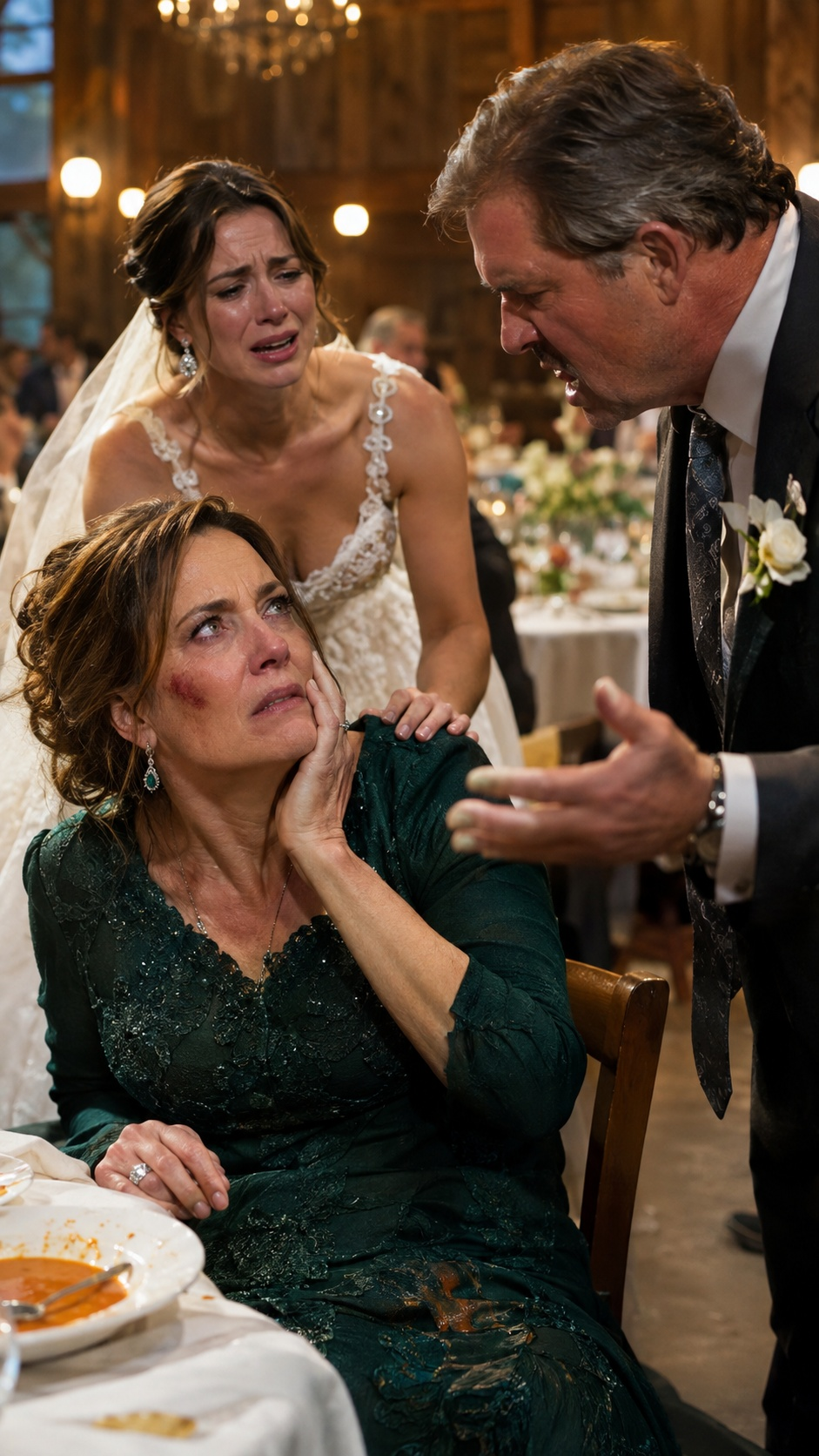
Hot pumpkin soup.
Gabriel's hand striking my face.
The silence that followed.
I had believed that night was the end of my life.
But it had been the beginning of my freedom.
"Grandma!"
Lily ran toward me.
I knelt.
"What is it, sweetheart?"
She held up a small wooden heart.
"I made this for you."
I stared at it.
The edges were uneven.
The surface was scratched.
But someone had carefully sanded the front.
And on the back, in crooked letters, Lily had written:
HOME.
My eyes filled.
"It's beautiful."
She smiled.
"Mommy helped."
I looked up.
Nora stood behind her.
She was crying.
I stood and hugged them both.
For a long time, we stayed that way.
Three generations.
Three women.
All of us still here.
Later, after dinner, Nora found me on the porch.
The sun was setting behind the pecan orchard.
The pond reflected the last orange light.
She sat beside me.
For a while, neither of us spoke.
Then she said, "Mom?"
"Yes?"
"Do you ever wish you could go back?"
I looked at her.
"To when?"
"Before the wedding."
I thought about it.
Thirty-one years of marriage.
The fear.
The excuses.
The silence.
The years I spent trying to become someone Gabriel would approve of.
Then I thought about the life I had now.
My workshop.
My friends.
My daughter.
My granddaughter.
The land.
The home.
I shook my head.
"No."
Nora looked surprised.
"Not even to change what happened?"
I smiled sadly.
"I wish I could have spared us the pain."
She nodded.
"But I don't want to go back to being the woman who thought she had to earn the right to be treated kindly."
Nora looked down.
"I'm sorry, Mom."
I reached for her hand.
"I know."
She swallowed.
"I should have stood beside you that night."
"Yes."
She began crying.
I squeezed her hand.
"But you're beside me now."
She looked up.
I smiled.
"And that's where I want you."
She leaned against my shoulder.
We watched the sun disappear.
A few weeks later, I visited Daddy's grave.
I brought fresh flowers.
And a small wooden heart.
The one Lily had made.
I placed it beside the headstone.
Then I sat on the grass.
"Hi, Daddy."
The wind moved through the trees.
I smiled through tears.
"I kept the land."
My voice broke.
"All eleven acres."
I looked at the headstone.
"I found your letters. Your recordings. Everything you tried to save."
I swallowed.
"I wish you could see what we've built."
For a long time, I sat quietly.
Then I told him about Nora.
About Lily.
About the workshop.
About Elena and Mateo getting their ranch back.
About Evelyn.
About Margaret.
About the people who had stood beside me when I finally learned to stand for myself.
And when I finished, I whispered, "You were right, Daddy."
I touched the stone.
"I was never difficult to love."
That Christmas, the farmhouse glowed with lights.
A wreath hung on the front door.
The kitchen smelled of cinnamon and roasted pecans.
Lily insisted on decorating the tree herself.
Most of the ornaments ended up on the lower branches.
Nora laughed.
I laughed.
And nobody complained.
After dinner, Lily climbed into my lap.
"Grandma?"
"Yes?"
"Are you happy?"
The question surprised me.
I looked around the room.
Evelyn was laughing with Samuel.
Luis was telling a story.
Nora stood beside the fireplace, smiling at something Daniel had said.
Elena and Mateo were looking through an old photo album.
The house was warm.
The people I loved were safe.
And outside, beneath the winter stars, my father's eleven acres stretched quietly around us.
I kissed Lily's forehead.
"Yes, sweetheart."
She smiled.
"How happy?"
I thought about the woman I had been seven years earlier.
The woman standing in a ruined velvet dress.
The woman who believed her life was over.
Then I looked at my granddaughter.
"Happy enough that I don't have to pretend."
Lily considered that.
Then she nodded.
"That's good."
She rested her head against my shoulder.
And I held her.
On the first warm morning of spring, I opened the workshop doors before sunrise.
The air smelled of fresh grass and damp earth.
Birds called from the pecan trees.
The pond shimmered beyond the orchard.
I stood at my workbench and ran my hand across a piece of walnut.
There was a time when I thought freedom would feel dramatic.
Like shouting.
Like winning.
Like watching Gabriel lose everything he had tried to steal.
But standing there, with sunlight spilling across the floor, I realized freedom felt much quieter.
It felt like waking without fear.
Like choosing my own clothes.
Like hearing my daughter laugh.
Like knowing my granddaughter would never have to watch me accept cruelty as love.
I picked up a pencil.
Marked a line.
And began working.
A few minutes later, the workshop door opened.
Nora stepped inside.
Lily followed, carrying her little wooden toolbox.
"Morning, Mom," Nora said.
I smiled.
"Morning, sweetheart."
Lily ran toward me.
"Grandma! What are we making today?"
I looked at the walnut board.
Then at my daughter.
Then at the little girl whose laughter had filled a house that once held only memories.
"A table," I said.
Lily grinned.
"Another one?"
I laughed.
"Yes."
"Who is it for?"
I looked through the open doors.
Across the orchard.
Past the pond.
Toward the farmhouse my father had left me.
Then I looked back at the two people I loved more than anything in the world.
"For our family."
Nora smiled.
Lily reached for my hand.
And together, we began.






Comments 0