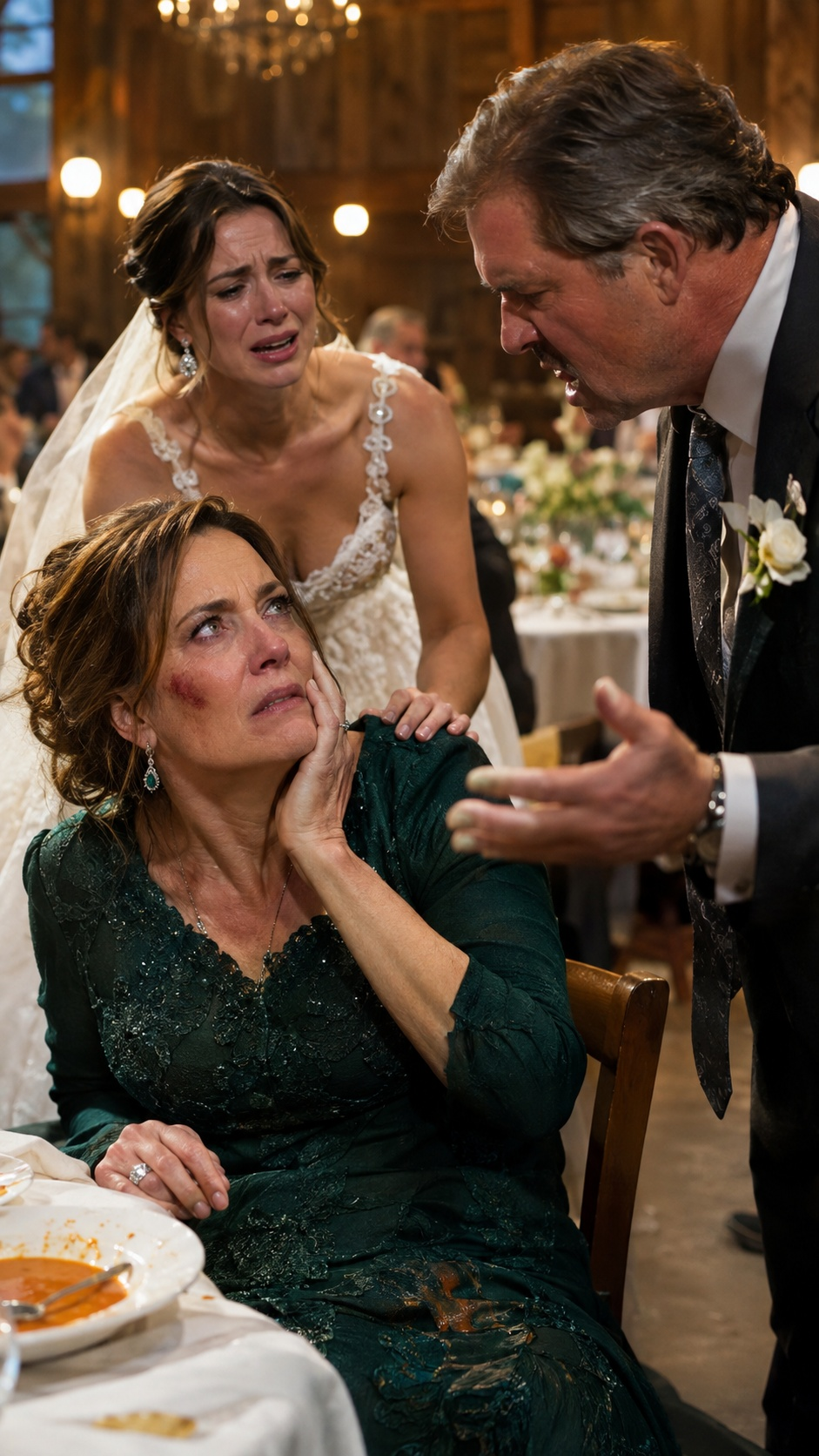
"Nora Cain."
Margaret Bell said my daughter's name once.
Then she fell silent.
I stood in my kitchen with the phone pressed against my ear, staring at the dark window above the sink.
For several seconds, I couldn't understand what she had told me.
Nora had identified my body.
That was what the document claimed.
My daughter, who had embraced me in her apartment two days earlier.
My daughter, who had slipped court papers into my hand at Charles Whitmore's dinner.
My daughter, who had cried and apologized for abandoning me seven years ago.
According to a sworn statement, that same daughter had stood before someone and declared that I was dead.
"Grace?"
Margaret's voice sounded distant.
"I'm here."
"I need you to understand that a name on a document doesn't establish who actually signed it."
I closed my eyes.
"Is it her signature?"
"I can't determine that from the scanned copy."
"What does the statement say?"
Margaret hesitated.
"That Nora personally viewed and identified the remains of a woman believed to be you on October nineteenth, seven years ago."
My hand tightened around the telephone.
"Where?"
"The statement refers to a private mortuary."
I thought of the woman who had called me.
Miriam Vale.
The frightened voice.
The scream.
The disconnected line.
"Does it name the funeral home?"
"Yes."
"Tell me."
Margaret read the name.
"Hillcrest Memorial Services."
I stared at the wall.
I knew that place.
Not because I had ever arranged a funeral there.
But because fifteen years earlier, Hillcrest Memorial Services had handled my father's burial.
And Gabriel had insisted on making every arrangement.
I arrived at Margaret's office at eight the following morning.
Evelyn drove me.
Neither of us spoke much during the journey.
I had spent the night imagining Nora standing beside a covered body.
Signing a document.
Accepting that her mother was dead.
But every time the image formed, another memory interrupted it.
Nora at Charles Whitmore's dinner.
Her frightened eyes.
Her whispered warning.
Don't let him know you saw me.
Something was wrong.
Not merely with the document.
With the entire story.
Margaret greeted us at the door.
Caroline Price was already seated at the conference table.
Several folders lay open.
A large monitor displayed the sworn statement.
I recognized Nora's name immediately.
NORA ELIZABETH CAIN.
Below it was a signature.
My daughter had always written her middle initial with a small loop.
The signature on the screen contained the same loop.
I felt sick.
"It looks like hers," I whispered.
Margaret pulled out a chair.
"Sit down, Grace."
I did.
She enlarged the document.
"Look at the date."
October nineteenth.
Seven years earlier.
The morning after the wedding.
Then she pointed to another section.
"The statement claims Nora identified your body at 9:40 a.m."
I stared at the time.
Something stirred in my memory.
Nine-forty.
That morning, I had been at Evelyn's guesthouse.
I remembered the sunlight through the kitchen window.
The coffee.
The eggs I couldn't eat.
The swelling on my cheek.
Then I remembered something else.
"Nora called me that morning."
Margaret looked up.
"Are you certain?"
I nodded slowly.
"She called after breakfast."
"What did she say?"
I closed my eyes.
I hadn't thought about that conversation in years.
Nora had been angry.
She said Gabriel was worried.
She said I needed to stop embarrassing the family.
She asked whether I was coming home.
I told her I wasn't ready.
Then she hung up.
I opened my eyes.
"I spoke to her while I was alive."
Margaret leaned forward.
"Do you remember approximately when?"
"After nine. Before eleven."
Caroline began typing.
"We may be able to locate historical telephone records, depending on what was retained."
I looked at the statement again.
"She couldn't have identified my body."
Margaret nodded.
"That's exactly why we need to determine how this document was created."
The sworn statement contained more than Nora's name.
It described a body supposedly recovered after an accident.
A woman matching my age and physical description.
Personal belongings allegedly found nearby.
A purse.
A wedding ring.
A damaged identification card.
I stared at the list.
Then my breath caught.
"The wedding ring."
Margaret looked at me.
"What about it?"
"I left mine in Daddy's workshop."
Evelyn turned toward me.
"The hidden drawer?"
I nodded.
"Before I drove to your house."
Margaret picked up her pen.
"Is the ring still there?"
"I don't know."
I hadn't opened that particular compartment in years.
The workshop had been repaired.
The farmhouse restored.
The land protected.
But the ring had remained where I left it.
At least, I had always believed it had.
"Can you describe the ring?" Margaret asked.
"Yellow gold. Narrow band. Three small diamonds set into the top."
"Any engraving?"
I hesitated.
Then remembered.
"Inside. Gabriel had our initials engraved."
"What did it say?"
"G.C. and G.W. Forever."
Margaret wrote it down.
Then she turned another page.
"The property inventory attached to the statement describes a gold ring with three stones."
My stomach tightened.
"Does it mention the engraving?"
"No."
I stared at the screen.
Someone had used a ring to help identify a body as mine.
But my actual wedding ring had been hidden in a drawer.
Unless someone had found it.
Unless someone had taken it.
I thought about Richard searching Daddy's workshop.
The broken cabinets.
The scattered tools.
The men looking for documents.
Had they discovered the hidden compartment after I escaped?
Had they found the ring?
Or had Gabriel simply bought another one?
I looked at Margaret.
"We need to check the workshop."
She nodded.
"Yes. But not alone."
At ten-thirty, I called Nora.
She answered after several rings.
"Mom?"
Her voice was cautious.
"Sweetheart, are you somewhere safe?"
"Yes. Lily's with me."
"Good."
I took a breath.
"I need to ask you something important."
A pause.
"Okay."
"Do you remember the morning after your wedding?"
Silence.
"Nora?"
"Yes."
"Did you go to a funeral home that morning?"
She didn't answer.
My stomach tightened.
"Sweetheart, please."
Finally, she whispered, "Dad took me somewhere."
I closed my eyes.
"Where?"
"I don't remember the name."
"Was it Hillcrest Memorial Services?"
A long silence followed.
Then she said, "Yes."
Evelyn looked at me.
I raised a hand.
"Why did he take you there?"
Nora began breathing faster.
"He said there had been an accident."
My chest tightened.
"What accident?"
"He said a woman had been found near the highway. He thought it might be you."
I stared at the wall.
"Nora, you spoke to me that morning."
"I know."
"Then why would you believe I was dead?"
Her voice broke.
"Because Dad said you might have been calling from someone else's phone before the accident."
I closed my eyes.
Gabriel had prepared an explanation for everything.
Even my voice.
"Did you see a body?" I asked.
Nora began crying.
"I don't know."
I sat straighter.
"What do you mean?"
"They showed me a photograph."
"A photograph?"
"Of a woman."
My heart pounded.
"Was it me?"
"No."
The word came immediately.
Then Nora began crying harder.
"No, Mom. I knew it wasn't you."
I gripped the edge of the table.
"Then why did you sign anything?"
"Because Dad said the paperwork was only to help them investigate."
I looked at Margaret.
She was listening carefully.
Nora continued.
"He told me they needed a family member to confirm whether the woman might be you. I said I wasn't sure."
I swallowed.
"Did you sign a statement saying you identified my body?"
"No."
Her answer was firm.
"I signed a form saying I couldn't identify her."
The room went silent.
Margaret leaned toward the phone.
"Nora, this is Margaret Bell. I represent your mother. Would you be willing to tell me exactly what happened that morning?"
Nora hesitated.
Then whispered, "Yes."
Margaret's expression changed.
Because now we had something more than a suspicious signature.
We had a witness who said the document had been altered.
After the call, Margaret sat quietly for a moment.
Then she looked at me.
"Grace, we need the original records from Hillcrest."
I nodded.
"And the person who handled the identification."
"Miriam Vale?"
"Possibly."
I thought about the frightened woman who had called me.
The voice that disappeared after a man entered her office.
"Do we know whether she's safe?"
Margaret's expression was serious.
"The authorities are following up. I don't have a confirmed update yet."
I looked down.
Somewhere, a woman might be frightened because she knew what Gabriel had done.
And I couldn't help thinking about the years I had spent protecting his reputation.
How many people had suffered because no one challenged him?
How many lives had been damaged by his lies?
I looked at Margaret.
"What happens if we prove the statement is false?"
"That depends on who prepared it, who submitted it, and what they knew. False sworn statements and forged documents can have serious legal consequences."
I nodded.
Then I asked the question that frightened me most.
"Could Nora be blamed?"
Margaret chose her words carefully.
"If Nora signed one document and someone later altered or replaced it, that's important. We need to preserve her account and obtain the original paperwork."
I looked at my daughter's name on the screen.
Seven years earlier, I had believed Nora chose Gabriel because she loved him more.
Now I was beginning to understand that Gabriel had used her trust as a weapon.
And he had been doing it for far longer than I knew.
That afternoon, Evelyn and I drove to my father's property.
The eleven acres looked almost exactly as they had when I was a child.
Pecan trees lined the driveway.
The old farmhouse stood beneath a wide Texas sky.
Beyond it, the workshop rested near the eastern fence.
I had restored the building years earlier.
Replaced damaged boards.
Repaired the roof.
Installed new locks.
But I had kept Daddy's workbench.
It was too important to replace.
Inside, the workshop smelled of cedar and old varnish.
Sunlight fell across the floor.
I stood beside the bench.
For a moment, I could almost hear Daddy whistling.
He used to whistle while he worked.
Never the entire song.
Just a few notes repeated until I threatened to hide his radio.
I smiled faintly.
Then I reached beneath the bench.
Found the disguised brass screw.
Turned it.
The hidden drawer slid open.
Empty.
I stared.
The ring was gone.
For several seconds, I couldn't move.
Then I searched the compartment again.
Ran my fingers along the corners.
Checked beneath the lining.
Nothing.
Evelyn stepped closer.
"Grace?"
I looked up.
"It's gone."
Her expression tightened.
"Are you sure?"
I nodded.
"I left it here."
I remembered the moment clearly.
The night of the wedding.
The bruising on my cheek.
The metal box.
The decision to remove the ring.
I had placed it inside the hidden drawer and closed it.
I hadn't returned for it.
Not once.
Evelyn looked around the workshop.
"Someone found it."
I swallowed.
"Richard."
Perhaps.
But I couldn't prove it.
I looked at the empty drawer.
The ring had been a symbol of thirty-one years of marriage.
I hadn't wanted it.
But now its disappearance mattered for an entirely different reason.
Someone might have used it to support the story of my death.
We searched the workshop for anything else that had been disturbed.
Most of the damage from seven years earlier had been repaired.
But behind the workbench, I noticed something strange.
A narrow strip of wood near the floor had been replaced.
I didn't remember replacing it.
I knelt.
Ran my fingers along the edge.
The grain didn't match.
Daddy had always been particular about matching wood.
He would never have used a strip that stood out so clearly.
I reached for a screwdriver.
Evelyn watched.
"What are you doing?"
"I don't know yet."
I removed two screws.
The strip came loose.
Behind it was a shallow cavity.
My heart quickened.
Inside lay a small envelope.
Yellowed.
Dusty.
Marked in my father's handwriting.
GRACE — IF ANYTHING HAPPENS TO ME.
I stared at the words.
Daddy had died fifteen years earlier.
I had spent years working in this building.
Restoring it.
Repairing it.
Remembering him.
And all that time, this envelope had been hidden behind the bench.
My hands trembled as I opened it.
Inside was a single page.
And a small brass key.
The note was brief.
Gracie,
If you're reading this, something has gone wrong.
I should have told you sooner what Gabriel asked me to do.
I refused him. But I made copies of everything.
The key opens the lower cabinet in my old office. Look behind the false back.
And whatever you find, take it to Walter Hensley.
Do not give it to Gabriel.
Love, Daddy.
I read the note twice.
Then I looked at Evelyn.
"Walter Hensley."
"The attorney?"
I nodded.
The same lawyer whose old letter I had found in Daddy's metal box seven years earlier.
The man who had warned Daddy about Gabriel's interest in the property.
I looked at the brass key.
Then toward the farmhouse.
Daddy's old office was still there.
I had turned it into a small library.
But the lower cabinet remained.
I stood.
"Come on."
The cabinet stood beneath the office window.
Dark oak.
Handmade.
One of Daddy's earliest pieces.
I had always loved it.
The brass key fit the lock perfectly.
I turned it.
The door opened.
Inside were old folders and a stack of yellowed newspapers.
I removed them.
Then pressed against the back panel.
It moved.
A hidden compartment.
My breath caught.
Inside was a flat metal case.
I pulled it out.
The case was heavier than I expected.
A small combination lock secured it.
But attached to the handle was a handwritten label.
THE YEAR GRACE WAS BORN.
I stared at it.
Daddy.
Even now, he was making me solve one of his little puzzles.
I entered my birth year.
The lock clicked.
Inside were documents.
Photographs.
A ledger.
And a cassette tape.
I stared at the tape.
Daddy had used an old recorder for years.
He liked leaving messages for himself while working.
Measurements.
Design ideas.
Reminders to buy supplies.
Sometimes he recorded stories about his childhood.
I picked up the cassette.
A label was attached.
GABRIEL — MARCH 12.
Sixteen years earlier.
I looked at Evelyn.
"What do you think is on it?"
She swallowed.
"Only one way to find out."
We took the case back to Kerrville.
Margaret agreed to meet us at my house.
By the time she arrived, I had found an old cassette player in a storage box.
It had belonged to Daddy.
I hadn't used it in years.
I cleaned the tape heads.
Inserted the cassette.
Then looked at Margaret.
"Should we listen?"
She nodded.
"Yes. But let's preserve the original and make a careful record of what we hear."
I pressed play.
For several seconds, there was only static.
Then Daddy's voice filled the kitchen.
"March twelfth. Thomas Whitaker speaking."
My eyes filled instantly.
Fifteen years.
Fifteen years since I had heard him.
His voice was rough.
Warm.
Familiar.
I pressed my hand against my mouth.
Daddy continued.
"I'm recording this conversation because Gabriel Cain has asked me to sign documents involving my daughter's property."
A pause.
Then another voice.
Gabriel.
Younger.
Impatient.
"Thomas, you're making this more complicated than it needs to be."
I gripped the table.
Daddy answered.
"No, Gabriel. I'm making sure my daughter doesn't lose what belongs to her."
Gabriel laughed.
"Grace doesn't understand business."
"She understands honesty."
Silence.
Then Gabriel said, "You're being unreasonable."
Daddy's voice hardened.
"Get out of my office."
Another pause.
Then Gabriel spoke again.
"Thomas, think carefully. You don't want to make an enemy of me."
My stomach tightened.
Daddy answered calmly.
"Then don't give me a reason to."
A chair scraped.
Footsteps sounded.
Then the recording continued.
Daddy spoke alone.
"Grace, if you ever hear this, I want you to know something."
I began crying.
His voice softened.
"Your husband came here today because he needs something from you. Not because he loves you. Because he wants what I worked my whole life to leave you."
I closed my eyes.
"Don't let him convince you that you're foolish. You were building things with me before that man knew how to hold a hammer."
A sob escaped my throat.
Evelyn reached for my hand.
Daddy continued.
"And if Gabriel ever tries to use my name on a document, remember this. I never gave him permission. Not once."
The tape clicked.
Then silence.
I sat frozen.
For fifteen years, I had wondered whether Daddy knew how unhappy I was.
Now I understood.
He had known more than I ever imagined.
Margaret listened to the recording twice.
Then she examined the documents in the case.
Several were copies of old financial agreements.
Others contained handwritten notes.
One was a letter from Walter Hensley.
Margaret read it carefully.
Then looked up.
"Grace, this is significant."
I wiped my eyes.
"What?"
"Your father preserved evidence that Gabriel attempted to obtain authorization over the property long before the recent filings."
I nodded.
"But there's something else."
She turned a page.
"This ledger records payments."
I leaned closer.
Dates.
Amounts.
Names.
Some were familiar.
Richard Voss.
Gabriel Cain.
Others meant nothing to me.
Then I saw one entry that made my heart stop.
HILLCREST MEMORIAL SERVICES.
I stared at it.
The date was fifteen years earlier.
The year Daddy died.
I looked at Margaret.
"Why would Hillcrest be in Daddy's ledger?"
She frowned.
"Possibly funeral expenses."
I shook my head.
"No. Look at the date."
The payment was recorded six weeks before Daddy's death.
Margaret studied the page.
Then looked at me.
"Grace, do you know why your father would have made a payment to a funeral home before he died?"
I swallowed.
"No."
She turned another page.
There was a handwritten notation beside the amount.
DOCUMENT STORAGE — PRIVATE ARRANGEMENT.
I stared at the words.
A funeral home.
A private arrangement.
A payment before Daddy's death.
And seven years later, a false statement claiming Nora identified my body at that same funeral home.
The connection was impossible to ignore.
At eight that evening, Margaret received an email from a colleague who had been helping verify the probate documents.
She opened it on her laptop.
Then went still.
I watched her expression change.
"Margaret?"
She didn't answer.
She clicked an attachment.
Read the first page.
Then the second.
Finally, she looked at me.
"Grace, we've obtained a copy of the purported will's supporting affidavit."
I sat straighter.
"What does it say?"
"It contains a statement from someone who claims to have witnessed you sign the will."
"Richard?"
"No."
My stomach tightened.
"Who?"
Margaret hesitated.
Then turned the laptop toward me.
A scanned affidavit filled the screen.
At the bottom was a signature.
I leaned closer.
The name was unfamiliar.
But the job title beneath it was not.
Licensed Funeral Director — Hillcrest Memorial Services.
I looked at Margaret.
"Is this Miriam Vale?"
She shook her head.
"No."
"Then who?"
Margaret swallowed.
"The affidavit is signed by the man who owned Hillcrest when your father died."
I stared at the screen.
"And?"
She looked at me.
"Grace, according to public records, that man died eleven years ago."
My mouth went dry.
"Then he couldn't have witnessed my will seven years ago."
"Exactly."
I looked at the signature.
Another dead person.
Another document.
Another impossible witness.
Then Margaret's phone rang.
She glanced at the screen.
Her expression tightened.
"It's Walter Hensley's office."
I stood.
"Answer it."
She did.
"Margaret Bell speaking."
A woman's voice came through.
Too faint for me to understand.
Margaret listened.
Then her face drained of color.
"What do you mean, he left instructions?"
I gripped the table.
Margaret looked directly at me.
"Grace," she whispered, "Walter Hensley died this morning."
I stopped breathing.
Then she listened again.
Her expression changed.
"Yes," she said slowly. "She's here."
A pause.
Then Margaret held out the phone.
"The woman from his office says he left a sealed package for you."
I reached for it.
But before I could take the phone, Margaret added one more sentence.
"Grace, she says the package can only be opened if someone tries to prove you're dead."






Comments 0