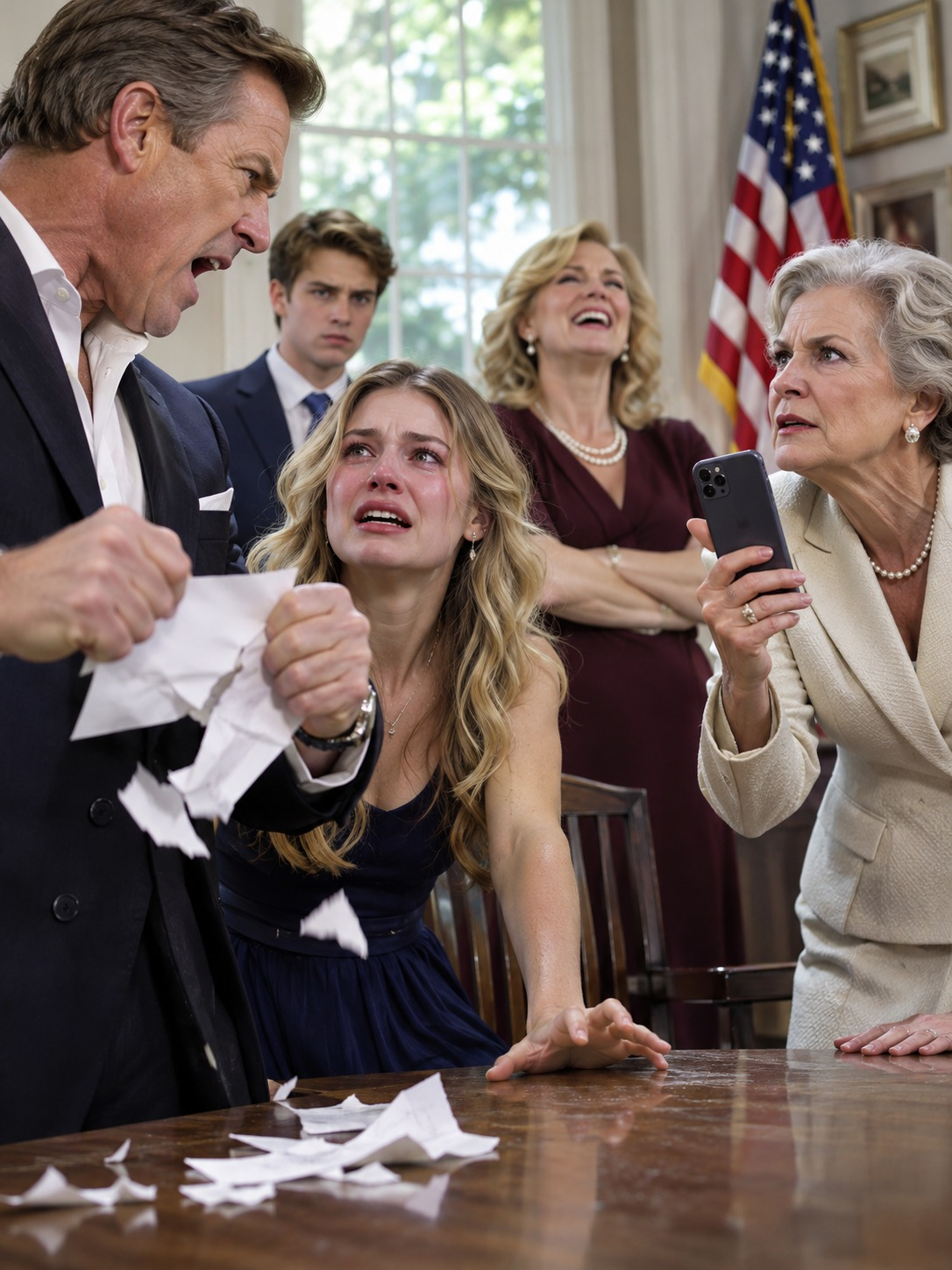
"Open the door, Lena. Your father wants this settled tonight."
The attorney knocked again.
I stood barefoot in my student apartment, clutching a letter that asked me to sign away any claim to the college savings account Grandma Ruth had funded for fourteen years.
Through the peephole, I could see the photograph of her farmhouse in his hand.
Tomorrow's date was written across the bottom.
Grandma's voice came through my phone.
"Don't open it, sweetheart."
I stepped away from the door.
Then the attorney said something that made my blood run cold.
"If your grandmother refuses to cooperate, your father says he'll make sure she understands the consequences."
I was eighteen years old when I learned that some threats didn't need to be shouted.
My father had always been good at shouting.
He shouted at employees who arrived late.
He shouted at suppliers who questioned invoices.
He shouted at me when I asked why my brother's education mattered more than mine.
But the man outside my apartment spoke softly.
Politely.
Almost pleasantly.
And somehow, that frightened me more.
"Miss Lena," he continued, "I'm not here to cause trouble."
I looked at the photograph through the peephole.
"Then why are you here?"
"To explain your options."
"You can explain them through the door."
A pause.
Then he said, "Your father would prefer to resolve this privately."
I almost laughed.
Privately.
That was Dad's favorite word whenever he wanted something hidden.
He had privately changed the beneficiary of my college savings account.
Privately told Tyler the money belonged to him.
Privately instructed the account administrator not to contact me.
And now he had sent a lawyer to my apartment to discuss my grandmother's farm.
I pressed the phone against my ear.
"Grandma, he's still here."
"I know."
"What should I do?"
"Tell him to send everything to Margaret."
I swallowed.
Then I raised my voice.
"My grandmother has an attorney. Send whatever you have to her."
The man didn't answer immediately.
Then he slipped his business card beneath the door.
"Very well."
I watched the card slide across the floor.
He continued.
"But you should understand that tomorrow's meeting concerns a financial arrangement your grandmother may not fully appreciate."
Grandma heard him.
Her voice became sharp.
"Lena, put me on speaker."
I did.
"Sir," Grandma said, "this is Ruth."
The man cleared his throat.
"Mrs. Ruth."
"If you have a legitimate document concerning my property, you may provide it to my attorney."
"Of course."
"And if my son sent you to frighten my granddaughter, tell him I said he has embarrassed himself enough."
Silence.
Then the man said, "I'll pass along your message."
His footsteps moved away.
I waited until I heard the stairwell door close.
Then I sank onto the floor.
My hands were shaking.
Grandma stayed on the line.
"Lena?"
"I'm here."
"Are you all right?"
I looked at the business card.
"No."
She was quiet.
Then she said, "That's an honest answer."
The next morning, Grandma's attorney, Margaret, called me before my first class.
She had reviewed the letter I'd received.
She told me not to sign anything.
She also explained something I desperately needed to hear.
A letter from an attorney was not a court order.
A demand was not proof that I owed anything.
And a photograph of Grandma's farmhouse did not give my father ownership of her land.
I sat on the edge of my bed, listening carefully.
"Can Dad take the farm?" I asked.
"Not simply because he wants to," Margaret said.
"But he's involved in Grandma's business loan."
"Your grandmother guaranteed a credit line for his hardware store. That doesn't mean he owns her property."
I stared at the floor.
"Then why would his attorney threaten her?"
Margaret paused.
"I haven't established that the attorney made a legal threat. But the circumstances you've described are concerning."
I appreciated her precision.
Margaret didn't promise miracles.
She didn't tell me everything would be fine.
She separated what we knew from what we feared.
And that made me trust her.
"What happens now?" I asked.
"I've arranged to review the documents with your grandmother. The bank will determine its position on the credit line. You need to focus on your classes."
I almost smiled.
"That's what Grandma keeps saying."
"She's a sensible woman."
I looked at the repaired Purdue acceptance letter taped above my desk.
"Yes," I said. "She is."
The meeting scheduled for the following day did not transfer Grandma's farm to anyone.
Margaret attended with her.
Dad was furious.
The bank wanted updated financial information before deciding what to do about the hardware store's credit line.
Grandma made it clear that she would not continue guaranteeing the debt at renewal.
My father had to find another arrangement.
He complained.
He threatened to stop speaking to her.
He accused her of choosing me over the family business.
But Grandma didn't change her mind.
The bank eventually restructured the store's financing under terms Dad could manage without her continuing guarantee.
It was not painless.
Dad had to reduce inventory, postpone expansion plans, and sell one of the store's delivery vehicles.
He blamed Grandma.
Then he blamed me.
But the hardware store remained open.
And Grandma kept her farm.
As for the college savings account, Margaret explained that Dad's authority as account owner complicated any attempt to reverse the beneficiary change.
The questionable acknowledgment bearing my name became part of the records she preserved.
She advised us not to assume a forged-looking signature automatically proved who had written it.
There would have to be evidence.
And evidence took time.
I wanted a dramatic ending.
A judge.
A courtroom.
My father forced to admit what he'd done.
Instead, I got paperwork.
Meetings.
Unanswered questions.
And a future I still had to pay for.
So I went back to class.
That first year at Purdue nearly broke me.
I worked twenty-eight hours a week whenever my class schedule allowed it.
I stocked shelves.
Answered phones.
Cleaned medical equipment.
And studied until the words in my textbooks blurred.
Some nights, I fell asleep with my anatomy notes spread across the bed.
Some mornings, I woke before my alarm because I was afraid I'd missed a shift.
I learned how to live on cheap groceries.
How to make one pot of soup last three days.
How to turn down invitations because I couldn't afford dinner out.
And how to smile when classmates complained that their parents had bought them the wrong color laptop.
I didn't resent those classmates.
Not exactly.
I just wondered what it felt like to have parents who wanted to make your life easier.
Grandma called every Sunday.
Sometimes she sent twenty dollars.
Sometimes she mailed cookies.
Once, she sent a handwritten note.
You are not behind. You are building.
I taped it beside my desk.
Whenever I wanted to quit, I read it.
And then I went back to work.
During my second year, I failed an important chemistry exam.
Not the entire course.
Just one exam.
But I sat outside the classroom afterward and cried like my whole future had ended.
A classmate named Rachel found me.
She was studying nursing, too.
She sat beside me without asking permission.
"Bad test?"
I nodded.
"Me too."
I wiped my face.
"You don't understand. I can't afford to lose my scholarship."
Rachel looked at me.
"Then we need to make sure you don't."
I stared at her.
She pulled out her planner.
"Study group. Library. Tomorrow. Six o'clock."
I almost laughed.
"You're giving me an appointment?"
"Yes."
"What if I don't come?"
"I'll find you."
She smiled.
And for the first time in months, I felt like someone my own age was on my side.
Rachel became my closest friend.
She helped me understand chemistry.
I helped her with anatomy.
We studied together.
Complained together.
And celebrated every passing grade like we'd won the lottery.
When I told her about my family, she listened.
Then she asked a question nobody had ever asked me.
"Why do you keep trying to convince your dad you're worth something?"
I stared at her.
"I don't know."
She nodded.
"Maybe you should stop."
It sounded impossible.
But the idea stayed with me.
By my final year, I was no longer the frightened eighteen-year-old who had arrived at Purdue with a repaired acceptance letter.
I was exhausted.
Stubborn.
Sometimes lonely.
But I knew what I wanted.
I loved clinical rotations.
Especially cardiac care.
I loved the careful work of watching monitors, recognizing changes, and helping frightened patients understand what was happening.
I discovered that I could remain calm when other people panicked.
I could explain difficult information without making someone feel foolish.
I could stand beside a hospital bed and make a patient feel less alone.
Those were skills I'd never realized I possessed.
Maybe because I'd spent so much of my childhood learning to read my father's moods.
At home, I had watched faces for signs of anger.
At the hospital, I watched faces for signs of pain.
The difference was that now I could actually help.
I graduated from Purdue.
Grandma attended.
Rachel attended.
Several professors congratulated me.
My parents did not come.
Tyler sent a text.
Congrats.
Dad sent nothing.
I told myself I wasn't disappointed.
But when Grandma hugged me after the ceremony, I cried into her shoulder.
"You did it," she whispered.
I nodded.
"I did."
She held me tighter.
"Your grandfather would have been so proud."
I looked at the diploma in my hand.
Then I looked at her.
"Are you?"
She pulled back.
Her eyes filled.
"Lena, I've been proud of you since before you knew what college was."
That was the moment I finally understood something.
I'd spent years waiting for one person's approval.
And almost missed the love that had been standing beside me the entire time.
The years moved quickly after that.
I began working as a nurse.
I paid my bills.
I paid down loans.
I took additional classes.
I earned advanced credentials.
Eventually, I became a nurse practitioner.
By thirty-four, I was working in cardiac care in Fort Wayne, helping oversee the care of patients across a twenty-two-bed unit.
My days were long.
Some were heartbreaking.
But I loved my work.
I had a small house.
A reliable car.
Friends who knew me as Lena, not Tyler's sister.
And a grandmother who still called every Sunday.
Grandma was ninety-two by then.
Her steps were slower.
Her hands shook sometimes.
But her mind remained sharp.
She still lived on her twenty-eight-acre farm.
And she still refused to let Dad make decisions about it.
I visited her whenever I could.
Sometimes I brought groceries.
Sometimes I helped with paperwork.
Sometimes we sat on the porch and talked about nothing important.
Those were my favorite afternoons.
I wish I could say my father changed as I grew older.
He didn't.
He simply found new ways to make me feel small.
When I first became a nurse, he called it "a decent job."
When I earned my advanced degree, he asked whether I was going to spend the rest of my life in school.
When I became a nurse practitioner, he told a neighbor I was "basically a nurse with extra paperwork."
He never asked what my work involved.
He never asked about the patients I helped.
He never asked how hard I'd worked to get there.
But he talked about Tyler constantly.
Tyler was going to take over the hardware store.
Tyler understood business.
Tyler had a degree from Ball State.
Tyler was the son who would carry on the family name.
I learned to let most of it pass.
Not because it stopped hurting.
Because arguing never changed him.
But there was one thing I couldn't ignore.
Dad had started talking about Grandma's farm again.
It began with small comments.
"The property taxes are getting ridiculous."
"Twenty-eight acres is too much for one woman."
"Mom ought to think about what happens after she's gone."
At first, I thought he was simply being practical.
Grandma was getting older.
The farm required maintenance.
There were fences to repair and buildings to inspect.
But then Dad began asking questions about her finances.
Who paid the insurance?
Who handled the lease with the neighboring farmer?
Where did she keep the deed?
Had she updated her will?
Grandma answered some questions.
Ignored others.
Then one Sunday, she called me.
"Lena, I need to ask you something."
I was folding laundry.
"Of course."
"Would you be willing to help me manage my affairs if I couldn't do it myself?"
I stopped.
"Grandma, are you okay?"
"I'm fine."
"Are you sick?"
"No."
"Then why are you asking?"
She sighed.
"Because I'm ninety-two, sweetheart. And I'd rather make decisions while I still can."
I sat down.
"What kind of decisions?"
"Medical decisions. Financial matters. The farm."
I swallowed.
"Wouldn't Dad expect to do that?"
Grandma was quiet.
Then she said, "That's exactly why I'm asking you."
We met with Margaret, who had continued advising Grandma over the years.
Grandma reviewed her estate documents.
She made sure her medical wishes were clear.
And she named me as her agent under a durable financial power of attorney.
She also completed the necessary healthcare documents.
Margaret explained my responsibilities carefully.
The authority was not permission to take Grandma's property.
It was a duty to act in her interests and within the powers the documents granted.
Grandma understood that.
So did I.
I signed the required acknowledgments.
Then Grandma squeezed my hand.
"Thank you."
I looked at her.
"Are you sure you don't want Dad?"
Her expression became serious.
"Lena, I love my son."
I waited.
"But love and trust are not the same thing."
I thought about the college account.
The torn letter.
The $74,000.
The years of silence.
And I understood.
Dad found out about the power of attorney several months later.
He called me at work.
I was standing near the nurses' station, reviewing a patient's chart.
My phone vibrated.
I saw his name.
I almost ignored it.
Then I answered.
"Hello?"
"What did you make your grandmother sign?"
I closed my eyes.
"Good afternoon to you, too."
"Don't get smart with me."
I stepped into an empty hallway.
"What are you talking about?"
"The power of attorney."
I took a breath.
"Grandma made that decision herself."
"She's ninety-two."
"She's competent."
"She's being manipulated."
I stared at the wall.
"By who?"
"You."
I almost laughed.
"Grandma asked me to help her."
"Because you've been filling her head with nonsense for years."
I felt the old anger rise.
The same anger I'd felt at eighteen.
But I wasn't eighteen anymore.
"Dad, Grandma has an attorney. She made her decisions with legal advice."
He ignored that.
"That farm belongs in the family."
"It is in the family."
"You know what I mean."
I did.
He meant it should be under his control.
He meant Grandma's land should be available whenever his business needed help.
He meant I should step aside.
Just as I had been expected to step aside for Tyler sixteen years earlier.
"Dad," I said, "I'm not discussing Grandma's private financial matters with you."
His voice sharpened.
"You always did think you were better than everyone else."
I stared at the hospital floor.
"No."
"You go off to college, get yourself some fancy title, and suddenly you think you can run this family."
I took a slow breath.
"I have patients waiting."
"Of course you do."
His laugh was bitter.
"Always hiding behind that hospital job."
I closed my eyes.
Then I said, "Goodbye, Dad."
I ended the call.
For several seconds, I stood there holding my phone.
My hands were steady.
That surprised me.
At eighteen, a conversation like that would have left me shaking.
At thirty-four, I felt tired.
But not defeated.
I returned to my patients.
A few weeks later, Tyler announced his engagement.
His fiancée, Emily, was kind.
She worked in education and had a warm smile.
I liked her immediately.
She didn't seem to know much about our family's history.
That worried me.
Tyler invited me to the engagement party.
It would be held in a renovated barn outside Fort Wayne.
Seventy guests.
Family.
Friends.
Business associates.
People Dad wanted to impress.
I almost declined.
Then Grandma called.
"Are you going?"
"I don't know."
"I'd like you there."
I sighed.
"Grandma."
"I know."
"Dad's going to make comments."
"Probably."
"Mom will laugh."
"Possibly."
"And Tyler will pretend not to hear."
Grandma was quiet.
Then she said, "Maybe."
I looked at my calendar.
"I have a hospital shift that day."
"Can you come afterward?"
I hesitated.
Then I said yes.
For Grandma.
Not Dad.
Not Mom.
Not even Tyler.
For the woman who had packed me into her Buick when I had nowhere else to go.
The week before the party, Grandma asked me to stop by the farm.
When I arrived, she was sitting at her kitchen table with a yellow envelope.
The same envelope she'd used years earlier to organize the college account documents.
I recognized it immediately.
My name was written across the front.
LENA — COLLEGE.
I sat down.
"Grandma?"
She pushed it toward me.
"I think it's time you kept this."
I opened it.
Inside was my repaired Purdue acceptance letter.
The tape had yellowed.
The paper was wrinkled.
But the words were still readable.
I stared at it.
"Grandma, you kept this?"
"Of course."
Beneath it were copies of the college savings statements.
The beneficiary change request.
The suspicious acknowledgment.
And correspondence Margaret had preserved.
I looked up.
"Why are you giving me all this now?"
Grandma studied me.
"Because your father has started telling people a story about your education that isn't true."
My stomach tightened.
"What story?"
She hesitated.
"That he paid for it."
I stared at her.
Then I laughed.
Not because it was funny.
Because I couldn't believe the nerve.
"He told people he paid for Purdue?"
Grandma nodded.
"And that Tyler was the one who earned the real business degree."
I looked down at the envelope.
Sixteen years.
Sixteen years since Dad had torn my letter apart.
Sixteen years since he'd told me college was for my brother.
And now he was claiming credit for the education he'd tried to prevent.
I closed the envelope.
"Grandma, I'm not going to fight with him at Tyler's party."
She reached across the table.
"I don't want you to fight."
"Then why give me this?"
Her eyes held mine.
"Because you should never have to prove your own life happened."
I swallowed.
Then I placed the envelope in my bag.
On the day of the engagement party, my hospital shift ran late.
A patient developed complications.
Another needed urgent evaluation.
By the time I finished my notes, I had missed the beginning of the celebration.
I considered going home to change.
Then Grandma texted.
Are you coming, sweetheart?
I looked at the time.
Then at my navy scrubs.
I was exhausted.
My hair was pulled into a loose ponytail.
My shoes were comfortable but worn.
I didn't look like someone attending a formal engagement party.
But Grandma was waiting.
So I drove straight there.
When I arrived, the barn was glowing with lights.
Cars filled the gravel lot.
Music drifted through the open doors.
I could hear laughter.
I took a breath.
Then I reached for my bag.
The yellow envelope was inside.
I hadn't planned to use it.
I simply hadn't wanted to leave it in my car.
I walked toward the entrance.
A young woman at the door smiled.
"Are you Lena?"
"Yes."
"Your grandmother's been asking for you."
I smiled.
"That sounds like her."
She pointed toward the main room.
"She's near the front."
I stepped inside.
Seventy guests filled the barn.
There were white tablecloths.
Flowers.
Champagne glasses.
A long table decorated with photographs of Tyler and Emily.
I spotted Grandma near the front.
She wore an ivory jacket.
Her silver hair was neatly styled.
She smiled when she saw me.
I started toward her.
Then I heard my father's voice.
"Lena?"
I stopped.
He stood near the center of the room, holding a glass.
Mom was beside him.
Tyler stood near Emily.
Dad looked me up and down.
His eyes settled on my scrubs.
Then he smiled.
Not warmly.
Not proudly.
The same smile I'd seen sixteen years earlier.
"Well," he announced loudly enough for nearby guests to hear, "look who finally decided to show up."
Several people turned.
I felt the old embarrassment rise.
But I kept walking.
"Hi, Dad."
He looked at my clothes.
"Couldn't even change for your brother's engagement?"
"I came straight from the hospital."
He laughed.
"Always an excuse."
Mom smiled into her glass.
I glanced toward Grandma.
She was watching us carefully.
Dad raised his drink.
"Well, since Lena's here, maybe we should make a toast."
My stomach tightened.
I knew that tone.
I'd heard it before.
At eighteen.
At the dinner table.
Just before he destroyed something that mattered to me.
Dad turned toward the guests.
He lifted his glass higher.
And then he said the words I had spent sixteen years trying to forget.
"College was for Tyler. He's the one with the business degree. Lena got a job."
A few people laughed politely.
Mom laughed louder.
Tyler looked down.
I stood perfectly still.
My hospital badge rested against my chest.
I touched it with one hand.
Then I calmly nodded.
Dad smiled.
He thought he'd won.
But across the room, Grandma Ruth was already reaching for her phone.
And beside her sat Margaret.
The attorney who had spent sixteen years keeping records my father believed nobody would ever see.
Margaret opened her briefcase.
Removed a sealed document.
Then leaned toward Grandma.
I watched Grandma read the first line.
Her expression changed.
She looked directly at my father.
And for the first time that evening, she began to stand.
But before she could speak, the barn doors opened behind us.
A man entered carrying a leather briefcase.
I recognized him immediately.
Dennis Puit.
My father's banker.
He walked straight toward Grandma.
Then he placed a document on the table.
My father saw it.
His smile disappeared.
Dennis looked around the room.
And said, "Before anyone signs anything tonight, there's a problem with the ownership of the twenty-eight acres."
Grandma reached for the document.
Margaret stood beside her.
And my father suddenly shouted:
"Don't let her read the second page!"






Comments 0