"Don't answer it, Grandma."
My voice came out louder than I intended.
The answering machine had gone silent, but my father's words still seemed to hang in the farmhouse kitchen.
Before you call Dennis, there's something you don't know about that account.
Grandma Ruth stood beside her wooden desk, holding a document with my father's signature at the bottom.
The number printed near the top was $180,000.
And for the first time in my life, I saw my grandmother look at a piece of paper as though it might be dangerous.
"Grandma," I whispered, "what did Dad do?"
She folded the document.
Then she looked at me.
"Your father has been making promises with money that doesn't belong to him."
I was eighteen years old.
I had been accepted into Purdue University's nursing program.
I had earned an $11,000-a-year presidential scholarship.
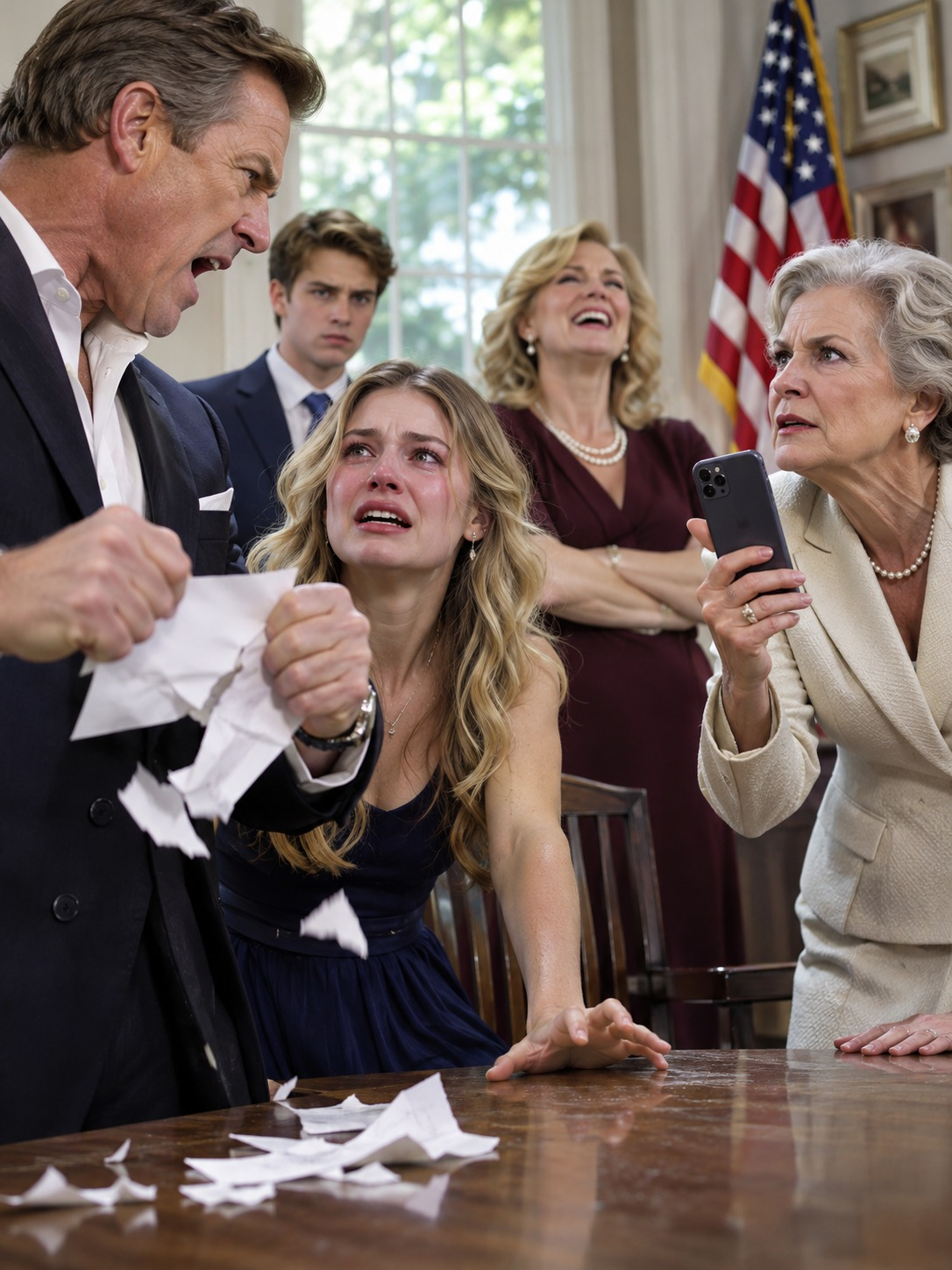
And less than two hours earlier, I had watched my father tear my acceptance letter into four pieces because he believed college was for my brother.
Now I was standing in my grandmother's farmhouse with everything I owned for the night stuffed into a black trash bag.
I didn't know whether I was still welcome at home.
I didn't know whether I could afford college.
And I certainly didn't understand why my father's banker had anything to do with my future.
Grandma placed the document back inside the yellow envelope.
"Sit down, sweetheart."
I remained standing.
"Is that my college money?"
"No."
"Then what is it?"
"A business loan."
I stared at her.
"Dad's business?"
She nodded.
"The hardware store."
I looked toward the answering machine.
"Why would Dad call you about his business loan?"
Grandma took off her glasses.
"Because I helped him get it."
That didn't surprise me.
Grandma had helped Dad with the store for as long as I could remember.
She had helped him buy his first delivery truck.
She had loaned him money during a difficult winter.
She had even paid for repairs when a pipe burst in the stockroom.
But she rarely talked about those things.
Dad certainly never did.
"What does that have to do with the account?" I asked.
Grandma lowered herself into the desk chair.
"That's what I intend to find out."
She opened the yellow envelope again.
Inside were several bank statements, a copy of an old account agreement, and a handwritten ledger.
I leaned closer.
The ledger contained rows of dates.
One after another.
Every month.
For fourteen years.
Beside nearly every date was the same amount.
$350.
My throat tightened.
"Those are the deposits?"
Grandma nodded.
"Every single one."
I ran my finger down the page.
January.
February.
March.
April.
Years passed in neat columns.
I found the year I started kindergarten.
Then the year I learned to ride a bicycle.
Then the year I broke my wrist falling off Grandma's porch steps.
She had been saving money through all of it.
While I was growing up, she had been quietly building a future for me.
"Why didn't you just keep the account in your name?" I asked.
Grandma looked at the ledger.
"At the time, your grandfather and I were working with an adviser. We decided to have your father establish the college account and manage it. He was younger, and we believed he'd handle the paperwork as you got older."
"You trusted him."
"Yes."
Her answer was immediate.
Then she added, "I trusted him with something that mattered more than money."
I looked at her.
"What?"
"You."
Grandma made tea.
I didn't want any, but she poured me a cup anyway.
Then she brought out a plate of crackers and cheese.
"Eat something."
"I'm not hungry."
"You haven't eaten dinner."
"I was trying to."
She gave me a sad smile.
"Humor me."
I took a cracker.
It tasted like cardboard.
Grandma sat across from me.
For several minutes, neither of us spoke.
Then I asked the question that had been growing inside me since Tyler admitted Dad had told him about the account the previous year.
"Did Dad ever want me to go to college?"
Grandma looked at me carefully.
"I can't tell you what your father wanted in his heart."
"He tore up my letter."
"I know."
"He gave Tyler my college money."
"I know."
"He told me I could work at Walmart."
Grandma's jaw tightened.
"That was cruel."
I stared at my tea.
"Maybe he thinks Tyler's smarter."
"That isn't true."
"Maybe he thinks Tyler's more important."
Grandma didn't answer immediately.
That hurt.
Not because she agreed.
Because she understood why I believed it.
I pushed my cup away.
"I got better grades than Tyler."
"I know."
"I worked at the library after school."
"I know."
"I volunteered at the hospital every summer."
"I remember driving you."
"I did everything they told me to do."
My voice cracked.
"Everything."
Grandma reached across the table.
I pulled my hands into my lap before she could touch them.
"I just wanted him to be proud of me."
The words came out so quietly that I barely heard them myself.
Grandma sat back.
"Oh, Lena."
I shook my head.
"Don't."
She waited.
"If you say you're proud of me, I'm going to cry."
Her eyes filled.
"Then I won't say it."
That made me laugh.
Just once.
Then I cried anyway.
Not the pretty kind of crying people do in movies.
I cried until my chest hurt.
Until my nose ran.
Until I couldn't get enough air between sobs.
Grandma came around the table and wrapped her arms around me.
She didn't tell me to stop.
She didn't say everything happened for a reason.
She just held me.
And for the first time that evening, I didn't have to pretend I was fine.
At eleven-thirty, Grandma showed me to the guest bedroom.
It was the same room where I'd slept during childhood visits.
There was a quilt on the bed.
A small dresser beside the window.
And a wooden rocking chair Grandpa had made before I was born.
Grandma placed my trash bag on the floor.
"We'll get you a proper suitcase tomorrow."
I looked at the bag.
"It's fine."
"No, it isn't."
She opened the closet.
Inside were extra blankets and an old overnight bag.
She took it down.
"Your clothes deserve better than a garbage bag."
Something about that sentence made my throat tighten again.
Grandma set the overnight bag on the bed.
"Get some sleep."
I nodded.
She started toward the door.
"Grandma?"
She turned.
"Am I really staying here?"
"For as long as you need."
"What if Dad gets mad?"
She looked at me.
"Your father is already mad."
"What if he doesn't let me come home?"
Grandma was quiet for a moment.
Then she said, "You have a home here."
She closed the door gently.
I sat on the bed.
My phone was in my pocket.
I checked it.
Three missed calls from Mom.
One text from Tyler.
Nothing from Dad.
I opened Tyler's message.
You didn't have to make everything worse.
I stared at the screen.
Then I typed:
I didn't tear up my own letter.
I deleted it.
I typed:
Did you know Dad was going to do that?
I deleted that, too.
Finally, I put the phone facedown.
I didn't answer.
For once, I didn't know how to make things easier for everyone else.
I couldn't sleep.
At midnight, I got up and opened the overnight bag.
I folded my clothes into it.
Then I took the four pieces of my acceptance letter from my backpack.
I laid them on the quilt.
The first piece contained the Purdue letterhead.
The second held part of my name.
The third contained the scholarship amount.
The fourth had the closing signature.
I arranged them carefully.
The torn edges didn't fit perfectly anymore.
Dad had crumpled one corner when he placed the pieces beside his plate.
I smoothed it with my thumb.
Then I found a roll of clear tape in Grandma's desk drawer.
I taped the letter back together.
Slowly.
One strip at a time.
When I finished, I held it up to the bedside lamp.
The seams were ugly.
The paper was wrinkled.
But the words were still there.
Congratulations.
Purdue University.
Presidential Scholarship.
Eleven thousand dollars annually.
My father had destroyed the paper.
He hadn't destroyed the offer.
I repeated that thought until I almost believed it.
Then I folded the repaired letter and placed it inside my backpack.
I had no idea that Grandma would preserve that same letter for the next sixteen years.
Or that one day it would sit inside a yellow envelope at a party where my father would once again try to make me ashamed of my education.
That night, it was simply proof that I hadn't imagined being accepted.
The next morning, Grandma was already awake when I came downstairs.
She sat at the kitchen table with her reading glasses on.
A legal pad lay beside her coffee.
Three names were written across the top.
Gary.
Dennis.
Attorney.
I stopped in the doorway.
"Are you making a list?"
"Yes."
"Of what?"
"People I need to speak with."
I poured myself a glass of water.
"Did you call Dad?"
"No."
"Did he call again?"
"Twice."
I looked at her.
"What did he say?"
"Nothing useful."
She closed the legal pad.
Then she smiled.
"How would you feel about pancakes?"
I stared at her.
"Grandma."
"What?"
"You're acting like we're having a normal Saturday."
"Would you prefer waffles?"
I almost smiled.
She stood.
"Lena, your father has made some serious decisions. I intend to address them. But you still need breakfast."
I sat down.
She made pancakes.
I ate three.
And for fifteen minutes, we talked about nothing important.
The weather.
A neighbor's new tractor.
A stray cat that had been sleeping under the porch.
It was the first peaceful meal I'd had in days.
Then the telephone rang.
Grandma looked at the caller ID.
Her expression changed.
"Who is it?" I asked.
She picked up the receiver.
"Good morning, Gary."
I stopped eating.
Grandma listened.
"No, she's not coming home this morning."
Another pause.
"Because she doesn't want to."
I could hear Dad's voice through the receiver.
Not the words.
Just the anger.
Grandma held the phone away from her ear.
"Gary, if you want to have a conversation, lower your voice."
He kept talking.
Grandma waited.
Then she said, "I know exactly what authority you have over the college account."
My stomach tightened.
She listened again.
"No. I am not threatening you."
A longer silence.
Then Grandma's voice became very calm.
"I'm explaining that I won't continue guaranteeing a business obligation while you treat my granddaughter this way."
I looked up.
Dad stopped talking.
Even from across the table, I could hear the silence.
Grandma continued.
"The line of credit comes up for renewal. I will not renew my guarantee."
I stared at her.
The $180,000 document.
The banker.
The hardware store.
Pieces of the conversation began fitting together.
Dad said something.
Grandma's face hardened.
"That was your decision, Gary. This is mine."
She hung up.
For several seconds, I couldn't speak.
Then I asked, "What did you just do?"
Grandma returned to her chair.
"I told your father something he needed to hear."
"About the loan?"
"Yes."
"Are you taking his business away?"
"No."
"Then what happens?"
"He'll have to make arrangements without relying on my guarantee when the credit line renews."
I frowned.
"Can you do that?"
"At renewal, I can decline to continue guaranteeing it. The bank will decide what terms it requires."
"Will he lose the store?"
"I don't know."
I stared at her.
She reached for her coffee.
"I am not responsible for every consequence of your father's decisions."
That sounded so unlike anything I'd ever heard an adult say about Dad that I almost didn't understand it.
In our family, everyone worked around his moods.
We changed plans to avoid upsetting him.
We apologized when he was angry.
We pretended things were fine when they weren't.
Grandma had just told him no.
And she didn't look frightened.
Later that morning, she drove me into town.
We stopped at a discount store.
Grandma bought me a suitcase.
A real one.
Dark blue.
With four wheels and a sturdy handle.
I protested when I saw the price.
She ignored me.
Then she bought me shampoo, toothpaste, socks, and a notebook.
At the checkout, I reached for my wallet.
Grandma placed her hand over mine.
"Put that away."
"I have money."
"I know."
"I can pay for my own stuff."
"I know that, too."
"Then let me."
She looked at me.
"Lena, accepting help doesn't mean you're incapable."
I didn't answer.
She paid.
On the way back to the car, she handed me the receipt.
"Keep that."
"Why?"
"So you know exactly what I spent."
I stared at her.
She smiled.
"There's no hidden bill coming later."
I looked away before she could see my eyes fill.
That was how Dad's help worked.
Every favor became a debt.
Every gift came with conditions.
Grandma had just bought me a suitcase.
And she wanted me to know I didn't owe her anything.
We stopped at the public library before returning to the farm.
Grandma waited while I used one of the computers.
I logged into my email.
There it was.
The acceptance message from Purdue.
I opened it.
Read it.
Then printed two copies.
One for me.
One for Grandma.
She held hers carefully.
"May I keep this?"
I nodded.
"Of course."
She folded it and placed it in her purse.
Then she looked at me.
"Have you accepted the offer?"
"Not yet."
"Why not?"
I hesitated.
"Because I don't know how I'm going to pay for everything."
She nodded.
"That's a practical concern."
I looked at the screen.
"What if I can't?"
"Then we'll work through the numbers."
"What if Dad refuses to give the money back?"
"Then we'll work through that, too."
"What if I have to borrow thousands of dollars?"
Grandma pulled up a chair.
"Then you'll understand exactly what you're borrowing before you sign anything."
I looked at her.
"You make it sound easy."
"It won't be easy."
She leaned closer.
"But difficult and impossible are not the same thing."
I read the acceptance email again.
Then I clicked the link to the enrollment portal.
My hands shook.
I entered my information.
Checked the required boxes.
Read the instructions twice.
And finally submitted my acceptance.
A confirmation appeared.
I stared at it.
Then I turned toward Grandma.
"I did it."
She smiled.
"Yes, you did."
For the first time since dinner, I felt something other than fear.
I felt hope.
That afternoon, Mom called my cell phone.
I was sitting on Grandma's porch.
I almost didn't answer.
But I did.
"Hello?"
"Lena, this has gone far enough."
No greeting.
No question about whether I was okay.
Just that.
"Mom."
"Your father is furious."
I closed my eyes.
"I know."
"He's been on the phone all morning because of your grandmother."
I said nothing.
"Do you understand what she's threatening to do?"
"She told me."
"Then you need to talk some sense into her."
I stared across the yard.
"Why me?"
"Because this started with you."
My stomach tightened.
"No. It started when Dad tore up my letter."
Mom sighed.
"You're still going on about that?"
I gripped the phone.
"Mom, it happened yesterday."
"And now you're punishing the whole family."
I couldn't believe what I was hearing.
"How am I punishing anybody?"
"Your father has employees who depend on that store."
"I didn't tell Grandma what to do."
"You could ask her to reconsider."
I watched a bird land on the fence.
"Would Dad reconsider giving Tyler my college money?"
Silence.
Then Mom said, "That money was never yours to begin with."
I felt the words like a slap.
"Grandma saved it for me."
"Your father managed the account."
"Because she trusted him."
Mom's voice sharpened.
"Don't speak about your father that way."
I swallowed.
"Mom, do you even care that I got into Purdue?"
She didn't answer.
I waited.
Finally, she said, "I care that you're tearing this family apart."
Something inside me went quiet.
I looked down at my new suitcase beside the porch door.
Then at the repaired acceptance letter resting on my lap.
"I have to go."
"Lena, don't you dare hang up on—"
I ended the call.
My hands were shaking.
But I didn't call back.
That evening, Grandma found me sitting at the kitchen table with a notebook.
I had written down every expense I could think of.
Tuition.
Housing.
Books.
Transportation.
Food.
Insurance.
I had subtracted the scholarship.
Then I had estimated how many hours I could work.
The numbers still frightened me.
Grandma sat beside me.
"Making a plan?"
"Trying to."
She studied the page.
"That's a good start."
I looked at her.
"Do you think I can really do this?"
She took a moment before answering.
"I think you can do the work."
"That's not what I asked."
"I know."
She placed her hand over mine.
"I can't promise you that everything will be fair, Lena. I can't promise you that your father will apologize. And I can't promise you that college will be easy."
I looked down.
"But I can promise you something else."
"What?"
"You won't have to face every problem alone."
I wanted to believe her.
More than anything.
Then her telephone rang.
She glanced at the caller ID.
This time, she didn't smile.
"Who is it?" I asked.
"An old friend."
She answered.
"Hello, Dennis."
I sat up.
My father's banker.
Grandma listened without speaking.
Her expression grew serious.
Then she looked at me.
"Yes," she said. "Lena is here."
A pause.
"No, Gary hasn't discussed that with me."
She reached for her legal pad.
"What date?"
She wrote something down.
Then she asked, "And you're certain?"
I watched her face.
Whatever Dennis said made her sit completely still.
Finally, she thanked him and hung up.
"Grandma?"
She stared at the page.
"What happened?"
She didn't answer.
I moved closer.
On the legal pad, beneath my father's name, she'd written three words.
Beneficiary change date.
Underneath was a date from the previous year.
And beside it was another notation.
Loan review.
I looked at her.
"Does that mean Dad changed my account because of the store?"
Grandma slowly closed the notebook.
"I don't know yet."
"Then why did Dennis call?"
She stood.
"Because he wanted me to be aware of something before I spoke to your father again."
"What?"
Grandma looked toward the window.
A vehicle was coming up the driveway.
I heard tires crunch against the gravel.
Then a car door slammed.
Grandma's expression changed.
"Stay here, Lena."
She walked toward the front door.
I followed her into the hallway.
Through the narrow glass panel, I could see a man standing on the porch.
He wore a dark suit.
A leather briefcase hung from his hand.
Grandma reached for the lock.
But before she could turn it, the man lifted a thick folder against the glass.
Across the front, in large black letters, were the words:
COLLEGE SAVINGS ACCOUNT — BENEFICIARY CHANGE REQUEST
And beneath them was a signature.
My father's.
The man looked directly at Grandma.
Then he raised a second document.
"Mrs. Ruth," he called through the door, "there's another signature you need to see."
Grandma's hand froze on the lock.
The man turned the page around.
And the name printed at the bottom was—






Comments 0