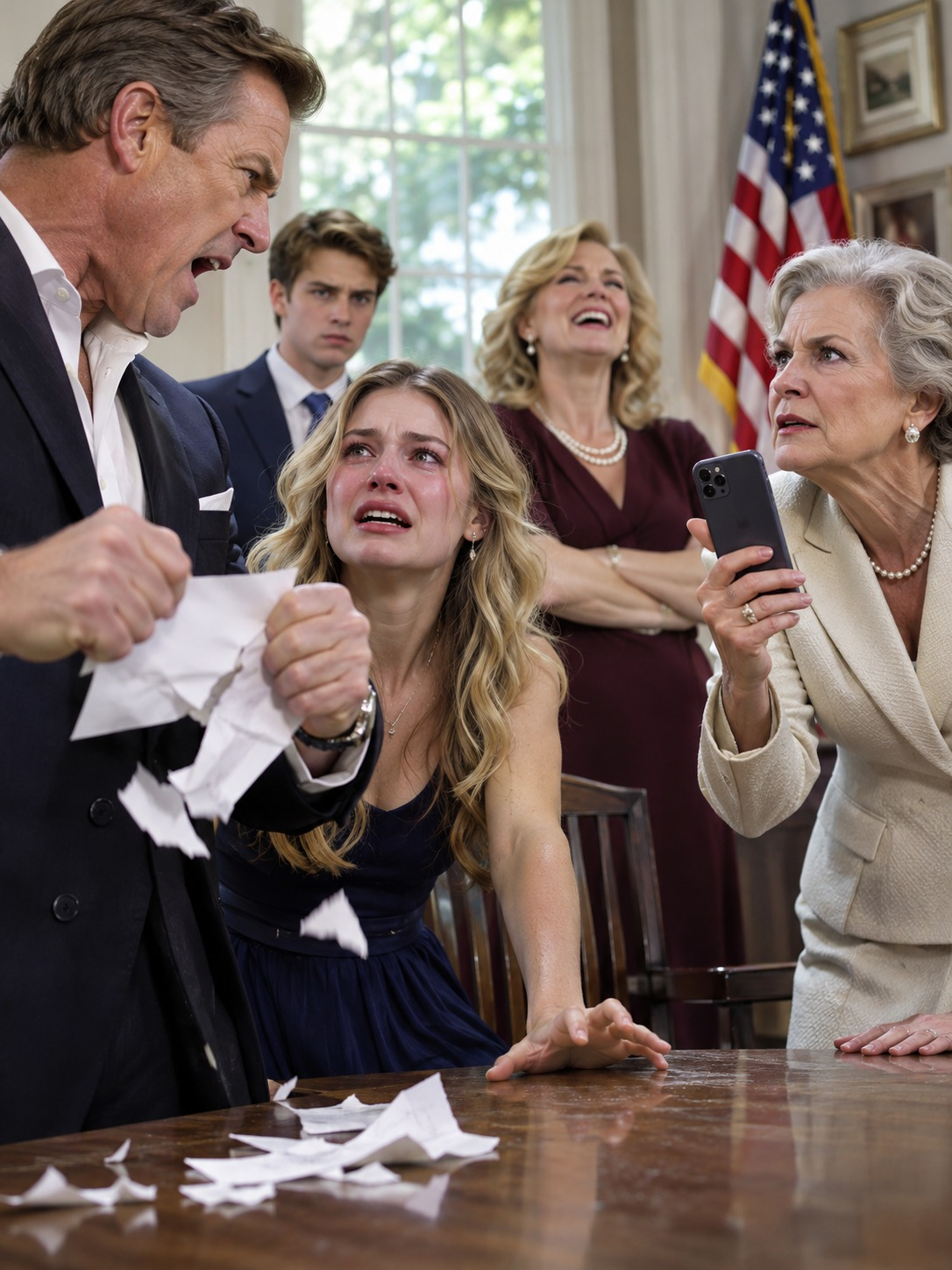
"Grandma, don't open that door!"
I grabbed Ruth's arm as the man outside pressed a second document against the glass.
The first page carried my father's signature.
The second carried a name I recognized.
Tyler.
But it wasn't my brother's signature that made Grandma go pale.
It was the date printed above it.
The paperwork had been prepared eleven months before my father tore up my Purdue acceptance letter.
And suddenly, the decision that had destroyed my future didn't look like an angry father's reaction.
It looked like something he'd planned.
The man standing on Grandma's porch was Dennis Puit.
I knew him because he sometimes came into Dad's hardware store wearing expensive suits and carrying a leather briefcase.
Dad always treated him differently from other customers.
He offered Dennis coffee.
He laughed at jokes that weren't funny.
And whenever Dennis visited, Dad reminded everyone that the store was doing well.
I had never understood why.
Now I was beginning to.
Grandma opened the door.
"Dennis."
"Ruth."
He glanced at me.
"Lena."
I nodded.
He looked uncomfortable.
That frightened me more than if he'd looked angry.
Dennis was the kind of man who always seemed to know exactly what to say.
At church fundraisers, he remembered everyone's name.
At the hardware store, he shook hands firmly and asked about business.
But standing on Grandma's porch that evening, he looked like someone who had walked into a family argument he desperately wished he could avoid.
"I'm sorry to come by without calling first," he said.
Grandma stepped aside.
"You called."
"I meant before coming over."
"Come inside."
He hesitated.
Then he entered.
I watched him carefully.
"Are you here because of my dad?"
Dennis looked at Grandma.
"In part."
"Did he send you?"
"No."
That answer came quickly.
Too quickly for me to doubt it.
Grandma led him into the living room.
She didn't offer coffee.
She didn't ask about his wife.
She simply pointed toward the chair across from her desk.
"Tell me what you can."
Dennis placed his briefcase on the floor.
Before opening it, he looked at me.
"Some of what we're discussing involves private financial information."
I folded my arms.
"It's my college account."
He nodded slowly.
"I understand why you feel that way."
"Because Grandma saved the money for me."
"Yes."
"And Dad changed it to Tyler."
Dennis glanced toward Grandma.
"I can't disclose account information beyond what the account owner has authorized. But I can explain certain documents that have already been shared with Ruth."
Grandma reached for the folder he'd brought.
"Then start there."
Dennis opened the first document.
It was a copy of the beneficiary change request.
My father's name appeared near the top as the account owner.
The original beneficiary was listed as Lena.
The replacement beneficiary was Tyler.
The form carried Dad's signature.
I stared at it.
The letters were unmistakable.
Gary.
The same sharp G.
The same heavy downward stroke at the end of his last name.
I had seen that signature on report cards, permission slips, and checks for years.
But seeing it on that document made my stomach turn.
"That's his handwriting," I whispered.
Grandma nodded.
Dennis pointed to the date.
"May 2009."
I looked up.
"Last year?"
"Yes."
I stared at the paper.
May 2009.
I had been seventeen.
I was finishing my junior year of high school.
I had already started researching nursing programs.
I had told Dad I wanted to apply to Purdue.
He'd told me to focus on graduating first.
And while I was studying for final exams, he had been changing the beneficiary of the account Grandma had created for me.
"Why?" I asked.
Dennis didn't answer.
"Why would he do that?"
Grandma placed a hand over mine.
"Lena."
I pulled away.
"No. I want to know."
Dennis adjusted his glasses.
"I can't tell you what your father was thinking."
"Did he say anything when he submitted it?"
Dennis hesitated.
"The form itself doesn't explain his reasons."
I stared at him.
"Did you know Grandma had been saving that money for me?"
He looked at Ruth.
"I knew she had helped fund the account."
"Then why didn't anyone tell her?"
His expression tightened.
"Because your father was the account owner. He had the authority to request a beneficiary change under the account's terms."
I looked at Grandma.
"Even though it was your money?"
She nodded.
"Even though it was my money."
The unfairness of it made me feel physically sick.
I wanted someone to say there had been a mistake.
A missing signature.
An incorrect date.
Anything that meant Dad hadn't been allowed to do what he'd done.
But Dennis was careful.
He explained that the account had been established as a college savings plan with my father as the legal owner.
Grandma had contributed money over the years.
She had intended it for my education.
But the account documents gave Dad control over certain decisions, including the ability to change the beneficiary to another eligible family member.
It was legally different from stealing cash out of my bedroom.
That distinction didn't make it hurt less.
It made it worse.
Because Dad hadn't needed to break into anything.
He had used authority Grandma trusted him with.
And he'd used it against me.
Dennis turned to the second document.
"This is the part I wanted Ruth to review."
My eyes moved immediately to Tyler's name.
The page was a preliminary financial worksheet associated with the hardware store's banking relationship.
Near the bottom was a section identifying expected family educational expenses.
Tyler's name appeared there.
Beside it was a notation.
Education funding available.
I frowned.
"What does that mean?"
Dennis folded his hands.
"It was part of the information your father provided when discussing his household obligations and the store's financial position."
"Did Dad tell the bank Tyler had money for college?"
"That appears to be what the worksheet reflects."
"Money Grandma saved for me?"
Dennis didn't answer directly.
"The worksheet doesn't identify the source of those funds."
I looked at Grandma.
She was staring at the page.
Her expression had become very still.
"Gary told me he needed additional flexibility with his business financing," she said.
Dennis nodded.
"Yes."
"And this was prepared around that time?"
"Yes."
Grandma looked at him.
"Did he tell you he intended to change the beneficiary?"
Dennis paused.
"I wasn't the administrator handling that transaction."
"But you knew about the account."
"I knew it existed."
Grandma looked down at the documents.
For a long moment, nobody spoke.
Then she said something that made me understand why she had been so calm the night before.
"Gary didn't just disappoint Lena. He made financial decisions while assuming I would keep supporting his business."
Dennis lowered his eyes.
"Ruth, I don't want to get between you and your son."
Grandma looked up.
"You already are, Dennis."
He didn't argue.
I had always thought my grandmother was wealthy.
Not in the way people in movies were wealthy.
She didn't wear expensive jewelry.
She drove an older Buick.
She clipped coupons and reused wrapping paper.
But she owned twenty-eight acres of farmland outside Fort Wayne.
Grandpa had left it to her.
She had kept the property even when Dad suggested selling part of it.
She rented some acreage to a neighboring farmer and maintained the rest herself.
To me, the farm was simply Grandma's home.
I never thought about its financial value.
But Dad did.
He talked about property values.
Loan collateral.
Equity.
Interest rates.
He treated Grandma's land like an asset waiting to be used.
When I was younger, I assumed that was normal.
After all, Dad owned a business.
He understood money.
Grandma understood people.
That was how our family described them.
But sitting beside Grandma's desk, I began to realize that she understood money very well.
She had saved $350 every month for fourteen years.
She had maintained a farm.
She had helped Dad secure financing.
And she knew exactly what she had signed.
"Dennis," she said, "the business line is still scheduled for renewal later this year?"
He nodded.
"Yes."
"And my guarantee is part of the current arrangement?"
"Yes."
"Then I want to make something clear."
Dennis straightened.
Grandma's voice remained calm.
"I will not renew that guarantee."
He looked at her carefully.
"Ruth, I understand you're upset."
"I'm not making this decision because I'm upset."
"Gary may have difficulty replacing the support."
"Then Gary will need to address that."
Dennis sighed.
"The bank will have to review the credit line under whatever circumstances exist at renewal."
"I understand."
"He has employees."
"I know."
"He has obligations."
"So do I."
Dennis looked down.
Grandma continued.
"My obligation was to help my family when I could. It was never to provide unlimited protection from my son's decisions."
I stared at her.
I'd never heard anyone speak about Dad that way.
Not with anger.
Not with fear.
Just certainty.
Dennis nodded.
"I'll make sure your position is documented through the proper process."
Grandma leaned back.
"Thank you."
After Dennis left, I sat at the kitchen table while Grandma organized the documents.
She made three piles.
One for the college account.
One for the business loan.
One for correspondence.
I watched her write dates on a legal pad.
May 2009.
April 2010.
Loan renewal.
She underlined the last one.
"Grandma?"
"Yes?"
"Is Dad going to lose the store?"
She looked up.
"I don't know."
"Because of me?"
She put down her pen.
"No."
"But if you hadn't found out about the account—"
"Lena."
Her voice was firm.
"Your father chose to change the beneficiary. Your father chose not to tell me. Your father chose to destroy your letter."
I stared at her.
"Those were his decisions."
I looked away.
"He'll blame me."
"Probably."
That surprised me.
Grandma didn't soften the truth.
She didn't tell me Dad would understand.
She didn't promise he'd apologize.
She simply said what she believed.
"He may blame you because it's easier than taking responsibility."
I swallowed.
"I don't want the store to close."
"Neither do I."
"Then why are you doing this?"
Grandma folded her hands.
"Because helping someone doesn't mean allowing them to hurt other people."
I thought about that.
Dad had always made family loyalty sound like obedience.
If he needed something, we helped.
If he was angry, we stayed quiet.
If he made a decision, we accepted it.
But Grandma was telling me something different.
That love could include saying no.
That helping wasn't the same as surrendering.
I wasn't sure I believed it yet.
But I wanted to.
That afternoon, I went through my college expenses again.
I had accepted Purdue's offer.
Now I needed a plan.
I spread papers across Grandma's kitchen table.
Tuition.
Housing.
Books.
Transportation.
Meals.
I subtracted the scholarship.
Then I calculated what I might earn working part-time.
The numbers were frightening.
Even with eleven thousand dollars a year, college would be expensive.
I would need grants.
Possibly loans.
Definitely a job.
I had hoped the savings account would make those decisions easier.
Now I didn't know whether any of that money would ever be available to me.
Grandma sat across from me.
"Have you spoken to the financial aid office?"
"Not yet."
"Then that's our next step."
I looked at her.
"What if they can't help?"
"Then we'll ask what other options exist."
"What if I have to work thirty hours a week?"
"Then we'll see whether that's realistic with your classes."
"What if I can't keep my scholarship?"
Grandma leaned forward.
"Lena, you're trying to solve four years of problems in one afternoon."
I looked down.
"I just don't want to fail."
She smiled sadly.
"Neither did I when I was your age."
I glanced up.
"You wanted to go to college?"
She nodded.
"Very much."
I stared at her.
Grandma rarely talked about her younger years.
I knew she'd married Grandpa when she was twenty-one.
I knew they'd bought the farm together.
I knew she'd worked harder than anyone I knew.
But I had never asked what she'd wanted before all that.
"What happened?"
She looked toward the window.
"My father became ill. My mother needed help. There wasn't enough money."
"Did you ever go?"
"No."
I felt a strange ache in my chest.
"Do you regret it?"
She considered the question.
"Sometimes."
I waited.
Then she looked directly at me.
"That's one reason I started saving for you."
I couldn't speak.
Grandma reached across the table.
"I wanted you to have choices I didn't have."
I looked at the papers.
At the scholarship.
At the calculations.
At the future that still seemed impossibly far away.
And I made a decision.
I would go to Purdue.
Even if I had to work nights.
Even if I had to borrow money.
Even if Dad never spoke to me again.
I would go.
That evening, Tyler called.
I was sitting on Grandma's porch when my phone rang.
I almost ignored it.
Then I answered.
"Hello?"
"Lena."
His voice sounded tired.
"Hi."
He hesitated.
"Can we talk?"
I looked across the yard.
"You're talking."
"Don't do that."
"Do what?"
"Act like I'm the enemy."
I closed my eyes.
"Tyler, Dad gave you money Grandma saved for me."
"I didn't ask him to."
"Did you know?"
A pause.
"I knew he changed something."
"That's not an answer."
He sighed.
"Lena, I thought Grandma knew."
"Why would you think that?"
"Because Dad said she did."
I sat up.
"He told you Grandma agreed?"
"Yes."
I stared at the porch railing.
"She didn't."
"I know that now."
"Then why didn't you say anything at dinner?"
He was quiet.
I waited.
Finally, he said, "Because Dad was already angry."
I almost laughed.
"That's why?"
"You know how he gets."
"Yes, Tyler. I do."
He sighed.
"I didn't want to make it worse."
I looked toward the farmhouse.
Grandma was visible through the kitchen window, washing dishes.
"Do you know what made it worse?"
He didn't answer.
"You sitting there while he tore up my letter."
"Lena—"
"You watched him do it."
"I know."
"And you said nothing."
His voice dropped.
"I'm sorry."
I froze.
Tyler had apologized to me before.
For borrowing my things.
For forgetting birthdays.
For teasing me in front of friends.
But never for something that mattered this much.
I wanted to believe him.
I really did.
"Then help me understand something," I said.
"What?"
"Did Dad ever tell you why he changed the account?"
Tyler hesitated.
"He said it made more sense."
"Because you're a boy?"
"No."
"Because you're going into the business?"
"Maybe."
I waited.
Then he said, "He also said Grandma wouldn't need to know."
My stomach tightened.
"What?"
"He said it was just paperwork."
I stared at the yard.
"Tyler, that's not just paperwork."
"I know."
"Did you sign anything?"
Silence.
My heart began beating faster.
"Tyler?"
He cleared his throat.
"Some forms."
"What forms?"
"I don't remember exactly."
"Did they have anything to do with my account?"
He didn't answer.
I stood.
"Tyler."
"Lena, I have to go."
"Wait."
"I'll call you later."
The line went dead.
I stared at my phone.
Then I walked inside.
Grandma was drying a plate when I entered.
"Everything all right?"
"No."
I told her about Tyler's call.
About Dad claiming she'd agreed.
About the forms.
About Tyler admitting he'd signed something.
Grandma listened without interrupting.
When I finished, she put down the towel.
"Did he say what he signed?"
"No."
She nodded slowly.
"Then we shouldn't assume."
"But Grandma—"
"I know."
She looked toward the desk.
"We need the actual documents."
I followed her into the living room.
She opened the yellow envelope again.
Inside were the account statements and copies Dennis had provided.
She examined the beneficiary change request.
Dad's signature was clearly visible.
But Tyler's signature wasn't on that form.
"Maybe he signed something else," I said.
"Possibly."
Grandma reached for her address book.
She found a number.
Then she dialed.
"Hello, Margaret? It's Ruth."
I listened.
"Yes, I'm well. I need to schedule an appointment."
Grandma paused.
"It's about a college savings account and some documents my son signed."
Another pause.
"Yes. I think it's time we had an attorney look at them."
She wrote down an appointment for the following week.
Then she thanked Margaret and hung up.
I stared at her.
"You're getting a lawyer?"
"I'm getting advice."
"Are you going to sue Dad?"
"I haven't decided anything like that."
I looked at the yellow envelope.
"What if the lawyer says Dad didn't break any rules?"
Grandma considered the question.
"Then we'll know where we stand."
I felt tears threatening again.
"It isn't fair."
"No," she said. "It isn't."
She placed the papers back inside the envelope.
"But fairness and legal authority aren't always the same thing."
I sat down.
For the first time, I understood that Dad might have done something cruel without doing something the law would automatically undo.
That frightened me.
Because I had spent my whole life believing that if someone did something wrong, eventually an adult would step in and fix it.
Now I was learning that sometimes the adults were the problem.
The next morning, I received an email from Purdue.
My enrollment confirmation had been processed.
There were instructions about orientation, housing, and financial aid.
I read every word.
Then I printed the email and placed it beside my repaired acceptance letter.
Grandma came into the kitchen carrying a basket of laundry.
"Good news?"
I smiled.
"I think so."
She read the confirmation.
Then she hugged me.
"I'm proud of you."
This time, I didn't tell her not to say it.
I hugged her back.
For a few minutes, I let myself imagine the future.
A dorm room.
A campus full of students.
Anatomy textbooks.
Hospital rotations.
A life where nobody introduced me as Tyler's little sister.
A life where I could become someone on my own terms.
Then my phone rang.
Dad.
I stared at the screen.
Grandma noticed.
"You don't have to answer."
I swallowed.
"I know."
But I did.
"Hello?"
Dad didn't bother with a greeting.
"Your grandmother's been talking to Dennis."
I closed my eyes.
"Yes."
"And now she's getting lawyers involved."
I said nothing.
"This is what happens when you fill her head with nonsense."
I gripped the phone.
"I didn't tell her to do anything."
"Don't lie to me."
"I'm not lying."
He exhaled sharply.
"Listen carefully, Lena. You want to go to Purdue? Fine. Go."
I froze.
For one impossible second, I thought he was finally changing his mind.
Then he continued.
"But don't expect this family to finance your little adventure."
I looked at Grandma.
She was watching me.
"I wasn't expecting that anymore," I said.
Dad went quiet.
Then his voice became colder.
"Your brother is going to run the business someday. Everything I'm doing is for this family's future."
I swallowed.
"Am I not part of the family?"
He didn't answer.
That silence told me more than any insult could have.
Finally, he said, "You need to tell your grandmother to stop interfering."
"No."
The word came out before I could think.
Dad went completely silent.
I had never said no to him that way.
Not without an explanation.
Not without apologizing.
"What did you say?"
I looked at the repaired letter on the table.
"I said no."
His breathing changed.
"Lena, you're making a very serious mistake."
"Maybe."
"Don't test me."
I closed my eyes.
Then I said something I'd been afraid to say my entire life.
"I'm not asking your permission anymore."
I ended the call.
My hands shook so badly that I nearly dropped the phone.
Grandma sat beside me.
She didn't congratulate me.
She didn't tell me I was brave.
She simply waited until I could breathe normally again.
Then she handed me a glass of water.
That afternoon, Grandma received a large envelope from the bank's account administrator.
It contained the account history she'd requested through the available procedures.
She opened it at the kitchen table.
I sat beside her.
There were several pages.
Deposits.
Investment balances.
Beneficiary information.
And a copy of the change request.
Grandma examined each page carefully.
Then she stopped.
Her finger rested on a line near the bottom of the beneficiary change record.
"What is it?" I asked.
She didn't answer.
I leaned closer.
The line identified the date the change had been processed.
May 2009.
But beneath it was a reference to another document.
A supporting acknowledgment.
Grandma frowned.
"I didn't know there was an acknowledgment."
"What does that mean?"
"It may be an administrative record. We need to see it."
She reached for the telephone.
Before she could dial, someone knocked on the front door.
Three sharp knocks.
Grandma looked toward the hallway.
I stood.
"Are you expecting anyone?"
"No."
The knocking came again.
Louder.
I walked toward the door.
Through the glass, I could see Tyler standing on the porch.
He was holding a manila envelope.
His face was pale.
I opened the door.
"Tyler?"
He looked past me toward Grandma.
"Is Dad here?"
"No."
He stepped inside quickly.
Then he shut the door behind him.
"Lena, I need to show you something."
I stared at the envelope.
"What is it?"
He looked at Grandma.
Then back at me.
"I found the papers Dad had me sign."
My stomach tightened.
"Tyler—"
He shook his head.
"Just look."
He opened the envelope.
Pulled out a document.
And placed it on the table.
At the top was my name.
Below it was a statement claiming that I had agreed to give up any expectation of receiving the college savings funds.
I stared at the signature line.
There was handwriting beneath it.
Handwriting that looked like mine.
But I had never signed that paper.
Tyler swallowed.
"Lena, Dad told me this was already taken care of."
Grandma reached for her glasses.
I picked up the document.
The date was from the previous year.
I read the first paragraph.
Then the second.
And when I reached the final page, I saw a second signature beneath the acknowledgment.
Grandma leaned over my shoulder.
Her face went white.
Because the name printed beside that signature belonged to someone who had just called our house.
And before either of us could speak, Tyler whispered:
"There's one more page. Dad told me never to show you this one."
He reached into the envelope.
His fingers closed around a folded sheet.
Then he began to pull it out.






Comments 0