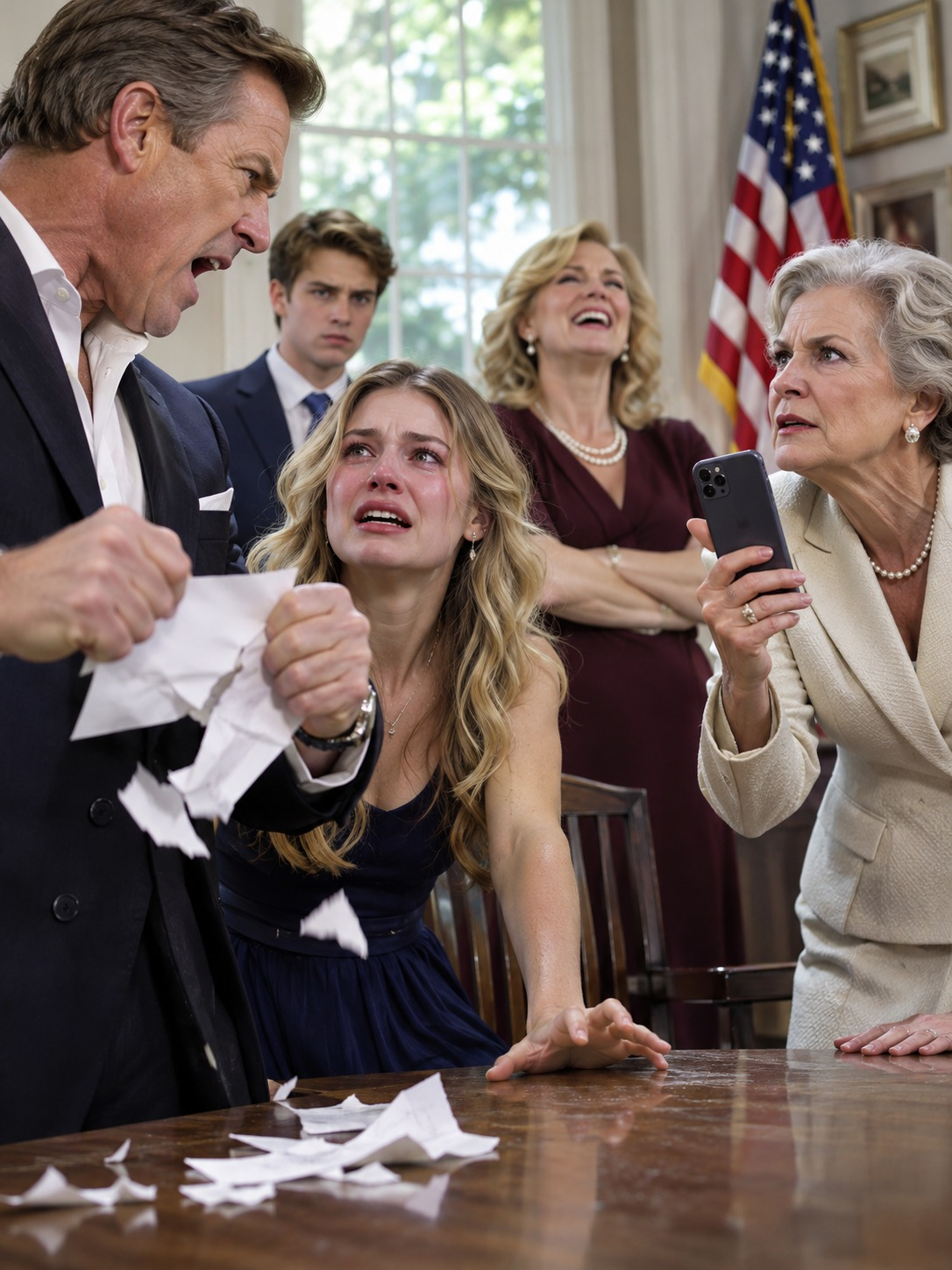
"Give it back!" I cried, reaching across the dinner table.
My father, Gary, held my Purdue University acceptance letter between his hands.
Near the bottom of the page, beneath the university seal, was a number.
$11,000 per year.
He tore the letter in half.
That was the moment I realized my father wasn't afraid I would fail.
He was afraid I might succeed.
Sixteen years later, I would watch that same man stand in front of seventy people and tell them I had never amounted to anything.
He would smile while saying it.
My mother would laugh.
My brother would stare at his plate.
And my grandmother would do something that nobody in our family had ever managed to make her do.
She would make my father afraid.
But in the spring of 2010, I was eighteen years old, and I still believed that if I worked hard enough, my father would eventually be proud of me.
That belief lasted until dinner.
The envelope had arrived that afternoon.
I remember the exact sound it made when I pulled it from the mailbox. The paper was thick, heavier than the bills and advertisements that usually arrived at our house outside Fort Wayne, Indiana.
The return address read Purdue University.
For a moment, I couldn't move.
I had checked the mailbox every afternoon for nearly three weeks. I'd checked my email twice before breakfast and again during lunch at school. I'd even called the admissions office once, pretending I needed to confirm that my application was complete.
I knew my grades were good.
I knew my teachers had written strong recommendations.
I knew I'd done everything I could.
But wanting something desperately doesn't make you believe you're going to get it.
I carried the envelope into the kitchen and laid it on the counter.
Then I stared at it for almost five minutes.
My hands shook when I finally opened it.
"Dear Ms. Lena..."
I read the first sentence.
Then I read it again.
Then I sat down because my knees had stopped feeling reliable.
I had been accepted into Purdue University's nursing program.
And I had received a presidential scholarship worth eleven thousand dollars a year.
I wasn't just going to college.
I had been given a real chance to afford it.
I called my grandmother first.
Not my mother.
Not my father.
Grandma Ruth.
She answered on the fourth ring.
"Hello, sweetheart."
"Grandma?"
"What's wrong?"
"Nothing."
I started crying.
"Lena?"
"I got in."
Silence.
Then I heard something fall on her end of the phone.
"Into Purdue?"
"Yes."
"Your nursing program?"
"Yes."
"Oh, honey."
Her voice cracked.
"Oh, my sweet girl."
I could hear her trying not to cry.
Grandma Ruth wasn't someone who cried easily.
She had buried my grandfather, survived two surgeries, managed a farm, and spent decades dealing with my father's temper without ever letting him see her break.
But that afternoon, she cried with me.
"Tell me everything," she said.
I told her about the acceptance.
The scholarship.
The financial aid information.
The orientation dates.
The possibility that I could actually become a nurse.
When I finished, she asked one question.
"Have you told your father?"
"Not yet."
Another silence.
"Well," she said carefully, "let's see how he takes it."
I should have noticed the hesitation.
I should have wondered why she didn't sound as excited about telling him as she had about hearing the news herself.
But I was eighteen.
And I still thought good news belonged to everyone.
My father owned a hardware store.
He liked to remind people that he'd built it from nothing, although Grandpa had helped him buy the building and Grandma had guaranteed several of his early loans.
Dad never mentioned those details.
His version of the story was simpler.
He worked hard.
He made sacrifices.
He deserved respect.
And everyone else owed him gratitude.
Our family lived comfortably, but money was always a subject of conversation.
Not because we didn't have enough.
Because Dad wanted us to remember who controlled it.
He paid the mortgage.
He paid the utilities.
He bought the groceries.
And if anyone questioned him, he had a favorite response.
"Then you can start paying your own way."
My older brother, Tyler, rarely heard those words.
Tyler was twenty.
He had attended Ball State University, where Dad liked to tell people he was studying business.
Dad talked about Tyler's education the way other fathers talked about military medals.
"My boy's going to take over the store someday."
"Tyler understands business."
"Tyler's got a future."
I had a future, too.
Dad just didn't seem interested in discussing it.
When I was fourteen, I told him I wanted to become a nurse.
He asked why I wanted a job where I'd spend my life cleaning up after sick people.
When I was sixteen, I told him I wanted to specialize in cardiac care.
He said I watched too many hospital shows.
When I was seventeen, I brought home a brochure from Purdue.
He looked at the tuition.
Then he handed it back.
"That's a lot of money for somebody who's going to get married eventually."
I laughed because I thought he was joking.
He wasn't.
Still, I believed the scholarship would change everything.
Eleven thousand dollars a year.
Surely even Dad would understand what that meant.
I spent the afternoon imagining his reaction.
Maybe he'd shake my hand.
Maybe he'd tell me he'd known I could do it.
Maybe, for once, he'd look at me the way he looked at Tyler.
I even practiced what I was going to say.
"Dad, I have some really good news."
I said it in the bathroom mirror.
Twice.
Then I folded the letter carefully and waited for dinner.
Mom made meatloaf that night.
Tyler was home for the weekend.
Grandma Ruth had come over because she usually ate with us on Thursdays.
There were five plates around the table.
Five glasses of iced tea.
Five people who should have been happy for me.
I waited until Dad finished cutting his meatloaf.
Then I reached into my pocket.
"I got something in the mail today."
Dad didn't look up.
"Another bill?"
"No."
I smiled.
"Something better."
Mom glanced at me.
"What is it?"
I unfolded the letter.
"I got accepted to Purdue."
Tyler stopped chewing.
Grandma smiled into her glass.
Dad set down his fork.
"Purdue?"
"Yes."
"For what?"
"Nursing."
He leaned back.
I hurried on before he could respond.
"And I got a scholarship. Eleven thousand dollars a year. They said it's renewable if I keep my grades up."
I read the acceptance paragraph aloud.
My voice shook with excitement.
When I finished, I looked at Dad.
He was staring at the paper.
"Let me see that."
I handed it to him.
He examined the university seal.
Then the scholarship amount.
Then the financial aid section.
For one wonderful second, I thought he was impressed.
"Eleven thousand," he repeated.
"Every year," I said.
"That doesn't cover everything."
"I know. But I can work. And there are grants. I already talked to my counselor about—"
He held up one hand.
I stopped.
"Who's paying the rest?"
"I was going to apply for more aid."
"And if you don't get it?"
"I'll work."
"At what?"
"Whatever I need to."
Dad looked at Tyler.
Then back at me.
"Your brother's already in college."
"I know."
"We're not paying for two."
My stomach tightened.
"I wasn't asking you to pay for everything."
"Somebody has to."
"I have a scholarship."
He tapped the letter.
"This isn't a full scholarship."
"No, but—"
"And you're going to need books. Housing. Transportation."
"I can live at home at first if—"
"No."
The word was sharp enough to make me stop.
Mom put down her fork.
"Gary, she's just excited."
Dad ignored her.
He looked directly at me.
"College is for your brother."
I thought I'd misunderstood.
"What?"
"Tyler's going to run the family business. He needs an education."
"I need one, too."
"You need a job."
My face went hot.
"Dad, I want to be a nurse."
"And I wanted a lot of things when I was eighteen."
He lifted the letter.
"Wanting something doesn't mean you get it."
Then he tore it.
Straight down the middle.
The sound was small.
Almost ordinary.
Like someone opening a package.
But I felt it in my chest.
"Dad!"
He tore the two halves again.
Four pieces.
Four pieces of paper that had taken years of studying, volunteering, and hoping to earn.
He placed them beside his dinner plate.
"There."
I stared at them.
I couldn't understand what I was seeing.
The university seal was split.
My name was cut through the middle.
The scholarship amount had been separated from the sentence that explained it.
It looked like a mistake.
Something that could be fixed if I moved quickly enough.
I reached across the table.
"Give it back."
Dad pushed his chair away.
"Sit down."
I was already sitting.
I didn't know what else he wanted me to do.
Mom laughed.
Not loudly.
Just a short, amused sound.
"Oh, Lena. Don't make such a production out of it."
I turned toward her.
"Mom, he ripped up my acceptance letter."
"It's paper, sweetheart."
"It's my college acceptance!"
"You can get a job. Walmart's hiring. Or the store."
She picked up her fork again.
As if the conversation were finished.
As if my future had been an inconvenient interruption between dinner and dessert.
I looked at Tyler.
He was staring at his plate.
"Tyler?"
He didn't answer.
"You think this is okay?"
His fork moved.
He pushed a piece of meatloaf across the plate.
"Tyler."
Dad slammed his palm against the table.
"Leave your brother out of it."
I flinched.
Grandma didn't.
She had been quiet since Dad first mentioned Tyler.
Now she set her napkin beside her plate.
Carefully.
Almost ceremoniously.
"Gary," she said.
Dad exhaled.
"Mother, don't start."
"Why did you tear up her letter?"
"Because somebody needs to be realistic."
"She's eighteen."
"Exactly."
"She earned that scholarship."
"She earned an offer. There's a difference."
Grandma looked at the four pieces of paper.
Then at me.
"Did you make a copy, sweetheart?"
I swallowed.
"No."
"Did you receive an email?"
"I think so."
"Good."
Dad laughed without humor.
"You're not helping."
Grandma folded her hands.
"I wasn't speaking to you."
The room went still.
My father hated being corrected.
He especially hated being corrected by his mother.
"You don't get to interfere with how I raise my children," he said.
Grandma's expression didn't change.
"I watched you raise them, Gary."
"Then you know I did a good job."
She looked at Tyler.
Then at me.
"I know what I watched."
Dad's face darkened.
Mom shifted in her chair.
"Ruth, please. We don't need an argument."
Grandma turned toward her.
"No, Diane. What this family needed was a celebration."
Nobody spoke.
Grandma looked at the torn letter again.
"Instead, we got this."
I wish I could say I stood up and delivered some powerful speech.
I wish I'd told my father that he couldn't control my future.
That his approval didn't matter.
That I would go to Purdue whether he liked it or not.
But I didn't.
I was eighteen.
I still lived in his house.
I still needed permission to borrow the car.
And some frightened part of me still wanted him to say he was sorry.
So I did something much smaller.
I gathered the four pieces of my letter.
Dad watched me.
"What are you doing?"
"Picking it up."
"Why?"
I didn't answer.
He leaned forward.
"Lena, listen carefully. I'm not having this conversation again."
I smoothed one torn piece against the table.
"You don't have to."
"Good."
"I'm still going."
He stared at me.
Then he laughed.
It wasn't a happy laugh.
"With whose money?"
I looked down.
I didn't know.
I had the scholarship.
I could apply for loans.
I could work.
But suddenly every number I'd calculated seemed impossibly large.
Dad saw my hesitation.
His smile widened.
"That's what I thought."
He reached for his iced tea.
"Dreams are easy when somebody else pays for them."
I felt something inside me fold.
Not break.
Not yet.
Just fold into a smaller space.
I put the letter pieces together and pressed them flat with my palm.
Dad resumed eating.
Mom asked Tyler whether he'd heard anything about summer internships.
And Tyler, who hadn't said a word while my father destroyed my acceptance letter, finally found his voice.
"Not yet."
They began discussing the hardware store.
Inventory.
Suppliers.
A possible expansion.
I sat there with my hands over the torn paper while the conversation moved around me.
It was as though I had disappeared.
Then Grandma Ruth pushed back her chair.
The wooden legs scraped against the floor.
Everyone looked up.
She stood slowly, using the edge of the table for support.
At seventy-six, her knees bothered her, especially after sitting for a long time.
But she refused my mother's offer to help.
She straightened her ivory cardigan.
Then she looked directly at me.
"Pack your bags."
I blinked.
"What?"
"Your clothes. Your school things. Anything important."
Dad lowered his glass.
"Mother."
Grandma ignored him.
"Lena, go upstairs."
I looked between them.
"Grandma, I don't—"
"Sweetheart."
Her voice softened.
"Trust me."
Dad stood.
His chair struck the wall behind him.
"You're not taking my daughter anywhere."
Grandma turned toward him.
"She's eighteen."
"She's living under my roof."
"Not tonight."
Mom rose halfway from her chair.
"Ruth, you're being ridiculous."
Grandma didn't even glance at her.
Dad stepped around the table.
"And then what?"
He spread his arms.
"You take her home? Pay her tuition? Buy her a car? You think you can just walk in here and undo everything I've decided?"
Grandma reached into her pocket.
She pulled out her silver flip phone.
I had seen that phone hundreds of times.
She carried it everywhere, even though she rarely used it.
She opened it.
Looked at the screen.
Then looked at my father.
"Then I fix what you stole."
For the first time that evening, Dad didn't have an immediate answer.
His expression changed.
Not much.
Just enough.
The anger remained, but something else appeared behind it.
Recognition.
Grandma had said something he understood.
Something I didn't.
"What are you talking about?" Mom asked.
Dad didn't look at her.
"Mother," he said quietly, "put the phone away."
Grandma pressed a button.
"No."
He took one step toward her.
"Don't do this."
I stared at him.
My father had shouted at employees, argued with customers, and once threatened to fire a delivery driver for arriving twenty minutes late.
I had never heard him use that voice.
Not with Grandma.
Not with anyone.
He sounded frightened.
Grandma lifted the phone to her ear.
I could hear it ringing.
Once.
Twice.
Dad reached for the table.
His fingers tightened around the edge.
"Mother, I said put it away."
She didn't move.
On the third ring, someone answered.
Grandma's expression remained calm.
"Hello," she said. "It's Ruth."
She listened.
"Yes, I'm calling about the account."
Dad went completely still.
I looked at the torn letter beneath my hand.
Then at my father.
He was no longer looking at me.
He was watching Grandma's phone.
And suddenly I understood that whatever was happening had started long before my acceptance letter arrived.
Grandma listened for another moment.
Then she asked a question.
"Before we go any further, would you confirm the name of the current beneficiary?"
My father lunged toward her.
"Mother, don't!"
Grandma turned away from him.
The person on the phone began to answer.
And the first name I heard was—






Comments 0