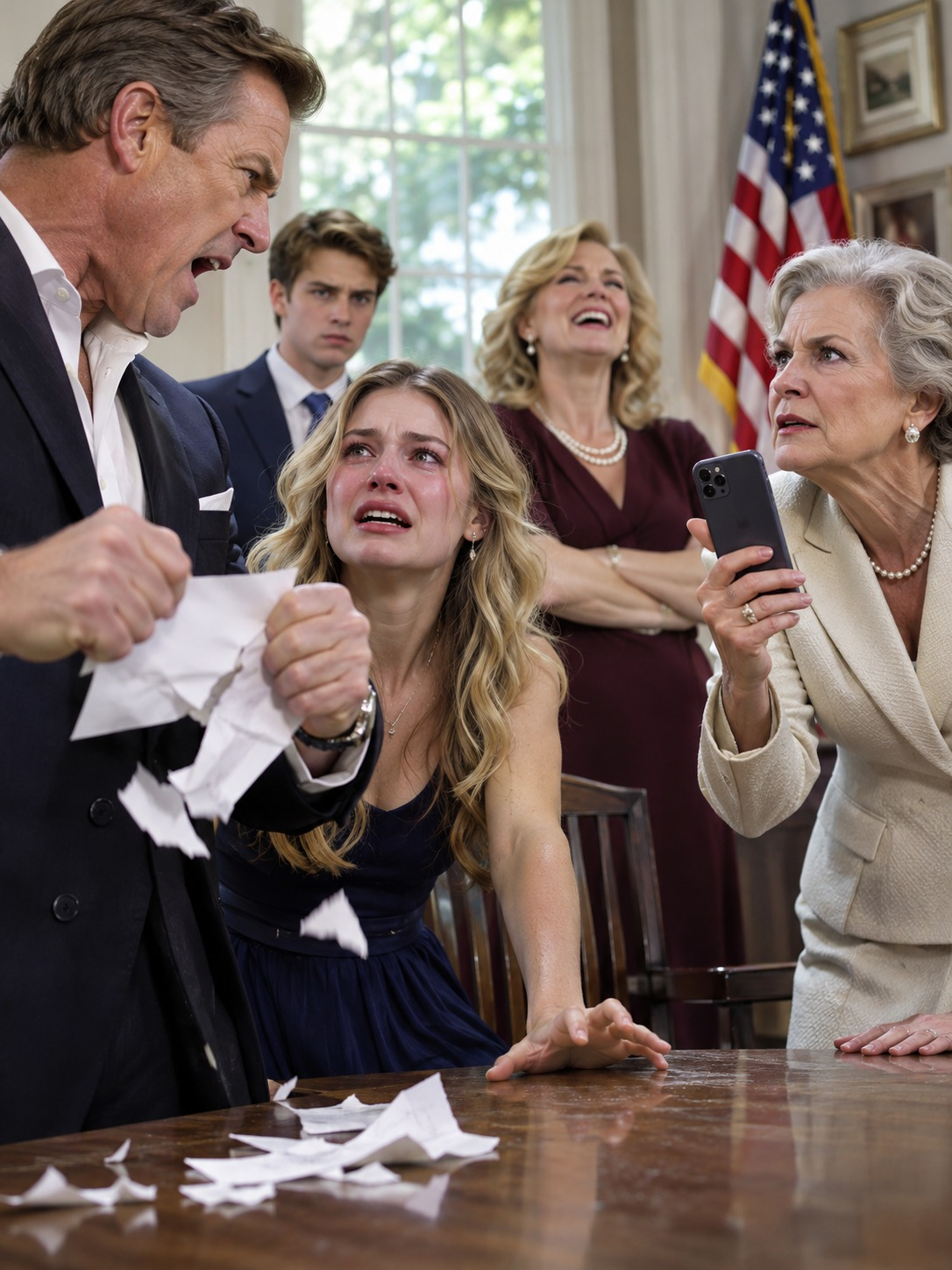
"Don't show her that!"
Tyler's voice cracked as he pulled the folded paper halfway out of the envelope.
I stared at him.
"Then why did you bring it?"
He looked toward the front door.
"Because Dad doesn't know I took it."
Grandma Ruth stepped between us and held out her hand.
"Tyler. Give me the paper."
My brother hesitated.
Then he handed it over.
Grandma unfolded it carefully.
At the top were three words.
Authorization for Release.
Beneath them was my father's signature.
And underneath that was a handwritten instruction that made Grandma's face go completely still.
Do not contact Lena.
I had spent the last three days trying to understand how my college savings account had become my brother's.
Now I was staring at a document that suggested my father had gone out of his way to make sure I never found out.
"Read it," I whispered.
Grandma adjusted her glasses.
Tyler stood beside the kitchen table, rubbing his hands together.
He looked like he wanted to leave.
Grandma read the document once.
Then again.
Finally, she placed it beside the beneficiary change request.
"This is a communication authorization," she said.
"What does that mean?"
"It means Gary instructed the account administrator to send notices and correspondence to his address."
I frowned.
"Isn't that normal if he owns the account?"
"Some of it is."
She pointed to the handwritten note.
"But this is not how a father should handle money his mother saved for his daughter."
I stared at the words.
Do not contact Lena.
My name.
My father's handwriting.
A direct instruction to keep me out of the conversation.
I looked at Tyler.
"Where did you find this?"
"In Dad's office."
"At the store?"
He nodded.
"He keeps a file cabinet behind his desk. I was looking for some business paperwork."
"And you found this?"
"There was a folder with Grandma's name on it."
Grandma looked up.
"My name?"
Tyler nodded.
"It had copies of the college account forms and some loan papers."
I felt my stomach tighten.
"Why were you looking through Dad's files?"
Tyler looked away.
"Because he told me to bring him something."
"What?"
"A statement from the business account."
I waited.
He rubbed his forehead.
"And I saw the college folder sitting on top."
I studied him.
"Tyler, did you know Dad was keeping this from me?"
He shook his head.
"Not like this."
"Then what did you know?"
He stared at the floor.
"I knew he changed the beneficiary. I knew he said the money was for my education. But I thought Grandma agreed."
I looked at him for a long moment.
"Did you ever ask her?"
"No."
"Why not?"
His face reddened.
"Because Dad told me it was handled."
There was that word again.
Handled.
My father had handled my college fund.
Handled my future.
Handled my acceptance letter by tearing it apart.
And apparently, he had handled the truth by making sure nobody sent me a copy.
Grandma folded the paper.
"Tyler, I appreciate that you brought this."
He looked relieved.
Then she continued.
"But I need you to understand something. You cannot simply remove documents from your father's office and expect that to solve the problem."
His expression changed.
"I know."
"We'll have an attorney review what we have. And we need to be honest about where these copies came from."
Tyler nodded.
I looked at Grandma.
"Can we get the money back?"
She didn't answer immediately.
"I don't know, sweetheart."
The words hurt.
But they were the truth.
And after three days of hearing people tell me what they thought I wanted to hear, I was beginning to appreciate the difference.
Tyler stayed for another twenty minutes.
He didn't sit down.
He didn't accept the coffee Grandma offered.
He just stood near the kitchen doorway, looking increasingly uncomfortable.
Finally, he turned toward me.
"Lena, I'm sorry about dinner."
I looked at him.
"You already said that."
"I know."
"Then why are you saying it again?"
He swallowed.
"Because I didn't do anything."
I stared at him.
He looked down.
"When Dad tore up your letter, I just sat there."
"Yes."
"I knew it was wrong."
I waited.
He rubbed the back of his neck.
"I should've said something."
I wanted to forgive him.
Part of me already had.
But another part of me remembered sitting at that table while Dad ripped my acceptance letter into four pieces.
I remembered looking at Tyler.
Waiting.
Hoping.
And watching him stare at his plate.
"Why didn't you?" I asked.
He gave a small, miserable shrug.
"Because Dad scares me, too."
That was the first honest thing my brother had said to me in days.
I looked at him.
For years, I'd assumed Tyler was Dad's favorite because he agreed with everything Dad said.
Maybe that wasn't the whole story.
Maybe Tyler had learned that agreeing was safer than arguing.
Maybe he'd spent his whole life being rewarded for staying quiet.
It didn't excuse what he'd done.
But it helped me understand it.
"Tyler," I said, "I don't want to fight with you."
He looked up.
"Me neither."
"But I can't pretend this didn't happen."
"I know."
"And I can't pretend the money was yours."
His expression tightened.
Then he nodded.
"I know."
He left a few minutes later.
Grandma watched his car disappear down the driveway.
Then she turned toward me.
"That wasn't easy for him."
I folded my arms.
"It wasn't easy for me either."
"No," she said. "It certainly wasn't."
The following Monday, Grandma drove me to the financial aid office at Purdue.
We left before sunrise.
I sat in the passenger seat with a notebook on my lap.
Inside it were all the numbers I'd calculated.
Tuition.
Books.
Housing.
Transportation.
Food.
The scholarship.
Possible grants.
Possible loans.
I had rewritten the figures so many times that the paper was beginning to tear.
Grandma glanced at it.
"You're going to wear a hole through that notebook."
I gave a nervous laugh.
"I just want to be prepared."
"You are prepared."
"What if they tell me I can't afford it?"
"Then we'll ask what options you have."
I stared out the window.
"What if there aren't any?"
Grandma didn't answer right away.
Then she said, "Lena, you're not the first student who has needed help paying for college."
"I know."
"And you won't be the last."
"I know."
She reached over and squeezed my hand.
"Then let's find out what's possible before deciding it's impossible."
I nodded.
But my stomach still hurt.
At Purdue, we met with a financial aid counselor named Mrs. Ellison.
She had short brown hair, reading glasses, and a desk covered in folders.
She smiled when she saw my acceptance letter.
"Congratulations, Lena."
I blinked.
"Thank you."
"You should be very proud."
I looked down.
It was strange hearing those words from someone who barely knew me.
Mrs. Ellison reviewed my scholarship.
Then she examined the rest of my financial information.
She explained grants, federal student loans, work-study opportunities, and payment deadlines.
She didn't promise anything.
But she didn't tell me to give up.
That alone felt extraordinary.
"Your scholarship gives you a strong starting point," she said.
I leaned forward.
"But it doesn't cover everything."
"No. And we need to look carefully at the remaining costs."
I nodded.
She pointed to one section of the paperwork.
"Have your parents completed the financial aid forms?"
My stomach tightened.
"Not yet."
"Will they?"
I looked at Grandma.
She looked back at me.
"I don't know," I admitted.
Mrs. Ellison studied my expression.
"Is there a problem at home?"
I hesitated.
How was I supposed to explain it?
That my father had torn up my acceptance letter?
That he'd redirected money my grandmother had saved for me?
That I was living at Grandma's farm because my parents thought my brother deserved college more than I did?
I swallowed.
"My parents aren't supporting my decision to attend."
Mrs. Ellison nodded slowly.
"I'm sorry to hear that."
I looked down.
"Does that mean I can't get aid?"
"Not necessarily. But we need to understand your circumstances and the rules that apply."
She explained that a parent's refusal to contribute didn't automatically make a student financially independent.
There were forms.
Deadlines.
Requirements.
And sometimes difficult conversations.
I wrote everything down.
Every word.
Every phone number.
Every deadline.
When we left, I had a folder full of information and a headache.
But I also had something I hadn't possessed that morning.
A plan.
On the drive home, Grandma stopped at a diner.
She ordered chicken noodle soup.
I ordered a cheeseburger.
We sat in a booth near the window.
For a while, we ate in silence.
Then Grandma asked, "What are you thinking?"
I looked at my folder.
"That college is expensive."
She smiled.
"That's true."
"And complicated."
"Also true."
I took a breath.
"But maybe I can do it."
Grandma set down her spoon.
"That's what I was hoping you'd discover."
I stared at her.
"Even without the money?"
She nodded.
"Even without the money."
I looked at the financial aid papers.
"I might have to work a lot."
"Probably."
"I might have to take out loans."
"Possibly."
"I might not have much time for anything else."
"That may be true."
I looked at her.
"You're not making this sound very exciting."
Grandma laughed.
"Sweetheart, I'm not trying to sell you a vacation."
I laughed, too.
Then she leaned forward.
"I'm trying to help you build a life."
Those words stayed with me.
Not because they solved anything.
Because they gave me permission to believe that the work might be worth it.
By June, I had a job.
Actually, I had two.
The first was at a grocery store outside Fort Wayne.
I worked evenings stocking shelves and helping customers.
The second was at a small medical supply company where I cleaned equipment, organized inventory, and answered phones.
Between the two jobs, I worked twenty-eight hours a week.
Sometimes more.
I was still finishing high school.
Still preparing for graduation.
Still completing paperwork for Purdue.
And still trying to understand how my family had become a place I no longer felt safe returning to.
Most mornings, I woke before six.
I studied before school.
Worked after classes.
Then came home to Grandma's farm and did homework at the kitchen table.
Grandma often sat across from me.
She balanced her checkbook.
Read the newspaper.
Or worked on crossword puzzles.
She never interrupted unless I asked for help.
Sometimes she brought me a sandwich.
Sometimes she left a glass of water beside my books.
And sometimes, when I fell asleep over my notes, she covered my shoulders with a blanket.
She never told me I was working too hard.
She never told me I was wasting my time.
She simply made sure I had somewhere quiet to keep going.
Graduation came in early June.
I wore a blue cap and gown.
My classmates laughed and took pictures.
Parents filled the bleachers.
Teachers shook hands.
Everyone seemed excited.
I was excited, too.
But I was also nervous.
I hadn't spoken to Dad in nearly six weeks.
Mom had called twice.
Both conversations ended with her telling me I needed to apologize.
Tyler had texted occasionally.
Mostly short messages.
How's school?
You okay?
Congrats on Purdue.
I answered politely.
But I didn't know how to talk to him anymore.
On graduation day, Grandma arrived early.
She wore a pale blue dress and carried a small camera.
When she saw me, she smiled so widely that I almost cried.
"There she is."
I hugged her.
"You look beautiful, sweetheart."
I laughed.
"I'm wearing a plastic cap."
"And you look beautiful in it."
She took six pictures before the ceremony even started.
Then she found a seat near the front.
I kept looking toward the entrance.
I told myself I wasn't waiting for Dad.
But I was.
Every time the doors opened, I looked up.
Every time someone entered, my heart jumped.
Then the ceremony began.
The principal spoke.
The choir sang.
Names were called.
When mine came, I walked across the stage.
I accepted my diploma.
And I heard Grandma cheering louder than anyone else.
I smiled.
But when I looked into the crowd, I saw an empty space beside her.
Mom hadn't come.
Dad hadn't come.
Tyler hadn't come.
I told myself it didn't matter.
But it did.
After the ceremony, Grandma hugged me.
"I'm so proud of you."
I nodded.
"Thanks."
She looked at my face.
"What's wrong?"
"Nothing."
She followed my gaze toward the bleachers.
Then she understood.
"Oh, Lena."
I shook my head.
"Don't."
She didn't.
She simply put her arm around me.
And we walked toward the parking lot.
That night, Grandma made my favorite dinner.
Roast chicken.
Mashed potatoes.
Green beans.
And chocolate cake.
She even put a small candle in the cake.
I laughed when I saw it.
"Grandma, it's not my birthday."
"I know."
"Then why the candle?"
"Because some things deserve celebrating."
I blew it out.
She clapped.
We ate dinner at the kitchen table.
Just the two of us.
It should have felt lonely.
But it didn't.
Not entirely.
After dinner, Grandma handed me a small wrapped box.
I stared at it.
"What's this?"
"A graduation present."
I opened it.
Inside was a silver necklace with a tiny heart-shaped pendant.
I lifted it carefully.
"Grandma."
She smiled.
"Your grandfather gave that to me when I finished my nursing assistant training."
I looked up.
"You trained as a nursing assistant?"
She nodded.
"For a little while, before the farm needed me full-time."
I stared at the necklace.
"I didn't know that."
"There's a lot you don't know about your old grandmother."
I laughed.
Then I hugged her.
"Thank you."
She held me tightly.
"You're welcome, sweetheart."
I wore that necklace every day for years.
Through exams.
Through clinical rotations.
Through long hospital shifts.
And eventually, through the hardest days of my career.
But that night, it was simply a reminder that someone believed in me.
The summer passed in a blur.
Work.
Paperwork.
More work.
I learned how to stretch twenty dollars across an entire week.
I learned which grocery store had the cheapest produce.
I learned how to repair a loose button on my work uniform.
And I learned that exhaustion didn't always mean defeat.
Sometimes it meant I was moving forward.
By August, I had saved enough to cover several immediate expenses.
Not everything.
Not even close.
But enough to begin.
Grandma helped me move into student housing near Purdue.
We packed the Buick with clothes, books, bedding, and a secondhand desk lamp.
My dark blue suitcase fit in the trunk.
The same suitcase she'd bought me after I left home with a trash bag.
When we arrived, students were carrying boxes into dormitories.
Parents hugged their children.
Some cried.
Some laughed.
I watched a father carry a mini-fridge up the stairs for his daughter.
He complained about the weight.
She rolled her eyes.
Then she hugged him.
I looked away.
Grandma noticed.
She didn't say anything.
Instead, she picked up the heaviest box.
"Come on, Lena. Let's get you settled."
I laughed.
"Grandma, I can carry that."
"So can I."
And she did.
My first semester was harder than anything I'd imagined.
Anatomy nearly defeated me.
Chemistry made me question every decision I'd ever made.
I studied until my eyes burned.
I worked part-time whenever my schedule allowed.
And I called Grandma every Sunday.
Sometimes I cried.
Sometimes I complained.
Sometimes I told her I was afraid I wasn't smart enough.
She always listened.
Then she asked the same question.
"Did you do your best today?"
Usually, I said yes.
"Then get some sleep and try again tomorrow."
It sounded simple.
But it worked.
I kept going.
One exam.
One assignment.
One difficult week at a time.
I learned how to study more efficiently.
How to ask professors for help.
How to work with classmates.
How to recover from a bad grade without deciding I was a failure.
And slowly, I began to believe that I belonged there.
Not because Dad approved.
Not because Tyler had given me permission.
Because I'd earned my place.
One evening in November, I was leaving the library when my phone rang.
Grandma.
I smiled and answered.
"Hi."
"Hello, sweetheart."
Something in her voice made me stop walking.
"Grandma?"
"Are you somewhere you can talk?"
My stomach tightened.
"Yes."
She took a breath.
"I had another conversation with Dennis today."
I closed my eyes.
The banker.
The account.
The business loan.
I had tried not to think about those things during the semester.
But they never really disappeared.
"What happened?"
Grandma hesitated.
"Your father's credit line is coming up for renewal."
I leaned against the wall.
"Okay."
"And the bank has asked him to provide additional financial information."
I waited.
"Grandma, what does that mean?"
"It means the bank is reviewing the business without assuming my guarantee will continue."
I swallowed.
"Is Dad okay?"
"I don't know."
"Has he called you?"
"Several times."
I looked down.
"What does he want?"
Grandma was quiet.
Then she said, "He wants me to change my mind."
I stared at the floor.
"Will you?"
"No."
Her answer was immediate.
I closed my eyes.
"Grandma, I don't want him to lose everything."
"Neither do I."
"Then maybe—"
"Lena."
I stopped.
"Your father's business is his responsibility."
I swallowed.
"I know."
"And your education is yours."
I looked at the books in my arms.
The notes.
The textbooks.
The future I was trying so hard to build.
"Okay," I whispered.
Grandma's voice softened.
"How are your classes?"
I laughed weakly.
"Hard."
"Good."
"Good?"
"That means you're learning something."
I smiled.
We talked for another ten minutes.
Then she told me to eat dinner and get some sleep.
I promised I would.
After we hung up, I stood outside the library for a long moment.
I thought about Dad.
About the hardware store.
About the $74,000 account.
About the papers Tyler had brought to Grandma's house.
And about the fact that I still didn't know whether my father had done anything illegal.
I only knew he'd done something cruel.
I went back inside and opened my anatomy textbook.
I had an exam the next morning.
Whatever Dad was doing, I couldn't let it stop me.
Three weeks later, I received a letter.
It arrived at my student housing mailbox.
The envelope was plain.
No return address.
My name was typed across the front.
I opened it in the hallway.
Inside was a single sheet of paper.
At first, I thought it was a bill.
Then I saw the letterhead.
A law office in Fort Wayne.
I read the first paragraph.
Then the second.
My hands began to shake.
The letter stated that an attorney representing my father had been asked to contact me regarding a financial matter involving the college savings account.
I stared at the words.
Your acknowledgment is requested.
I read the sentence again.
Then I noticed a second page.
It was a form.
A statement for me to sign.
At the bottom was a line with my name printed beneath it.
I didn't understand why Dad wanted my signature now.
He'd already changed the account.
He'd already told me the money belonged to Tyler.
He'd already refused to help with college.
Why did he need anything from me?
I pulled out my phone.
Called Grandma.
She answered immediately.
"Lena?"
"Grandma, I got a letter."
"What kind of letter?"
"From a lawyer."
Silence.
Then she said, "Read it to me."
I did.
Every word.
When I finished, she didn't speak for several seconds.
"Grandma?"
"Don't sign anything."
"I wasn't going to."
"Good."
I looked at the form again.
"Why would Dad send this?"
Grandma's voice was very quiet.
"Because something has changed."
"What?"
"I don't know yet."
I stared at the page.
Then I turned it over.
There was a handwritten note on the back.
Just one sentence.
Your father says you already agreed.
My stomach dropped.
"Grandma?"
"Yes?"
"There's something written on the back."
I read it aloud.
Grandma went silent.
Then she said, "Lena, I need you to listen carefully."
I gripped the phone.
"Okay."
"Put that letter somewhere safe."
"Okay."
"And don't discuss it with your father until I've spoken to Margaret."
I swallowed.
"Grandma, what's happening?"
Before she could answer, someone knocked on my apartment door.
Three sharp knocks.
I looked toward the hallway.
"Grandma, someone's here."
"Who?"
"I don't know."
The knocking came again.
Louder.
I walked toward the door.
Through the peephole, I saw a man in a dark suit.
He held a leather briefcase.
I didn't recognize him.
But he was looking directly at my door.
Then he lifted a business card toward the peephole.
I read the name.
My father's attorney.
My heart began pounding.
"Grandma," I whispered, "he's standing outside."
Her voice changed immediately.
"Lena, don't open that door."
I stepped back.
The man knocked a third time.
Then he spoke.
"Miss Lena, I know you're in there."
I froze.
He continued.
"Your father sent me because there's something you need to understand before you sign that form."
I looked down at the letter in my hand.
Then back at the door.
The man lowered his voice.
"And if you don't hear me out, your grandmother could lose something far more valuable than that college account."
He reached into his briefcase.
Pulled out a photograph.
And pressed it against the peephole.
It showed Grandma's farmhouse.
But across the bottom of the photograph was a date.
Tomorrow.
Then the man said:
"Your father has already scheduled the meeting."






Comments 0