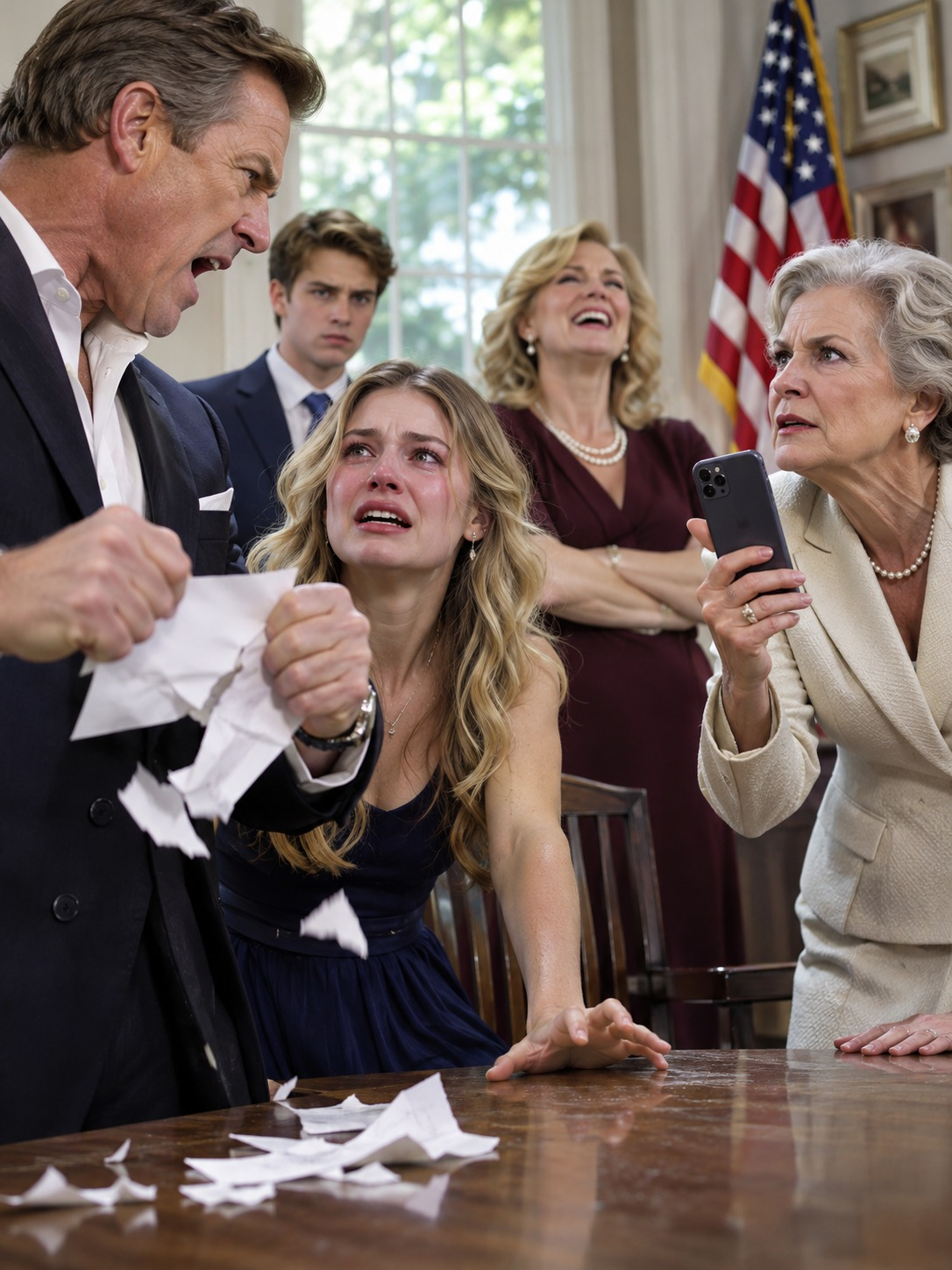
"Tyler."
My father said my brother's name as though it explained everything.
I stood in Margaret's conference room, staring at the phone.
For a moment, I couldn't speak.
Then I heard Tyler shout in the background.
"That's not what the document says!"
Dad laughed.
"Your grandfather left the house to Tyler, Lena. Not you. Tyler was always supposed to have the business and the family property."
I looked at Margaret.
Her expression remained carefully controlled.
"Gary," she said, "we have the recorded deed and the closing documents. You need to stop making claims about ownership that haven't been established."
Dad ignored her.
"Tell Lena she's not getting another penny from this family."
Something inside me went quiet.
Not broken.
Not defeated.
Just quiet.
Sixteen years earlier, those words would have destroyed me.
Now I looked at the yellow envelope resting beside Margaret's legal pad.
The repaired acceptance letter.
Grandpa's handwritten instructions.
The account statements.
The evidence of everything I'd survived.
Then I spoke.
"Dad, I'm thirty-four years old."
Silence.
"I have a career. I have a home. I have people who love me."
He said nothing.
"I don't need your permission to have a future."
His breathing changed.
Then he snapped, "You always were an ungrateful little—"
Margaret ended the call.
The room went silent.
I stared at the phone.
For the first time in my life, my father's anger had been interrupted before it could finish becoming my responsibility.
Margaret folded her hands.
"Lena, we need to separate three things."
I sat down.
She continued.
"What Gary claims your grandfather intended, what the recorded documents actually establish, and what may have happened during the 2010 transaction."
I nodded.
Dennis sat beside her.
Arthur Bell was across the table.
The folder containing the closing records lay open between us.
Margaret pointed to the deed.
"The recorded owner of your parents' house is Tyler."
My chest tightened.
She continued.
"That is the present title record. A separate document claiming the house was intended for you does not automatically transfer ownership."
I looked at the affidavit.
The one bearing a signature I had never written.
"What about this?"
"We're having the original reviewed. But nobody should assume it is valid merely because it appears in the closing file."
Arthur leaned forward.
"Your grandfather never owned that house."
I looked at him.
"What?"
He shook his head.
"Gary purchased the property years before your grandfather died. Your grandfather helped with an early down payment, but he wasn't the owner."
I stared at him.
"Then Dad was lying when he said Grandpa left it to Tyler?"
Arthur nodded.
"Your grandfather couldn't leave property he didn't own."
Margaret added, "Unless there were separate enforceable arrangements, which we haven't found."
I closed my eyes.
Another lie.
Not even a complicated one.
Just a statement Dad had made because he thought it would hurt me.
I opened my eyes.
"Then why does the second page say the house was supposed to be held for me?"
Margaret looked at Dennis.
Then back at me.
"Because it appears someone created a private arrangement while the property was being refinanced and transferred into Tyler's name."
My stomach tightened.
"Who?"
"Gary and Diane."
I stared at her.
She continued.
"The document describes the house as security for money diverted from the education account. It states that Tyler would hold title temporarily and that you would receive an ownership interest when you turned thirty."
I swallowed.
"But I never agreed to that."
"No."
"And I didn't sign the affidavit."
"You've consistently denied signing it."
I looked down.
"Then why would they do it?"
Arthur answered quietly.
"Because Gary wanted the money to remain in the family business without admitting he'd taken it from the account intended for your education."
I stared at him.
"And the house?"
"He may have believed it would make the arrangement appear fair."
I almost laughed.
Fair.
Dad had taken money meant for my education.
Used it to support his store.
Moved funds through other accounts.
Then created paperwork suggesting I'd been compensated with a house nobody had told me about.
A house my brother legally owned.
A house my parents still lived in.
And somehow, Dad had convinced himself that made everything right.
Margaret turned another page.
"There's something else you should understand."
I looked up.
"The second page Tyler found may be important evidence of the family's intentions, but its legal effect is disputed. It doesn't mean you automatically own the house."
I nodded.
"I understand."
"However, the underlying financial records give us grounds to investigate the transactions and pursue recovery where legally supported."
I stared at the documents.
For sixteen years, I'd wanted someone to tell me what Dad had done was wrong.
Now I was learning that the truth could be established without pretending every wrong had an easy legal remedy.
Margaret continued.
"We can seek an accounting, examine the disputed signatures, and pursue appropriate claims. But the outcome will depend on the evidence, applicable deadlines, and the law."
I took a breath.
"Then that's what we do."
She nodded.
"All right."
Dennis closed his folder.
"The bank will preserve its records and handle the concerns about the financing application through the appropriate channels."
I looked at him.
"And Grandma's farm?"
He met my eyes.
"The bank has not approved the proposed loan or accepted her property as collateral."
I exhaled.
Margaret added, "We've also completed another title review. Ruth remains the recorded owner of her twenty-eight acres. We found no recorded mortgage arising from Gary's recent application."
For the first time that morning, I smiled.
Grandma's farm was still hers.
Dad hadn't taken it.
And now, with Margaret watching the records and Grandma's wishes documented, he wasn't going to quietly turn it into another bargaining chip.
Tyler arrived an hour later.
He looked exhausted.
There was a bruise on his forearm.
I stood immediately.
"Are you okay?"
He nodded.
"Dad grabbed my arm when I tried to take the folder."
My stomach tightened.
"Did he hurt you?"
"Not seriously."
Margaret looked concerned.
"Tyler, you should document what happened."
He nodded.
"I already did."
He sat across from me.
For a moment, neither of us spoke.
Then he pushed a folder toward Margaret.
"The originals."
She opened it carefully.
Inside were the two-page agreement, the affidavit bearing my disputed signature, and several closing records.
Tyler looked at me.
"Lena, I didn't know about the second page."
I stared at him.
"How could you own the house and not know?"
He looked ashamed.
"Dad told me putting it in my name would help with the refinancing."
I shook my head.
"And you signed?"
"Yes."
"Without asking why?"
He swallowed.
"Yes."
I looked away.
Tyler continued.
"I was twenty-one. I'd left Ball State. Dad said the business was in trouble, and he needed me."
I closed my eyes.
The same explanation.
The same pressure.
The same father.
Tyler looked at me.
"But I was old enough to ask questions. I should have."
I turned back.
He continued.
"I should have told you about the college account. I should have told Grandma what Dad was doing. And I should have stopped lying about my degree."
His voice broke.
"I'm sorry."
I stared at him.
For years, I'd imagined what it would feel like to hear my brother admit everything.
I thought it would make the anger disappear.
It didn't.
But something shifted.
Because this time, Tyler wasn't asking me to forgive Dad.
He wasn't telling me to understand.
He wasn't defending the money.
He was accepting responsibility for his own choices.
I took a breath.
"Tyler, I can't pretend none of this happened."
He nodded.
"I know."
"And I can't promise I'll trust you tomorrow."
"I understand."
I looked at the folder.
"But if you really want to make things right, keep telling the truth."
His eyes filled.
"I will."
The next two months were difficult.
There were meetings.
Letters.
Financial records.
Questions about old account distributions and tax reporting.
Margaret coordinated the review of the disputed documents.
A forensic document examiner was retained to compare original signatures and available handwriting samples.
The bank investigated the application Dad had submitted.
And Grandma, despite her age, remained determined to make her own decisions.
She refused to pledge the farm.
She refused to sign a new guarantee.
She refused to let Dad tell people she was confused.
One afternoon, after a particularly exhausting meeting, she looked at Margaret and said, "I'm ninety-two. I may forget where I put my glasses, but I haven't forgotten who owns my land."
Margaret smiled.
"That's very clear, Ruth."
I laughed.
Grandma winked at me.
It was the first time I'd laughed that freely in weeks.
The investigation uncovered more than we'd expected.
The $42,000 withdrawal from the education savings account had been deposited into the hardware store's business account.
Other distributions had followed.
Some were connected to expenses Dad claimed were educational.
Others were not.
The records showed that a portion of the money had moved through accounts associated with Mom before being used in the refinancing of my parents' house.
The transactions were complicated.
Some had occurred sixteen years earlier.
Not every payment could be reconstructed perfectly.
But the documents established something Dad had denied for years.
Money Grandma had contributed for my education had been used to support his business and household finances.
The original account had not paid for my Purdue education.
I had.
Through scholarships.
Loans.
Work.
And help from Grandma.
Margaret also obtained evidence that the disputed acknowledgment bearing my signature had not been signed by me.
The examiner identified significant inconsistencies between the questioned signatures and verified examples of my handwriting.
That wasn't a magical solution to every legal issue.
But it supported what I'd been saying from the beginning.
I had never agreed to surrender the money.
I had never authorized Dad to use Grandma's farm.
And I had never signed a statement saying I'd received full compensation.
For sixteen years, Dad had insisted his version of events was the only one that mattered.
Now the records were finally telling a different story.
Mom moved out of the house in December.
She rented a small apartment near her sister.
When she called to tell me, I was sitting at Grandma's kitchen table.
"Lena?"
"Hi, Mom."
Her voice trembled.
"I wanted you to hear it from me."
I listened.
She told me she'd separated from Dad.
That she had provided Margaret with the documents she still possessed.
That she was cooperating with the review of the signatures and financial records.
Then she went quiet.
Finally, she whispered, "I know I don't deserve forgiveness."
I stared at the window.
Snow was falling over Grandma's fields.
I thought about all the times Mom had stayed silent.
All the times she'd defended Dad.
All the times she'd looked at me and chosen not to see what was happening.
"Mom," I said, "I don't know whether I can forgive you yet."
She began crying.
"I understand."
"But I'm glad you're telling the truth."
She took a shaky breath.
"Thank you."
I closed my eyes.
"And I need time."
"I know."
When the call ended, Grandma looked at me.
"How do you feel?"
I thought about it.
"Sad."
She nodded.
"That's understandable."
I looked down.
"But not guilty."
Grandma smiled.
"Good."
The hardware store closed the following spring.
Dad had tried to keep it open.
He negotiated with creditors.
Sold inventory.
Reduced expenses.
But without additional financing, and with years of losses behind him, the business couldn't continue.
The building was eventually sold through a creditor-supervised process.
The employees received notice and assistance locating other work.
Frank found a position managing inventory for a regional supplier.
Tyler helped him prepare references for several former coworkers.
Dad blamed everyone.
The bank.
The economy.
Margaret.
Grandma.
Me.
But the financial records told a simpler story.
The business had been struggling for years.
And Dad had kept borrowing time instead of confronting the problem.
The store didn't close because I went to Purdue.
It didn't close because Grandma protected her farm.
It closed because the business could no longer support itself.
For the first time, I understood that I didn't have to accept responsibility for an outcome simply because Dad wanted someone to blame.
The house was resolved through a negotiated agreement.
Tyler was the recorded owner.
Dad and Mom had occupied it for years.
And the disputed documents created questions that nobody wanted to leave hanging over the property.
With independent legal advice, Tyler agreed to sell the house after Dad moved out.
The sale proceeds were used to satisfy the valid liens and transaction costs.
The remaining funds became part of a settlement addressing the documented transfers and disputed family arrangements.
The agreement did not pretend that I had owned the house all along.
It did not erase the years of financial hardship.
And it did not require me to accept Dad's version of events.
Instead, the parties acknowledged the disputed transactions, resolved the claims they could resolve, and established a payment arrangement.
Dad signed it.
Not because he'd suddenly become kind.
Not because he'd finally admitted every wrong.
But because the evidence, legal costs, and financial consequences had left him with few reasonable alternatives.
Margaret made sure I understood every page before I signed.
I read them slowly.
Asked questions.
And signed only when I was satisfied.
For the first time, my name appeared on a family financial document because I had chosen to put it there.
Grandpa's separate trust was easier to resolve.
The successor institution confirmed the account and reviewed the original terms.
After the necessary documentation and administrative review, the trustee authorized a distribution to me.
The balance was a little over forty-one thousand dollars.
I stared at the statement for a long time.
Grandpa had opened that reserve because he was afraid Dad might interfere with my education.
He'd been right.
But the money had remained protected.
Waiting.
Not because Grandpa could predict everything that would happen.
Because he'd taken the trouble to make a careful plan.
I used part of the distribution to pay off the remaining student loans.
When the final payment cleared, I sat at my kitchen table and cried.
I'd been making those payments for years.
Some months, they had felt like the last remaining chain connecting me to the night Dad tore my acceptance letter.
Now they were gone.
I called Grandma.
"Guess what?"
She laughed.
"What, sweetheart?"
"I'm debt-free."
For a moment, she didn't speak.
Then she began crying.
"Oh, Lena."
I smiled through my own tears.
"Grandpa helped."
Grandma whispered, "He would have been so happy."
I looked at the silver heart necklace resting against my chest.
"I know."
Tyler started over.
He didn't return to Ball State immediately.
He found work with a logistics company.
The job was smaller than the title Dad had given him at the hardware store.
There were no grand announcements.
No claims about business degrees.
No speeches about being the family's future.
He worked.
Learned.
And slowly began building a life that belonged to him.
One afternoon, he called me.
"Lena?"
"Hey."
"I enrolled in two evening classes."
I smiled.
"Really?"
"Yeah."
"At Ball State?"
"Through a program that accepts some of my old credits."
I leaned against the kitchen counter.
"That's great, Tyler."
He laughed nervously.
"I'm scared."
I smiled.
"Good."
He paused.
"Good?"
"Means you care."
He laughed.
Then he said, "I don't know if I'll finish."
I thought about my own college years.
The fear.
The exhaustion.
The nights I wanted to quit.
"Then take one semester at a time."
He was quiet.
Then he whispered, "Thanks."
I smiled.
"You're welcome."
Emily eventually agreed to meet him.
Not to restart the engagement.
Not immediately.
She wanted to hear the truth without Dad standing nearby to explain it away.
Tyler told her everything.
The unfinished degree.
The family money.
The house.
The years of silence.
He didn't ask her to forget.
He didn't blame Dad for every choice he'd made.
And he didn't promise he'd become a different person overnight.
He simply told her the truth.
Months later, they began seeing each other again.
Slowly.
Carefully.
The engagement remained off while they rebuilt trust.
But one Sunday, Emily came to Grandma's farm for lunch.
She brought flowers.
Grandma welcomed her inside.
Tyler stood beside her, looking nervous.
Emily smiled at me.
"Hi, Lena."
"Hi."
She hesitated.
Then she said, "I wanted to tell you something."
I looked at her.
"I'm listening."
She glanced at Tyler.
Then back at me.
"I didn't know what happened to you."
I nodded.
She continued.
"And I'm sorry I believed the stories Gary told."
I swallowed.
"Thank you."
She smiled sadly.
"Tyler's learning how to tell the truth."
I looked at my brother.
He smiled faintly.
"So am I," she added. "I'm learning how to ask questions."
Grandma laughed.
"That's a good place to start."
Dad never gave me the apology I'd imagined.
There were letters.
Some angry.
Some defensive.
One that claimed he'd done everything for the family.
Another that said I'd humiliated him.
And finally, a short note.
I didn't think you would make it through college.
I stared at those words for a long time.
Then I turned the page over.
On the back, he'd written:
I was wrong.
It wasn't enough.
Not for sixteen years.
Not for the money.
Not for the lies.
Not for the nights I'd cried over tuition bills.
But it was the first time he'd admitted even that much.
I placed the note in a drawer.
I didn't frame it.
I didn't call him.
I didn't rush to forgive him.
I simply let it be what it was.
A small acknowledgment from a man who had spent most of his life refusing to acknowledge anything.
I could live without more.
Grandma turned ninety-three that summer.
We held her birthday party at the farm.
Not at a fancy restaurant.
Not in a rented hall.
At home.
Under the old maple tree.
Rachel came with her husband.
Tyler brought Emily.
Frank stopped by with a card.
Arthur Bell traveled from Ohio with his daughter.
Mom came too, after asking Grandma's permission.
There were flowers on the tables.
Chocolate cake in the kitchen.
And a banner Tyler had hung crookedly between two trees.
HAPPY 93RD BIRTHDAY, GRANDMA RUTH!
Grandma laughed when she saw it.
"That looks like a drunk squirrel put it up."
Tyler grinned.
"Love you too, Grandma."
Everyone laughed.
I stood near the porch, watching.
For years, I'd imagined what a happy family gathering was supposed to look like.
I thought it required everyone to agree.
Everyone to forgive.
Everyone to pretend nothing painful had happened.
Now I knew better.
There were people at that party who still had difficult conversations ahead of them.
Relationships that needed time.
Trust that had to be rebuilt.
But nobody was pretending.
And nobody was being asked to sacrifice themselves to keep the peace.
That was enough.
After the cake, Grandma asked everyone to gather around.
She stood beside the picnic table, holding her cane.
I moved toward her.
"Grandma, do you want to sit?"
She gave me a look.
"Lena, I stood up to your father. I can stand up for a birthday speech."
Everyone laughed.
I smiled.
"Fair enough."
Grandma looked around.
Then she began.
"I've lived ninety-three years."
She paused.
"That's long enough to make plenty of mistakes."
Arthur chuckled.
Grandma smiled.
"I've loved people who disappointed me."
Her eyes moved toward Mom.
Then Tyler.
Then back to me.
"And I've been disappointed in myself."
I felt my throat tighten.
She continued.
"But I've also learned something."
She looked directly at me.
"Love isn't deciding someone else's future."
My eyes filled.
"It isn't controlling them."
She paused.
"And it isn't making them earn the right to be treated with kindness."
The yard went quiet.
Grandma reached for my hand.
"Sixteen years ago, my granddaughter came to my house carrying her clothes in a black trash bag."
My chest tightened.
I remembered.
The cold driveway.
The porch light.
The sound of Grandma opening the door.
She continued.
"She thought her future was over."
I wiped my eyes.
"But it wasn't."
Grandma smiled at me.
"She went to college."
Her voice grew stronger.
"She worked harder than anyone should have to."
I began crying.
"And she became the kind of woman who spends her days helping people through some of the hardest moments of their lives."
Rachel squeezed my shoulder.
Grandma looked around.
"I want everyone here to know something."
She took a breath.
"I am proud of Lena."
My tears fell freely.
Grandma continued.
"Not because she has a degree."
She looked at me.
"Not because she has a good job."
Her voice softened.
"But because she never let anyone convince her that her kindness was weakness."
I covered my mouth.
Grandma smiled.
"And because she never stopped believing she deserved a future."
The yard erupted in applause.
I stepped forward.
Wrapped my arms around her.
And held on.
Later that afternoon, Grandma and I walked toward the edge of the property.
The fields stretched beyond the fence.
The old barn stood against the summer sky.
I could hear laughter from the house.
Tyler arguing with Frank about how to operate the grill.
Rachel calling for more plates.
Emily laughing.
Grandma leaned on her cane.
"Beautiful day."
I nodded.
"It is."
We stopped beside the fence.
She looked across the fields.
"Your grandfather loved this place."
I smiled.
"I know."
"He used to say the land didn't belong to us so much as we belonged to it."
I looked at the farmhouse.
The white porch.
The kitchen window.
The old maple tree.
The place where I'd arrived with nothing but a trash bag and a broken heart.
"Grandma?"
"Yes?"
"Thank you."
She looked at me.
"For what?"
I laughed softly.
"Everything."
She smiled.
"That's a lot of thanking."
I shook my head.
"For opening the door."
Her expression changed.
I continued.
"That night. When I left home."
Her eyes filled.
"You didn't ask me to explain."
She squeezed my hand.
"You didn't tell me to go back."
I swallowed.
"You just opened the door."
Grandma smiled through her tears.
"Of course I did."
I looked at her.
"Why?"
She seemed surprised.
"Because you were my granddaughter."
I laughed through my tears.
She continued.
"And because you needed somewhere safe to land."
I leaned my head against her shoulder.
For a long moment, we stood there.
The wind moved through the grass.
The house was full of people.
And for once, there was nothing I needed to prove.
A few weeks later, I received a letter from Purdue.
I opened it at my kitchen table.
The university was inviting alumni to participate in a mentoring program for nursing students facing financial hardship.
I read the letter twice.
Then I smiled.
I thought about Mrs. Ellison, the financial aid counselor who had helped me when I was eighteen.
About Rachel sharing her notes.
About Grandma buying me that dark blue suitcase.
About every person who had helped me keep going when quitting would have been easier.
I called the program coordinator.
And I said yes.
That fall, I began mentoring a first-year nursing student named Hannah.
She was nineteen.
Smart.
Determined.
And terrified she wouldn't be able to afford another semester.
The first time we met, she sat across from me in a campus office.
Her hands trembled as she explained her situation.
"I don't know if I can do this," she whispered.
I looked at her.
And for one moment, I saw myself.
Eighteen years old.
Holding a torn acceptance letter.
Wondering whether my future had already been decided by someone else.
I leaned forward.
"Hannah, listen to me."
She looked up.
"Being scared doesn't mean you can't do it."
Her eyes filled.
I continued.
"It means this matters to you."
She swallowed.
"But what if I fail?"
I smiled gently.
"Then we'll figure out what comes next."
She stared at me.
"We?"
I nodded.
"We."
The following spring, Grandma and I established a small education fund through a local community foundation.
We named it the Ruth and Thomas Education Opportunity Fund, after Grandma and Grandpa.
Its purpose was simple.
To help students who were working hard to attend college but lacked enough financial support.
I contributed part of the money recovered through the family settlement.
Grandma made a modest gift from her savings.
Arthur helped us review the foundation's financial information.
Margaret helped ensure the arrangements were properly documented.
And Tyler volunteered to assist with the annual fundraising event.
The first recipient was Hannah.
When she received the award, she cried.
Then she hugged me.
"I don't know how to thank you."
I smiled.
"Finish your semester."
She laughed through her tears.
"I will."
"And when you can, help somebody else."
She nodded.
"I promise."
I watched her walk away.
Then I looked at Grandma.
She was smiling.
"What?" I asked.
She shook her head.
"Nothing."
"Grandma."
She laughed.
"Your grandfather would have loved this."
My eyes filled.
I looked at the scholarship certificate.
At Hannah's name.
At the small fund we'd created.
For sixteen years, I'd thought the story of my college money was about something stolen.
Now part of that money was helping someone else begin.
One evening, I brought Grandma a framed photograph.
It showed the two of us standing outside Purdue on my graduation day.
I wore my cap and gown.
Grandma stood beside me, smiling proudly.
Her arm was wrapped around my waist.
I placed it on her mantel.
She looked at it.
"Oh, Lena."
I smiled.
"Remember that day?"
She nodded.
"Of course."
"You cried through the whole ceremony."
She laughed.
"I was entitled."
I grinned.
Then she looked at the photograph again.
"You were so happy."
I swallowed.
"I was."
She turned toward me.
"Are you happy now?"
I thought about the question.
My work.
My home.
My friends.
My brother slowly rebuilding his life.
Mom trying to repair what she'd damaged.
Grandma safe on her farm.
The education fund.
The student loans finally paid.
The yellow envelope resting in a drawer at my house.
The repaired acceptance letter I'd once thought represented everything I'd lost.
I smiled.
"Yes."
Grandma studied my face.
"Really?"
I nodded.
"Really."
She reached for my hand.
"Good."
That night, I went home and opened the yellow envelope one last time.
I spread the four pieces of my Purdue acceptance letter across the table.
The tape was old.
The paper was worn.
But the words were still there.
Congratulations, Lena.
I smiled.
Then I placed Grandpa's letter beside it.
Your future belongs to you.
For years, I'd thought those two letters told opposite stories.
One about the opportunity I'd been given.
The other about the danger of having it taken away.
Now I understood they belonged together.
My father had torn up a letter.
He'd changed an account.
He'd lied about money.
He'd tried to use Grandma's land.
He'd told me I wasn't worth the investment.
But he hadn't been able to decide who I would become.
That part had always belonged to me.
I placed the letters in a new archival folder.
Then I added a photograph.
Grandma and me.
Standing beneath the maple tree on her ninety-third birthday.
Both smiling.
Both still here.
I closed the folder.
Put it on the shelf beside my nursing textbooks.
And turned off the light.
The next morning, I drove to Grandma's farm.
She was waiting on the porch.
Two cups of coffee sat on the small table beside her.
The sun was rising over the fields.
I climbed the steps.
"Morning, Grandma."
She smiled.
"Morning, sweetheart."
I sat beside her.
She handed me a cup.
For a while, we watched the sunlight move across the grass.
Then Grandma looked at me.
"Lena?"
"Yes?"
"Do you ever wish things had been different?"
I thought about Dad.
The torn letter.
The money.
The years of struggle.
The things I'd lost.
And the people I'd found.
"Sometimes," I said.
She nodded.
"Me too."
I took a sip of coffee.
Then I looked at her.
"But I don't wish I were someone else."
Grandma smiled.
"Neither do I."
I reached for her hand.
She squeezed mine.
Beyond the porch, the fields stretched toward the horizon.
The farm was still hers.
My future was still mine.
And the woman who had opened her door to me sixteen years earlier was sitting beside me, drinking coffee in the morning sunshine.
I leaned against her shoulder.
"Love you, Grandma."
She kissed the top of my head.
"Love you more, sweetheart."
I smiled.
For once, I didn't argue.






Comments 0