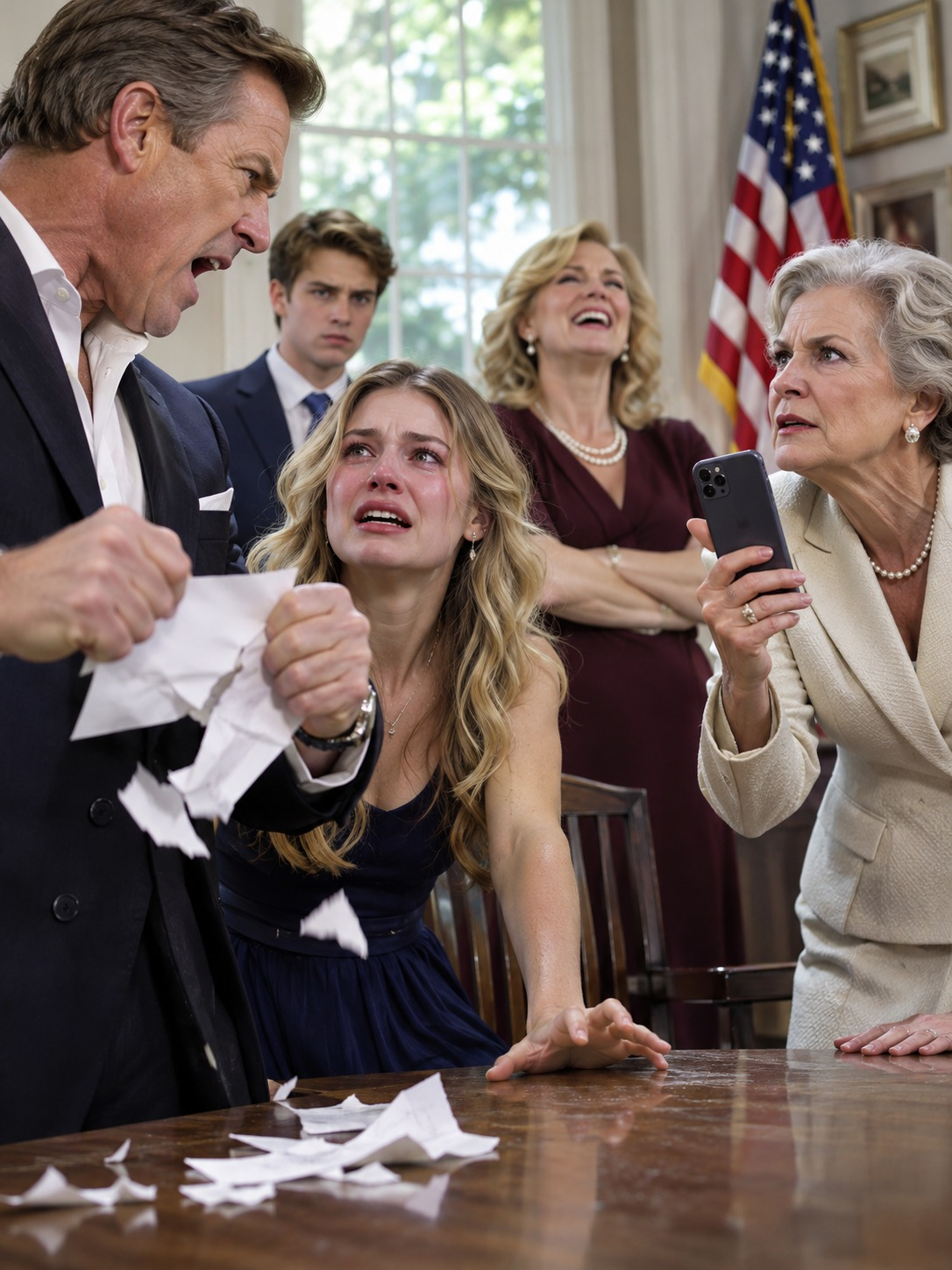
"Tyler."
That was the name I heard through my grandmother's silver flip phone.
Not mine.
Tyler.
My father stood frozen beside the dining table, his hand still gripping the back of his chair.
Grandma Ruth closed her eyes for one brief second.
Then she asked the woman on the phone to repeat herself.
"You're telling me the current beneficiary is Tyler?"
The woman confirmed it.
Grandma's expression didn't change.
But my father's did.
And that was how I learned that the money my grandmother had spent fourteen years saving for my education had somehow become my brother's.
I remember looking down at the four pieces of my Purdue acceptance letter.
A few minutes earlier, I had thought those pieces represented the worst thing my father could do to me.
I was wrong.
"Mother, hang up the phone."
Dad's voice was low.
Dangerously low.
Grandma ignored him.
"When was that change made?" she asked.
The woman on the other end said something I couldn't hear.
Grandma reached for a pen beside the telephone directory on the kitchen counter.
She wrote a date on the back of an envelope.
Then she asked another question.
"And who authorized it?"
My father moved toward her.
"That's enough."
Grandma raised one finger.
It was such a small gesture.
But he stopped.
I had never seen anyone stop my father with one finger.
"Gary," she said, covering the phone, "you will sit down."
He stared at her.
"You're in my house."
"And you're behaving like a man who has something to hide."
Mom stood up.
"Ruth, what is going on?"
Grandma looked at her.
"That's what I'm finding out."
Tyler was still sitting at the table.
His fork lay beside his plate.
He hadn't touched his food since Grandma mentioned the account.
I turned toward him.
"Tyler?"
He looked up.
"Did you know about this?"
"About what?"
"The account."
His eyes moved toward Dad.
That was all the answer I needed.
"Tyler."
"I don't know what Grandma's talking about."
Dad pointed at me.
"Stop interrogating your brother."
I stared at him.
"Why is his name on my college account?"
Nobody answered.
Grandma returned to the phone.
"Thank you. I'll need a copy of the beneficiary change documentation and the account history. Please tell me how to request those records."
She listened.
"Yes. I understand the account owner will have to authorize certain disclosures."
Dad gave a short, humorless laugh.
"Exactly."
Grandma looked directly at him.
"Then we'll discuss that, too."
She ended the call.
For several seconds, nobody moved.
The kitchen clock ticked above the doorway.
Somewhere outside, a car passed along the road.
And I sat at the table trying to understand how my brother's name had found its way into something I hadn't even known existed.
Grandma placed the phone beside her plate.
"Lena, sweetheart, go upstairs and pack."
I shook my head.
"Not until somebody tells me what's happening."
Dad pulled out his chair.
"Nothing is happening."
Grandma turned toward him.
"Seventy-four thousand dollars is not nothing, Gary."
The words landed harder than his palm had landed on the table.
I stopped breathing.
"How much?"
Grandma looked at me.
Her eyes softened.
"The last statement I saw showed a little over seventy-four thousand dollars."
I stared at her.
"For what?"
"For you."
My father made a disgusted sound.
"Oh, for God's sake."
Grandma didn't look away from me.
"For your education, Lena."
When I was four years old, Grandma Ruth started putting away three hundred and fifty dollars every month.
I didn't learn that until the night my father destroyed my acceptance letter.
At four, I had no idea what a college savings account was.
I knew Grandma had a farm.
I knew she made cinnamon rolls every Christmas.
I knew she kept peppermint candies in the glove compartment of her Buick.
And I knew she was the only adult in my family who never made me feel foolish for asking questions.
When I was six, I asked her why people needed hearts if machines could pump blood.
She took me to the public library.
We checked out three books about the human body.
When I was nine, I told her I wanted to work in a hospital.
She bought me a secondhand medical dictionary.
It was too advanced for me.
I read it anyway.
When I was twelve, I spent an entire Saturday helping her clean the barn after a storm.
She paid me twenty dollars.
I told her I was saving it for college.
She smiled and said, "That's a good habit."
I never knew she was doing the same thing.
Every month.
Three hundred and fifty dollars.
For fourteen years.
She had continued making deposits even after Grandpa died.
Even when the farm needed repairs.
Even when her own medical bills increased.
She had invested that money for a future she believed I deserved.
And somehow, my father had decided it belonged to Tyler.
I looked at Grandma.
"Why didn't you tell me?"
She pulled out the chair beside me.
"Because I wanted you to grow up without feeling that you owed me anything."
"But seventy-four thousand dollars?"
"That's what the account had grown to."
I looked at Dad.
"Did you know?"
He rubbed his forehead.
"Lena, this is adult business."
"I'm eighteen."
"Then start acting like it."
"Did you know Grandma was saving money for me?"
He didn't answer immediately.
That hesitation hurt more than I expected.
"Your grandmother made arrangements years ago," he finally said.
"What arrangements?"
"Financial arrangements."
"For me?"
He sighed.
"Originally."
The word seemed to hang between us.
Originally.
As though I were an outdated plan.
As though somebody had decided my future no longer justified the expense.
Grandma leaned forward.
"Gary, tell her the truth."
Dad looked at her.
"You want the truth?"
"Yes."
"Fine."
He turned toward me.
"Your brother has a future in this family business. The money is more useful supporting his education."
I stared at him.
"You changed the account?"
He folded his arms.
"I was authorized to manage it."
"That's not what I asked."
His expression hardened.
"Watch your tone."
"Did you change it to Tyler?"
He looked me directly in the eyes.
"Yes."
For a moment, I couldn't hear anything.
Not Mom.
Not Grandma.
Not even my own breathing.
My father had just admitted that he had redirected money my grandmother had saved for me.
And he was acting as though I'd been unreasonable to ask.
Grandma stood again.
"Gary, when I arranged that account, you told me you would make sure Lena received the benefit of it."
Dad waved his hand.
"Things change."
"Not without a conversation."
"You put me in charge."
"Because you were her father."
"And I made a decision."
Grandma's voice became very quiet.
"You made a decision about money I saved for her."
Mom stepped between them.
"Can we please stop making Tyler sound like he's done something wrong?"
I turned toward her.
"Nobody said Tyler did anything."
"Then stop looking at him like that."
"Like what?"
"Like you're accusing him."
I glanced at my brother.
He was staring at the table again.
"Tyler," I said, "did Dad tell you the money was mine?"
He swallowed.
"Lena, don't."
"Did he?"
Dad slammed his hand against the table.
"I said leave him alone!"
I jumped.
Grandma didn't.
"Gary."
"What?"
"Lower your voice."
"This is my house!"
"And that's my granddaughter."
He laughed.
"She's my daughter."
Grandma's eyes narrowed.
"Then perhaps you should remember what that means."
Nobody spoke.
I looked at the torn acceptance letter.
The four pieces were still beside my plate.
I picked them up carefully.
I couldn't stop thinking about the money.
Seventy-four thousand dollars.
That was more than enough to change the way I approached college.
With my scholarship, part-time work, and financial aid, it could have given me room to breathe.
It could have meant fewer loans.
Fewer impossible choices.
More time to study.
But Dad had never mentioned it.
Not when I brought home college brochures.
Not when I asked about tuition.
Not when I applied for scholarships.
He had watched me worry about money while knowing Grandma had spent fourteen years saving for me.
I looked at him.
"How long?"
He frowned.
"What?"
"How long has Tyler been the beneficiary?"
Dad glanced toward Grandma's handwritten note.
"That doesn't matter."
"It matters to me."
"You're not entitled to an explanation for every financial decision I make."
I felt tears burning behind my eyes.
But I refused to let them fall.
"Did you change it before I applied to Purdue?"
Dad said nothing.
"Before I got accepted?"
Still nothing.
"Before you told me college was too expensive?"
His face reddened.
"Lena, you are pushing your luck."
Grandma picked up the envelope she'd written on.
She looked at the date.
Then she folded it once and slipped it into her purse.
"That's enough for tonight."
Dad stared at her.
"You think you can just come in here and take over?"
"No."
She looked at me.
"I'm taking Lena home."
I didn't want to leave.
That sounds strange now.
But at eighteen, home was still home, even when it hurt.
My bedroom was upstairs.
My books were on the shelves.
My graduation dress hung in the closet.
There were photographs on the dresser of people I still wanted to believe loved me.
Leaving felt like admitting something I wasn't ready to admit.
"Grandma," I whispered, "maybe we can talk tomorrow."
She touched my shoulder.
"We can talk tomorrow."
"Then why do I have to leave tonight?"
Her eyes moved toward Dad.
"Because you need somewhere you can think without being frightened."
Dad scoffed.
"Oh, please."
Grandma didn't respond.
I stood slowly.
My legs felt unsteady.
Mom watched me.
"You're really going to walk out because your father told you no?"
I looked at her.
"He tore up my letter."
"You can get another copy."
"He gave my college money to Tyler."
Mom's mouth tightened.
"Your brother needs an education."
"So do I."
She shook her head.
"You've always been dramatic."
I wanted to tell her that I wasn't being dramatic.
I wanted to ask why she thought Tyler's dreams were investments while mine were inconveniences.
But I had spent eighteen years trying to explain myself to people who didn't want to understand.
I was exhausted.
I gathered the letter pieces and went upstairs.
My bedroom looked exactly as it had that morning.
That was the cruelest part.
The same blue comforter.
The same desk.
The same nursing school brochures pinned above it.
A small photograph of Grandma and me at the county fair.
Everything ordinary.
Everything unchanged.
Except me.
I pulled my old suitcase from under the bed.
One wheel was broken.
I tried to open it, but the zipper caught.
After struggling for almost a minute, I gave up.
I found a large black trash bag in the upstairs bathroom.
I began filling it with clothes.
Jeans.
T-shirts.
Underwear.
My favorite sweater.
I packed my school notebooks into my backpack.
Then I took the photograph of Grandma and me from the dresser.
I stood there holding it.
I was eleven in the picture.
Grandma had one arm around my shoulders.
We were both smiling.
I wondered whether she'd already been saving money for seven years by then.
Whether she'd looked at that little girl and imagined a future I hadn't even begun to understand.
Downstairs, voices rose.
Dad's voice.
Then Grandma's.
Then Mom's.
I couldn't make out every word.
But I heard my name.
And Tyler's.
And one sentence that made me stop packing.
"You had no right to promise him that."
Grandma.
I moved toward the doorway.
Dad answered.
"I didn't promise him anything I couldn't deliver."
Then Mom said something too quietly for me to hear.
A door slammed.
I stood frozen.
A few seconds later, footsteps approached the stairs.
Tyler appeared in my doorway.
He looked at the trash bag.
"You're actually leaving?"
I kept folding a shirt.
"Looks that way."
He leaned against the frame.
"This whole thing got out of hand."
I looked at him.
"Did it?"
"Lena, Dad's just trying to do what's best."
"For who?"
He sighed.
"Don't start."
I dropped the shirt into the bag.
"Did you know about the money?"
He looked down.
"Tyler."
"I knew there was an account."
"For me?"
He rubbed the back of his neck.
"I didn't know all the details."
"Did you know Dad changed it?"
He didn't answer.
I waited.
Finally, he said, "Dad said Grandma wanted to help with college."
I stared at him.
"Your college?"
"Yeah."
"And you never wondered why she didn't tell me?"
He shifted uncomfortably.
"That's between you and Grandma."
"No, Tyler. It wasn't."
He looked irritated.
"Look, I'm not the one who made the decision."
"Did you ever ask where the money came from?"
He opened his mouth.
Then closed it.
I waited.
He looked toward the stairs.
"Dad said it was handled."
Something inside me went cold.
Handled.
That was the word my father used when he didn't want questions.
When an employee complained about missing overtime, it was handled.
When a supplier disputed an invoice, it was handled.
When Grandma asked about the business loan, it was handled.
And now my future had been handled, too.
Tyler stepped into the room.
"Lena, I don't want us fighting over this."
I looked at him.
"Then help me understand."
He said nothing.
"Did you know Grandma was putting away money for fourteen years?"
His face changed.
Just slightly.
But enough.
"Fourteen years?" he repeated.
I studied him.
He looked genuinely surprised.
For the first time that evening, I wondered how much he really knew.
Then he said something I would remember for years.
"Dad told me the money was already mine."
I felt my stomach drop.
"Already yours?"
He nodded.
"That's what he said."
"When?"
Tyler hesitated.
"Last year."
I stared at him.
Last year.
Before I had even applied to Purdue.
Before my scholarship.
Before the dinner.
My father hadn't made a sudden decision because college was expensive.
He had already decided.
And he'd let me spend an entire year believing I still had a chance.
Grandma called from downstairs.
"Lena, sweetheart, are you ready?"
I looked at Tyler.
He stepped aside.
I lifted the trash bag.
It was heavier than I expected.
Tyler reached for it.
"Here. Let me."
I pulled it away.
"No."
His face tightened.
"Lena."
I walked past him.
At the bottom of the stairs, Dad was waiting.
He looked at the bag.
Then at me.
"You're making a mistake."
I didn't answer.
"You walk out that door, don't expect me to pay for your little college adventure."
Grandma stood beside the front door.
Her purse hung from one arm.
Her car keys were in her hand.
I looked at Dad.
"You weren't going to pay anyway."
His expression hardened.
"Don't come crawling back when the real world teaches you a lesson."
Mom stood behind him.
She didn't say goodbye.
Tyler remained on the stairs.
I looked at all three of them.
For one terrible moment, I wanted somebody to stop me.
Not with anger.
With love.
I wanted Mom to hug me.
Tyler to apologize.
Dad to tell me he'd made a mistake.
Nobody moved.
Grandma opened the door.
"Come on, honey."
I followed her outside.
The trash bag brushed against my leg.
Behind us, Dad called her name.
"Mother."
Grandma stopped.
But she didn't turn around.
Dad's voice had changed again.
"You'd better think very carefully about what you're doing."
Grandma looked over her shoulder.
"I have."
Then she took my hand.
And we walked toward her Buick.
I sat in the passenger seat with the trash bag at my feet.
Grandma started the engine.
Neither of us spoke as she backed out of the driveway.
I watched our house disappear behind the trees.
I had lived there for eighteen years.
I had imagined leaving for college in August.
I had pictured Mom helping me pack boxes.
Dad carrying a suitcase.
Tyler teasing me about being homesick.
Instead, I was leaving in April with my clothes in a garbage bag.
Grandma drove for several minutes before speaking.
"Are you hungry?"
I shook my head.
"There's soup at home."
"I'm not hungry."
"All right."
She kept driving.
I looked at her hands on the steering wheel.
They were small.
The knuckles swollen with arthritis.
Those hands had worked a farm.
Raised a family.
Held mine when I was little.
And somehow saved more money for my education than I'd ever imagined.
"Grandma?"
"Yes, sweetheart?"
"Why did you let Dad control the account?"
She took a breath.
"Because he was your father."
I stared out the window.
"That's not really an answer."
"No," she said quietly. "It isn't."
I turned toward her.
"Did you know he changed it?"
"Not until tonight."
"How could he do that?"
"The account was set up with him as the legal owner. I funded it, but I trusted him to manage it for your benefit."
"Can he just change the name?"
"In that type of account, the owner has certain powers."
"Even though it was your money?"
"Yes."
I felt sick.
"So there's nothing we can do?"
Grandma didn't answer immediately.
Then she said, "There are things I can do."
I looked at her.
"What things?"
She kept her eyes on the road.
"Your father has forgotten that not everything he controls belongs to him."
I waited.
But she said nothing more.
We turned onto the road leading toward her farm.
The familiar fields stretched into the distance.
I had spent countless weekends there.
For the first time, I wondered how many conversations Grandma and Dad had had about money when I wasn't listening.
"Grandma?"
"Yes?"
"Did Dad take the money out?"
She shook her head.
"I don't know yet."
"Could Tyler have spent it?"
"I don't know."
"Could it still be there?"
"Possibly."
I looked down at the torn letter in my lap.
I had fitted the pieces together during the drive.
My name was still readable.
So was the scholarship amount.
I ran my finger along the tear.
"Then maybe we can fix it."
Grandma looked at me.
Her expression was sad.
"We'll find out what can be fixed."
We pulled into her driveway.
The farmhouse porch light was on.
Grandma parked beside the garage.
But she didn't turn off the engine immediately.
She sat looking at the dark windows.
Then she reached into her purse.
She took out the envelope on which she'd written the date during the phone call.
I watched her unfold it.
She studied the numbers.
Then she whispered something.
I couldn't hear it.
"What?"
She folded the envelope again.
"Your father changed that account much earlier than I expected."
"How early?"
Grandma looked at me.
For the first time that night, she seemed genuinely shaken.
"Before he told me he needed help with the store."
I stared at her.
"What does the store have to do with my college money?"
Grandma didn't answer.
Instead, she reached into the glove compartment and removed a small leather address book.
She flipped through several pages.
Then she stopped at a name.
I recognized it.
Dennis Puit.
My father's banker.
Grandma stared at the number for a long moment.
Then she closed the book.
"Come inside, Lena."
I followed her toward the farmhouse.
She unlocked the front door and switched on the hallway light.
I carried my trash bag into the living room.
Grandma went straight to the old wooden desk near the window.
She opened the bottom drawer.
Inside was a locked metal document box.
She took a small key from her purse.
I watched her unlock it.
She removed a thick folder.
Then a bank statement.
Then a yellow envelope.
My name was written across the front in her handwriting.
LENA — COLLEGE.
I stared at it.
"Grandma, what's that?"
She placed the envelope on the desk.
"Something I should have shown you a long time ago."
She reached inside.
Her fingers stopped.
Her expression changed.
She pulled out a folded sheet of paper.
At the top was my father's name.
Below it was a date.
And beneath the date, a number that made Grandma grip the edge of the desk.
$180,000.
I looked from the paper to her face.
"Grandma?"
She didn't answer.
She was staring at the signature at the bottom.
Then she reached for her phone.
But before she could dial, the farmhouse telephone rang.
Once.
Twice.
Grandma looked toward the kitchen.
The answering machine clicked on.
And my father's voice filled the room.
"Mother, we need to talk about what you found. Before you call Dennis, there's something you don't know about that account."
A second voice spoke behind him.
It was Tyler.
"Dad, she needs to know whose name is on the other paperwork."
Then the line went dead.






Comments 0