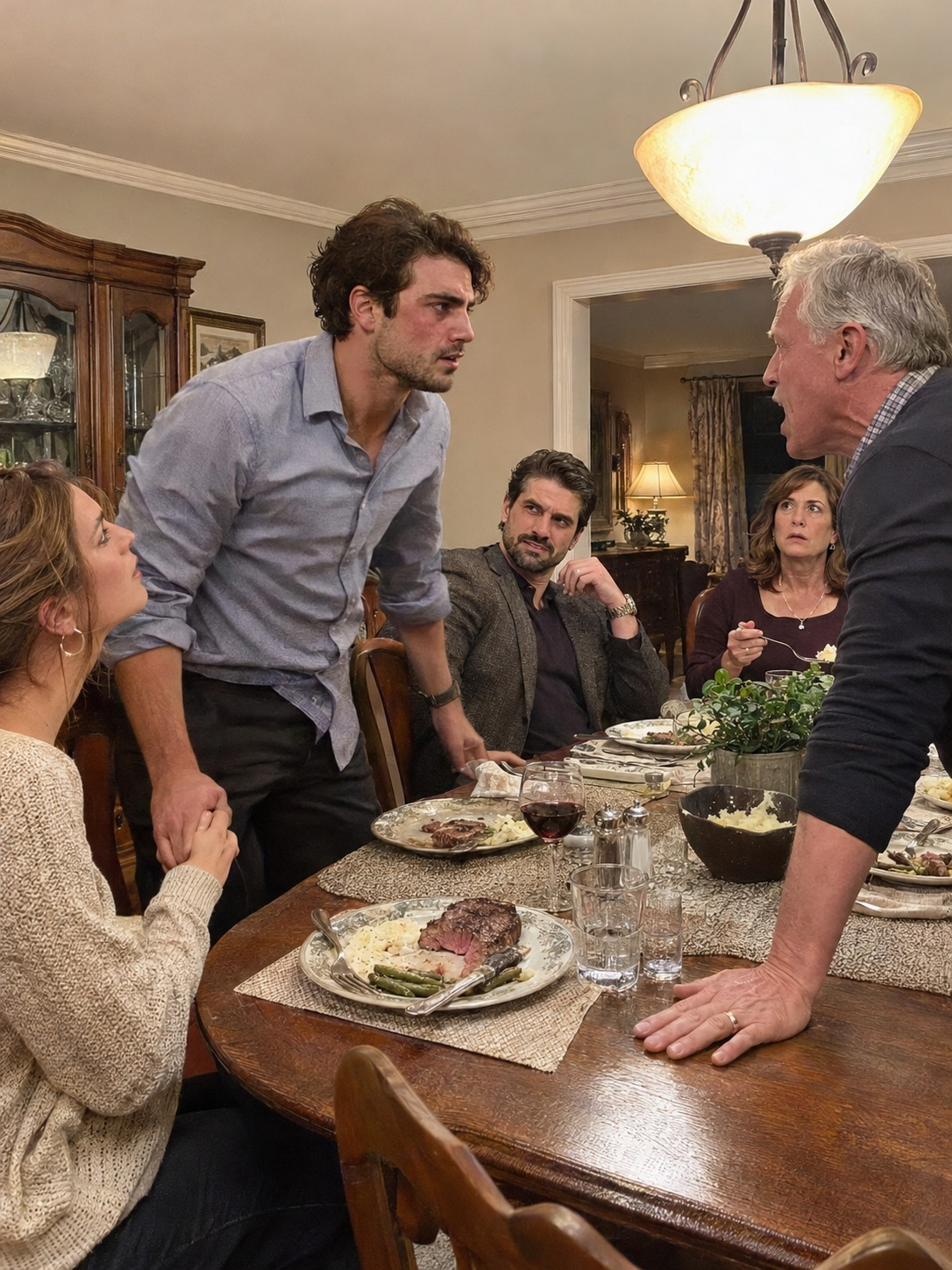
"Before this ownership distribution can be finalized, we need Isaac to confirm whether he personally signed away his original interest."
Patricia's words hung over the dining table.
Nobody reached for their food.
I looked at the document in front of her. My name appeared beneath a paragraph stating that I had voluntarily surrendered my original ownership rights in Dalton Construction.
The signature looked familiar.
The date was familiar too.
But I had never signed it.
"Can I see that?" I asked.
Patricia slid the document toward me.
I read the paragraph carefully.
It stated that I had reviewed the proposed succession arrangement, understood its financial implications, and agreed to relinquish any future claim to company ownership in exchange for continued employment.
There was another sentence near the bottom.
It said I had accepted that my responsibilities would remain administrative rather than executive.
I looked up.
"Who prepared this?"
Patricia glanced at my father.
"The document was submitted as part of the restructuring package."
"That's not what I asked."
She adjusted her glasses.
"It was prepared by the company's legal administration team."
"Who instructed them to prepare it?"
My father placed his napkin beside his plate.
"Isaac, we're not going to turn dinner into a courtroom."
I looked directly at him.
"Then don't ask me to confirm a document I never signed."
Omid leaned forward.
"Nobody is asking you to do anything complicated. It's just paperwork."
I turned toward him.
"Then you can sign it."
His expression changed.
"Why would I sign something with your name on it?"
"Exactly."
Jennifer remained beside me, her hand resting quietly against mine.
Mom looked between us.
"Please. We can discuss this without fighting."
I wanted to believe that.
But the discussion had already gone far beyond a family disagreement.
I had spent years assuming that the worst thing my family could do was underestimate my contribution.
Now I was looking at a document that could make it appear as though I had voluntarily surrendered the rights they were trying to take away.
I pushed the paper toward Patricia.
"I'm not confirming this."
She nodded.
"That's understandable. We can arrange an independent verification."
Dad immediately interrupted.
"There's no need to make this bigger than it is."
Patricia looked at him.
"Given the circumstances, I believe verification is appropriate."
For the first time that evening, my father seemed to realize that Patricia wasn't simply going to follow his instructions.
He leaned back.
"Fine. We'll deal with it next week."
Omid shook his head.
"Unbelievable."
I picked up my coat.
Jennifer stood beside me.
Mom reached toward my arm.
"Isaac, don't leave angry."
I looked at her.
"I'm not angry, Mom."
It was true.
I was disappointed, but the anger had begun to give way to something else.
I was finally seeing the situation clearly.
I had spent years trying to earn a position that my family seemed determined to redefine whenever I came close to receiving it.
I walked out with Jennifer.
Neither of us spoke until we reached the car.
Then she asked, "Are you going to keep working there?"
I started the engine.
"I don't know."
She nodded.
"That's an honest answer."
We drove home.
The next morning, Daniel called.
He had reviewed the ownership waiver and wanted to discuss several issues.
"Isaac, I don't want you to panic, but this document is important."
"Because of the signature?"
"Because of the language. It attempts to establish that you voluntarily surrendered an ownership interest and accepted a limited employment role."
"But I never agreed to that."
"Then we need to establish that formally."
He explained that the document should be examined alongside the original succession proposal, the valuation certificate, and the electronic submission records.
I agreed.
He also advised me not to sign the ten-percent offer.
"Once you sign an agreement acknowledging the proposed structure, you could create unnecessary complications."
"I wasn't planning to."
"Good."
After the call, I sat at my desk and opened my employment records.
I had worked at Dalton since I was thirteen.
My first official payroll entry showed me earning a modest hourly wage for organizing invoices and filing supplier receipts.
There were years of records after that.
My university internship agreements.
My engineering degree.
My employment contracts.
My salary adjustments.
My project responsibilities.
I had saved most of them.
I began assembling a chronological record of my work.
Not because I wanted to prove that I deserved more than Omid.
I wanted to establish what I had actually done.
That distinction mattered.
Over the next few days, Daniel helped me organize the relevant documents.
He also requested the original electronic signature metadata through the appropriate company channels.
Meanwhile, Dalton continued operating.
I still attended work.
I still reviewed invoices.
I still coordinated the courthouse project.
But something had changed.
I no longer accepted verbal instructions involving financial responsibility without written confirmation.
When Omid requested a report, I sent it through the official system.
When Dad asked me to review a purchase order, I documented my comments.
When an invoice contained a discrepancy, I recorded the reason it had been flagged.
Linda noticed.
One afternoon, she stopped by my desk.
"You're being very thorough lately."
I smiled faintly.
"Trying to keep things organized."
She looked toward Dad's office.
"There's been a lot of talk about the transition."
"I've noticed."
She lowered her voice.
"Some people think the changes are happening too quickly."
I looked at her.
"Who?"
She hesitated.
"Several department managers."
I nodded.
It wasn't surprising.
Dalton had doubled its revenue partly because its operational systems had become more reliable.
Changing leadership was one thing.
Changing the people responsible for maintaining those systems was another.
Later that afternoon, I received an email from one of the senior site supervisors.
He wanted to know whether Omid would be approving all future material orders.
I replied that the proposed management structure had not yet been finalized.
He called me immediately.
"Isaac, I need to know who to contact if there's a problem."
"Why?"
"Because the last time Omid approved an order without checking the specifications, we lost two days."
I understood his concern.
"I'll make sure the reporting process is clear."
He thanked me.
After the call, I stared at the company organizational chart.
My name still appeared beneath Omid's.
Operations and Financial Administration Associate.
I printed it.
Then I placed it beside the original governance report.
The contrast was difficult to ignore.
One document described me as essential to the company's operational continuity.
The other reduced my role to administrative support.
On Thursday, Dad called a management meeting.
He announced that the transition would proceed once the legal paperwork was complete.
Omid would become president.
He would oversee client relationships, executive decisions, and company expansion.
Dad would remain chairman.
My role would be limited to financial reporting and administrative coordination.
One of the department managers raised his hand.
"Who will approve major purchasing decisions?"
Omid answered immediately.
"I will."
The manager glanced toward me.
"And who will verify the costs?"
"Isaac will prepare the reports."
I looked at the table.
Another manager spoke.
"What happens if the reports identify a problem?"
Omid smiled.
"Then we'll discuss it."
Nobody seemed satisfied.
Dad brought the meeting to an end before anyone asked another question.
Afterward, he called me into his office.
"You're making people uncomfortable."
I looked at him.
"How?"
"You're encouraging them to question the transition."
"I'm answering questions about responsibilities."
"You're supposed to support your brother."
I took a breath.
"Supporting him doesn't mean pretending everything is ready."
Dad frowned.
"You think he can't do the job?"
I considered my answer.
"I think running Dalton requires more than meeting clients and signing contracts."
Dad looked away.
"You've always had a problem recognizing other people's strengths."
I almost laughed.
For years, I'd listened to him praise Omid's charisma while ignoring the work happening behind the scenes.
"Then give him the authority," I said. "But give him the responsibility too."
Dad stared at me.
"What does that mean?"
"It means if he approves an order, he owns the decision. If he changes a budget, he explains the change. If he signs a contract, he understands what we're committing to."
Dad shook his head.
"You've become very difficult to work with."
I stood.
"Maybe we've never had a clear agreement about what my work actually means."
I left.
That evening, Jennifer and I went out for dinner.
She asked how the meeting had gone.
I explained everything.
She listened, then said, "Have you thought about leaving?"
I looked at her.
"More than once."
"What's stopping you?"
I considered the question.
For years, my answer would have been the company.
The employees.
The projects.
My father's expectations.
The possibility that if I left, Dalton might struggle.
But there was another answer now.
Fear.
I was afraid of losing the only professional identity I'd built.
I had spent so much time becoming useful to my family that I wasn't sure who I would be without the company.
"I think I'm afraid of what happens afterward," I admitted.
Jennifer reached for my hand.
"That's normal."
"What if I leave and regret it?"
"Then you'll deal with that decision. But staying somewhere because you're afraid to leave isn't the same as choosing to stay."
I looked at her.
She smiled gently.
"You have an engineering degree, years of management experience, and people outside Dalton who respect your work. You're not starting from nothing."
I nodded.
For the first time, I allowed myself to consider a future that didn't involve my father's company.
The next morning, a former university professor called me.
He had heard about my work on the courthouse project and wanted to know whether I'd consider speaking with a regional engineering consultancy.
They were expanding their construction management division.
He believed my experience with cost control and project scheduling could be valuable.
I thanked him and asked for more information.
After the call, I sat quietly.
It was a strange feeling.
I had spent years waiting for my father to offer me an opportunity.
Now somebody outside the family was offering one without asking me to prove my loyalty first.
I arranged an introductory meeting for the following week.
I didn't tell Dad.
I wanted to understand my options before making any decisions.
Meanwhile, Daniel received the electronic records from Dalton.
He called me on Friday afternoon.
"Isaac, we've got something."
I closed my office door.
"What?"
"The signature on the waiver was generated through the company's shared administrative system."
"Can we identify who submitted it?"
"Not yet. The system records the originating account, but the detailed access history is incomplete."
"What about the date?"
"It was submitted on a day when you were attending your engineering examination."
I nodded.
"I can prove that."
"Good. Keep the university records."
He continued.
"There's another issue. The waiver references an attached acknowledgment document. That attachment isn't included in the file Dalton provided."
"Why?"
"They haven't located it."
I frowned.
"What does the acknowledgment say?"
"We don't know. But the waiver refers to it as evidence that you received the original succession proposal."
I sat down.
I had never received such a proposal.
Not once.
"Could it be a separate email?"
"Possibly. We're requesting the correspondence history."
I thanked him.
Before ending the call, Daniel gave me one more warning.
"Don't let your family pressure you into confirming anything informally. Even a casual statement can become part of a later dispute."
I promised I wouldn't.
That evening, Dad called.
He sounded unusually calm.
"I'd like you to come over tomorrow."
"Why?"
"We're having another family dinner."
I almost smiled.
"Another ownership discussion?"
"Your mother wants everyone together."
I hesitated.
"Will Patricia be there?"
"No."
"Will there be documents?"
"Not this time."
I looked at my calendar.
"I'll come."
On Saturday, I arrived with Jennifer.
Mom had prepared dinner, and Omid was already sitting at the table.
Dad greeted us.
For the first half hour, the conversation remained ordinary.
Then Omid began discussing the company.
He talked about expansion plans, new clients, and the possibility of opening another office.
Dad listened proudly.
Mom asked whether the new office would require additional employees.
Omid said he expected to hire a few people.
I asked who would manage the financial reporting.
He smiled.
"That's already taken care of."
I looked at him.
"By whom?"
"You, obviously."
I put down my glass.
"I haven't agreed to the new employment agreement."
Omid shrugged.
"Then we'll find somebody else."
Dad looked at him sharply.
"Omid."
"What? I'm just saying."
I turned toward my father.
"Have you finalized the ownership transfer?"
"Not yet."
"Why?"
He hesitated.
"There are some legal matters."
"Such as the waiver?"
His expression tightened.
"That matter is being handled."
I nodded.
Then Omid leaned forward.
"Look, Isaac. I don't understand why you're making this so complicated. Dad is giving you ten percent. You can stay, keep doing what you like, and still have a stake in the business."
I looked at him.
"You think ten percent is generous?"
He shrugged.
"It's more than most employees get."
I almost smiled.
"Most employees didn't spend fifteen years helping run the company."
Omid's expression hardened.
"Here we go."
I continued calmly.
"You want the title, the shares, and the house. You want me to remain responsible for the numbers while you control the decisions."
"That's not what I said."
"It's what the documents say."
Dad brought his hand down gently on the table.
"Enough."
Nobody spoke.
Then Mom looked at me.
"Your father is getting older. He wants to enjoy his retirement. Can't you make this easier for him?"
I looked at her.
"I've been making things easier for this family for years."
Her expression changed.
I didn't raise my voice.
I simply continued.
"I stayed when I had the chance to leave. I worked while I was studying. I fixed problems that weren't mine. I never asked Dad to give me the company. I wanted a fair place in it."
Mom looked down.
Omid pushed his plate away.
"Nobody forced you to stay."
I nodded slowly.
"You're right."
For the first time, I agreed with him.
Nobody had forced me to stay.
And nobody could force me to remain.
I looked at Jennifer.
She gave me a small nod.
I turned back to the table.
"I haven't made my final decision about Dalton."
Dad seemed relieved.
Then I added, "But I will not sign the ten-percent agreement or confirm that waiver."
His relief disappeared.
The dinner ended shortly afterward.
As Jennifer and I were leaving, Mom followed us to the doorway.
She took my hand.
"Please don't let this destroy your relationship with your father."
I looked at her.
"I don't want that, Mom."
She nodded.
"Then give him time."
I didn't answer.
Outside, Jennifer waited beside the car.
Before I could open the passenger door, my phone vibrated.
It was an email from Daniel.
The subject line read:
URGENT — ORIGINAL ACKNOWLEDGMENT RECOVERED.
I opened it.
There was one attachment.
A scanned document dated eleven months earlier.
It contained a statement confirming that I had received the original succession proposal and voluntarily declined an ownership interest.
But the signature at the bottom wasn't mine.
It belonged to someone who had been present at nearly every family discussion.
Someone who knew exactly what Dad wanted.
Someone who had access to the company's administrative records.
I zoomed in on the signature.
Then I read the name.
Jennifer Dalton.
My girlfriend's name.
And beneath it was a handwritten sentence:
Isaac understands and agrees that Omid is the appropriate successor.






Comments 0