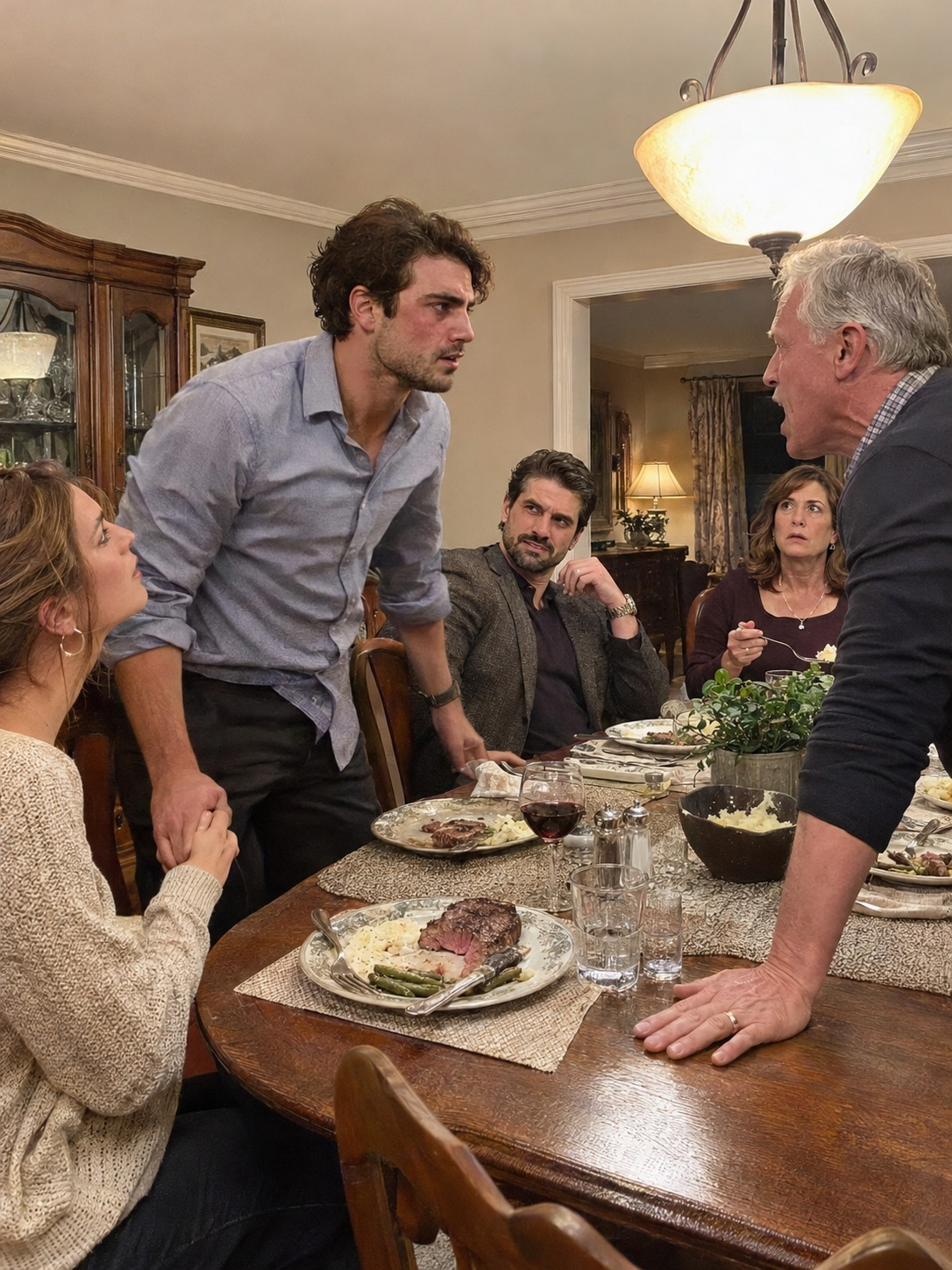
I read the signature three times.
Jennifer Dalton.
The name was unmistakable.
My girlfriend's name appeared beneath a statement claiming that I had voluntarily rejected my ownership interest in Dalton Construction and agreed that Omid was the appropriate successor.
For several seconds, I couldn't move.
Jennifer had been beside me through years of frustration with my family. She had watched my father praise Omid for work I had done. She had encouraged me to pursue opportunities outside the company. She had supported me when I finally refused to sign the ten-percent agreement.
And now her name was on a document that could explain how my ownership rights had disappeared.
I called Daniel.
He answered quickly.
"Did you open the attachment?"
"Yes."
"Have you spoken to Jennifer?"
"No."
"Don't make any accusations yet. We need to establish whether the document is authentic and what her signature represents."
I looked at the screen.
"She signed a statement saying I agreed to surrender my ownership."
"Does the document contain your signature?"
"No. Just hers."
"Then we need to know whether she signed as a witness, a representative, or someone claiming to have your authorization."
I swallowed.
"Can you investigate?"
"I can review the document and advise you on the appropriate steps. Send me the original file, including the email information."
I forwarded everything.
Then I called Jennifer.
She answered after two rings.
"Hey. Are you home?"
"Not yet. Why?"
"I need to ask you something."
Her voice changed.
"What's wrong?"
"Did you ever sign a document concerning Dalton's ownership restructuring?"
There was silence.
"What document?"
"An acknowledgment stating that I understood Omid was supposed to inherit the company."
Another pause.
"Isaac, where did you get that?"
I closed my eyes.
"Your signature is on it."
She didn't answer immediately.
Then she said, "Can we talk in person?"
"Yes."
"I'll come over."
The call ended.
I sat at the kitchen table.
I didn't want to believe what I was seeing.
But I also couldn't ignore it.
Twenty minutes later, Jennifer arrived.
She put her bag down and looked at me.
"Show me."
I turned my laptop toward her.
She read the document carefully.
Her expression changed.
"Oh, my God."
I watched her.
"Did you sign this?"
She didn't answer.
"Jennifer?"
She sat down.
"Yes."
The room seemed to become smaller.
I stared at her.
"Why?"
She pressed her hands together.
"It wasn't what you think."
I almost laughed.
"Then explain it."
She looked at the document again.
"Your father came to see me last year."
"When?"
"After the original succession discussions."
I remembered that period.
Dad had been increasingly concerned about retirement. Omid had started attending more management meetings. I had been working on the courthouse project.
"What did he tell you?"
"He said the family was trying to work out the future of Dalton. He told me there had been disagreements between you and Omid about leadership."
I shook my head.
"There were no ownership disagreements. I didn't even know there was an agreement."
"I know that now."
"Did he tell you I had rejected my ownership interest?"
Jennifer lowered her eyes.
"He said you had already discussed it with him."
I stood.
"And you believed him?"
She looked up.
"He showed me a document."
"What document?"
"The original succession proposal."
I stared at her.
"He showed you my ownership proposal?"
"Yes."
"And then?"
"He said you were uncomfortable accepting shares because you wanted to build your career independently. He told me you had agreed that Omid should lead the company."
I felt my jaw tighten.
"Why would I tell him that and not tell you?"
Jennifer looked down.
"I asked him the same thing."
"What did he say?"
"He said you didn't want to disappoint your mother by leaving the family business, but you also didn't want the responsibility of ownership."
I walked toward the window.
It was an extraordinary story.
And somehow, it had been presented as though it were a reasonable explanation.
"Did you speak to me about it?"
"No."
"Why not?"
She wiped her eyes.
"Your father said it was a sensitive family matter. He asked me to confirm that he had explained the situation to me and that I understood the proposed arrangement."
I turned around.
"That's not what the document says."
"I know."
"Then why did you sign it?"
She began crying.
"I thought I was helping you."
I stared at her.
"Helping me give away something I never knew I had?"
She covered her face.
"I didn't understand what he was doing."
I sat down.
For several seconds, neither of us spoke.
Then I asked the question that mattered most.
"Did Dad ask you to sign it?"
"Yes."
"Did Omid know?"
"I don't know."
"Did you receive anything in return?"
She looked at me immediately.
"No. Nothing. Isaac, I swear."
I believed that she hadn't received money.
But that didn't resolve the problem.
I pointed toward the document.
"Do you understand what this could mean?"
She nodded.
"Yes."
"Your signature is being used as evidence that I voluntarily surrendered my ownership rights."
"I never intended that."
"But that's what it says."
She started crying again.
I looked away.
I wasn't ready to comfort her.
Not because I wanted to punish her, but because I needed time to understand how someone who knew my situation so well could have made such a decision without asking me.
"Did you keep a copy?"
She nodded.
"I have the email."
I looked at her.
"From my father?"
"Yes."
"Can you send it to Daniel?"
She hesitated.
Then she nodded.
"Of course."
She opened her phone and began searching.
A few minutes later, she found the message.
The subject line read:
Dalton Family Succession — Confidential Confirmation.
The email was from my father.
It was dated eleven months earlier.
Jennifer forwarded it to Daniel.
Then she turned the laptop toward me.
"There's something else."
I leaned closer.
Dad's message contained three paragraphs.
The first explained that the family had reached an understanding about future leadership.
The second said I had agreed to support Omid's succession.
The third requested that Jennifer sign the acknowledgment to confirm that she had been informed of my decision.
There was one sentence that stood out.
Isaac has made it clear that he prefers to remain professionally involved without accepting the financial obligations or ownership responsibilities associated with the company.
I read it twice.
I had never said that.
In fact, I'd never been asked.
I looked at Jennifer.
"Did you question that statement?"
"Yes."
"What did he say?"
"He told me you had discussed it privately."
I closed the laptop.
"I need you to understand something."
She nodded.
"I never agreed to any of this."
"I know."
"Then you need to tell Daniel exactly what happened."
"I will."
"And if he needs you to provide a statement, you have to be completely honest."
She nodded again.
"I will."
I walked her to the door.
She stopped before leaving.
"Isaac, I love you."
I looked at her.
"I know."
She waited.
I didn't say anything else.
After she left, I called Daniel.
He had already received the email.
"Isaac, this changes the nature of the evidence."
"How?"
"Your girlfriend's statement appears to have been requested by your father. We need to establish whether she was asked to witness something she understood or whether she was given a misleading explanation."
"She says she didn't know what the document would be used for."
"Then she should explain that in her own words. Don't coach her. Don't tell her what to say."
I agreed.
Daniel continued.
"The important thing is that her signature does not automatically establish your consent. We need to examine the actual authorization requirements and the full sequence of documents."
I felt some relief.
Not much.
But enough to breathe.
The next day, Jennifer met Daniel independently.
She provided the original email, the acknowledgment document, and a written account of her conversation with my father.
She admitted signing the statement without speaking to me.
She also confirmed that Dad had described the document as a private acknowledgment rather than a legal waiver of my ownership rights.
Daniel thanked her and explained that the matter would need further examination.
When Jennifer returned, she called me.
"I told him everything."
"Thank you."
"Are you still angry?"
I looked at the documents on my desk.
"Yes."
She was quiet.
"But I don't think you intended to hurt me," I continued. "I just need to understand how you could make such a decision without asking me."
"I understand."
"I can't promise everything will go back to normal."
"I know."
We ended the call.
For the next few days, I concentrated on work.
I had no intention of allowing the ownership dispute to damage the courthouse project.
The city had recently requested an updated cost projection.
I completed it, checked the material schedules, and submitted the report.
The commissioner replied personally.
He thanked me for the accuracy of the numbers and asked whether I would be available for a meeting about another municipal development.
I accepted.
Then I received another email.
This one came from the regional engineering consultancy my former professor had mentioned.
They wanted to interview me for a senior construction operations position.
The salary was higher than my current compensation.
The role included responsibility for project scheduling, procurement oversight, cost management, and team leadership.
I read the description twice.
It sounded remarkably close to the work I had been doing at Dalton.
Except this time, the position came with clear authority.
I arranged an interview.
Meanwhile, Daniel continued examining the succession documents.
One afternoon, he called.
"We've identified a discrepancy."
"What kind?"
"The acknowledgment signed by Jennifer was submitted as supporting evidence for the ownership waiver. But the waiver itself was created earlier than the acknowledgment."
I frowned.
"How much earlier?"
"Approximately six weeks."
"So the waiver existed before she signed anything?"
"Correct."
"Then why was her signature added afterward?"
"That's what we're trying to establish."
I sat down.
Daniel continued.
"The timeline also shows that the valuation process began before the family meeting where your father announced Omid's succession."
I looked toward the window.
"So the outcome had already been planned."
"That is one possible interpretation. We need more evidence before reaching a conclusion."
I understood.
But the pattern was becoming difficult to ignore.
The waiver.
The valuation.
The ownership transfer.
The revised employment agreement.
All of them appeared to have been prepared before I was told what was happening.
I thanked Daniel.
Then I opened the original governance report again.
I wanted to understand what had changed between the first succession proposal and the later documents.
I compared the dates.
The original proposal had been prepared eleven months earlier.
The waiver appeared six weeks before Jennifer signed her acknowledgment.
The revised valuation had been commissioned shortly afterward.
Then the proposed ownership transfer had been accelerated.
I opened the vendor payment records.
Three payments had been made to the questionable supplier.
The parent company was connected to an old Dalton holding entity.
I checked the authorization history again.
Two payments had been approved by Omid.
One had been approved through Dad's executive account.
I didn't know whether those transactions were connected to the ownership dispute.
But I knew they needed to be reviewed.
I sent the information to Daniel.
He said he would advise me on how to raise the financial concerns appropriately.
The following Monday, I attended my interview.
The consultancy's managing director was a woman named Karen Mitchell.
She had reviewed my resume and several publicly available details about the courthouse project.
She asked me about the scheduling system I'd developed at Dalton.
I explained how I'd connected purchasing forecasts with actual site consumption.
She asked how I handled inaccurate supplier orders.
I told her about the steel beam problem.
She listened carefully.
Then she asked, "Why are you considering leaving your family's company?"
I took a moment.
"I've learned a great deal there. But I'm looking for a position where responsibility and authority are clearly defined."
She nodded.
"That's reasonable."
She asked about my experience managing teams.
I explained the projects I'd coordinated and the contractors I'd worked with.
At the end of the interview, she said she wanted to continue the conversation.
I thanked her.
On the drive back, I realized something important.
I hadn't once mentioned my father.
I hadn't needed to.
For the first time in years, someone was evaluating me based on my actual work.
That evening, Dad called.
"Where were you today?"
"At a meeting."
"What meeting?"
"Professional."
He paused.
"With whom?"
I wasn't going to lie.
"An engineering consultancy."
Silence.
Then he asked, "Are you looking for another job?"
"I'm considering my options."
His voice hardened.
"After everything I've done for you?"
I gripped the phone.
"Everything you've done for me?"
"I gave you a place in this company."
"You asked me to stay when Stanford offered me a scholarship."
"You chose to stay."
"Yes. I did. But that doesn't mean I agreed to surrender every opportunity afterward."
Dad exhaled sharply.
"Your brother needs this company."
"And I need a fair arrangement."
"You'll get ten percent."
"Not under an agreement that I never accepted."
He ended the call.
I sat quietly for a moment.
Then I opened my email.
There was a new message from Daniel.
He had received additional records from Dalton's legal department.
The message was short.
Isaac, we need to speak urgently. The ownership waiver was not merely an internal document. It was included in a formal filing connected to the proposed transfer.
I read the sentence twice.
Then I opened the attachment.
It contained the complete filing history.
The original waiver.
Jennifer's acknowledgment.
The valuation certificate.
And a final document I hadn't seen before.
It was a declaration stating that all family beneficiaries had been informed of the proposed succession arrangement and that no objections remained.
I scrolled to the signature page.
My father's name appeared first.
Omid's name appeared second.
Jennifer's name appeared beneath them.
Then I reached the final line.
It listed the person who had certified that all supporting signatures were genuine.
I leaned closer to the screen.
The certification had been submitted by the attorney responsible for Dalton's restructuring.
Patricia Wells.
But beneath her name was an additional handwritten note:
Supporting authorization personally confirmed by Robert Hayes.
My blood ran cold.
Robert had been the one who first warned me about the questionable ownership documents.
He had been helping me understand the original succession proposal.
And now his name appeared on a declaration connected to the very documents he had told me were suspicious.
I immediately called Daniel.
He answered.
"Isaac?"
I stared at the screen.
"Daniel, there's something you need to see."
"What is it?"
I read him the handwritten note.
He went silent.
Then he asked me to send the complete filing immediately.
I did.
A few minutes later, my phone vibrated again.
It was an incoming call from Robert Hayes.
I answered.
His voice was barely above a whisper.
"Isaac, before you do anything, there's something I should have told you about your father's original succession agreement."
I sat down.
"What?"
Robert paused.
Then he said:
"Your father wasn't the only person who had access to the original ownership documents. And the person who first authorized the changes was..."






Comments 0