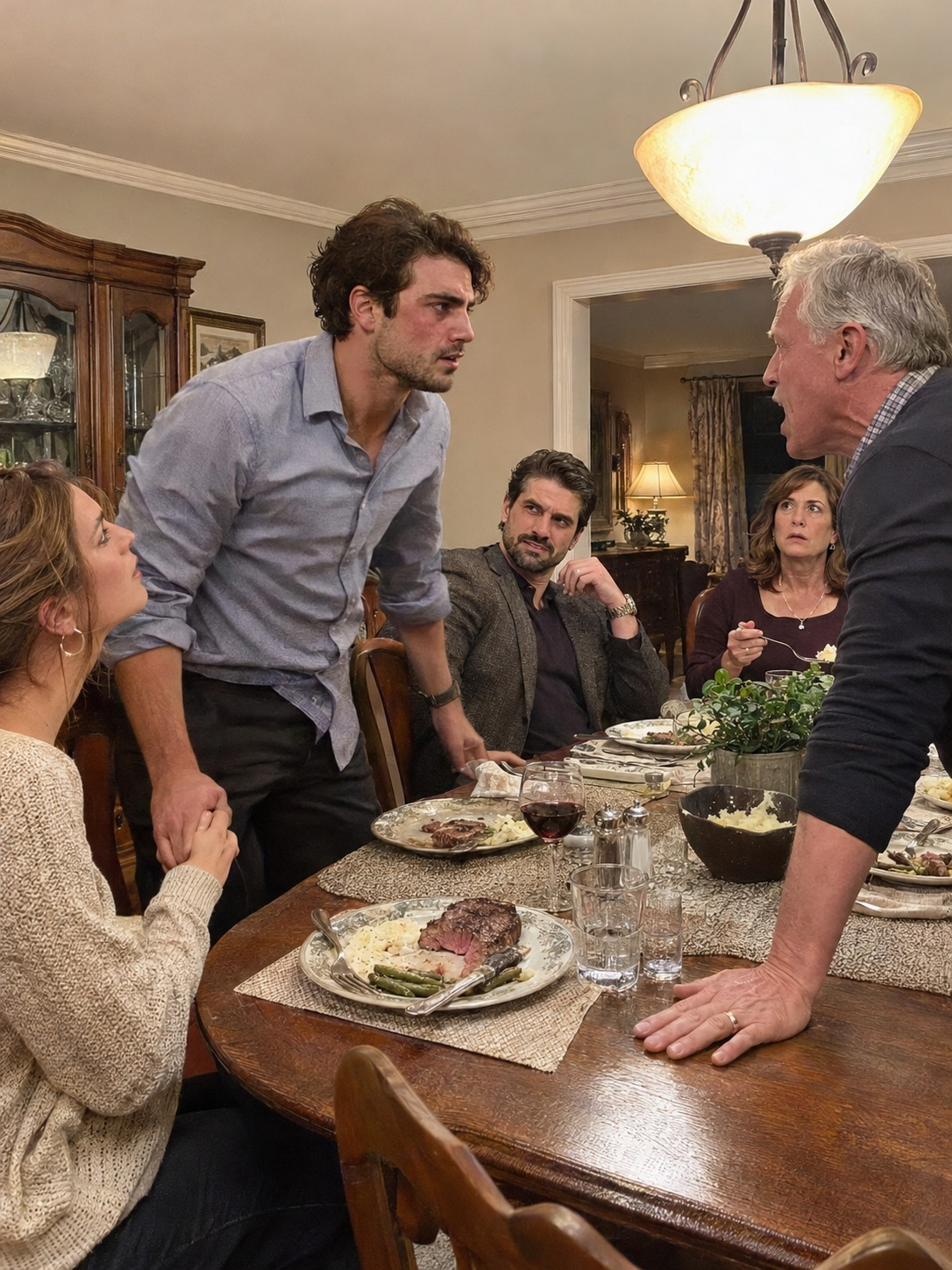
Someone knocked hard on my office door.
I turned away from the phone.
"Come in."
The door opened, and Linda stepped inside carrying a stack of documents.
"Isaac, your father wants to see you."
I glanced at the ownership schedule on my desk.
"Did he say why?"
She hesitated.
"He said it's about the management meeting."
I thanked her and waited until she left.
Then I returned to the phone.
"Robert, are you still there?"
"Yes."
"You said my name appears on the original ownership agreement. What does that mean?"
He exhaled slowly.
"It means you were included in the preliminary ownership structure when we conducted the review."
I looked at the document again.
"Included how?"
"That's something you need to see in writing. I don't want to give you an incomplete explanation over the phone."
"Can you send me a copy?"
"I'll check what records I'm legally permitted to provide. But Isaac, there's something important. The original proposal wasn't simply about transferring shares to your brother."
I waited.
"It involved recognizing the contributions of the people who had built the company."
I felt my throat tighten.
"Who was included?"
Robert didn't answer immediately.
Then he said, "You and your father."
The call ended a few minutes later.
I sat motionless.
For years, I'd assumed the ownership of Dalton was straightforward. Dad owned the company. Omid was the older son. I worked there because I was useful.
I had never imagined that somebody had formally considered my contribution significant enough to include in an ownership agreement.
I looked at the proposed transfer schedule.
Omid was supposed to receive majority ownership.
My name wasn't anywhere on it.
I folded the document and placed it inside my desk drawer.
Then I walked toward Dad's office.
He was waiting with Omid and a woman I recognized from the company's legal correspondence.
Her name was Patricia Wells.
She was a corporate attorney who had helped Dalton with contracts and business filings.
Dad gestured toward a chair.
"Sit down, Isaac."
I looked at Patricia.
"Good morning."
She nodded.
Dad closed the office door.
"We need to discuss the management transition."
I sat.
Omid leaned back, looking unusually relaxed.
Dad began explaining that the company was preparing for a new stage of growth.
He talked about retirement, executive responsibilities, and the importance of keeping Dalton within the family.
Then he announced that Omid would assume greater control over the company's operations.
I listened without interrupting.
Finally, I asked, "What happens to the ownership?"
Dad glanced at Patricia.
"We're still working through the details."
I looked at her.
"Is there an existing ownership agreement?"
She adjusted the folder in front of her.
"There are several historical documents."
"Does one include me?"
Dad's expression changed.
"Where did you hear that?"
I didn't answer immediately.
"Is there an agreement?"
Patricia looked toward my father.
Then she said, "There was a preliminary succession proposal prepared during the previous governance review."
"What did it say?"
Dad leaned forward.
"Isaac, that document was never finalized."
"Was my name included?"
Another silence.
Patricia opened her folder.
"Yes. You were included in the preliminary structure."
Omid sat upright.
"What?"
I looked at him.
He seemed genuinely surprised.
Dad interrupted.
"That was an early discussion. Nothing was approved."
I turned toward him.
"Why wasn't I told?"
"Because nothing had been decided."
"Then why is there a new ownership schedule transferring everything to Omid?"
Omid looked at Dad.
"Where did you see that?"
I kept my expression neutral.
"I've seen enough to know there's a proposed transfer."
Dad's face tightened.
"That document was confidential."
"So was the original agreement, apparently."
Patricia closed her folder.
"Perhaps we should clarify the legal position before discussing individual expectations."
I nodded.
"That's exactly what I'd like."
Dad stood.
"This meeting isn't about reopening old paperwork."
I looked at him.
"Then what is it about?"
He didn't answer.
Omid finally spoke.
"Look, Isaac. Nobody is trying to take anything away from you."
I turned toward him.
"Then why am I being excluded from the ownership discussion?"
He shrugged.
"Because Dad is making the decision."
I looked at my father.
He said nothing.
Patricia eventually suggested that the meeting be postponed until the ownership records had been reviewed.
Dad reluctantly agreed.
I returned to my desk.
For the rest of the afternoon, I struggled to concentrate.
The original agreement changed everything.
Not because it guaranteed me anything.
Robert had been careful to explain that it was preliminary.
But it meant that my contribution had been formally recognized at some point.
Someone had considered giving me an ownership interest.
And now that possibility seemed to have disappeared.
I called Jennifer.
"Can you meet me tonight?"
"Of course. What's happened?"
"I found out there was an original succession proposal."
She paused.
"What kind of proposal?"
"One that included me in the ownership structure."
"Did you know about it before?"
"No."
"Does your father?"
"He knows."
"And your brother?"
"He apparently didn't know either."
Jennifer was quiet for a moment.
"Come over. We'll talk."
That evening, I showed her the ownership schedule and explained what Robert had told me.
She examined the document carefully.
"Does this transfer already have legal approval?"
"I don't know."
"Has anybody independently valued the company?"
"Not that I'm aware of."
She put the papers down.
"Then why are they rushing?"
I looked at the table.
"I think Dad wants the transition completed before anyone questions the structure."
Jennifer studied me.
"Are you going to let that happen?"
"No."
It was the first time I'd said it without hesitation.
The following morning, I contacted Robert again.
He told me he'd located a copy of the original governance report and was checking what information he could share.
He also suggested that I consult an independent attorney.
I contacted a lawyer named Daniel Brooks, whose practice focused on business disputes and corporate governance.
I explained that I was an employee of a family construction company and had discovered conflicting ownership documents.
He agreed to meet.
During the consultation, I brought copies of the records I had lawfully obtained.
Daniel reviewed them carefully.
He asked about my employment history, responsibilities, and whether I had signed any shareholder agreements.
I told him I hadn't.
He explained that a preliminary succession proposal did not automatically create ownership rights.
But he also emphasized that the proposed transfer should be examined before anyone relied on it.
"Don't assume the document is valid," he said. "And don't assume it is harmless."
I nodded.
"What should I do?"
"Preserve everything. Don't alter company records. Don't access anything you're not authorized to see. And don't sign a new agreement without independent legal advice."
I thanked him.
Before leaving, I asked whether I could be held responsible for documents carrying my approval.
He looked at the unauthorized signature records.
"That's why these records matter. You need to establish exactly what you approved and what you didn't."
I left his office feeling more focused.
For the first time, I had a plan that didn't involve arguing with my father.
I would protect my professional reputation.
I would preserve the records.
And I would make sure nobody could use my name to justify decisions I hadn't made.
At Dalton, things continued as usual.
Omid attended client meetings.
Dad handled executive decisions.
I managed the operational details.
But the atmosphere had changed.
My father no longer discussed the ownership restructuring in front of me.
Omid became increasingly interested in who had access to financial reports.
He began asking Linda to send certain documents directly to him.
Sometimes he requested information I had already prepared.
Other times, he asked for reports that had never been part of his responsibilities.
I noticed that he had started arriving earlier.
He also began attending accounting meetings.
One afternoon, I found him sitting in Linda's office.
They were looking at a spreadsheet.
When I entered, he closed the laptop.
"What's going on?"
"Just reviewing some figures," he said.
"Which figures?"
"Company-wide financials."
I looked at Linda.
She seemed uncomfortable.
"Did Dad request this?"
Omid stood.
"Do you need to approve every conversation I have?"
"No."
"Then stop acting like you do."
He walked past me.
Linda waited until he was gone.
Then she spoke quietly.
"He's requested all outstanding supplier balances."
"Why?"
"He said he's preparing for the transition."
I nodded.
"Did he request the historical payment records too?"
"Yes."
I looked at her.
"Send me a copy of the request."
She hesitated.
"Should I?"
"Yes. I want the documentation."
That evening, I went through my old records.
I found the original courthouse proposal, the steel replacement correspondence, the disputed budget, and the unauthorized approval report.
I arranged everything chronologically.
Then I created a separate folder for the vendor transfers.
I wasn't sure what I would eventually need.
But I wanted a complete record of what had happened.
The next day, Dad called me into his office.
He was holding a printed organizational chart.
"I've been reviewing the management structure."
I sat down.
"Okay."
"Omid will be taking on more executive responsibility."
I nodded.
"I understand."
"You'll continue overseeing financial administration."
"Will my title change?"
He looked at the chart.
"We can discuss that later."
I waited.
Then he said, "There's another matter."
He placed a document in front of me.
It was an updated employment agreement.
I read the first page.
The title was Operations and Financial Administration Associate.
The responsibilities included maintaining company records, coordinating project budgets, preparing financial reports, and supporting executive management.
I turned to the compensation section.
My salary would remain unchanged.
I turned another page.
There was a new clause.
All financial reports prepared by my department would be subject to final executive approval.
The executive approver was Omid.
I looked up.
"Why is this being changed?"
Dad folded his hands.
"Because the company needs a clear reporting structure."
"So I'll prepare the numbers, but Omid will control the approvals."
"That's right."
"What happens if I disagree with an approval?"
"Then you discuss it with him."
I read the clause again.
It would effectively remove my authority to stop a financial report from being submitted, even if I believed the figures were incorrect.
I placed the document down.
"I need time to review this."
Dad frowned.
"It's a standard agreement."
"Then there shouldn't be a problem with me having my attorney review it."
His expression hardened.
"Your attorney?"
"Yes."
"Since when do you need an attorney to read an employment agreement?"
"Since it changes my responsibilities."
He leaned back.
"You're making this unnecessarily complicated."
I stood.
"I'll get back to you."
As I reached the door, he spoke again.
"Isaac, don't let outsiders convince you that your family is your enemy."
I turned.
"I'm not doing that."
"Then sign the agreement."
I looked at him.
"Not until I understand it."
I left.
That evening, Jennifer read the agreement with me.
She wasn't a lawyer, but she understood the difference between responsibility and authority.
"They want you accountable for the records while taking away your ability to control the approval process."
"That's how it reads."
"Are you going to sign it?"
"No."
She nodded.
"Good."
I contacted Daniel and sent him a copy.
He advised me not to sign until he had reviewed the full agreement.
The following morning, I received his response.
He had identified several provisions that needed clarification.
One concerned the transfer of responsibility for historical financial records.
Another concerned the use of employee credentials.
The final provision involved my right to challenge inaccurate executive approvals.
Daniel wanted me to request written clarification before agreeing to anything.
I forwarded his comments to Dad.
He didn't respond.
Instead, Omid called me into his office that afternoon.
He was sitting behind Dad's old conference desk.
"Sit down."
I remained standing.
"What do you need?"
He pointed toward the employment agreement.
"Why are you refusing to sign?"
"Because it changes my responsibilities."
"It clarifies them."
"It removes my approval authority."
He shrugged.
"That's because I'll be running the company."
I looked at him.
"Then you'll also be responsible for the decisions you make."
He smiled.
"Obviously."
"Good. Then the agreement should say that."
His expression changed.
"You're becoming difficult."
I said nothing.
Omid stood and walked around the desk.
"Listen, Isaac. Dad has made his decision. You can either accept the new structure or find something else to do."
I looked at him.
"Is that what you want?"
He shrugged.
"I want the company to move forward."
I nodded.
"Then we agree on something."
I turned toward the door.
Behind me, he said, "One more thing."
I stopped.
"Don't expect to be included in the ownership announcement."
I slowly turned around.
"What announcement?"
He smiled.
"The family meeting. Dad's telling everyone the final decision this weekend."
My stomach tightened.
"Has the transfer been approved?"
Omid picked up his phone.
"Everything is ready."
I left without answering.
I called Daniel from the parking lot.
He told me to send him the latest information immediately.
Then I called Robert.
He answered on the second ring.
"Isaac, I've found the original agreement."
I gripped the steering wheel.
"What does it say?"
He paused.
"The preliminary ownership schedule included a specific percentage for you, but there's something more important."
"What?"
"The document contains a condition that was never disclosed to you."
I stared through the windshield.
"What condition?"
Robert lowered his voice.
"Your father's succession plan was contingent on one thing: the company's independent valuation had to be completed before any majority-share transfer."
I swallowed.
"Was it completed?"
"No."
"Then how can Omid receive the shares?"
Robert was silent for several seconds.
Then he said, "That's why I'm calling you. Someone submitted a valuation certificate yesterday."
I felt my chest tighten.
"Who signed it?"
Robert read the name.
And it wasn't my father.
It was mine.






Comments 0