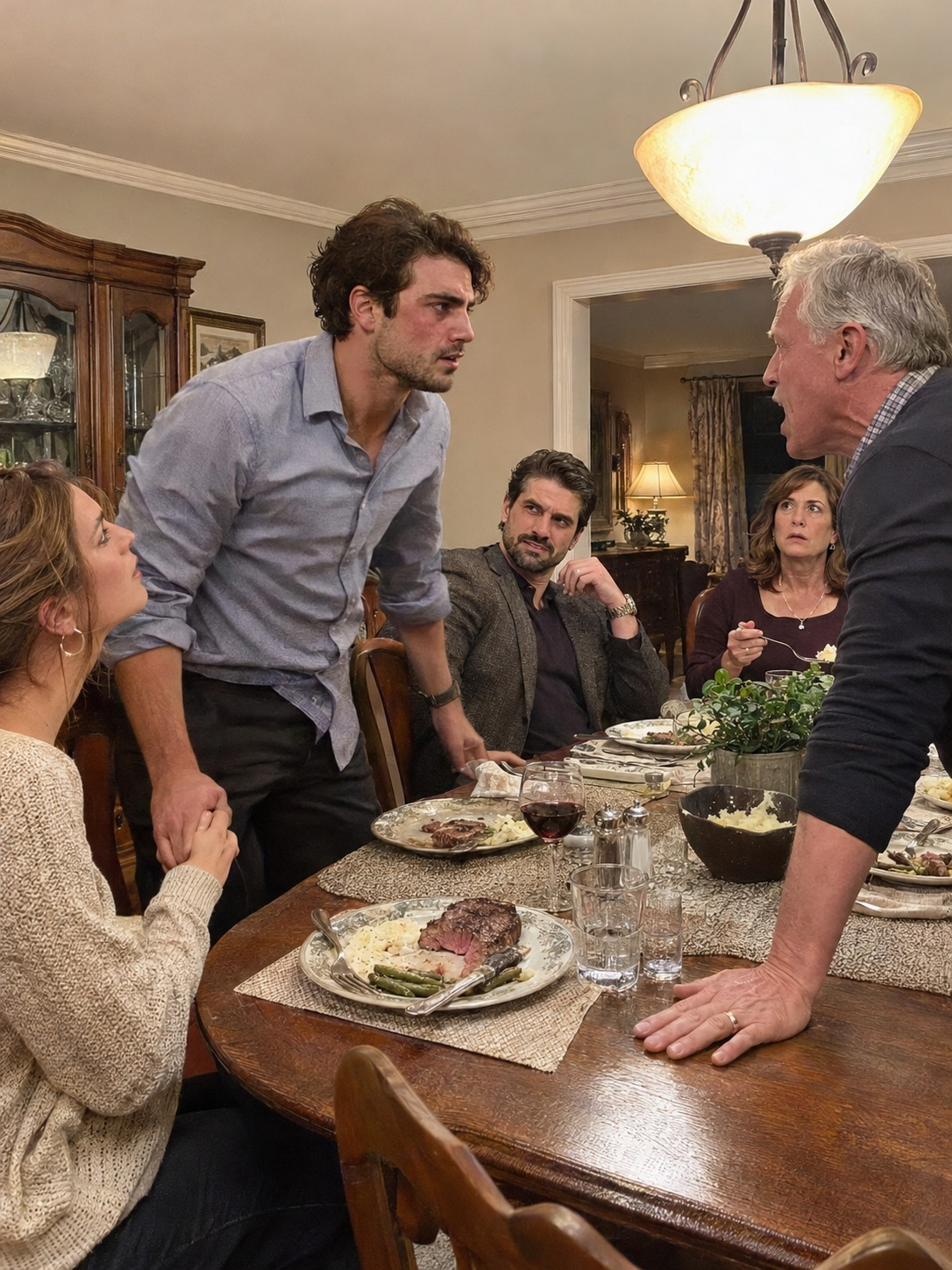
I slid the Stanford scholarship letter across my parents' dinner table.
"You're not going to California. Dalton needs you here," my father said.
He placed his fork beside the letter without even opening it.
The scholarship offer was worth more than my parents had spent on my entire education.
And my father had already decided what I would do with my life.
I was eighteen years old when I learned that being needed by your family and being supported by your family could mean two very different things.
At the time, I didn't understand the distinction.
I thought my father was worried about losing me. I thought he was looking at the company he'd spent decades building and seeing a future that required all of us to work together.
I even felt a little proud that he trusted me enough to ask.
That was before I understood that he wasn't asking.
He was making plans.
My mother sat across from me, carefully cutting a piece of steak. She glanced at the letter, then at Dad.
"How far is Stanford from here?" she asked.
"California," I said. "About two thousand miles."
She nodded slowly.
"That's a long way."
My older brother, Omid, sat to Dad's right. He was twenty-one, three years older than me, and had already left community college after one semester.
He didn't seem particularly interested in the conversation.
He took a long drink of milk, placed the glass down, and continued eating.
Dad leaned back.
"Look, Isaac. Nobody's saying Stanford isn't a good school. It's a great school. But we've got things happening here."
He started talking about Dalton Construction.
The company had grown steadily over the previous decade. Dad had started with a small crew, a used truck, and a handful of residential renovation contracts. By the time I was eighteen, Dalton had commercial clients, municipal bids, and enough employees that the office was rarely quiet.
I knew those numbers better than anyone.
I'd been working Saturdays since I was thirteen.
At first, Dad had me sweep the office, organize receipts, and carry folders between departments. Later, he let me help with invoices.
I discovered that I enjoyed the work.
There was something satisfying about finding a mistake in a complicated spreadsheet and tracing it back to the original order. I liked understanding why one project was making money while another was losing it.
Construction was physical work, but running a construction company required a different kind of discipline.
A crew could build a perfect wall and still lose money if someone ordered the wrong materials.
A project could look profitable on paper and become a disaster because the delivery schedule was wrong.
Dad understood construction.
I understood the numbers behind it.
By my senior year, I had started building spreadsheets to track materials, labor costs, supplier invoices, and delivery schedules.
Dad liked showing them to visitors.
He'd point at my computer and say, "This boy has a head for numbers."
I used to smile whenever he said it.
That evening, however, the compliment sounded different.
"I need somebody who understands the office," Dad continued. "Someone I can trust."
I looked at him.
"Can't somebody else learn?"
He frowned slightly.
"Of course somebody else could learn. But why would I spend years training somebody when I've already got you?"
I didn't answer.
Mom stopped cutting her steak.
"How often do you think you'd be able to come home?" she asked.
I explained that Stanford had a demanding academic schedule, but there would be holidays and breaks. I could visit during the summer.
Before I finished, she turned toward Dad.
"What are you supposed to do without him?"
Dad shrugged.
"Exactly."
I looked down at my plate.
Omid finally joined the conversation.
"Well, it's his decision."
He said it casually, without looking up.
It was an interesting comment coming from someone who had never seemed particularly concerned about his own future.
He had tried community college, decided it wasn't for him, and spent the following months helping Dad with occasional jobs.
Sometimes he'd go out to inspect a site.
Sometimes he'd make calls to clients.
Mostly, he came and went whenever he felt like it.
Nobody asked him to sacrifice anything.
Nobody told him the company couldn't survive without him.
I looked at my father again.
"What if I really want to go?"
He folded his napkin.
"Then we'll have to talk about what that means for the family."
There it was.
Not what it meant for my education.
Not what it meant for my career.
What it meant for the family.
I glanced at the scholarship letter.
Stanford had offered me a full engineering scholarship. It covered tuition and included additional academic support. I'd worked hard for it, taken the necessary exams, submitted applications, and spent months waiting for a decision.
When the acceptance email arrived, I'd read it three times before telling anyone.
I had imagined showing Dad the letter.
I'd imagined him asking about the engineering program, maybe calling one of his friends to tell them his youngest son had been accepted to Stanford.
Instead, he was calculating how difficult it would be to replace me in the office.
"I'll think about it," I finally said.
Dad's shoulders relaxed.
"Good. That's all I'm asking."
But he wasn't asking.
I understood that much, even if I couldn't yet explain it.
The next week, I visited the school counselor.
She congratulated me again and asked whether I'd made a final decision.
I told her about the conversation with my parents.
She listened without interrupting.
Then she asked one question.
"Isaac, if Dalton Construction didn't belong to your family, would you still turn down Stanford?"
I stared at the floor.
"No."
She nodded.
"Then make sure you're choosing your future, not just responding to somebody else's expectations."
I carried that sentence around for several days.
At home, Dad continued talking about the company's expansion. He showed me upcoming projects and explained that he wanted to reorganize the office.
He mentioned that Omid might eventually take on more responsibility.
I noticed something strange.
Dad was talking about giving Omid opportunities while asking me to stay because he couldn't afford to lose my skills.
I didn't know what to make of it.
A few nights later, Jennifer wasn't in my life yet, and I had nobody outside my family to discuss these things with.
I sat at my desk and opened the Stanford acceptance letter.
The scholarship details were printed beneath the university logo.
I read them slowly.
Then I opened the application portal and looked at the deadline for accepting the offer.
There were still several days left.
I could go.
I could leave Fairfield, study engineering, meet people who cared about the same things I did, and build a future that wasn't already mapped out.
But there was another part of me that wanted to prove something.
I wanted to see whether I could help make Dalton into a genuinely successful company.
I wanted to understand every part of the business, from the first client meeting to the final payment.
I wanted to be good enough that nobody could dismiss what I contributed.
That was the decision that eventually shaped the next decade of my life.
I didn't reject Stanford because I believed my father owned my future.
I rejected it because I thought I could build something meaningful at home while earning a degree.
A week after the dinner, I called my parents into the kitchen.
"I've made my decision," I said.
Dad looked up from his coffee.
"All right."
"I'm staying in Ohio. I've accepted the scholarship at Miami University."
For a moment, nobody spoke.
Then Dad smiled.
"That's the right choice, son."
He stood and put his hand on my shoulder.
Mom looked relieved.
Omid walked into the kitchen, opened the refrigerator, and asked what was going on.
Dad told him.
"Good," Omid said. "We need all the help we can get."
He grabbed a bottle of water and left.
Dad kept his hand on my shoulder.
"You'll have plenty of opportunities here, Isaac. Trust me."
I believed him.
I believed that hard work would eventually translate into responsibility.
I believed that if I helped the company grow, there would eventually be a place for me at the top.
And I believed that my father would remember who had done the work.
For the next several years, I would make sure he never had a reason to question my value.
I enrolled at Miami University and studied engineering while continuing to work at Dalton.
My weekdays were divided between lectures, assignments, and long hours in the office.
My weekends were often spent reviewing purchase orders or visiting construction sites.
Sometimes I arrived home after midnight.
Dad would occasionally call to ask whether I'd finished a spreadsheet.
I rarely said no.
At first, the arrangement seemed fair.
I was gaining experience, earning my degree, and learning how to operate a business from someone who had built one.
But there was something I hadn't considered.
A family business can make ordinary workplace boundaries difficult to recognize.
When Dad needed something, it wasn't always a professional request.
It was a family obligation.
When Omid missed something, it was a mistake.
When I missed something, it became a problem everyone expected me to solve.
And when the company succeeded, the credit rarely traveled in the same direction as the responsibility.
I wouldn't understand that pattern until much later.
For now, I was still the eighteen-year-old who believed that being indispensable was the safest way to earn a place in his father's world.
I had no idea how expensive that belief would become.
The first warning came during my second year at Miami University.
I was reviewing a municipal project proposal when Dad walked into my office carrying a folder.
He placed it on my desk.
"Isaac, I want you to look at something."
I opened the folder.
It contained a preliminary contract for a city construction project.
The figures were incomplete, the labor schedule was unrealistic, and several material costs were missing.
I looked up.
"Who prepared this?"
Dad hesitated.
"Omid."
I turned another page.
There was a handwritten note in the margin.
It contained a supplier estimate that didn't match the attached quotation.
I checked the date.
Then I checked the signature.
My brother had already sent the proposal to the client.
I slowly closed the folder.
"Dad, this can't go out."
He looked at me.
"Why?"
I turned the folder around and pointed to the first page.
"Because the numbers don't work."
Dad stared at the document.
Then he said something that I would remember for years.
"Well, that's why I've got you."
He walked away before I could answer.
I looked at the folder again.
And for the first time, I wondered whether my father was teaching my brother to run the company or teaching me to clean up after him.
Then my office phone rang.
It was the city commissioner.
And he wanted to speak to the person who had prepared the proposal.
PART 1 COMPLETE — Chapter 1 of 15. The story will continue chronologically from the commissioner's phone call, preserving the original characters, relationships, events, and eventual happy ending.






Comments 0