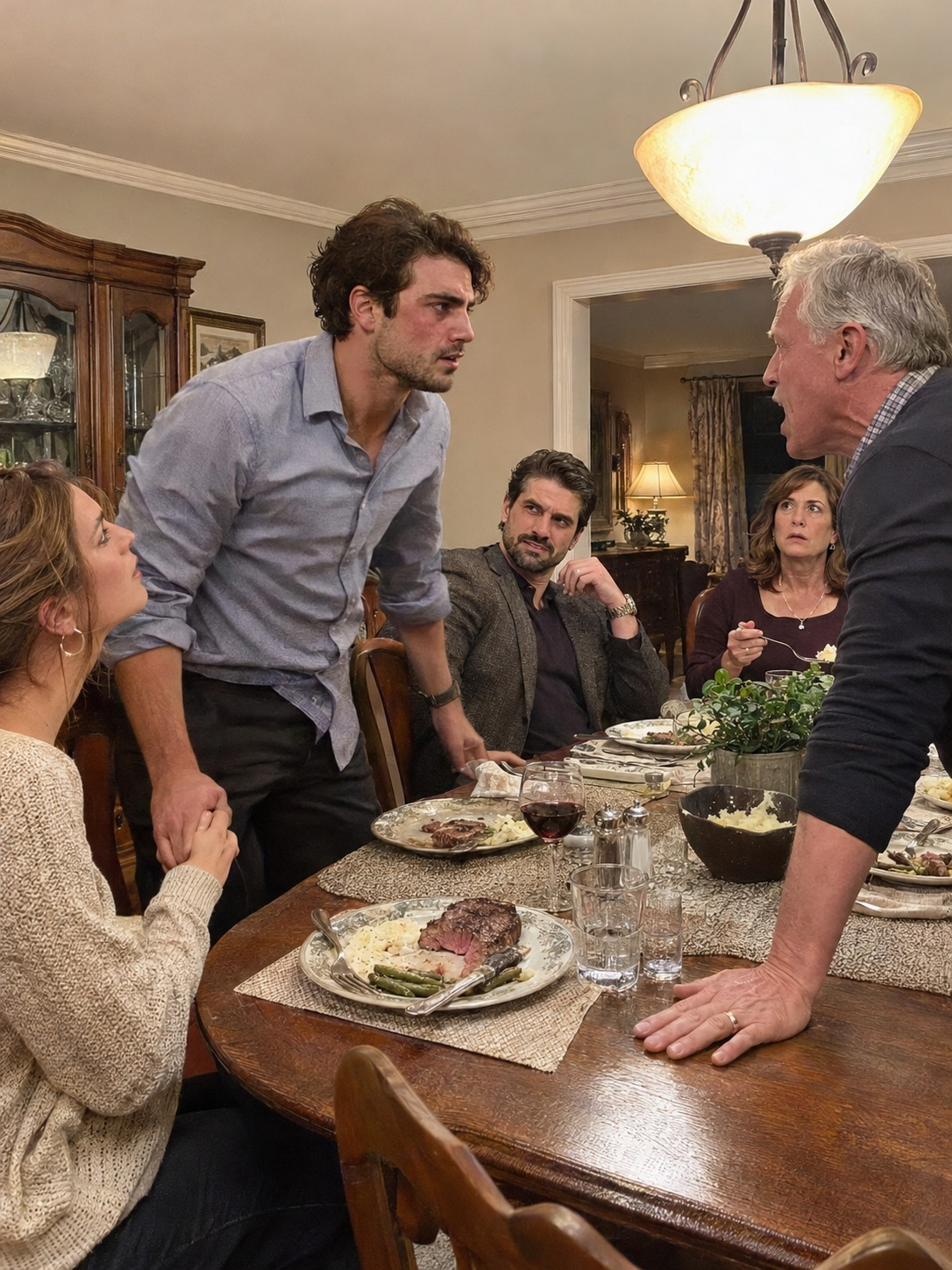
"Mr. Dalton, I think it's time you told this board exactly what you intended to do with the company's assets."
Omid remained standing.
His attorney leaned toward him and whispered something, but my brother barely seemed to hear.
Dad stared at the presentation screen.
The email was still visible.
Once the assets are moved out of the operating company, Isaac's objections will no longer matter because he won't have any ownership rights left to challenge the transaction.
I had read the sentence several times.
Each time, it became harder to believe that the person who wrote it was my brother.
The chairman repeated his question.
Omid finally sat down.
"The email doesn't explain the entire arrangement."
"Then explain it," the chairman replied.
Omid rubbed his forehead.
"The intention was to separate certain assets from the operating company. It was a restructuring proposal."
"Why was it connected to the disputed ownership waiver?"
"It wasn't supposed to be."
Patricia opened another document.
"Your email specifically references Isaac's ownership rights."
Omid looked toward Dad.
My father remained silent.
The chairman turned to him.
"Mr. Dalton, did you authorize this restructuring?"
Dad took a long breath.
"I approved an initial discussion about asset protection. I did not approve transferring company property without proper authorization."
"Did you know your son was communicating with the vendor?"
"I knew he was exploring options."
"Did you know about the payments?"
Dad hesitated.
"I knew certain expenses had been incurred."
The chairman looked at the accounting representative.
"Are those expenses supported by legitimate business records?"
"Not completely."
Nobody spoke.
I sat with my hands folded.
For years, I'd imagined what it would feel like if my father finally had to acknowledge the difference between my work and Omid's.
I thought I would feel vindicated.
Instead, I felt exhausted.
The chairman announced that the board would suspend all proposed asset transfers and restrict further financial approvals connected to the disputed transactions.
He also requested that the independent review continue.
Omid's attorney asked for a recess.
The meeting was paused.
As the directors left, my brother approached me.
"Are you happy now?"
I looked at him.
"No."
"You got what you wanted."
"What did I want, Omid?"
He shook his head.
"You wanted Dad to choose you."
I almost laughed.
"That's what you think this is about?"
"Isn't it?"
I stared at him.
"I wanted the truth. I wanted the company to be run properly. I wanted the work I did to mean something."
He looked away.
"You always thought you were better than me."
"No. I thought you could do better than this."
His face tightened.
For a moment, I thought he might say something honest.
Instead, he walked away.
Dad approached a few minutes later.
"Isaac, come with me."
I followed him into a small conference room.
He closed the door.
Then he sat down and looked at his hands.
"I never thought things would get this bad."
I remained standing.
"How did you think they would end?"
He looked up.
"I thought Omid would take over, you'd continue handling the financial side, and eventually everyone would adjust."
"To what?"
"To the new arrangement."
I shook my head.
"You never asked whether I wanted it."
"You never told me you wanted the company."
I stared at him.
"I told you what I wanted for years. I wanted responsibility. I wanted to build something. I wanted to be recognized for the work I was doing."
Dad lowered his eyes.
"I thought you understood."
"No, Dad. I understood that you needed me. I didn't understand that you thought needing me meant you could decide everything for me."
He remained silent.
I sat opposite him.
"Did you know about the false waiver?"
He looked down.
"I knew a waiver had been prepared."
"Did you know my signature wasn't genuine?"
"I knew you hadn't personally signed the version I saw."
My chest tightened.
"Then why did you allow it to be submitted?"
He took a long breath.
"I believed the family agreement could be completed afterward."
I stared at him.
"You allowed a document to say I'd surrendered my rights because you thought I would eventually agree?"
He nodded slightly.
I couldn't find words.
Finally, I stood.
"That's not how consent works."
Dad looked up.
"I know."
For the first time, he didn't argue.
He didn't mention family.
He didn't tell me that Omid needed the security more than I did.
He simply sat there.
And somehow, that made everything worse.
The independent review continued over the following weeks.
The accounting firm examined the three payments, the vendor relationships, and the supporting purchase orders.
They also compared the original valuation with the revised financial projections.
The findings were serious.
The first payment had been recorded as a deposit for equipment that was never delivered.
The second had been classified as consulting services without sufficient evidence that the work had been completed.
The third had been associated with a project that lacked proper approval.
The reviewers also found that the revised valuation excluded certain liabilities and used assumptions that overstated the company's financial position.
None of those findings automatically established criminal wrongdoing.
But together, they showed that the proposed restructuring could not safely proceed on the documents originally submitted.
The board retained independent legal and accounting advisers.
The disputed ownership waiver was excluded from the verified succession records.
Jennifer provided a written statement confirming that she had signed the acknowledgment after my father described it as a harmless confirmation of an agreement I had supposedly already accepted.
She admitted she had never spoken to me before signing.
Daniel submitted that statement alongside the original email and the relevant document history.
The board accepted that her acknowledgment could not establish my consent.
Robert also provided his original correspondence.
His earlier certification had been misrepresented in the later filing.
He formally clarified that he had never authenticated my signature or approved the ownership waiver.
For the first time, the documents were being examined in their actual chronological order.
And the story they told was very different from the one Dad had presented at dinner.
One afternoon, Patricia called me.
"The board would like to meet with you."
"About what?"
"Your position in the company and the original succession proposal."
I agreed.
The meeting took place the following Tuesday.
The chairman, Patricia, two independent directors, and the accounting representative attended.
Dad was invited but did not participate in the discussion about my individual employment position.
The chairman began by acknowledging that the company had failed to handle the succession process properly.
He explained that the original proposal had identified me as a significant beneficiary because of my operational responsibilities and long-term contribution.
The later documents had changed that arrangement without verified approval.
"We want to understand what you would consider an appropriate resolution," he said.
I looked at him.
"First, I want the disputed waiver formally withdrawn."
He nodded.
"That's reasonable."
"Second, I want the ownership records corrected so they don't suggest I voluntarily surrendered anything."
Patricia wrote that down.
"Third, I want the independent review completed before any new ownership proposal is considered."
The chairman nodded again.
"Agreed."
I paused.
"And I want to be clear about something else. I'm not asking to become president."
One of the directors looked surprised.
"You're not interested in leading the company?"
"I've spent years leading the work that kept it operating. I don't need a title to prove that."
I explained that I wanted any future arrangement to distinguish between ownership, executive authority, and operational responsibility.
The company needed qualified leadership.
It also needed clear accountability.
If Omid wanted to lead Dalton, he would need to demonstrate that he could manage its financial obligations and operational systems.
If I remained involved, I wanted a defined position with genuine authority.
The chairman listened carefully.
Then he asked, "Would you consider continuing with Dalton under a corrected agreement?"
I thought about Karen Mitchell's offer.
I thought about the years I'd spent trying to earn my father's approval.
Then I answered honestly.
"I'm considering another opportunity."
Nobody interrupted.
I continued.
"I haven't accepted it yet, but I won't make my decision based on family pressure."
The chairman nodded.
"That's fair."
After the meeting, Patricia handed me a copy of the original succession proposal.
It was the same document I'd first seen months earlier.
But this time, it included an official note confirming that the proposed beneficiary arrangement had never been validly waived by me.
I read the note twice.
Then I placed the document in my folder.
It wasn't the final resolution.
But it was the first official acknowledgment that my position had been misrepresented.
That evening, Dad called.
"Can we have dinner?"
I hesitated.
"Just us?"
"Your mother will be there."
I agreed.
When I arrived, Mom hugged me at the door.
She looked tired.
Dad was waiting in the kitchen.
He had prepared the meal himself.
For a while, we talked about ordinary things.
Mom asked about the consultancy.
Dad asked whether I had completed the courthouse project.
I answered politely.
Then he placed his fork down.
"I've been thinking about what happened."
I looked at him.
He continued.
"I made a mistake."
I didn't interrupt.
"I let Omid convince me that he was ready to take over. I wanted to believe him because I was tired of managing everything."
He looked at me.
"And I let your work become something I expected rather than something I appreciated."
Mom lowered her eyes.
Dad continued.
"When you were younger, I was proud that you were good with numbers. I told people you had a natural head for business. But I never stopped to consider that you might want to use those abilities somewhere else."
I listened.
"I should have discussed the ownership arrangements with you openly. I should never have allowed anyone to submit documents suggesting you had agreed to something you hadn't."
I took a breath.
"Why didn't you trust me enough to tell me the truth?"
He looked down.
"Because I was afraid of losing control."
The answer surprised me.
He continued.
"I knew Omid wasn't ready. I knew you were the person who understood how the company actually worked. But I wanted him to succeed. I thought if I gave him enough authority, he would grow into it."
"And me?"
Dad looked at me.
"I assumed you'd keep everything running."
I nodded slowly.
There it was.
Not an elaborate explanation.
Not a complicated family philosophy.
He had assumed I would always stay.
I looked at my mother.
She reached for my hand.
"Your father and I were wrong."
I didn't pull away.
But I didn't pretend everything was fixed.
"I'm willing to have a relationship with both of you," I said. "But I can't go back to pretending those documents never existed."
Dad nodded.
"I understand."
After dinner, he walked me to the front door.
Before I left, he said something I hadn't heard from him in years.
"You deserved better, son."
I looked at him.
For a moment, I wanted to believe that those words could repair everything.
But I knew they couldn't.
"Thank you for saying that."
Then I left.
The next week, the board issued its preliminary decision.
The proposed ownership transfer to Omid was formally suspended.
The disputed waiver would not be used as evidence of my consent.
The company would correct the relevant records.
The independent accounting review would continue, and the board would determine appropriate action regarding the unauthorized transactions and management approvals.
Omid was removed from his proposed appointment as president.
Dad stepped back from executive financial approvals while the review continued.
The company began searching for an experienced interim executive.
I received the formal offer from Karen Mitchell shortly afterward.
The terms were exactly what we'd discussed.
A senior construction operations position.
A competitive salary.
Clear reporting responsibilities.
Authority over project scheduling and procurement oversight.
I accepted.
My final working day at Dalton was scheduled for the end of the month.
When I told Linda, she looked genuinely sad.
"Who's going to fix our scheduling system?"
I smiled.
"Someone will have to learn."
She shook her head.
"I don't think anyone understands it as well as you do."
I looked around the office.
For years, this place had been my second home.
I had started here as a teenager, carrying boxes of invoices and organizing receipts.
I had grown into the person everyone called when something went wrong.
Leaving wasn't easy.
But it was my decision.
On my final Friday, I completed the handover documents and walked through the office one last time.
Linda hugged me.
Several managers thanked me.
The courthouse project supervisor called to wish me luck.
Even a few employees from the yard came inside to shake my hand.
Omid wasn't there.
Dad was.
He stood near my office door.
"I hope the new job goes well."
"Thank you."
He looked around the room.
"You built a lot here."
I nodded.
"I did."
He seemed about to say something else.
Then his phone rang.
He glanced at the screen.
I recognized the expression that crossed his face.
It was the same look I'd seen whenever an unexpected problem appeared.
For years, that expression had meant he was about to call me.
This time, he didn't.
He answered the phone and began asking questions.
I picked up my box.
"Goodbye, Dad."
He looked at me.
"Goodbye, Isaac."
I walked out.
Outside, Jennifer was waiting.
She opened the passenger door and smiled.
"Ready?"
I placed the box in the back seat.
"Yes."
She reached for my hand.
We drove away.
For the first time, I wasn't leaving because someone had told me where I belonged.
I was leaving because I'd finally decided for myself.
But the final resolution at Dalton still remained incomplete.
Three weeks later, Daniel called me.
The independent review had uncovered another document.
It was an original memorandum concerning the ownership of the Fairfield house.
Unlike the later asset transfer proposal, this memorandum had been prepared before the succession dispute began.
Daniel said it contained a clause that could affect the entire inheritance arrangement.
"Isaac," he said carefully, "I think you should read this before your father makes another decision."
I looked at the document he had emailed.
The first page carried my grandfather's name.
The second contained a reference to a family trust.
And the third page included a handwritten instruction that neither Dad nor Omid had ever mentioned.
It read:
The Fairfield property must remain outside Dalton Construction and may not be transferred to either son without the written agreement of both beneficiaries.






Comments 0