"Isaac, whatever you just received, don't show it to your brother."
My father's voice sounded different.
It wasn't angry.
It wasn't impatient.
It was frightened.
I stared at the document on my computer screen.
The signature beneath the waiver looked almost identical to mine. The date was from a day I'd spent taking an engineering examination at Miami University. I remembered that day clearly because I'd called Dad afterward to tell him I'd passed.
I had never signed away my ownership rights.
"Why?" I asked.
There was a pause.
"Because Omid doesn't know the entire situation."
I leaned back.
"What situation?"
"Come to the house tonight. We'll discuss it privately."
"Why can't we discuss it now?"
"Isaac, please. Just come."
The call ended.
I remained at my desk, listening to the quiet office around me.
For the first time in years, my father had asked me for something without giving me an instruction.
He had asked me to trust him.
I wasn't sure I could.
I forwarded the document to Daniel Brooks and explained what had happened. He replied within minutes.
Do not sign anything or agree to any waiver. Preserve the original file and its transmission information. We need to establish whether this document is authentic.
I followed his instructions.
Then I called Jennifer.
She answered immediately.
"What's wrong?"
"My father wants to meet me tonight."
"About the document?"
"Yes."
"Are you going alone?"
I hesitated.
"I think I should."
"Isaac, you don't have to prove anything by handling this alone."
"I know. But I want to hear what he has to say."
She was quiet.
"All right. Call me afterward."
I promised I would.
At six-thirty, I drove to my parents' house.
Dad was waiting in the living room.
Mom was upstairs, and Omid's car wasn't in the driveway.
Dad gestured toward the sofa.
"Sit down."
I remained standing.
"Where's Mom?"
"She's visiting your aunt."
"And Omid?"
"He's meeting a client."
I nodded.
Dad looked older than I remembered.
His gray hair seemed thinner, and the lines around his eyes were more pronounced.
He reached for a glass of water.
"Did you receive a document today?"
"Yes."
"Where did it come from?"
"An unknown email address."
He closed his eyes briefly.
"I was afraid of that."
I pulled out my phone.
"Do you know who sent it?"
"No."
"Do you know why there's a waiver with my signature?"
Dad placed his glass on the coffee table.
"There's something you need to understand about the company."
I waited.
"When Dalton was smaller, I was the only shareholder. Everything was simple. I made the decisions, signed the contracts, and handled the financial risks."
He paused.
"As the company grew, I started thinking about succession."
I looked at him.
"When?"
"Several years ago."
"Before the governance review?"
"Yes."
He explained that he had considered dividing ownership between his sons.
At the time, he believed Omid would eventually become responsible for business development while I would manage the operational and financial side.
He said he wanted both of us involved.
"Then why did the original proposal include me as an ownership beneficiary?"
"Because I recognized what you were contributing."
I stared at him.
"You recognized it?"
He nodded.
"Of course."
I almost laughed.
"Then why have I spent years being treated like an assistant?"
Dad looked down.
"Things became complicated."
"How?"
He took another drink.
"Omid wanted more responsibility. He believed he deserved a larger role because he was older and had started working with me earlier in the business."
I shook my head.
"He left community college and spent years coming and going whenever he wanted."
"He's your brother."
"That doesn't answer the question."
Dad rubbed his forehead.
"I was trying to keep the family together."
I looked at him.
"By giving him everything?"
He didn't respond.
I took out my phone and showed him the waiver.
"Did you know this document existed?"
He examined it.
His expression changed.
"I've seen something similar."
"Did you authorize it?"
"No."
"Did you sign it?"
"No."
I studied his face.
"Then who did?"
He remained silent.
I placed the phone on the table.
"There's another problem. The valuation certificate also carries my name."
Dad looked toward the window.
"I know."
Those two words hit harder than anything else he'd said.
"You know?"
He nodded slowly.
"When the restructuring process began, I discovered that some documents had been prepared without my final approval."
"Which documents?"
"The valuation certificate. The ownership waiver. Several internal transfers."
I felt my stomach tighten.
"How long have you known?"
"Not long."
"How long?"
He looked at me.
"Several weeks."
I stood.
"Several weeks?"
"Isaac, I was trying to understand what happened before making a decision."
I stared at him.
"Someone used my identity to remove me from an ownership agreement, and you waited weeks?"
He raised his voice.
"I was trying to protect the company!"
I shook my head.
"From whom?"
He had no answer.
For several seconds, we stood facing each other.
Then Dad spoke more quietly.
"I thought I could resolve it privately."
I picked up my phone.
"Did Omid know?"
He hesitated.
That hesitation told me more than his answer would have.
"Did he?"
"I don't know exactly what he knows."
I looked at him.
"That's not an answer."
Dad sat down.
"Your brother was involved in the restructuring. But I don't know whether he understood everything that was being submitted."
I felt something inside me harden.
For years, Dad had defended Omid whenever I questioned his decisions.
Now, even when confronted with documents carrying my unauthorized signature, he was still protecting him.
"I need the original succession agreement."
Dad nodded.
"I'll look for it."
"And the valuation report."
"I'll arrange that."
"And the records showing who approved the waiver."
He looked uncomfortable.
"That may take time."
I picked up my coat.
"Then start looking."
Before I reached the door, Dad spoke.
"Isaac."
I turned.
"I never intended for you to lose your place in this company."
I looked at him.
"Then why did you let it happen?"
He lowered his eyes.
I left without another word.
Jennifer was waiting at my apartment when I arrived.
She had ordered dinner, but neither of us touched it.
I told her everything.
She listened quietly.
When I finished, she asked, "Did he admit knowing about the documents?"
"Yes."
"Did he explain who created them?"
"No."
She leaned back.
"That's important."
"I know."
"Did he say whether Omid knew?"
"He wouldn't give me a straight answer."
Jennifer reached for my hand.
"Then you need to stop relying on verbal explanations."
I nodded.
The following morning, Daniel requested the original ownership documents through formal correspondence.
He also asked Dalton to preserve the electronic records connected to the disputed signatures.
I sent the request to Patricia Wells.
Her response was brief.
She acknowledged receipt and said the company would cooperate.
Two days later, she sent a package containing several documents.
The original governance review was included.
So was the preliminary succession proposal.
I opened it carefully.
The document had been prepared eleven months earlier.
It listed my father as the majority shareholder.
It also proposed distributing a portion of the company's equity between Omid and me.
The proposed division wasn't equal.
Omid would receive a larger share because Dad intended him to oversee business development and eventually become president.
I would receive a substantial minority interest tied to my operational responsibilities.
There were conditions.
The company needed an independent valuation.
Both beneficiaries needed to receive full disclosure.
And neither transfer could proceed until the ownership documents were properly executed.
I read the proposal several times.
For the first time, I saw written evidence that my father had once intended to recognize my contribution.
Then I found an attached memorandum.
It contained comments from the governance consultant.
One sentence was underlined.
The operational continuity of Dalton Construction is heavily dependent on Isaac Dalton's financial and scheduling systems. Any succession plan should preserve his authority over the functions he currently manages.
I sat back.
Someone had understood what I did.
Someone had documented it.
And yet, the company had continued treating my responsibilities as ordinary administrative work.
I forwarded the memorandum to Daniel.
He replied that the document could be relevant to understanding the original succession discussions, although it did not independently establish ownership.
I understood.
I wasn't going to mistake a proposal for a completed agreement.
Still, it mattered.
The next document was more troubling.
It was a revised ownership schedule prepared four months later.
Omid's proposed share had increased.
Mine had decreased.
The valuation assumptions had also changed.
I compared the two versions.
The original proposal valued Dalton based on its revenue, assets, liabilities, and projected earnings.
The revised schedule used a lower estimate of the company's operational value.
That alone might have been explainable.
But the revised document also included a note suggesting that my operational responsibilities would be transferred to a newly appointed executive after the restructuring.
I checked the date.
It was prepared shortly after Omid began accessing the restricted governance report.
I called Daniel.
He reviewed the document.
"Don't jump to conclusions," he said. "But this is something we need to examine carefully."
"Why would they reduce my share and remove my authority at the same time?"
"I can't tell you why. We need to know who prepared the revisions and what instructions they received."
I nodded.
That afternoon, I received a call from Dad.
"Can we talk?"
"About what?"
"The family dinner."
I frowned.
"What family dinner?"
"Saturday. Your mother wants everyone there. We're going to discuss the future of Dalton."
I looked at the calendar.
"Is Omid attending?"
"Of course."
"Is Patricia attending?"
"Yes."
I hesitated.
"Will there be documents to sign?"
"Possibly."
"Then Daniel will need to review them first."
Dad sighed.
"Must you involve an attorney in everything?"
"Only things involving ownership and legal responsibility."
He didn't answer.
Then he said, "Fine. Bring him if you want."
I wasn't sure whether he'd understood what I meant.
But I agreed to attend.
Saturday arrived.
Jennifer accompanied me.
We drove to my parents' house shortly before seven.
Mom greeted us at the door.
She looked nervous.
"Your father is in the dining room."
We walked inside.
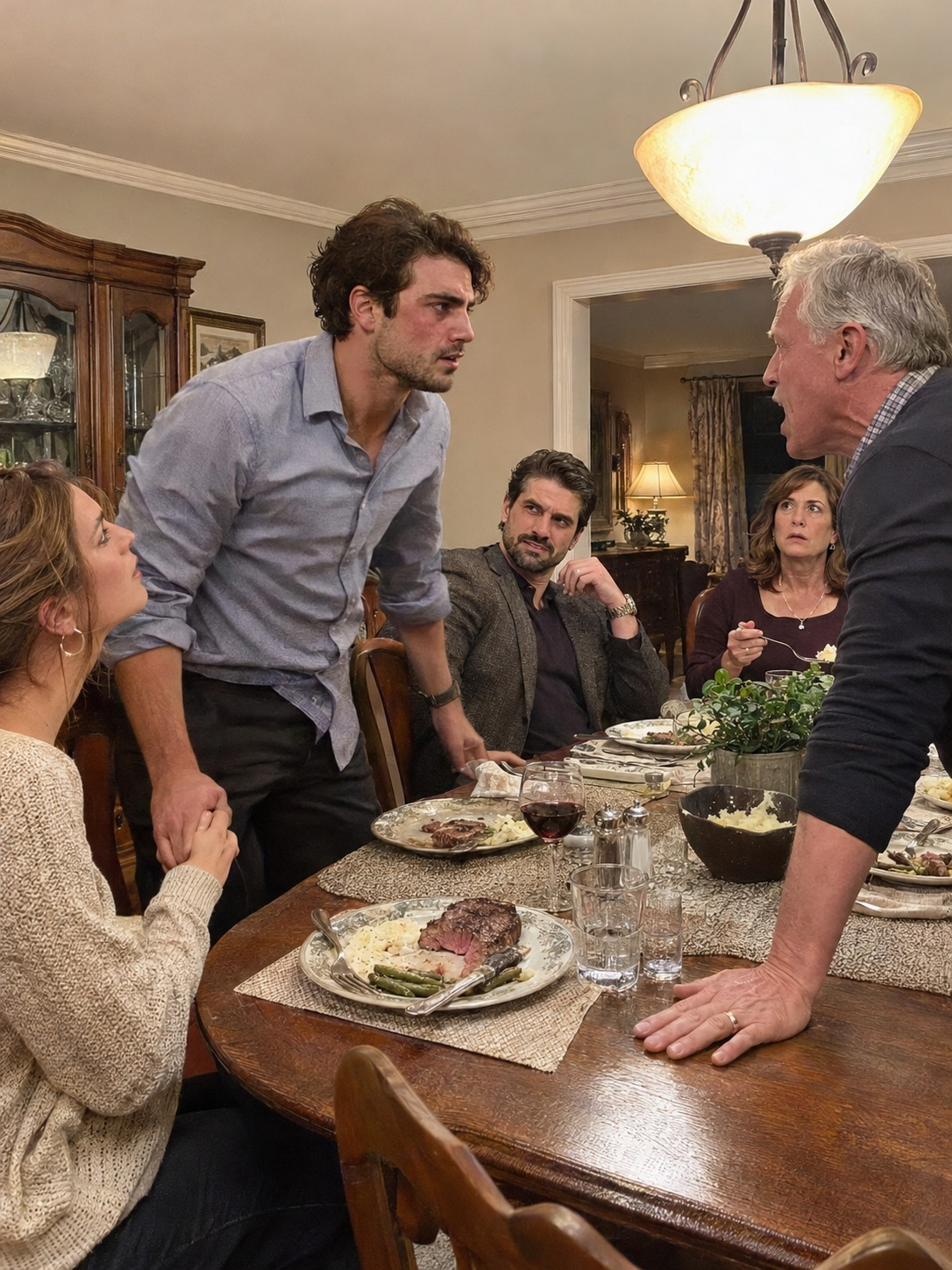
Omid was already seated at the table.
He wore a dark blazer and looked unusually pleased with himself.
Patricia sat beside Dad with a leather folder.
Several documents were arranged in front of her.
Dad stood when we entered.
"Good. Everyone's here."
Jennifer sat beside me.
Mom brought dinner to the table.
For the first twenty minutes, we discussed ordinary things.
Work.
Weather.
A relative's upcoming birthday.
Omid talked about a new commercial opportunity.
I listened without contributing much.
Then Dad placed his fork down.
"I want to talk about the company's future."
The room became quiet.
He explained that he intended to step back from daily operations.
Omid would become president.
He would oversee business development, executive management, and the company's future expansion.
Then Dad turned toward me.
"You'll continue handling financial administration."
I waited.
He continued.
"We've also decided on the ownership distribution."
Omid leaned back.
Mom folded her hands.
Patricia opened her folder.
Dad looked directly at me.
"Omid will receive the majority interest."
I glanced at the documents.
"And me?"
Dad took a breath.
"You'll receive a smaller minority interest, provided you remain with the company under the new management structure."
I felt Jennifer's hand close around mine.
"How much?"
Dad looked at Patricia.
She answered.
"The current proposal provides Isaac with ten percent."
I stared at her.
Ten percent.
After years of building the systems that kept the company running.
After years of correcting my brother's mistakes.
After the courthouse contract, the supplier negotiations, and the financial models.
Ten percent.
I turned toward Dad.
"What happened to the original agreement?"
He frowned.
"This is the final arrangement."
"That's not what I asked."
Omid leaned forward.
"Isaac, don't start."
I ignored him.
"Why was my ownership interest reduced?"
Dad's expression hardened.
"Omid deserves the responsibility. He needs the security more than you do."
I looked at him.
"He deserves it?"
"Yes."
I slowly pushed my chair backward.
For years, I'd imagined this conversation ending differently.
I'd imagined my father recognizing what I'd done.
I'd imagined him explaining that the company had a place for both of us.
Instead, he was offering me a fraction of what had once been discussed and expecting gratitude.
I stood.
"I need to understand something."
Dad looked up.
"What?"
"Am I being offered ten percent because that's what my work is worth?"
He sighed.
"Don't make this personal."
"Then what is it?"
Omid shook his head.
"You're lucky Dad is offering you anything."
Jennifer's fingers tightened around mine.
I looked at my brother.
Then at my father.
And finally at the documents in front of Patricia.
I remembered the unauthorized signatures.
The hidden transfers.
The ownership waiver.
The valuation certificate.
And the original agreement that nobody had wanted me to see.
I wasn't going to sign anything that night.
I wasn't going to accept a position that made me responsible for the company's finances while giving my brother control over every decision.
But before I could speak, Patricia turned to my father.
"There's one issue we still haven't resolved."
Dad's face tightened.
"What issue?"
She opened a separate folder.
"The original beneficiary waiver."
I looked at the document.
Patricia removed a printed page and placed it beside the ten-percent offer.
Then she said something that made everyone at the table go silent.
"Before this ownership distribution can be finalized, we need Isaac to confirm whether he personally signed away his original interest."
My father stopped moving.
Omid's smile disappeared.
Jennifer turned toward me.
And for the first time that evening, I realized that the family dinner wasn't really about offering me ten percent.
It was about getting me to confirm a signature I had never made.






Comments 0