"Your access has been revoked, Nolan. Please surrender your badge."
Diane Foster held out her hand while I stood in the Human Resources office, staring at the cardboard box on her desk.
A small white sticker on its side read $2.40.
When the chairman's investment party arrived downstairs, that same box would contain the document that made a powerful man stop in his tracks.
And the little drawing tucked between my engineering manuals would eventually matter more than anyone imagined.
But at that moment, I was just another employee being told to leave.
"Is there a problem, Mr. Vance?"
I looked up.
Diane had been working in Human Resources for almost six years. She was a decent woman, as far as I knew. She remembered birthdays, organized the annual charity drive, and once spent an entire afternoon helping a technician whose wife had been diagnosed with cancer.
Today, she couldn't quite meet my eyes.
"No problem," I said.
I reached into my shirt pocket and removed the plastic identification badge I'd worn every workday for nine years.
NOLAN VANCE.
SENIOR STRUCTURAL COORDINATOR.
CRESTLINE ENGINEERING.
Nine years reduced to three lines of plastic.
I placed it on the desk.
Diane slid a document toward me.
"This is simply an acknowledgment that you've received the separation information. It doesn't mean you agree with the decision."
I read it carefully.
That was a habit I'd developed over twenty-five years in structural engineering.
Read everything.
Check every number.
Never sign something because someone in a nice suit says it's routine.
The document confirmed that my employment was being terminated as part of an organizational restructuring.
It listed my final paycheck, unused vacation compensation, and the severance package the company was offering.
It also reminded me that certain confidentiality obligations would survive my departure.
I signed the acknowledgment.
Not because I agreed.
Because arguing with a piece of paper wouldn't change anything.
Diane watched me place the pen down.
"Nolan, I want you to understand that this wasn't a reflection of your performance."
I almost laughed.
Not because it was funny.
Because I'd heard those exact words before.
Twenty-three years earlier, my father had come home from a manufacturing plant carrying a brown paper bag containing his lunchbox and a photograph of my mother.
He'd worked there for eighteen years.
They'd told him his position was being eliminated.
They'd also told him it wasn't a reflection of his performance.
He never found another job that paid the same.
He spent the next decade pretending he didn't mind.
I was forty-nine years old.
I had a mortgage, an eight-year-old daughter, and a wife who had recently reduced her hours at the medical clinic so she could spend more time helping Chloe with school.
I couldn't afford to pretend this didn't matter.
But I wasn't going to give Crestline the satisfaction of watching me fall apart.
"I understand," I told Diane.
She hesitated.
Then she lowered her voice.
"For what it's worth, I didn't expect your name to be on the list."
That caught my attention.
"What list?"
Her expression changed.
"The restructuring list."
"Who prepared it?"
"Nolan..."
"I'm not asking you to violate anything. I'm asking whether this was a company-wide decision or whether somebody specifically recommended eliminating my position."
Diane glanced toward the closed office door.
Then she said something I wouldn't forget.
"Your name was the only one in your department."
I stared at her.
Only one.
For the previous three weeks, management had been talking about reducing senior engineering overhead by approximately four hundred thousand dollars.
Everyone assumed several positions would be affected.
Some consultants might lose their contracts.
A few administrative roles might be consolidated.
Maybe one of the vacant engineering management positions would disappear.
But Diane was telling me I was the only person being terminated from my department.
"Four hundred thousand dollars," I said quietly.
She looked uncomfortable.
"I can't discuss the financial calculations."
"You don't have to."
I knew exactly how management arrived at numbers like that.
They didn't just count salary.
They added benefits, insurance, retirement contributions, projected bonuses, software allocations, equipment costs, and whatever other expenses they could reasonably attach to a position.
Then they rounded everything upward.
It made eliminating one experienced employee look like a major financial victory.
Diane pushed the cardboard box toward me.
"Take whatever time you need to collect your personal belongings. Security will deactivate your building access at four."
I looked at my watch.
2:17 p.m.
Forty-three minutes earlier, I'd been reviewing a concrete inspection report for the Riverfront Towers project.
Now I had less than two hours before I would no longer be allowed inside the building.
"Thank you, Diane."
She looked surprised.
"For what?"
"For treating me like a person."
Her eyes glistened.
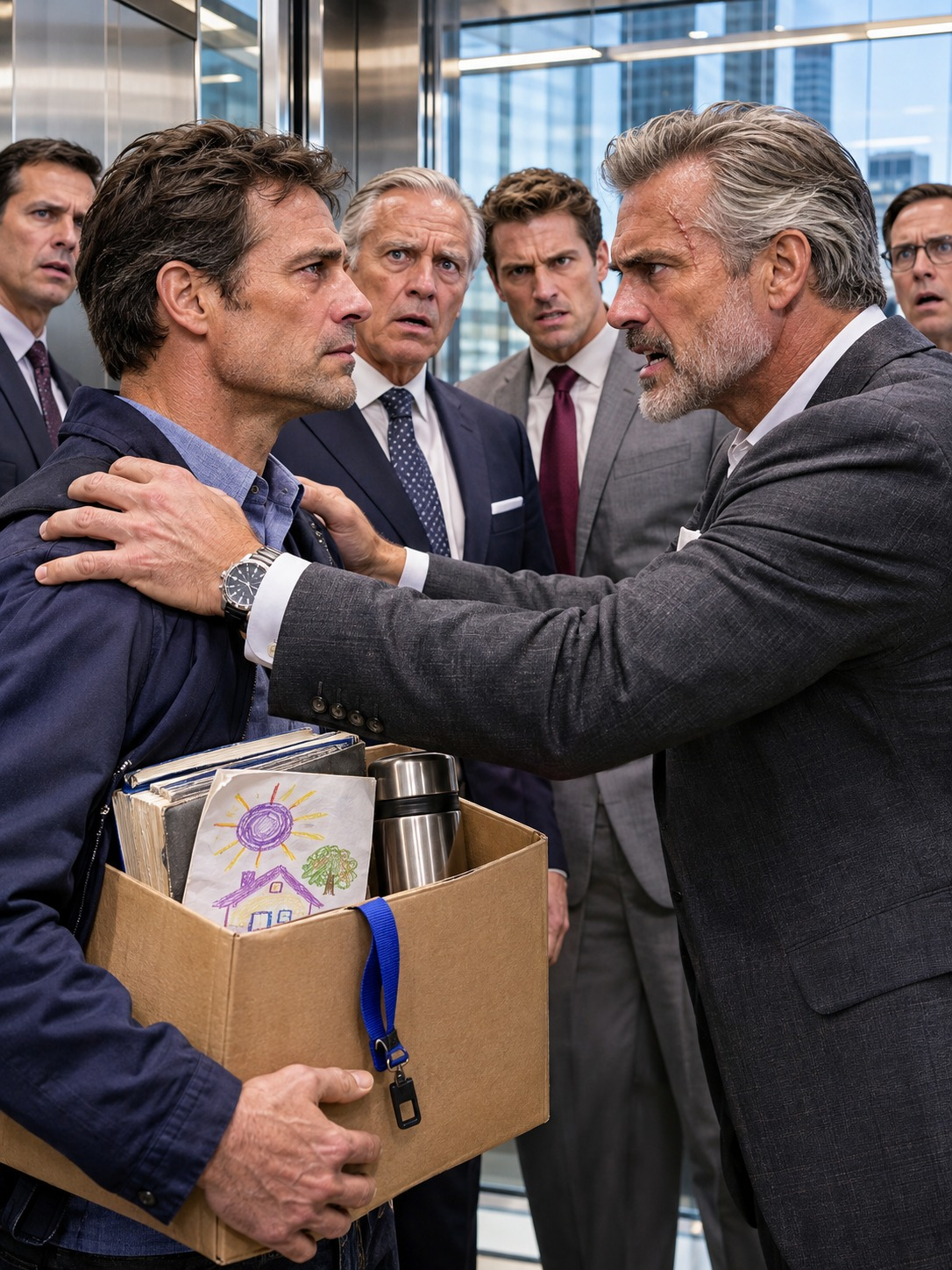
I picked up the box.
As I reached the door, she spoke again.
"Nolan?"
I turned.
"Please be careful about what you take from your workstation. Personal belongings only. Company files have to remain on the network."
"I know."
And I did.
I had spent my entire career respecting the difference between information I was authorized to use and information that didn't belong to me.
I wasn't going to start stealing documents because somebody had hurt my pride.
But there was something about the way Diane had said it.
Something rehearsed.
Almost as though someone had specifically instructed her to remind me.
I stepped into the hallway.
That's when I heard Darren Boyd laughing.
His voice came from the executive conference room across the corridor.
The door was partially open.
"We're shedding legacy baggage," he said.
A second voice responded through the conference speaker.
"And the savings?"
"Four hundred thousand in senior engineering overhead. Annualized. That's before we calculate the efficiency gains."
Someone chuckled.
Darren continued.
"The old model doesn't work anymore. We can't keep paying people to double-check what the software already tells us."
I stopped walking.
Not because I wanted to listen.
Because I recognized what he was talking about.
Me.
My inspections.
My refusal to approve structural milestones until the physical evidence matched the computer model.
Darren was thirty-four years old.
He had a business degree, an expensive watch, and an extraordinary ability to speak for twenty minutes without explaining anything.
He'd joined Crestline two years earlier as vice president of project delivery.
Within six months, he had introduced a new performance dashboard that tracked engineering productivity through something he called "deliverable velocity."
The faster a report was approved, the better the department looked.
The fewer field inspections required, the more efficient the project appeared.
And the more milestones completed ahead of schedule, the larger Darren's quarterly bonus became.
I didn't object to technology.
I'd spent twenty-five years using structural analysis software.
Modern modeling tools were extraordinary.
They could simulate loads, identify stress concentrations, and help engineers examine design alternatives that would have taken weeks to calculate manually.
But software had limitations.
A model could tell you how a foundation should behave.
It couldn't guarantee that a subcontractor had installed every waterproofing membrane correctly.
It couldn't smell standing water trapped behind a wall.
It couldn't see a damaged post-tensioning tendon hidden beneath a rushed concrete pour unless someone had collected the right evidence.
And it couldn't make a dishonest inspection report true.
Darren never understood that distinction.
Or perhaps he understood it perfectly and simply didn't care.
I continued down the hallway.
At the fourteenth-floor engineering department, the atmosphere had changed.
Normally, the office sounded like a small airport.
Printers.
Phones.
Conversations about load paths and construction schedules.
People arguing over coffee about whether a detail needed another revision.
Today, the room was quiet.
Too quiet.
As I walked toward my cubicle, several people looked up.
Then quickly looked away.
Word had already spread.
I placed the cardboard box on my desk.
For a moment, I simply stared at it.
Nine years.
Nine years of early mornings.
Nine years of weekend site visits.
Nine years of taking calls during family dinners because somebody had discovered a discrepancy in a foundation report.
Nine years of explaining to contractors that a deadline wasn't a substitute for a safe building.
And all of it was supposed to fit inside a box that cost less than a cup of coffee.
I opened the bottom drawer.
My old concrete standards manual was inside.
The cover had been repaired with black tape.
Several pages were marked with handwritten notes.
I had purchased it long before joining Crestline.
It had followed me through three companies, dozens of construction sites, and more late-night engineering reviews than I could count.
I placed it inside the box.
Next came my stainless steel thermos.
A dent ran along one side.
Chloe had once asked why I didn't buy a new one.
I'd told her the dent made it easier to recognize.
The truth was that my father had given it to me when I completed my first major project.
He'd died six years earlier.
I still used it every day.
Then I opened the shallow drawer beneath my keyboard.
Inside was a drawing.
Purple sun.
Yellow house.
Green tree.
Three stick figures holding hands.
Chloe had made it during a school project about what parents did for work.
Under the house, in uneven blue letters, she'd written:
MY DADDY BUILDS GIANT TOWERS THAT KEEP THE RAIN AWAY.
I remembered the day she'd brought it home.
She'd been seven then.
She had climbed onto my lap and asked whether the towers I worked on were taller than the clouds.
"Not quite," I'd told her.
"Do they fall down?"
"Not if we do our jobs right."
She had considered that answer with the seriousness only a child could manage.
"Then you have to do your job right every time, Daddy."
I had promised her I would.
Now, standing in an office that no longer wanted me, I carefully placed her drawing inside the box.
I positioned it in front of the thermos so it wouldn't bend.
"Nolan?"
I turned.
Liam Brooks stood beside my cubicle.
He was twenty-nine, with a permanently wrinkled shirt and the exhausted expression of someone who spent too many hours driving between construction sites.
Liam was one of the best field technicians I'd ever worked with.
He noticed things.
Small things.
A hairline crack in a slab.
A missing sealant bead.
A discrepancy between the installation photographs and the inspection report.
Those details didn't impress executives.
But they mattered.
"Are they actually letting you go?" he asked.
I nodded.
"Apparently."
He looked at the box.
Then at me.
"That's insane."
"Maybe."
"No, Nolan. I'm serious. They can't just get rid of you."
"They can."
"But Riverfront—"
"The handoff folder is on the shared drive."
He stared.
"You're worried about the handoff?"
"I'm worried about the building."
Liam dragged a chair beside my desk.
"Nolan, the north podium waterproofing still hasn't been verified."
"I know."
"And those core samples from the east foundation wall?"
"Still pending."
"And the post-tensioning inspection photographs?"
I looked directly at him.
"That's what I need you to remember."
His expression tightened.
"Remember what?"
"Don't approve anything you haven't verified."
He leaned closer.
"Darren wants the next milestone signed off by Friday."
"Then Darren needs to make sure the work is complete by Friday."
Liam shook his head.
"You know that's not how he thinks."
"I know."
He lowered his voice.
"He's been telling everyone the automated platform can handle most of the verification now."
"The platform can assist with verification. It can't replace evidence."
"That's what I told him."
"What did he say?"
Liam gave a humorless laugh.
"He said I was starting to sound like you."
For the first time that afternoon, I smiled.
"Could be worse."
Liam didn't smile back.
He glanced toward the corridor.
"There's something else."
I waited.
"Yesterday, Darren asked me whether the north podium inspection could be closed using the preliminary photographs."
I felt my stomach tighten.
"Which photographs?"
"The ones from before the membrane repairs."
"Those aren't final inspection photographs."
"I told him that."
"And?"
"He said the difference was administrative."
I set down the folder I was holding.
"Liam, listen carefully."
He straightened.
"If the repairs haven't been inspected, the inspection isn't complete. I don't care what the dashboard says."
"I know."
"Do not certify something you haven't personally verified."
He nodded.
Then he looked at me with an expression I hadn't seen before.
Fear.
Not for himself.
For the project.
"Nolan, what if they don't listen?"
I wanted to give him an easy answer.
I wanted to say that good engineering always won.
That management eventually recognized the difference between caution and obstruction.
That doing the right thing guaranteed a good outcome.
But I was standing beside a cardboard box because I'd spent years believing those things.
So I told him the truth.
"Document your findings. Follow the approved reporting procedures. And don't put your name on something you know is wrong."
Liam swallowed.
"Okay."
I placed my hand on his shoulder.
"You're a good technician, Liam. Don't let anybody convince you that asking questions makes you difficult."
He nodded again.
Then he looked away.
I could tell he wanted to say more.
But two project managers were walking toward us, and the moment passed.
I finished packing.
A framed photograph of Chloe at her first soccer game.
A small calculator I'd owned since college.
Three personal notebooks.
A pair of reading glasses.
The cardboard box was nearly full.
I checked the drawers one last time.
Nothing left.
At 2:46 p.m., I logged out of my workstation.
The screen went dark.
I stood there for a few seconds, looking at my reflection.
Forty-nine years old.
Twenty-five years of experience.
Nine years with Crestline.
And no job.
My phone vibrated.
A message from my wife, Rachel.
How's your afternoon going? Chloe wants to know if you'll be home for dinner tonight.
I stared at the screen.
Rachel had been my wife for eleven years.
She knew when something was wrong, even over the phone.
If I told her now, she'd call immediately.
She'd ask whether I was okay.
She'd start calculating bills in her head.
She'd worry about the mortgage, Chloe's school expenses, and the medical insurance that had suddenly become much more complicated.
I wasn't ready to hear that worry in her voice.
So I typed:
I'll be home early. We'll talk tonight.
Three dots appeared.
Then her reply.
Everything okay?
I closed my eyes.
For a moment, I considered lying.
Then I remembered what I'd told Liam.
Don't put your name on something you know is wrong.
I typed:
I lost my job today. I'm okay. I'll explain when I get home.
Her response came almost immediately.
Come home. We'll figure it out together. We love you.
I read those words twice.
Then I slipped the phone into my pocket.
That was when I realized something.
Crestline had taken my job.
It hadn't taken everything.
I lifted the box.
As I turned to leave, Liam stood up.
"Hey, Nolan."
I looked back.
He held out his hand.
I shook it.
Then he pulled me into a quick embrace.
"Thank you," he said.
"For what?"
"For teaching me that the drawings aren't the building."
I felt my throat tighten.
"Take care of yourself."
"You too."
I walked toward the elevators.
No one stopped me.
No one from senior management came to say goodbye.
No farewell meeting.
No handshake from Darren.
No acknowledgment from the executives who had spent years asking me to solve problems their schedules created.
Just a quiet corridor and the soft sound of my shoes against the polished floor.
At the far end of the hallway, the executive conference room door was still open.
Darren's voice drifted out.
"Once we eliminate the old bottlenecks, Riverfront will be back on schedule."
I kept walking.
The elevator button glowed when I pressed it.
I waited.
A few seconds later, the doors opened.
I stepped inside.
The elevator was larger than most, with polished steel walls and glass panels overlooking the downtown skyline.
I moved to the rear-left corner.
The box rested against my chest.
Chloe's drawing faced outward.
I pressed the lobby button.
The doors began to close.
Then a voice called from the corridor.
"Hold that elevator."
I reached forward and pressed the door-open button.
The doors slid apart.
Donald Davenport approached with a group of men.
Crestline's chairman.
Majority shareholder.
A man who rarely visited the engineering floor unless investors were present.
He wore an expensive suit and carried himself with the relaxed confidence of someone accustomed to having other people solve his problems.
Darren walked beside him.
Behind them were four men I didn't immediately recognize.
Donald was speaking.
"This way, gentlemen. We've reconfigured our engineering matrix to ensure maximum delivery efficiency."
I lowered my eyes.
I didn't want a confrontation.
I didn't want to explain why I was leaving.
I simply wanted to go home.
Donald stepped toward the elevator.
Then one of the men beside him stopped.
He was tall and broad-shouldered.
Silver hair at his temples.
A pale scar beside his left eyebrow.
Something about his face seemed familiar.
He looked at my cardboard box.
Then at me.
His expression changed.
Not gradually.
Instantly.
As though someone had struck him with a memory.
"Nolan?"
I stared.
His voice.
I knew that voice.
But it had been more than twenty years.
"Grant?"
The man stepped closer.
"Grant Holloway?"
He looked almost offended that I needed to ask.
Then he gave a short, disbelieving laugh.
"Nolan Vance."
I could hardly believe it.
The last time I'd seen Grant Holloway, he'd been a young field technician sleeping on a folding cot in a freezing West Texas trailer.
Now he stood in front of me wearing a suit that probably cost more than my first car.
Donald glanced between us.
"Mr. Holloway, you know our former employee?"
Grant didn't answer.
He stepped into the elevator.
Walked straight toward me.
And placed both hands on my shoulders.
His eyes moved from my face to the cardboard box.
Then to the broken lanyard visible beside Chloe's drawing.
"What in the world are you doing with a packing box?"
I swallowed.
"It seems Crestline decided my position was redundant."
Grant stared.
I continued.
"I just signed the separation paperwork."
His hands remained on my shoulders.
For a moment, he said nothing.
Then he slowly turned toward Donald.
The warmth disappeared from his expression.
"Donald."
The chairman straightened.
"Yes, Grant?"
"Did you just terminate Nolan Vance?"
Donald blinked.
"Well, there appears to be some confusion regarding an internal personnel decision."
Grant released my shoulders.
"What confusion?"
Donald cleared his throat.
"This is simply part of a departmental realignment."
Grant pointed toward my box.
"He's carrying his belongings."
"Yes, but—"
"His company badge is broken."
Darren stepped forward.
"Mr. Holloway, Nolan has served the company well, but our new automated modeling platform requires a faster delivery structure."
Grant looked at him.
Darren continued.
"Certain legacy inspection practices were creating unnecessary delays in critical project milestones."
I remained silent.
Grant's expression hardened.
"Legacy inspection practices?"
Darren nodded.
"Redundant physical verification, primarily."
Grant stared at him.
"You're telling me you fired Nolan Vance because he insisted on verifying structural work?"
Darren's smile faltered.
"That's an oversimplification."
"Then simplify it for me."
The elevator was completely silent.
Donald shifted his weight.
One of the investors adjusted his glasses.
Darren looked toward the chairman for help.
None came.
Grant turned back toward me.
"Nolan, were you working on Riverfront Towers?"
"Yes."
"What was your role?"
"Senior structural coordination. Foundation interfaces, moisture mitigation, inspection sequencing, and several technical review packages."
Grant nodded slowly.
Then he looked toward Donald.
"Three years ago, when Crestline approached Holloway Infrastructure Partners about Riverfront Towers, you personally gave my investment committee a forty-page technical framework."
Donald said nothing.
Grant continued.
"Subterranean moisture mitigation. Foundation seismic ties. Cold-joint sealant requirements. Elevation offsets."
I recognized every phrase.
I'd spent months developing that framework.
I'd written it after reviewing early geotechnical findings and discovering inconsistencies between the foundation assumptions and the proposed waterproofing system.
It wasn't glamorous work.
It involved calculations, field notes, technical standards, and endless meetings with people who wanted simpler answers.
But the framework mattered.
It explained how the project could address specific engineering risks without compromising long-term performance.
I remembered submitting the final version to management.
I remembered the revisions.
I remembered the arguments.
I also remembered that Donald had never once asked me about it afterward.
Grant's voice grew quieter.
"That document was the reason my committee agreed to consider the investment."
Donald swallowed.
"Grant, the technical package was a collaborative company effort."
"Was it?"
"Naturally. Our engineering teams work together."
Grant looked at Darren.
"Did you review that framework?"
Darren hesitated.
"I joined Crestline after the initial investment discussions."
"Then perhaps you shouldn't be explaining the value of the man who prepared it."
Darren's face flushed.
I shifted the cardboard box slightly.
My arms were beginning to ache.
Grant noticed.
His expression changed again.
For one brief second, I saw the young man I'd known in West Texas.
The man who had nearly died during a freezing November storm.
The man I'd carried through four miles of mud after lightning destroyed our radio tower and our truck refused to start.
The man whose father I'd later helped when emergency surgery threatened to bankrupt his family.
We hadn't spoken in years.
Life had taken us in different directions.
But he remembered.
I could see it.
And suddenly I understood that this wasn't simply an investor questioning a business decision.
This was personal.
Grant looked toward Donald.
"Do you know how I met Nolan?"
Donald shook his head.
"No."
"West Texas. Twenty-two years ago."
He paused.
"We were field technicians on a wind turbine installation. I got pneumonia during a storm. The truck was dead. Communications were down."
I looked at him.
"Grant, you don't need to—"
He raised one hand gently.
"Let me finish."
Then he looked back at Donald.
"That man carried me four miles to a highway because he refused to leave me in a trailer to die."
Nobody spoke.
Grant continued.
"Two years later, my father needed emergency heart surgery. Nolan gave me ninety-five hundred dollars from his first major project bonus."
Donald stared.
Darren's eyes dropped.
I felt uncomfortable.
Not because Grant was exaggerating.
Because I'd never considered those things extraordinary.
Grant had been my friend.
He'd needed help.
I'd helped him.
That was all.
But Grant wasn't finished.
"He never asked for recognition. Never asked for a favor. Never called me when my business became successful."
His voice hardened.
"And now I find him standing in your elevator with a cardboard box because you decided his experience was too expensive."
Donald opened his mouth.
Nothing came out.
Grant stepped closer to him.
"Three years ago, you stood in my office and told me Crestline had developed one of the most rigorous structural risk-control frameworks in the region."
Donald nodded stiffly.
"I remember."
"You told me it represented the technical foundation of your Riverfront proposal."
"Yes."
"You told me your engineering leadership had personally guaranteed its integrity."
"That's correct."
Grant studied his face.
Then he reached into the inside pocket of his jacket.
He removed a folded document.
Not the full technical framework.
Just a single page.
I recognized the formatting immediately.
The revision block.
The reference number.
The document control header.
My heart began beating faster.
Because I knew exactly which page he was holding.
Grant unfolded it.
Donald looked down.
His expression changed.
Grant tapped the upper corner.
"RF-ST-041."
I knew that number.
It belonged to the final technical submission package.
The document I'd prepared before the investment committee review.
Grant turned the page slightly.
"Revision Seven."
I stared at him.
Revision Seven had been the final approved version.
The one containing the corrected foundation moisture-risk assumptions.
The one I'd insisted couldn't be released until several technical conditions were acknowledged.
Grant looked toward Donald.
"Do you recognize this?"
Donald nodded slowly.
"Of course."
"Good."
Grant held the document between them.
"Then perhaps you can explain something."
Darren shifted behind the chairman.
One of the investors leaned forward.
I looked at the bottom of the page.
There was a signature block.
I remembered signing my technical review section.
I remembered submitting the document through Crestline's internal approval system.
But I couldn't see the entire page from where I stood.
Grant moved his finger toward the lower-right corner.
His expression became colder than I'd ever seen it.
"Donald, before you tell me another story about restructuring, I want you to look at the name on this page."
Donald stared down.
His face lost its color.
Grant's voice was barely above a whisper.
"Who authored that technical framework, Donald?"
The chairman didn't answer.
Grant slowly turned the document toward me.
And when I saw the signature beneath the words Prepared By, I realized something was terribly wrong.
It wasn't mine.
"Grant lowered the page toward the light. Beneath the forged signature was a second line of text, and the moment I recognized the name printed there, I knew someone at Crestline had been hiding far more than my termination..."






Comments 0