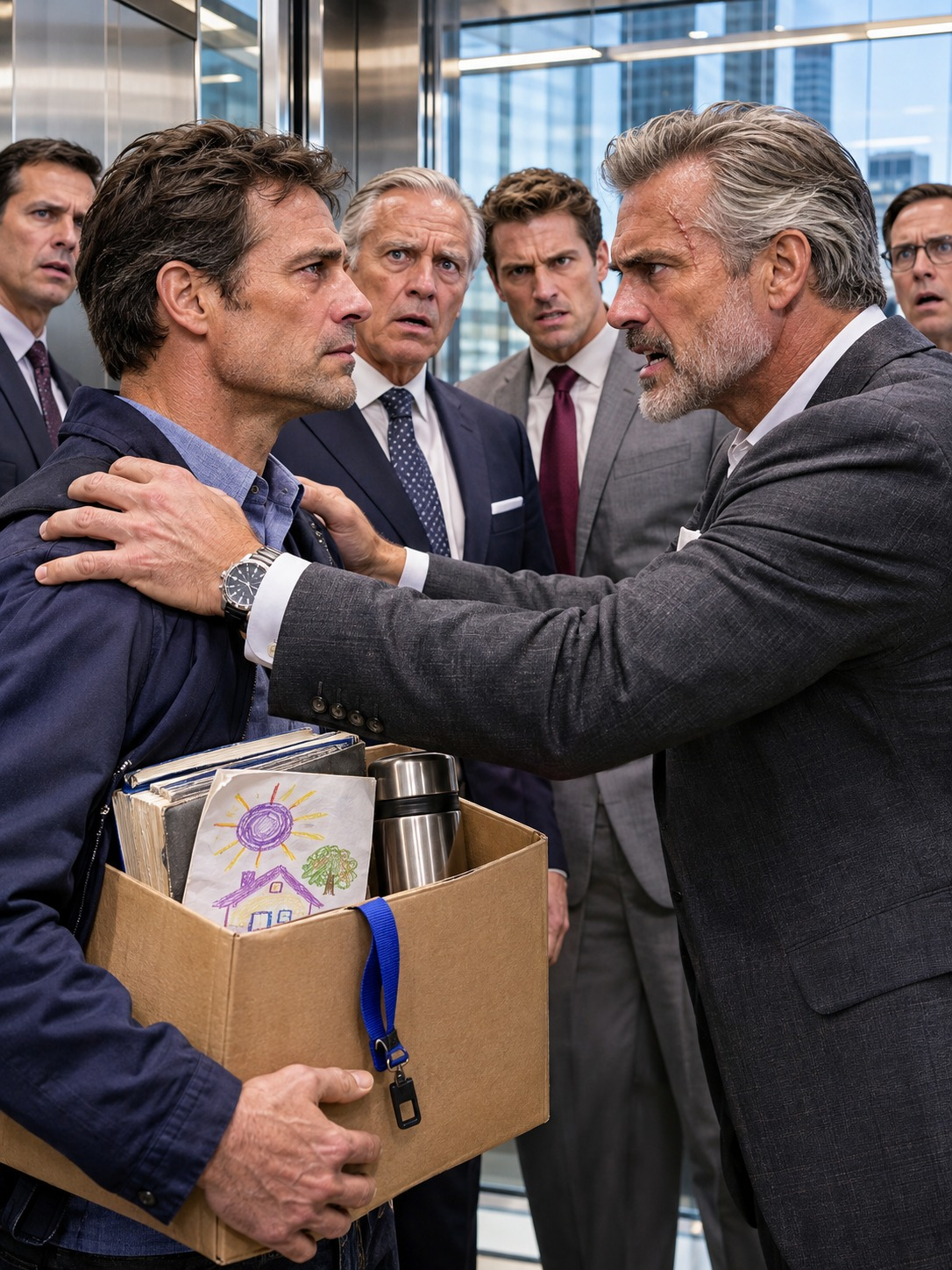
The person standing behind me was Grant Holloway.
For three days, I had trusted him more than anyone outside my family.
He had defended me in the elevator when my own employer treated me like something disposable. He had suspended seventy-eight million dollars in funding because my engineering work had been altered. He had brought lawyers, investigators, and independent engineers into a situation everyone at Crestline wanted buried.
And now Donald Davenport was looking past my shoulder with the expression of a man who believed he had finally won.
I turned.
Grant stood in the boardroom doorway, one hand resting against the polished wood. His face was pale, but his eyes were steady.
Donald smiled.
"There he is."
Nobody spoke.
Then Donald pointed toward the frozen video.
"Tell him, Grant."
Grant looked at the screen.
For a moment, something passed across his face.
Not surprise.
Recognition.
My stomach tightened.
"Grant?"
He didn't answer immediately.
Instead, he walked past me and stopped beside the conference table.
"Donald," he said quietly, "you have made a very serious mistake."
Donald laughed.
"Have I?"
"Yes."
The chairman leaned back in his leather chair.
"Then perhaps you should explain why your signature appears on the original Riverfront authorization."
I stopped breathing.
Grant's signature.
Not Walter's.
Not Darren's.
Not Donald's.
Grant Holloway's.
I looked at the screen again.
The third man in the video had been wearing a dark suit. His hand had rested against a folder. A gold wedding band had caught the light, and a thin scar crossed one knuckle.
Grant had a scar like that.
I remembered seeing it twenty-two years earlier, after we'd survived the storm in West Texas.
He'd cut his hand climbing over a broken section of fencing.
I had wrapped it with a strip torn from my shirt.
The scar had remained.
Now Donald was using that same scar to identify him in a recording that supposedly proved I had ordered an engineering safeguard removed.
I felt sick.
"Grant," I said, "tell me what's happening."
He turned toward me.
"Nolan, the video is not an authentic recording of that meeting."
Donald slapped the table.
"That's convenient."
Grant ignored him.
"The image of me is genuine. The conversation is not."
I stared at him.
"What does that mean?"
"It means someone used footage from an actual meeting and combined it with material recorded at another time."
Rebecca Sloan stepped forward.
"Mr. Holloway, are you stating that the video has been manipulated?"
"Yes."
Donald laughed.
"Of course he is."
Rebecca turned toward him.
"Mr. Davenport, my client disputes both the video and the alleged acceptance letter. Those disputes have been formally communicated. I suggest you stop presenting either as an established fact."
Donald leaned forward.
"Miss Sloan, this board has a right to examine evidence."
"Absolutely," she answered. "Authentic evidence."
The room went quiet.
I looked toward the screen.
The frozen image of me stared back.
Same hair.
Same face.
Same clothes.
But there was something wrong with the office.
I stepped closer.
"Can you rewind it?"
Donald frowned.
"What?"
"The recording."
He hesitated.
Rebecca looked at me.
"Nolan?"
I pointed toward the screen.
"Please."
Donald glanced at his attorney.
The attorney nodded reluctantly.
Donald pressed the remote.
The video returned to the beginning.
There I was, seated at a desk.
The timestamp read March 14, 11:42 p.m.
The man who looked like me spoke.
"Remove the north podium inspection hold point."
I watched carefully.
Not my mouth.
Not my face.
The wall behind me.
The filing cabinet.
The drafting table.
Then I saw it.
"Stop."
Donald paused the video.
I stepped closer.
"There."
I pointed toward the lower corner of the image.
A blue steel cabinet stood beside the desk.
On its front was a yellow inspection sticker.
I knew that cabinet.
I'd used it for years.
I turned toward the board.
"That cabinet was installed in our engineering department eighteen months after the date shown on this recording."
Silence.
Donald frowned.
"What?"
I pointed again.
"That cabinet wasn't there in March three years ago."
Darren Boyd shifted in his chair.
I continued.
"It replaced a damaged wooden storage unit after the sprinkler leak on the sixth floor."
One director leaned forward.
"Can you document that?"
"Yes. Facilities issued a work order. The installation was charged to the engineering department. There should be purchase records, delivery records, and photographs."
Rebecca nodded.
"We'll request preservation of those records."
I looked back at the screen.
"And there's another problem."
Donald stared at me.
"What?"
"The drawing behind the desk."
Everyone looked.
A framed technical illustration hung on the wall.
I recognized it immediately.
It showed the Riverfront north podium drainage assembly.
But not the original version.
The updated one.
The drawing incorporated a revised access detail I'd prepared eighteen months after the date on the recording.
I turned toward Donald.
"That drawing didn't exist in March three years ago."
His smile disappeared.
I continued.
"Someone used footage recorded much later and gave it an earlier timestamp."
Grant nodded.
"Exactly."
Donald stood abruptly.
"That proves nothing about the audio."
"No," I said. "It doesn't. But it proves this recording cannot be what you claim."
Rebecca stepped forward.
"And that is why independent authentication matters."
Donald looked toward Franklin Shaw.
Franklin avoided his eyes.
For the first time since entering the boardroom, I saw something I hadn't expected.
Fear.
Not in me.
In the men who had spent days trying to make me afraid.
The boardroom doors opened again.
Margaret Ellis entered with a woman carrying a laptop case.
Margaret looked directly at Grant.
"The independent digital examination has produced preliminary findings."
Donald stiffened.
"What examination?"
Margaret placed a folder on the table.
"The examination of the video supplied to the board."
One of Crestline's independent directors, a silver-haired woman named Patricia Monroe, leaned forward.
"Who authorized it?"
Grant answered.
"The Holloway special committee. We received a copy of the recording through counsel yesterday."
Donald looked furious.
"You had no right—"
Patricia raised a hand.
"Mr. Davenport, the recording has been presented as evidence concerning an engineer's professional conduct. If there are questions about authenticity, this board needs to hear them."
Donald sat.
Slowly.
The woman beside Margaret introduced herself as Dr. Melissa Chen, a digital media forensic examiner retained by outside counsel.
She connected her laptop to the conference system.
The screen changed.
A series of still frames appeared.
Dr. Chen spoke carefully.
"The preliminary examination identifies inconsistencies between the file's stated creation date and its underlying media characteristics. We also identified discontinuities in the audio and image sequences."
Donald crossed his arms.
"Are you saying it's fake?"
"I'm saying the file cannot be authenticated as a continuous recording from the stated date. Several findings are consistent with editing or compositing."
Rebecca nodded.
"Can you identify who made the changes?"
"No. That requires additional source records."
I appreciated the distinction.
Evidence was evidence.
Suspicion was not proof.
Dr. Chen displayed two frames side by side.
"In this section, the background and foreground subjects exhibit different compression histories. There is also an abrupt transition in the audio ambience."
She played a short segment.
My recorded voice said:
"Keep the revision number unchanged."
Then the room noise shifted.
Barely noticeable.
But once she isolated it, everyone could hear the difference.
Dr. Chen stopped playback.
"The audio may have been assembled from separate recordings. Further analysis is required to determine its source."
Patricia Monroe looked toward Donald.
"Who provided this video?"
Donald hesitated.
"Walter Pierce."
My stomach tightened.
Walter.
The man who'd demanded my notebooks.
The man whose department controlled the altered executive repository.
The man who'd disappeared.
Patricia continued.
"Where is Mr. Pierce?"
Donald didn't answer.
She waited.
Finally, he said:
"I don't know."
Patricia looked toward the company's general counsel.
"Then we need to establish how this material entered the board packet."
The attorney nodded.
"Agreed."
I stood beside Rebecca, staring at the screen.
Someone had constructed a recording to make it appear I had approved the removal of mandatory inspection requirements.
They had given it a false timestamp.
They had paired it with a forged acceptance letter.
And they had presented it to the board just as an independent investigation threatened to expose what had happened beneath Riverfront.
I looked toward Donald.
"Was this the evidence you wanted me to see?"
He stared at the table.
I waited.
He didn't answer.
At 9:36 a.m., Patricia Monroe called for a recess.
Not because the meeting was over.
Because the board needed to decide whether Donald Davenport should continue presiding over it.
The directors moved into an adjoining conference room.
Donald remained seated.
Darren whispered urgently to Franklin.
Grant stood near the windows, speaking with Margaret.
I walked toward the hallway.
Rebecca followed.
"Nolan."
I stopped.
She looked at me.
"How are you holding up?"
I considered lying.
Then shook my head.
"Not well."
She nodded.
"Understandable."
I looked back toward the boardroom.
"They were going to put all of it on me."
Rebecca didn't answer.
I continued.
"The altered framework. The missing inspection. The underground chamber. Every decision they made without me."
She looked at me carefully.
"That appears to be what the proposed documents would have accomplished."
I felt my jaw tighten.
"And they offered me a million dollars to sign."
"Yes."
I stared at the carpet.
"Three days ago, I was worried about paying my mortgage."
Rebecca was quiet.
"Now I'm worried that an entire company may have built its financial position on records that aren't reliable."
She nodded.
"Those are serious concerns. But remember, the investigation still has to establish which records were altered, by whom, and with what consequences."
I looked at her.
"I know."
She hesitated.
"And Nolan, you are not responsible for proving every crime or resolving every corporate dispute."
I almost smiled.
"You sound like Rachel."
"Then Rachel is giving you good advice."
I looked through the glass wall.
Donald Davenport was still seated at the head of the table.
For nine years, I'd seen him as the man who built Crestline.
The man who gave speeches about integrity.
The man who told employees they were a family.
Now he sat alone while the directors discussed whether he could be trusted to remain chairman.
I felt no satisfaction.
Only exhaustion.
Then my phone vibrated.
A message from Rachel.
Chloe is doing better. She's eating pancakes and asking whether you'll be home for dinner.
I stared at the words.
For a moment, the boardroom disappeared.
I could almost see Chloe sitting at the kitchen table.
Her hair falling into her eyes.
Her stuffed rabbit beside her plate.
Rachel pouring orange juice.
I typed:
Tell her I'll do everything I can.
Then another message arrived.
And Nolan? Whatever happens today, come home to us.
I closed my eyes.
I will.
At 10:04 a.m., the board reconvened.
Patricia Monroe took the chairman's seat.
Donald stood beside his chair.
His face was dark with anger.
"On what authority are you doing this?"
Patricia looked at him.
"Under the board's governance procedures, the independent directors have voted to appoint an acting chair for matters involving the current investigation."
Donald stared at her.
"You can't remove me."
"We have not removed you from the board. We have determined that you should not preside over proceedings in which your own conduct is under review."
He looked toward the other directors.
Nobody spoke.
Patricia continued.
"Mr. Davenport, you may remain with counsel while the board considers your statements. You will not direct the proceedings."
Donald slowly sat.
I watched him.
The man who had fired me without allowing me to finish a sentence was now being told he could no longer control the room.
Patricia turned toward Grant.
"Mr. Holloway, we understand your firm has suspended the next seventy-eight-million-dollar funding milestone."
Grant nodded.
"Correct."
"Is that suspension still in effect?"
"Yes."
"Under what conditions would funding resume?"
Grant took a breath.
"Independent verification of material technical conditions, reliable project records, appropriate governance controls, and a financing decision based on accurate information."
Patricia nodded.
"Has the independent engineer completed the review?"
Dr. Evelyn Hart stood.
"No."
I looked toward her.
She placed a technical summary on the table.
"The review remains in progress. We have confirmed significant documentation discrepancies and identified conditions requiring direct verification."
Patricia leaned forward.
"Does the evidence establish that Riverfront Towers is structurally unsafe?"
Dr. Hart shook her head.
"Not on the information currently available."
A few people exhaled.
Then she continued.
"But neither can we certify that the affected areas meet the required performance criteria. The concealed chamber, the unresolved north podium waterproofing verification, the pending east foundation wall core results, and the incomplete post-tensioning inspection documentation must be addressed."
Patricia nodded.
"What immediate action do you recommend?"
"Maintain the relevant construction hold points. Restrict work that could conceal or load affected conditions until the responsible engineers and authorities have reviewed the evidence. Preserve the site records. Complete independent testing."
I nodded.
That was the answer I wanted.
Not panic.
Not speculation.
Verification.
The same principle I'd defended before Crestline fired me.
Patricia turned toward me.
"Mr. Vance."
I stood.
"Yes, ma'am."
"You authored the original forty-page risk-control framework?"
"Yes."
"Did you approve a revision making the north podium physical inspection discretionary?"
"No."
"Did you authorize removal of the inspection hold point?"
"No."
"Did you sign the technical exception document presented to the investment committee?"
"No."
"Did you instruct Franklin Shaw to alter RF-NP-217?"
"No."
She studied me.
"Are you willing to provide your original notes and explain your engineering decisions to the independent reviewers?"
"Yes, through appropriate procedures and with counsel."
Patricia nodded.
"Thank you."
I remained standing.
Then said:
"May I add something?"
She considered it.
"Go ahead."
I looked around the table.
At the directors.
At the executives.
At Donald.
At Darren.
At Franklin.
"I worked here for nine years."
Nobody moved.
"I wasn't perfect. I made mistakes. I missed deadlines. I argued with project managers. Sometimes I spent too much time checking details other people thought were settled."
I paused.
"But I never signed an engineering approval because someone needed a better number for a financing presentation."
Donald looked away.
I continued.
"The inspection hold points in my framework weren't decorative language. They were there because some construction conditions become difficult or impossible to verify once they're covered."
I looked toward Dr. Hart.
"That's why we require documented acceptance before work proceeds."
She nodded.
I turned back toward the directors.
"I don't know everything that happened beneath Riverfront. I don't know who changed every file. I don't know who authorized every payment."
I took a breath.
"But I know what I wrote. I know what I approved. And I know what I refused to approve."
The room was silent.
I continued.
"If you want to protect this company, start by telling the truth about the records. Then let qualified people inspect the work."
I sat.
For several seconds, nobody spoke.
Then Patricia Monroe nodded.
"Thank you, Mr. Vance."
The next witness was Liam Brooks.
When he entered the boardroom, I nearly stood.
He looked exhausted.
His shirt was wrinkled.
There were dark circles beneath his eyes.
But he walked to the table with his shoulders straight.
Liam had been twenty-nine when I first met him.
Fresh out of a technical training program.
Nervous around senior engineers.
Afraid to ask questions because he thought questions made him look inexperienced.
I'd told him something during his first week.
"The dangerous engineer isn't the one who asks what he doesn't know. It's the one who pretends he knows."
He'd remembered.
Now he was standing in front of Crestline's board.
Patricia addressed him.
"Mr. Brooks, please explain how the original north podium inspection report came to your attention."
Liam swallowed.
Then spoke.
"The report was referenced in the quality assurance register, but the active project folder contained a different version."
Patricia nodded.
"What did you do?"
"I followed the document-control procedure and reported the discrepancy."
"To whom?"
"Franklin Shaw."
Franklin shifted in his chair.
Patricia looked toward him.
Then back at Liam.
"What was Mr. Shaw's response?"
Liam took a breath.
"He told me the earlier report had been superseded."
"Was there a superseding inspection?"
"Not that I could verify."
Patricia leaned forward.
"What happened next?"
Liam hesitated.
"He instructed me to remove the old report from the active register."
I felt my stomach tighten.
"Did you comply?"
"No."
Franklin looked up sharply.
Liam continued.
"I told him the report couldn't be removed without a documented revision or disposition."
Patricia nodded.
"And then?"
"He told me I was making a simple administrative matter unnecessarily difficult."
I closed my eyes.
I could hear Darren saying the same thing.
A simple administrative matter.
That was how serious problems became invisible.
Liam continued.
"Later, I received a message directing me to delete the scanned copy and dispose of the paper version."
Patricia looked toward the company's attorney.
"Do you have that message?"
"Yes. It was preserved in the company system, and I provided the record reference to the investigation team."
Patricia nodded.
"Did you delete the report?"
"No."
"Why not?"
Liam looked at me.
Then back at the board.
"Because the inspection had not passed."
The room went quiet.
He continued.
"The report documented a failed waterproofing verification at the north podium. There were unresolved moisture pathways and incomplete repair documentation."
Patricia asked:
"Does that establish a structural failure?"
Liam shook his head.
"No. But it means the condition required corrective action and reinspection before acceptance."
Dr. Hart nodded.
Liam looked toward Franklin.
"And nobody had shown me evidence that the corrective work had been accepted."
Franklin stood abruptly.
"That's not true."
Patricia raised a hand.
"Mr. Shaw, you'll have an opportunity to respond."
Franklin sat.
His face was red.
Liam continued.
"After Mr. Vance was terminated, I was told the inspection issue had been resolved."
Patricia frowned.
"By whom?"
"Darren Boyd."
Darren leaned forward.
"I said the documentation had been reconciled."
Liam looked at him.
"Yes, sir."
Patricia turned toward Darren.
"Do you have the reconciliation record?"
Darren hesitated.
"The project team should have it."
"Do you personally know whether the required physical verification occurred?"
He didn't answer.
Patricia waited.
Finally, Darren said:
"I relied on the quality assurance department."
Patricia turned toward Franklin.
Franklin stared at the table.
And for the first time, I understood what was happening.
Each man had relied on someone else.
Each approval pointed toward another department.
Each altered record had been described as an administrative correction.
But the physical inspection still hadn't been verified.
The building didn't care which department was responsible.
Water didn't care who signed a form.
And concrete didn't care how persuasive a financing presentation looked.
At 11:22 a.m., the board received a preliminary report from the outside forensic accounting team.
A woman named Helen Price entered with two binders.
She spoke calmly.
The way people do when they know the documents are more powerful than their voices.
"The investigation has identified a series of transactions involving Crestline Engineering, Meridian Advisory Group, and entities associated with Riverfront Towers."
Donald stared at her.
Patricia nodded.
"Please continue."
Helen opened the first binder.
"Approximately three years ago, Meridian received a four-hundred-thousand-dollar payment described as a technical optimization advisory fee."
My stomach tightened.
The number.
Again.
Helen continued.
"That payment was recorded during the same period in which the revised engineering framework entered the financing review."
Patricia asked:
"Was the payment properly authorized?"
"We have not completed that determination."
"Who requested it?"
Helen turned a page.
"The request originated through Crestline's executive operations department."
Walter Pierce.
I felt cold.
"Who approved it?"
Helen hesitated.
"The approval record contains a digital signature attributed to Donald Davenport."
Donald stood.
"I didn't authorize that payment."
Patricia looked at him.
"Mr. Davenport, please sit."
He remained standing.
"That signature was copied."
Helen nodded.
"That is one possibility under examination."
Donald looked around the table.
"Someone has been using my name."
I stared at him.
For the first time, he sounded genuinely frightened.
Helen continued.
"We also identified a separate historical Meridian payment associated with the West Texas project twenty-two years ago."
Grant stiffened.
Helen turned another page.
"The earlier transaction was also four hundred thousand dollars."
Silence.
Patricia leaned forward.
"Are you saying the payments are connected?"
Helen shook her head.
"Not yet. The identical amount and overlapping business relationships warrant further investigation, but they do not establish a common purpose by themselves."
I nodded.
That distinction mattered.
Two identical numbers weren't proof.
But the documents surrounding them might be.
Helen continued.
"The more immediate concern is that the Riverfront payment appears to have been routed through a consulting entity whose beneficial ownership was not fully disclosed in the investment review."
Patricia frowned.
"Which entity?"
Helen looked toward Grant.
"Whitcomb Meridian Holdings."
Grant closed his eyes.
I felt my pulse quicken.
Samuel Whitcomb.
Caroline Mercer.
The trust.
The original authorization.
Patricia asked:
"Who controls Whitcomb Meridian Holdings?"
Helen hesitated.
"The beneficial ownership records identify Caroline Whitcomb Mercer as a beneficiary. The voting control is exercised by a separate trustee."
I leaned forward.
"Who is the trustee?"
Helen looked toward the next page.
Then stopped.
Her expression changed.
Patricia noticed.
"Ms. Price?"
Helen swallowed.
"The trustee designation was amended eighteen months ago."
My stomach tightened.
"To whom?"
Helen looked directly at Donald Davenport.
"The amended record identifies Walter Pierce."
The room erupted.
Darren stood.
Franklin cursed under his breath.
Donald slammed his hand against the table.
"That's impossible!"
Patricia struck the table with her palm.
"Order."
The room quieted.
Helen continued.
"The amendment appears to have been executed under a power of attorney attributed to Caroline Mercer."
I stared at her.
"Was it genuine?"
"That is under investigation."
I felt cold.
Caroline had approached me because she knew the documents had been altered.
She'd warned me.
She'd sent me toward Rebecca.
And now the records suggested Walter had obtained control over the trust connected to Meridian's payments.
Patricia turned toward Margaret.
"Where is Caroline Mercer?"
Margaret stood.
"Her attorney has confirmed she is safe and has been in contact with investigators."
I exhaled.
Relief.
At least one answer.
Margaret continued.
"She has agreed to provide testimony through counsel."
Patricia nodded.
"Good."
Donald looked toward the door.
Then toward his attorney.
His face had changed.
The confidence was gone.
The anger remained.
But underneath it was something else.
The realization that the records were beginning to point toward people he could no longer protect.
At 12:08 p.m., Crestline's board voted to suspend Donald Davenport from his executive duties pending investigation.
The vote was not unanimous.
Two directors opposed it.
One abstained.
But the resolution passed.
Donald remained seated.
For a long moment, he stared at the table.
Then he looked at me.
"Nolan."
I met his eyes.
"Yes?"
He swallowed.
"I didn't want this."
I felt something hard settle inside me.
"Neither did I."
He looked down.
I continued.
"You could have stopped it when you learned the engineering team didn't have the complete site information."
He didn't answer.
"You could have stopped it when the inspection hold points were changed."
Silence.
"You could have stopped it when Liam reported the failed verification."
Donald closed his eyes.
"And you could have stopped it when you fired me."
He looked up.
I held his gaze.
"But you didn't."
For a moment, I thought he might argue.
Instead, he whispered:
"No."
Patricia Monroe stood.
"Mr. Davenport, you are directed to preserve all relevant records and cooperate with the independent investigation. Your access to certain executive systems will be restricted under the board's preservation protocol."
Donald nodded.
Slowly.
Then he rose.
His attorney stood beside him.
As they approached the door, Donald stopped.
He turned toward me.
"Nolan, I never thought you'd be the one standing here when this happened."
I looked at him.
"Neither did I."
He nodded once.
Then left.
I watched the door close.
Nine years.
One cardboard box.
And a company chairman walking out of his own boardroom without the authority he'd spent decades accumulating.
But the investigation wasn't over.
Not even close.
At 1:14 p.m., Grant asked to speak with me privately.
We stepped into a small conference room.
Rebecca joined us.
Grant closed the door.
For a moment, he stood by the window.
Then turned.
"Nolan, I owe you an explanation."
I sat.
"About what?"
"Samuel Whitcomb."
I felt my stomach tighten.
Grant took a breath.
"Samuel was my first business partner. He helped arrange financing when I had very little money and almost no reputation."
I nodded.
"I know that part."
He continued.
"After West Texas, I learned that Meridian had received an insurance-related payment connected to the equipment failure."
I stared at him.
"When?"
"Years later."
"Did you investigate?"
"Yes. I requested records. Samuel told me the payment was a legitimate settlement involving equipment downtime."
I frowned.
"Did you believe him?"
"At the time."
Grant looked down.
"That was a mistake."
I waited.
He continued.
"When I started Holloway Infrastructure Partners, Samuel helped structure the early investments. Eventually, we separated our businesses."
"Why?"
Grant hesitated.
"Because I began finding transactions I couldn't reconcile with the explanations he gave me."
I felt cold.
"Did you report them?"
"I brought in outside accountants and counsel. Some matters were resolved through settlements. Others remained disputed."
I studied him.
"And you didn't tell me?"
Grant looked at me.
"Nolan, I didn't know those records had any connection to your work at Crestline until the Riverfront investigation began."
I wanted to believe him.
I also knew belief wasn't evidence.
Rebecca leaned forward.
"Grant, the relevant question is whether your firm's investment committee received accurate information and whether anyone knowingly relied on altered technical documents."
Grant nodded.
"Agreed."
I took a breath.
"Then let's find out."
He looked at me.
For a moment, I saw the man I'd carried through the West Texas storm.
Not a billionaire.
Not an investor.
Just someone who'd survived because another person refused to leave him behind.
Grant spoke quietly.
"I should have been more careful about who I trusted."
I nodded.
"Maybe."
He looked down.
Then I said:
"But that doesn't mean we stop trusting everyone."
He looked up.
I continued.
"It means we verify what matters."
Grant smiled faintly.
"Spoken like an engineer."
I almost smiled.
"Unfortunately."
At 2:03 p.m., Caroline Mercer arrived.
She entered through a private conference entrance with her attorney.
I stood when I saw her.
She looked exhausted.
Her hair was pulled back.
Her eyes were red.
But she was alive.
"Caroline."
She stopped.
For a moment, she simply looked at me.
Then said:
"I'm sorry about your daughter."
I felt my chest tighten.
"She's safe."
Caroline nodded.
"Good."
She looked toward Rebecca.
"Can we talk?"
Rebecca glanced at Caroline's attorney.
He nodded.
The attorneys confirmed the terms of the meeting.
Then we sat.
Caroline placed a folder on the table.
"I need to explain something."
I waited.
She took a breath.
"My father was Samuel Whitcomb."
I nodded.
"Grant told me."
She looked down.
"I didn't tell you because I was afraid you'd think I was part of what happened."
I considered that.
"Are you?"
She looked up sharply.
"No."
I held her gaze.
"Then tell me what you know."
She nodded.
"My father left me a beneficial interest in Meridian. I didn't control the company. I didn't manage the accounts. I received statements through a trustee."
"Walter Pierce?"
She nodded.
"Eventually."
I felt cold.
"Did you authorize him?"
She shook her head.
"Not knowingly."
Her attorney leaned forward.
"Ms. Mercer disputes the authenticity of the power-of-attorney amendment. That issue has been referred to the appropriate authorities."
I nodded.
Caroline continued.
"Eighteen months ago, I discovered that Meridian had received payments connected to Riverfront."
I frowned.
"How?"
"A trust statement listed a distribution I didn't recognize."
She opened the folder.
Inside were copies of financial records.
I didn't touch them.
She continued.
"I asked questions. Walter told me the payments were legitimate consulting revenue."
"Did you believe him?"
"No."
I stared at her.
"Why?"
"Because I recognized the project."
She looked at me.
"I'd handled the original RF-ST-041 transmittal at Crestline."
My stomach tightened.
She continued.
"I knew your framework required physical inspection hold points. Then I saw a later financing package that described those inspections as discretionary."
I nodded.
"And you reported it?"
"Yes."
"To whom?"
"Donald Davenport's office."
I felt cold.
"What happened?"
She looked down.
"Walter contacted me the next day."
I stared at her.
"What did he say?"
"That I had misunderstood the revision history."
I nodded slowly.
She continued.
"Then my system access was restricted. I was told my position was being eliminated."
My stomach tightened.
"Just like mine."
She nodded.
"Yes."
For a moment, neither of us spoke.
Then Caroline said:
"I kept asking questions through my attorney."
I looked at her.
"About the framework?"
"About the framework, the Meridian payments, and the original authorization."
She opened another section of the folder.
"That's when I found something my father had hidden."
My pulse quickened.
"What?"
"A letter."
She looked toward Grant.
He went still.
Caroline continued.
"My father wrote it shortly before he died."
I felt cold.
"What did it say?"
She took a breath.
"That the West Texas equipment failure had been deliberately arranged."
Grant closed his eyes.
I stared at her.
"By whom?"
Caroline hesitated.
"He named Victor Hale as the person who disabled the generator."
I nodded.
Victor had admitted that.
But then Caroline continued.
"He also named the person who authorized the payment."
My pulse quickened.
"Who?"
She looked toward Grant.
Then back at me.
"Walter Pierce."
I froze.
"Walter?"
She nodded.
I stared at her.
"Twenty-two years ago?"
"Yes."
I felt cold.
Walter had been involved in West Texas.
Before Crestline.
Before Riverfront.
Before I ever met him.
I took a breath.
"How?"
Caroline continued.
"He was working as an outside financial operations consultant for Meridian."
I looked toward Grant.
He seemed stunned.
Caroline continued.
"My father wrote that Walter arranged the payment through an account connected to the insurance settlement."
I felt sick.
"Why disable the generator?"
She hesitated.
"Because the shutdown would interrupt the site survey."
My stomach tightened.
"The survey of the buried structure."
She nodded.
"Yes."
I stared at the table.
The original West Texas survey.
The missing subsurface records.
The concealed chamber beneath Riverfront.
Two projects.
Two decades apart.
And Walter Pierce appearing in both.
Caroline continued.
"My father believed the survey would expose a property interest Meridian had failed to disclose."
I frowned.
"What property interest?"
She looked at me.
"An underground utility corridor."
I froze.
The chamber.
The corridor.
The original survey.
I felt cold.
"Caroline, are you saying the West Texas survey and Riverfront involved the same infrastructure?"
She shook her head.
"Not the same physical corridor. The same ownership arrangement."
I stared at her.
"What arrangement?"
She took a breath.
"Meridian held financial interests in old industrial properties through a network of companies. Some of those properties had undocumented subsurface easements and liabilities."
I nodded slowly.
She continued.
"The surveys could have affected the value of those assets and the financing secured against them."
I felt sick.
"And Walter knew."
"Yes."
I looked toward Grant.
He was staring at the table.
Then Caroline said:
"That's why the original records mattered."
I took a breath.
"And why they were hidden."
She nodded.
"Yes."
At 3:26 p.m., Margaret Ellis entered the room.
Her expression was serious.
"Grant, we have a development."
Grant stood.
"What?"
"The outside investigators have located Walter Pierce."
My pulse quickened.
"Where?"
Margaret hesitated.
"At a private storage facility outside Dallas."
I felt cold.
"Was he arrested?"
"Authorities are responding. We don't have a confirmed status yet."
Rebecca nodded.
"Let's avoid assumptions until we receive verified information."
Margaret continued.
"But the investigators obtained records from the storage facility through the appropriate process."
I leaned forward.
"What records?"
"An inventory of boxes registered under a Meridian-related entity."
My stomach tightened.
"Engineering records?"
"Possibly."
She looked toward Caroline.
"One of the inventory entries references the original Riverfront executive authorization."
Caroline went pale.
Grant stared at Margaret.
"Do we have it?"
"Not yet."
I took a breath.
"What else?"
Margaret hesitated.
"There's a second entry."
I felt cold.
"What?"
"A personal file."
She looked directly at me.
"Your name is on it."
I froze.
"My name?"
"Yes."
I stared at her.
"What kind of file?"
Margaret shook her head.
"We don't know."
I felt my pulse quicken.
"How old?"
She hesitated.
"The inventory date is twenty-two years ago."
I stopped breathing.
Twenty-two years.
Before Crestline.
Before Riverfront.
Before Chloe was born.
Before I married Rachel.
Before I even knew Donald Davenport.
I stared at Margaret.
"Why would Walter have a file on me from twenty-two years ago?"
She didn't answer.
Grant looked at me.
His face had gone pale.
Then Caroline whispered:
"Because my father knew who you were."
I turned toward her.
"What?"
She looked down.
Then said:
"He mentioned you in his letter."
My stomach tightened.
"What did he say?"
She hesitated.
"That you were the engineer who refused to approve the West Texas survey changes."
I froze.
I remembered.
A young engineer.
A temporary assignment.
A survey package with missing subsurface notes.
A supervisor telling me the omissions were administrative.
I had refused to sign.
I had forgotten how angry they were.
But they hadn't forgotten me.
Caroline continued.
"My father wrote that Walter considered you a problem."
I stared at her.
"Twenty-two years ago?"
She nodded.
"Yes."
I felt cold.
The storm.
The generator.
Grant's injury.
The missing survey.
My refusal to sign.
All of it had been connected long before I understood.
Then Caroline said:
"And Nolan, there's something else."
I looked at her.
"What?"
She swallowed.
"My father wrote that after the West Texas incident, Walter kept a record of everyone who could contradict the official version."
I stared at her.
"Everyone?"
She nodded.
"Yes."
My pulse quickened.
"Was Grant on the list?"
"Yes."
"Victor?"
"Yes."
"Donald?"
"Yes."
I felt sick.
"And me?"
She looked directly at me.
"At the top."
I stopped breathing.
At 4:11 p.m., Crestline Engineering issued a formal announcement.
Donald Davenport had been suspended from executive duties.
Darren Boyd had been placed on administrative leave pending investigation.
Franklin Shaw had been removed from project quality assurance responsibilities.
The Riverfront technical records were under independent review.
The seventy-eight-million-dollar financing milestone remained suspended.
And the company would cooperate with regulators, investors, and outside investigators.
I read the announcement on my phone.
Nine years of loyalty.
Three days after being fired.
And Crestline Engineering was facing the greatest crisis in its history.
But I didn't feel victorious.
I felt tired.
Rachel called.
"How are you?"
I looked out the conference room window.
"I don't know."
She was quiet.
Then said:
"Chloe wants to know whether you're coming home."
I closed my eyes.
"Yes."
"Tonight?"
"Yes."
Rachel exhaled.
"Good."
I smiled faintly.
"How is she?"
"Better. She drew you another picture."
I almost laughed.
"Of course she did."
Rachel hesitated.
"Nolan?"
"Yeah?"
"Please come home."
I took a breath.
"I will."
We ended the call.
I stood.
Rebecca was gathering her files.
Grant approached.
"Nolan."
I turned.
"Yes?"
He looked exhausted.
"Thank you."
I shook my head.
"Don't."
He frowned.
"Why?"
"Because this isn't finished."
Grant nodded.
"No."
I looked toward the city.
"There's still a building that needs to be verified. People who need answers. Records that need to be authenticated."
He nodded again.
"And Walter."
I turned toward him.
"Yes."
Grant took a breath.
"Whatever he has in that storage facility, we'll make sure the investigators receive it."
I nodded.
"Good."
Then Margaret's phone rang.
She answered.
Listened.
And went completely still.
Grant noticed.
"Margaret?"
She didn't answer.
Her eyes moved toward me.
Then she said quietly:
"Are you certain?"
A pause.
She swallowed.
"Understood."
She ended the call.
For a moment, nobody spoke.
Then Grant asked:
"What happened?"
Margaret looked at him.
Then at me.
"The storage facility has been secured."
I felt my pulse quicken.
"And Walter?"
She hesitated.
"He's in custody."
I exhaled.
Relief.
Finally.
Then Margaret continued.
"But investigators opened the personal file labeled NOLAN VANCE."
My stomach tightened.
"What was inside?"
She looked pale.
"Photographs."
I frowned.
"Of what?"
"Your family."
I froze.
Rachel.
Chloe.
Our home.
My stomach dropped.
Margaret continued.
"Some were recent."
I felt cold.
"How recent?"
She hesitated.
"Within the last week."
I stared at her.
The school.
The house.
The threatening messages.
Someone had been watching us.
I took a breath.
"Margaret, tell the police."
"They already know."
I nodded.
"Good."
Then she said:
"Nolan, there was something else in the file."
My pulse quickened.
"What?"
"A document."
I stared at her.
"What document?"
She swallowed.
"An original engineering employment agreement."
I frowned.
"From Crestline?"
She shook her head.
"No."
My stomach tightened.
"Then where?"
She looked directly at me.
"From twenty-two years ago."
I froze.
"West Texas?"
She nodded.
"Yes."
I stared at her.
"What does it say?"
Margaret hesitated.
"It identifies you as a technical consultant on the original subsurface survey."
I nodded slowly.
"That part is true."
She continued.
"But there's an attachment."
My pulse quickened.
"What attachment?"
"A signed instruction concerning the survey records."
I felt cold.
"Whose signature?"
She looked at me.
"Yours."
I stopped breathing.
"That's impossible."
Margaret nodded.
"We have not authenticated it."
I stared at her.
"What does it instruct?"
She took a breath.
"That the original survey be withheld from the project file."
My stomach dropped.
"No."
I shook my head.
"No. I refused to approve that."
Margaret looked at me.
"I know."
I felt anger rising.
"Someone forged my signature twenty-two years ago."
She hesitated.
"Possibly."
I stared at the wall.
Two decades.
The same method.
The same pattern.
Altered records.
False signatures.
And my name placed on decisions I had never made.
Then Margaret said:
"Nolan, the investigators found something attached to the agreement."
I turned.
"What?"
She swallowed.
"A photograph."
My pulse quickened.
"Of whom?"
She looked toward Grant.
Then back at me.
"Your father."
I froze.
My father.
The man who'd lost his manufacturing job after eighteen years.
The man who'd taught me to work honestly.
The man whose dented steel thermos I'd carried out of Crestline.
The man who'd died six years ago.
I stared at Margaret.
"What?"
She nodded slowly.
"The photograph shows him standing beside Walter Pierce."
My stomach tightened.
"Where?"
She hesitated.
"At the West Texas site."
I stopped breathing.
My father had never told me he'd been there.
Never mentioned Meridian.
Never mentioned Walter.
Never mentioned the survey.
I stared at her.
"Margaret, that's not possible."
She looked at me.
"I understand."
I shook my head.
"My father worked in manufacturing. He wasn't involved in engineering surveys."
Grant stepped closer.
"Nolan."
I turned toward him.
He looked pale.
Then he said:
"There's something I remember about the day you carried me out of that storm."
I froze.
"What?"
He took a breath.
"Before the generator failed, I saw a man speaking with Victor Hale."
My stomach tightened.
"What man?"
Grant hesitated.
"Older. Work jacket. Steel thermos."
I stopped breathing.
The thermos.
My father's thermos.
The one sitting in my kitchen.
The one I'd carried out in the $2.40 box.
I stared at Grant.
"You're saying my father was there?"
Grant nodded slowly.
"I think so."
I felt the room spin.
Twenty-two years.
A missing survey.
A disabled generator.
A forged authorization.
And my father.
I gripped the edge of the table.
Then Margaret's phone vibrated again.
She looked down.
Her face changed.
"Grant."
He turned.
"What?"
"The investigators have examined the photograph more closely."
My pulse quickened.
"And?"
Margaret swallowed.
"There's writing on the back."
I stared at her.
"What writing?"
She hesitated.
"A name."
My stomach tightened.
"Whose name?"
Margaret looked directly at me.
Then whispered:
"Nolan, it's not your father's name."
I froze.
"What?"
She took a breath.
"It's the name of the person who ordered him to be there."
I stared at her.
"Who?"
Margaret looked at the screen.
Her hands began shaking.
Then she said:
"The name is—"
The conference room door opened.
A security officer stepped inside.
His face was pale.
"Mr. Vance?"
I turned.
"Yes?"
He swallowed.
"There's a woman downstairs asking for you."
My stomach tightened.
"Who?"
He hesitated.
"She says she knew your father."
I stared at him.
"What woman?"
The officer looked toward Margaret.
Then back at me.
"She says she's the only person who can explain why your father was at West Texas."
I felt cold.
"What's her name?"
The officer swallowed.
Then said:
"She wouldn't give it."
I stared at him.
"Then what did she say?"
He hesitated.
"She gave me something to show you."
He held out a photograph.
I stepped closer.
The photograph showed my father.
Younger.
Standing beside a truck.
Holding his steel thermos.
And beside him stood a woman.
A woman I recognized immediately.
My stomach dropped.
Because I had seen her face every morning for the past twenty years.
In my kitchen.
In my home.
Beside my daughter.
I stared at the photograph.
Then whispered:
"Rachel?"
The officer shook his head.
"No, sir."
I looked up.
He swallowed.
"The woman downstairs says she's Rachel's mother."
My heart stopped.
Rachel's mother had died before we were married.
At least, that was what Rachel had always told me.
The officer stepped aside.
The elevator at the end of the hallway chimed.
Its doors began opening.
And a woman's voice called out:
"Nolan Vance, before you ask me why I'm alive, you need to know what your father discovered the night they decided he had to disappear."






Comments 0