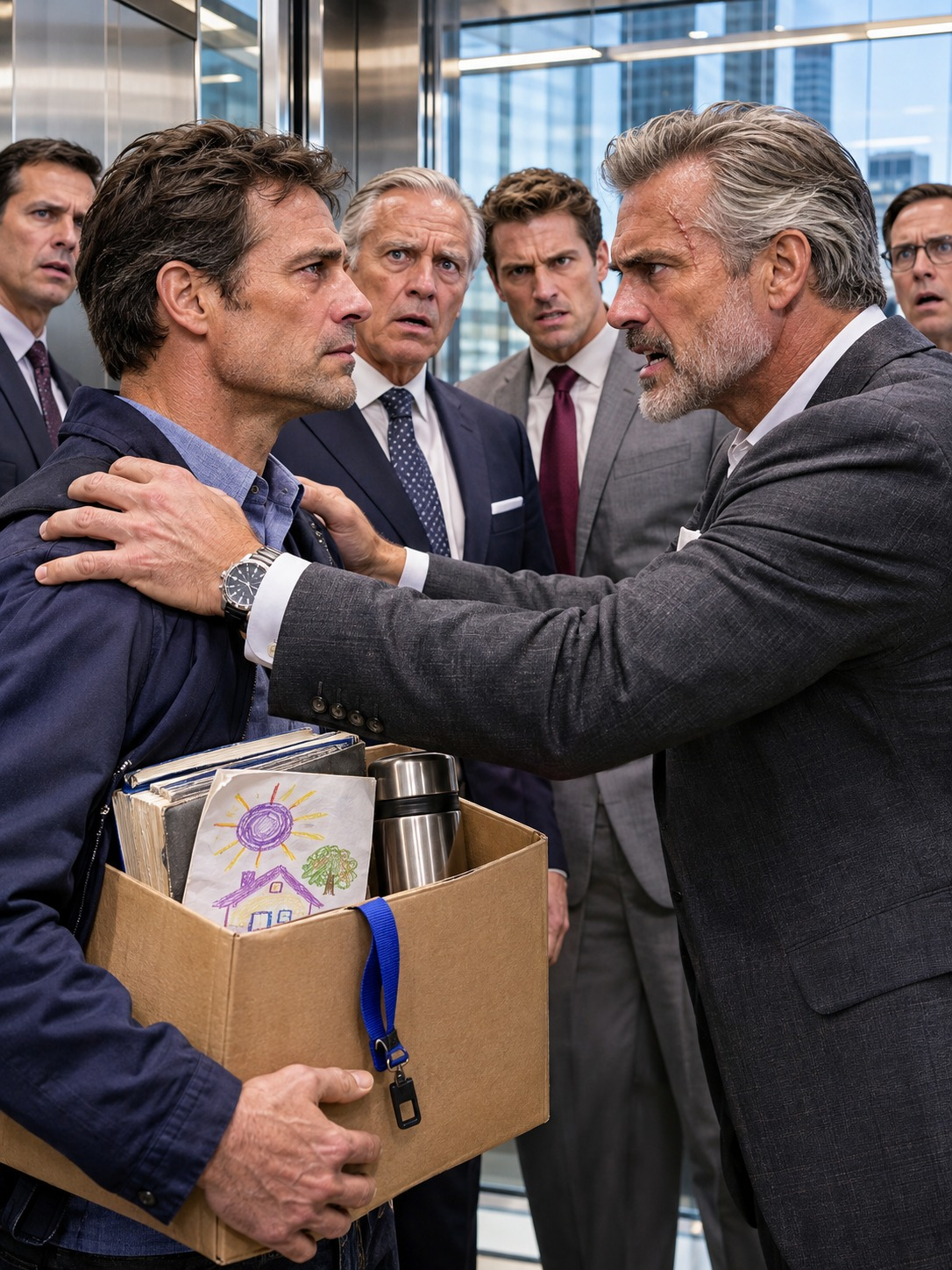
"Mr. Vance, the engineers found a locked steel door beneath the foundation. Your name is written on it. And someone is knocking from the other side."
For three seconds, nobody in the conference room moved.
Then Dr. Evelyn Hart stood so quickly her chair rolled backward.
"Who is speaking with the site team?"
The young assistant looked frightened.
"Daniel Mercer, the independent field supervisor. He's on the line with our operations desk."
"Transfer him here," Dr. Hart said. "Now."
Grant Holloway turned toward the wall display.
"Put the call on speaker."
Across the table, Donald Davenport stared at the assistant.
His face had gone gray.
Darren Boyd looked down at his phone.
Walter Pierce reached for a glass of water, but his hand was shaking badly enough that he set it down without drinking.
I noticed all three reactions.
But my mind was somewhere else.
A locked steel door.
My name written on it.
And knocking from the other side.
The words sounded impossible.
I had never been inside an underground chamber beneath Riverfront Towers. I hadn't approved any modification to the north podium foundation alignment. And I certainly hadn't authorized a sealed compartment bearing my name.
The wall display flickered.
A man's face appeared.
He wore a white hard hat and a fluorescent safety vest. Behind him, I could see temporary lighting, concrete walls, and two other workers standing near a metal barrier.
"Daniel Mercer," he said. "Independent field supervisor."
Dr. Hart stepped closer.
"Daniel, this is Evelyn Hart. First question: Is everyone safe?"
"Yes, ma'am. We have stopped access to the chamber."
"Good. Is anyone inside?"
"We don't know."
"Explain the knocking."
Daniel hesitated.
"We heard three distinct impacts from behind the door. Then another two. We initially thought someone might be trapped."
My stomach tightened.
"Did you contact emergency services?" Dr. Hart asked.
"Yes. Site security initiated the emergency response protocol. Fire-rescue personnel are on their way."
"Do not attempt to force the door until the area has been assessed for confined-space hazards, structural instability, and potentially dangerous atmospheric conditions."
"Understood."
Dr. Hart leaned toward the screen.
"What exactly is written on the door?"
Daniel turned his camera.
The image shifted.
A narrow concrete corridor appeared.
Temporary work lights illuminated a steel door set into a thick wall.
The door was old.
Not newly installed.
Its surface was covered in scratches, corrosion, and several layers of paint.
Near the center, someone had written three words in black marker.
NOLAN VANCE — REVIEW.
I felt the blood drain from my face.
Rachel's voice echoed in my memory.
My daddy makes buildings safe.
I stared at my name.
Not a signature.
Not an approval.
An instruction.
Someone had marked that door for me.
Grant turned toward me.
"Nolan?"
"I've never seen it."
"Are you certain?"
"Absolutely."
Daniel's voice came through the speaker.
"There's another marking below it."
Dr. Hart leaned forward.
"What marking?"
Daniel moved the camera closer.
Beneath my name, partially obscured by rust, was a stenciled designation.
RF-NP-217.
My stomach dropped.
The failed inspection report.
The same number Liam Brooks had found.
I stood.
"Daniel, can you confirm that designation?"
He adjusted the camera.
"RF-NP-217."
I looked at Dr. Hart.
"That's the north podium inspection record."
She nodded slowly.
"Yes."
Grant turned toward Donald.
"Explain this."
Donald didn't answer.
His eyes remained fixed on the screen.
Walter shifted in his chair.
Darren spoke first.
"This is clearly some kind of misunderstanding."
Dr. Hart turned toward him.
"Mr. Boyd, we have not established what the markings mean."
"Exactly," Darren said quickly. "So we shouldn't draw conclusions."
I looked at him.
"For once, Darren, I agree."
He seemed surprised.
I continued.
"We shouldn't draw conclusions. We should preserve the scene, establish what the chamber is, and determine whether anyone is in danger."
Dr. Hart nodded.
"Precisely."
Daniel's voice returned.
"Dr. Hart, there's something else."
"What?"
"The knocking stopped."
I felt my chest tighten.
"Did anyone respond?" she asked.
"Yes. We called out and identified ourselves. There was no verbal answer."
"Do not enter without the emergency team."
"Understood."
Then Daniel turned his camera again.
A technician stood beside the door.
He was holding a handheld gas detector.
Dr. Hart's expression sharpened.
"Daniel, move everyone back until the atmosphere is assessed."
"We already have."
"Good."
Grant looked toward the assistant.
"Stay on the line with the field team."
She nodded.
The display switched to a holding screen.
And the conference room fell silent.
Then Donald Davenport spoke.
Very quietly.
"That chamber should have been filled."
I turned toward him.
"What?"
He looked up.
His expression was terrible.
"Three years ago. Before the north podium foundations were completed."
Dr. Hart leaned forward.
"Mr. Davenport, are you saying you knew the chamber existed?"
Donald swallowed.
"Yes."
I felt anger rise.
"You knew?"
He looked at me.
"Nolan—"
"Did you know before the foundation design was finalized?"
He didn't answer.
I stepped closer to the table.
"Donald, that matters."
"I understand."
"No. I don't think you do."
Rebecca Sloan touched my arm.
A small reminder.
Stay factual.
Stay controlled.
I took a breath.
Then asked again.
"Was the chamber identified before the original foundation design was approved?"
Donald stared at the table.
Finally, he nodded.
"Yes."
Dr. Hart looked at him.
"Was the information provided to the engineer of record?"
Donald hesitated.
"Some information was."
"What information?"
"The abandoned utility corridor."
"And the chamber?"
He looked away.
Dr. Hart's voice hardened.
"Mr. Davenport."
Donald closed his eyes.
"No."
I felt sick.
A concealed underground structure.
Near a foundation.
In an area where groundwater pathways and waterproofing details were already under dispute.
And the responsible engineers had not been given the complete information.
I thought about my forty-page framework.
The mandatory inspection hold points.
The requirements for documenting unforeseen subsurface conditions.
I'd written those provisions precisely because construction projects sometimes revealed things nobody expected.
But you couldn't manage a condition you weren't allowed to know existed.
Grant placed both hands on the table.
"Donald, why wasn't the chamber disclosed?"
Donald looked toward Walter.
Then Darren.
Neither man met his eyes.
Finally, he said:
"Because the remediation estimate would have made the project financially unviable."
The room went still.
Forty-two million dollars.
The estimate Victor Hale had mentioned.
I looked at Donald.
"So you concealed it?"
His expression tightened.
"I authorized a revised remediation strategy."
"That's not what I asked."
Rebecca touched my arm again.
I stopped.
Dr. Hart spoke.
"Mr. Davenport, we need the complete technical record. The existence of a chamber does not by itself establish a structural defect. But withholding known subsurface conditions from the design team can materially compromise the assessment."
Donald nodded.
"I understand."
Grant stared at him.
"Then tell us where the records are."
Donald looked at Walter.
Walter looked down.
And I realized something.
Donald might have known about the chamber.
But Walter knew where the documents had gone.
At 10:34 a.m., the emergency investment committee meeting was suspended.
Not canceled.
Suspended.
Grant instructed Margaret Ellis to coordinate preservation requests and ensure that the independent engineering team had the contractual access necessary to continue its investigation.
Rebecca spoke privately with me.
"Nolan, don't confront Walter or Darren outside the meeting."
"I wasn't planning to."
She studied me.
"You look like you're planning to."
I exhaled.
"Fair."
She gave a small nod.
"Good."
I looked toward the wall display.
The site feed had gone dark while emergency personnel assessed the chamber.
"What do you think is behind that door?" I asked.
Rebecca shook her head.
"I don't know."
"Someone was knocking."
"Possibly. We need confirmation of the source."
I rubbed my forehead.
"That designation was the inspection report number."
"Yes."
"And my name was written on the door."
"Yes."
I looked at her.
"Someone wanted me connected to it."
She paused.
"That's a reasonable concern. But we don't yet know who wrote it or when."
I nodded.
She was right.
Again.
Facts first.
Conclusions later.
But I couldn't shake the feeling that someone had been preparing a story.
A story in which I was the engineer responsible for a hidden chamber.
A story in which I'd approved changes I never saw.
A story in which I'd destroyed records that could prove what really happened.
And now my name was physically written on a door beneath the building.
I looked toward Donald.
He stood near the windows, speaking quietly with Margaret.
Darren was on the phone.
Walter had disappeared into the hallway.
I turned toward Rebecca.
"Where's Walter?"
She looked around.
"I don't know."
I felt my stomach tighten.
He'd been sitting at the far end of the table minutes earlier.
Now he was gone.
I looked toward the conference room exit.
Then my phone vibrated.
A message from Liam Brooks.
Nolan, I heard they found the chamber.
I stared at the screen.
Another message appeared.
I know why your name is on that door.
My pulse quickened.
I typed:
How?
His reply came almost immediately.
Because Franklin ordered the marking during the last inspection cycle.
I froze.
I looked toward Rebecca.
"Liam just contacted me."
She held out her hand.
"Show me."
I handed her the phone.
She read the messages.
Then looked up.
"Don't ask him to retrieve anything. Let his representative know what he's reporting."
I nodded.
Then another message arrived.
It wasn't supposed to say REVIEW.
I stared at the screen.
My stomach tightened.
A third message followed.
The original instruction was to mark it APPROVED BY NOLAN VANCE.
I felt cold.
I looked at Rebecca.
She read the message.
Her expression changed.
"That is significant," she said.
I nodded.
"Someone intended to make it look as though I'd approved the chamber."
"Possibly. We need to verify the instruction and its source."
I took a breath.
Then another message arrived.
I refused to paint the word APPROVED.
I stared at the screen.
Liam.
Of course.
The young technician who kept questioning the records.
The man who'd been pressured into signing a statement.
The man who was frightened of losing his job.
He'd refused.
And someone had apparently changed the marking to REVIEW instead.
I felt a strange mixture of relief and dread.
Relief that Liam had resisted.
Dread because the marking suggested someone had been trying to build a physical trail of false approval.
I looked toward the door.
Walter still hadn't returned.
At 11:06 a.m., Dr. Hart came back into the conference room.
Her expression was serious.
"The emergency team has completed an initial assessment."
Grant stood.
"Is anyone inside?"
"No."
I felt a wave of relief.
"Then what caused the knocking?" I asked.
Dr. Hart looked at me.
"An unsecured metal panel inside the chamber. Air movement from the newly opened access corridor caused it to strike a support frame."
I exhaled.
A mechanical explanation.
Not a trapped worker.
Not someone hiding underground.
Just a loose panel.
But the relief didn't last.
Dr. Hart continued.
"The chamber is accessible under controlled conditions. The independent team has begun a preliminary visual examination."
Grant nodded.
"What have they found?"
She hesitated.
"Evidence that the chamber was used after the original industrial facility closed."
I frowned.
"Used how?"
"Recent electrical modifications. Temporary storage fixtures. Signs of access within the past few years."
My stomach tightened.
"Was it part of the current construction work?"
"We don't know yet."
Grant leaned forward.
"Any structural concerns?"
"Potentially. The chamber is close enough to the north podium foundation system that its location, dimensions, and condition need to be incorporated into the engineering assessment."
I nodded.
"Exactly."
Dr. Hart continued.
"There are also indications of groundwater intrusion."
My pulse quickened.
"The failed membrane inspection."
"Possibly related. We need more information."
I looked at the screen.
RF-NP-217.
The same number.
The same location.
The same unresolved verification.
Dr. Hart turned toward Grant.
"I recommend maintaining the hold on affected construction activities until the independent team completes its assessment."
Grant nodded immediately.
"Agreed."
Donald entered the room.
He'd heard the last sentence.
"How long will that take?"
Dr. Hart looked at him.
"As long as necessary to establish the relevant conditions."
Donald closed his eyes.
"That could cost millions."
I looked at him.
"Donald, an incomplete assessment can cost more."
He stared at me.
For a moment, I thought he'd argue.
Instead, he sat down.
And said nothing.
At 11:42 a.m., the meeting resumed.
This time, the room felt different.
The investors were no longer discussing a routine financing milestone.
They were examining whether the information used to approve the project had been complete and reliable.
Margaret Ellis stood at the front.
She displayed a timeline.
Three years earlier, the original site investigation had identified an abandoned utility corridor and possible subsurface contamination.
A preliminary remediation estimate had been prepared.
Forty-two million dollars.
The estimate was later reduced.
The technical justification cited revised risk controls.
My framework had been included in the financing package.
But the version submitted to investors contained changes I hadn't approved.
The north podium inspection hold point had been weakened.
The foundation alignment had been modified.
And the hidden chamber had not been clearly disclosed to the responsible design team.
I watched the timeline unfold.
Each event had seemed isolated when I first encountered it.
Now they formed a sequence.
A financial problem.
A revised technical justification.
An altered approval record.
A reduced contingency.
A construction milestone.
A failed inspection.
A revised report.
Missing records.
My termination.
Grant looked toward Donald.
"Do you dispute this sequence?"
Donald stared at the screen.
"I dispute the implication that I knowingly authorized falsified engineering documents."
Margaret nodded.
"Then let's address the authorization records."
She displayed the Meridian Advisory Group agreement.
Two signature blocks.
One belonged to Walter Pierce.
The other carried the name of a Meridian executive.
Victor Hale.
I felt my stomach tighten.
Victor had admitted signing an agreement.
Now I could see the document itself.
Margaret continued.
"The agreement delegated certain coordination responsibilities to Meridian, including preparation of financing submissions and consolidation of technical materials."
Dr. Hart leaned forward.
"Consolidation is not the same as engineering approval."
"Correct," Margaret said.
She displayed the next page.
A technical submission protocol.
It required that material changes to engineering assumptions be approved by the responsible licensed professionals.
I stared at the clause.
That was the safeguard.
The one someone had bypassed.
Margaret turned toward Darren.
"Mr. Boyd, what was your role at Meridian during this period?"
Darren adjusted his tie.
"I was a consultant."
"What kind of consultant?"
"Investment strategy."
"Did you have authority to revise engineering requirements?"
"No."
"Did you prepare the revised technical risk summary?"
"I participated in coordinating the materials."
Margaret looked at him.
"Did you change the inspection hold-point language?"
Darren hesitated.
"I don't recall making that specific edit."
I watched him.
He wasn't denying it.
He was avoiding a direct answer.
Margaret continued.
"Did you authorize anyone else to make it?"
Darren looked toward Donald.
Then back at Margaret.
"I would need to review the complete records."
Grant leaned forward.
"You've had two days to review them."
Darren's jaw tightened.
"These are complicated documents."
Dr. Hart spoke calmly.
"Mr. Boyd, the change removed a mandatory verification step. That is not a minor formatting difference."
Darren looked at her.
"I understand."
"Then who approved the change?"
He didn't answer.
The silence stretched.
Then Donald spoke.
"Darren, answer the question."
Darren turned toward him.
"Donald—"
"Answer it."
For the first time, I heard genuine anger in the chairman's voice.
Darren swallowed.
"I was told the revised language had been approved."
"By whom?" Donald demanded.
Darren looked toward the empty chair at the far end of the table.
Walter's chair.
I felt my pulse quicken.
"By Walter Pierce," Darren said.
The room went silent.
Grant looked toward Margaret.
"Where is Walter?"
She checked her phone.
Then looked toward the assistant.
"Please locate Mr. Pierce."
The assistant left.
I stared at the empty chair.
Walter had disappeared just as the meeting began examining the approval chain.
That wasn't proof of anything.
But it was troubling.
Very troubling.
At 12:18 p.m., Margaret received a call.
She stepped into the hallway.
When she returned, her expression had changed.
"Grant, may I speak with you privately?"
He stood.
They moved toward the window.
I couldn't hear everything.
But I caught two words.
Document control.
Then another.
Preservation.
Grant turned sharply.
"Are you certain?"
Margaret nodded.
He looked toward the conference table.
Then said:
"We need to inform everyone."
They returned.
Grant stood at the head of the table.
"There's been an attempt to access the engineering archive."
My stomach tightened.
Donald looked up.
"What?"
Margaret spoke.
"An administrative account attempted to initiate a bulk deletion process involving archived Riverfront project records."
I felt cold.
"When?"
"Approximately twenty minutes ago."
I stared at her.
During the meeting.
While the investment committee was examining the altered documents.
Someone had tried to delete the records.
Again.
Donald stood.
"Who authorized it?"
Margaret looked directly at him.
"That's under investigation."
Darren shifted in his chair.
Grant continued.
"The process was blocked by the preservation controls implemented after our formal notice."
I felt relief.
At least the records hadn't disappeared.
Not this time.
Margaret looked toward Donald.
"Mr. Davenport, Crestline's counsel needs to ensure that all relevant systems remain preserved and that authorized personnel cooperate with the investigation."
Donald nodded.
"Of course."
But he looked shaken.
Then Margaret added:
"The attempted deletion used an account associated with executive operations."
I stared at Walter's empty chair.
Donald followed my gaze.
His expression darkened.
"Walter."
Nobody answered.
Then the assistant returned.
She looked pale.
"Mr. Holloway?"
Grant turned.
"Yes?"
"Mr. Pierce has left the building."
The room went silent.
Donald stood.
"Where did he go?"
"We don't know."
"Did he say anything?"
The assistant hesitated.
"He told security he had an urgent appointment."
Grant looked toward Margaret.
"Notify Crestline's counsel and preserve the relevant access records."
She nodded.
Donald sat down slowly.
For the first time, he looked like a man who had lost control of the company he'd spent his life building.
At 1:03 p.m., I stepped into a smaller conference room with Rebecca.
My phone had been vibrating repeatedly.
Rachel.
Liam.
An unfamiliar number.
I called Rachel first.
She answered immediately.
"Nolan?"
"Hey. Everything okay?"
"Yes. Chloe's at school."
I exhaled.
"Good."
She hesitated.
"How's the meeting?"
I looked through the glass wall.
Grant was speaking with Dr. Hart.
Donald sat alone.
Darren was surrounded by attorneys.
"Complicated."
Rachel gave a tired laugh.
"That seems to be the word of the week."
I smiled faintly.
"Yeah."
Then she said:
"Nolan, someone from Crestline called the house."
My stomach tightened.
"Who?"
"They said they were from corporate security."
"What did they want?"
"They asked whether you had received a package."
I stared at the wall.
The box.
The Meridian agreement.
The unknown sender.
"Did you answer?"
"No. I told them to contact your attorney."
I felt relief.
"Good."
She continued.
"But they knew the exact wording written on the package."
My pulse quickened.
"What?"
"They asked about a box marked 'For the man who refused to sign.'"
I felt cold.
Only a few people knew about that box.
Caroline.
Rebecca.
Grant's legal team.
Victor.
And whoever had been monitoring its delivery.
I took a breath.
"Rachel, keep the doors locked. Don't discuss the package with anyone. I'll tell Rebecca."
"Okay."
She paused.
"Nolan?"
"Yes?"
"Be careful."
I closed my eyes.
"I will."
We ended the call.
I turned toward Rebecca.
She'd heard enough to understand.
"Someone knows about the package," I said.
She nodded.
"We'll document the call and coordinate safe handling of the materials."
I looked toward the conference room.
"Do you think Walter is trying to recover it?"
Rebecca hesitated.
"Possibly. But we shouldn't assume."
I nodded.
Then my phone vibrated.
A message from Liam.
Nolan, I need to tell you something about RF-NP-217.
I stared at the screen.
Another message appeared.
The report wasn't originally about waterproofing.
My stomach tightened.
I typed:
What do you mean?
His reply came immediately.
The original field observation included the chamber.
I froze.
Another message.
Franklin separated the chamber observation from the membrane inspection before the revised report was issued.
I stared at the screen.
That changed everything.
The failed inspection wasn't just about a membrane discontinuity.
It was also about an undocumented underground structure.
The two conditions had been recorded together.
Then someone had separated them.
The membrane issue became a routine construction defect.
The chamber disappeared from the revised report.
I showed Rebecca.
She read the messages carefully.
Then said:
"That needs to be brought to the independent engineering team through the proper process."
I nodded.
"Agreed."
She continued.
"And Nolan?"
"Yes?"
"If this is accurate, it may explain why the original report was so important."
I stared at her.
"Because it documented the chamber before the financing milestone."
She nodded.
"Exactly."
I felt sick.
The timing.
Again.
The dates.
The records.
The signatures.
Everything seemed to lead back to what the company knew and when it knew it.
At 2:11 p.m., Dr. Hart asked me to join a technical discussion.
She had received preliminary measurements from the north podium chamber.
The chamber was approximately thirty feet long and twelve feet wide.
Its roof slab was reinforced concrete.
The walls appeared to be part of an older industrial utility structure.
The chamber was not directly beneath the primary tower core.
But it was close enough to the podium foundation system to require further evaluation.
Dr. Hart displayed a cross-section.
I studied it carefully.
"What's the elevation of the chamber roof?"
She gave me the measurement.
I compared it with the original foundation drawings.
My stomach tightened.
"That's close."
She nodded.
"Yes."
"Have they confirmed the horizontal offset?"
"Not yet. They're surveying it now."
I looked at the drawing.
The original foundation alignment.
The revised alignment.
The abandoned corridor.
The chamber.
I could see why the change mattered.
A shift in foundation location could alter how loads interacted with adjacent subsurface structures.
It could affect excavation support.
Groundwater pathways.
Waterproofing details.
And the assumptions used in the original design.
I looked at Dr. Hart.
"Has the engineer of record been notified?"
"Yes."
"Good."
She studied me.
"You're worried."
"Yes."
"About what?"
I pointed toward the cross-section.
"The revised alignment may have been treated as a routine field adjustment."
She nodded.
"That's one of the questions we're examining."
"But if the chamber wasn't disclosed, the design team may not have evaluated the actual condition."
"Correct."
I took a breath.
"Then we need to know whether the foundation system was designed for the real geometry."
Dr. Hart looked at me.
"Exactly."
For a moment, we stood in silence.
Then she said:
"Nolan, your original framework required an inspection hold point before concealment of the north podium construction joint."
I nodded.
"Yes."
"Why did you include it?"
I looked at the cross-section.
"Because that joint was located near a transition between foundation elements. I wanted confirmation that the waterproofing and structural details matched the approved design before the area became inaccessible."
She nodded.
"And if the foundation alignment changed?"
"The verification requirements should have been reassessed."
She looked at me.
"That's what I thought."
I stared at the screen.
Then noticed something.
A dimension.
Small.
Easy to overlook.
I leaned closer.
"Wait."
Dr. Hart looked at me.
"What?"
I pointed.
"That offset."
She studied it.
"Yes?"
"The revised foundation alignment moved the north podium closer to the abandoned corridor."
She nodded.
"That's correct."
I felt cold.
"But the remediation estimate was reduced after the alignment change."
Dr. Hart looked at me.
For a moment, neither of us spoke.
Then she said:
"That inconsistency needs explanation."
I nodded.
"Yes."
Because moving a foundation closer to an uncertain subsurface condition would not automatically justify reducing the contingency associated with that condition.
If anything, it could require more investigation.
Unless someone had changed the risk assumptions.
Or concealed the condition.
Or both.
At 3:27 p.m., Grant reconvened the investment committee.
This time, Donald sat alone.
Darren had left with his attorney.
Walter remained missing.
The room was quieter.
But the tension was worse.
Grant stood.
"We have enough information to conclude that the current financing package cannot be relied upon without further independent verification."
Nobody objected.
He continued.
"The next investment milestone remains suspended."
Again, nobody objected.
Margaret spoke.
"We will pursue the appropriate contractual remedies, preserve all relevant records, and coordinate with the independent technical reviewers."
Grant nodded.
Then turned toward Donald.
"Donald, Crestline needs to cooperate fully."
Donald looked exhausted.
"I understand."
Grant studied him.
"Do you?"
Donald looked up.
For a moment, I saw the chairman I'd known for nine years.
The confident executive.
The man who spoke at company meetings about integrity and responsibility.
But now his voice was barely audible.
"I built Crestline from twelve employees."
Nobody spoke.
"Twenty-eight years."
He looked around the table.
"I thought I knew the people running it."
Grant's expression didn't change.
"Then help us establish what happened."
Donald nodded slowly.
"I will."
He looked toward me.
"Nolan."
I sat straighter.
"Yes?"
"I owe you an apology."
I didn't answer.
He continued.
"I allowed people to use my authority without sufficient oversight. I accepted assurances I should have verified."
I looked at him.
"Donald, the apology matters. But the records matter more."
He nodded.
"I know."
Then he said:
"There's something I haven't told you."
My stomach tightened.
"What?"
He looked toward Grant.
Then back at me.
"Three years ago, I received a report about the chamber."
I stared at him.
"From whom?"
He hesitated.
"An outside consultant."
I leaned forward.
"Victor Hale?"
Donald nodded.
"Yes."
I felt cold.
"What did the report say?"
He swallowed.
"That the chamber might contain evidence of earlier industrial activity."
Dr. Hart leaned forward.
"What kind of evidence?"
Donald looked down.
"Storage records. Equipment. Possibly hazardous materials."
I stared at him.
"Was the report provided to the environmental consultants?"
He hesitated.
"Not in its original form."
My stomach tightened.
"Why?"
Donald looked toward the window.
"Because Walter told me the report was preliminary and unreliable."
I felt anger rise.
"And you believed him?"
Donald closed his eyes.
"Yes."
I took a breath.
"Did you ask for an independent review?"
He shook his head.
"No."
I stared at him.
Then he said:
"That was a mistake."
I looked at the table.
A mistake.
A word that seemed painfully small for what had happened.
But I didn't argue.
Not yet.
Donald continued.
"The report also mentioned a sealed compartment inside the chamber."
My pulse quickened.
"A compartment?"
He nodded.
"Yes."
"What was inside?"
He hesitated.
"I don't know."
Dr. Hart leaned forward.
"Was the compartment identified on any drawings?"
Donald shook his head.
"No."
I felt cold.
"Then how did Victor know about it?"
Donald looked at me.
"Because he'd been inside."
I stared at him.
Victor.
The man who'd disabled the generator in West Texas.
The man who'd signed the Meridian agreement.
The man who'd warned me about the buried structure.
He'd been inside the chamber.
I took a breath.
"When?"
Donald hesitated.
"Before the foundation alignment was changed."
My stomach tightened.
"And he didn't tell the engineering team?"
Donald shook his head.
"No."
I stared at him.
Then asked:
"Why?"
Donald looked down.
"Because Walter told him not to."
The room went silent.
Grant leaned forward.
"Donald, do you have evidence of that instruction?"
Donald hesitated.
"Yes."
My pulse quickened.
"Where?"
He looked toward his briefcase.
Then slowly opened it.
Inside was a thin folder.
He placed it on the table.
Margaret reached for it.
Donald stopped her.
"Before you read this, there's something you need to understand."
Grant stared at him.
"What?"
Donald looked toward me.
"The chamber was not originally part of the Riverfront development."
I frowned.
"We know that."
He shook his head.
"No. You don't understand."
I leaned forward.
"What do you mean?"
Donald swallowed.
"The chamber was part of a private storage facility."
My stomach tightened.
"Owned by whom?"
He hesitated.
"Meridian Advisory Group."
I froze.
"What?"
Donald nodded.
"Through a subsidiary."
I stared at him.
"Meridian owned an underground storage facility beneath the property before Crestline acquired the development rights?"
Donald looked at me.
"Yes."
My mind raced.
That could explain why Victor knew about the chamber.
Why the records were incomplete.
Why the environmental disclosures mattered.
Why the financing agreement contained unusual technical coordination provisions.
I took a breath.
"What was stored there?"
Donald looked at the folder.
Then said:
"That's what the report was supposed to establish."
I stared at him.
"And?"
He hesitated.
"The inspection was never completed."
I felt sick.
"Why?"
Donald looked toward Grant.
Then back at me.
"Because Walter ordered the chamber sealed."
The room went silent.
I stared at him.
"Before the environmental assessment?"
He nodded.
"Yes."
Dr. Hart closed her eyes.
Then opened them.
"Mr. Davenport, that information must be provided to the appropriate environmental and engineering professionals immediately."
Donald nodded.
"I understand."
Grant looked at Margaret.
"Make sure it happens."
She nodded.
Then Donald pushed the folder across the table.
Margaret opened it.
Inside was a single-page memorandum.
She read silently.
Her expression changed.
Grant leaned forward.
"What is it?"
Margaret looked up.
"The memorandum references a storage inventory."
I felt my pulse quicken.
"What inventory?"
She turned the page toward us.
A list of materials.
Equipment.
Containers.
Archived records.
And one item marked:
SEALED STEEL CABINET — AUTHORIZED ACCESS ONLY.
I stared at it.
The chamber.
The sealed compartment.
The missing records.
I looked at Donald.
"Was the cabinet ever opened?"
He shook his head.
"Not officially."
I felt cold.
"What does that mean?"
He hesitated.
"Someone accessed it after the chamber was sealed."
My pulse quickened.
"Who?"
Donald looked toward the door.
Then said:
"Walter."
I stared at him.
"How do you know?"
He swallowed.
"Because the access log carries his authorization code."
I felt my jaw tighten.
Again.
Walter.
The executive operations director.
The man who'd ordered my termination.
The man who'd requested my notebooks.
The man whose department attempted to delete records during the meeting.
And now the man connected to a sealed cabinet beneath Riverfront Towers.
I looked toward Grant.
He was staring at the memorandum.
Then Margaret's phone vibrated.
She looked down.
Her expression changed.
"Grant."
He turned.
"What?"
"The site team has opened the internal cabinet."
My heart began pounding.
Dr. Hart stood.
"Under what conditions?"
"After the emergency and environmental safety assessment authorized controlled access."
She nodded.
"Good."
Grant leaned forward.
"What did they find?"
Margaret looked at her phone.
Then at me.
Her face had gone pale.
"Nolan."
I sat straighter.
"What?"
She swallowed.
"They found documents."
My pulse quickened.
"What kind?"
"Original engineering records."
I stared at her.
"From Riverfront?"
She nodded.
"Yes."
I felt cold.
"Anything else?"
Margaret hesitated.
"Personal items."
I frowned.
"Whose?"
She looked directly at me.
"Yours."
The room went silent.
I stared at her.
"That's impossible."
She shook her head.
"The site supervisor sent photographs."
I felt my heart pounding.
"What items?"
Margaret turned her phone toward me.
On the screen was a photograph of an open steel cabinet.
Inside were several folders.
A hard hat.
An old engineering notebook.
And a small cardboard box.
My stomach dropped.
A cardboard box.
The same size as the one I'd carried out of Crestline.
The same cheap brown material.
The same black printing.
I leaned closer.
On the side was a price sticker.
$2.40.
I felt cold.
Then I saw something else.
A drawing.
Folded.
Tucked beneath the notebook.
A purple sun.
A yellow house.
A green tree.
Three stick figures holding hands.
My daughter's drawing.
I stopped breathing.
Rachel's voice echoed in my memory.
My daddy builds giant towers that keep the rain away.
I stared at the photograph.
That drawing had been inside my termination box.
I'd brought it home.
I'd placed it on my desk.
I'd looked at it the night before.
It couldn't be underground.
Not unless someone had made a copy.
Or taken a photograph.
Or deliberately recreated the contents of my box.
I looked at Margaret.
"That isn't my box."
She nodded.
"We haven't established that it is."
I pointed toward the drawing.
"Someone copied it."
Grant looked at me.
"Why?"
I stared at the photograph.
Then I noticed something.
A small mark in the lower corner.
A handwritten notation.
Not part of Chloe's drawing.
Not something I'd ever seen before.
Three letters.
And a number.
M.A.G. — 041.
My pulse quickened.
Meridian Advisory Group.
Forty-one.
The same number in my framework identifier.
RF-ST-041.
I felt cold.
Someone had placed a copy of my daughter's drawing inside a sealed underground cabinet.
Someone had connected it to the altered technical framework.
Someone wanted investigators to find it.
Or wanted me to believe they had.
I looked at Grant.
"This was staged."
He didn't answer.
Dr. Hart leaned forward.
"We need to preserve the scene and establish when those items were placed there."
I nodded.
"Yes."
Margaret's phone vibrated again.
She read the message.
Then looked up.
"The site supervisor found another document."
My stomach tightened.
"What?"
She hesitated.
"A sealed envelope."
I stared at her.
"Addressed to whom?"
She looked directly at me.
"Nolan Vance."
My pulse quickened.
"What's inside?"
Margaret swallowed.
"The envelope hasn't been opened."
I stared at her.
Then she continued.
"But there's writing on the back."
I felt cold.
"What does it say?"
Margaret looked at the screen.
Her voice was barely audible.
"It says, 'For Chloe, when she is old enough to understand what her father discovered.'"
I stopped breathing.
Chloe.
My eight-year-old daughter.
Someone had written her name on an envelope hidden beneath Riverfront Towers.
Someone had copied her drawing.
Someone had connected my family to a technical investigation that began years before she understood what I did for a living.
I stood.
My chair scraped against the floor.
Grant looked at me.
"Nolan—"
I held up a hand.
"Don't."
He stopped.
I looked at Margaret.
"Has anyone touched the envelope?"
"Only the authorized evidence team, using their documented handling procedures."
I nodded.
"Good."
My voice sounded strange.
Too calm.
Too controlled.
I looked toward the window.
Then back at the table.
"Someone is trying to make this personal."
Nobody answered.
Because everyone knew I was right.
Then my phone vibrated.
A message from Rachel.
Nolan, Chloe's school just called.
My stomach dropped.
I opened the message.
Another line appeared.
Someone came to the front office asking to deliver a letter to her.
I felt cold.
Then a third message.
The letter had your name on it.
I stared at the screen.
My hands began shaking.
I called Rachel.
She answered immediately.
"Nolan?"
"Is Chloe safe?"
"Yes. She's with the principal."
I closed my eyes.
"Thank God."
Rachel continued.
"The school wouldn't release her to anyone."
"Good."
"But Nolan—"
"What?"
"The person left the letter."
My stomach tightened.
"Did the principal open it?"
"No."
"Good. Tell them to preserve it and contact the appropriate authorities if necessary."
Rachel took a shaky breath.
"Okay."
I looked toward Rebecca.
She was already reaching for her phone.
Then Rachel said:
"Nolan, the school secretary recognized the person."
I froze.
"What?"
"She said he'd been there before."
My pulse quickened.
"When?"
"Earlier this week."
I stared at the wall.
The call about Chloe's pickup schedule.
The questions about my work hours.
Someone had been watching.
Someone had been preparing.
"Rachel, who was it?"
She hesitated.
Then said:
"The secretary said he showed a Crestline Engineering identification card."
I felt cold.
"Who?"
Rachel took a breath.
"Nolan, the name on the card was—"
The call disconnected.
I stared at the screen.
Then another message arrived.
From an unknown number.
The envelope under Riverfront is only the beginning.
My heart began pounding.
A second message appeared.
Your daughter has the original.
I froze.
The original.
The drawing.
The one Chloe had made.
The one I'd carried home.
The one I'd placed on my desk.
I stared at the screen.
Then a third message arrived.
Ask her what she drew behind the house.
I felt cold.
I remembered the purple sun.
The yellow house.
The green tree.
The three stick figures.
And suddenly, I remembered something else.
Chloe had drawn that picture on a Saturday.
A Saturday when I'd taken her to the Riverfront construction site for a family open house.
She'd spent nearly an hour sitting beside the visitor center window, drawing the cranes and buildings.
I'd assumed the house was imaginary.
But now I wasn't sure.
I looked at Rebecca.
"There's something I need to check."
She frowned.
"What?"
I swallowed.
"Chloe's original drawing."
Grant stepped closer.
"Nolan, what are you thinking?"
I stared at my phone.
Then at the photograph of the underground cabinet.
The copied drawing.
The handwritten notation.
The sealed envelope.
I felt a terrible realization beginning to form.
"Someone thinks Chloe saw something at Riverfront."
Rebecca looked at me.
"What?"
I took a breath.
"Something she drew without understanding what it meant."
Then my phone vibrated again.
This time, the message came from Rachel.
Only four words.
He's inside the school.
I stopped breathing.
Another message appeared.
The principal locked the office.
I stared at the screen.
Then a third message.
Chloe says she knows him.
My hands went cold.
I called Rachel again.
No answer.
I tried once more.
Straight to voicemail.
Then my phone rang.
Unknown number.
I answered immediately.
"Hello?"
A man's voice spoke.
Calm.
Familiar.
Too familiar.
"Nolan, don't panic."
I froze.
I knew that voice.
I'd heard it in conference rooms.
On construction sites.
Across my desk.
For years.
The man continued.
"Your daughter is safe. But we need to talk about what she drew."
I gripped the phone.
"Who are you?"
A pause.
Then he said:
"You know exactly who I am."
I stared at the screen.
And suddenly, the name appeared.
A contact I'd saved years ago.
A man I'd trusted with inspection records.
A man who'd signed the failed report.
A man who'd accused me of removing documents.
Franklin Shaw.
I felt my stomach drop.
"Franklin, stay away from my daughter."
He was silent.
Then he said:
"Nolan, I'm not the person you should be afraid of."
I stared at the phone.
"What does that mean?"
He took a breath.
"Because the person who ordered me to approach Chloe is standing beside her right now."
I froze.
"Who?"
Franklin hesitated.
Then said:
"Nolan, you need to understand something about the drawing."
My heart pounded.
"What?"
"The house she drew wasn't a house."
I stopped breathing.
He continued.
"It was the entrance to the underground chamber."
I stared at the wall.
The yellow house.
The green tree.
The purple sun.
The stick figures.
And something hidden behind the house.
I felt cold.
"Franklin, what did Chloe see?"
He didn't answer.
Instead, I heard a door open on his end.
A child's voice.
My daughter's voice.
"Daddy?"
My heart nearly stopped.
"Chloe!"
She sounded frightened.
"Daddy, the man from the building is here."
I gripped the phone.
"What man, sweetheart?"
She hesitated.
Then whispered:
"The man who told me not to draw the red door."
I felt the room tilt.
A red door.
Not yellow.
Not green.
Red.
A detail I'd never noticed.
A detail someone had apparently tried to make her forget.
I swallowed.
"Chloe, listen to me. Stay with your principal. Don't go anywhere with anyone."
She took a shaky breath.
"Okay."
Then she whispered:
"Daddy?"
"Yes, sweetheart?"
"The man said you already know what's behind the door."
I stared at the wall.
"No, honey. I don't."
She was quiet.
Then said:
"But Daddy..."
I held my breath.
"What?"
Her voice became very small.
"The man behind the red door was in the picture I drew."
My stomach dropped.
"What man?"
She hesitated.
Then whispered:
"I didn't draw his face because he told me not to."
I closed my eyes.
"Chloe, who was he?"
There was a sound on the other end.
Footsteps.
A chair scraping.
Then a man's voice.
"That's enough, Chloe."
I froze.
The voice wasn't Franklin's.
It was deeper.
Older.
And painfully familiar.
I heard Chloe gasp.
Then she whispered:
"Daddy, he's here."
I felt my heart hammering.
"Who, sweetheart?"
She took one frightened breath.
Then said:
"The man who told me to hide the picture is standing right next to me. And Daddy... he's the same man who came to our house the night you lost your job."






Comments 0