The signature on the document belonged to Darren Boyd.
That was impossible.
Darren hadn't even worked at Crestline Engineering when I'd written the technical framework.
Yet there it was.
His name.
His title.
His signature.
Printed beneath the words Prepared By on a document that had helped secure one of the largest infrastructure investments in North Texas.
I stared at the page.
For a moment, I forgot about the cardboard box in my arms.
I forgot about losing my job.
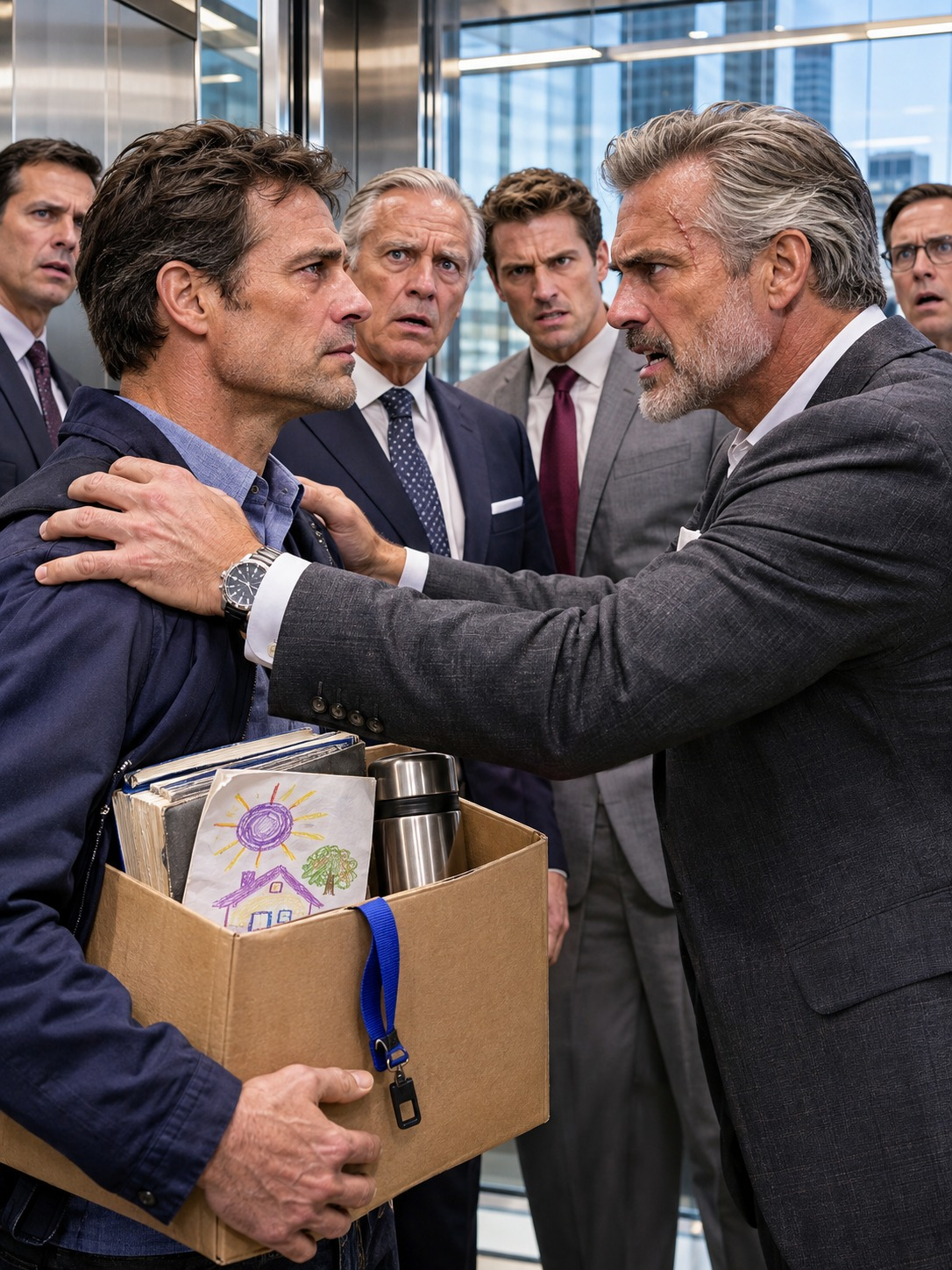
I even forgot that six other men were standing inside the elevator, waiting for someone to speak.
All I could see was a name that had no business being there.
"Darren Boyd," I said quietly.
Grant Holloway looked at me.
"That's what it says."
I shook my head.
"He didn't write that."
Darren immediately straightened.
"Now, Nolan, let's not make accusations based on a misunderstanding."
I turned toward him.
"That's not an accusation."
"Then what is it?"
"A fact."
His expression hardened.
I continued.
"You joined Crestline two years ago. That framework was completed three years ago."
Nobody moved.
Grant looked slowly from me to Darren.
"Is that correct?"
Darren adjusted his tie.
"The technical package went through multiple revisions. My name may have been added during subsequent administrative updates."
"Administrative updates?" Grant repeated.
"Yes."
Grant lowered his eyes to the page.
"Interesting."
He turned it over.
Then back again.
"Because this document is dated March 14, three years ago."
Darren said nothing.
Grant looked directly at him.
"According to the investment committee records, this is the original submission copy. Not a later revision."
Donald's face had become unusually still.
I knew that expression.
I'd seen it on construction sites when a superintendent discovered an inspector had found something nobody wanted documented.
It was the expression of a man calculating how much trouble he was in.
Donald cleared his throat.
"Grant, I think we're getting distracted by an internal document-control issue."
Grant turned toward him.
"Are we?"
"These technical submissions often involve multiple departments. Names can be updated. Responsibilities can be reassigned."
"Before someone joins the company?"
Donald hesitated.
"Obviously, that would require clarification."
Grant folded the document once.
Very carefully.
"Then clarify it."
The elevator remained silent.
One of the investors, a man wearing rectangular glasses, looked toward Darren.
Another glanced at Donald.
I stood in the corner with my cardboard box pressed against my chest.
My arms were beginning to ache, but I refused to put it down.
Something about holding that box had become important.
It was evidence of what had happened.
Nine years of service.
A termination notice.
A cheap container for my belongings.
And now the people responsible were standing in front of a man who appeared to know exactly what they'd thrown away.
Darren tried again.
"Mr. Holloway, with respect, technical authorship isn't always as straightforward as a single engineer's name."
Grant nodded.
"You're right."
Darren seemed relieved.
"For a project of this complexity, numerous professionals contribute—"
"But the person who prepared the technical framework should still be identifiable."
Darren stopped.
Grant continued.
"Especially when the document was presented to investors as evidence of engineering competence."
Donald stepped forward.
"Grant, why don't we continue this discussion upstairs? We have a conference room prepared, and I'm sure our legal department can explain the documentation process."
Grant didn't move.
"Why?"
Donald blinked.
"Excuse me?"
"Why should we go upstairs?"
"Because this is hardly the appropriate setting."
Grant looked around the elevator.
"Six executives and investors. The engineer whose name appears to have been removed from a critical technical document. And the vice president whose signature replaced it."
He paused.
"Seems like an appropriate place to start."
Donald's jaw tightened.
For the first time, I saw irritation beneath his polished expression.
Not outrage over a possible falsified document.
Not concern about my termination.
Irritation that the conversation was happening somewhere he couldn't control it.
I knew that feeling too.
I'd sat through enough management meetings to recognize when an executive wanted to move a difficult conversation behind a closed door.
Behind closed doors, there were agendas.
Prepared statements.
Legal representatives.
People whose job was to turn uncomfortable facts into manageable language.
Inside this elevator, there was only the truth.
Or at least the beginning of it.
Grant turned toward me.
"Nolan, do you remember preparing this document?"
"Every page."
"Tell me about it."
I looked at Donald.
Then Darren.
Neither appeared pleased.
"Three years ago, Riverfront Towers was still in preliminary development. The foundation design had been revised twice because the geotechnical reports showed more groundwater movement than the original assumptions allowed."
Grant nodded.
I continued.
"The development team wanted a technical framework explaining how the project would address subterranean moisture, seismic connections, and long-term structural movement."
"Why?"
"Because the investment committee had raised concerns about the site conditions."
Grant gave a small nod.
"That's correct."
I shifted the box against my chest.
"The original waterproofing concept depended too heavily on ideal installation conditions. I recommended additional inspection points, revised cold-joint details, and a more conservative approach to certain foundation interfaces."
Darren crossed his arms.
"Those recommendations were later integrated into a broader company strategy."
I ignored him.
"The framework wasn't just a collection of specifications. It established a sequence of verification requirements. Certain work couldn't be concealed until inspection evidence was documented."
Grant looked interested.
"Hold points?"
"Exactly."
He nodded.
I could see that he understood.
That surprised me less than it might have surprised the others.
Grant had started in the field.
He knew what happened when construction schedules moved faster than inspections.
"What did those hold points protect against?" he asked.
"Several things. Water intrusion. Incomplete membrane repairs. Improperly documented post-tensioning interfaces. Conditions that might not become visible until years after occupancy."
Grant looked toward Donald.
"Sounds important."
"It was," I said.
Darren exhaled sharply.
"Nobody is disputing the importance of structural integrity."
I turned toward him.
"Then why was I terminated for insisting on the inspections?"
He opened his mouth.
Closed it.
Then looked toward Donald.
The chairman stepped in.
"Nolan, your separation was part of a broader financial restructuring. It was not a judgment about any individual engineering recommendation."
I stared at him.
"Then why was I the only person in my department selected?"
Donald's eyes narrowed slightly.
"Personnel decisions involve confidential considerations."
"Of course."
I said it without sarcasm.
That seemed to bother him more.
Grant looked at me.
"Only person?"
I nodded.
"That's what Human Resources told me."
Grant's expression changed.
"Four hundred thousand dollars?"
I looked at him.
"How did you know that number?"
He didn't answer immediately.
Instead, he looked toward Darren.
"Because your vice president mentioned it during our preliminary discussion this morning."
Darren went pale.
Grant continued.
"He described the reduction as a significant efficiency improvement."
I felt something cold settle in my stomach.
So that was how it worked.
Before I had even finished packing my desk, my termination had already become a talking point in an investor presentation.
I was no longer Nolan Vance.
I was a cost reduction.
A number on a slide.
A success story in someone else's quarterly report.
Grant studied my face.
"You didn't know?"
"No."
He nodded slowly.
Then he turned toward Donald.
"Let me make sure I understand. You eliminated a senior structural engineer responsible for a major portion of the project's technical risk controls, and you presented the resulting savings as an operational improvement."
Donald spread his hands.
"That's an unfair characterization."
"Then give me a fair one."
"Modern engineering organizations have to evolve."
Grant waited.
"Automation has changed the way projects are delivered."
Grant continued waiting.
"We can't operate indefinitely under legacy staffing models."
Grant looked toward me.
Then back at Donald.
"Do you know what I find interesting?"
Donald said nothing.
"Every time I ask about engineering risk, someone answers with staffing terminology."
One of the investors shifted his weight.
The man with glasses removed them and cleaned the lenses.
Darren stared at the elevator floor.
Grant spoke again.
"Let's talk about the framework."
Donald visibly relaxed at the change of subject.
That relaxation lasted approximately three seconds.
"Who authorized the replacement of Nolan's name?"
The chairman's expression tightened again.
"I don't know that anyone replaced anything."
Grant unfolded the page.
He held it beside my cardboard box.
"Nolan says he prepared it. The document predates Darren's employment. Yet Darren's signature appears in the authorship block."
Donald looked toward Darren.
"Darren?"
For the first time since entering the elevator, the vice president seemed genuinely uncertain.
"I'd have to review the document history."
Grant nodded.
"Good."
He reached into his jacket and removed his phone.
Darren's eyes followed the movement.
Grant tapped the screen.
Then held it to his ear.
"Margaret? It's Grant."
He paused.
"I'm at Crestline headquarters. I need you to preserve the original Riverfront Towers investment submission records, including document metadata and revision history."
Donald stepped forward.
"Grant, that's unnecessary."
Grant raised one finger.
Not aggressively.
Just enough to stop him.
"Yes," Grant continued into the phone. "The March fourteenth technical framework. Revision Seven. And the associated transmittal records."
He listened.
"Correct. Preserve them as they exist. No alterations."
Another pause.
"Thank you."
He ended the call.
Darren stared at him.
"Who was that?"
"My general counsel."
The answer landed heavily.
Donald looked toward the investors.
One of them had begun typing on his phone.
The others remained silent.
Grant slipped his phone back into his pocket.
"Now," he said, "I'd like to hear from Nolan."
I looked at him.
"About what?"
"Why you were really fired."
I hesitated.
"I don't know that I can answer that."
"Tell me what you do know."
I thought about Liam.
About the north podium waterproofing.
About the core samples.
About the pressure to approve inspections before the evidence was complete.
I also thought about the confidentiality obligations I'd signed years earlier.
I wasn't going to disclose protected project information in front of people whose roles I didn't fully understand.
Even if I no longer worked for Crestline.
Even if I was angry.
Even if Grant was standing there offering me the kind of attention I'd never received from management.
"I can tell you that I disagreed with changes to the inspection schedule," I said.
Grant nodded.
"What changes?"
"Some physical verification steps were being treated as administrative delays."
Darren interrupted.
"That's a gross misrepresentation."
I looked at him.
"Then explain the north podium."
His face changed.
Only slightly.
But I saw it.
So did Grant.
"What about the north podium?" Grant asked.
I took a breath.
"There were outstanding inspection items."
"Safety-related?"
"Potentially."
Donald stepped forward.
"Nolan, I would strongly advise you not to discuss confidential project matters in an elevator."
I looked at him.
He was right about one thing.
This wasn't the place to disclose technical records.
But there was a difference between respecting confidentiality and allowing someone to use it as a weapon.
"I'm not disclosing any confidential findings," I said. "I'm explaining why I refused to approve incomplete work."
Donald stared at me.
Grant turned toward him.
"Is there an unresolved inspection issue at Riverfront Towers?"
Donald hesitated.
"Our project team manages hundreds of routine quality-control items."
"That wasn't my question."
Darren stepped forward.
"Mr. Holloway, the project is operating within approved engineering parameters."
Grant looked at him.
"Have all required inspections been completed?"
Darren opened his mouth.
Then closed it.
I knew that silence.
It was the same silence I'd heard during project meetings when I asked for evidence that didn't exist.
Grant looked toward me.
"Nolan?"
I answered carefully.
"As of this morning, certain verification items remained open."
Grant nodded once.
Then he looked toward Donald.
"That's a problem."
Donald tried to smile.
"Grant, let's not overreact to normal construction administration."
Grant's voice remained calm.
"I'm not overreacting."
He paused.
"I'm asking questions."
Nobody answered.
The elevator's overhead lights reflected in the polished metal walls.
Outside the glass, downtown traffic moved far below us.
I could see my own reflection.
A tired man in a work jacket.
Holding a cardboard box.
Standing beside people whose combined wealth probably exceeded anything I'd earn in a thousand lifetimes.
And yet, for the first time that afternoon, I didn't feel small.
I felt strangely steady.
Grant turned back toward me.
"Do you remember West Texas?"
I blinked.
"Of course."
He smiled faintly.
"That miserable trailer?"
"The one with the heater that only worked when nobody needed it?"
He laughed once.
A real laugh.
For a brief moment, the tension eased.
Then his expression softened.
"I never thanked you properly."
"You thanked me."
"Not enough."
"Grant—"
"You carried me four miles through freezing mud."
I looked away.
"I wasn't going to leave you there."
He nodded.
"That's exactly what you said twenty-two years ago."
I remembered that night.
Not as some heroic moment.
Mostly as a collection of unpleasant details.
The wind.
The mud.
The weight of another grown man leaning against me.
The fear that I wouldn't reach the highway before he stopped responding.
Grant had been burning with fever.
Our truck wouldn't start.
The radio tower had been struck by lightning.
The nearest working telephone was miles away.
I had wrapped him in blankets and started walking.
At one point, he'd told me to leave him.
I told him to shut up and keep moving.
Eventually, an oilfield tanker appeared through the darkness.
I stepped into the road and waved both arms.
The driver nearly ran us over.
Then he helped get Grant to the county hospital.
That was the entire story.
At least to me.
To Grant, apparently, it had become something else.
"You know what I remember most?" he asked.
I shook my head.
"After the hospital, I asked why you didn't leave me and go for help alone."
I remembered.
"You told me you weren't going to gamble with somebody else's life just because carrying him was inconvenient."
The words came back to me.
I had said something like that.
I hadn't thought about them in years.
Grant looked toward Darren.
"Funny how some people never change."
Darren said nothing.
Grant continued.
"Two years later, when my father needed surgery, Nolan handed me ninety-five hundred dollars."
I felt uncomfortable again.
"Grant, please."
He looked at me.
"Let me say this."
I fell silent.
"I tried to repay him six months later. He wouldn't take it."
I shook my head.
"Your father was recovering. You needed the money."
Grant smiled sadly.
"That's what you said."
He turned toward Donald.
"I spent years building Holloway Infrastructure Partners. I've met brilliant people, wealthy people, powerful people. I've met executives who could make a room stand up just by entering it."
His voice hardened.
"But I haven't met many people I trust more than Nolan Vance."
Donald's expression became unreadable.
Grant continued.
"And you just told me he was redundant."
For a long moment, nobody spoke.
Then Donald tried a different approach.
"Grant, I think we all recognize Nolan's contributions. Perhaps there is an opportunity to revisit the separation decision."
I looked at him.
There it was.
The first attempt to reverse the damage.
Not because they'd discovered my value.
Because someone more powerful had noticed.
Darren nodded quickly.
"Absolutely. We can review the situation."
Grant looked at me.
"What do you think, Nolan?"
I considered the question.
An hour earlier, I'd have given almost anything to keep my job.
Not because I loved Crestline.
Because I loved my family.
Because mortgages didn't disappear when executives changed their minds.
Because Chloe deserved stability.
Because Rachel had already spent too many evenings listening to me worry about project deadlines.
But now something had changed.
I had seen my name removed from a technical document.
I had heard management describe my termination as a financial victory.
I had learned that the investor who trusted our engineering work had apparently been shown a version of my framework bearing another man's signature.
And I had watched Darren struggle to explain inspection requirements he wanted eliminated.
Going back to my desk wouldn't make those things disappear.
"I appreciate the offer," I said.
Donald seemed relieved.
"But I haven't been offered anything yet."
His smile froze.
I continued.
"And before anyone talks about reversing my termination, I need to understand why my name was removed from that document."
Grant nodded slowly.
Donald looked toward Darren.
Darren stared at the floor.
One of the investors spoke for the first time.
"Mr. Davenport, perhaps we should suspend the scheduled presentation until the document history is clarified."
Donald turned sharply.
"There's no reason to suspend anything."
The investor remained calm.
"I'm not suggesting wrongdoing. I'm suggesting we establish the facts before discussing additional funding."
Additional funding.
Those two words changed the atmosphere.
I knew Riverfront Towers was a major project.
I knew Crestline had invested heavily in securing the contract.
But I hadn't realized the investment discussions were still active.
Grant looked toward the investor.
"Agreed."
Donald stiffened.
"Grant, surely we can handle this internally."
Grant shook his head.
"Not anymore."
He looked toward me.
"Nolan, are you willing to answer some technical questions?"
"Of course."
"Not as a Crestline employee."
I blinked.
"What do you mean?"
"As an independent professional."
Darren stepped forward.
"Mr. Holloway, Nolan is subject to contractual confidentiality obligations."
Grant nodded.
"Then we'll respect them."
He looked directly at me.
"I won't ask you to disclose anything you're not authorized to share. My counsel can determine the appropriate process for obtaining records and conducting a technical review."
That mattered.
More than he probably realized.
I had spent my career insisting that procedures existed for a reason.
I wasn't about to abandon those principles because somebody finally wanted to listen.
"Then yes," I said. "I'm willing."
Grant nodded.
"Good."
Donald looked increasingly uncomfortable.
"Grant, I must insist that any review be coordinated through Crestline management."
Grant turned toward him.
"It will be coordinated through the proper legal and contractual channels."
Donald said nothing.
Grant continued.
"And until those questions are resolved, Holloway Infrastructure Partners will not authorize the next investment milestone."
The words seemed to drain the air from the elevator.
Darren's face went pale.
Donald took a small step backward.
The investors exchanged glances.
I stared at Grant.
"How much is the milestone?" I asked before I could stop myself.
Grant looked at me.
"Seventy-eight million dollars."
My grip tightened around the cardboard box.
Seventy-eight million.
The company had eliminated my position to claim four hundred thousand dollars in annualized savings.
Now that decision had helped place a seventy-eight-million-dollar investment milestone under review.
Donald recovered first.
"Grant, that's an extraordinary response to a personnel issue."
Grant shook his head.
"This stopped being a personnel issue when I discovered an unresolved question about the technical framework my investment committee relied upon."
He looked toward Darren.
"And when I learned that the engineer who insisted on physical verification had been removed while inspection items remained open."
Darren tried to speak.
Grant raised his hand.
"I'm not finished."
Darren fell silent.
Grant turned toward Donald.
"I want the original submission history. I want the authorized revision records. I want confirmation of the current inspection status through the proper channels."
Donald nodded stiffly.
"Of course."
"And I want no interference with anyone responsible for preserving those records."
Something flickered across Darren's face.
I couldn't identify it.
But I noticed.
Grant noticed too.
He looked toward me again.
"Nolan, do you have somewhere you need to be?"
I thought about Rachel.
Chloe.
The dinner I'd promised to attend.
"Home," I said.
Grant nodded.
"Then go home."
I stared at him.
"Just like that?"
"Just like that."
He smiled faintly.
"Your family has waited long enough for you today."
For the first time since Diane had handed me the termination papers, my throat tightened.
I looked down at Chloe's drawing.
The purple sun.
The crooked house.
The little stick figure wearing a hard hat.
Grant followed my gaze.
"Your daughter?"
"Chloe."
"How old?"
"Eight."
He studied the drawing.
"She thinks you build towers that keep the rain away?"
I smiled.
"That's her interpretation."
Grant looked at me for a long moment.
"Sounds like she understands your job better than some people in this elevator."
Nobody laughed.
Not even me.
Because he wasn't joking.
The elevator doors opened at the lobby.
I hadn't noticed us begin moving.
For a moment, everyone remained still.
Then Grant stepped aside.
"Go home, Nolan."
I nodded.
"Thank you."
He held out his hand.
I shifted the box and shook it.
His grip was firm.
"Don't thank me yet."
I looked at him.
He lowered his voice.
"We need to talk. Properly. After my counsel reviews the documents."
I nodded.
"I'd like that."
I stepped toward the open doors.
Then Donald spoke.
"Nolan."
I stopped.
The chairman's voice had changed.
It was softer now.
Almost friendly.
"I hope you understand that today's circumstances were unfortunate. Perhaps we can arrange a private conversation tomorrow."
I looked at him.
For nine years, I'd worked for his company.
I'd attended emergency meetings.
I'd answered calls after midnight.
I'd missed birthdays and family dinners because somebody needed a technical answer before morning.
Donald had never once requested a private conversation with me.
Now he wanted one.
I kept my voice calm.
"Any discussion about my employment can go through Human Resources and the appropriate representatives."
His expression tightened.
I turned back toward the lobby.
As I walked away, I heard Grant speak.
"Donald, we aren't finished."
The elevator doors closed behind me.
I stood in the lobby for several seconds.
People moved around me.
A receptionist answered a telephone.
Two contractors walked past carrying rolled drawings.
A delivery driver pushed a cart toward the service elevators.
The world continued as though nothing extraordinary had happened.
But I could barely process what I'd just witnessed.
I had entered that elevator as a terminated employee.
I had left it with the chairman's investment presentation interrupted, a major funding milestone under review, and a billionaire investor demanding answers about a document I had written.
And I still didn't understand why Darren's signature was on that page.
I walked toward the glass entrance.
My phone vibrated.
Rachel.
Are you on your way?
I typed:
Leaving now.
Then I stopped.
I added:
Something strange happened. I'll explain when I get home.
Her reply came immediately.
Are you safe?
I looked back toward the elevators.
Yes.
I meant it.
At least I thought I did.
Outside, I crossed the parking garage toward my truck.
It was an eleven-year-old Ford with a cracked dashboard and a driver's seat that had started making an embarrassing squeaking noise.
I'd been planning to replace it next year.
That plan would probably have to wait.
I placed the cardboard box on the passenger seat.
Chloe's drawing slipped slightly.
I straightened it.
Then I sat behind the wheel and rested my hands on the steering wheel.
For several minutes, I didn't start the engine.
I kept thinking about the signature.
Darren Boyd.
Prepared By.
March 14.
Revision Seven.
The dates didn't make sense.
And the more I thought about it, the more uncomfortable I became.
There were only a few ways a document could acquire a false authorship block.
Someone could have altered the original file.
Someone could have created a replacement copy.
Or someone could have changed the submitted version before it reached the investment committee.
Each possibility raised serious questions.
But one detail bothered me more than the others.
Grant had specifically called the page an original submission copy.
If that was true, the signature might have been present in the version Crestline delivered three years ago.
Before Darren joined the company.
Why would anyone place his name on a document that early?
Unless the date wasn't genuine.
Or the signature had been inserted later.
Or the entire document history had been manipulated.
I rubbed my forehead.
I was tired.
Too tired to solve a mystery in a parking garage.
I started the truck.
Then my phone rang.
An unfamiliar number.
I considered ignoring it.
But something made me answer.
"Hello?"
A woman spoke.
"Mr. Vance?"
"Speaking."
"My name is Margaret Ellis. I'm general counsel for Holloway Infrastructure Partners."
I straightened.
"Yes, ma'am."
"Mr. Holloway asked me to contact you."
"All right."
"First, I want to assure you that we're not asking you to provide confidential Crestline documents or discuss protected technical information without an appropriate legal framework."
"I appreciate that."
"Second, Mr. Holloway wanted me to confirm that he remembers your history together."
I glanced toward the cardboard box.
"That wasn't necessary."
"He felt it was."
There was a brief pause.
Then her tone became more serious.
"Mr. Vance, I need to ask you something about the Riverfront Towers framework."
I waited.
"Did you personally prepare the original technical submission?"
"Yes."
"Did you retain any personal notes or records that would establish your work history?"
I considered the question carefully.
"I have personal notebooks from my career, but I haven't reviewed them. Any company-owned technical records should be obtained through Crestline's systems."
"Understood. Please don't remove or access anything you're not authorized to possess."
"I wouldn't."
"Good."
She paused.
"Mr. Vance, were you ever informed that your authorship had been changed?"
"No."
"Did you authorize Darren Boyd to sign the document on your behalf?"
"No."
"Did you know him when the framework was prepared?"
"No. He wasn't employed there."
Silence.
Then Margaret spoke again.
"Thank you. That's helpful."
Something in her voice concerned me.
"Can I ask why?"
She hesitated.
"We're comparing the document Mr. Holloway retained with other records already in our possession."
"And?"
"I can't discuss preliminary findings yet."
I understood.
But I didn't like the way she said it.
"Ms. Ellis, is there something wrong with the framework?"
"That's what we're trying to determine."
My stomach tightened.
I thought about the foundation assumptions.
The moisture mitigation details.
The inspection hold points.
The cold-joint sealant requirements.
I'd spent months ensuring those sections were technically defensible.
If someone had changed the framework after I submitted it, the consequences could be serious.
"Please make sure the engineering review is handled by qualified professionals," I said.
"We intend to."
"And if there's any indication of an unresolved safety issue, the appropriate project and regulatory channels need to be notified."
"I understand."
She paused again.
Then said something unexpected.
"Mr. Vance, there's one more question."
"Go ahead."
"Did you ever prepare a version of the framework that removed the mandatory north podium inspection hold point?"
I sat completely still.
"No."
"Are you certain?"
"Absolutely."
I remembered that requirement.
I'd argued for it repeatedly.
The north podium was particularly vulnerable to groundwater intrusion because of its location relative to the retaining wall and adjacent drainage structures.
Removing that inspection requirement would have undermined one of the framework's central safeguards.
"Why are you asking?" I said.
Margaret didn't answer immediately.
Then she spoke carefully.
"Because the copy in our investment archive contains language that appears to make that inspection discretionary."
I felt cold.
"That wasn't my recommendation."
"I understand."
"No," I said, more firmly. "I need you to understand something. The inspection hold point was mandatory because the underlying condition couldn't be verified after the work was concealed."
She was silent.
"If somebody changed that requirement, they changed the engineering intent."
"I understand, Mr. Vance."
I took a breath.
"I'm sorry."
"There's no need to apologize."
I looked through the windshield at the parking garage exit.
For the first time, I wondered whether my termination had been about more than saving money.
Maybe Darren didn't simply dislike my insistence on inspections.
Maybe someone needed me out of the way before I discovered what had happened to the technical framework.
Margaret spoke again.
"Mr. Vance, please don't contact Crestline personnel about this conversation. Our counsel will coordinate the appropriate process."
"I understand."
"And please preserve any lawful personal records you already possess."
"I will."
She gave me her office number.
Then the call ended.
I sat there staring at the phone.
The parking garage seemed suddenly quiet.
I thought about Liam.
His worried expression.
His warning about the preliminary photographs.
His question about what would happen if management didn't listen.
I had told him to document everything.
Now I wondered whether he'd already seen something I hadn't.
My phone vibrated again.
This time, it was a text message.
From Liam.
Nolan, are you still in the building?
I typed:
No. I'm in the parking garage. Why?
His response appeared almost immediately.
Something happened after you left.
I stared at the screen.
Another message followed.
Darren came down to engineering with IT. They're asking about your Riverfront files.
I felt my pulse quicken.
I typed:
Those files are on the shared drive. They belong to the company.
Three dots appeared.
Disappeared.
Then appeared again.
Finally, Liam replied.
I know. But they're not looking for the files you handed over.
I sat forward.
What are they looking for?
The response took almost a minute.
Then my phone lit up.
Your original Revision Seven backup.
I stared at the message.
There was no personal backup.
At least none I had created outside the approved company systems.
The original submission had been stored in Crestline's document management platform.
Its revision history should have been preserved.
Its approval records should have been traceable.
Its metadata should have shown who changed what and when.
I typed:
Why would they need a backup?
Liam didn't respond.
I waited.
Thirty seconds.
A minute.
Then my phone rang.
Liam.
I answered immediately.
"Liam?"
His voice was low.
"Nolan, I can't talk long."
"What's going on?"
"They're in the engineering archive."
"Who?"
"Darren. Two people from IT. And someone from legal."
My grip tightened around the phone.
"What are they doing?"
"They asked me where the original technical package was stored."
"Did you tell them?"
"I told them to check the approved document management system."
"Good."
"Nolan, that's not the problem."
I closed my eyes.
"What is?"
He hesitated.
Then I heard footsteps in the background.
A door opened.
Someone called his name.
"Liam?"
His voice dropped to a whisper.
"I found something before they got here."
My heart began beating harder.
"What?"
"A transmittal record."
I sat completely still.
"What kind of transmittal record?"
"The one from the original Riverfront submission."
I stared through the windshield.
Liam continued.
"It shows the file was transmitted to the executive office before the investment committee received it."
"That's normal."
"I know."
"Then what's wrong?"
He took a breath.
"The system recorded a replacement upload after your final approval."
I felt my stomach drop.
"Who uploaded it?"
"I couldn't see the full account name. The access log is restricted."
"Then don't try to bypass it."
"I didn't."
His breathing sounded uneven.
"But Nolan, there's something else."
I waited.
"The replacement file had the same revision number."
I stared at the dashboard.
That was not normal.
A controlled technical document shouldn't be silently replaced under the same revision identifier after approval.
Not without an authorized correction process.
Not without traceable records.
Not without a reason.
"Liam, listen to me," I said. "Don't copy anything you're not authorized to copy. Don't delete anything. Don't confront Darren."
"I know."
"Just preserve what you're allowed to preserve through the proper reporting channels."
"Okay."
"And if you believe there's a safety issue, report it through the approved process."
He was silent.
"Liam?"
"There's somebody coming."
"Then hang up."
"Nolan—"
"What?"
His voice became barely audible.
"The replacement wasn't uploaded three years ago."
I stopped breathing for a moment.
"What do you mean?"
"The system shows a new upload."
"When?"
I heard a door open on his end.
Then a man's voice.
"Liam? Who are you talking to?"
Liam didn't answer.
I heard movement.
A chair scraping.
Then Liam whispered one final sentence.
"The timestamp is from this morning."
The call disconnected.
I stared at the phone.
This morning.
Before my termination.
Before Grant arrived.
Before the chairman entered the elevator.
Someone had replaced a critical technical document on the same day Crestline fired me.
I looked at the cardboard box on the passenger seat.
The concrete standards manual.
The thermos.
Chloe's drawing.
My personal notebooks.
For a moment, I felt an irrational urge to search everything.
To find some forgotten note that would explain what was happening.
But I stopped myself.
I needed to think clearly.
There was a proper way to handle this.
And there was a reckless way.
I had spent twenty-five years refusing to confuse urgency with permission.
I wasn't going to abandon that principle now.
I picked up my phone and opened Margaret Ellis's contact information.
Before I could call, a new message appeared.
Unknown number.
No name.
No introduction.
Just a photograph.
It showed the entrance to Crestline's engineering archive.
The image was slightly blurry.
Two men stood near the door.
One wore an IT identification badge.
The other appeared to be Darren Boyd.
Below the photograph was a message.
They know you spoke to Holloway's lawyer.
I stared at it.
Another message arrived.
Do not go back inside.
I looked toward the parking garage entrance.
A black sedan had stopped near the elevators.
Its windows were heavily tinted.
I couldn't see who was inside.
My phone vibrated again.
A third message.
The document isn't the only thing they changed.
I swallowed.
Then a fourth message appeared.
Check the original project approval roster. Look at the person who signed immediately after you.
I stared at the screen.
I remembered the approval roster.
My signature.
The technical review manager.
The project delivery authorization.
The final executive release.
There had been a specific order.
A controlled sequence.
And I remembered that one of those signatures had always bothered me.
Not because it was obviously false.
Because the person who signed had never attended a single technical review meeting.
I began typing a reply.
Who is this?
Before I could send it, the unknown number called.
I answered.
"Hello?"
Nobody spoke.
I could hear breathing.
Then a faint mechanical sound.
An elevator chime.
The same sound I'd heard hundreds of times on Crestline's fourteenth floor.
"Who is this?" I asked.
A voice whispered.
"Mr. Vance, you need to listen carefully."
It was a woman.
Her voice sounded familiar.
But I couldn't place it.
"Who are you?"
"There's no time."
"Then tell me what you want."
She took a shaky breath.
"The chairman didn't fire you because of the inspections."
I stared at the black sedan.
"Then why?"
A door slammed somewhere on her end.
She gasped.
I heard footsteps.
Fast footsteps.
Then she whispered:
"Because someone discovered the original framework had been altered, and your name was the only one they couldn't erase from the internal audit trail."
My mouth went dry.
"Who discovered it?"
Silence.
Then a man's voice in the background.
"Who are you calling?"
The woman inhaled sharply.
"Please," she whispered. "You have to understand. The person who ordered your termination wasn't Darren."
I gripped the steering wheel.
"Who was it?"
The line crackled.
She whispered a name.
But before I could hear it clearly, someone shouted.
The phone struck something hard.
A brief scuffle followed.
Then the call ended.
I stared at the screen.
My heart was pounding.
I tried calling back.
The number was unavailable.
I looked toward the black sedan.
It was still parked near the elevators.
Then its headlights came on.
The engine started.
Slowly, the car began moving toward my truck.
I reached for the ignition.
But before I could put the vehicle in gear, my phone lit up with one final message from the unknown number.
This time, there was no photograph.
No warning.
Just six words.
"Nolan, don't trust the man who..."






Comments 0