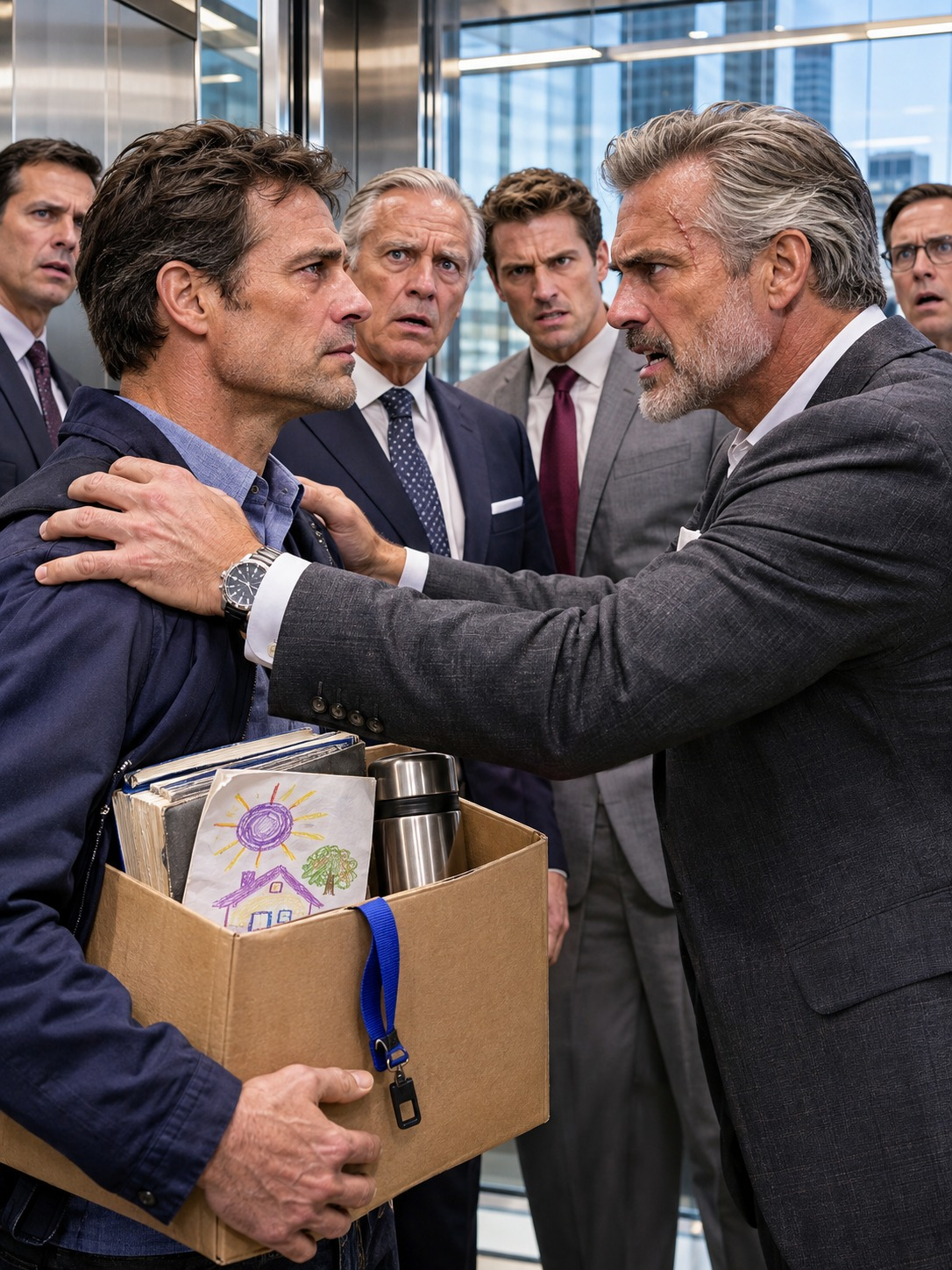
"Open the door, Nolan. I know you have the notebook."
The voice belonged to Walter Pierce.
For three years, Walter had been the director of executive operations at Crestline Engineering. Before that, he'd served as Donald Davenport's special adviser, the kind of man who attended important meetings without ever appearing on the organizational chart.
And according to the handwritten notes lying on my kitchen table, Walter had been the last person to request an editable copy of the Riverfront Towers technical framework before it was submitted to investors.
Rachel looked at me.
"Who is that?"
I kept my voice low.
"Someone from Crestline."
"At ten o'clock at night?"
"I know."
Another knock.
"Nolan, I can see the lights are on."
Rachel's expression hardened.
"That doesn't mean we have to open the door."
She was right.
I picked up my phone.
The message from Margaret Ellis was still visible.
Please do not contact the person listed as the approving executive.
I looked down at my notebook.
WALTER PIERCE.
Executive release authorization.
March 13.
The name appeared in my own handwriting.
I remembered writing it after the final technical review meeting.
What I didn't remember was Walter ever being authorized to approve engineering changes.
He wasn't a structural engineer.
He wasn't a licensed design professional.
He wasn't part of the quality assurance team.
His job was to coordinate executive communications, investor materials, and administrative approvals.
Yet somehow, his name had appeared at the end of the technical approval chain.
And now he was standing outside my house.
"Nolan?"
His voice was almost friendly.
"I know this is an inconvenient time. Donald asked me to come by."
That was the first thing that made me suspicious.
Donald Davenport didn't send executives to employees' homes at night.
Especially employees he'd fired that afternoon.
I stepped toward the front window, keeping away from the direct line of sight through the glass.
A dark blue sedan was parked at the curb.
Walter stood on the porch wearing a tan jacket over a white shirt.
He carried a leather briefcase.
He looked like a man arriving for a business meeting.
Not someone who had driven across town to confront a recently terminated engineer.
Rachel touched my arm.
"Don't let him in."
"I won't."
I called through the door.
"Walter, it's late. What do you need?"
He sounded relieved.
"Nolan. Good. Listen, there's been a misunderstanding at the office."
"Then we can discuss it tomorrow."
"I'd rather clear it up tonight."
"Why?"
A pause.
"Because Donald is concerned about how today's events may have affected you."
I looked at Rachel.
She raised one eyebrow.
Even under the circumstances, I almost smiled.
"Donald is concerned about me?"
"Of course."
"That's interesting. He didn't seem concerned when Human Resources handed me a cardboard box."
Walter sighed.
"Nolan, I understand you're upset."
"I'm not upset, Walter. I'm asking why you're standing on my porch."
Another pause.
Then his voice changed.
"Donald wants to make sure certain company materials were not inadvertently removed from the premises."
There it was.
I looked toward the kitchen table.
My three personal notebooks lay beside Chloe's drawing.
"What materials?"
"Engineering notes. Technical records. Anything associated with the Riverfront Towers submission."
"Company records are on the company systems."
"We understand that."
"Then what's the problem?"
Walter hesitated.
"We've been informed that you may possess handwritten notes from the March thirteenth review meeting."
My stomach tightened.
I glanced at Rachel.
She had heard it too.
Someone had told Walter about my notebook.
Someone knew exactly what I had written.
"Those are my personal notes," I said.
"Of course. Nobody is suggesting otherwise."
"Then why are you asking about them?"
"Because they may contain information relevant to an internal review."
I took a breath.
"Then have Crestline's legal department contact me through the appropriate process."
Walter was silent.
Then he said something that made my skin crawl.
"Nolan, we can make this much easier than you're making it."
I stared at the door.
"How?"
"Donald is prepared to reconsider your separation package."
Rachel slowly shook her head.
I remained quiet.
Walter continued.
"There may be an opportunity for a consulting arrangement. Something that would allow you to maintain financial stability while the company completes its restructuring."
I looked toward the family photograph hanging beside the staircase.
Rachel.
Chloe.
Me.
Taken at the lake the previous summer.
We'd spent the afternoon fishing.
Chloe had caught nothing but insisted she'd seen a turtle the size of a bicycle.
I remembered how happy she'd been.
How ordinary everything had felt.
And now a man from Crestline was standing outside our home offering money in exchange for something he hadn't yet named.
"What would I have to do?" I asked.
Walter answered too quickly.
"Nothing complicated."
"Be specific."
"We'd simply need to review any personal notes relating to the Riverfront framework and establish that no confidential company information remains in your possession."
"Through legal counsel?"
"That would create unnecessary delays."
I looked at Rachel.
She mouthed two words.
Absolutely not.
I agreed.
"Walter, I'm not handing over personal property to someone who arrives at my house unannounced."
His tone hardened.
"Nolan, you're making this more difficult than it needs to be."
"Then stop making it difficult."
Silence.
I continued.
"If Crestline believes I possess company-owned materials, have its counsel identify them and make a proper request. I'll cooperate with any legitimate process."
Walter exhaled.
"You're being advised by Holloway's people, aren't you?"
That stopped me.
"Why would you ask that?"
"Because Grant Holloway has a reputation for turning routine business disputes into expensive legal exercises."
I almost laughed.
"Grant asked questions about a technical document."
"Grant doesn't understand the internal circumstances."
"Then explain them to him."
Walter didn't answer.
I waited.
Finally, he spoke.
"Nolan, Donald wants to protect everyone involved."
I stared at the door.
"Everyone?"
"Yes."
"Does that include the people who changed my technical framework?"
For the first time, Walter seemed genuinely caught off guard.
There was a long silence.
Then he said quietly:
"You don't know what you're talking about."
"Then why are you here?"
Another pause.
I heard him shift his weight on the porch.
"Nolan, I'm going to leave my card. Call me tomorrow before you speak to anyone else."
"I won't promise that."
"Think about your family."
Rachel's expression changed instantly.
I felt something cold move through my chest.
"What did you say?"
Walter hesitated.
"I meant financially. You have a family to support. This doesn't need to become a prolonged dispute."
I kept my voice level.
"Don't mention my family again."
"Nolan—"
"Good night, Walter."
I stepped away from the door.
For several seconds, he remained outside.
Then I heard his shoes against the porch steps.
A car door opened.
The engine started.
I watched through the side window as the sedan pulled away.
Only when the taillights disappeared did Rachel speak.
"That wasn't a normal visit."
"No."
"He knew about the notebook."
"Yes."
"How?"
I looked toward the kitchen.
"I don't know."
Rachel folded her arms.
"And he offered you money."
"He offered a consulting arrangement."
"After firing you."
I nodded.
She stared at me.
"Nolan, I've known you for thirteen years. I know when you're trying to make something sound less frightening than it is."
I looked away.
She stepped closer.
"That man didn't come here because Donald suddenly developed a conscience."
"I know."
"He came because they're afraid of something."
I looked toward the notebooks.
"Yes."
She followed my gaze.
"And whatever it is, they think you have it."
At 10:23 p.m., I called Margaret Ellis.
She answered immediately.
"Mr. Vance?"
"Walter Pierce just came to my house."
There was a brief silence.
"Did you invite him?"
"No."
"Did you let him inside?"
"No."
"Did you give him any documents?"
"No."
I heard her exhale.
"Good."
I described the conversation.
The offer.
The request for my notes.
The suggestion that legal involvement would create unnecessary delays.
And the comment about my family.
Margaret listened carefully.
When I finished, she asked for the exact time Walter arrived and departed.
I told her.
"Do you have a doorbell camera?"
"Yes."
"Please preserve the recording."
"I will."
"Did he leave anything?"
"A business card, apparently."
"Don't discard it."
I looked toward the front door.
"All right."
Then I asked the question that had been bothering me.
"Ms. Ellis, was Walter Pierce the person listed on the executive authorization record?"
She hesitated.
"I can confirm that his name appears in the records we're reviewing."
My stomach tightened.
"Was he authorized to approve engineering changes?"
"That's one of the questions we're investigating."
I sat down.
"He's not an engineer."
"I'm aware."
"He shouldn't have been approving technical modifications."
"Not without the appropriate authority and review."
I rubbed my forehead.
"Then how did his name get there?"
"We don't know yet."
I stared at the notebook.
"There's something else."
"I'm listening."
"The woman who called me earlier said someone wanted me fired before I discovered who signed the executive release."
Margaret was quiet.
"Did she identify herself?"
"No."
"Did you recognize her voice?"
"I thought I did. But I couldn't place it."
"Have you preserved the voicemail?"
"Yes."
"Good."
I hesitated.
"Ms. Ellis, I need to ask you something directly."
"Go ahead."
"Is Grant in danger of losing money because of this?"
She took a moment before answering.
"Potentially. But the immediate concern is determining whether the technical representations supporting the investment accurately reflect the approved engineering requirements."
"That's a careful answer."
"It's the only responsible one I can give."
I appreciated that.
Even if it frustrated me.
"What's the next step?"
"Tomorrow morning, we'll arrange a formal meeting. Our firm will coordinate with appropriate independent engineering and legal professionals."
"Will Crestline be there?"
"Not initially."
I nodded.
"All right."
"And Mr. Vance?"
"Yes?"
"Please don't discuss the notebook with anyone from Crestline until you've received independent legal advice."
I looked toward Rachel.
She was standing near the doorway.
"I understand."
After the call, Rachel sat beside me.
"Are we safe?"
I considered the question.
Walter hadn't threatened us directly.
He hadn't tried to enter the house.
He hadn't raised his voice.
But he'd arrived uninvited at ten o'clock at night and suggested that cooperating with him would be better for my family.
That was enough to make me uncomfortable.
"I think so," I said.
Rachel studied me.
"You think?"
"I don't have evidence that anyone intends to hurt us."
She nodded slowly.
"Then let's make sure we don't give them a reason to come back."
I agreed.
We checked the doors.
Made sure the cameras were working.
And went upstairs.
But I didn't sleep.
Not for a long time.
At 6:14 the next morning, I was sitting at the kitchen table with a cup of coffee when my phone rang.
Grant Holloway.
I answered.
"Morning."
"Nolan."
His voice was unusually serious.
"Did Walter Pierce come to your house last night?"
I looked toward the stairs.
"Yes."
Grant muttered something under his breath.
Then he said:
"I'm sorry."
"Why are you apologizing?"
"Because this shouldn't be happening."
I leaned back.
"Did you know he was coming?"
"No."
"Then it's not your fault."
Grant was quiet.
Then he said:
"Margaret told me about the visit. We're documenting it."
"Good."
He paused.
"Nolan, I need to ask you something."
"Go ahead."
"Do you still have your personal notebooks from the original Riverfront review?"
"Yes."
"Did you write down what happened during the final approval meeting?"
"I did."
"Do you remember whether Donald Davenport personally authorized the release?"
I thought carefully.
"Donald attended the meeting. He wanted the package submitted quickly."
"That's not what I asked."
"I know."
I opened the brown notebook.
The page was still marked.
"Walter Pierce was listed as the executive release contact."
Grant was silent.
I continued.
"But that doesn't necessarily mean he had authority to change technical content."
"No," Grant said. "It doesn't."
I heard papers moving on his end.
Then he spoke again.
"Here's what bothers me."
I waited.
"Donald personally presented the framework to our investment committee."
"Yes."
"He represented it as Crestline's approved technical risk-control plan."
"Yes."
"And he signed an executive certification stating that the submitted materials accurately reflected the company's approved engineering requirements."
I sat straighter.
"Donald signed that?"
"Yes."
I stared at the notebook.
"Then he should have known what was in it."
"Exactly."
I rubbed my forehead.
"Unless someone changed the document after he reviewed it."
"Possible."
"Or he signed without reviewing it."
"Also possible."
I hesitated.
"Or he knew."
Grant didn't answer immediately.
Then he said:
"That's the possibility we have to investigate carefully."
I looked at Chloe's drawing on the counter.
Her purple sun.
Her little house.
Her father in a hard hat.
I thought about all the people who would eventually work inside Riverfront Towers.
People who would never know my name.
People who would assume the building had been inspected properly.
People who would trust that the engineers, contractors, and executives responsible for the project had done their jobs.
"Grant," I said, "we need to make sure the building is safe."
"I agree."
"Before we worry about signatures or money."
"I agree with that too."
He paused.
"That's why I've arranged an independent technical review."
I felt a little relief.
"Who is conducting it?"
"A licensed engineering firm with no prior involvement in the project. They'll work through the appropriate contractual channels."
"Good."
"And Nolan?"
"Yes?"
"I'd like you to attend a meeting this morning."
I looked at the clock.
"What time?"
"Nine."
"Where?"
"My office."
I hesitated.
"Grant, I'm not sure I should be involved without my own attorney."
"You're right."
That surprised me.
He continued.
"Margaret can explain the process, but I want you to have independent representation. We can discuss how to arrange that without compromising anyone's interests."
I nodded.
"Thank you."
"Don't thank me yet."
I almost smiled.
He'd said the same thing yesterday.
Then his voice became serious again.
"There's something else."
"What?"
"We found a second executive certification."
I sat completely still.
"Second?"
"Same project. Same framework reference."
"Different date?"
"Yes."
"Different signature?"
Grant paused.
"That's what we need to discuss."
At 8:52 a.m., I arrived at Holloway Infrastructure Partners.
The building stood near downtown Dallas, a glass-and-steel office tower with a lobby that looked more like a luxury hotel than a place where people discussed construction financing.
I parked my truck in the visitor garage.
For a moment, I sat behind the wheel.
Yesterday, I'd been fired.
Today, I was walking into the office of a billionaire investor to discuss whether a technical framework I'd written had been altered before securing hundreds of millions of dollars in financing.
Life had become very strange very quickly.
I checked my phone.
A message from Rachel.
Remember, you don't have to prove anything to anyone today. Just tell the truth.
I smiled.
Then I stepped out of the truck.
The receptionist directed me to the twenty-first floor.
A young assistant met me outside the elevator.
"Mr. Vance?"
"Yes."
"Mr. Holloway is expecting you."
She led me down a quiet hallway.
The walls displayed photographs of bridges, ports, rail terminals, and energy projects.
I recognized several.
Some I'd studied during professional training.
Others I'd followed in engineering journals.
At the end of the corridor, she opened a conference room door.
Grant stood near the window.
Margaret Ellis sat at the table with two other professionals.
One was a woman in her fifties with short gray hair and a serious expression.
The other was a man wearing a navy suit and carrying a thick legal folder.
Grant approached.
"Nolan."
He shook my hand.
"Thank you for coming."
"Of course."
He introduced everyone.
Margaret Ellis.
General counsel.
Dr. Evelyn Hart.
Independent structural engineering consultant.
And Thomas Reed.
An attorney from an outside firm retained to advise Holloway Infrastructure Partners on the investment review.
Margaret immediately explained that Thomas represented Holloway, not me, and that I should obtain my own legal advice before providing any privileged or protected information.
I appreciated the clarity.
Too many people treated legal boundaries as obstacles.
I saw them as safeguards.
Grant gestured toward a chair.
"Please."
I sat.
Margaret opened a folder.
"Mr. Vance, before we begin, I want to explain what we're reviewing."
She placed two documents on the table.
Both bore the same reference number.
RF-ST-041.
Both were labeled Revision Seven.
Both were dated March 14.
But the signatures were different.
The first contained Darren Boyd's name in the authorship block.
The second contained mine.
I stared at them.
"Where did you get that one?"
I pointed toward the copy bearing my name.
Margaret looked at Grant.
He nodded.
"From our original due diligence archive," she said.
I frowned.
"Then why did Grant have the other version yesterday?"
"Because the version presented during the most recent financing review was different."
I looked between the documents.
"You're saying the investment committee received one version three years ago, but another version was used later?"
"That's what the records currently suggest."
I leaned forward.
"May I examine them?"
Margaret nodded.
"These are review copies. Please don't mark them."
I carefully compared the pages.
The formatting was nearly identical.
Same title.
Same reference number.
Same revision.
Same date.
But the content wasn't the same.
On page twelve, the original framework required physical verification of certain waterproofing interfaces before concealment.
The altered version described those inspections as subject to project management discretion.
On page nineteen, the original required documentation of specified post-tensioning inspection evidence before milestone approval.
The altered version permitted reliance on approved digital records without clearly preserving the same physical verification requirement.
On page twenty-seven, the original included a mandatory hold point for the north podium.
The altered version had softened it.
My stomach tightened.
"This is serious."
Dr. Hart leaned forward.
"Explain."
I looked at her.
"These aren't cosmetic changes. They alter the verification sequence."
She nodded.
"That's our preliminary concern."
I pointed toward page twenty-seven.
"This hold point was included because the north podium has a specific groundwater exposure condition. Once the work is concealed, some aspects become much harder to inspect."
Dr. Hart studied the page.
"Would removing the hold point necessarily make the structure unsafe?"
"No."
I answered immediately.
She looked at me.
I continued.
"It would remove a safeguard intended to verify that the work was completed correctly. Whether the actual construction is safe depends on what was installed, what was inspected, and what evidence exists."
Dr. Hart nodded.
"That's an important distinction."
I looked toward Grant.
"We shouldn't assume a defect just because the paperwork changed."
He nodded.
"Agreed."
"But we also shouldn't assume the work was properly verified."
"Agreed."
Margaret made a note.
Then she turned to another page.
"Mr. Vance, we need to understand the authorship issue."
I sat back.
"All right."
She pointed toward the document bearing Darren's signature.
"This version appears to have been introduced into the financing record during a later submission cycle."
"That makes sense," I said. "Darren wasn't at Crestline three years ago."
"Correct."
"But the date wasn't updated."
"Correct."
I stared at the page.
"Then someone made it look like he'd authored the original."
Margaret chose her words carefully.
"That is one possible interpretation. We need to establish how the document was generated and whether the signature block was intentionally misrepresented."
I nodded.
Fair.
Grant leaned forward.
"There's another issue."
He slid a third document across the table.
It was a certification page.
Crestline Engineering letterhead.
Riverfront Towers.
Executive Technical Assurance.
I recognized the format.
It was the kind of document executives signed when they wanted investors to believe the technical team had completed its review.
At the bottom was Donald Davenport's signature.
I studied the date.
March 15.
One day after the original framework submission.
Grant watched me.
"Do you recognize it?"
"I've seen similar forms."
"Read the certification."
I did.
It stated that the technical materials submitted to Holloway Infrastructure Partners accurately reflected Crestline's approved engineering requirements and that no material technical qualifications had been omitted without appropriate review.
I looked up.
"That's a significant representation."
Grant nodded.
"Yes."
Margaret placed another certification beside it.
Same project.
Same general language.
But dated much later.
The signature looked similar.
Almost identical.
I leaned closer.
"What's different?"
Margaret pointed toward the lower section.
"The later certification references a revised technical package."
I looked at the reference number.
RF-ST-041.
Revision Seven.
Again.
I frowned.
"Why would they certify a revised package under the same revision identifier?"
"That's one of our questions," Margaret said.
I studied the signature.
Something bothered me.
I couldn't immediately identify it.
Then I noticed the spacing.
The angle.
The position of the final stroke.
It looked exactly like the signature on the earlier certification.
Not similar.
Exactly the same.
I looked at Margaret.
"Was this electronically signed?"
"That's under review."
I pointed.
"The signatures appear identical."
Thomas Reed leaned forward.
"We noticed that."
Grant watched me carefully.
"What does that suggest?"
I shook my head.
"Nothing conclusive without the underlying records. But it raises a question about how the signature was applied."
Margaret nodded.
"Exactly."
Then she opened another folder.
"Mr. Vance, we also reviewed the document-control transmittal records."
I felt my pulse quicken.
"Caroline Mercer?"
"Her name appears on the original submission."
I nodded.
"She handled it."
Margaret continued.
"She also appears to have flagged an inconsistency in a later internal review."
I sat straighter.
"What inconsistency?"
"The document reference remained unchanged even though the technical content differed."
I stared at her.
"She caught it?"
"According to the record, she raised a question."
"When?"
Margaret hesitated.
"Approximately eighteen months ago."
I leaned back.
Eighteen months.
That was around the time Caroline had disappeared from Crestline.
I'd assumed she'd moved to another company.
Nobody had told me otherwise.
"Was she terminated?" I asked.
Margaret looked toward Thomas.
He answered.
"We haven't verified the circumstances of her departure."
I nodded slowly.
Then I remembered the woman in the black sedan.
Her trembling hands.
Her warning.
Her claim that the framework had become the basis for additional financing.
She had known something.
Maybe for a long time.
Grant spoke.
"Nolan, there's a reason I asked you here."
I looked at him.
He continued.
"I need to know whether the framework we relied on was changed in a way that affected the engineering safeguards."
I nodded.
"I can help explain the original technical intent through an appropriate review process."
"Good."
"But I won't speculate about who changed it."
"I wouldn't ask you to."
I looked toward Donald's signature.
"Then we need the complete approval history."
Margaret nodded.
"That's our next step."
She paused.
"And that's where the records become unusual."
I looked at her.
"How?"
She turned her laptop toward me.
On the screen was a document-control timeline.
Several entries appeared in chronological order.
Original submission.
Executive review.
Investment transmittal.
Later financing package.
Document replacement.
The last entry was dated yesterday morning.
The same day I was fired.
I leaned closer.
"What happened yesterday?"
Margaret pointed toward the entry.
"A new file was uploaded into Crestline's executive document repository."
I stared at the timestamp.
8:17 a.m.
My termination meeting had been at 2:00 p.m.
Someone had uploaded the replacement file nearly six hours before Human Resources told me my position was being eliminated.
I looked at Grant.
"That's not a coincidence."
He didn't answer.
Margaret spoke carefully.
"We can't establish intent from timing alone."
"I know."
"But it warrants investigation."
I nodded.
Then I noticed another field.
Uploaded by.
The account name was partially redacted.
But the department code remained visible.
EXEC-OPS.
Executive Operations.
Walter Pierce's department.
I looked up.
"Walter."
Margaret nodded.
"His department controlled that repository."
I stared at the screen.
"Did he upload it?"
"We haven't established that."
I took a breath.
"Then who did?"
Margaret closed the laptop slightly.
"That's what we're working to determine."
Grant leaned back.
For several seconds, nobody spoke.
Then Dr. Hart asked me a question.
"Mr. Vance, when you prepared the original framework, did you believe the project could be constructed safely under the specified conditions?"
"Yes."
"With the inspection requirements included?"
"Yes."
"And without them?"
I considered my answer.
"I would need to review the actual construction records and determine what alternative verification, if any, was performed. The requirements were there for a reason."
She nodded.
"Thank you."
I looked at Grant.
"What's happening at Riverfront right now?"
He exchanged a glance with Margaret.
Then answered.
"Construction is continuing under the existing project management structure, but the next funding milestone is suspended pending review."
I felt uneasy.
"Are they still working on the north podium?"
Dr. Hart looked down at her notes.
"That's one of the areas we're requesting information about."
I leaned forward.
"Then the inspection status needs to be verified promptly."
Grant nodded.
"We're arranging that."
I looked at him.
"Grant, I don't care who gets credit for the framework. I don't care whose name appears on a presentation."
He watched me.
"I care whether the building is safe."
His expression softened.
"I know, Nolan."
I looked down at the documents.
Then I said something I hadn't planned to say.
"And I care about Liam Brooks."
Grant frowned.
"Who?"
"A field technician at Crestline. He was still trying to verify the north podium inspections when I left."
Margaret made a note.
"Has he reported any concerns?"
"He told me certain verification items remained open. I advised him to document everything through approved channels."
Dr. Hart nodded.
"That was appropriate."
I looked toward the window.
Dallas stretched beneath us.
Buildings.
Roads.
Construction cranes.
Thousands of people moving through structures they trusted without ever thinking about the engineering decisions behind them.
That trust mattered.
More than schedules.
More than bonuses.
More than executive presentations.
I turned back toward the table.
"There's something else I need to tell you."
Margaret looked up.
"What?"
"Yesterday, Darren asked Liam about my personal notebooks."
Grant's expression changed.
"Why?"
"I don't know."
"Do you have them?"
"Yes."
Margaret leaned forward.
"Have you reviewed them?"
"One of them. It contains notes from the March thirteenth approval meeting."
Thomas Reed spoke.
"Before we discuss the contents, I recommend you obtain independent legal advice and confirm that any disclosure is appropriate."
I nodded.
"That's fair."
Grant looked toward Margaret.
"Can we help him identify independent counsel?"
"We can provide information about appropriate options, with clear disclosure of any potential conflicts."
I appreciated that.
I didn't want favors that created obligations I didn't understand.
Then my phone vibrated.
Rachel.
I glanced at the screen.
Chloe's school called. She's okay, but someone asked the front office whether you were picking her up today.
My stomach tightened.
I read the message again.
Someone had asked about Chloe.
I immediately typed:
Who?
Rachel replied:
They didn't give a name. The school didn't release any information.
I stared at the screen.
Grant noticed.
"Nolan?"
I looked up.
"Someone contacted my daughter's school."
The room became quiet.
Margaret leaned forward.
"Do you know who?"
"No."
"Did the school provide any information?"
"Rachel says no."
She nodded.
"Then I recommend you contact the school directly, verify the circumstances, and make sure their normal pickup authorization procedures remain in place."
I stood.
"I need to call my wife."
"Of course," Grant said.
I stepped into the hallway.
Rachel answered immediately.
"Hey."
"Is Chloe okay?"
"She's fine. She's in class."
"Who called?"
"The school secretary said a man asked whether you'd be picking her up this afternoon."
"Did he identify himself?"
"No."
I closed my eyes.
"Rachel, it could be nothing."
"I know."
"But I don't like it."
"Neither do I."
We agreed that Rachel would pick Chloe up herself and confirm the school's authorization list.
I told her not to confront anyone.
Just document the call.
She agreed.
Then she asked:
"Nolan, are you coming home soon?"
I looked toward the conference room.
"I hope so."
"Please be careful."
"I will."
After we hung up, I stood in the hallway for a moment.
I didn't know whether the school call was connected to Crestline.
It might have been a misunderstanding.
A wrong number.
An ordinary administrative question.
But after Walter's visit, I couldn't dismiss it completely.
I returned to the conference room.
Grant stood when I entered.
"Everything all right?"
"Chloe's safe."
He nodded.
"Good."
I sat.
Margaret looked toward Thomas.
Then she turned back to me.
"Mr. Vance, there's one more record we need to discuss."
I looked at her.
She opened a sealed folder.
Inside was a printed copy of an executive authorization form.
The document bore Donald Davenport's signature.
But beneath it was another signature block.
A secondary approval.
The name had been obscured in the earlier copies.
Margaret placed the page on the table.
"Yesterday, we obtained a clearer version from an archived transmittal."
I leaned forward.
The signature was visible now.
Walter Pierce.
I stared at it.
Grant watched my face.
"Recognize it?"
"Yes."
Margaret nodded.
"His signature appears as the executive release coordinator."
I looked at the date.
March 14.
Then at the time.
11:42 p.m.
I frowned.
"That's after the final engineering review."
"Correct."
"And before the investment committee received the package."
"Correct."
I studied the form.
Then noticed something else.
A small notation beneath the approval block.
Technical exception accepted.
I felt my stomach tighten.
"What exception?"
Margaret turned to the next page.
There was a reference to an attachment.
A separate technical exception memorandum.
I stared at the title.
I had never seen it before.
"Where's the memorandum?" I asked.
Margaret looked at Grant.
He nodded.
She opened another folder.
Then slid a single page toward me.
At the top were the words:
RIVERFRONT TOWERS — TECHNICAL EXCEPTION AUTHORIZATION.
Below that was a paragraph stating that certain physical inspection requirements could be replaced by approved alternative verification procedures.
I read it twice.
Then a third time.
My mouth went dry.
At the bottom was a certification.
Reviewed and accepted by the responsible senior structural coordinator.
And beneath it was my name.
Nolan Vance.
I stared at the signature.
It looked like mine.
But I had never signed that document.
I looked up.
"That's not my signature."
Nobody spoke.
I pointed toward the page.
"I never approved this."
Grant's expression hardened.
Margaret leaned forward.
"Are you certain?"
"Absolutely."
I looked at the date.
March 14.
The same day the framework was submitted.
The same day the executive release was processed.
The same day someone had apparently authorized changes I never accepted.
I felt my hands go cold.
"Someone forged my approval."
Margaret didn't immediately respond.
She looked at Thomas.
Then at Grant.
Finally, she said:
"We need to have the signature examined and establish the document's origin."
I nodded.
But my mind was already racing.
Because the forged signature wasn't the only thing wrong with the page.
There was a second name.
A witness.
Someone who had supposedly watched me sign.
I leaned closer.
And the moment I saw the witness block, I recognized the name.
It belonged to someone I had trusted for years.
Someone who had been in the engineering department when I packed my desk.
Someone who had looked me in the eye and told me to be careful.
My phone vibrated.
A new message from Liam Brooks.
I'm at Riverfront. I found the original inspection report.
Then another.
The report says the north podium failed verification.
I stared at the screen.
A third message appeared.
But Nolan, that's not the worst part.
I felt my pulse hammering.
Then Liam sent a photograph.
The image showed a technical report.
A red stamp.
A handwritten notation.
And a signature block.
I enlarged the photograph.
The signature was familiar.
Too familiar.
Before I could read the name, my phone rang.
Liam.
I answered.
"Liam?"
His voice was shaking.
"Nolan, someone just arrived at the site."
"Who?"
He didn't answer immediately.
I heard footsteps.
Then a door opening.
Then Liam whispered:
"Nolan, the person who signed the false inspection report is standing right in front of me. And it's someone you..."






Comments 0