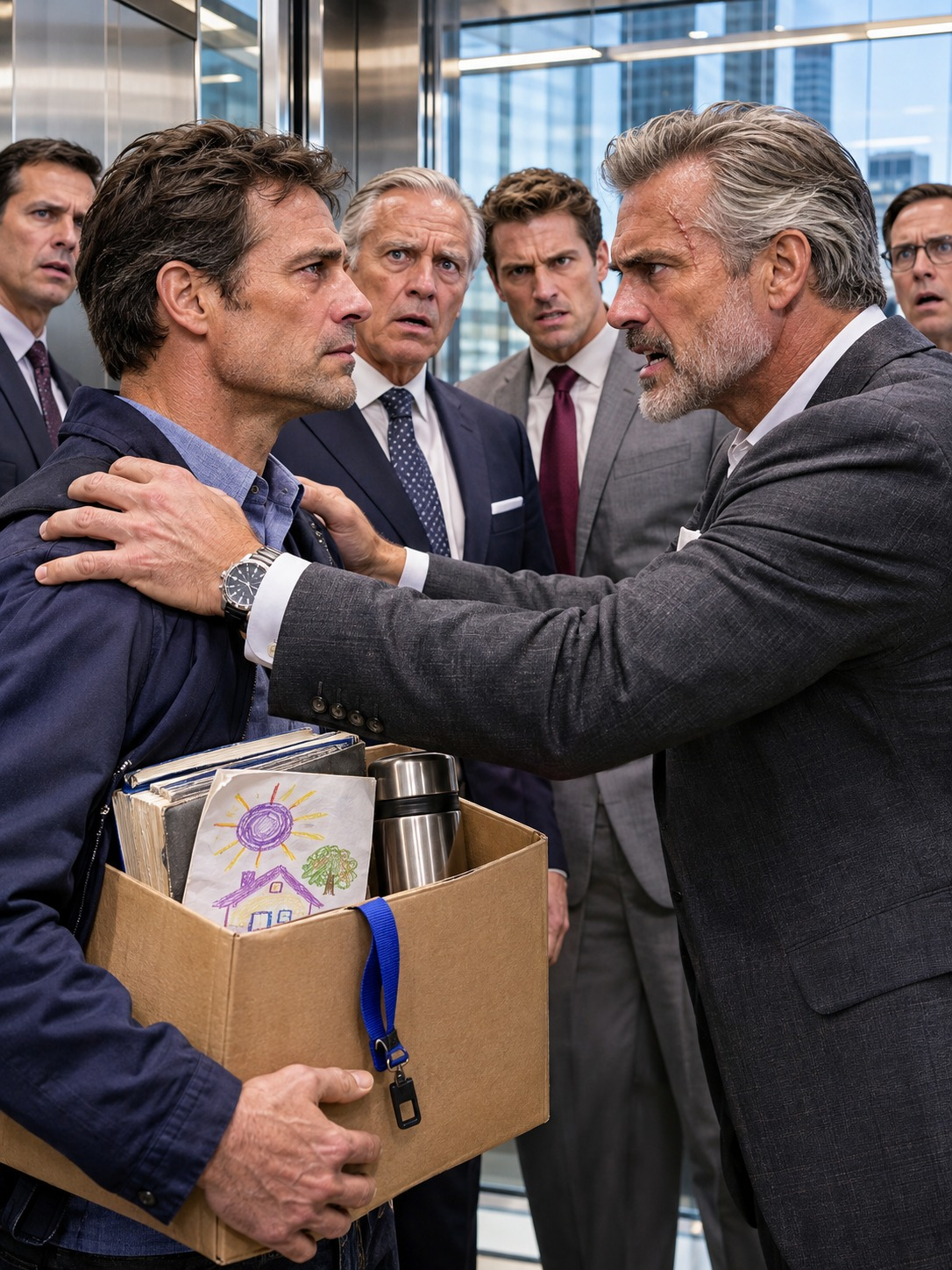
"Before you open that box, there's something you need to know about the night you saved Grant Holloway. Because the man you carried out of that storm wasn't the person you thought he was."
I stood in my living room with the phone pressed against my ear.
Outside, the man in the gray coat smiled directly into our security camera.
Twenty-two years had passed since I'd last seen him.
But I remembered his face.
The scar above his left eyebrow.
The uneven shoulders.
The peculiar way he stood with his feet apart, as though he expected the ground to shift beneath him.
"Victor Hale," I whispered.
Rachel looked at me.
"Who?"
I didn't answer.
Victor's voice came through the phone.
"Good. You remember."
I stared at the security monitor.
"You're not coming inside."
"I didn't ask to."
"Then why are you here?"
He looked down at the photograph in his hand.
"Because somebody needs to tell you what really happened in West Texas."
I felt my jaw tighten.
"I remember what happened."
"Do you?"
"Grant got sick. The truck broke down. The radio failed. I carried him to the highway."
Victor smiled faintly.
"That's the version you've been telling yourself."
I looked toward Rachel.
She had already taken her phone from the kitchen counter.
I nodded toward the hallway.
She understood.
Without saying a word, she moved toward the stairs to check on Chloe.
I kept watching Victor.
"What do you want?"
He lowered the photograph.
"To make sure you understand what you're getting involved in."
"I understand enough."
"No, Nolan. You understand engineering. That's different."
I felt anger rising.
"Don't come to my house and lecture me about what I understand."
Victor's expression changed.
The smile disappeared.
"Still stubborn."
"Still willing to let other people suffer for your mistakes?"
He was silent.
I remembered the night in West Texas.
The freezing rain.
The generator that wouldn't start.
Grant lying on the trailer floor, burning with fever.
Victor had been responsible for site logistics.
He'd left before the storm.
He'd assured us the access road was safe.
He'd assured us the backup equipment had been checked.
None of it had worked.
I had spent four hours carrying Grant through mud and rain, terrified that he would stop breathing before we reached help.
Victor looked toward the street.
Then back at the camera.
"You're making the same mistake you made twenty-two years ago."
I tightened my grip on the phone.
"What mistake?"
"Believing Grant Holloway is the only person who remembers that night."
I stared at him.
"You're not making sense."
He raised the photograph again.
"Look closely, Nolan."
The image showed three young men standing beside a concrete foundation.
Grant.
Victor.
Me.
I remembered the day.
The wind was so strong we'd had trouble keeping our hard hats on.
Grant had borrowed a camera from the site office.
We'd taken the picture after completing the foundation survey.
Victor tapped the photograph.
"There's a fourth person who should have been standing here."
I frowned.
"What?"
"A man who wasn't supposed to be on the project."
My stomach tightened.
"Who?"
Victor looked directly into the camera.
"Someone who made a great deal of money because of what happened afterward."
I took a breath.
"Victor, if you have information about Crestline or Riverfront, give it to the appropriate investigators."
He laughed softly.
"Investigators?"
"Yes."
"You think they're going to protect you?"
"I think they'll examine evidence."
Victor's expression hardened.
"Evidence can disappear."
I stared at him.
"Is that a threat?"
"No."
He paused.
"It's a warning."
I looked toward the kitchen counter.
The package Caroline Mercer had delivered was still there.
Plain cardboard.
Brown tape.
Black writing.
FOR THE MAN WHO REFUSED TO SIGN.
Victor followed my gaze through the window.
"You have it."
I said nothing.
His eyes narrowed.
"Caroline sent you the agreement."
I felt cold.
"How do you know?"
"Because she's been trying to give it to somebody for eighteen months."
I stared at him.
"Where is Caroline?"
Victor hesitated.
"Somewhere she shouldn't be."
My pulse quickened.
"What does that mean?"
He looked away.
Then said:
"She's frightened, Nolan. And she has reason to be."
I felt anger rise.
"Then help her."
Victor looked back at the camera.
"You still think everything is that simple."
I took a breath.
"Did you sign the Meridian agreement?"
He didn't answer immediately.
Then he said:
"I signed a document."
My stomach tightened.
"Which document?"
"The one that allowed Meridian Advisory Group to coordinate certain submissions."
I stared at him.
"So it was you."
Victor looked almost amused.
"That depends on what you think I did."
"Your company altered technical documents."
"Allegedly."
"Someone forged my signature."
"Allegedly."
"Someone ordered inspection records deleted."
Victor's expression changed.
For the first time, he looked genuinely uncomfortable.
I noticed.
"You knew about that."
He didn't answer.
I continued.
"You knew the inspection reports were being changed."
Victor glanced toward the street.
"Nolan, the Riverfront project is much bigger than one inspection report."
"That's not an answer."
He took a breath.
"There's something beneath that site."
I stared at him.
"What?"
"Something that was never supposed to be discovered."
I felt my pulse quicken.
"Victor, Riverfront is a construction project. If there's an unknown condition beneath the foundation, it needs to be evaluated."
He smiled bitterly.
"That's exactly what I told them."
I froze.
"What?"
Victor looked directly into the camera.
"Three years ago, I told them the site needed additional investigation."
I stared at him.
"Who?"
He hesitated.
"Donald Davenport."
My stomach tightened.
"And?"
"He said the project couldn't afford another delay."
I felt cold.
"What did you find?"
Victor looked down.
Then he said:
"An abandoned underground structure."
I frowned.
"What kind?"
"An old service tunnel. Part of a utility corridor that predated the current development."
I stared at him.
"Was it shown on the geotechnical drawings?"
"Not accurately."
My mind began racing.
The Riverfront site had undergone multiple redevelopment phases.
Old industrial properties.
Utility relocations.
Demolished structures.
Abandoned infrastructure.
A buried service tunnel wouldn't necessarily be unusual.
But an undocumented void near a foundation could create serious engineering questions.
"Where was it?" I asked.
Victor hesitated.
"Near the north podium."
I felt my stomach drop.
The north podium.
The same area with the failed waterproofing inspection.
The same area where verification records had been altered.
The same area Crestline had refused to make available to independent engineers.
I took a breath.
"Victor, did the geotechnical team know?"
He didn't answer.
"Did anyone evaluate the tunnel?"
He looked toward the street.
"Not adequately."
I stared at him.
"Then why wasn't I told?"
Victor's expression hardened.
"Because you would have stopped the project."
I felt anger rise.
"I would have asked for an engineering assessment."
"Exactly."
I closed my eyes.
Of course.
To someone like Victor, an engineering assessment was an obstacle.
To me, it was the reason the project could be built safely.
I opened my eyes.
"Victor, if there's an undocumented subsurface condition, you need to report it."
He laughed bitterly.
"Report it to whom?"
"The owner. The engineer of record. The appropriate authorities if necessary."
He shook his head.
"You still don't understand."
"Then explain."
Victor stepped closer to the camera.
"The tunnel wasn't the only thing they found."
My stomach tightened.
"What else?"
He looked toward the package.
"Open the agreement."
"I won't open an unexpected package without following my attorney's advice."
Victor stared at me.
Then gave a slow nod.
"Good."
That surprised me.
He continued.
"At least you've learned to be careful."
I tightened my grip on the phone.
"Victor, what did they find beneath Riverfront?"
He hesitated.
Then said:
"Something that made the original $400,000 cost-saving proposal look like pocket change."
I froze.
Four hundred thousand dollars.
Darren's celebrated annualized reduction in senior engineering overhead.
The number he'd used to justify eliminating experienced technical staff.
Victor was telling me that the buried condition involved far more money.
"How much?" I asked.
He looked at me.
"Enough to threaten the financing."
My stomach tightened.
"How much?"
Victor took a breath.
"More than forty million dollars."
I stared at the security monitor.
Forty million.
Not four hundred thousand.
Forty million dollars.
A sum large enough to change the economics of a major development.
Large enough to make executives desperate.
Large enough to explain why someone might try to hide an engineering problem.
I felt my hands go cold.
"What was the cost for?"
Victor looked away.
"Remediation."
I frowned.
"Of what?"
He didn't answer.
I leaned forward.
"Victor."
He stared at me.
Then said:
"Contaminated material."
My stomach tightened.
"Under the site?"
He nodded.
"Near the old industrial foundation."
I stared at him.
Riverfront Towers stood on land that had once housed manufacturing facilities and storage yards.
Environmental assessments were supposed to identify contamination risks.
Geotechnical investigations were supposed to identify subsurface conditions.
If significant contamination or abandoned structures had been missed, the project could face expensive remediation and redesign.
But I needed evidence.
Not a frightened man's claims.
"Victor, do you have reports?"
He hesitated.
"Some."
"Then preserve them."
"I have."
"Give them to your attorney."
He looked at me.
"You think I haven't tried?"
I stared at him.
"Then what happened?"
His expression darkened.
"The last attorney who reviewed the documents told me to leave the state."
I felt cold.
"Why?"
Victor looked toward the street.
Then said:
"Because the people who approved the financing knew the site wasn't ready."
I stared at him.
"Who?"
He hesitated.
"Some of the same people who are now pretending they didn't know anything."
I took a breath.
"Victor, I can't help you if you keep speaking in riddles."
He looked at the photograph.
Then at the camera.
"You're right."
For a moment, he seemed to make a decision.
Then he said:
"I'll tell you what I know."
I stood still.
Victor took a breath.
"Three years ago, Meridian Advisory Group was retained to help Crestline secure financing for Riverfront Towers."
I nodded.
"Go on."
"The project had a problem. The original environmental and geotechnical investigations identified conditions that could delay construction."
"What conditions?"
"Potential contamination. Abandoned infrastructure. Uncertain groundwater pathways."
I felt my stomach tighten.
"Those should have been investigated before the foundation design was finalized."
"They were supposed to be."
"Then what happened?"
Victor looked down.
"The cost estimates came back."
I waited.
"Forty-two million dollars."
My pulse quickened.
"For remediation?"
"And related design changes."
I stared at him.
"That would have affected the investment model."
"Exactly."
Victor looked directly into the camera.
"Meridian was told to find a way to keep the project financially viable."
I felt cold.
"By whom?"
He hesitated.
"Donald Davenport's office."
I took a breath.
"That doesn't necessarily mean Donald knew the technical details."
Victor nodded slowly.
"You're right."
That surprised me.
He continued.
"But somebody did."
I stared at him.
"Who?"
Victor looked toward the street again.
Then said:
"The person who approved the revised risk assumptions."
My stomach tightened.
"Who was that?"
He hesitated.
Then answered:
"Darren Boyd."
I closed my eyes.
Of course.
Darren.
The outside consultant who later became vice president.
The man who'd pushed automation and reduced engineering oversight.
The man who'd treated inspection requirements as administrative obstacles.
Victor continued.
"Darren argued that the remediation contingency was excessive."
I opened my eyes.
"Based on what?"
"A revised technical risk model."
My stomach tightened.
"Whose model?"
Victor looked directly into the camera.
"Yours."
I froze.
"What?"
"Your forty-page framework."
I stared at him.
"That framework wasn't an environmental remediation study."
"I know."
"It addressed structural risk controls, foundation verification, waterproofing, seismic ties, and inspection requirements."
"I know."
"Then how could they use it to reduce an environmental contingency?"
Victor looked away.
"By changing how the technical safeguards were represented."
My mind raced.
If someone had taken a legitimate structural risk-control framework and altered its requirements, they could make certain unresolved conditions appear manageable through routine construction procedures.
They could present expensive investigations as unnecessary.
They could make investors believe the risks were already controlled.
But that wouldn't make the underlying conditions disappear.
It would only hide them.
I felt sick.
"Victor, did Darren know the framework had been altered?"
He hesitated.
Then said:
"He helped prepare the revised submission."
I stared at him.
"Did he forge my signature?"
Victor didn't answer.
I leaned forward.
"Did he?"
Victor looked at the camera.
"I don't know who physically applied the signature."
I took a breath.
"But you knew it wasn't mine."
He was silent.
Then he nodded.
I felt anger rise so sharply that I had to grip the edge of the table.
"You knew."
Victor looked down.
"Yes."
"And you said nothing."
He didn't answer.
I thought about the years I'd spent at Crestline.
The long nights.
The missed dinners.
The weekends reviewing drawings.
The responsibility I felt toward people who would never know my name.
And someone had taken my work, changed its meaning, and used my name to support decisions I would never have approved.
I stared at Victor.
"Why are you telling me now?"
He looked exhausted.
"Because they're going to make you responsible."
I felt cold.
"For what?"
"The missing records."
"I know about the complaint."
Victor shook his head.
"That's only the beginning."
I stared at him.
"What do you mean?"
He hesitated.
"They're preparing to claim that you knew about the buried conditions and failed to disclose them."
My stomach dropped.
"That's impossible."
"I know."
"I was never given those reports."
"I know."
"Then how could they claim I knew?"
Victor looked toward the package.
"Because someone added your name to the environmental exception file."
I stared at him.
Another document.
Another false approval.
Another attempt to use my identity.
I took a breath.
"Victor, you need to stop talking to me and start talking to investigators."
He nodded.
"I intend to."
"Then why come here?"
He looked at me.
"Because I wanted to see whether you remembered me."
I frowned.
"Why?"
He hesitated.
"Because the last time I saw you, you saved Grant Holloway's life."
I stared at him.
"And?"
Victor looked down at the photograph.
"And I let you believe the equipment failure was an accident."
My blood went cold.
"What?"
He looked directly into the camera.
"The generator didn't fail on its own."
I stared at him.
"What are you saying?"
Victor swallowed.
"Someone disabled it."
For a moment, I couldn't speak.
The memory returned with painful clarity.
The freezing trailer.
The dead radio.
The darkness.
Grant coughing.
The wind shaking the walls.
I remembered checking the generator.
The fuel.
The starter.
The wiring.
I'd assumed a mechanical failure.
I hadn't considered sabotage.
"Who disabled it?" I whispered.
Victor looked away.
Then said:
"I did."
I felt the world narrow.
The security monitor.
The phone.
The man standing beneath the porch light.
Everything else seemed to disappear.
"You?"
Victor nodded.
I stared at him.
"You left us out there."
His voice trembled.
"Yes."
"You knew Grant was sick."
"I knew he wasn't feeling well."
"You knew the storm was coming."
"Yes."
"And you disabled the generator?"
He closed his eyes.
"Yes."
I felt rage rise in my chest.
Real rage.
The kind that made my hands shake.
"Why?"
Victor opened his eyes.
"Because I was told to."
I stared at him.
"By whom?"
He hesitated.
Then said:
"Someone who wanted the project records destroyed."
My stomach tightened.
"What records?"
"The original foundation survey."
I stared at him.
"Why?"
Victor looked at the photograph.
"Because it showed something the project owner didn't want documented."
I felt cold.
"What?"
He hesitated.
"An undocumented subsurface condition."
I stared at him.
"Another buried structure?"
Victor nodded.
"Yes."
I felt my pulse quicken.
"West Texas?"
"Yes."
I took a breath.
"Victor, are you telling me this happened before Riverfront?"
He looked at me.
"Long before."
I stared at him.
"And the same people were involved?"
He hesitated.
"Some of them."
I closed my eyes.
The pattern was older than Crestline.
Older than Riverfront.
Older than Darren's vice presidency.
Someone had been manipulating technical records for decades.
I opened my eyes.
"Victor, who ordered you to disable the generator?"
He looked toward the street.
Then back at the camera.
"That name is in the agreement."
I stared at the package.
"Then I'll let the appropriate professionals examine it."
Victor nodded.
"Good."
He took a step backward.
"That's all I came to tell you."
I felt anger rise again.
"You're not leaving without explaining what you did."
Victor stopped.
He looked at me.
"Nolan, I know what I did."
"Do you?"
He nodded.
"I've lived with it for twenty-two years."
I stared at him.
"Grant could have died."
"I know."
"I could have died."
"I know."
"You left us without power or communication in a storm."
Victor's face tightened.
"I know."
I took a breath.
"Then why didn't you tell anyone?"
He looked down.
"Because I was afraid."
I stared at him.
He continued.
"And because the people who paid me made sure I understood what would happen if I talked."
I felt cold.
"What people?"
Victor didn't answer.
Instead, he looked toward the street.
A car had slowed near the intersection.
He watched it carefully.
Then said:
"Nolan, I have to go."
"Victor—"
"Don't trust the executive approval records."
I stared at him.
"Why?"
"Because the signatures aren't the only things that were changed."
My stomach tightened.
"What else?"
He hesitated.
"The dates."
I frowned.
"Which dates?"
"The dates on the original Riverfront site investigation."
I felt cold.
"Why would they change the dates?"
Victor looked directly into the camera.
"To make it appear the contamination was discovered after financing closed."
I stared at him.
That mattered.
A great deal.
If a material condition had been known before financing but represented as discovered afterward, the timing could affect disclosures, warranties, contingency assumptions, and responsibility for remediation.
I took a breath.
"Victor, do you have evidence?"
He nodded.
"Yes."
"Then preserve it."
"I have."
"Give it to your attorney."
He looked at me.
"That's what I'm going to do."
Then he stepped away from the porch.
I watched him walk toward the SUV.
But before he reached it, he stopped.
He looked back at the camera.
"Nolan?"
I held the phone tighter.
"What?"
He raised the old photograph.
"There's one thing you should remember about West Texas."
I stared at him.
"What?"
"The foundation survey wasn't the only document missing after the storm."
I felt my pulse quicken.
"What else?"
Victor hesitated.
"The payment authorization."
I frowned.
"Payment for what?"
He looked at me.
"For the equipment shutdown."
I stared at him.
"You were paid?"
He nodded.
I felt sick.
"How much?"
Victor looked away.
"Four hundred thousand dollars."
I froze.
Four hundred thousand.
The same number Darren had used to celebrate reducing senior engineering overhead.
The same number that had been repeated in Crestline's restructuring presentation.
The same number that had become the justification for eliminating experienced engineers.
I took a breath.
"Victor, are you saying the amount is connected?"
He looked directly into the camera.
"That's what you need to find out."
Then he turned.
Walked to the SUV.
And drove away.
I stood in the living room for several minutes after Victor left.
Rachel came downstairs.
"Chloe's asleep."
I nodded.
She looked at me.
"What happened?"
I sat down.
Then told her everything.
West Texas.
The disabled generator.
The missing foundation survey.
The buried conditions at Riverfront.
The forty-two-million-dollar remediation estimate.
The altered technical framework.
Victor's claim that Darren had been involved before joining Crestline.
Rachel listened without interrupting.
When I finished, she sat beside me.
"Nolan, this is bigger than your job."
I nodded.
"Yes."
She looked toward the package.
"And bigger than one inspection report."
"Yes."
She took my hand.
"What are you going to do?"
I looked at her.
"The same thing I should have done the moment I saw the forged signature."
"What's that?"
"Tell the truth. Through the right people. With evidence."
Rachel nodded.
Then she looked toward the stairs.
"And keep Chloe safe."
I squeezed her hand.
"Always."
I called Rebecca.
She answered immediately.
I told her about Victor's visit.
His admissions.
His claims about West Texas.
His statements concerning Riverfront.
Rebecca listened carefully.
Then asked:
"Did you record the conversation?"
"The doorbell camera recorded video. The phone call may not have been recorded."
"Preserve what you have."
"I will."
"Did Victor give you any documents?"
"No."
"Did he threaten you?"
"Not directly."
She paused.
"Did he admit disabling equipment at the West Texas site?"
"Yes."
Rebecca was quiet.
Then said:
"That is a serious allegation. We need to handle it carefully."
I nodded.
"Agreed."
She continued.
"And Nolan?"
"Yes?"
"Don't assume his claims about Riverfront are true simply because he admitted something about West Texas."
I took a breath.
"I know."
"We need independent verification."
"I know."
She paused.
"Good."
Then she said:
"There's something I want to discuss tomorrow."
"What?"
"The four-hundred-thousand-dollar figure."
My stomach tightened.
"Why?"
"Because it appears in more than one place."
I stared at the wall.
"Where?"
She hesitated.
"In the Riverfront financing records."
I sat straighter.
"What records?"
"A cost adjustment memorandum."
My pulse quickened.
"Prepared by whom?"
She paused.
"Meridian Advisory Group."
I closed my eyes.
Of course.
Rebecca continued.
"The memorandum describes a four-hundred-thousand-dollar reduction in annualized technical oversight costs."
I stared at the phone.
"Darren's savings proposal."
"Possibly."
She took a breath.
"But there's another entry."
I felt cold.
"What?"
"A four-hundred-thousand-dollar consulting payment."
I froze.
"To whom?"
Rebecca hesitated.
"We're still verifying the recipient."
I stared at the package.
"Rebecca, Victor said he was paid four hundred thousand dollars in West Texas."
She was quiet.
Then said:
"I know."
I felt my pulse quicken.
"Do you think it's connected?"
"I don't know yet."
I nodded.
"Fair."
She continued.
"But if the same amount appears in multiple transactions, we need to establish whether that's coincidence, a recurring contractual figure, or evidence of something else."
I took a breath.
"Understood."
Then she said:
"Nolan, tomorrow morning, Grant's investment committee is holding an emergency session."
I sat straighter.
"About Riverfront?"
"Yes."
"Will Donald be there?"
"Likely."
"Darren?"
"Possibly."
I felt my jaw tighten.
"What about the independent engineers?"
"They'll present their preliminary findings."
I nodded.
"Good."
Rebecca paused.
"And Nolan?"
"Yes?"
"Grant has requested that you attend."
I stared at the phone.
"Me?"
"Yes."
"Why?"
"Because your original technical framework is central to the review."
I took a breath.
"All right."
She continued.
"But before you agree, we need to discuss the scope of your participation and protect your interests."
"I understand."
"Good."
We ended the call.
I looked toward Rachel.
She had heard enough to understand.
"You're going to the meeting?"
"Probably."
She nodded.
"Then get some sleep."
I almost laughed.
"That might be impossible."
She stood.
"Try."
I smiled faintly.
"I will."
At 7:42 the next morning, I arrived at Rebecca's office.
She had already spoken with Grant's legal team.
The emergency investment committee meeting was scheduled for ten.
The independent engineering firm had submitted a preliminary memorandum.
And Crestline had finally agreed to limited access to the north podium.
That was good news.
But the memorandum contained a troubling observation.
The available site records did not clearly establish that all required verification had been completed before certain construction activities proceeded.
Not proof of a structural failure.
Not proof that the building was unsafe.
But a serious documentation gap requiring further investigation.
Rebecca explained the distinction carefully.
I understood.
Then she showed me a summary of the financing records.
The forty-two-million-dollar remediation estimate appeared in an early project risk register.
A later version reduced the contingency significantly.
The supporting explanation cited revised technical controls.
My framework.
But not the version I'd written.
I stared at the page.
"That's how they used it."
Rebecca nodded.
"That's what the records suggest."
I felt sick.
"They took a framework designed to manage risk and used it to justify reducing the money set aside to address risk."
She looked at me.
"That's one possible interpretation. The financial and technical reviewers will need to determine whether the assumptions were reasonable and properly disclosed."
I nodded.
"Right."
She continued.
"There's also the four-hundred-thousand-dollar figure."
I leaned forward.
She placed another page on the table.
A consulting expense entry.
Meridian Advisory Group.
Four hundred thousand dollars.
I stared at it.
"What's the description?"
Rebecca pointed.
Special technical coordination services.
I frowned.
"That's vague."
"Yes."
"Who approved it?"
She looked at me.
"That's one of the questions for the investigation."
I stared at the document.
Then noticed the date.
March 14.
The same day my original framework had been submitted.
The same day the executive release had been approved.
The same day the technical exception memorandum had supposedly been signed.
I felt my pulse quicken.
"Rebecca."
"Yes?"
"That payment was approved on the same day as the framework submission."
She nodded.
"I noticed."
I stared at the page.
"That's not proof of wrongdoing."
"No."
"But it's worth examining."
"Absolutely."
I leaned back.
For a moment, I thought about Victor.
The photograph.
The disabled generator.
The missing survey.
The payment authorization.
Then I thought about Riverfront.
The altered framework.
The reduced contingency.
The missing inspection records.
The forged signatures.
I didn't know whether the two projects were connected.
But I knew someone had been willing to manipulate technical information for financial reasons.
And I knew the consequences could be enormous.
Rebecca closed the folder.
"Ready?"
I took a breath.
"As I'll ever be."
At 9:56 a.m., we arrived at Holloway Infrastructure Partners.
The conference room was larger than the one I'd visited before.
A long table filled the center.
Screens covered one wall.
Several attorneys and investment professionals were already seated.
Dr. Evelyn Hart stood near the front, reviewing a technical presentation.
Grant waited beside the window.
When he saw me, he walked over.
"Nolan."
"Grant."
He shook my hand.
"Thank you for coming."
I nodded.
"Of course."
He looked tired.
Older than he had two days earlier.
I wondered whether he'd slept.
Probably not much.
"How are you holding up?" he asked.
I considered the question.
"One hour at a time."
He gave a small smile.
"That sounds familiar."
Then his expression became serious.
"Victor Hale contacted me."
I froze.
"What?"
"Last night."
I stared at him.
"What did he say?"
Grant hesitated.
"He admitted something about West Texas."
My stomach tightened.
"The generator?"
Grant nodded.
"Yes."
I felt cold.
"Did he tell you why?"
"He said he'd been paid to interfere with the site records."
I stared at him.
"Did he name the person who paid him?"
Grant shook his head.
"Not yet."
I took a breath.
"Grant, he told me there was another man involved."
Grant looked at me.
"I know."
I frowned.
"How?"
He hesitated.
"Because I remember him now."
My pulse quickened.
"Who?"
Grant looked toward the conference room door.
Then back at me.
"Someone who attended the original Riverfront financing meetings."
I stared at him.
"Who?"
Grant took a breath.
"Donald Davenport."
I froze.
"Donald was in West Texas?"
Grant nodded slowly.
"Not as the project owner. He was representing a financial advisory group."
I stared at him.
Twenty-two years.
Donald.
Victor.
Grant.
Me.
The same people connected to two projects separated by decades.
I felt sick.
"Why didn't you remember?"
Grant looked down.
"Because Donald used a different company name then. And because I was young, sick, and focused on surviving."
I nodded slowly.
That made sense.
But it also raised questions.
Serious questions.
"Does Donald know you remember?"
Grant looked at me.
"I don't think so."
I stared at him.
Then he said:
"That's why I wanted you here."
I felt my pulse quicken.
"Why?"
"Because Donald is going to explain the Riverfront approval process in front of the investment committee."
I looked toward the table.
"And you want to see whether his explanation matches the records."
Grant nodded.
"Exactly."
I took a breath.
"All right."
He looked toward Rebecca.
She nodded.
"We've discussed Nolan's role. He'll answer factual questions within the agreed scope."
Grant nodded.
"Good."
Then the conference room door opened.
Donald Davenport entered.
He wore a dark suit.
His face looked pale.
Darren Boyd followed him.
Behind Darren came Walter Pierce.
I felt my jaw tighten.
The three men I'd been trying to understand.
The chairman.
The vice president.
The executive operations director.
All in one room.
Donald saw me.
He stopped.
For a moment, nobody spoke.
Then he looked toward Grant.
"What is he doing here?"
Grant's voice was calm.
"Nolan Vance authored the technical framework your company submitted."
Donald looked at me.
Then at Rebecca.
His expression hardened.
"This is inappropriate."
Grant didn't move.
"What's inappropriate is asking an investment committee to rely on documents whose approval history cannot be reconciled."
Donald stared at him.
Darren stepped forward.
"Grant, with respect, these are internal administrative matters."
Dr. Hart looked up from her presentation.
"Mr. Boyd, the discrepancies involve technical verification requirements."
Darren turned toward her.
"We've already explained that the revised procedures were equivalent."
Dr. Hart's expression didn't change.
"Then the engineering records should demonstrate that equivalence."
Darren opened his mouth.
Then closed it.
I watched him.
For the first time since I'd met him, he seemed to have no prepared answer.
Grant gestured toward the table.
"Please sit."
Donald remained standing.
"Before we begin, I want to know whether this meeting is intended to accuse Crestline of wrongdoing."
Grant looked directly at him.
"This meeting is intended to establish whether the investment committee received accurate information."
Donald stared at him.
Then slowly sat.
Darren took the chair beside him.
Walter sat at the far end.
I sat beside Rebecca.
Across the table, Donald kept looking at me.
Not with anger.
Not exactly.
With something I couldn't identify.
Fear, perhaps.
Or recognition.
Dr. Hart began her presentation.
She explained the original framework.
The altered version.
The missing inspection hold points.
The documentation gaps.
The need for further site verification.
She was careful.
Precise.
Professional.
She didn't accuse anyone of fraud.
She didn't declare the building unsafe.
She simply showed the differences between the records and explained why those differences mattered.
When she finished, the room was silent.
Then Grant turned toward Donald.
"Donald, who authorized the changes?"
Donald looked toward Darren.
Darren looked toward Walter.
Walter stared at the table.
Nobody answered.
Grant waited.
Then he placed a document in front of Donald.
The Meridian Advisory Group agreement.
I felt my pulse quicken.
Donald stared at it.
His expression changed.
Grant spoke quietly.
"Let's start with this."
Donald swallowed.
"Where did you get that?"
Grant didn't answer.
Instead, he pointed toward the signature block.
"Is this your signature?"
Donald stared at the page.
For several seconds, he didn't move.
Then he looked up.
And the expression on his face told me something I hadn't expected.
He wasn't surprised to see the document.
He was terrified.
Grant leaned forward.
"Donald?"
The chairman opened his mouth.
Then closed it.
Finally, he whispered:
"That agreement was never supposed to leave the executive archive."
I felt my stomach drop.
Grant's expression hardened.
"Why?"
Donald looked toward Walter.
Then toward Darren.
Neither man moved.
The chairman took a shaky breath.
"Because the agreement contains a condition."
I leaned forward.
"What condition?"
Donald looked directly at me.
For the first time, he seemed to forget everyone else in the room.
"Nolan," he said quietly, "there's something about Riverfront Towers you were never told."
My pulse quickened.
"What?"
Donald swallowed.
"The north podium wasn't built over the original surveyed foundation area."
I froze.
"What?"
He looked toward Dr. Hart.
Then back at me.
"The foundation alignment was changed."
My stomach tightened.
"By how much?"
Donald hesitated.
"Enough to affect the underground corridor."
I stared at him.
The buried tunnel.
The undocumented subsurface condition.
The altered framework.
The missing inspection records.
Everything seemed to converge.
Dr. Hart leaned forward.
"Mr. Davenport, are you stating that the as-built foundation location differs materially from the approved design documents?"
Donald looked at her.
Then nodded.
The room went silent.
Grant's voice was barely above a whisper.
"Why wasn't this disclosed?"
Donald looked toward Darren.
Then Walter.
Then me.
And for a moment, I thought he was finally going to tell the truth.
But before he could speak, the conference room door opened.
A young assistant stepped inside.
Her face was pale.
"Mr. Holloway?"
Grant turned.
"What is it?"
She hesitated.
"There's an urgent call from the Riverfront site."
Dr. Hart stood.
"What happened?"
The assistant looked at her.
Then at me.
"The independent engineers opened the sealed access chamber beneath the north podium."
My heart began pounding.
Grant stepped forward.
"And?"
The assistant swallowed.
"They found something inside."
Donald closed his eyes.
Darren went completely still.
Walter's face drained of color.
I stared at the assistant.
"What did they find?"
She looked at me.
Then said:
"Mr. Vance, the engineers found a locked steel door beneath the foundation. Your name is written on it. And someone is knocking from the other side."






Comments 0