The woman stepping out of the elevator looked like someone who had spent twenty years preparing to be recognized.
She was in her late sixties, with silver hair pulled into a neat knot and a dark blue coat buttoned to her throat. Her face was thinner than the woman in the photograph, but the resemblance was unmistakable.
Rachel's eyes.
Rachel's mouth.
The same small crease between her eyebrows when she was worried.
I stood in the hallway outside Crestline's executive conference room, holding a photograph of my father beside a woman I had been told was dead.
For several seconds, neither of us spoke.
Then she looked at me.
"Nolan Vance."
Her voice trembled.
"I'm Helen Mercer."
I felt the name settle into the room.
Helen Mercer.
Rachel's mother.
The woman whose photograph had stood on our living room shelf for twenty years.
The woman Rachel visited at the cemetery every Mother's Day.
The woman whose death had shaped so much of my wife's life.
I swallowed.
"That's not possible."
Helen nodded slowly.
"I know."
I stared at her.
"Rachel told me you died."
"She believed I did."
My chest tightened.
"Why?"
Helen looked toward Grant Holloway, Margaret Ellis, and Rebecca Sloan, who had followed me into the hallway.
"Because I made sure she would."
I felt anger rise so quickly that I had to look away.
My wife had spent two decades grieving her mother.
She had cried on our wedding morning because her mother wasn't there to help with her dress.
She had held our newborn daughter and whispered that she wished Grandma Helen could have seen her.
And this woman was standing in front of me, alive.
I took a breath.
"You have a lot to explain."
Helen's eyes filled with tears.
"Yes."
Rebecca stepped beside me.
"Mrs. Mercer, before we discuss anything involving the investigation, we need to establish your identity and make sure you have legal representation."
Helen nodded.
"I've already spoken to an attorney."
She reached into her coat.
The security officer stiffened.
Helen stopped immediately.
"Just an envelope."
She waited until he nodded, then withdrew a sealed packet.
Inside were identification documents, a recent notarized statement, and a letter from an attorney in New Mexico.
Margaret examined the information without taking possession of the originals.
"We can verify this through counsel," she said.
Helen looked at me.
"Please don't tell Rachel I'm here until I can explain."
I stared at her.
"No."
She flinched.
I continued.
"Rachel is my wife. She deserves the truth. I'm not going to keep another secret from her because someone says it's necessary."
Helen lowered her eyes.
"You're right."
I took out my phone.
Then I stopped.
Not because I was reconsidering.
Because I knew Rachel deserved to hear this from me in person, with time to process it, rather than in a hurried call from a corporate hallway.
I looked at Rebecca.
"I need to go home."
She nodded.
"Of course."
Helen took a step toward me.
"Nolan, what your father discovered—"
I raised a hand.
"We'll discuss it. But first, you need to understand something."
She stopped.
"My family is not another file in this investigation."
Her expression changed.
She nodded.
"You're right."
I looked toward Grant.
"Can we arrange a meeting somewhere private, with counsel, after Rachel knows?"
Grant nodded immediately.
"Whatever you need."
I turned back toward Helen.
"Then start with one question."
She looked at me.
"Did you know my father?"
Her eyes filled.
"Yes."
"Did you help him disappear?"
She shook her head.
"No, Nolan."
Her voice broke.
"I helped him survive."
I called Rachel from the parking garage.
She answered on the second ring.
"Hey. Are you coming home?"
"Yes."
She heard something in my voice.
"Nolan?"
I leaned against my truck.
"Rachel, I need you to sit down."
Silence.
Then:
"Is Chloe okay?"
"She's fine."
"Are you hurt?"
"No."
"Then what happened?"
I closed my eyes.
"Someone came to see me."
"Who?"
I took a breath.
"A woman who says she's your mother."
The silence that followed was unlike anything I had ever heard.
Not confusion.
Not disbelief.
Just the sudden absence of sound.
Then Rachel whispered:
"Don't."
My throat tightened.
"Rachel—"
"Don't say that to me."
I stared at the concrete floor.
"I know what you were told."
"My mother died."
"I know."
"She died when I was twenty-four."
I swallowed.
"That's what you believed."
Rachel began breathing unevenly.
"Nolan, what are you saying?"
I told her the woman's name.
I told her about the identification documents.
I told her that the woman had known my father.
I did not tell her she had to believe any of it.
When I finished, Rachel was crying.
"Is this some kind of trick?"
"I don't know everything yet."
"Then how can you be sure?"
"I'm not asking you to be sure. I'm coming home, and we'll verify it together."
She was quiet.
Then she asked the question I had been dreading.
"Did she ask about me?"
I closed my eyes.
"Yes."
Rachel made a sound I had never heard from her before.
It was grief and hope colliding.
"Come home," she whispered.
"I'm on my way."
By six that evening, Helen Mercer was sitting across from Rachel in the living room of our house.
Chloe was spending the evening with Rachel's closest friend, Denise, who knew only that we needed privacy for an unexpected family matter.
Rebecca had helped us arrange the meeting. Helen's attorney attended by video, and Margaret had agreed that any discussion involving the engineering investigation would be documented separately.
But no lawyer could make the first few minutes easier.
Rachel stood beside the fireplace.
Helen sat on the sofa.
Neither moved.
Finally, Helen whispered:
"Rachel."
My wife shook her head.
"No."
Helen lowered her eyes.
Rachel took a step forward.
"Do you know what I did on my wedding day?"
Helen began crying.
Rachel continued.
"I put your photograph beside my flowers."
"I know."
"No, you don't."
Rachel's voice broke.
"I saved a chair for you at the ceremony. Dad said it would help me feel like you were there."
Helen covered her mouth.
Rachel stared at her.
"Was he lying too?"
Helen shook her head.
"No."
"Did he know?"
"No. Your father believed I was dead."
Rachel stepped backward.
I moved closer, but she raised her hand.
She wanted to stand on her own.
I understood.
Helen took a shaky breath.
"The death certificate was issued under circumstances that were not what you were told. I was placed in protective custody after threats against my life. The public account was false."
Rachel stared at her.
"Protective custody?"
Helen nodded.
"Not a witness-protection program like the movies. A temporary arrangement involving investigators, followed by a new identity and relocation. The original investigation failed to produce charges. By then, the people threatening me still had influence."
Rachel looked sick.
"And you never came back?"
Helen began crying harder.
"I wanted to."
"But you didn't."
"No."
Rachel shook her head.
"Twenty years."
Helen nodded.
"Yes."
"Twenty years of birthdays."
"I know."
"My wedding."
"I know."
"My daughter."
Helen closed her eyes.
"I know."
Rachel stared at her.
"You don't get to tell me you did it for my own good."
Helen looked up.
"You're right."
That answer seemed to surprise Rachel.
Helen continued.
"I made a choice because I was afraid. Some of that fear was justified. Some of it became a habit. And eventually I was more frightened of explaining my absence than I was of remaining gone."
Rachel's face crumpled.
"You let me bury you."
Helen whispered:
"Yes."
I watched my wife struggle to breathe.
Then she asked:
"Did you ever stop loving me?"
Helen shook her head fiercely.
"Not for one second."
Rachel closed her eyes.
"Then why wasn't that enough to bring you home?"
Helen had no answer.
And for once, nobody tried to fill the silence.
The explanation came slowly.
Helen had worked as a records administrator for Meridian Advisory Group more than twenty years earlier.
She had handled financial files, survey contracts, and property records.
That was how she met my father.
His name was Edward Vance.
He had worked in manufacturing, just as I remembered.
But for several months, he had also taken temporary work maintaining industrial equipment at the West Texas site.
The dented steel thermos he'd carried for decades had accompanied him there.
My father had never been an engineer.
He had been a mechanic who understood when equipment had been deliberately damaged.
Helen opened a small folder.
"Your father was assigned to inspect the backup generator after the storm."
I sat beside Rachel.
Helen continued.
"He found evidence that the shutdown wasn't accidental."
I felt my stomach tighten.
"Victor Hale."
She nodded.
"Victor disabled the generator under instructions from Walter Pierce."
I looked toward Rebecca, who was taking notes with Helen's permission.
"Why?"
Helen took a breath.
"Because the generator failure interrupted the final survey and created a reason to remove certain records from the active project file."
I frowned.
"What records?"
"Subsurface property records."
She opened a diagram.
It showed several industrial parcels, each linked to financing arrangements controlled through Meridian.
"Samuel Whitcomb had been using incomplete land and subsurface disclosures to support inflated property valuations. Some sites contained abandoned utility corridors, underground storage areas, and environmental liabilities that hadn't been properly reflected in the financing."
I stared at the diagram.
"Riverfront."
Helen nodded.
"Riverfront was one of the properties later acquired through those arrangements."
I leaned forward.
"The underground chamber?"
"Yes."
She pointed to a faded line on the survey.
"The chamber was part of an older industrial drainage and service network. Its existence wasn't necessarily a structural emergency. But its location, condition, and legal status mattered to the foundation design and the financing disclosures."
I nodded slowly.
"That's why the original survey needed to be preserved."
"Yes."
"And why someone wanted it hidden."
Helen nodded.
"Walter believed the records would expose the valuation scheme."
I stared at the diagram.
Twenty-two years.
The same missing information.
The same financial interests.
The same man moving between companies.
Then I asked:
"What happened to my father?"
Helen looked at me.
"Edward found evidence of deliberate equipment tampering. He also found a duplicate set of survey records."
My pulse quickened.
"Did he keep them?"
"Not the originals. He preserved a written account and identified where authorized copies had been filed."
I swallowed.
"And Walter found out."
"Yes."
Helen looked down.
"Walter threatened him. He threatened me too, because I had processed the records."
Rachel leaned forward.
"Is that why you disappeared?"
Helen nodded.
"After Samuel Whitcomb learned I was prepared to speak to investigators, someone tried to force me into a car outside my apartment. I escaped. My attorney helped me contact the authorities."
Rachel stared at her.
"And they told you to fake your death?"
Helen shook her head.
"No. The relocation was arranged for safety. The false death story came later, through a private intermediary who claimed it was the only way to keep Walter from searching for me."
Rebecca's expression hardened.
"That was not a lawful or appropriate way to handle the situation."
Helen nodded.
"I understand that now."
Rachel whispered:
"And Dad?"
Helen looked at her.
"He was told I had died in an accident."
Rachel covered her face.
I put my arm around her.
She leaned into me.
For a long time, nobody spoke.
Then I asked Helen:
"Why come back now?"
She looked at me.
"Because Caroline found me."
I froze.
"Caroline Mercer?"
Helen nodded.
"She's my niece. Her father, Samuel Whitcomb, was my brother."
The connection settled into place.
Caroline Whitcomb Mercer.
Meridian's trust beneficiary.
The woman who had helped expose the altered Riverfront records.
She had found the one person who knew how the old records connected to the new ones.
Helen continued.
"Caroline contacted me through my attorney after she discovered Walter was using the trust to move money."
I nodded.
"And she told you about me."
"Yes."
Helen's eyes filled again.
"When I heard your name, I knew the past had caught up with us."
The following morning, Rebecca arranged a formal interview with the independent investigators.
Helen provided her records through counsel.
Caroline provided the original letter written by Samuel Whitcomb before his death.
Grant's forensic accounting team supplied the financial transaction history.
And my father's old notebooks, preserved by Helen's attorney, finally explained why Walter Pierce had maintained a file on me for twenty-two years.
I sat in a conference room while an investigator laid out the chronology.
It was the first time anyone had placed the events in a sequence that made sense.
In West Texas, I had refused to approve a survey package with missing subsurface information.
Victor Hale had disabled the backup generator to interrupt the work.
My father had discovered the tampering.
Helen had preserved evidence of financial discrepancies.
Samuel Whitcomb had authorized the scheme, while Walter Pierce coordinated payments and document handling.
Grant had been injured during the storm, and I had helped carry him to safety.
Afterward, Walter had created a file identifying people who might contradict the official account.
My name was at the top.
Not because I was powerful.
Because I had refused to sign.
I stared at the investigator.
"And the forged survey instruction?"
He nodded.
"We've compared it with available signature exemplars. The preliminary examination indicates it was not signed by you."
I exhaled.
For twenty-two years, that document had existed somewhere with my name on it.
Now, finally, someone was treating it as evidence to examine rather than a fact to accept.
The investigator continued.
"The Riverfront authorization appears to follow a similar pattern."
Rebecca leaned forward.
"Please be precise."
He nodded.
"The evidence supports a coordinated effort to alter the technical record and attribute approvals to people who did not provide them. We are continuing to determine individual responsibility."
I looked toward Margaret.
"What about the video?"
She answered.
"The full forensic report confirms that the boardroom recording was assembled from multiple sources. The footage of you came from a later engineering presentation. The audio was reconstructed using recordings of your voice."
I felt sick.
"And Grant?"
"The image of Grant was taken from a separate meeting. The scar and wedding ring were genuine visual details, but they did not place him in the alleged March 14 conversation."
Grant looked at me.
"I should have told you sooner that Walter had access to old footage of both of us."
I nodded.
"Yes. You should have."
He accepted that.
No excuses.
The investigator continued.
"The supposed acceptance letter and the revised engineering framework contain signature irregularities consistent with unauthorized reproduction."
I stared at the table.
"And Donald?"
Margaret took a breath.
"Donald has acknowledged that he learned of material technical omissions before the financing milestone and failed to ensure the issues were disclosed and resolved. He denies directing the forgeries."
Rebecca nodded.
"His precise legal responsibility will be determined through the appropriate proceedings."
I looked at the investigator.
"What about Darren?"
He turned a page.
"Darren Boyd's communications show that he promoted a four-hundred-thousand-dollar annual overhead reduction as justification for eliminating senior technical review capacity. Separate records indicate he requested faster release of project documentation despite unresolved inspection items."
I shook my head.
"Four hundred thousand dollars."
The investigator nodded.
"The same amount as the Meridian consulting payment, but the accounting evidence indicates those were separate transactions. The repeated number helped conceal the relationship between the claimed savings and the costs of bypassing review."
I thought about the meeting where Darren had called me redundant.
He had spoken about efficiency.
Velocity.
Overhead.
He had treated experienced engineering judgment as an expense.
Now the cost of that decision was being measured in delayed financing, legal fees, independent testing, and lost trust.
I asked:
"Did Darren know about the original West Texas scheme?"
"There's no evidence he knew its full history. He appears to have participated in the Riverfront document changes and relied on assurances from Walter and Franklin."
I nodded.
That distinction mattered.
Responsibility had to follow evidence.
Not anger.
Walter Pierce's cooperation changed everything.
His attorney negotiated an interview after investigators presented the trust records, payment instructions, and archived correspondence.
Walter admitted that he had used the executive operations account to replace the Riverfront framework in the repository on the morning I was fired.
He admitted directing the creation of a false exception authorization.
He admitted arranging the altered video.
And he admitted attempting to use the proposed executive settlement to make me accept responsibility for approvals I had never given.
He also identified the person who had instructed Franklin Shaw to alter the inspection status.
Walter himself.
Franklin had known the original report was failed.
He had changed the active record to conditionally accepted without the required verification.
Liam's signature on the sworn declaration had been obtained through a misleading acknowledgment form.
That declaration was withdrawn.
The original RF-NP-217 was preserved through the document-control retention system, and the independent engineers received authenticated copies through proper channels.
For the first time since my firing, Liam called me without sounding frightened.
"Nolan?"
"Hey, Liam."
He laughed nervously.
"I don't know what to say."
"How about telling me how you're doing?"
He took a breath.
"Better."
"Good."
"They cleared me of the allegation that I approved the revised report."
I smiled.
"I heard."
"And the company has offered to reinstate me."
I paused.
"Are you going back?"
"Maybe. The new quality assurance team seems serious about fixing things."
I nodded.
"Then make sure they are."
He laughed.
"I will."
Then his voice softened.
"Nolan, I thought I was going to lose everything."
I looked at the old steel thermos sitting on my desk.
"I know."
He hesitated.
"You taught me not to sign something I couldn't verify."
I smiled faintly.
"That was good advice."
"Yeah."
He took a breath.
"And you followed it even when they fired you."
I looked out the window.
"Sometimes doing the right thing costs more than you expect."
Liam was quiet.
Then he said:
"My partner and I are having a girl."
I smiled.
"Congratulations."
"We're thinking of naming her Emma."
"That's a beautiful name."
He laughed.
"And when she's old enough, I'm going to tell her about the engineer who wouldn't let people erase a failed inspection."
I felt my throat tighten.
"Tell her about the technician who refused to erase it too."
The independent engineering review took another six weeks.
I attended technical meetings as an outside witness and consultant, but I did not approve work on behalf of Crestline.
Dr. Evelyn Hart led the verification process.
Her team examined the north podium waterproofing system, the concealed chamber, the east foundation wall, and the post-tensioning documentation.
The results were serious, but not the catastrophe some people had feared.
The chamber was real.
Its location had been omitted from the engineering package.
Its drainage connections required investigation.
Several waterproofing details had not been properly verified.
And some inspection records were incomplete.
But the independent testing did not identify evidence of an imminent global structural failure.
That mattered.
Because the truth wasn't that Riverfront Towers was secretly about to collapse.
The truth was that people had been willing to claim it was safe without completing the work necessary to know.
Dr. Hart required corrective waterproofing, additional monitoring, documented repairs, and a revised inspection program.
The relevant authorities reviewed the findings.
The project remained under restricted work conditions until the required corrective actions and inspections were accepted.
Only then did the financing partners consider releasing funds in controlled stages.
At the final technical review, Dr. Hart looked at me across the table.
"Nolan, your original framework anticipated exactly the kind of verification problems we found."
I nodded.
"That's why I wrote it."
She smiled.
"And that's why it should never have been altered."
I looked at the repaired details on the screen.
The work wasn't glamorous.
No dramatic rescue.
No collapsing tower.
Just engineers doing the careful, sometimes tedious work that kept buildings reliable.
I felt more proud of that than I had of any ribbon-cutting ceremony.
The legal consequences followed.
Walter Pierce pleaded guilty to offenses involving fraudulent records and obstruction-related conduct. His sentence was imposed after the court considered the evidence and his cooperation.
Franklin Shaw accepted responsibility for falsifying quality assurance documentation and faced professional disciplinary proceedings.
Darren Boyd lost his executive position. The company pursued civil remedies concerning the financial and operational damage caused by the altered records.
Donald Davenport resigned from Crestline's board.
He later entered into a settlement resolving certain civil claims and acknowledged his failure to act after learning that material technical information had been withheld.
Separate regulatory proceedings addressed the company's disclosure failures.
The old West Texas records were referred to the appropriate authorities for review of the historical conduct. The passage of time limited some possible actions, but the findings established the roles of Samuel Whitcomb, Walter, and Victor Hale in the equipment shutdown and document suppression.
Victor cooperated and accepted responsibility for his part.
Caroline's disputed power-of-attorney amendment was invalidated through legal proceedings, and the trust's control was restored under independent supervision.
The Meridian financial arrangements were unwound where required.
And the original Riverfront authorization file was finally authenticated.
Grant Holloway had not signed the altered engineering approval.
Neither had I.
Donald had signed an executive certification that relied on incomplete information, but the false technical authorization had been assembled under Walter's direction.
The distinction was important.
Not everyone had committed the same wrong.
But enough people had failed to do their jobs that one man's fraud had become an institutional disaster.
Crestline paid heavily for it.
The company lost contracts.
Its lenders imposed new conditions.
Its leadership was reorganized.
And its reputation, built over decades, would take years to repair.
Yet the company survived.
The board appointed a new chief executive with a background in engineering operations.
Independent technical oversight became mandatory for major projects.
Document-control access was separated from executive approval authority.
And employees received a protected process for reporting unresolved safety concerns.
The first public announcement from the new leadership contained a sentence I never expected to read.
The company acknowledges that Nolan Vance raised legitimate technical concerns and that his termination was unjustified.
I read it twice.
Then I put down my phone.
Rachel was sitting across from me.
She watched my face.
"What does it say?"
I handed it to her.
She read the statement.
Then she began crying.
I moved beside her.
"Hey."
She shook her head.
"I'm okay."
I put my arm around her.
She leaned against me.
"They finally said it."
I nodded.
"Yeah."
She looked up.
"After everything."
I stared at the statement.
Nine years.
A $2.40 cardboard box.
A career nearly destroyed.
And one sentence acknowledging what should never have been disputed.
I thought I would feel triumphant.
Instead, I felt free.
Helen's return was harder to resolve.
There was no legal document that could give Rachel back twenty years.
No explanation that could erase the birthdays, the funerals, the wedding, or the years she had believed her mother was dead.
Rachel did not forgive Helen immediately.
She didn't even want to see her for several weeks.
Helen respected that.
She remained nearby and worked with her attorney to correct the records surrounding her disappearance.
Eventually, Rachel agreed to meet her at a small café.
I drove her there but waited outside.
When she returned two hours later, her eyes were red.
I opened the truck door.
"How was it?"
She sat quietly.
Then said:
"Complicated."
I nodded.
"Yeah."
She stared through the windshield.
"She remembers my favorite birthday cake."
I smiled faintly.
"Chocolate?"
"With strawberries."
I nodded.
Rachel swallowed.
"She remembered the song she used to sing when I was sick."
I took her hand.
She looked at me.
"I don't know if I can forgive her."
"You don't have to decide today."
She nodded.
Then whispered:
"But I think I want to know her."
I squeezed her hand.
"Then you can."
Over the following months, Rachel and Helen began rebuilding something.
Not the relationship they should have had.
That was gone.
But a new one.
Built on difficult conversations.
Honest answers.
And boundaries Rachel chose for herself.
When Chloe finally met her grandmother, she studied Helen for a long time.
Then asked:
"Are you the grandma from Mommy's picture?"
Helen nodded, tears filling her eyes.
"Yes."
Chloe thought about that.
Then said:
"Mommy says you were gone for a really long time."
Helen swallowed.
"I was."
Chloe nodded solemnly.
"That's sad."
Helen began crying.
Chloe stepped closer.
Then offered her stuffed rabbit.
"You can hold him if you want."
Helen took the rabbit with trembling hands.
Rachel turned away, wiping her eyes.
I stood beside her.
Neither of us spoke.
Some moments didn't need words.
Three months after my termination, Grant invited me to lunch.
Not at his office.
Not at a luxury restaurant.
At a diner near the highway.
The kind of place where the coffee was strong and the waitress called everyone honey.
Grant arrived wearing jeans and an old jacket.
I laughed when I saw him.
"You look almost normal."
He smiled.
"Don't tell anyone."
We ordered burgers.
For a while, we talked about ordinary things.
Rachel.
Chloe.
The weather.
The repairs to my truck.
Then Grant placed a folder on the table.
I looked at it.
"What's that?"
"An offer."
I raised an eyebrow.
"Another one?"
He laughed.
"Not from Crestline."
I opened the folder.
Inside was a proposal for a new engineering consultancy.
Independent structural verification.
Construction quality assurance.
Technical risk reviews.
Training programs for younger engineers.
No political hierarchy.
No executive pressure to change technical findings.
No bonuses tied to removing inspection requirements.
I looked up.
"Grant."
He smiled.
"I want to help you build it."
I stared at the proposal.
"Why?"
He shrugged.
"Because the industry needs firms that aren't afraid to tell clients what they don't want to hear."
I looked down.
The proposed name was:
VANCE INTEGRITY ENGINEERING.
I laughed softly.
"That's a little dramatic."
Grant smiled.
"Then change it."
I studied the numbers.
Seed funding.
Office space.
Equipment.
Insurance.
Legal support.
Enough to start without putting our house at risk.
But something bothered me.
I looked up.
"What's the catch?"
Grant leaned back.
"No catch."
I shook my head.
"There's always a catch."
He laughed.
"All right. I want a minority investment."
I nodded.
"And control?"
"You keep it."
"Technical decisions?"
"Yours."
"Client selection?"
"Yours."
"Who can override an engineer's findings?"
Grant smiled.
"Nobody."
I stared at him.
"That sounds expensive."
He laughed.
"Good engineering usually is."
I looked at the proposal again.
For twenty-five years, I'd worked inside other people's companies.
I'd built systems.
Reviewed drawings.
Trained engineers.
Solved problems.
But I'd never imagined owning a firm.
I was forty-nine.
I had a mortgage.
A daughter.
A wife who'd carried more worry than she deserved.
And a cardboard box sitting in my garage.
I closed the folder.
"Grant, I appreciate this."
He nodded.
"But?"
I took a breath.
"But if I do it, I want to build it properly."
He smiled.
"I wouldn't expect anything else."
"No shortcuts."
"Agreed."
"No hidden agreements."
"Agreed."
"And I want an independent board adviser who can challenge both of us."
Grant laughed.
"Now you sound expensive."
I smiled.
"Very."
He held out his hand.
"Then let's build something worth paying for."
I shook it.
Twenty-two years earlier, I'd carried Grant through a storm.
Three months earlier, he'd recognized me in an elevator.
Now we were sitting in a diner, planning a company neither of us had imagined.
But I wasn't going to build it because a billionaire offered me money.
I was going to build it because I finally understood what I wanted the rest of my career to mean.
We named the company Vance Structural Integrity.
I chose the name because it described the work.
Nothing more.
Our first office was a modest suite above a printing shop.
Three rooms.
A conference table.
Two drafting stations.
A coffee machine that made terrible coffee.
Rachel helped us set up the accounts and office systems while continuing her clinic work on the schedule she preferred.
Rebecca reviewed our contracts.
Dr. Hart agreed to serve as an independent technical adviser on appropriate projects.
And Liam Brooks became our first full-time field quality specialist after completing his responsibilities at Crestline.
He arrived on his first day carrying a lunch bag and a notebook.
I met him at the door.
"Ready?"
He grinned.
"Yes, sir."
I shook my head.
"Don't call me sir."
He laughed.
"Yes, sir."
We hired two young engineers.
Then another.
Within six months, we had seven employees.
Not seventy.
Not seven hundred.
Seven.
Every one of them knew they could stop work when they found a condition that required verification.
Every one of them knew an inspection failure wasn't a personal embarrassment.
It was information.
Information that allowed people to correct a problem before it became something worse.
Our first major contract involved a municipal bridge rehabilitation.
The second was a hospital expansion.
The third came from a developer who had heard about Riverfront and wanted independent verification before construction began.
At our first company meeting, I stood beside a whiteboard and looked at the people who had trusted me enough to join.
I had prepared a speech.
Three pages.
I never used it.
Instead, I told them about a cardboard box.
About a company that had called me redundant.
About the temptation to sign something I knew was wrong because I was frightened about money.
Then I wrote one sentence on the board.
NO SCHEDULE BENEFIT JUSTIFIES CONCEALING A CONDITION THAT HAS NOT BEEN VERIFIED.
I turned toward the room.
"This isn't a slogan."
Nobody spoke.
"It's how we work."
Liam smiled.
The young engineers nodded.
And for the first time in years, I felt that the people around me understood exactly what I meant.
A year after my firing, Crestline invited me to speak at its annual engineering ethics conference.
I almost declined.
Rachel asked why.
I told her I didn't want to walk back into that building.
She considered that.
Then said:
"Maybe you don't have to go back as the man they fired."
I looked at her.
"What do you mean?"
She smiled.
"Go back as the man you became afterward."
So I accepted.
The conference was held in a hotel ballroom.
Not Crestline headquarters.
The new chief executive introduced me.
She spoke about the company's reforms.
The independent oversight program.
The importance of preserving technical records.
Then she said:
"Today, we welcome an engineer whose professional judgment should have been respected from the beginning."
I walked onto the stage.
The audience stood.
I hadn't expected that.
I stopped for a moment.
Then nodded.
When everyone sat, I looked across the room.
Engineers.
Technicians.
Project managers.
Young people beginning careers.
Older people nearing retirement.
People who knew what it meant to have a supervisor tell them a problem was inconvenient.
I took a breath.
"One year ago, I was fired from Crestline Engineering."
The room went quiet.
"I was forty-nine years old. I'd worked here for nine years. And I walked out carrying my belongings in a cardboard box that cost two dollars and forty cents."
A few people smiled sadly.
I continued.
"I thought the worst part was losing my job."
I paused.
"It wasn't."
The room was silent.
"The worst part was realizing how close I had come to believing that my judgment no longer mattered."
I looked toward the back of the room.
Rachel sat beside Chloe.
Helen sat a few seats away, smiling through tears.
Grant was there too.
So was Liam.
I continued.
"Engineering isn't about being the smartest person in the room. It's about being willing to admit what you don't know, verify what you can, and refuse to certify what hasn't been established."
I looked across the audience.
"A failed inspection isn't a failure of character. A missing record isn't a reason to invent an answer. And a schedule isn't more important than the people who will eventually use what we build."
I paused.
"Sometimes the most valuable thing an engineer can say is, 'We need to check.'"
The room was completely still.
Then I smiled.
"And sometimes that sentence will make you very unpopular."
A few people laughed.
I continued.
"Say it anyway."
When I finished, the applause lasted longer than I expected.
I stepped down from the stage.
Chloe ran toward me.
"Daddy!"
I bent down and caught her.
She threw her arms around my neck.
"You did good!"
I laughed.
"Thank you."
She pulled back.
"Did you tell them about my drawing?"
I smiled.
"Not yet."
She frowned.
"Why?"
"Because I wanted to save that part for you."
She looked confused.
I took her hand.
"Come on. I want to show you something."
That evening, we drove to our new office.
The sun was setting.
The parking lot was almost empty.
Inside, the lights were warm.
The conference room smelled faintly of fresh paint and coffee.
I led Chloe to the wall behind my desk.
There, in a simple wooden frame, was her drawing.
The purple sun.
The yellow house.
The green tree.
Three stick figures holding hands.
And beneath them, in the uneven letters of an eight-year-old girl:
MY DADDY BUILDS GIANT TOWERS THAT KEEP THE RAIN AWAY.
Chloe stared at it.
"You kept it?"
I smiled.
"Of course."
She stepped closer.
"But it's just a drawing."
I shook my head.
"No."
She looked up.
"What is it?"
I knelt beside her.
"It's a reminder."
"Of what?"
I looked at the picture.
"Of why I do my job."
She considered that.
Then smiled.
"Because of rain?"
I laughed.
"Partly."
Rachel stood in the doorway.
Helen was beside her.
Grant waited near the conference table, giving us space.
I looked at Chloe.
"Because buildings are for people. Homes are for families. Schools are for kids. Hospitals are for people who need help."
She nodded.
"And towers?"
"Towers too."
She smiled.
I continued.
"When I work on something, I want to know I've done everything I reasonably can to make it safe and reliable."
Chloe thought about that.
Then said:
"Like when you check my bike before I ride it?"
I smiled.
"Exactly."
She nodded seriously.
"That's a good job."
I felt my throat tighten.
"Yeah."
I looked at the drawing again.
"It is."
Later that night, after Chloe was asleep, Rachel and I sat on the back porch.
The air was cool.
The neighborhood was quiet.
Somewhere down the street, a dog barked.
I held my father's dented steel thermos.
Rachel looked at it.
"You're still using that thing?"
I smiled.
"Still works."
She laughed softly.
For a while, we sat in silence.
Then she leaned against me.
"Do you ever think about what would have happened if Grant hadn't stepped into that elevator?"
I considered the question.
"Sometimes."
"What do you think?"
I looked out at the yard.
"I think I would have gone home. We would have worried about the mortgage. I would have started applying for jobs."
She nodded.
"And Riverfront?"
"I don't know."
I took a breath.
"Maybe the investigation would have happened another way. Maybe Liam would have kept pushing. Maybe Caroline would have found someone else willing to listen."
Rachel looked at me.
"But you were there."
I nodded.
"Yeah."
She smiled faintly.
"And you didn't give up."
I thought about that.
Then shook my head.
"I almost did."
Rachel turned toward me.
"When?"
"The night Donald offered me the money."
She was quiet.
I continued.
"For a few seconds, I wanted to take it. I wanted the mortgage gone. I wanted you to stop worrying. I wanted Chloe to have everything we couldn't always afford."
Rachel took my hand.
"Nolan."
I looked at her.
She smiled.
"We already had the important things."
I glanced toward the house.
The warm light in Chloe's bedroom.
The kitchen where we'd spent so many evenings figuring out bills.
The living room where Rachel had cried when she learned her mother was alive.
The home we'd almost lost to fear.
I nodded.
"Yeah."
Rachel rested her head on my shoulder.
Then said:
"I'm proud of you."
I looked down.
"For what?"
She smiled.
"For coming home with that box and not letting it be the end of your story."
I felt my throat tighten.
I put my arm around her.
We sat there until the porch light attracted moths and the neighborhood grew quiet.
On the anniversary of my termination, I arrived at the office early.
I unlocked the door.
Turned on the lights.
Started the terrible coffee machine.
Then walked into my office.
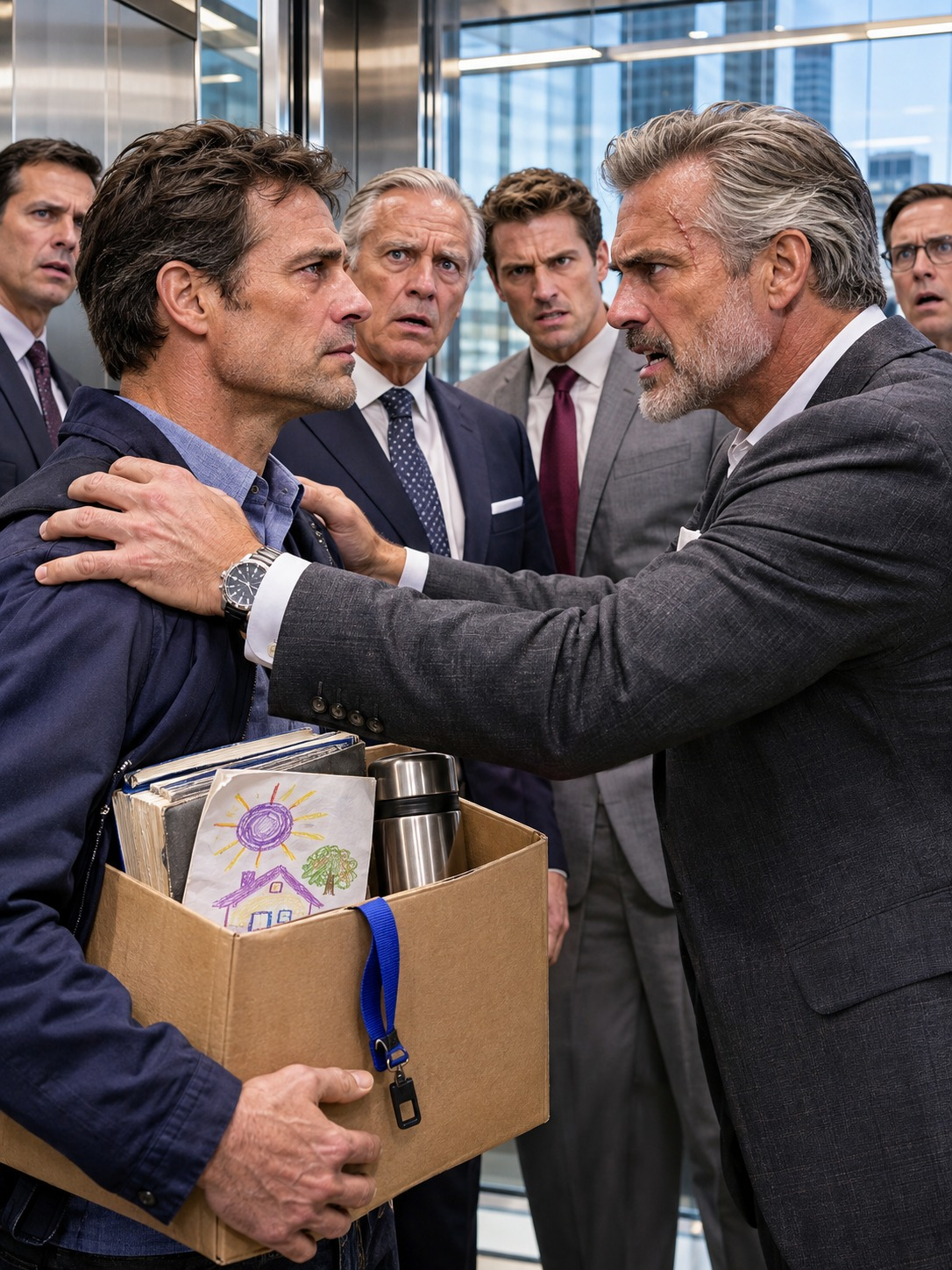
The cardboard box was sitting on the top shelf.
I'd kept it.
Not because I enjoyed remembering what happened.
But because I never wanted to forget how easily a person's value could be mistaken for a line on a budget.
I took it down.
The corners were bent.
The tape was peeling.
On one side, in faded black marker, someone from Crestline had written:
NOLAN VANCE — PERSONAL EFFECTS.
I smiled.
Then opened it.
Inside were a few things I'd never bothered to remove.
An old mechanical pencil.
A company anniversary pin.
A photograph from a project team dinner.
And a folded note from Rachel.
The one she'd slipped into my lunch bag years earlier.
Don't forget to eat. We love you.
I sat down.
For a moment, I was back in that elevator.
Forty-nine years old.
Unemployed.
Holding a box.
Wondering how I was going to tell my family that nine years of loyalty had ended in less than ten minutes.
Then I heard laughter in the hallway.
Liam was arriving with the younger engineers.
Someone was arguing about coffee.
Someone else was asking where the latest bridge inspection photographs had been filed.
Ordinary sounds.
Work sounds.
The sounds of a company beginning another day.
I folded Rachel's note and put it in my desk drawer.
Then I carried the box to the conference room.
I placed it on a shelf beneath Chloe's drawing.
Beside it, I set a small plaque.
It didn't mention Crestline.
It didn't mention Donald Davenport.
It didn't mention Grant Holloway or the investigation.
It simply read:
EVERY PERSON DESERVES TO BE HEARD. EVERY FACT DESERVES TO BE VERIFIED.
I stepped back.
Then Liam appeared in the doorway.
"Morning, Nolan."
"Morning."
He looked at the box.
Then at the plaque.
He smiled.
"Keeping the old one?"
I nodded.
"Yeah."
"Why?"
I looked around the room.
At the drawings on the walls.
At the inspection schedules.
At the engineers gathering for the morning meeting.
At the company we'd built from the wreckage of something I thought would last forever.
Then I looked at Liam.
"Because I want everyone who works here to know something."
He waited.
I smiled.
"A person's worth doesn't disappear because someone in an office decides they're too expensive."
Liam nodded slowly.
Then he looked toward the conference table.
"Ready for the morning review?"
I picked up my notebook.
"Absolutely."
We walked into the room together.
Seven employees had become fourteen.
The company had more work than I'd imagined.
We had projects to inspect.
Questions to answer.
Drawings to review.
And a responsibility to the people who would live, work, and raise families inside the things we helped build.
I took my seat.
Opened my notebook.
And began.
Not as the man Crestline had called redundant.
Not as the engineer a billionaire had rescued.
Not as the victim of a corporate conspiracy.
But as Nolan Vance.
Husband.
Father.
Engineer.
A man who had lost his job, discovered the truth, protected his family, and built a future on work he could stand behind.
Outside, the morning sun rose over the city.
Inside, my team waited for me to begin the review.
I looked around the table and smiled.
"All right," I said. "Let's make sure we get it right."






Comments 0