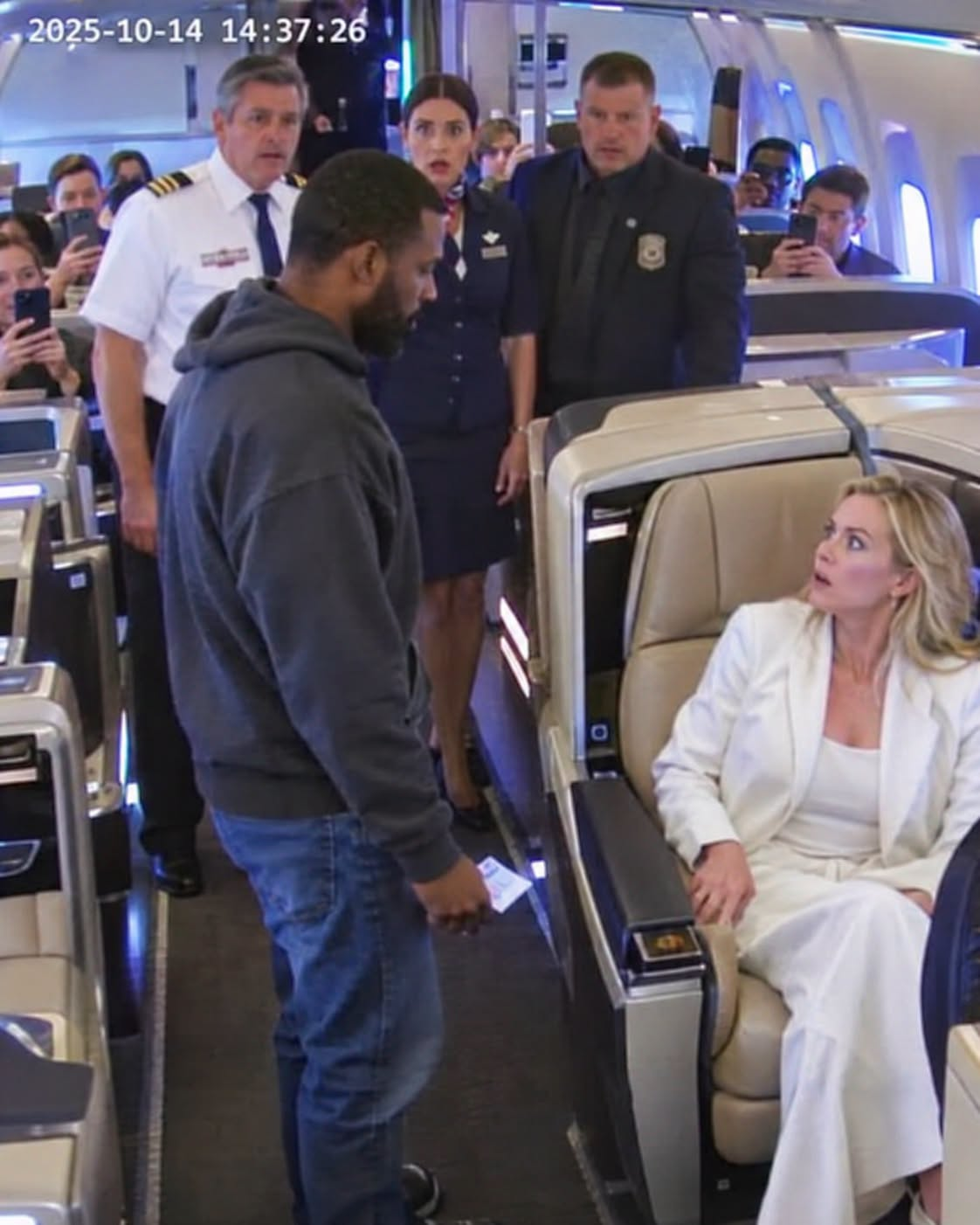
“Would you like me to inform the board that you've arrived, sir?”
The captain's question hung in the first-class cabin.
For several seconds, nobody moved.
The woman in the emerald-green suit stared at him as if he had suddenly begun speaking another language. Her mouth remained slightly open, and her fingers tightened around the handle of her black handbag.
I noticed the flight attendant glance at the captain, then at me. Two rows behind us, a passenger slowly lowered his phone.
The woman finally found her voice.
“The board?” she repeated. “What board?”
The captain turned toward her with professional courtesy.
“The airline's board of directors, ma'am.”
She gave a short, nervous laugh.
“That doesn't answer my question. Why would the captain need to inform the board that this man has boarded an airplane?”
I could have answered her.
Instead, I picked up my coffee and took a small sip.
The captain understood my silence. He had worked for the company for eleven years, long enough to know that when I chose to observe rather than speak, I usually had a reason.
“No announcement is necessary, sir,” he said to me. “I simply wanted to confirm whether you needed anything before departure.”
“Thank you, Captain. I'm fine.”
He nodded.
That should have ended the conversation.
But the woman stepped forward, placing herself between the captain and my seat.
“Excuse me. I am still waiting for someone to explain why this passenger is receiving special treatment.”
The captain looked at her calmly.
“Mr. Cole has a confirmed reservation for Seat 1A.”
“I heard that already.”
“Then I'm not sure what remains unclear.”
Her face reddened.
I could almost hear the thought forming in her mind. She had expected the captain to arrive, take one look at my clothes, and understand that she was the sort of passenger whose wishes should be accommodated.
Instead, he had addressed me with a respect she clearly believed I hadn't earned.
She turned toward me.
“Who exactly are you?”
It was the first reasonable question she had asked since approaching my seat.
I set my coffee down.
“Daniel Cole.”
She waited.
When I offered nothing else, her expression hardened again.
“And what do you do, Mr. Cole?”
“I work for the airline.”
A small, triumphant smile appeared on her face.
“There. You see? That explains everything.”
I raised an eyebrow.
“Does it?”
“Of course. You're an employee. Perhaps you were assigned this seat because of your position. But that doesn't mean you can ignore the way customers are treated.”
For the first time, I felt a flicker of genuine disbelief.
She had somehow managed to transform her own behavior into a complaint about mine.
The flight attendant looked down, clearly struggling to keep her expression neutral.
The captain, however, remained composed.
“Ma'am, Mr. Cole is entitled to occupy the seat printed on his boarding pass.”
The woman shook her head impatiently.
“I don't care what his boarding pass says. I care about standards.”
“What standards are you referring to?” I asked.
She looked at me as though I had deliberately misunderstood.
“Presentation. Professionalism. The experience passengers pay for.”
I glanced at my sweatshirt.
“Are you suggesting that my clothing makes my reservation invalid?”
She hesitated for less than a second.
“I'm suggesting that first class should mean something.”
“So am I.”
My answer was quiet enough that she had to listen carefully.
That seemed to irritate her even more.
She turned to the captain.
“Look, I don't want an argument. I want this handled properly. There must be a senior manager available.”
“There is,” I said.
Her eyes snapped toward me.
“Then call them.”
I reached into my pocket and took out my phone.
For one brief moment, she looked satisfied. She probably imagined that I was about to call someone who would finally explain the rules to me.
Instead, I opened a secure company messaging application.
A message from our chief operating officer waited at the top of the screen.
BOARD MEETING MOVED FORWARD. PLEASE CONFIRM YOU'RE STILL ON SCHEDULE.
I typed a short response.
ON BOARD. ARRIVING AS PLANNED.
Then I put the phone away.
The woman had been watching me closely.
“Did you just message someone?”
“Yes.”
“Who?”
“A colleague.”
She scoffed.
“Unbelievable.”
The captain glanced toward the cockpit, where preparations for departure were continuing. He had a responsibility to keep the boarding process moving, but he was also clearly aware that the confrontation had become more serious than an ordinary seating dispute.
“Ma'am,” he said, “I would appreciate it if you returned to your assigned seat so we can complete boarding.”
“My assigned seat?”
She looked offended.
“I haven't even been allowed to explain the situation.”
“You've explained it several times,” I said.
Her eyes narrowed.
“And you seem to think this is amusing.”
“I don't.”
“Then stop acting as though you're above everyone else.”
The accusation was so far removed from reality that I almost asked her to repeat it.
I didn't.
Instead, I looked at the captain.
“Captain, has the cabin finished boarding?”
“Almost, sir. We have a few passengers still coming down the jet bridge.”
“Then let's not delay them.”
He nodded immediately.
“Of course.”
That small exchange changed something in the woman's expression.
She had heard the captain call me sir. She had seen him accept my request without hesitation. And she had noticed that I seemed entirely unconcerned about the possibility of being removed from my seat.
Her confidence had begun to fracture, although she was doing everything she could to hide it.
She took a step toward the captain.
“I need to speak to your supervisor privately.”
“Certainly. The senior cabin crew member can assist you.”
“No. I want someone from corporate.”
The captain paused.
“Corporate?”
“Yes. I want to file a formal complaint about the way this airline handles first-class passengers.”
I watched the captain's face.
He was a disciplined man, but I saw his jaw tighten slightly.
He knew who I was. He also knew that I had spent months reviewing complaints about passengers who believed money entitled them to control employees.
The irony was becoming difficult to ignore.
“Very well,” he said. “We can document your complaint.”
“Good.”
“And we'll also document the circumstances that led to it.”
Her smile vanished.
“What does that mean?”
“It means the report will include the complete interaction, including the confirmed seat assignment and the instructions you've received from the crew.”
She stared at him.
For the first time, she appeared to understand that the people standing around her were not props in a private performance. They were employees with responsibilities, and their records would not necessarily support her version of events.
She turned toward the passengers behind us.
“I'm sure everyone here can see what's happening.”
Nobody answered.
A middle-aged man across the aisle shifted in his seat.
“I saw the whole thing,” he said quietly. “The gentleman was sitting there before you arrived.”
The woman stared at him.
“I wasn't speaking to you.”
“I know,” he replied. “I just thought you should know.”
A young woman near the window looked up from her phone.
“I saw it too.”
Another passenger nodded.
The woman in green seemed to shrink beneath the sudden weight of their attention.
I felt no satisfaction in it.
Public embarrassment rarely improved anyone's judgment. If anything, it often made people more determined to defend the indefensible.
I wanted to understand what had brought her to this point, but I wasn't going to encourage a spectacle.
“Let's leave it there,” I said.
She turned toward me.
“Don't tell me what to do.”
“I wasn't.”
“You were.”
I looked at her for a moment.
“Then I'll be more precise. I have no intention of arguing with you. Your seat assignment can be verified by the crew. Mine has already been verified. We can both continue our journey without another confrontation.”
My tone never changed.
There was no threat in my words, no hint that I could make a phone call and alter her life.
I simply offered her an opportunity to stop.
She could have taken it.
Instead, she lifted her chin.
“You think you can speak to me like that because the captain likes you?”
“No.”
“Then why is everyone treating you differently?”
I considered the question.
“Perhaps because I'm letting them do their jobs.”
Her face tightened.
The captain stepped aside and quietly spoke to the flight attendant. She nodded, then moved toward the galley to assist with the remaining boarding passengers.
For a few seconds, the woman stood motionless beside my seat.
Then she abruptly turned and walked toward the next row.
I watched her go without comment.
She stopped beside an empty first-class seat near the window, placed her handbag on it, and pulled out her phone.
Her fingers moved rapidly across the screen.
I returned to my newspaper, although I wasn't reading it.
From the corner of my eye, I could see her glancing in my direction every few seconds.
Whatever she was typing seemed to be making her angrier.
Finally, she lifted the phone to her ear.
“Yes,” she whispered sharply. “It's me. I have a situation.”
She listened.
“No, you need to hear me. The captain is involved now.”
Another pause.
Her eyes shifted toward me.
“I don't care who he says this man is. I want someone from corporate on this flight.”
She lowered her voice even further.
Then she said a name.
I couldn't hear the rest of the conversation, but the name itself caught my attention.
It belonged to a senior executive in my company.
A man who had personally assured me, only three weeks earlier, that our internal review had found no evidence of systematic mistreatment among our premium cabin staff.
I looked down at my folded newspaper.
Perhaps the woman was simply acquainted with him. Large companies had thousands of professional relationships, and a familiar name meant very little by itself.
Still, the timing troubled me.
The woman listened for another few seconds before ending the call.
She slipped her phone into her handbag and turned toward the aisle.
Her expression had changed again.
The embarrassment was gone.
In its place was a confidence that looked almost rehearsed.
She walked back toward me, stopping just beyond the armrest.
“You should know something, Mr. Cole.”
I looked up.
“What's that?”
She leaned closer, lowering her voice so the passengers behind us couldn't easily hear.
“You aren't the only person on this flight who knows people at corporate.”
I remained silent.
She smiled faintly.
“And when this plane lands in New York, I think you'll discover that your position isn't quite as secure as you imagine.”
Before I could respond, her phone vibrated inside her handbag.
She pulled it out.
One message appeared on the screen.
Her eyes widened as she read it.
Then she looked directly at me and whispered—
“There's something you don't know about your own company.”






Comments 0