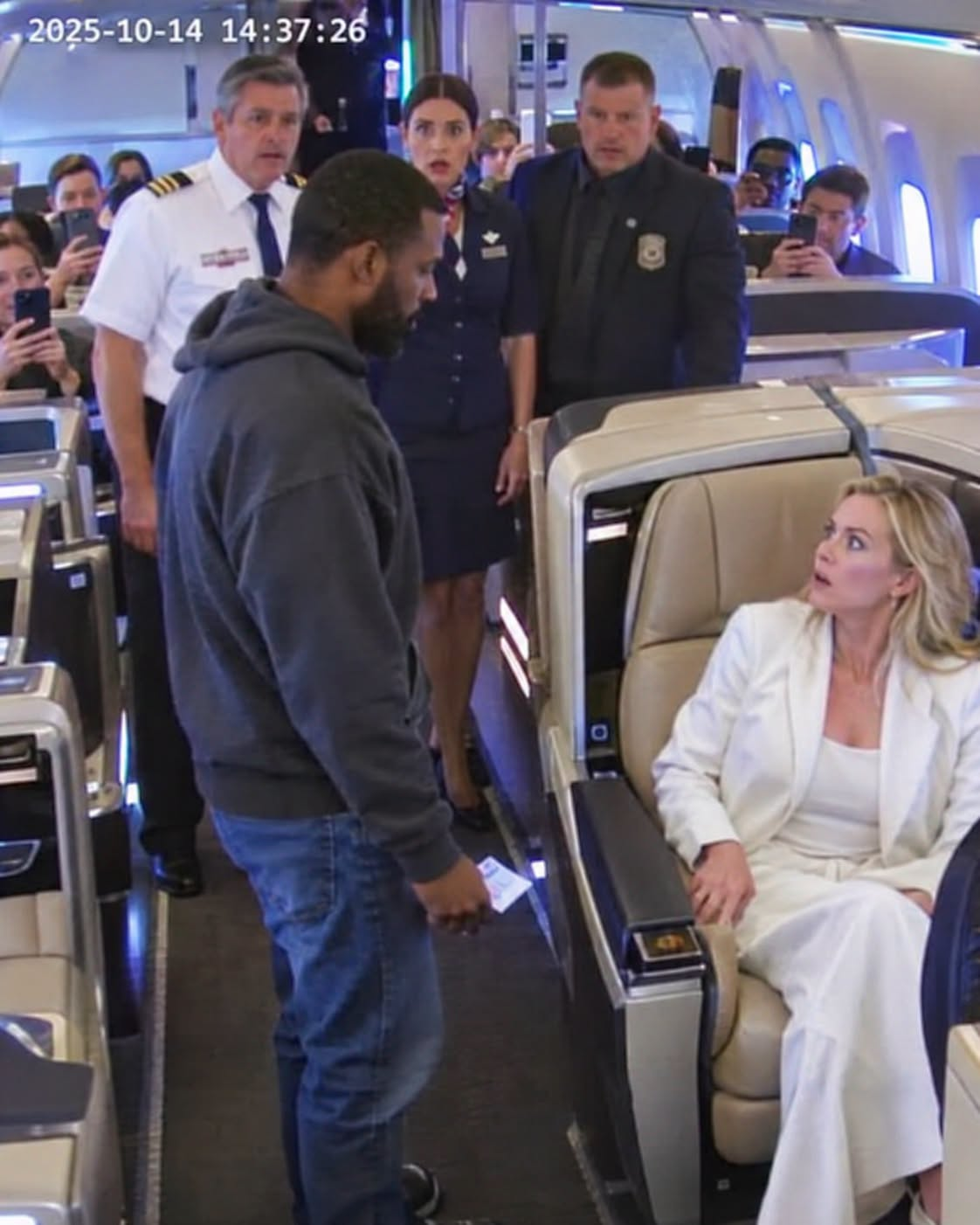
A woman pointed at my boarding pass and demanded, “Get out of that seat!”
I looked up from my coffee.
The captain appeared behind her, carrying a small black folder marked with my initials.
Inside the folder was a document that could change her entire afternoon.
She had no idea who she was speaking to.
My name is Daniel Cole, and on that spring afternoon in 2025, I boarded Flight A921 at Hartsfield-Jackson Atlanta International Airport wearing a dark olive sweatshirt, faded blue jeans, and a pair of white sneakers that had seen better days.
I looked like someone traveling home after a long week of work.
That was precisely the point.
I had spent fifteen years building an airline from a struggling regional operation into one of the most profitable carriers in the country. I owned sixty-eight percent of the company, served as its chief executive, and had spent more nights in hotel rooms than I cared to count.
My face appeared in business magazines. My signature authorized multimillion-dollar contracts. My decisions affected thousands of employees.
Yet I had discovered something troubling during the previous six months.
Our financial reports looked excellent.
Our customer satisfaction numbers were improving.
Our executives assured me that the company culture was healthy.
But the complaints arriving through our internal review system told a different story.
Passengers described being ignored, mocked, or treated differently because of their appearance. Employees reported that certain travelers received preferential treatment while others were dismissed before they had even finished speaking.
The incidents were scattered across airports and routes. No single report seemed serious enough to explain the pattern.
Together, however, they suggested that something was wrong.
I could have summoned department heads, ordered another investigation, and waited for a carefully prepared presentation.
Instead, I decided to see what happened when nobody recognized me.
I booked my regular first-class seat under my own name, but I traveled without an assistant, an entourage, or any visible indication of my position.
I carried a black leather briefcase, a paper boarding pass, and a cup of plain coffee.
I wanted to observe people without the invisible protection that came with being the man who signed their paychecks.
Flight A921 was scheduled to leave Atlanta shortly after two in the afternoon and arrive in New York less than two hours later.
I had an emergency board meeting waiting for me at the other end of the journey.
Before that meeting, I wanted answers to a simpler question.
How did my airline treat someone it believed had no power?
I reached Seat 1A, placed my briefcase beside the seat, and settled into the cream leather cushion.
The cabin smelled faintly of fresh coffee and polished wood. Afternoon sunlight spilled through the oval windows, illuminating the metallic armrests and neatly arranged overhead compartments.
A flight attendant passed by and offered me a polite greeting.
I returned it and unfolded a newspaper.
For several minutes, everything seemed ordinary.
Then I heard the sharp clicking of heels approaching from behind me.
A woman stopped beside my seat.
She looked to be in her late thirties, with platinum-blonde hair styled in a precise bob. Her emerald-green designer suit fitted perfectly, and a structured black handbag hung from her forearm.
A gold bracelet flashed beneath the cabin lights when she adjusted her sleeve.
She glanced at me.
Then she glanced at the seat number above my shoulder.
Her expression changed.
“Excuse me,” she said. “You're sitting in the wrong place.”
I lowered my newspaper.
“Am I?”
She pointed toward the aisle.
“Yes. This is first class.”
I looked at the seat around me, then back at her.
“I know.”
For a moment, she appeared genuinely confused that I had answered without immediately standing.
Then her gaze dropped to my sweatshirt.
I watched her make a decision about me without asking a single question.
“I think you need to check your ticket,” she said.
I placed my coffee on the armrest and reached for my boarding pass.
“Seat 1A,” I told her. “That's my assigned seat.”
She barely glanced at it.
“I'm sure there's been some kind of mistake.”
“There hasn't.”
Her lips tightened.
Behind her, two passengers had stopped arranging their carry-on bags. A man seated across the aisle looked up from his phone, while a woman near the window quietly turned toward us.
The blonde noticed the attention, but rather than lower her voice, she seemed to become more determined.
“Listen,” she said, leaning closer. “I fly first class all the time. I know how these things work.”
I said nothing.
She interpreted my silence as an invitation to continue.
“Sometimes people board the wrong cabin. It happens. But you can't simply sit wherever you want and expect everyone else to accommodate you.”
I looked at the boarding pass still resting between my fingers.
Then I looked at her.
“Have you checked your own seat assignment?”
Her expression hardened.
“Don't be difficult.”
That was the moment I understood that this wasn't about a seat.
She had already decided that I did not belong. Every answer I gave her only irritated her further because I refused to behave like the person she had imagined.
She wanted me embarrassed.
She wanted me to apologize.
Most importantly, she wanted me to move.
I had seen the same behavior in conference rooms, hotel lobbies, and airport lounges. People who confused expensive clothing with authority often assumed that anyone dressed differently must answer to them.
I had never expected to encounter such a clear example within the first five minutes of my experiment.
“I have a valid boarding pass,” I said. “If you believe there's a problem, we can ask the flight attendant to verify it.”
The woman let out a short, incredulous laugh.
“Of course we're going to ask the flight attendant.”
She turned toward the forward galley and raised her hand.
“Excuse me! Could someone help me here?”
A young flight attendant approached, her dark brown hair secured in a neat bun beneath a navy-blue uniform cap.
“Good afternoon,” she said. “How can I help?”
The woman immediately pointed at me.
“This man is refusing to move from my seat.”
The attendant looked at the seat number, then at me.
“Sir, may I see your boarding pass, please?”
I handed it to her.
She examined the printed details.
For a second, her expression suggested that she had found something unexpected.
Then she checked the seat number above the armrest.
“Mr. Cole, this is Seat 1A,” she said carefully. “Your boarding pass is correct.”
The woman blinked.
“What?”
“The seat is assigned to him.”
The attendant spoke politely, but uncertainty had entered her voice. She looked from the boarding pass to the woman, as though hoping the misunderstanding would resolve itself without becoming a scene.
The blonde folded her arms.
“That cannot be right.”
“I'm sorry, ma'am, but—”
“I paid an extraordinary amount for this ticket,” the woman interrupted. “I expect the airline to maintain certain standards.”
Her eyes moved toward my jeans.
She did not need to explain what she meant.
The flight attendant's expression became uncomfortable.
I noticed it immediately.
She was no longer simply verifying a seat assignment. She was trying to manage a passenger who appeared determined to turn a routine question into a public confrontation.
And she was doing so in front of a cabin full of people who were watching her.
I knew that feeling. I had watched employees struggle under pressure from demanding customers before, but seeing it unfold from the other side of the executive office made the problem more immediate.
“Ma'am,” the attendant said, “the reservation system confirms that Seat 1A belongs to Mr. Cole.”
The woman stared at her as though the attendant had personally insulted her.
“Then find out why.”
“There is no discrepancy in the reservation.”
“Get your supervisor.”
The words landed harder than they needed to.
The attendant hesitated.
I could have ended the confrontation by announcing my position. One phone call would have brought a senior executive to the aircraft before the doors closed.
But that would have defeated the purpose of being there.
I wanted to know what happened when employees had to choose between doing their jobs correctly and satisfying someone who demanded special treatment.
So I remained seated.
The woman turned back toward me.
“You should have moved when I asked you.”
I folded my newspaper and placed it on my lap.
“You asked me to leave a seat that belongs to me.”
Her cheeks flushed.
“You have no idea who you're dealing with.”
I almost smiled at the irony, but I stopped myself.
She truly believed that power belonged to whoever could intimidate the other person first.
“Neither do you,” I replied.
For the first time, she had no immediate answer.
The flight attendant excused herself and moved toward the galley, presumably to consult a senior crew member.
The woman watched her go.
Then she looked at the passengers who had been observing us.
Nobody volunteered to support her.
That seemed to anger her more than anything else.
She leaned toward me again.
“I am not going to sit here while someone like you takes advantage of the system.”
I kept my voice level.
“Then perhaps you should let the crew do their job.”
Her face went rigid.
Before she could respond, a familiar voice came from farther down the aisle.
“Is there a problem here?”
The captain had approached, his silver-gray hair neatly combed, four gold stripes visible on his white uniform sleeves.
The flight attendant stood beside him.
The woman straightened immediately, relief spreading across her face.
“Thank goodness,” she said. “I've been trying to resolve this situation, but your staff seem unable to understand what I'm telling them.”
The captain looked at her.
Then he looked at me.
For a fraction of a second, his expression changed.
Recognition.
He glanced at the boarding pass in the flight attendant's hand, then back at my face.
I gave him the smallest possible nod.
He understood.
The woman did not.
“Captain,” she continued, “I need you to have this man removed from my seat before we depart.”
The captain held her gaze for a moment.
Then he stepped closer to my row.
His posture became unmistakably respectful.
“Good afternoon, Mr. Cole,” he said. “I wasn't expecting you on this flight today.”
The woman's mouth fell open.
The captain paused, still looking at me.
And then, in front of the entire first-class cabin, he added one sentence that made her turn completely still—
“Would you like me to inform the board that you've arrived, sir?”






Comments 0