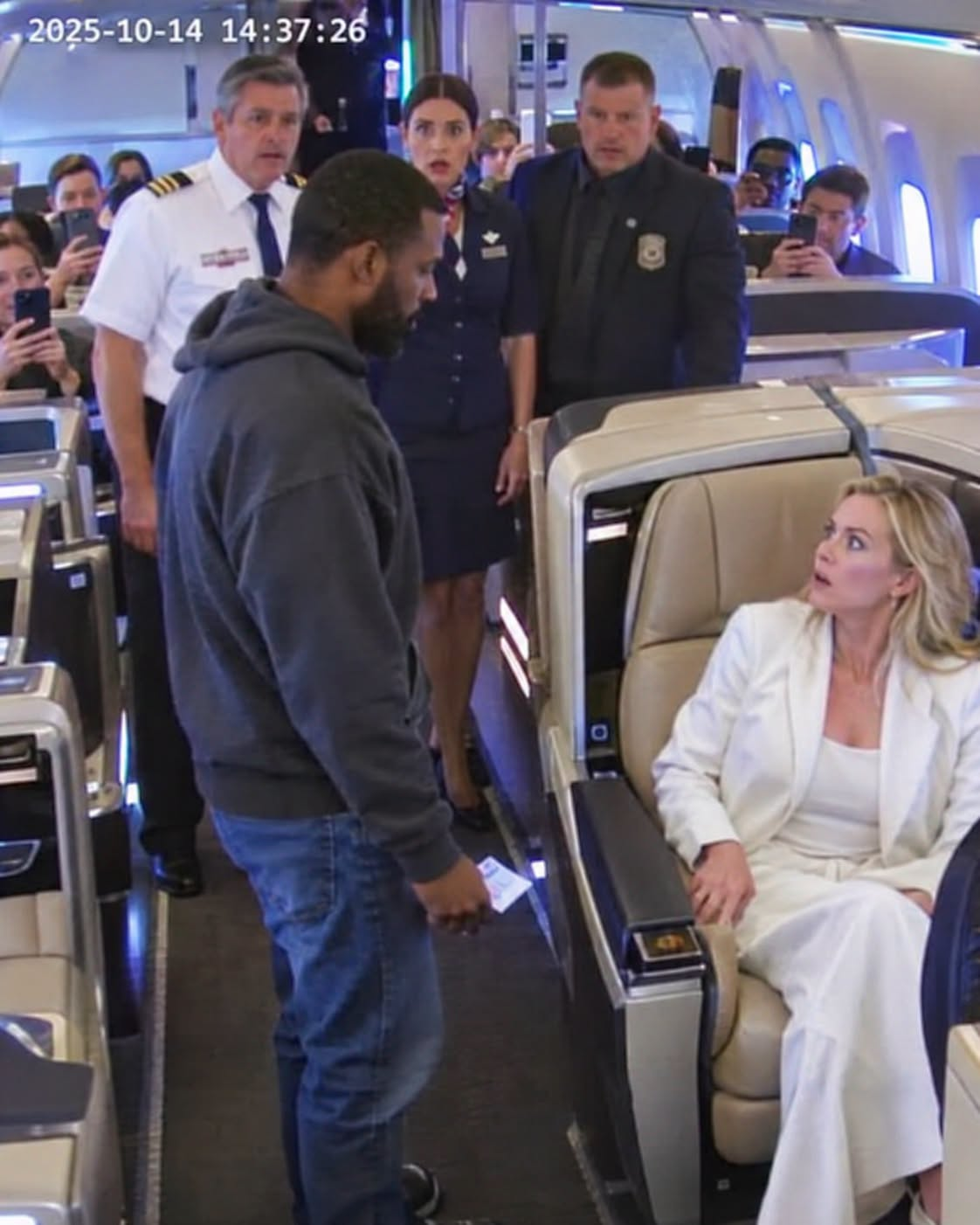
The captain had barely finished speaking when Richard Vaughn reached for his phone.
“Who authorized the legal department to get involved?” he demanded.
The captain looked at him steadily.
“I was told that a representative had arrived at the gate.”
“That isn't what I asked.”
“And I don't have any additional information, Mr. Vaughn.”
Richard lowered his phone, but his expression had changed. The polished confidence he had carried into the cabin was gone. In its place was something sharper, something that looked dangerously close to panic.
Across the aisle, the woman in the emerald suit had stopped pretending to be interested in anything else.
She watched Richard.
Richard watched the captain.
And I watched both of them.
For fifteen years, I had learned that the most revealing moment in a difficult conversation often came just after someone realized the situation was no longer under their control.
That moment had arrived.
“Captain,” I said, “please ask the gate agent to hold the envelope until we establish who is requesting it and why.”
“Certainly, sir.”
“And nobody is to remove or alter its contents.”
The captain nodded and stepped toward the galley.
Richard gave a short, humorless laugh.
“This is becoming absurd.”
“Is it?”
“We're holding up an aircraft because a former employee claims to have documents.”
“No one has asked you to approve anything, Richard.”
His jaw tightened at the use of his first name.
“I am responsible for customer experience. If there has been a complaint involving a passenger, I have a legitimate interest in resolving it.”
“Then you should welcome a complete investigation.”
“I do.”
“Good.”
I took out my phone.
“Because that's exactly what we're going to have.”
He stared at me for a moment, then turned away.
I could see him composing a message with quick, angry movements. His thumbs moved across the screen, stopped, and moved again.
A few seconds later, the woman in green received a notification.
She looked at it.
Then she looked at him.
Neither spoke.
I didn't need to read their messages to understand that they were coordinating their responses.
What I needed was evidence.
I called our general counsel, Elena Brooks, a woman whose reputation for precision had survived every executive reshuffle the airline had experienced.
She answered on the second ring.
“Daniel?”
“I need you to listen carefully. I'm on Flight A921 in Atlanta. Jonathan Reed is at the gate with original records related to our internal compliance review. Someone from corporate legal has arrived and is apparently requesting access to those records.”
Elena's voice became serious.
“Who is the attorney?”
“I haven't confirmed the name.”
“Has anyone taken possession of the envelope?”
“Not that I know of.”
“Then it needs to remain untouched until we establish the chain of custody. Don't let anyone remove it, photograph it, or pressure Reed into handing it over without documentation.”
“That's my intention.”
She paused.
“Daniel, what prompted this?”
“A passenger dispute led to a conversation with Richard Vaughn. Jonathan then called and claimed the board received altered versions of the original complaint records.”
Silence.
When Elena spoke again, her voice was quieter.
“Did Jonathan say who altered them?”
“He said Richard knew what happened. He didn't have time to explain further.”
Elena exhaled.
“I'll contact the airport's appropriate operations personnel and arrange for an independent legal representative to meet him. But I need to tell you something.”
“What?”
“Three weeks ago, I requested the original complaint files for a separate legal review. I was told they had been archived and that the records were complete.”
“Who told you that?”
“Martin Hayes's office.”
I looked across the aisle.
Richard had stopped typing.
He was staring at me.
“Was that request documented?” I asked.
“Yes. I have the emails.”
“Send them to me through the secure channel. Don't circulate them beyond the people necessary to preserve the records.”
“Understood.”
“And Elena?”
“Yes?”
“If anyone attempts to destroy, alter, or remove those files, I want the incident documented immediately.”
“I'll handle it.”
The call ended.
I sat quietly for a moment, absorbing what she had told me.
This was no longer simply about an executive who might have mishandled a complaint. If the original records had been withheld from our legal department, the implications could reach much further than customer service.
They could involve corporate governance, financial disclosures, employment decisions, and potential legal exposure.
I glanced at the woman in green.
She was looking at her phone again.
When she noticed me watching, she quickly locked the screen.
“Is there something you need?” she asked.
“I was wondering whether you know Jonathan Reed.”
Her expression hardened.
“I don't know why you keep asking me questions.”
“Because you seemed particularly interested when his name came up.”
“I'm interested because this entire situation is ridiculous.”
“Then it should be easy to clarify.”
She lifted her chin.
“I have done nothing wrong.”
“I haven't accused you of anything.”
“You're implying it.”
“No. I'm asking a question.”
She opened her mouth, but Richard interrupted.
“That's enough.”
He had spoken to her, not to me.
The woman turned toward him.
“Excuse me?”
“Please stop discussing this.”
Her eyes widened.
For the first time, she appeared offended by Richard rather than by me.
“You told me you would handle everything.”
Richard's face went rigid.
“Not here.”
The words escaped before he could stop them.
A passenger behind us looked up.
The woman stared at Richard, suddenly realizing that she had revealed more than she intended.
I leaned back.
Neither of them looked at me.
That was fine.
People often told the truth when they forgot someone was listening.
The captain returned several minutes later.
“Mr. Cole, the gate agent has confirmed that the envelope is still with Mr. Reed.”
“And the lawyer?”
“He has identified himself as Peter Lang, outside counsel retained by the company.”
I knew the name.
Peter Lang was a partner at a prominent Atlanta law firm. He had represented the airline in several commercial disputes, but he was not our general counsel and did not have unrestricted authority over internal compliance records.
“Did Mr. Reed agree to give him the envelope?” I asked.
“No, sir. According to the gate agent, Mr. Reed requested confirmation from our legal department before releasing anything.”
“Good.”
The captain hesitated.
“There's another detail. Mr. Lang says he has written authorization to collect the materials.”
“From whom?”
“He didn't specify.”
I looked at Richard.
His eyes shifted toward the window.
“Captain,” I said, “please tell the gate agent that no documents are to be released until our general counsel confirms the authorization directly.”
“Understood.”
He returned to the galley.
Richard stepped closer to my seat.
“Daniel, I strongly advise you not to interfere with an established legal process.”
“I'm not interfering with it. I'm asking that it be followed.”
“You're making assumptions about people who may be acting in good faith.”
“Then the documentation should settle the matter.”
He lowered his voice.
“Not every internal disagreement belongs in front of the board.”
I studied him.
“That's an interesting observation.”
“I'm speaking generally.”
“Of course.”
He straightened his jacket.
“You have an important meeting in New York. You should focus on that instead of allowing a disgruntled former employee to derail your afternoon.”
“Jonathan's concerns appear to involve records that were presented to the board. That makes them relevant to my meeting.”
“Only if his allegations are true.”
“Exactly. Which is why I want the records.”
Richard looked away.
His phone vibrated again.
He checked the screen, and this time I saw his hand tremble.
He turned the display toward his body before I could identify the sender.
“Excuse me,” he muttered.
He walked several steps down the aisle and answered the call in a whisper.
I couldn't hear every word, but a few fragments reached me.
“No, he hasn't seen them.”
A pause.
“I said he hasn't seen the originals.”
Another pause.
Then, more urgently, “You told me this was already handled.”
He turned his back toward the cabin.
I watched him for a moment before looking at the woman.
She was no longer sitting comfortably.
Her handbag rested in her lap, and she had both hands wrapped around it. She looked toward Richard, then toward the aircraft door.
I wondered whether she was considering leaving the plane.
Before I could decide, her phone rang.
She answered immediately.
“Yes?”
A man's voice came through the speaker, loud enough for me to hear a few words.
“Don't speak to anyone about the list.”
Her face drained of color.
“I haven't,” she whispered.
“Keep it that way. Do you understand?”
She swallowed.
“But Richard said—”
“Richard doesn't decide what happens next.”
The call ended.
The woman lowered the phone slowly.
For several seconds, she didn't move.
Then she looked at me.
There was something different in her eyes now. Not arrogance. Not even anger.
Fear.
“Mr. Cole,” she said, barely above a whisper.
I waited.
“If I tell you what happened, can you promise that my name won't appear in any report?”
I considered the question carefully.
“No.”
Her face crumpled.
“Then I can't help you.”
“You haven't helped me yet.”
She looked down at her hands.
“I was only trying to get where I needed to go.”
“Everyone on this plane is trying to get somewhere.”
She shook her head.
“You don't understand.”
“Then explain it.”
She glanced toward Richard, who was still speaking on his phone.
“I wasn't supposed to confront you,” she said.
The words were so quiet that I almost missed them.
I leaned forward.
“What did you say?”
She looked at me, and I saw genuine regret for the first time.
“I wasn't supposed to confront you personally.”
“Who told you to?”
Her lips trembled.
She glanced toward the galley, then at the passengers around us.
“I can't say his name.”
“Why not?”
“Because if I do, he'll know I talked.”
I kept my voice steady.
“Who will know?”
She opened her mouth.
Then Richard returned.
The woman immediately fell silent.
He looked from her to me and seemed to understand that something had changed.
“What are you discussing?” he asked.
“Nothing,” she replied quickly.
Richard didn't believe her.
Neither did I.
He stepped closer, his expression cold.
“I thought I asked you not to discuss this.”
The woman stared at him.
“You said it would be simple.”
Richard's eyes flashed.
“Not another word.”
The entire exchange lasted only seconds, but it was enough.
Whatever connection existed between them, it was no longer a matter of speculation.
The woman had followed instructions from someone.
Richard had expected her to remain silent.
And somebody outside the aircraft was frightened enough to warn her not to reveal the existence of a list.
I turned toward Richard.
“What list?”
He froze.
For a moment, the cabin seemed to hold its breath.
Then he forced a laugh.
“I have no idea what you're talking about.”
I didn't answer.
My phone vibrated.
Elena had sent the emails she promised.
I opened the first message and scanned the correspondence.
The request for original complaint records was there, dated three weeks earlier. Elena had asked for the full files and the complete audit history.
Martin's office had replied that the materials were available and complete.
A second message contained an attachment.
I opened it.
The file was a short internal summary, but one sentence caught my attention.
All exceptions involving designated premium customers were reviewed and approved under executive discretion.
I read it twice.
Designated premium customers.
Executive discretion.
The language was vague enough to conceal almost anything.
I opened the metadata.
The document had been revised four times after the original review was supposedly completed.
The last revision had been made two days before the board meeting.
The author field contained a name.
I stared at it.
Then I looked at Richard.
He was watching my face.
He knew I had found something.
And when I turned the phone toward him, he stepped backward as if the screen itself could expose him.
“Where did you get that?” he whispered.
I kept my eyes on his.
“From my own legal department.”
He swallowed.
I opened the revision history.
The final entry showed that the document had been altered at 11:47 p.m., two nights before it reached the board.
The change had been approved using an executive authorization code.
I enlarged the entry.
A name appeared beside the approval.
It wasn't Richard Vaughn.
It wasn't Martin Hayes.
It was someone whose authority reached above both of them.
Before I could read the full entry, the aircraft door remained open and the captain's phone rang again.
He answered, listened for a few seconds, and hurried toward me.
“Mr. Cole,” he said, his face unusually tense, “Mr. Reed has just handed the envelope to the gate agent.”
I stood.
“Why?”
The captain looked toward Richard.
“Because the person who authorized the collection has just arrived in person.”
Then the captain lowered his voice and told me that the person walking down the jet bridge was the last individual I expected to see.






Comments 0