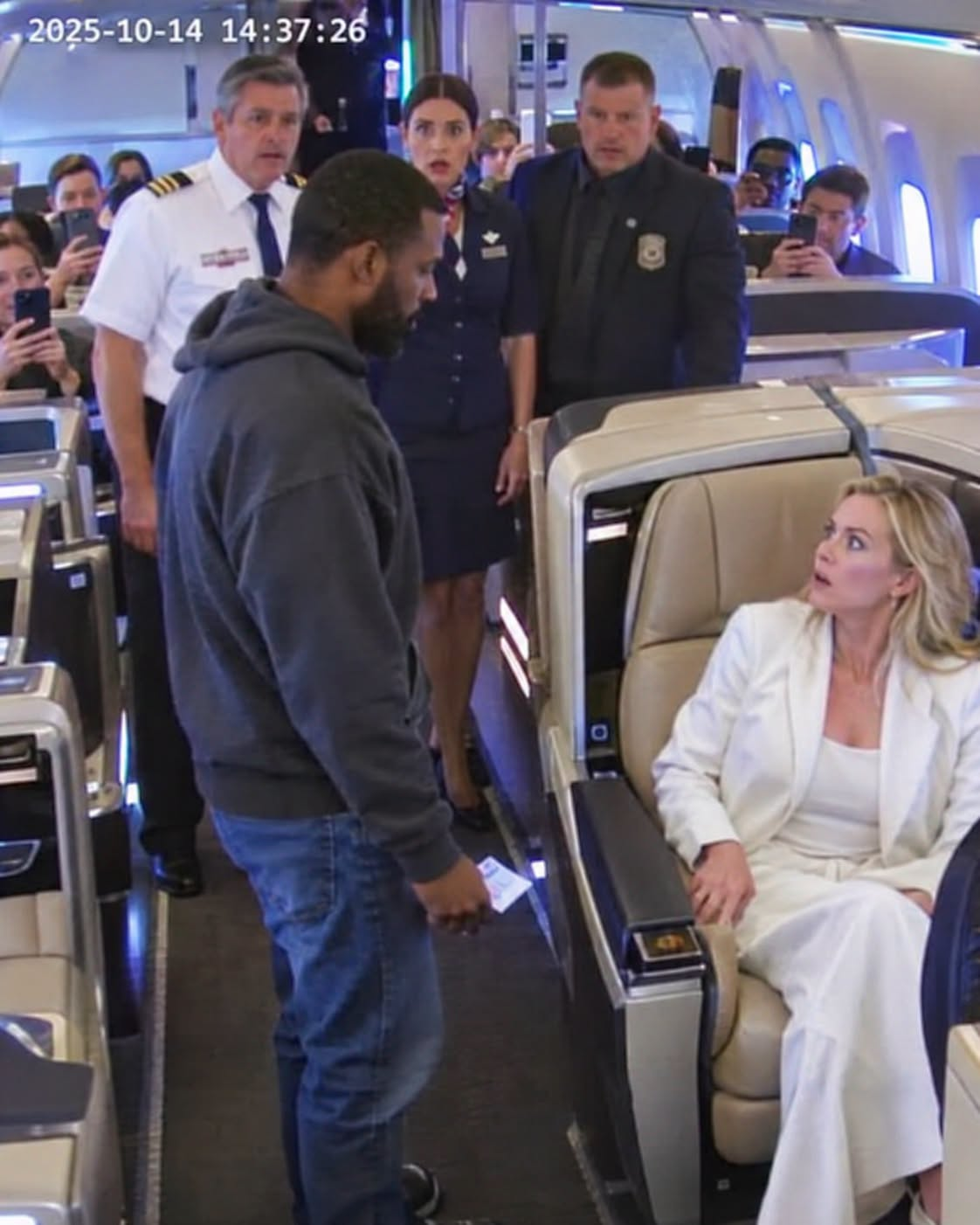
The name the captain gave me was the last one I expected to hear.
“Mr. Cole, the person at the gate is Edward Whitmore.”
For a moment, I thought I had misunderstood him.
Edward Whitmore was the chairman of our board of directors.
He was also the man who had stood beside me when I signed the papers that transformed a small regional airline into a national carrier. He had defended my decisions during our most difficult financial years, challenged me when I became too confident, and reminded me that an airline's reputation depended on thousands of people whose names would never appear in a newspaper.
He knew the company almost as well as I did.
And now he was standing at the gate of my aircraft, demanding access to documents that a former compliance director had risked his reputation to preserve.
“Are you certain?” I asked.
The captain nodded.
“He identified himself personally. The gate agent recognized him.”
I looked toward Richard Vaughn.
The senior vice president had gone so still that he seemed to have forgotten where he was.
Across the aisle, the woman in the emerald suit pressed her handbag against her chest.
Neither of them said a word.
I stood beside my seat.
“Captain, please ask Mr. Whitmore to wait until our general counsel arrives or confirms the procedure. Nobody should take possession of those records until their authorization is verified.”
“Understood, sir.”
The captain moved toward the galley.
Richard immediately stepped into my path.
“You cannot seriously be considering delaying the chairman of the board.”
I looked at him.
“I haven't delayed anyone. I'm asking for a documented process.”
“He is the chairman, Daniel.”
“I know who he is.”
“Then you should understand the consequences of making him wait.”
I studied Richard's face.
There it was again.
Not an argument about evidence.
Not a concern about preserving records.
A warning about consequences.
“Are you suggesting that the chairman should receive documents without verification simply because of his position?”
Richard opened his mouth, but no answer came.
I stepped around him.
The aircraft door remained open. Outside, the jet bridge stretched toward the terminal, and a ground crew member waited near the entrance. The captain was speaking with someone beyond the doorway.
A few passengers had begun whispering among themselves.
I could hardly blame them. They had boarded expecting a quiet flight to New York. Instead, they had found themselves watching a confrontation involving senior airline executives and the company's chairman.
I turned to the captain.
“Please assure the passengers that we're addressing an administrative matter and that their safety remains our priority.”
“Of course.”
He made a brief announcement, explaining that departure would be delayed while a company matter was resolved.
Then he returned to the entrance.
Several minutes passed.
Finally, Edward Whitmore appeared in the doorway.
He wore a charcoal suit, a pale blue shirt, and a dark tie. His silver hair was neatly combed, and he carried a leather document case in one hand.
He looked older than he had at our last board meeting.
Not physically, exactly.
There was a tension around his eyes that I hadn't noticed before.
He entered the cabin, acknowledged the captain, and looked directly at me.
“Daniel.”
“Edward.”
We shook hands.
His grip was firm, but his eyes moved briefly toward Richard before returning to me.
“I understand there's been a misunderstanding.”
“That depends on which part you're referring to.”
He paused.
Then he looked at the passengers.
“Perhaps we should speak privately.”
“I'd prefer to establish why you're here before we move anywhere.”
Edward's expression changed slightly.
For years, our conversations had been candid. We disagreed often, but neither of us had ever needed to hide behind formal language.
Today, however, he appeared to be choosing every word carefully.
“I came because I was informed that Jonathan Reed had contacted you regarding confidential company records.”
“He did.”
“Did he tell you what those records contain?”
“He said the original complaint files had been altered before they reached the board.”
Edward exhaled slowly.
“That's a serious allegation.”
“Yes.”
“And one that should be investigated properly.”
“Agreed.”
He glanced toward Richard.
“Richard, would you mind giving us a moment?”
Richard hesitated.
“Of course, Mr. Whitmore.”
He stepped back, but he did not move far.
Edward noticed.
“Please wait in the forward galley.”
For the first time, Richard looked genuinely offended.
“Chairman, I have direct responsibility for the customer experience division. I believe my presence is relevant.”
“Your presence is relevant,” Edward replied. “Which is why I may need to speak with you afterward.”
Richard's face tightened.
He walked toward the galley without another word.
The woman in green remained in her seat.
Edward turned toward her.
“And you are?”
She straightened immediately.
“Victoria Bennett.”
The name meant nothing to me at first.
Then I remembered the woman who had asked to meet our premium services team during a charity event the previous winter. She had been introduced to me briefly, but I had spent most of that evening speaking with employees and local community representatives.
I couldn't remember whether Victoria had been there.
Edward, however, appeared to recognize her.
His expression became guarded.
“Ms. Bennett,” he said. “I wasn't aware you were traveling today.”
“Neither was I aware that this situation would become so complicated.”
Her tone was controlled, but her hands were shaking.
Edward looked at me.
“Daniel, may we speak near the galley?”
I considered the request.
“Not until Elena Brooks confirms the handling procedure for Jonathan's documents.”
Edward's jaw tightened.
“Elena has already been informed.”
“By whom?”
“By me.”
“When?”
“Several minutes ago.”
I nodded slowly.
“Then we can wait for her confirmation.”
He looked at me for a long moment.
Something in his expression suggested that he had expected me to defer to him automatically.
I didn't.
I had spent years trusting Edward because he valued evidence over appearances. If he was acting in good faith, a few minutes would make no difference.
If he wasn't, those minutes might matter enormously.
My phone vibrated.
Elena had sent another message.
I'm coordinating directly with the airport contact. Do not release the originals to anyone until I confirm identity and authority. Jonathan has agreed to preserve the envelope in its current condition.
I showed Edward the message.
He read it without comment.
“Very well,” he said. “We'll follow the procedure.”
It was the right answer.
But it didn't reassure me.
Edward had arrived in person before our legal department had completed its review. He had come to an aircraft at an airport where thousands of passengers passed every day, and he had asked to speak with me about confidential records.
That was unusual enough.
What troubled me more was his reaction when I mentioned the altered report.
He hadn't asked whether the allegation was true.
He had asked what Jonathan had told me.
I looked toward the galley.
Richard stood near the partition, pretending to examine his phone.
The woman in green watched Edward with the tense concentration of someone waiting for a verdict.
I decided to ask the question directly.
“Edward, did you know about the priority list?”
His face went still.
“What priority list?”
“The list Jonathan mentioned. The one that supposedly identified certain premium customers whose complaints were handled outside normal procedures.”
Edward took a slow breath.
“I have heard of informal customer escalation arrangements.”
“That's not what I asked.”
“No,” he said. “I did not know about a list that bypassed established complaint procedures.”
“Did you authorize any exceptions to the normal process?”
“Not without documentation.”
“Then you won't object to an independent review.”
His gaze sharpened.
“Of course not.”
I waited.
He looked away first.
The captain returned from the galley.
“Mr. Cole, Ms. Brooks is on the line. She would like to speak with you and Mr. Whitmore.”
I accepted the phone.
Elena's voice was crisp and professional.
“Daniel, I've verified the request. Jonathan Reed has not transferred the envelope to Mr. Lang. The gate agent has retained custody while we arrange an independent witness.”
“Good.”
“However, I need to tell you something else. The corporate legal office has received an instruction to suspend access to the archived complaint database.”
“Who issued it?”
“That's what we're trying to determine. The request was submitted under an executive authorization code.”
I glanced at Edward.
He was listening carefully.
“Can the request be traced?”
“Yes. The system records the account used, the time of submission, and the approval chain. But someone has also requested that the access logs be preserved under a restricted legal hold.”
“Is that a problem?”
“Not necessarily. A legal hold can protect evidence. The concern is that the request to suspend access appears to have been made before anyone notified the legal department about Jonathan's allegations.”
I understood.
Someone had moved to restrict the records before the investigation had even formally begun.
“Can you identify the account?”
“Not yet. I'm waiting for the system administrator to verify the audit trail.”
“Keep the original logs untouched.”
“Already done.”
I ended the call and returned the phone to the captain.
Edward looked at me.
“This is becoming more complicated than it needs to be.”
“Then let's simplify it. We preserve the records, investigate the allegations, and determine who authorized the changes.”
“And if the allegations are false?”
“Then the evidence will establish that.”
Edward nodded, but his expression remained troubled.
I wondered whether he was concerned about the company's reputation or something more personal.
Before I could ask, Richard emerged from the galley.
“Mr. Whitmore, I'm sorry to interrupt, but we need to discuss the operational implications of this delay.”
Edward turned toward him.
“Not now.”
“Sir, passengers are becoming restless.”
“Then the crew can update them.”
Richard lowered his voice.
“There's another issue. If the documents are released, certain private customer records could be exposed.”
That caught my attention.
“What private records?”
Richard looked at me.
“Passenger information. Contact details. Payment histories. Sensitive correspondence.”
“Were those records included in the complaint files?”
“I don't know the full contents.”
“Then how do you know what might be exposed?”
He hesitated.
Edward intervened.
“Richard has a legitimate concern about protecting customer privacy.”
“I agree,” I said. “Which is why the records should be handled by legal counsel under a documented process.”
Richard's expression tightened again.
For a moment, he seemed ready to argue.
Then his phone rang.
He glanced at the display.
His entire posture changed.
“Excuse me,” he muttered, moving toward the galley.
I watched him answer.
He listened without speaking.
Then he said, “No. He hasn't seen the full file.”
A pause.
“I understand.”
Another pause.
Then, in a voice so low that only someone nearby could have heard it, he said, “But the chairman is here now.”
He ended the call and remained motionless for several seconds.
When he turned back toward us, his face had regained its professional composure.
Almost.
I noticed that his right hand was trembling.
My phone vibrated again.
Elena had sent a photograph of the envelope.
It was sealed with a strip of tamper-evident tape. Jonathan had written my name across the front in black ink.
Beneath it, in smaller letters, was a warning.
Original records. Do not separate pages.
I enlarged the photograph.
At the bottom corner, I noticed a handwritten reference number.
It matched the number attached to the altered report I had received minutes earlier.
Then another message arrived.
Daniel, the audit trail has just been verified. The authorization code used to modify the board report belongs to an account that should have been disabled six weeks ago.
I read the message twice.
Six weeks ago.
The same period when Jonathan Reed had resigned.
I looked at Edward.
“Who disabled Jonathan's account?”
He frowned.
“I don't remember the details.”
“Wouldn't that have been documented?”
“Certainly.”
“Then we can check.”
Edward's expression grew colder.
“Daniel, I understand your concern, but we should be careful not to turn an administrative irregularity into an accusation.”
“I'm not accusing anyone.”
“You're treating every inconsistency as evidence of misconduct.”
“No. I'm treating every inconsistency as a reason to ask questions.”
For several seconds, neither of us spoke.
Then the captain returned with another call from the gate.
“Mr. Cole, Jonathan Reed has requested permission to speak to you again. He says the envelope contains a document that he believes will identify the person responsible for the altered report.”
“Put him through.”
The captain handed me the phone.
“Jonathan?”
His voice was strained.
“Daniel, I need you to listen carefully. I finally checked the last page of the original file.”
“What did you find?”
“A signature.”
“Whose signature?”
“I thought it was Richard's at first. But it's not.”
I glanced toward Richard.
He was watching me.
Jonathan continued.
“The approval came from someone who had authority to override both compliance and legal review.”
“Who?”
Jonathan took a shaky breath.
“I didn't believe it until I compared the signature against the original authorization record.”
“Jonathan, tell me the name.”
There was a sudden noise on his end of the line.
A door opening.
A voice calling out.
Jonathan whispered, “Daniel, they're here. The people who ordered me to stay silent just found out that I still have the original—”
The call cut off.
I stared at the phone.
Then the captain looked toward the aircraft entrance, where a ground operations employee had appeared, carrying a sealed document envelope.
“Mr. Cole,” he said, “the gate agent says Jonathan Reed has disappeared from the waiting area.”
And the envelope the employee was carrying had my name on it—but the seal had already been broken.






Comments 0