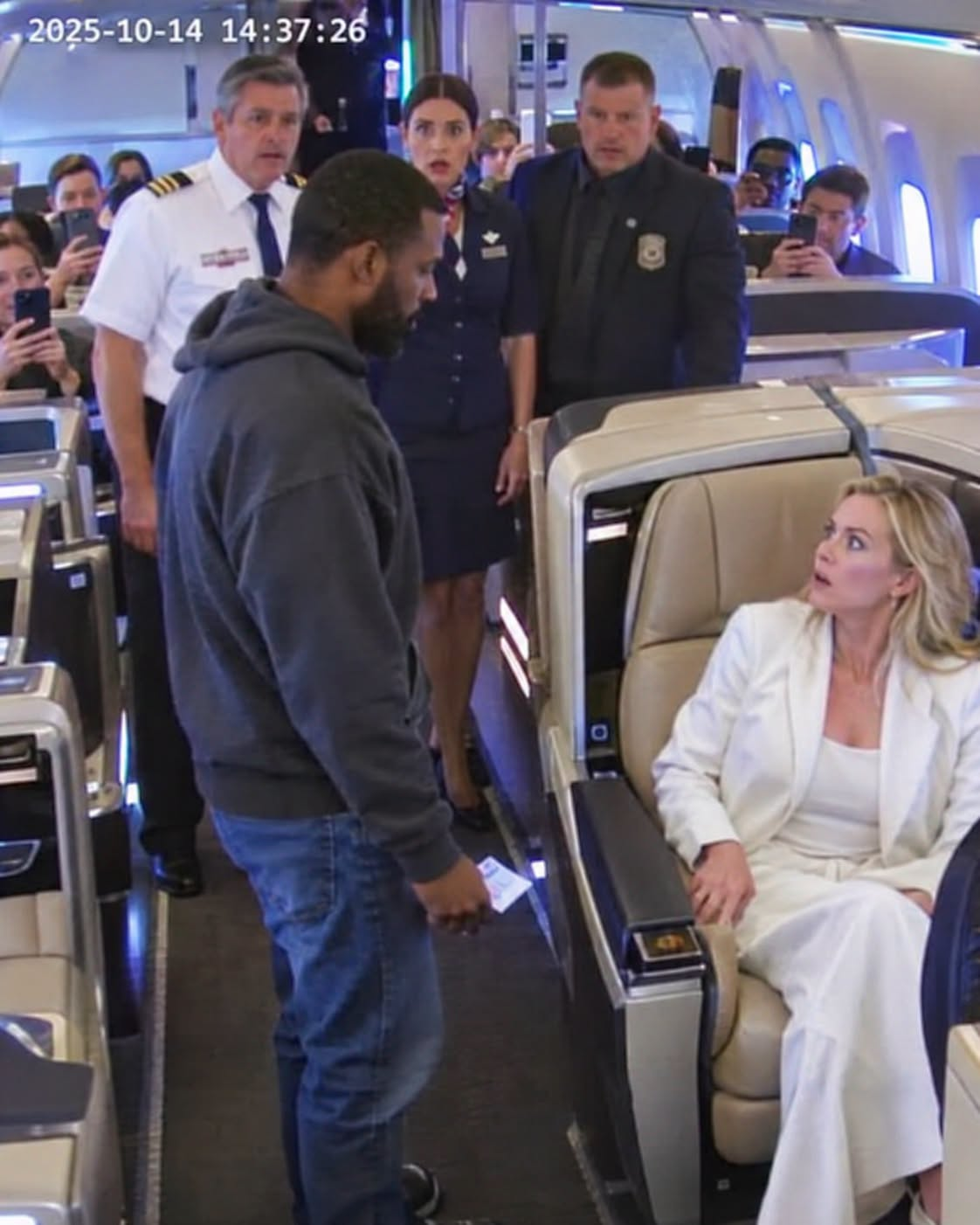
“Jonathan Reed has just contacted airport security,” the captain repeated. “He says he can prove who ordered the report altered, and he believes that person is still aboard this aircraft.”
For a moment, nobody spoke.
I looked at Edward Whitmore, then at Richard Vaughn.
Edward's face had lost its color. Richard stood beside the galley with his hands clenched around his phone, his professional composure finally beginning to crack.
The woman in the emerald suit, Victoria Bennett, stared at the floor.
I had spent the afternoon searching for the person responsible for the missing records. Now the person who claimed to know the truth was waiting less than a hundred yards away, and someone on my own aircraft had apparently threatened him.
“Captain,” I said, “please inform airport security that Jonathan has my full cooperation. Arrange a safe, documented meeting at the gate. No one is to approach him alone, and no company employee is to take possession of his records without independent witnesses.”
“Understood, Mr. Cole.”
“And please make sure the passengers are kept informed about the delay.”
The captain nodded and moved toward the galley.
I turned to Edward.
“You heard what he said.”
“Yes.”
“Do you know who threatened Jonathan?”
“No.”
I looked at Richard.
He shook his head before I could ask.
“I had no contact with Jonathan today.”
“That isn't what I asked.”
Richard swallowed.
“I don't know who threatened him.”
I believed that he was frightened. I still didn't know whether he was frightened of being falsely accused, of losing his career, or of the truth becoming public.
There was only one way to find out.
“Then come with me to speak with him,” I said. “Both of you.”
Richard hesitated.
Edward straightened his jacket.
“I'll go.”
Richard looked toward the aircraft door.
“I think I should remain here until the situation is clarified.”
“Why?”
“Because my presence could complicate the conversation.”
“Your division is central to the investigation. If you have nothing to hide, your cooperation will help establish the facts.”
He looked at Edward, hoping the chairman would intervene.
Edward did not.
Finally, Richard nodded.
“All right.”
Before we left, I turned toward Victoria.
“You don't have to join us. But I want you to know that your statement will be preserved, and nobody should pressure you to withdraw it.”
She looked up.
“Will the company retaliate against me?”
“No. I cannot promise that nobody will attempt to influence the process, but I can ensure that any retaliation reported to us is investigated independently.”
She nodded slowly.
For the first time since the confrontation began, she seemed able to breathe.
The captain escorted us toward the aircraft entrance. Two airport security officers waited at the gate, accompanied by a woman wearing a dark business suit and carrying a document case.
She introduced herself as an independent attorney appointed through our general counsel's office.
“Mr. Cole,” she said, “Jonathan Reed is in a secure meeting room nearby. He has agreed to provide a statement and transfer his records under documented custody.”
“Is he safe?”
“Yes. Airport security has confirmed that he entered the room voluntarily. He has requested that no one speak with him privately until his statement is recorded.”
“That is entirely reasonable.”
We followed the officers through the jet bridge and into the terminal.
For the first time that afternoon, I was no longer surrounded by passengers waiting for a flight. The noise of the terminal seemed distant as we approached a small meeting room beside the gate office.
Jonathan sat at the table.
He looked exhausted. His shirt was wrinkled, his tie had been loosened, and a shallow cut marked the back of one hand. A sealed evidence pouch lay in front of him.
When he saw me, he stood.
“Daniel.”
I crossed the room and shook his hand.
“Are you hurt?”
“Nothing serious. I caught my hand on a door when I was trying to leave the waiting area.”
“What happened?”
Jonathan glanced at the attorney.
She explained that airport security was still reviewing the relevant footage. Until the review was complete, they would not assume that a crime had occurred or identify anyone as responsible.
I appreciated that caution.
“Tell me what you found,” I said.
Jonathan sat down and opened the evidence pouch under the attorney's supervision.
Inside were printed emails, copies of the original complaint reports, and a storage device containing the audit history.
“I didn't take these when I resigned,” he explained. “I preserved the records through the company's authorized retention process. When I realized the final report no longer matched the original findings, I submitted a formal request to review the archive.”
“Why didn't you contact me sooner?”
“I tried. My messages were redirected, and my access request was denied. Then I discovered that someone had continued using my credentials after my resignation.”
He placed a printed report on the table.
“This is the original version of the compliance review.”
I began reading.
The report documented repeated complaints involving preferential treatment, inconsistent enforcement of passenger policies, and pressure on frontline employees to close certain cases without a full investigation.
It also contained records of employees who had raised concerns internally.
Some had been transferred. Others had been told that they misunderstood the escalation process.
The evidence did not suggest that every premium customer had received improper treatment, nor did it prove that every complaint had been deliberately suppressed. But it established a pattern that the final board report had concealed.
I looked at the revision history.
“Who ordered the changes?”
Jonathan pointed to a series of emails.
“Martin Hayes authorized the instruction to delay release of the unredacted report. Richard Vaughn approved the final customer-experience summary after the original findings were removed.”
“And the leadership resolution?”
“Martin's office coordinated the supporting material. The board was told that the investigation had established a failure of executive oversight, but the original records were never included.”
I looked at Edward.
He had been reading the documents over my shoulder.
“Did you know this?” I asked him.
“No,” he said quietly. “I knew about the leadership discussions. I did not know the original findings had been removed.”
Jonathan handed the attorney another page.
“There is one more record. This identifies the person who requested that my account remain active after my resignation.”
I looked down.
The request had been approved by Martin's office, but the accompanying correspondence revealed that Richard had asked for continued access to the archived customer files.
The stated reason was to complete the final review.
A later message, however, instructed the administrator to keep the access trail restricted until the board had completed its leadership vote.
The authorization had been approved by Martin.
The records showed a chain of decisions, not a single mysterious mastermind: Richard had maintained the customer program and approved the altered summary; Martin had authorized the withholding instruction and coordinated the leadership materials; and Edward had supported a proposed leadership change without demanding the original evidence.
The documents did not establish that Edward had participated in the alteration itself. They did establish that his failure to question the report had helped the flawed process continue.
I turned toward Richard.
“Do you dispute these records?”
He looked at the pages for a long time.
Finally, he shook his head.
“I approved the summary.”
“Did you know the original findings had been removed?”
“Yes.”
“Why?”
His voice became barely audible.
“I was afraid the board would conclude that my division had failed. I thought we could correct the process before the full investigation became public.”
“You allowed the board to evaluate my performance using a report you knew was incomplete.”
“I know.”
“Did you threaten Jonathan?”
“No.”
The attorney raised a hand.
“That allegation remains under review. We will rely on the security footage, witness statements, and other available evidence before reaching any conclusion.”
Richard nodded.
“I understand.”
Jonathan then provided the original digital files, and the attorney documented each item before taking custody. Copies were sent to the independent directors and external investigators.
For the first time, the company had a reliable record of what had happened.
The board vote was suspended before it could proceed.
By the time I reached New York, the independent directors had agreed to postpone any decision concerning my position until the investigation was complete. They also approved an external review of the customer-service program, the altered report, and the handling of Jonathan's resignation.
The next several weeks were difficult.
Martin stepped aside from his operational duties while the investigation proceeded. Richard was removed from responsibility for customer complaint handling pending the findings. Both men were given the opportunity to respond to the evidence through the formal process.
The independent review ultimately confirmed that the priority program had been allowed to bypass standard reporting procedures and that the board had received an incomplete summary. It found that Martin had knowingly delayed the release of material findings and that Richard had approved a report that omitted important evidence.
Both executives left their positions after the findings were delivered to the board. The company referred potential legal violations to the appropriate authorities and cooperated with the resulting inquiries.
Edward publicly acknowledged that he had supported a leadership resolution without demanding the underlying records. He apologized to the board and accepted responsibility for his failure to insist on a complete review.
He remained chairman during the initial transition, but the board adopted stricter procedures requiring independent verification of compliance reports and documented review before any leadership decision based on an internal investigation.
I could have used the crisis to protect myself and moved on.
Instead, I insisted that the reforms address the people who had suffered under the old system.
We created an independent passenger-complaint office, established a protected channel for employees to report pressure from supervisors, and required every complaint to remain in the official reporting system regardless of a customer's status or spending history.
Special assistance remained available for passengers who needed it. What disappeared was the ability to use special treatment as a reason to conceal complaints.
Victoria cooperated fully with the review. She acknowledged that she had wrongly assumed my appearance made my seat assignment suspicious, and she provided the messages that helped investigators understand how the private program operated.
I never asked her to apologize publicly.
She sent me a written apology herself.
She admitted that she had judged me before knowing anything about me and that her behavior had been unacceptable. I accepted the apology, while making clear that the reforms would apply to everyone, regardless of wealth, position, or personal connections.
Jonathan was offered the opportunity to return to the company, but he chose to remain independent while completing his cooperation with the investigation. We agreed that his departure had been handled poorly, and the board approved a formal correction to his personnel record.
Several months later, I visited the Atlanta operations center without an entourage.
I walked through the customer-service floor and spoke with employees who had previously been afraid to raise concerns. Some told me that they were still learning to trust the new reporting process. Others said that, for the first time, they believed a complaint could be heard without their manager deciding whether it deserved to exist.
That mattered more to me than any press release.
When I returned to the airport, I found myself thinking about Flight A921.
The woman who had challenged my seat assignment had been wrong about me. But the deeper failure had not been her assumption alone. It had been the system that had taught people to believe that appearance and influence mattered more than fairness.
I had boarded the aircraft hoping to observe a problem.
I had left it understanding how far that problem had reached—and how much work was required to repair it.
The following spring, I took another flight from Atlanta to New York.
I wore the same comfortable style of clothing: a simple sweatshirt, jeans, and white sneakers. My boarding pass once again read Seat 1A.
A young flight attendant greeted me, checked my pass, and wished me a pleasant journey.
No one announced my title.
No one needed to.
When the aircraft doors closed and the captain welcomed the passengers aboard, I settled into my seat and opened a book.
The airline was not perfect. No company was. But complaints were now recorded, investigations were independently reviewed, and no executive could quietly remove an inconvenient finding from a report without leaving a trace.
More importantly, the people who worked for us knew that they were allowed to tell the truth.
I looked out the window as the aircraft began to taxi.
For years, I had believed that protecting a company meant defending its reputation.
Now I understood that a reputation worth protecting had to be earned, one honest decision at a time.
Flight A921 had begun with a woman telling me that I didn't belong in first class.
It ended by forcing me to confront a far more important question: whether the company I had built still belonged to the values I had promised to uphold.
In the end, the answer was not found in my title, my ownership stake, or the seat assigned to me.
It was found in the changes we made, the people we finally listened to, and the decision to make fairness a rule rather than a privilege.
And when I looked back on that difficult afternoon, I no longer remembered the insult as the most important moment.
I remembered the moment the truth was finally allowed to speak—and the moment we chose to listen.






Comments 0