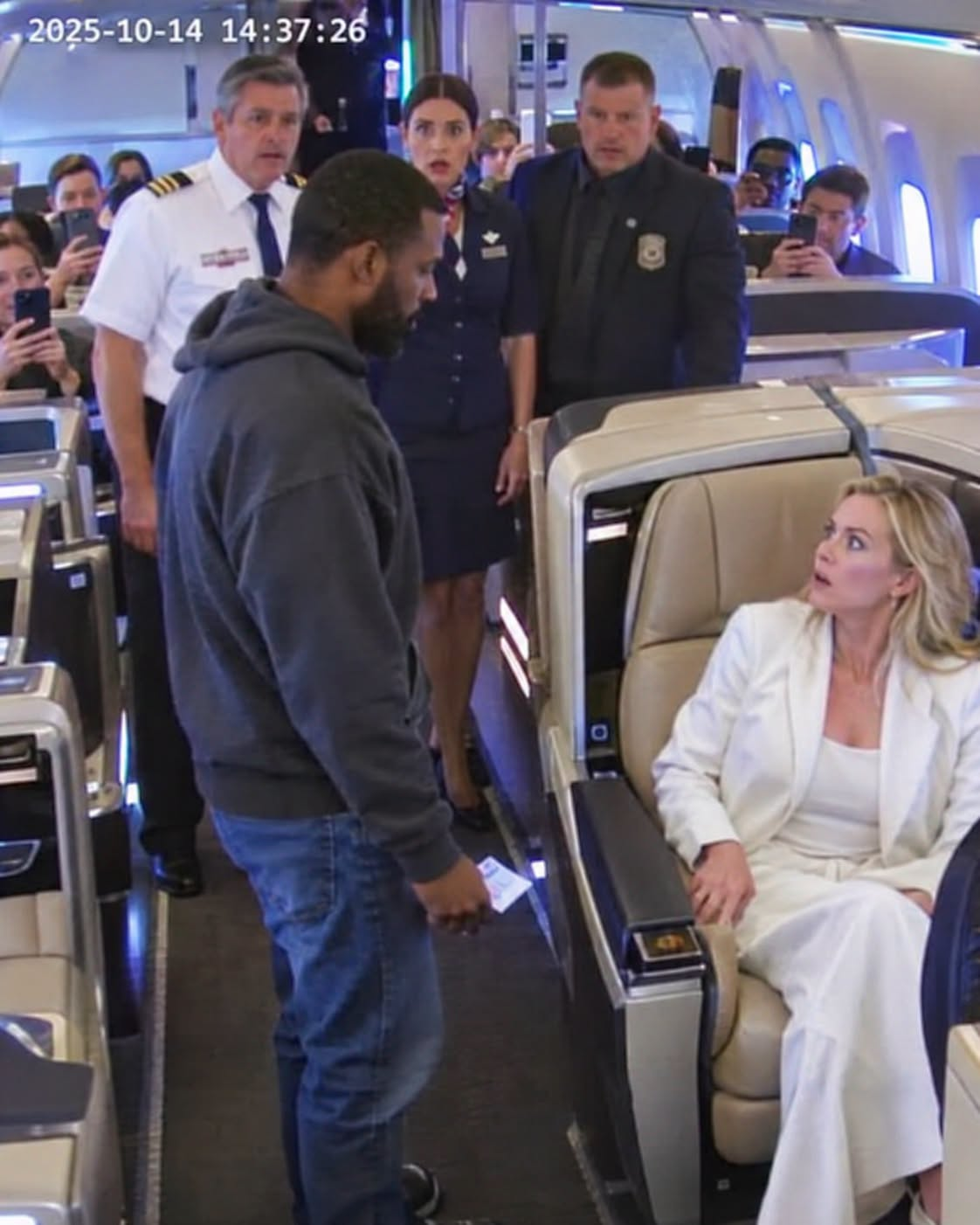
The captain was still holding his phone when he repeated the name.
“Mr. Cole, the person at the gate is asking to speak with you before we depart. His name is Jonathan Reed.”
For the first time that afternoon, I felt my composure slip—not because I was afraid, but because I hadn't expected that name to surface on this flight.
Jonathan Reed was our former director of internal compliance.
Six weeks earlier, he had resigned without warning.
His departure had followed a closed-door meeting with Martin Hayes, our chief operating officer. The explanation given to the board had been simple: Jonathan had accepted an opportunity elsewhere and wanted to pursue a different career.
I had believed him.
Now he was standing at the gate of an aircraft I was about to take to New York, demanding to speak with me before departure.
I looked at Richard Vaughn.
The senior vice president's face had become strangely blank. His fingers remained wrapped around his leather portfolio, but his attention was no longer on me.
It was fixed on the captain's phone.
The woman in the emerald suit noticed the change too.
“Who is Jonathan Reed?” she asked.
Nobody answered her.
I turned toward the captain.
“Did he say why he needs to speak with me?”
“He said the matter concerns the company's internal review, sir. He also asked me to tell you that it cannot wait until New York.”
The words settled over the cabin.
Richard cleared his throat.
“Captain, I don't believe it's appropriate to interrupt a scheduled departure because a former employee wants a private conversation.”
The captain regarded him calmly.
“I haven't made any decision about departure, Mr. Vaughn. I was simply passing along the message.”
“Then perhaps you should let corporate security handle it.”
That suggestion came too quickly.
I studied Richard's face.
“Why would corporate security need to handle a former compliance director asking to speak with me?”
Richard shifted his weight.
“I don't know the details. I'm merely trying to protect the operation from unnecessary disruption.”
“Of course.”
I said it without sarcasm, which seemed to unsettle him more than an argument would have.
I turned back to the captain.
“Please ask Mr. Reed to wait at the gate. I'll speak with him by phone.”
The captain nodded and stepped toward the galley to make the necessary arrangements.
Richard immediately leaned closer.
“Daniel—”
He stopped.
It was the first time he had used my first name.
I looked at him.
“Yes?”
He seemed to reconsider whatever he had intended to say.
“Mr. Cole,” he corrected himself, “I strongly recommend that you allow me to resolve this matter through the proper channels.”
“Which channels would those be?”
“The executive office.”
“I'm listening.”
Richard glanced toward the woman in green, then lowered his voice.
“There are sensitive personnel issues involved. Bringing a former employee into this situation could create unnecessary confusion.”
I rested my hands on the armrests.
“If the issues are sensitive, that makes it more important to understand them—not less.”
He pressed his lips together.
I had spent years listening to executives explain why a problem could not be investigated immediately. Sometimes their reasons were legitimate. More often, they were attempts to buy time.
Richard's reaction was making me increasingly concerned about which category this situation belonged to.
Before I could ask another question, the woman interrupted.
“I'm sorry, but I don't understand why we're discussing corporate investigations on an airplane.”
Her voice was quieter now.
She had lost the certainty that had carried her through the earlier confrontation, but she was still searching for a way to regain control.
“I came here to travel,” she continued. “I paid for my seat, and I expect this situation to be resolved.”
I looked at her.
“So do I.”
She swallowed.
For a moment, her eyes met mine.
Then she looked away.
The flight attendant returned with a small bottle of sparkling water. She placed it on the woman's tray table, offered a polite smile, and moved on without comment.
The woman didn't touch the bottle.
Instead, she reached for her phone again.
I saw the screen illuminate.
A message appeared.
Her eyes moved rapidly across the text.
Whatever she read caused her to grip the phone with both hands.
Then she looked at Richard.
He noticed her expression and gave a small shake of his head.
It was subtle.
Almost invisible.
But I saw it.
So did the passenger across the aisle.
The man leaned forward slightly, pretending to adjust the strap of his carry-on bag while watching them.
I began to suspect that the woman and Richard knew more about each other than they had admitted.
I still didn't know whether that connection had anything to do with my company.
But I intended to find out.
The captain returned.
“Mr. Cole, Mr. Reed is on the phone.”
He offered me the handset.
I accepted it.
“Jonathan?”
There was a pause.
Then a familiar voice answered.
“Daniel. Thank God.”
Jonathan sounded exhausted. His words came quickly, as if he had been rehearsing them while waiting for someone to answer.
“I've been trying to reach you for three days.”
“Why didn't you contact my office?”
“I did.”
The answer was immediate.
“I sent messages to your executive assistant. I called the corporate office. I even submitted a written request for a private meeting.”
“I wasn't told about any of that.”
“I know.”
His voice broke slightly on the last word.
I looked at Richard.
He was staring at the floor.
“Jonathan,” I said, “tell me what this is about.”
“I need to give you something. Something I should have given you before I left.”
“What?”
“A copy of the original investigation records.”
I felt my shoulders tighten.
“What original records?”
“The complaints we reviewed last quarter. The complete files, Daniel. Not the summaries that went to the board.”
I looked toward the cabin windows.
Beyond the glass, ground vehicles moved along the airport pavement. A baggage cart passed the aircraft, its wheels rattling over a seam in the concrete.
For a moment, the ordinary activity outside seemed strangely distant.
“Are you saying the report I received was incomplete?” I asked.
“I'm saying the version you received was changed.”
Richard moved suddenly.
He stepped toward the captain.
“Excuse me. We need to end this call. Boarding is complete, and we're already behind schedule.”
The captain raised one hand, asking him to wait.
I kept the phone against my ear.
“Jonathan, who changed the report?”
Silence.
“Jonathan?”
“I can't explain everything over the phone.”
“Then give me the name.”
Another pause.
Finally, he spoke.
“Richard Vaughn knows what happened.”
Every muscle in Richard's face tightened.
The woman in green made a small sound, almost like a gasp, then covered it with a cough.
I looked directly at Richard.
He had gone completely still.
“Jonathan,” I said, “are you certain?”
“Daniel, I have the original files. I have the emails. I have the approval records. But there's something else you need to understand.”
“What?”
“The complaints weren't just being buried. Certain passengers were being placed on a private priority list.”
I frowned.
“What kind of priority list?”
“A list that allowed specific customers to receive special treatment, regardless of company policy. Complaints against them were redirected. Some were closed without investigation. Others disappeared from the official reporting system.”
My grip tightened around the phone.
“How many passengers?”
“I don't know the full number. The list changed every week.”
“Who maintained it?”
Jonathan exhaled shakily.
“That's the part I couldn't prove before I resigned.”
I glanced toward the woman in green.
She had lowered her phone into her lap. Her eyes were fixed on the handset in my hand.
“Jonathan, why did you come to the airport?”
“Because I found something in the archived records yesterday. Something that connected the priority list to a senior executive.”
“Who?”
“I don't want to say the name until I can show you the evidence.”
I closed my eyes briefly.
“Jonathan, you have my attention. What do you need from me?”
“I need you to stop this flight from leaving until I can get the files into your hands.”
The request was extraordinary.
A commercial aircraft could not simply be held indefinitely because a former employee claimed to have evidence of misconduct. There were procedures, operational responsibilities, and passengers whose journeys mattered.
But Jonathan had not been reckless during his years at the company. He had been meticulous, sometimes frustratingly so.
If he had come to the airport himself, he must have believed the evidence was urgent.
“Where are you now?” I asked.
“Outside the gate.”
“Do you have the documents with you?”
“Yes. They're in a sealed envelope.”
“Then remain there. I'll arrange a secure handoff.”
“Daniel, listen to me. Don't let Richard take control of those documents.”
I looked up.
Richard's expression had become unreadable.
“Why would he take them?”
“Because if the files are what I think they are, he has every reason to make sure you never see them.”
The call crackled.
Then Jonathan spoke again, more quietly.
“There is one more thing. The woman sitting near you—”
I looked at the passenger in the emerald suit.
Her face had turned pale.
“What's her name?” I asked.
Jonathan began to answer.
But before he could finish, the call abruptly disconnected.
I stared at the phone.
For several seconds, I heard only the soft hum of the cabin ventilation and the distant murmur of passengers waiting for departure.
Then the captain reached for the handset.
“Sir, would you like me to reconnect the call?”
“Yes, please.”
He stepped away.
Richard moved closer to my seat.
“Daniel, I think we need to have a private conversation.”
I looked up at him.
“About what?”
“About the former employee you just spoke with.”
“Why?”
“Because Jonathan Reed is disgruntled. His departure was difficult, and he has made accusations before.”
“You said you didn't know the details.”
Richard's mouth tightened.
“I meant I didn't know why he had contacted the gate today.”
“That isn't what you said.”
He glanced toward the other passengers.
“Perhaps we should discuss this somewhere more appropriate.”
I leaned back.
“No. If there's a legitimate concern, you can explain it here.”
His eyes hardened.
For the first time, I saw something beneath the professional polish that had defined his behavior since he boarded.
Not irritation.
Fear.
He looked toward the woman in green.
She shook her head almost imperceptibly.
That tiny exchange told me more than either of them had intended.
The captain returned with his phone.
“I'm sorry, Mr. Cole. The call isn't going through.”
“Can you ask the gate agent to contact Mr. Reed again?”
“Certainly.”
He turned away.
Richard seized the opportunity.
“Daniel, please. Whatever Jonathan believes he has discovered, we shouldn't make decisions based on allegations.”
“Agreed.”
He appeared relieved.
Then I continued.
“Which is why we'll examine the original records before making any decisions.”
His relief disappeared.
I reached for my phone and opened the secure channel again.
Martin still hadn't answered my last message.
That was unusual.
I called him directly.
The call rang once.
Twice.
Then his assistant answered.
“Mr. Cole's office.”
“This is Daniel. Put Martin on the line.”
There was a brief pause.
“I'm sorry, sir. Mr. Hayes is unavailable at the moment.”
“Unavailable?”
“He's in a meeting.”
“Tell him I need him immediately.”
“Of course.”
The line went quiet.
I waited.
Thirty seconds passed.
Then a minute.
Finally, the assistant returned.
“Mr. Cole, Mr. Hayes asked me to tell you that he will contact you as soon as possible.”
I looked at the screen.
Martin had never used his assistant to avoid a direct question from me.
Not once in fifteen years.
I ended the call and slipped the phone into my pocket.
Across the aisle, the woman was whispering into her own phone again.
This time, I heard only a few words.
“He knows about the files.”
Richard turned toward her so quickly that his portfolio struck the armrest.
“Stop talking,” he hissed.
She froze.
The passengers nearby pretended not to notice.
I watched the two of them in silence.
Until that afternoon, I had believed I was conducting a straightforward experiment in customer service. I expected to observe arrogance, poor judgment, perhaps a few uncomfortable interactions.
I had not expected to uncover a possible system designed to protect favored passengers from accountability.
And I certainly hadn't expected a senior executive to look frightened of a former compliance director.
The captain returned once more.
“Mr. Cole, the gate agent has confirmed that Mr. Reed is still there. He says he has the envelope and insists it must be delivered directly to you.”
“Tell him to wait.”
“Yes, sir.”
The captain hesitated.
“There is one other issue.”
“What is it?”
“The gate agent says someone else has arrived and is demanding to speak with Mr. Reed.”
Richard's face went white.
The captain glanced at him, then back at me.
“He says the person has identified himself as a representative of our corporate legal department.”
I stood for the first time since boarding.
“Did Mr. Reed recognize him?”
The captain nodded slowly.
“He did, sir.”
I waited.
The captain lowered his voice.
“And according to the gate agent, Mr. Reed immediately tried to hide the envelope when he saw who had arrived.”
Then the captain told me the name of the lawyer standing beside Jonathan Reed—and I realized that the person waiting at the gate might be the very person who had helped bury the truth.






Comments 0