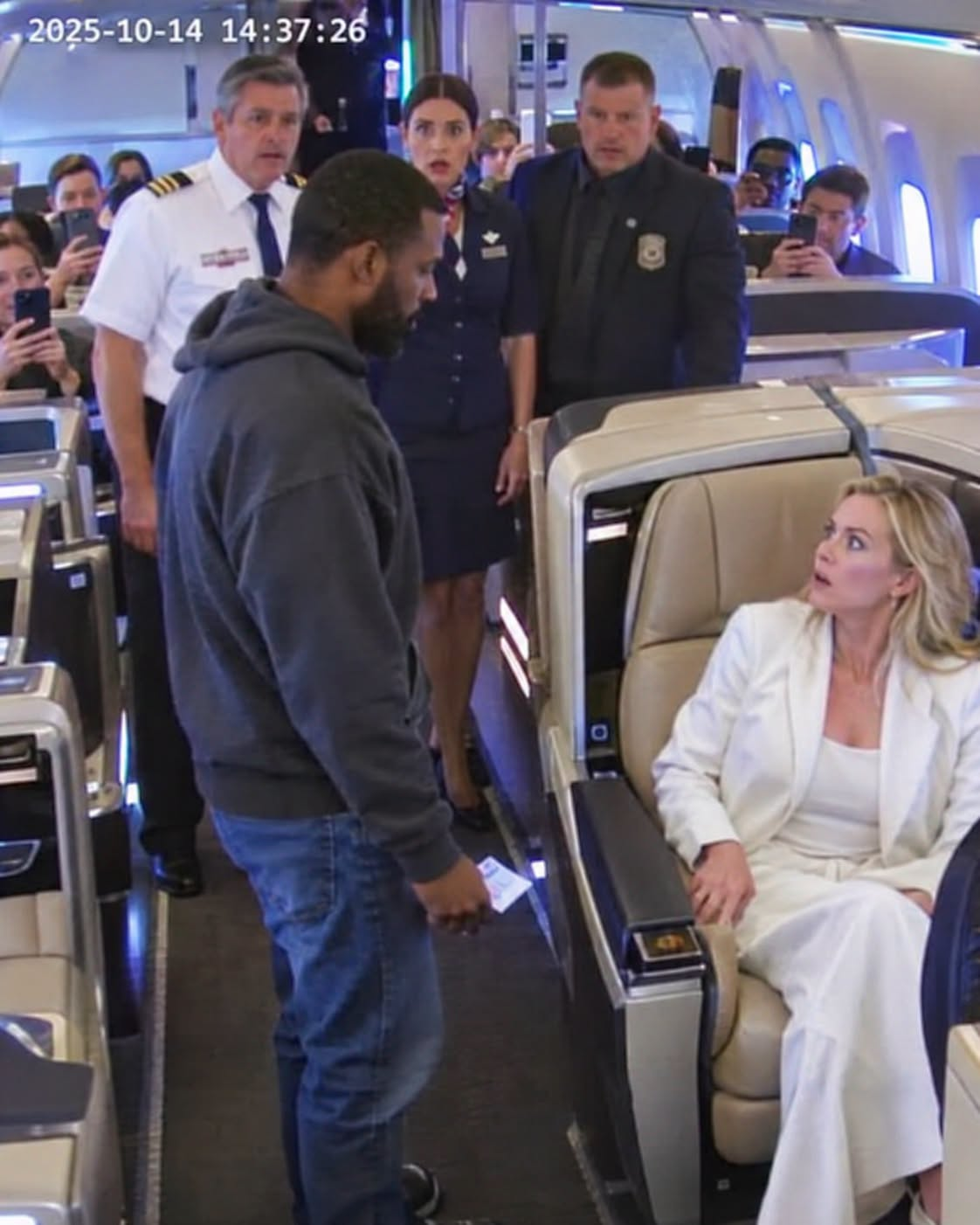
The woman held her phone so tightly that her knuckles turned white.
“There's something you don't know about your own company,” she whispered.
I looked at her for a moment, then glanced toward the captain, who was speaking quietly with the flight attendant near the galley.
“What exactly are you suggesting?” I asked.
She smiled, but there was nothing friendly about it.
“You'll find out soon enough.”
Then she turned away and returned to her seat, leaving me with a sentence that sounded less like a warning and more like a promise.
I had spent fifteen years learning not to react to threats before understanding who was making them. In business, people sometimes confused access with influence, and influence with power. They assumed that knowing an executive's name meant they understood the decisions being made behind closed doors.
Most of the time, they didn't.
Still, I couldn't dismiss her words.
She had mentioned someone from corporate. She had spoken as though she expected a particular outcome. And when her phone had vibrated, whatever she read had transformed her embarrassment into renewed confidence.
That was enough to make me pay attention.
I opened my company messaging application again and selected the encrypted channel used by the senior leadership team.
My first message went to Martin Hayes, our chief operating officer.
Have you authorized anyone to intervene in a passenger complaint aboard Flight A921?
I watched the screen.
No response.
I sent a second message to the head of internal compliance.
Please confirm whether any active investigations involve preferential treatment or interference with passenger complaints on this route.
Then I put my phone away.
The aircraft continued filling with passengers. Overhead compartments opened and closed. A flight attendant welcomed an elderly couple, helping them place their bags beneath their seats. Somewhere behind me, a child asked whether the plane would have movies.
Ordinary life continued around a problem that might have been anything from an arrogant passenger's empty bluff to a serious breach of company policy.
I preferred not to decide before I had evidence.
Across the aisle, the woman was typing again.
She had removed her sunglasses and placed them carefully beside her handbag. Her emerald suit remained immaculate, and she sat with her back straight, as if the entire confrontation had been an inconvenience rather than something she had caused.
When a flight attendant passed her row, she stopped the woman with a raised finger.
“Could I have some sparkling water?”
“Certainly, ma'am.”
“And please make sure it's properly chilled.”
“Of course.”
The attendant continued toward the galley.
The woman glanced at me.
I returned to my newspaper.
A few seconds later, she spoke again.
“Mr. Cole?”
I lowered the paper.
“What is it?”
“I'm curious. How long have you worked for this airline?”
“Long enough.”
She seemed dissatisfied with the answer.
“That's not very specific.”
“You didn't ask a specific question.”
Her eyes narrowed.
For a moment, I thought she might start another argument. Instead, she leaned back and crossed her legs.
“People who work for large corporations sometimes forget that the people paying their salaries are the reason those corporations exist.”
“Customers are important,” I replied.
“Then you agree with me.”
“I agree that customers are important. I don't agree that paying for a service gives someone permission to humiliate another person.”
Her expression stiffened.
“I never humiliated you.”
I looked at her.
“You told me I didn't belong in the seat assigned to me before you bothered to check my boarding pass.”
“I was trying to prevent a problem.”
“By creating one?”
She opened her mouth, then closed it.
A passenger seated behind her gave a quiet cough that sounded suspiciously like a suppressed laugh.
The woman turned sharply toward the sound.
“Is something funny?”
“No, ma'am,” the passenger replied.
She faced forward again, furious that her authority had failed to produce the reaction she wanted.
I had seen this pattern before. When someone built their confidence around being obeyed, even a polite refusal could feel like an attack.
But I had no intention of turning the flight into a contest of egos.
I unfolded my newspaper and returned to the financial section.
That was when my phone vibrated.
Martin Hayes had replied.
No intervention authorized. Why are you asking?
I typed back.
I'm observing a situation. I'll explain when I have more information. Please check whether anyone has contacted the corporate office about A921.
His answer arrived almost immediately.
Understood. I'll look into it.
I stared at those three words longer than necessary.
Martin was efficient, intelligent, and usually direct. He had been with me through two difficult acquisitions and had helped restructure our operations when the airline was close to running out of cash.
I trusted his judgment.
At least, I had.
Three weeks earlier, he had presented the results of our internal review to the executive committee. His report concluded that most complaints involving premium cabin service stemmed from isolated misunderstandings, inconsistent training, or unrealistic passenger expectations.
He had assured us that no senior manager had interfered with complaint handling.
I had accepted the report because its findings appeared consistent with the available records.
Now a stranger on my flight had hinted that someone inside the company was protecting her.
I didn't know whether the two things were connected.
But I knew what I would do if they were.
I would follow the evidence wherever it led.
A soft chime sounded overhead, followed by the captain's voice.
“Ladies and gentlemen, welcome aboard Flight A921 to New York. We expect to depart shortly. Please ensure that your carry-on luggage is properly stowed and that your seat belts are fastened.”
The remaining passengers settled into their seats.
The woman in green placed her phone face down on her lap.
For the first time since our confrontation began, she appeared nervous.
It lasted only a moment.
Then she lifted her chin and looked toward the galley, where the flight attendant was completing the final cabin checks.
I noticed that she kept glancing at the entrance to the aircraft.
She was waiting for someone.
I didn't have to wait long to discover who.
Just before the cabin door was scheduled to close, a man in a tailored navy suit appeared at the front entrance. He was in his early fifties, with neatly combed brown hair and a silver watch that caught the light when he adjusted his cuff.
He carried no visible luggage.
Instead, he held a slim leather portfolio beneath one arm.
The gate agent spoke briefly to the captain, then stepped aside to allow the man aboard.
He looked around the first-class cabin with the confidence of someone accustomed to entering rooms where other people were expected to make space for him.
His eyes found the woman in green.
She immediately stood.
“Richard,” she said, her voice suddenly warm. “Thank goodness you're here.”
The man approached her.
“I received your message,” he replied. “What happened?”
She gestured toward me.
“This man has been causing a scene, and the crew has been treating him as though he's someone important.”
Richard's gaze shifted to my seat.
He took in my sweatshirt, jeans, and worn white sneakers.
A faint smile appeared.
“I see.”
The woman lowered her voice, but not enough to prevent me from hearing her.
“I told you this was exactly the kind of thing that happens when standards aren't enforced.”
Richard nodded as though she had presented him with a familiar problem.
Then he turned toward the captain.
“I'm Richard Vaughn, senior vice president of customer experience. I understand there's been an issue with one of your passengers.”
The captain's expression became formal.
“Mr. Vaughn. I wasn't aware you were joining us.”
“Last-minute change of plans.”
Richard offered no further explanation.
He looked at the woman.
“Don't worry. We'll sort this out.”
She exhaled, visibly relieved.
Then Richard approached my seat.
“Sir,” he said, “I'm told there's been some confusion about seating.”
“No confusion,” I replied. “My boarding pass assigns me Seat 1A.”
He glanced at the pass resting on my armrest.
“I'm sure we can find a reasonable solution.”
“What solution would that be?”
He paused.
“Perhaps you could move to another seat while we investigate the complaint.”
I looked at him carefully.
“You want me to leave my assigned seat because another passenger objected to my appearance?”
Richard's smile became thinner.
“I'm simply trying to avoid delaying the flight.”
“The flight isn't delayed because I'm sitting in my assigned seat.”
His eyes hardened for an instant before his professional expression returned.
“There's no need to make this difficult.”
I recognized the phrase immediately.
It was the same language the woman had used when she expected obedience.
I looked at the captain.
“Captain, is there a seat-assignment problem?”
“No, sir,” he answered. “Your reservation is correct.”
Richard turned toward him.
“Then perhaps we should handle the matter through the appropriate corporate channels.”
“Of course,” the captain said. “But there is no reason to relocate a passenger whose reservation is valid.”
The woman looked from one man to the other.
Her confidence began to waver again.
Richard adjusted his portfolio beneath his arm.
“Captain, I appreciate your position. However, I have authority over customer experience matters, and I would prefer to resolve this before departure.”
The captain said nothing.
I could see the calculation behind Richard's expression. He was used to making decisions that other employees accepted without question.
He hadn't yet realized that I was watching him as closely as I had watched the woman.
“Mr. Vaughn,” I said, “how long have you been with the airline?”
He turned back to me.
“Seven years.”
“And you oversee customer complaints?”
“Among other responsibilities.”
“Do you review complaints that involve preferential treatment toward premium passengers?”
“Of course.”
“Personally?”
He hesitated.
“Depending on the circumstances.”
I nodded slowly.
Then I asked the question that made his expression change.
“Have you ever instructed an employee to alter a complaint report because the passenger involved had connections inside the company?”
The cabin seemed to grow quieter.
Richard's fingers tightened around the edge of his portfolio.
“No,” he said. “Absolutely not.”
The answer came too quickly.
I held his gaze.
“Good. Then you won't mind helping me understand a message I received this afternoon.”
For the first time, the woman in green looked genuinely frightened.
Richard glanced at her.
She stared back at him, silently pleading for something I couldn't yet identify.
His phone vibrated.
He pulled it from his pocket, glanced at the screen, and went completely still.
The color drained from his face.
Then he looked at me again.
“Where did you get that information?” he whispered.
I hadn't shown him anything.
I hadn't mentioned a document.
I hadn't even told him what I had discovered.
Yet his reaction suggested that he knew exactly what I was about to uncover.
Before I could ask another question, the captain's phone rang.
He answered, listened for three seconds, and looked toward the aircraft door.
Then he turned to me.
“Mr. Cole,” he said quietly, “there's someone at the gate insisting that this flight cannot depart until they speak to you personally.”
And when he told me the name of the person waiting outside, I realized that the confrontation over Seat 1A had only been the beginning.






Comments 0