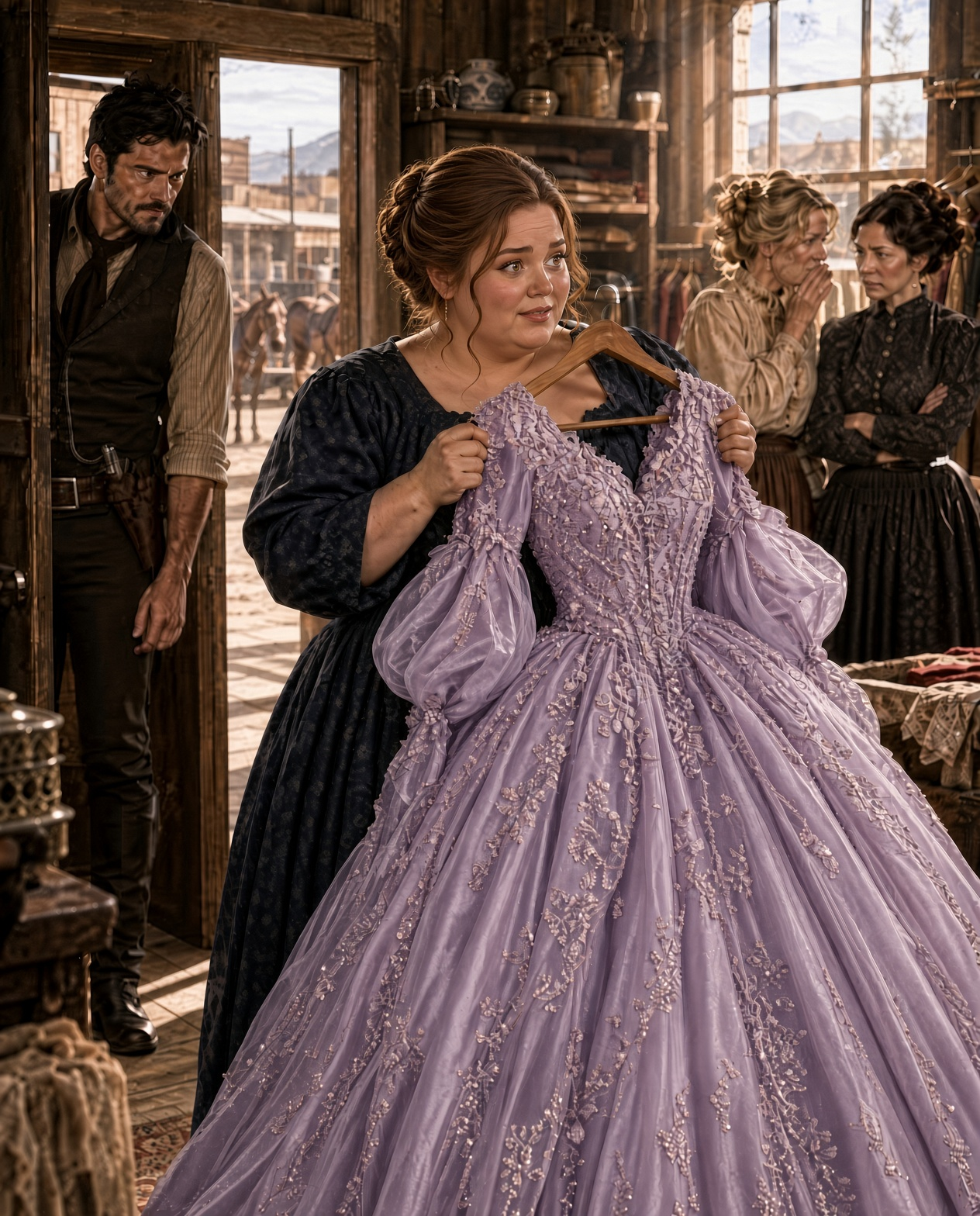
"Mr. Mercer, there's something you need to see."
The storekeeper's voice was barely louder than a whisper.
I stared at him, then at the narrow doorway behind his counter. Somewhere beyond it, my wife was speaking to a child. I heard the rustle of paper, the scrape of a wooden chair, and the unmistakable sound of an elderly woman trying to stop herself from crying.
"What is my wife doing back there?" I asked.
Samuel Porter, who had owned the general store for nearly twenty years, removed his spectacles and wiped them with a handkerchief.
"Helping people," he answered.
"I can see that."
"No, Gideon." He glanced toward the doorway. "I don't believe you can."
I had known Samuel long enough to recognize when he was frightened. He was not a nervous man. He had survived cattle thieves, two disastrous winters, and a fire that had nearly destroyed half of Cheyenne's business district.
Yet now he looked as though he regretted every word he had spoken.
"Then tell me," I said.
Samuel lowered his eyes.
"I made your wife a promise."
Those words struck me harder than I expected.
My wife had made a promise with another man, a promise important enough that he was unwilling to explain it to her husband.
Six months earlier, I would have dismissed such a thing as impossible. Martha had never given me a reason to doubt her loyalty. She was honest almost to a fault, sometimes confessing to breaking a drinking glass before I even noticed it was missing.
But I had followed her into town because something about her behavior had troubled me for months.
And now I was standing in a store where everyone seemed to know something I did not.
"Samuel," I said carefully, "I am not asking you to betray my wife. I'm asking whether she's in trouble."
His expression softened.
"Not the kind you're thinking."
"Then what kind?"
Before he could answer, Martha's voice came through the doorway.
"Mrs. Whitcomb, please take the extra blanket. You need it more than we do."
An elderly woman protested.
"Child, you've already done too much."
"Nonsense. Winter hasn't even properly begun."
"But what will your husband say?"
There was a pause.
Then Martha answered so quietly that I had to lean forward.
"Gideon doesn't need to know."
I felt something twist inside my chest.
Samuel watched my face.
"You see the difficulty," he murmured.
I did.
But understanding that a difficulty existed was not the same as understanding why.
"How long?" I asked.
Samuel hesitated.
"How long has she been coming here?"
"Since shortly after your wedding."
I looked at him.
"Six months?"
He nodded.
The first blue silk dress had disappeared five months earlier.
I remembered Martha standing in our kitchen wearing it, her hands folded nervously in front of her waist. I remembered telling her how beautiful she looked.
And I remembered the way she had looked at herself in the mirror.
Not with pleasure.
With something closer to shame.
A terrible suspicion began forming in my mind.
"Those dresses," I said.
Samuel's eyes shifted toward the folded receipt in my hand.
He said nothing.
"She traded them here?"
"She brought store credit from the dress shop."
"For flour and blankets?"
"And other necessities."
"All of them?"
Samuel swallowed.
"Every one I know about."
I looked toward the doorway again.
Martha was laughing softly at something a child had said.
It was the same laugh I heard when she found a newborn calf standing for the first time, or when one of our ranch hands made a ridiculous joke at supper.
Warm.
Unselfconscious.
Completely genuine.
I realized I had not heard her laugh like that in our own home for several weeks.
"Why?" I whispered.
Samuel put his spectacles back on.
"That's something you ought to ask her."
I almost walked into the back room.
My hand was already reaching toward the doorframe when I stopped.
What would happen if Martha turned and found me standing there?
Would she feel betrayed?
Would she think I had followed her because I suspected her of stealing?
Worse, would she believe I was angry that she had given away the gifts I bought her?
I could still see her face in the dress shop.
The way she had folded the crimson silk after hearing those women laugh.
The way she had kept her eyes lowered, as though she had no right to object.
I withdrew my hand.
"She doesn't know I'm here," I told Samuel.
"I gathered that."
"Don't tell her."
Samuel studied me.
Then he nodded.
I moved toward the front window, where I could watch the street without being seen from the back room.
A few minutes later, Martha emerged.
She was carrying two paper-wrapped bundles.
Behind her came Mrs. Whitcomb, a thin woman whose silver hair escaped from beneath a faded bonnet.
Three children followed.
The oldest was a girl of perhaps ten. The middle child, a boy, held a pair of sturdy leather shoes against his chest as though they were made of gold.
The youngest boy wore a coat with sleeves that had been patched so many times I could no longer distinguish the original fabric.
Martha knelt in front of him.
"Let me see those feet."
He lifted one boot.
The sole had separated from the upper leather.
Martha examined it, then reached into one of her parcels.
She took out a smaller pair of shoes.
"These should fit."
The boy stared.
"Mine?"
"Unless you know another young gentleman with feet exactly that size."
He grinned.
I recognized the joke.
It was almost identical to the one I had made when I gave Martha her first silk dress.
The memory nearly broke me.
The little boy sat on the floor and pulled on the shoes.
He stood.
Took two uncertain steps.
Then threw his arms around Martha's neck.
"Thank you!"
She held him tightly.
"You're very welcome, sweetheart."
Mrs. Whitcomb covered her mouth.
The oldest girl was crying.
And my wife, who had been humiliated by two wealthy women only minutes earlier, looked happier than I had seen her in months.
I turned away before anyone noticed my face.
Samuel stood quietly beside me.
"She does this every week," he said.
"Every week?"
"Sometimes twice."
I stared at him.
"With what money?"
He gave me a sad look.
"You already know."
I looked down at the receipt in my hand.
The crimson gown had cost more than a hired ranch hand earned in several weeks.
I had bought it because I wanted my wife to feel cherished.
She had returned it because someone else's children needed shoes.
I did not know whether to feel proud or ashamed.
Perhaps both.
"Why didn't she ask me?" I said.
Samuel did not answer immediately.
"That's the question, isn't it?"
I watched Martha help Mrs. Whitcomb gather the parcels.
The elderly woman touched her cheek.
"You're a blessing, child."
Martha shook her head.
"Please don't say that."
"But you are."
"I'm only doing what anybody would do."
Samuel gave a quiet, humorless laugh.
"No, she isn't."
I turned toward him.
He continued, "There are plenty of people in this town who could buy those children a hundred pairs of shoes without noticing the expense."
I thought of Mrs. Bellamy and Mrs. Whitfield.
Their expensive dresses.
Their jeweled brooches.
Their carefully arranged hair.
Their laughter.
"Some people," Samuel said, "would rather spend the money making sure everyone knows how much they have."
I looked through the window.
Martha was guiding the family toward the door.
I stepped behind a tall shelf of flour sacks.
They passed within a few feet of me.
The youngest boy was still talking excitedly about his shoes.
Mrs. Whitcomb paused near the counter.
"Martha, I don't know how we'll repay you."
"You won't."
"But—"
"Promise me something instead."
"Anything."
"Keep those children warm."
Mrs. Whitcomb nodded.
Martha lowered her voice.
"And please don't mention any of this to Gideon."
The old woman's expression changed.
"Doesn't he know?"
Martha shook her head.
"No."
"Surely he'd understand."
My wife looked down.
"He has enough responsibilities."
There was something in her voice that made me feel as though I had swallowed a stone.
Mrs. Whitcomb hesitated.
"Child, a man who loves you ought to know what kind of woman he married."
Martha gave a small, sad smile.
"He knows enough."
Then she left.
I remained behind the shelf until I heard the front door close.
Samuel did not speak.
Neither did I.
Finally, I stepped into the open.
"She thinks I wouldn't approve."
Samuel folded his hands.
"I don't believe that's the whole of it."
"What else could there be?"
He looked toward the street.
"Some wounds begin long before a marriage, Gideon."
I thought of Martha's reluctance to wear beautiful clothing.
Her habit of apologizing when I spent money on her.
The way she sometimes looked startled when I reached for her hand in public.
I had mistaken those things for modesty.
Now I wondered whether they were the remnants of something crueler.
"Did someone hurt her?" I asked.
Samuel's expression grew serious.
"That's not my story to tell."
I felt anger rising.
Not toward him.
Not toward Martha.
Toward whoever had taught my wife that kindness was something she had to hide and beauty was something she did not deserve.
I placed the receipt on the counter.
"Can you tell me what she bought today?"
Samuel examined the paper.
"Flour. Three wool blankets. Four pairs of children's shoes. Winter stockings. Two coats. Some sewing needles and thread."
"All for Mrs. Whitcomb?"
"No."
He reached beneath the counter and brought out a small ledger.
I watched him open it.
There were names written in careful handwriting.
Some I recognized.
Families who had lost livestock during the previous winter.
A widow whose husband had died in a mining accident.
A young mother whose children had been sick since autumn.
Beside each name were small lists of supplies.
Flour.
Coal.
Blankets.
Medicine.
Clothing.
And beside nearly every entry was the same notation.
M. Mercer.
My wife.
I counted the names.
There were eleven.
"Eleven families?" I asked.
Samuel nodded.
"At least."
I stared at the ledger.
I had lived outside Cheyenne for years. I knew the town had poor families. I had donated money to church collections and helped neighbors when their barns burned or their cattle strayed.
But Martha had done something different.
She had learned their names.
Their children's sizes.
Their particular needs.
She knew who required medicine, who needed coal, and which child had been walking barefoot.
She had turned charity into something personal.
Something quiet.
Something that protected the dignity of the people receiving it.
And she had done it without telling her own husband.
I ran my thumb across the edge of the ledger.
"How much does she owe you?"
Samuel shook his head.
"Nothing."
"How much has she spent?"
He looked uncomfortable.
"That's between your wife and the store."
"Samuel."
He sighed.
"More than most people would believe."
I took out my wallet.
"Then let me reimburse her."
He put a hand over the ledger.
"Don't."
I stared at him.
"Why not?"
"Because she asked me not to involve you."
"She's my wife."
"And she's a woman with her own reasons."
His words irritated me because I knew they were true.
I had come into town believing I needed to uncover a mystery.
Now I was beginning to understand that the mystery might not belong to me to solve.
But I could not forget the dress shop.
The laughter.
The way Martha had folded the silk.
"Those women," I said.
Samuel looked up.
"What women?"
"Bellamy and Whitfield."
His mouth tightened.
"What about them?"
"They laughed at Martha."
He closed his eyes briefly.
"Again."
The word stopped me.
"Again?"
Samuel said nothing.
I stepped closer.
"What do you mean, again?"
He looked as though he wished he could take the word back.
"Gideon, you need to speak with your wife."
"Have they done this before?"
He hesitated.
"People talk."
"About what?"
Samuel looked down at the ledger.
"About things that are none of their business."
I felt my jaw tighten.
"What things?"
He raised his eyes.
"Your marriage."
For a moment, I could not speak.
My marriage?
Martha had brought more warmth into my house in six months than it had known in the previous ten years.
She had cared for sick ranch hands, helped with difficult calvings, and sat beside me through long evenings when the wind rattled the windows.
She was the best thing that had ever happened to me.
And people were laughing because I had married her?
I remembered Mrs. Whitfield's words.
Perhaps Gideon bought it because he cannot see what everyone else sees.
Suddenly, I understood the cruelty behind them.
They believed my wife was too large, too plain, too ordinary to deserve the attention of a prosperous rancher.
They believed silk belonged on women like themselves.
Not Martha.
My hands curled into fists.
Samuel noticed.
"Don't do anything foolish."
I looked toward the door.
"Where did those women go?"
"Gideon."
"Where?"
He stepped around the counter.
"Your wife has spent months trying to avoid becoming the subject of more gossip. If you storm into that dress shop and make a scene, who do you think they'll blame?"
The question stopped me.
I hated that it did.
Because he was right.
Women like Eleanor Bellamy could insult someone in a whisper and still emerge from the encounter looking respectable.
A man shouting in defense of his wife would give them another story to tell.
And Martha would be the one forced to endure it.
I exhaled slowly.
"Then what am I supposed to do?"
Samuel's expression softened.
"Listen to her."
I looked down at the ledger again.
Eleven families.
Eleven names.
Eleven reasons my wife had believed someone else needed her beautiful dresses more than she did.
I closed the book.
"Thank you, Samuel."
He nodded.
I turned toward the door.
Then he spoke again.
"Gideon?"
I stopped.
"There's one thing I think you should understand."
I waited.
He looked toward the back room.
"Your wife never once asked for anything for herself."
I swallowed.
"Not even a ribbon?"
"Not even a ribbon."
I left the store before he could see my eyes fill.
Outside, Cheyenne carried on around me.
Wagons rattled over the hard street.
A blacksmith hammered iron somewhere nearby.
Two men argued over the price of feed.
Life continued as though nothing had happened.
But I felt as though the ground beneath my boots had shifted.
I found Martha's wagon parked near the far end of the street.
She was standing beside it, speaking with a young mother holding a baby.
I watched her take a small bundle from beneath the wagon seat.
The woman shook her head.
Martha insisted.
Finally, the woman accepted it.
Then Martha touched the baby's cheek and smiled.
I could not hear what she said.
I did not need to.
I knew that smile.
It was the one she gave our youngest calves.
The one she gave frightened children.
The one she rarely gave herself.
I wanted to cross the street and take her into my arms.
I wanted to tell her I knew.
That I understood.
That she never had to hide another act of kindness from me.
But Samuel's words stayed with me.
Listen to her.
So I waited.
Martha climbed into her wagon and started toward home.
I followed at a distance.
The afternoon was growing colder.
A gray line of clouds stretched across the western horizon, and the wind carried the sharp promise of snow.
As we left town, I noticed Martha stop near a small cemetery.
She climbed down from the wagon.
For several minutes, she stood beside an old grave near the fence.
I remained hidden among a stand of cottonwoods.
She removed her hat.
Then she knelt.
I watched her place something small against the headstone.
A folded piece of cloth.
She stayed there longer than I expected.
When she finally rose, she wiped her face with the back of her hand.
I felt an ache spread through my chest.
There were parts of Martha's life I still did not know.
Perhaps I had been so eager to give her a happy future that I had never asked enough about the past she carried.
She returned to the wagon.
I waited until she had disappeared around the bend before riding toward the cemetery.
I knew I should have gone home.
I knew following her this far was already a betrayal of the trust she had placed in me.
But something about the way she had knelt beside that grave would not let me leave.
I dismounted and walked through the narrow gate.
The headstone was weathered.
Its inscription had been softened by years of wind and snow.
I crouched to read it.
The name belonged to a woman I had never heard Martha mention.
Sarah Ellen Whitcomb.
Below it were the dates of her birth and death.
She had died young.
I remembered that Mrs. Whitcomb's daughter had passed away, leaving three children behind.
This was her grave.
Martha had left a small piece of blue fabric beside the stone.
I recognized it immediately.
It was silk.
The same shade as the first dress I had bought her.
I picked it up carefully.
The fabric had been folded around a tiny hand-sewn pouch.
Inside was a single silver coin.
And a note written in Martha's familiar handwriting.
For the children, if they ever need more than I can give.
I sat back on my heels.
The wind moved through the dry grass.
I stared at the note until the words blurred.
My wife had been preparing for needs that had not yet arrived.
She was thinking about children who were not hers.
Planning for a winter that had barely begun.
Giving away the things I bought her because she could not bear the thought of someone else going without.
I folded the note and returned it to the pouch.
Then I placed it exactly where Martha had left it.
As I stood, I heard footsteps behind me.
I turned.
An elderly man stood near the cemetery gate.
He wore a battered black coat and held his hat in both hands.
I recognized him vaguely from town.
He looked at the grave.
Then at me.
"You're Gideon Mercer," he said.
"That's right."
His expression changed.
"Then you're Martha's husband."
I nodded.
He glanced toward the road, where Martha's wagon had disappeared.
"Did she tell you why she comes here?"
"No."
The old man looked troubled.
"Then perhaps I shouldn't say anything."
I stepped toward him.
"Say what?"
He stared at the blue silk beside the headstone.
For a long moment, he seemed unable to speak.
Then he reached into his coat and withdrew a yellowed envelope.
"I was supposed to give this to her years ago," he whispered.
I looked at the writing on the front.
It was addressed to Martha.
But beneath her name were four words that made my blood run cold.
Before she married Gideon Mercer.
The old man held the envelope toward me.
"There's something about your wife," he said, "that you need to know."
Then he turned the envelope over.
The wax seal was already broken.
And inside was a letter bearing the signature of someone I had believed was dead.






Comments 0