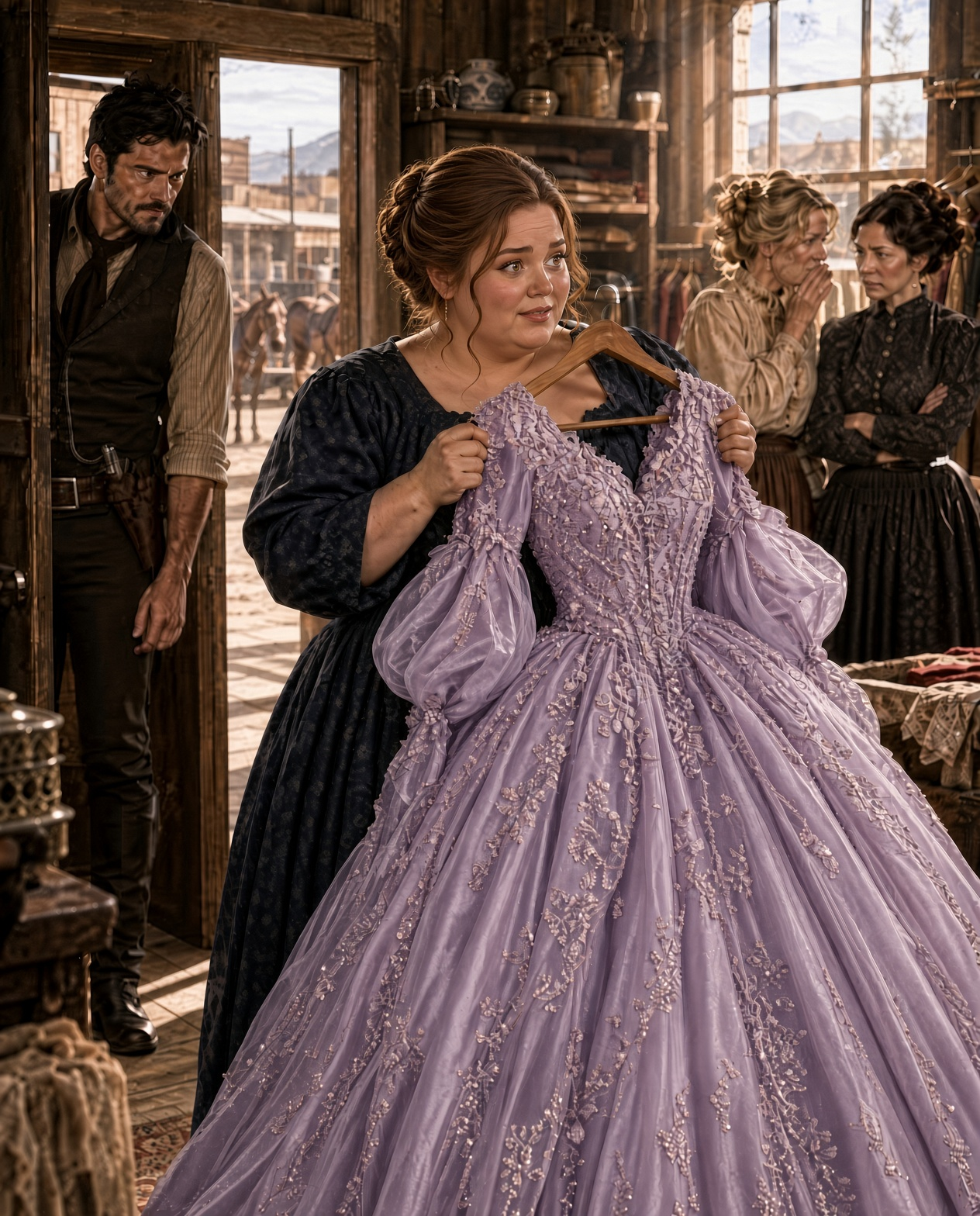
"She says it belonged to your dead brother."
Caleb's words hung in the kitchen like smoke that refused to clear.
I stood beside the open door, staring at the young ranch hand while the November wind pushed cold air across the floorboards.
Behind me, Martha made a small sound.
Not quite a gasp.
Not quite a cry.
When I turned, she was gripping the back of her chair so tightly that her knuckles had gone white.
"Eleanor Bellamy?" she whispered.
Caleb nodded.
"She's waiting by the gate, ma'am."
I looked at my wife.
Only a few hours earlier, I had watched Eleanor Bellamy laugh at Martha inside a Cheyenne dress shop. I had heard her ridicule the woman I loved for daring to hold an expensive silk gown against her body.
Now that same woman had arrived at my ranch after dark, claiming to possess a letter from my brother Thomas.
A brother who had been dead for seven years.
And inside my coat, I was already carrying another letter bearing his signature.
Something was terribly wrong.
"Caleb," I said, "bring Mrs. Bellamy to the house."
He hesitated.
"Are you sure, boss?"
"Yes. And have one of the men see to her horse."
Caleb nodded and hurried into the darkness.
I closed the door.
Martha had not moved.
"Do you know why she's here?" I asked.
She shook her head.
But her expression told me the visit frightened her.
I crossed the kitchen and took her hands.
"Listen to me. Whatever that woman wants, she has no right to come into our home and make you feel small."
Martha looked startled.
"What do you mean?"
I realized I had said too much.
For a moment, I considered telling her that I had witnessed everything at the dress shop.
But footsteps sounded outside.
There would be time for that conversation later.
Or so I believed.
Eleanor Bellamy entered our kitchen as though she had stepped into a building she considered beneath her dignity.
She wore an expensive burgundy traveling coat with black velvet trim. A dark hat sat above her carefully arranged gray hair, and a pair of spotless gloves covered her hands.
The wind had reddened her cheeks, but she had somehow managed to preserve the same superior expression I remembered from the dress shop.
"Mr. Mercer," she said.
"Mrs. Bellamy."
Her eyes moved toward Martha.
"Mrs. Mercer."
Martha gave a small nod.
"Eleanor."
The familiarity surprised me.
I knew the two women had encountered each other in town, but I had not realized they were acquainted well enough to use first names.
Eleanor noticed my expression.
"Oh, Martha and I have known each other for some time."
Martha lowered her gaze.
"Not closely."
The correction was quiet.
But I heard it.
Eleanor smiled thinly.
"Of course."
I gestured toward the table.
"You said you had a letter."
Her smile disappeared.
"Yes."
She reached into her handbag and withdrew a folded envelope.
It was yellowed with age.
The paper looked similar to the one Walter Hensley had given me at the cemetery.
But this envelope bore no address.
Only a name.
Thomas Mercer.
My stomach tightened.
"Where did you get that?"
Eleanor glanced at Martha.
"Perhaps we should discuss this privately."
"No," I said.
She blinked.
"Mr. Mercer—"
"Whatever concerns my family can be discussed in front of my wife."
Martha looked at me.
There was gratitude in her eyes.
And something else.
Fear.
Eleanor slowly placed the envelope on the table.
"My late father handled certain business arrangements for your brother."
I frowned.
"Your father was a banker."
"He was involved in several enterprises."
"Thomas never mentioned doing business with him."
"Your brother did not always share his affairs with you, did he?"
The remark struck an old wound.
Eleanor knew it.
I could see that she knew.
I kept my voice steady.
"What is in the letter?"
"Information concerning a debt."
"A debt?"
"An old obligation."
"Thomas has been dead seven years."
"Some obligations survive the people who create them."
I stared at her.
"Are you asking me for money?"
Eleanor gave a small, offended laugh.
"Certainly not."
"Then what do you want?"
Her eyes moved toward Martha again.
"I came because certain matters have recently been brought to my attention."
Martha's breathing changed.
I felt it before I saw it.
She had stepped closer to me, almost unconsciously.
Eleanor continued.
"Your wife has been conducting rather unusual business in Cheyenne."
I went still.
"Unusual?"
"Returning expensive dresses. Exchanging them for merchandise. Distributing goods to people who cannot afford them."
Martha's face drained of color.
I looked at Eleanor.
"How do you know that?"
"The dress shop is not a private establishment, Mr. Mercer."
"Neither is the general store."
"Exactly."
I felt anger begin to rise.
"Get to the point."
Eleanor folded her hands.
"People are talking."
I almost laughed.
Of course they were.
People like Eleanor Bellamy had always considered gossip a form of public service.
"What people?" I asked.
"Respectable people."
"Names."
She hesitated.
"That isn't necessary."
"It is to me."
Her smile tightened.
"You're being rather defensive."
I stepped closer to the table.
"You came to my house after dark carrying a letter from my dead brother. You mentioned my wife's private errands and suggested something improper about them. If you have something to say, say it plainly."
Eleanor's eyes hardened.
"Very well."
She turned toward Martha.
"Some people believe Mrs. Mercer has been using your generosity to purchase affection among the poorer families in town."
Martha flinched.
I saw it.
A tiny movement.
But it was enough.
"That's a strange accusation," I said.
Eleanor lifted her chin.
"Is it?"
"Yes. Especially coming from someone who has never been accused of excessive generosity."
The silence that followed was sharp.
Eleanor's cheeks reddened.
Martha whispered my name.
"Gideon."
I did not look away from our visitor.
"Did you come here to insult my wife?"
"Certainly not."
"Then why are you here?"
Eleanor glanced at the envelope.
"Because your brother's name has become connected to certain charitable arrangements, and I thought you should know."
My anger faltered.
Thomas.
Charity.
The letter.
I remembered Walter Hensley standing beside Sarah Whitcomb's grave.
Your brother knew something about her family.
"What arrangements?" I asked.
Eleanor's expression changed.
For the first time, she seemed uncertain.
"I believe that is something best explained by the documents."
She pushed the envelope toward me.
I picked it up.
The paper felt old and fragile.
Inside was a single sheet.
I unfolded it.
The handwriting was not Thomas's.
It belonged to someone who had written quickly, using a formal business hand.
The document described a shipment of flour, blankets, and winter clothing sent to a struggling settlement years earlier.
The supplies had been purchased through an account associated with Thomas Mercer.
At the bottom was a notation indicating that the goods had been delivered through a local family.
The name was partially faded.
But I could still read it.
Whitcomb.
I looked up.
"Why bring this to me now?"
Eleanor's mouth tightened.
"Because certain people have begun suggesting that your wife's charitable activities are connected to an old arrangement involving your brother."
"Who suggested that?"
She hesitated.
"Mr. Hensley."
I stared at her.
"Walter Hensley?"
"Yes."
"When?"
"Several days ago."
My mind raced.
Walter had given me a letter that afternoon.
He had claimed Martha knew nothing about it.
And now Eleanor Bellamy was telling me that he had been discussing my brother's affairs with her.
"Why would Hensley speak to you?"
"My father handled the original account. Mr. Hensley came asking questions about the records."
"What questions?"
Eleanor looked away.
"About where the supplies went."
I studied her face.
She was hiding something.
I had spent enough years bargaining over cattle to recognize the look of someone who knew more than they intended to reveal.
But before I could press her, Martha spoke.
"Mrs. Bellamy, I don't understand why any of this concerns me."
Her voice was quiet.
Eleanor turned.
"Because you have been giving away goods purchased with your husband's money."
Martha's eyes filled.
"I haven't taken anything without his knowledge."
The words escaped before she could stop them.
Eleanor's eyebrows rose.
"Then he knows about the dresses?"
Martha went silent.
I felt my heart break all over again.
The woman who had carried flour to hungry children and blankets to freezing families was standing in her own kitchen, being made to feel like a thief.
I stepped between them.
"Mrs. Bellamy."
She looked at me.
"My wife does not need your permission to help anyone."
Eleanor opened her mouth.
I continued.
"And she does not need to explain her kindness to people who mistake cruelty for good breeding."
Her face turned crimson.
"Mr. Mercer!"
"You will not speak to her that way again."
The room fell silent.
Martha stood behind me, breathing unevenly.
Eleanor gathered her gloves.
"I see this visit was a mistake."
"That makes two of us."
She snatched up her handbag.
But before leaving, she looked at the document in my hand.
"Keep that. You may find it useful."
I said nothing.
At the doorway, she paused.
Her eyes settled on Martha.
"Some people should be careful about becoming involved in matters they do not understand."
Martha lowered her gaze.
I opened the door.
"Good evening, Mrs. Bellamy."
She left without another word.
I watched Caleb help her into her carriage.
Only when the wheels disappeared into the darkness did I close the door.
Martha was still standing beside the table.
Her hands trembled.
I crossed the room.
"Martha."
She shook her head.
"I'm sorry."
I stopped.
"For what?"
"For embarrassing you."
The words hit me like a physical blow.
I stared at her.
She looked down at the floor.
"I never meant for anyone to come here. I never wanted you to hear people talking."
I took her hands.
"Look at me."
She hesitated.
"Martha."
Slowly, she raised her eyes.
"You have not embarrassed me."
Her lips trembled.
"But the dresses—"
"I know about the dresses."
She froze.
For several seconds, neither of us moved.
Then she whispered, "You know?"
I nodded.
"I followed you into Cheyenne."
Her hands slipped from mine.
She stepped backward.
I had expected surprise.
Perhaps anger.
I had not expected the look of devastation that crossed her face.
"You followed me?"
"Yes."
"Because you didn't trust me?"
I swallowed.
"Because I was worried."
She looked away.
"I see."
"No, Martha. I don't think you do."
I moved closer.
"I saw what happened in the dress shop."
Her face went completely still.
I continued gently.
"I heard what those women said."
She closed her eyes.
For one terrible moment, I thought she might collapse.
Then she whispered, "I wish you hadn't."
"Why?"
"Because now you know."
"Know what?"
She opened her eyes.
"How people see me."
I could barely speak.
"Martha—"
"They think you made a mistake."
"Who does?"
She gave a sad little laugh.
"Everyone who matters in town."
I shook my head.
"Those women don't matter to me."
"They matter to the people who do business with you."
"Not enough to change how I feel about my wife."
She looked at me as though she wanted desperately to believe it.
But could not.
I pulled out a chair.
"Sit down."
She obeyed.
I sat beside her.
For several moments, we listened to the wind moving around the house.
Then I said, "I went to Samuel Porter's store."
Her face changed again.
"You did?"
"I saw the supplies."
She looked down.
"The flour?"
"And the blankets. The shoes. The coats."
Her eyes filled.
"I can explain."
"You don't have to defend yourself."
"But I should have told you."
"Yes," I said gently. "You should have."
She began to cry.
Not loudly.
Martha had never been someone who made a spectacle of her pain.
Her tears slipped down her cheeks while she sat perfectly still.
I reached for her hand.
"Why didn't you tell me?"
She stared at our joined fingers.
"Because I was afraid."
"Of me?"
She shook her head quickly.
"No. Never of you."
"Then what?"
She swallowed.
"Of disappointing you."
I waited.
She took a trembling breath.
"When I was younger, people used to say I was fortunate if any man looked twice at me."
My chest tightened.
"They said I was too large. Too plain. Too useful to be pretty."
She tried to smile.
It failed.
"I learned early that a woman like me was supposed to be grateful for whatever kindness she received."
I felt anger rising again.
But I kept it out of my voice.
"Who told you those things?"
She looked toward the window.
"People who should have known better."
I waited.
She continued.
"When you bought me that first blue dress, I thought it was the loveliest thing I'd ever seen."
"I remember."
"I wanted to wear it."
Her voice broke.
"I truly did."
I squeezed her hand.
"Then why didn't you?"
She looked at me.
"Because when I saw myself in the mirror, I could hear all those voices again."
I closed my eyes briefly.
She continued.
"I imagined wearing it into town. I imagined people staring at you. Laughing because you had spent so much money trying to make me look like a lady."
"Martha, you are a lady."
She shook her head.
"You say that because you love me."
"I say it because it's true."
She wiped her cheeks.
"I thought if I returned the dresses, I could do something good with the money. Something that would make the gifts worthwhile."
I stared at her.
"The gifts were worthwhile because they were for you."
She looked confused.
As though the idea had never occurred to her.
I leaned closer.
"You don't have to earn the right to receive something beautiful."
Her face crumpled.
I pulled her into my arms.
For the first time since our wedding, she did not stiffen or pull away.
She held on to me.
And cried.
Later that evening, after Martha had washed her face and returned to her sewing, I sat beside the kitchen lamp examining the document Eleanor had brought.
The shipment records were old.
The handwriting difficult to read.
But one detail troubled me.
The supplies had been delivered during a severe winter, years before Martha and I married.
The recipient's name was Whitcomb.
And the account had been authorized by my brother.
I thought about the letter inside my coat.
The one Walter Hensley had given me.
It was still unopened.
Martha was sitting across from me, carefully mending the child's coat.
I looked at her.
"Did you ever know my brother Thomas?"
Her needle stopped.
She raised her eyes.
"Thomas?"
"Yes."
She thought for a moment.
"I don't believe so."
"He traveled through this territory years ago."
She shook her head.
"I may have heard his name, but I never met him."
I believed her.
Then I asked, "Did you know Sarah Whitcomb?"
Martha's expression softened.
"Yes."
"Well?"
She nodded.
"She was a good woman."
I waited.
Martha looked down at the coat.
"She worked herself nearly to death trying to keep her children fed."
"Did you help her?"
"When I could."
"Before we married?"
"Yes."
I studied her.
"How?"
She hesitated.
"Whatever I had."
I thought of the blue silk pouch at the grave.
The silver coin.
The note.
"Did she know how much you cared?"
Martha's eyes filled again.
"I hope so."
I reached across the table and took her hand.
"She did."
Martha looked at me.
"How can you know?"
"Because her children know."
She began crying again.
I moved beside her and held her until the tears passed.
For a while, neither of us spoke.
Then I asked a question that had been troubling me since leaving Samuel's store.
"How many families have you been helping?"
Martha looked embarrassed.
"I don't know exactly."
"Samuel's ledger listed eleven."
She gave a small nod.
"Some only needed help once."
"And others?"
She looked down.
"Some need help every week."
I stared at her.
"How long have you been doing this?"
"Since before we married."
"With your own money?"
She nodded.
"When I had any."
I felt a mixture of pride and sorrow.
My wife had been helping people long before she had access to my money.
The dresses had simply allowed her to do more.
"Why those families?" I asked.
Martha considered the question.
"Because someone had to notice them."
I waited.
She continued quietly.
"People notice a hungry child when the child starts crying. They notice a widow when she comes begging. But by then, she's already suffered more than she should."
I looked at her.
"So you try to help before they have to ask."
She nodded.
"Nobody likes being made to feel helpless."
The irony nearly broke me.
Martha had spent months protecting the dignity of strangers while allowing cruel people to strip away her own.
I reached for her hand.
"From now on, we do this together."
She looked startled.
"What?"
"The families. The supplies. Whatever they need."
"Gideon, you don't have to—"
"I know."
She stared at me.
I smiled gently.
"I want to."
Her lips trembled.
"But the money—"
"We have enough."
"What if people talk?"
"Let them."
She looked frightened.
I softened my voice.
"We won't make a spectacle of it. We'll help quietly, the way you've been doing."
For the first time that evening, a genuine smile appeared on her face.
It was small.
Almost uncertain.
But it was real.
I wanted to hold on to that moment.
Then I remembered the unopened letter.
I reached into my coat.
"Martha, there's something else."
She watched as I placed the yellowed envelope on the table.
Her smile disappeared.
"What's that?"
"A letter."
"From whom?"
I hesitated.
"My brother."
She stared at it.
"Thomas?"
I nodded.
"An old man gave it to me this afternoon."
She looked confused.
"Why would your brother write to me?"
"I don't know."
She reached toward the envelope.
Then stopped.
"Did you read it?"
"No."
Her eyes lifted to mine.
"Why not?"
"Because it was addressed to you."
She looked at me for a long moment.
Then she took the letter.
Her fingers trembled as she unfolded the brittle paper.
I watched her eyes move across the first lines.
At first, she looked puzzled.
Then her expression changed.
The color drained from her face.
"Martha?"
She did not answer.
She read another line.
Then another.
Her hand flew to her mouth.
I stood.
"What is it?"
She looked up at me.
There was something in her eyes I had never seen before.
Not fear.
Not shame.
Recognition.
"Gideon," she whispered, "your brother knew my father."
I stared at her.
"What?"
She looked back at the letter.
Her breathing quickened.
"He knew what happened that winter."
I moved beside her.
"What winter?"
She shook her head.
"I thought nobody knew."
Before I could ask another question, she turned the page.
A small folded document slipped from between the sheets.
It landed on the table.
I reached for it.
Martha caught my wrist.
"Wait."
I looked at her.
Her eyes were wide.
"Gideon, please."
But the document had already unfolded.
And across the top, in faded black ink, were three words.
TRANSFER OF PROPERTY.
Beneath them was a description of land bordering the old Cheyenne schoolhouse.
I stared at the page.
Then I saw the signature.
It was not my brother's.
It belonged to a man whose name I had heard only once before.
A man Martha had told me was responsible for ruining her family.
I looked at my wife.
She was trembling.
"Martha," I whispered, "why is your father's name on this?"
She did not answer.
Instead, she turned toward the kitchen window.
A horse had stopped outside.
Then another.
We heard voices in the yard.
Caleb shouted something I couldn't make out.
I moved toward the door.
Before I reached it, someone struck the wood three times.
Hard.
A man's voice came from the porch.
"Mr. Mercer! Open up!"
I recognized the voice immediately.
Walter Hensley.
I pulled the door open.
The old man stood beneath the porch lamp, his coat covered in snow.
He was breathing heavily.
Behind him stood Sheriff Daniel Reeves.
Walter looked past me toward Martha.
Then he said something that made her drop the letter.
"Mrs. Mercer, we found the original deed."
The sheriff stepped forward.
He held a sealed leather folder.
And written across its front was a name neither Martha nor I had expected to see.
Eleanor Bellamy.






Comments 0